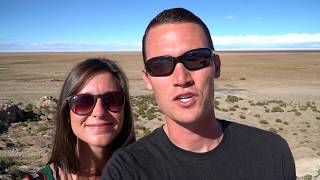
Nate Buchanan explores Bolivia's Salar de Uyuni salt flats and Siloli Desert, staying in a hotel built entirely of salt. A volcanic explosion created a 9,000 square kilometer rock valley; one coca leaf contains more potassium than three bananas.
Questions this video answers
Over 9,000 square kilometers.
About 6,000 in the observed lagoon; about 20,000 in the next lagoon.
About 14 times.
One coca leaf has more potassium than three bananas.
Twelve alkaloids (one mentioned as cocaine; common alkaloid noted as caffeine).
Chapters
Sam.
Today is day two of our Bolivian adventure with quota travel. Last night, we stayed in a salt hotel that was made completely of salt. It was incredible. I wish we had, like, three more days to spend here, but the adventure must continue.
I'm so sad that we're leaving this place today.
The salt flats are, like, one of those things that you see pictures of and you're like, there's no possible way that it could be as good as the pictures look. And this was one of those that exceed it. The Pictures Just like 10,000 km of the most beautiful landscape you've ever seen.
And now we're about to get picked up, and we are driving into the Andes mountains. Today.
We just stopped in this tiny town of San Cristobal to see this really cool church and go to the bathroom. And now we're getting back on the road.
So in this place, a very, very big volcanic activity happened. And all of this rock valley was created by just one explosion. A gigantic volcano that would be placed over here exploded completely. The explosion was so hard, scientists estimate that it should have been heard all around the world about 14 times. We are going to climb a little bit so you can see the extension of this rock Valley is over 9,000 square kilometers. And we are stopping here because one of the prettiest formations we have here is the Condor. The rock condor. Cool. So we can climb in the top of.
Time for lunch, but first we're going to look at the black lake.
This is called a yareta plant.
They are very hard, and it has an oil that you can see sparkling on the top. It's actually very nice to smell, and that's what it makes. Makes it burn. So when you are lost in this kind of deserts, this plant can save your.
These are B. Skecutches. They're like little bunnies that have a squirrel tail, and they're sleeping on this rock. Our picnic was so good. My favorite part today was the quinoa soup. Quinoa grows really well in Bolivia, so it's a huge part of their food here. And we keep passing it, and I've just been craving it. It's been one of my favorite foods even before we came here. And I just love that we can have such a nice meal with the view in the middle of nowhere. It's just been so great. And now we're getting in the car and going to the next lagoon.
The mountain right there, an active volcano. And right on the other side of it is Chile. So now we're basically going to be driving south down the Chilean and Bolivian border.
We just got to the smelly lagoon. It's called that because there's hot springs and sulfur, and it smells like a porta potty. But we got chocolate with quinoa and there's hundreds of flamingos.
Carlos told us that there are 6,000 flamingos that live in this lagoon. And tomorrow's lagoon is going to have 20,000 and be much less stinky.
Hopefully.
These rocks look like they were piled, but this is one. One whole piece that has been broken in different layers because of the ice. The water freezing, expanding. So then the result looks like it's a brick that was built or a wall that was built by many bricks, but it's actually one unique piece that has been breaking.
So tell me more about, like, chewing the cock relief. And a lot of people do it.
It is actually very nutrient. It has more. One leaf has more potassium than three bananas. And bananas are usually known for having a lot of potassium. It also has calcium and sodium and 12 alkaloids. One of them is cocaine. But in this kind of leaves, you cannot get the cocaine out of it without destroying the leaf itself. It's another kind of leaf, the one that they use for drugs. This traditional one, the most. Well, the most common alkaloid it has is actually caffeine.
So it's basically a natural energy booster. Yeah. And how do you eat it?
Well, one by one, if you have the time, taking out the center of it.
And it's like tobacco. You just chew it. You don't have to swallow anything. You actually have to spit once in a while.
This is mint and banana ashes. You want to chew a little bit. Yeah.
Mint and banana ashes.
Mint and banana ashes.
And it helps you process the cocoa leaves.
Yeah.
So just eat a little piece.
Yeah. It's a catalyzer. It speeds the effect of the coca leaf.
Ah. And do you swallow it?
Yeah, that one you can swallow.
It's actually really good. I'm on, like, leaf number 20.
Also. We've been, like, since we've passed the lagoons, we have not seen a single other car. It feels like we are out in the middle of nowhere by ourselves, still trying to perfect the technique of getting the middle hard part out of it.
The wind was really bad in this clip. What I was saying is that we had just arrived at this hotel in the middle of the desert. The only reason it even existed is because it was located next to a freshwater spring. All of the power from the hotel came from solar and wind energy.
I cannot believe we're in this nice of a room in the middle of the desert. They told us that dinner is at 7 and it is 5:25. There is an area where we can go drink coffee or tea. So I assume we'll go hang out over there until dinner.
Sa.
Is this one of those things, like, the first time you do it, you get sick?
No, but your mouth is going to get sweet.
Okay, that is crazy. Here, you need to try.
I kind of feel like I'm eating toothpaste.
So weird. It's like crunchy.
It's like a sweet, minty toothpaste. And it was. Oh, there's a mouse.