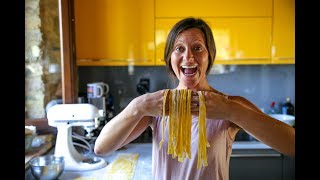
A short YouTube vlog episode ('Making Pasta FROM SCRATCH in Italy!') in which Kara and Nate Buchanan join friends Bob and Gina in Italy to make homemade pasta and a vegetable-based sauce. The video demonstrates ingredient measurements (flour, semolina, salt, eggs, olive oil), technique for forming and kneading pasta dough, resting the dough, using a pasta roller as a time-saving 'permitted cheat', cutting noodles by hand, and cooking them briefly; it also shows picking vegetables from Gina's garden and preparing a simple eggplant-tomato sauce. The tone is casual, instructional, and celebratory of homemade cooking.
Chapters
Today, we're going to start the vlog with a segment that we've talked about doing before that we thought would be really fun. Maybe even one day when we're not traveling anymore. We want to do it more often, potentially.
It's.
It's one of the. Like, a lot of times we think about what will we do when we hit 100 countries, and this is one of the ideas.
So today's vlog is going to start with Cooking with Kara. And it's when we cook things that we've eaten around the world and try to make them on our own. So Bob and Gina are going to teach us their homemade pasta recipe today.
And they've been generous enough to even share it with you. So we'll link the recipe in the comments below. Don't judge their recipe based off how well Kara cooks it.
I'm not a very good cook.
First up, we are going to pick some vegetables and herbs for our pasta dish in Gina's garden. She has this huge, beautiful garden. And when you walk into it, you can just smell the vegetables and the herbs and the fruits. It is just so beautiful. We are going to take some.
Oh, whoops.
Note this. Now we have tomatoes, eggplant, thyme, and oregano.
All right, so we're going to start with. We're going to make about a pound of pasta. And there's only one trick. There's only one thing that's important, which is that you need to sneak up on the flour. And what I mean by that is we're going to put together all the dry ingredients and we're going to create like a little mountain, and we'll make a little, like, well in it. And then we're going to put the wet ingredients in, which is mostly eggs and a little bit of olive oil. So we're going to need about two and a half cups of regular all purpose flour, which is here. And put it. And you can put it in here. And then we'll add the rest of the dry ingredients.
Okay. No, no, no.
Here, let's measure it.
Oh, I thought we're off to a.
Really good this time. Okay, that's great.
I'm adding in semolina flour, which is made out of corn.
Half a teaspoon of regular old table salt.
How is that?
That's perfect. Looks great. Can't go wrong here. And a pinch of nutmeg.
Oh, a real nutmeg.
Just the nutmeg, not your fingers. Okay. This is going to be a vegetarian pasta. We don't need your finger in there.
O.
If only there were smell o vision.
You're gonna take that, and you're gonna make a little volcano with my hands. You're just gonna dump it slowly to try to get it to pile up. And again, there's no problem. You cannot mess this up. Okay, don't get nervous. Just put it in a pile right there.
Oh, I'm putting it on the table.
Put it on the table. This is where it gets real.
I feel like a real chef.
Be bold. It's just flour.
Great. We're just going to create a little crater. A little crater. This will be the fun part of the. When we get to this in a minute, we're going to put the wet ingredients right in this well, and you'll see what happens. The recipe calls for three large eggs. We don't have large eggs here typically, so we're going to use four, and it's your call. We can use four whole eggs, or we could use three whole eggs and a yolk.
Wow. Look at how she does it.
Is that it?
Holy moly. Did you see that?
I've never seen it like that.
What do you mean? Fantastic.
It's a lot more complicated than what you just did. That's fantastic. Yay. I usually cross crack it and then pour the yolk.
But that was fantastic.
These eggs are so orange.
They're red, aren't they?
Yeah.
In fact, they call that the white and the red of the egg here, the Rosso and bianco. So we say the white and the yolk. They say the red, even though it's not red too.
Like, they're, like, wrinkly.
Hopefully your pasta turns out okay. All right, let's see. You're gonna need whisk, I think, about a tablespoon of olive oil or maybe a tablespoon and a half in here.
Mm.
Don't worry. None of this is very precise.
Okay.
I'm such a rule follower. It's hard for me to just try.
To let your hair down. Metaphorically. Okay, so you decided to go with one tablespoon. That's good.
What did you say?
One to two? It's all right. Now. I just don't know how to do eggs. Beat those a little bit. So they're all stirred up, and he's gonna get. I'm gonna have some fun here.
Yeah.
Okay, that's good.
I'm going to pour the wet ingredients into the crater.
This is the scariest thing.
It's okay.
This is the big fork in the road. You can use your fingers or you can use that fork?
Definitely use my fingers.
Okay. Sort of try to bring the dry ingredients into the. With the wet. Without breaking the. Without breaking the wall. I probably should have made this. Well, a little bigger, and we would have been able to fit it all in. So you want to just kind of stir it in.
On the edges.
Who knew making pasta was so cool?
Okay, your turn.
Okay. Is there a certain spe.
Are we in the northern hemisphere or the southern?
Really getting lazy here, doing the work.
You're doing great, Bob.
Thanks, Bob.
Keep up the good work.
The way I do this is try to get it to where you feel like you can just barely handle it by hand. See how it's not. It's not spreading out much. Can I get it. Can I get it off the surface? Can I just. Right, exactly. See how it's starting to.
Mm.
Get to more of a. More of it. Like you said, a dough. It's pasta dough. It's pasta dough, actually. Pasta means dough.
Really?
Yeah. How's it feel?
Feels good to me.
You ready to go to a restaurant and get some pasta? Get under there with this thing and kind of flip it over.
Flip the whole thing over?
Yeah, Just kind of like. Just so that we can see where we are now.
I started with flipping things.
Having flashbacks. 1.
Don't be nervous.
3.
That's great. You did it. Just keep adding a little bit of flour like this, and we're just gonna fold it over until it's just not quite sticky a little bit. Yeah, very smooth. By folding it, you're bringing the outside to the inside and the outside.
So we just finished kneading the dough. It has a nice consistency, like an earlobe or a baby's bottom. Feels really good. It really wasn't that crazy hard. I was very nervous. Bob kept me calm. I think we could do this on our own if we wanted to. It has to sit for 30 minutes in plastic so it doesn't dry out. And in the meantime, we're gonna make.
The sauce, but we're gonna actually. You're gonna make slices, and then you're gonna layer them in a pan with olive oil. We're gonna brown them, flip them over, brown them, and that's basically it. Then we're gonna add some herbs, the garlic, a little bit of tomato sauce, and then that's it. Really, really simple.
Okay.
And then you'll be tossing that, so.
Yum.
Your job right now is to slice up the melonzana this way.
Yeah. We should totally be listening to Italian music. That looks great, Karen.
Those are perfect slices.
So Bob helped me make the dough, and Gina is helping me make the sauce. We're going to brown them. Bellanzana. In the pan with olive oil, because we're in Italy. Great. O.
I like a lot of herbs, and so.
Just keep sliding them off.
And they're all going to go in together.
They're all going to go in together.
We are putting in the final touches for the sauce. Putting in the herbs, garlic, the vegetables, red pepper flakes, and tomato sauce.
Oh, that's so pretty. I love white with spicy. Bob likes spicy. I like it pretty spicy.
Okay, that's perfect.
Okay, so I've just put everything into this pan. It is smelling so delicious. The garlic that's cooking with the herbs. I am so excited. And this is going to sit for a bit while we roll out the pasta and put it in the pasta machine. Cutting machine.
What is it called?
Pasta roller.
Pasta roller.
And that's it. Your sauce is done.
It does smell so, so good.
I feel like we're in an Italian restaurant.
If you want to be completely traditional, you'd get a roller and roll it out, and that's totally authentic, and it's beautiful and cool. The problem is, when you go that far with authentic, it becomes so difficult that you do it maybe once a year. So we have what we call permitted cheats. Right? And this is a permitted cheat. You make the pasta by hand, but you take one of the most difficult steps. And if a machine can do it as well, then I'm okay with. Because it means we make pasta more often than we might otherwise. So we're going to use them. Okay, that's good.
I'm hungry.
Yeah, that's the other thing. Okay, so your. Your dough is looking really good. It kind of flattened out. It looks like it's. It's a little on the wet side, which is totally fine. We don't want it on the dry side. It'll dry as we use it. Feel that?
Yes. Oh, yeah.
All right, so let's cut that one in half.
I don't know what it's supposed to. I feel like it feels good.
It's just nice and soft and pliable. So as you dial this down, it gets thinner and thinner and thinner. So we're going to start at one, which is the widest opening, and we're just going to feed this thing through slowly. Nothing bad's going to happen.
Okay.
I don't think.
Okay.
This is crazy. That's good.
That's fine.
Oh, I made it too far.
It's okay.
It's all right.
It's all right.
Beautiful.
Wow. That is fantastic, Carol.
The only reason to catch it is it doesn't stretch any more than it.
Yeah, it's beautiful.
There you go. Just let it down. Oh, beautiful. Love. Well, I didn't. This is all Cara.
So we have these nice strips of pasta that are nice and flat and beautiful, and we're going to roll them up and cut them by hand with the knife, and then unroll them, and it's gonna look like pasta.
Hopefully.
It's just not the fastest.
That's my first time.
That's perfect. All right.
This width.
All right.
Or whatever width you want. It doesn't matter.
That looks good.
This is homemade pasta, so however it turns out is what we're gonna eat.
It doesn't look perfect. That means you can tell it's homemade.
Yeah, exactly.
Like one thing.
My first noodle.
I love my first one. It's so imperfect.
How fun is that?
And you said these only cook for, like, a minute.
Minute or two. Yeah.
They cook almost basically already noodle y. Like, I feel like I could just eat it right now.
Yay.
We just finished cutting all of the noodles. They're all very imperfect and different, which I think is super fun, because that means they were homemade. And we're about to put them all in the water, and then we throw in the sauce.
It's done like a pro.
I lost an eggplant and a noodle. Okay. Cheese.
Red, white, both.
All.
Right.
A little bit of smile to you guys.
To you guys.
To you guys.
Thanks so much for lunch, Carol.
Family.
So everything is ready to eat.
This has had a lot of hard work put into it. Really hope you can taste all of the hard work. It looks really good, and it smells really good.
Mm.
I love it. This is so delicious. I can't take all the credit, but I am super impressed with us making this pasta. I can't believe how good the noodles are and the sauce. And, of course, the setting just makes it so much better. Okay.
You're gonna have to. We definitely don't want cat in our pasta. I know, I know, I know.
Towel and throw it in.
Get some oil in here.
Yeah.
No.
Okay, well, there's still a little bit of white.
It's fine. It's fine. You're there. I don't need to. I'm just gonna. You're on your own now. I need you. This is. You're a.
This is a. She's obviously a professional.
Obviously.










