A short documentary-style YouTube video by Nate Buchanan (uploaded Nov 25, 2017) documenting small-scale winemaking in Italy. The chunk covers post-harvest steps: a 1,000 kg lot taken to a co-op while Bob and Gina kept 500 kg for house wine; fermentation of the must (about 10 days), pressing the must to separate skins/seeds from juice, collecting roughly 100+ liters of unsettled wine, pumping it to a basement tank for later barreling, and adding potassium metabisulfite to stop fermentation and inhibit spoilage. The segment includes tasting notes (young, a bit green/puckery) and practical details about pressing and expected yields (roughly 130 bottles from this batch).
Questions this video answers
1,000 kilograms
500 kg
About 10 days ("Not bad for 10 days old").
A little over 100 liters ("we got a little over 100 liters of wine").
About 130 bottles ("If we're lucky, we'll get about 130 bottles out of this").
Chapters
The thousand kilograms worth of red grapes that we harvested today was only a part of the grapes in their vineyard and only a part of the red grapes. So the thousand kilograms that we took to the the co op will be turned into wine by the co op. But Bob and Gina also kept 500kg of grapes to make their own house wine.
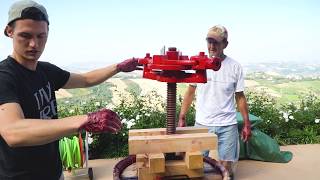
So it's a few days later, the musk that has been fermenting inside of the shed is ready to be pressed. And the must is basically grape juice. The skins, the seeds, and then they've added yeast to it for fermentation. And this, like, layer of the skin forms on top, and it cuts off the oxygen. So you have to push it down and expose all of the juice to the oxygen. So we've gotten out the barrel press, some tarps, a bunch of other equipment that I'm not really sure exactly what it is, and today we are separating the wine from the grape skins and the seeds. It's going to go into the barrel, press into this big. Into a smaller bucket, into the bigger bucket, and then ultimately it's going to.
Be pumped downstairs and then into my liver.
So pressing the wine today was not part of the plan at all. But Bob and I came out here and we checked the sugar. Actually, Bob came out here, I came and watched, and we checked the sugar with some. Some scientific equipment, and there was no more sugar left in the must. So that means that the yeast had done its job, and if you would have left it in here much longer, then it would have started to turn to vinegar. So it had to press today. So pouring the must into the barrel press, the skins, and the seeds are staying inside of the wood, and all of the juice is flowing out into this thing. So after it comes out of the barrel press, it's going through a colander and a screen that looks just like a window screen. Is that what it actually is or is this wine equipment?
Yeah, that's why it looks like that.
And then it goes into the smaller bucket, and at that point it's basically unsettled wine. We're pouring it into the bigger bucket because it's going to need to be pumped into the metal tank that is down in the basement. And ultimately it's going to go into a barrel. But the barrel's not ready yet. Right.
Let's try a little of this.
Thank you.
Nate's getting the first taste.
Little, little green, a little puckery. Not bad. Yay.
Not bad for 10 days old.
Now. Now it needs is 4 or 5 years.
Go.
Wo beautif.
Sa.
The first two years we didn't have this barrel press. And what that meant is we took colanders like pasta strainers, took a pile of the must like this.
And just use our hands to squeeze out the juice or the wine.
For over a hundred liters.
Yeah, more like a couple hundred liters. It was a long process. I mean, you know what else we have to do.
Thankfully, we had some friends here, we had help.
We're high tech today though. Yeah.
Could it be a more beautiful day for this?
I know, it's great, right?
You always have a good view when you're working here.
Great idea. Good, good.
Yeah.
And down to the bitter end.
Ah, the bitter end.
Whoa.
You think it's wine or coffee?
Could work for either one for sure.
There it goes.
That's it.
Nice, nice.
Okay, let me get in here.
It's almost perfect.
That's good.
Not sticky, Nate. Not.
Not till it dries on my hand. Well, not. I guess there's no sugar left in it.
We push as hard as we can. And now it's time to use the real press part of the press. I'll put these paddles down.
Little persuasion. That's it.
Bit of a mess there.
Do you remember how we did this, love with the blocks?
He's a big boy.
Go.
A poor decision for everybody.
If we're lucky, we'll get about 130 bottles out of this.
Okay, so how much more do you think this will press out in comparison to what we've already done? Can we get a couple buckets or.
No clue.
Okay, I'd say a couple buckets.
And how. How do you think this changes the.
Taste when you press? So if you. If we press gently, it'll be the same.
Okay.
Once you get to the point where seeds are starting to crack, then you get a real astringent taste.
Nate, you want to do that?
No, no.
Where else are you gonna get to do this, Nate?
That's true. All right. Just back and forth.
Yeah, Just try to keep this in. I got it. Just kind of gently. Yeah, so it doesn't move too much.
This is the last bucket before it gets pumped downstairs to the tank. It looks like we got a little over 100 liters of wine. That didn't take long at all. No, it took like less than an hour to press 100 liters. It would have taken a lot longer using this in our hands. I still can't believe y' all did that.
Five grams per hundred liters.
Uh huh.
That's about 100 liters.
So we're adding something to the wine to make sure the fermentation process stops here.
That's correct. And to keep. It's sort of a go away sign for the bad bugs.
Okay.
Okay.
So that's.
I'd say that's scant.
So we don't want it to turn to vinegar.
Right now all we need to do is stir in the potassium metabisulfite with a sterile instrument.
That's amazing.
How about that?
Now we're going to pump. Watching where the hose is going in the middle of the whole. I mean, what's the worst that could happen?
Yeah, exactly.
Whoa. The wine is pumping. What an operation. Oh, my God. This wine is coming from all the way up on the driveway. It's literally going to. Okay, and now over here and then over.
And then.
You know, that is this. Whichever one, we did it.
Okay, that's it.
Got one more bottle.
All right.
And that's a wrap on the 2017 red Vendemia. Y' all are so cool.
You guys did a great job. I know you gals did a great job.