YouTube vlog (Day 4) documenting a Galapagos Islands cruise led by Nate Buchanan and guide Jaime. Activities include hiking Sierra Negra (described as the world’s second-largest volcanic crater), visiting a flamingo lagoon, and touring the Charles Darwin Research Station where tortoise breeding and 25-day-old baby tortoises are shown. The video mixes travel narration, wildlife facts, local anecdotes (e.g., poison apple fruit toxicity), and impressions of food and transportation.
Questions this video answers
Day four.
About 4,000 people.
Sierra Negra; described as the second-largest volcanic crater in the world and still active.
It last erupted five years ago; described as a small eruption.
25 days old.
Chapters
Today is day four with rural Galapagos. Last night we sailed five hours south to the town of Via Mille. And today is going to be a little different than the last few days because we're going to be spending most of the day on land.
We're about to get on the dinghy bell and it's going to take us to the shore. Then we got on a bus and it's going to take us about an hour to the second largest volcano, active volcano crater in the world. And we get to hike to the top of it.
Should be a good start to the day.
We just got to the town of Via Mill. It is the third largest city in the Galapagos, but it only has about 4,000 people. Now we're about to get on some trucks that's going to take us to mountain. We're really hoping for good weather so we can have a good view at the top.
That's where we're going.
We have about a 45 minute hike to the top of the crater. So far so good.
But what impressed so much to Fray Tomas de Berlanga was the type of the shell of the land tortoise. Normally you see the tomb shell here, the dome shell looks like saddleback, that in Spanish means Galapagos. So they say the tortoise shells looks like Galapagores and then they call the islands of the Galapagores. The land tortoise is a reptile. Reptiles is very slow metabolism. So for one meal that they get today they need at least a week or 10 days to drop it to digest it. So they always are full. They get giant size, a lot of fat. So they don't need to eat for more or less one year.
So we're climbing straight up this volcano, the Galapagos sits basically right on the equator. So it's really hot here, but thankfully it's a little overcast today. So the hike's actually been really nice.
So after an hour hike we arrived at the top of the Sierra Negra volcano, which is the second largest volcanic crater in the entire world. It's still active. It the last time it erupted was five years ago, just like a small eruption because our guide Jaime told us that it, if it were ever to actually erupt, it would basically kill everything on Earth. It's what's known as a mega volcano. Also you just like can't appreciate the size of this thing in the camera. Like there's no way to capture it in one frame. I did my best with pans, but yeah, you just can't appreciate how truly big it is.
We made it back down the mountain. We're about to get back on the bus and then back on the dinghy and then back on the national paradise.
It.
Thank you.
How are you, sir?
Fantastic. It was a fantastic day.
Yes, Very nice.
Good morning.
After we got back to the boat, we had another delicious lunch. And then we just had two hours to rest and relax and enjoy the views.
I enjoyed the view with some coffee and cookies on the roof. The food here has been mind blowingly good. We keep saying, like, lunch was delicious. But seriously, breakfast, lunch and dinner is top notch. Every single meal. I'm like, that was so good. I can't believe we're on a boat and eating this deliciously.
I think I had the best fish of my life for lunch. Like coming to the Galapagos. I expected to have an amazing trip with nature, but I did not expect the food to be so good.
The coffee and cookies are like 247 too, any time of the day. Want some?
You can go get some. It's a big deal for carrying coffee 24 7.
And now we're about to get back on the dinghy boat. It's taking us back to the town where we're gonna get on the bus and go to a few other cool places.
We're on a new form of transportation this time. It's called a chupa.
It's like a big open.
Like a safari.
Our first, our stop is this Flamingo lagoon. They came here all the way from the Caribbean on their own and then stayed here. There's not a ton of them in the Galapagos, but I think most of them live here. And out of all the flamingos we've seen lately, I just learned for the first time they do this little dance with their feet and it's like breaking up the ground while they eat. It's so cute. And they do it. It's like they're dancing. It's the first time I've noticed that they do that.
We're about to see baby turtles.
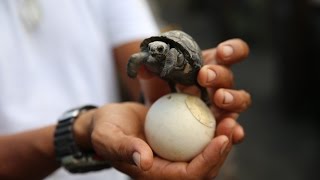
Or dinos. Charlie's Darwin station opened the doors in 1959. More or less, 67% of the eggs that they collect, they hatch and they survive.
Sam.
I'm not sure how well you can see or hear what's happening behind me, but those are some mating turtles. They started this breeding center because people used to hunt tortoises not too long ago. And so they're trying to repopulate. So they have four males and four females in captivity and they have tons of babies over here. And apparently they do this every day for about an hour. The sea turtles do it for six to eight hours every day. It seems to be working. Kind of sounds like he's snoring. Like, if I didn't know what it was. It sounds like snoring.
We like to blow. Magic. Magic.
25 days.
25 days. Baby.
That's so cute.
It is beautiful, Donatello.
That little baby Turtle was only 25 days old. He's so tiny. So we just went in the museum and learned a little bit more about this center. It turns out that the baby tortoises basically can't survive here because of all the introduced animals that have come, like pigs and dogs and ants. They all basically kill the baby tortoises. So they have to be bred here and then released when they're, like, five years old. And then they mate naturally, and then they just keep releasing them, I guess.
So. Our guide, Jaime, told us that these are called poison apple fruits. If you eat one of them, your stomach will start bleeding, and you'll have to go to the. Almost got me. Have to go to the hospital. If you eat two of them, certain death. So that's why I picked it up with the sticks.
Apparently, Jaime told that to a family once, and the parents didn't believe them and let their child eat one.
Crazy.
Was the child okay?
Now we're walking on this nature trail that's going to take us back into town, and we have about an hour of free time to shop, maybe for a gopro.
I think we went in every store in the town of BML, and there were no GoPros. So with our last 15 minutes on this island, we're going to spend it walking on the beach for the sunset.