North Cyprus ROAD TRIP! Olive Oil factory, Famagusta, Salamis Ruins
Nate and Kara drive through North Cyprus, touring an olive oil factory, exploring Famagusta's walled city and Venetian palace ruins, then walking through Salamis to see Roman-era archaeological sites. They stop at a family-run cafe and watch olive oil production firsthand.
Chapters
Thank you.
It is a beautiful morning here in Car Paz National Park. We got in late yesterday afternoon. Then we stayed in these bungalows that are up on the hill. We've seen a total of like four, five people since we've been here. It's like this remote, beautiful beach. I could literally stay here for an entire week as long as I had a few good books to keep me occupied.
I feel like I'm on this deserted island paradise. And the food here is so good. We're really surprised. At breakfast this morning, it was delicious. So now we're gonna go to the beach and soak up our last few minutes of beach time before we hit the road.
Unfortunately, we only had time for a quick walk on the beach. Now we've got to go back up to the hotel, check out and get back on the road. Go north. Cyprus has suggested that we head to the town of Famagusta today, which is like this old walled city that's supposed to be really cool. And past that is a place called the Salamis ancient city, which is old Roman ruins.
The apostle Paul went there.
Should make for a fun day for you.
I'm legitimately sad to be leaving this place. Car Paw is like no other place we've been this entire year. It felt like we had this entire beautiful beach all to ourselves. And right before we left, we had somebody tell us because about an olive oil factory that's on the way to Famagusta. So we might be making a pit stop.
Not positive if we're at the right place, but they told us to look for a wooden donkey. Pot says olive milk.
We've arrived at the olive oil factory. We just went in this little building behind us. We met this super nice old man and he told us we could give ourselves a tour around the factory if we wanted to. There's a portion of the factory it's like the old machinery, how they used to make the olive oil and then a new portion as well. I'm hopeful that we're going to get to taste some after the tour is over.
They were so cute.
Whoa. So since this is a self guided tour, we're having to kind of guess our way through it. We're assuming that these giant stone wheels right here turned and crushed the olives and then somehow oil was created.
I feel like they did something with this thing here.
They squashed carpet. The olive oil ends up here. Oh, here.
English picture screw press. The fresh olives are reduced to a paste through crushing.
For real.
Here's what we've gathered. They crush the olives into a paste with this thing. Then they put the olives in a wool bag and use ropes to squeeze out the oil.
And then ultimately, the one part of the process we got right is that the olive oil squirts out of this hose into this tank and on to the new process. I can hear a lot of machines going and think they are literally making olive oil right now.
I wish I could subscribe to you. The smell right now. I feel like I'm in a pizza restaurant.
This is sucking all the leaves off, and it's going in there.
So after all the leaves get sucked off, they get washed, and all the clean olives go down this little tunnel and all the dirty water goes in here.
So this is the new machine that crushes the olives.
The presser and the filter.
That's not the freshest olive oil I've ever had.
So after the olives are crushed and all the oil is squeezed out of it, all the leftover olive parts go here. Then they're shot up this pipe into this tank. After dry like that, now it's wet. Okay. So then the olives dry out right here. Ultimately, it turns into the sand looking stuff and, ah.
So this is the end product. After all the oil has been squeezed out of the olives. Do you burn this for fire? Fire. Fire.
Yeah. Thank you.
Thank you.
We had to have gotten here at, like, the exact perfect moment for this tour. It all happened so fast. The olives were going up the thingy, and then they go into the press, and then they go into the other thingy, and then they come out the hole.
We literally got to see the entire process. And when Kara says tour, she means like. We walked in, and the guy that was actually making the olive oil showed us what he was doing as he was making it.
He knew very little English, but it was awesome.
Now my goal is to stop Kara from buying everything in the store.
I really want this hand cream now.
Ooh, this one's Mandarin. We went into the gift shop and got some handmade 100% olive oil soap.
But there was nobody in the gift shop. So now we're walking around with money in our soap, trying to find somebody to pay.
We don't want to steal it. We want to purchase it.
We will not steal it. Hello.
We just leave money on the desk. We found a man to give our money to, and now we're back on the road, heading to Bama Gusta.
You barely fit.
I love little doors.
We've arrived in Famagusta we are inside the wall. First order of business is to find some food. I read online before we got here that this city was established in 285 BC.
We don't know how old the wall is yet, so stay tuned.
We really know very little about the city at all. How cool are these walls? And then do a Turkish coffee. Yeah. Can we get two Turkish coffee? Yeah. Yes. Without sugar or no sugar? No sugar. Okay.
Two Turkish coffee and two meatballs with pita bread. That's right.
Okay.
TripAdvisor led us here to Cafe Malia, I think. Yeah. I'm already in love with this place. They are treating us like family and brought us back into this little library. Like, I feel like I'm in their house.
And they're so cute and sweet. I don't even care if the food's good.
You'll care.
I might care a little bit.
Looks good. That is incredible. That was delicious, and I love that place.
Now we have, like, very little time to explore Famagusta. It's going to be like a whirlwind tour. And then we're heading to the Salamis ancient city.
Turns out you can park inside the ruins of the Venetian Royal Palace.
This kind of reminds me of Split in Croatia, how they've really embraced all of the ruins. Like, they're just part of the city. They're not, like, walled off again.
You can't touch.
I'm like, I could climb up that probably, if I wanted to.
I'd like to see you try.
Challenge excitement. Oh, it's so heavy. What is that made out of?
No clue.
That's insane.
We didn't have time to do everything. I'm sure there is way more to explore here in Famagusta, but we only have, like, two hours till it gets dark, so we're heading to the Salamis ancient city.
Whoa.
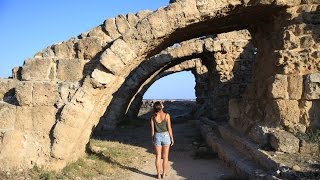
Kara, come check out this little passageway.
I'm so tempted to crawl through. I'm too wide. My shoulders, like, don't even fit.
I read all these heads came off from the earthquake.
Really.
Sam?
This is nuts. Kara just read that 90% of these ruins are still buried underneath the ground.
That's what buried means, underneath the ground.
I'm gonna take a wild guess and say this is the oldest tile I've ever walked on. The last inhabitants were here in 648.
We also read that Salamis was inhabited in the 11th century BC for the first time, which is just, like, almost unfathomable how long ago that was. Especially the fact that like, they had baths and tiles and furnaces. It all seems very civilized.
They really had adorable floors. I would take these floors in our house. Nate.
Today has been huge. We have squished so much into this one day. I'm exhausted.
The ruins were awesome. Besides, like, one big tour group that came through. We basically had the place all to ourselves. It was probably the best Roman ruins we've ever seen. I'm sure there's better in the world, but these are the best we've ever seen. And now we are heading back to Kyrena, which is the town that we've been staying in every night. Kyrenia, except for last night. But we're moving to a new hotel. It's right on the harbor. Supposed to have a terrace that overlooks that. I'm really excited about.
Home sweet home.
It's a beautiful morning here in Carpot.
So this is the traditional old olive oil press. You take the olive and then place it.
We were wondering what we were going to do with all these extra, extra carrots.
He must get plenty of food. He also has his ears back, which is a sign of not being happy. Yeah. Oh, he put him forward.
Watch out for the donkey.
Don't do that.
Kara.
These were the toilets.
The Romans used to poop down here.










