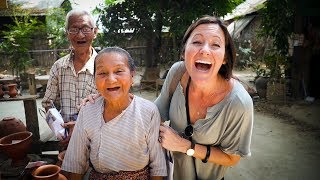
A travel vlog by Nate and Kara Buchanan documenting day seven of a journey up the Irrawaddy River in Myanmar. They visit multiple riverside villages, observing everyday life (children, bamboo-basket weaving), attending a large novice/monk ceremony paid for by the boy's grandparents, and visiting a pottery workshop where locals produce large numbers of pots daily and sell them cheaply. The vlog highlights contrasts between villagers' limited infrastructure (no electricity or running water) and rich communal ceremonies and craft traditions.
Questions this video answers
May 9, 2018
Over 60%
Over $6,000
About 100 pots a day
About $1 each
Chapters
It is already day seven on our journey up the Irrawaddy. Yesterday, we sailed north for Bagan, and we made a quick stop in a little riverside village. We've learned that over 60% of the people here in Myanmar actually live in these small villages without electricity and without running water. So it was really neat to just get a little bit of insight into how the majority of the population here in Myanma.
It's harder than it looks. You gotta get.
As soon as we got off the boat, the kids came running towards us. I totally adopted this one little boy. We held hands the entire time we walked around the village. He was so cute. They were all so playful. And then we got to see these ladies weaving these massive bamboo baskets. It's what this village was known for. And you could buy the biggest one for less than $3. That would be like a hundred doll at home.
And it was super special because yesterday, the town was preparing for a wedding. So they were cooking all these huge pots of food. They were decorating the town. They had music blaring. It was just a lot of fun to be there during that time.
I had fun with you.
Bye. Bye.
Bye. Today we're at a new riverside village, and this one is known for making pottery.
Good morning.
We're being greeted by the biggest pig I've ever seen in my life.
Wow.
We're super lucky. Today we're here during a very exciting day in the village. One of the young boys is becoming a monk, and they're holding what's called a novice ceremony. So they're celebrating him going to the monastery. It's a big party. Everybody's dressed up. There's loud music playing, and we're going to get to witness a little bit of.
Sam.
Hello. Hello.
Hello.
Oh, they're giving her a microphone. We're in trouble.
That was so much fun. He just asked if I wanted to dance on the stage, and I said okay, and I joined the band. This is not what I expected at all to be in this village.
Okay. So I feel like I need to explain. Before we got off the boat, I told you that we were coming to a village that had no electricity, no running water. And then the first thing that we did when we got here was go to this big party with all of this live music. This is not normal here in this village. From what we've learned, the grandparents basically used their life savings to pay for these novice ceremonies. So we learned that the grandfather Today spent over $6,000 for all this live entertainment and to feed the entire Village, basically, Zaw, our guide, told us that the thinking behind it was, you can't take the money with you when you go. And this is one of their proudest moments. So they just spend all of their money to make this day as special as possible for the young monk that's going to the monastery.
Now. We are in a pottery building.
Oh, my goodness.
So like we said this morning, this village is known for selling pottery. This family alone, which I think they said is about three. Three women make a hundred pots a day. There are so many steps into making these things, and they only sell them for about a dollar each, which is just mind blowing. The coolest thing about coming to these villages is this is just their life. They're not doing this for show for the tourists. Like, this is what they get up and do every single day. And they're all so happy and so beautiful. I just love it.
Bye. Bye. Goodbye.
Sam.
I can't believe how fast she makes it look like a pot. She's only had that going for, like, a minute.
Yeah.
I'm making it really hard for her to make a pot right now. Oh, it feels so bad. Okay, here we go. I'm getting better.
You have no rhythm. Okay, let's give him the flop.
You got a good job.
I won't say it was good, but we did make a pot together. She told me I had no rhythm, which that's not the first time in my life. I've been told that if you cook pork meat with the carrots with a pot taste, it's amazing.
So the ladies use these big paddles to make designs on the pots. We don't buy a lot of souvenirs, but we thought we would buy this little mini paddle to remind us of this village from this sweet little lady Jesus.
You do.
I love it.
Oh, I made somebody else's in. So before we left the village, we stopped at this local tea shop, and we're playing the local game. It's like the combination of air hockey and pool. You draw cards out of a deck. It's based on the cards that you draw. You have to, like, shoot in these different little pucks.