SLEEPING INSIDE CHERNOBYL EXCLUSION ZONE (are we crazy?)
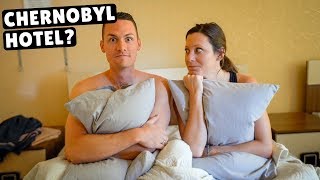
Vlog by Kara and Nate Buchanan documenting an overnight stay inside the Chernobyl exclusion zone. They demonstrate Geiger counters and report comparative readings (about 0.1–0.11 μSv/h near Kiev/at their hotel), describe staying at the only private hotel inside the zone (curfew, locked gate, above-ground water pipes, staff 15-on/15-off shifts), tour abandoned Pripyat landmarks (amusement park, Ferris wheel, public pool closed 1996, schools, Red Forest, equipment graveyard, contaminated hospital basement, Duga radar), and visit an elderly resettler living inside the zone. The transcript records localized high radiation spikes in cleanup areas (readings into the hundreds, with meters briefly showing ~699–800), plus personal impressions and safety precautions.
Questions this video answers
Everyone within 30 km was forced to evacuate.
The explosion happened on April 26; the amusement park was due to open on May 1.
About 0.1–0.11 (the video cites 0.11 and 0.1 as comparative readings).
Localized spikes into the hundreds, with meters briefly showing readings around 699–800.
Chapters
So if you missed our last video, you might think that we are kind of crazy for sleeping in the exclusion zone. And we're not convinced that we're not.
Crazy too, but we've been told it's safe.
It does now seem likely that sometime.
In the last couple of days, there's.
Been perhaps the worst accident in the.
Short history of the world's nuclear power industry.
The accident was at Chernobyl, a town of around 50,000 people about 50 miles due north of Kyiv in Ukraine.
The accident he was referring to was the explosion of nuclear reactor number four. It forced everyone within 30km to leave everything and evacuate due to the deadly radiation released into the air. It killed thousands and eventually affected millions of people. 33 years later, Chernobyl and the surrounding towns are mostly abandoned and frozen in time. In our last video, we spent the entire day exploring different locations inside the exclusion zone where this tragedy happened.
So this is what measures the level of radiation. So you kind of are always exposed to, like, some level of background radiation in your life. We're putting on boots, long pants, long sleeves, being on the same side. So we've just entered the 30 kilometer exclusion zone, which inside of the 10.
Kilometer exclusion zone, I'm getting less radiation next to reactor four than I would be on an airplane. Wow.
So it's one of the most highly contaminated areas.
Unlike most tourists who come see it for the day, we won't be leaving tonight.
We are staying at the only private hotel inside of the exclusion zone. I had no clue you could do this.
The restroom and shower.
How? Sleep home.
Oh, it just feels so good to be in a T shirt. We've had to wear long sleeves and long pants since we've been here. It's been about 90 degrees today.
Time for dinner.
T shirts.
T shirt. Vending machine.
Looks good. For dinner, we're having what looks like Asian chicken with rice with dill on top, of course, because we're gonna need grain and a salad that also has dill on top. Not bad, especially considering we're inside the exclusion zone.
So one of the interesting things that we've learned today is that none of the water in this town runs underground for fear of contamination. So instead, all of the usable water is pumped above ground. And so, like, as you're driving down the road, you'll just see these big silver pipes that you have to pass under. And that's pretty much the water system for the town. There's one right here at our hotel. I'm just hanging out outside because I feel like trapped when I'm in there. But based on the lights that I can see in some of the windows, it looks like we might be the only people here. So probably the most interesting thing about staying at this hotel is that there's a curfew. So after 10pm we're not allowed to leave. And they literally lock us in using this gate. So in one hour and 45 minutes, our freedom will be taken away.
Very creepy.
So we were given these Geiger counters, which measure the amount of radiation that your body's exposed to. We are pretty much in the Kiev city center, and it's measuring 0.11. So we're experiencing the same amount of radiation sleeping here tonight as we would in the Kiev city center. According to this department.
That we've put.
All of our trust in at the same time. The people that work here do like 15 day shifts. So they only stay for 15 days and then they leave for 15 days.
Well, you've heard it's like more of an old rule that's just more precautionary now.
Like there used to be a lot more radiation than there is now, but then they just never changed.
There are a hundred people that still live in Chernobyl, and there's thousands of people that come here and work every day. So surely one night. Yeah, my lips are really choked due to radiation. I don't think that happens.
It is day two in Chernobyl, and we both slept surprisingly good with the dogs barking and the beep of the radiation alarm last night.
Coffee was strong this morning, covering up our bodies, and we are ready for another day.
If anyone was wondering what a convenience store looks like inside Chernobyl, they have ice cream cones, souvenirs, coffee mugs, and a lot of booze.
1, 0, 100,000 and more.
15.
That's cool.
Never seen anybody using a calculator like that.
Okay, we have just re entered the 10 kilometer exclusion zone, and we are on our way back to Pripyat.
This telephone sign right here is this exact telephone sign with this mosaic in this building being behind these trees.
This is the amusement park that never actually opened. The explosion happened on April 26, and this was due to open on May 1. So there are just a few rides that never got to be enjoyed. Apparently the Ferris wheel used to be completely stuck stable. Like the cables held everything in its place. But someone recently came and broke one of the cables. So now when the wind blows, it kind of moves and creaks.
This is starting to beep because apparently after the explosion, the helicopters that Were flying around. It would use this as, like, a landing area. So a lot of radiation is here, and they've repaved it to try to cover some of it up, but it's obviously still here.
So the second town hall is located just right around the corner from the amusement park. It was kind of like a sports complex. So this was the swimming pool. We just saw the boxing rink and like a gymnastics vault.
Like, it was a town, and now it's just empty. It's just mind blowing. But it's really like getting to travel back in time. Like, you're seeing a town that's, like, frozen in 1986.
I'm impressed with how good the hardwoods held up.
What are you doing?
It still holds.
So this was Pripyat's public pool. And I think the craziest thing about this is it actually wasn't closed till 1996, which was 10 years after the accident. So there were workers living here trying to clean it up, and they actually wanted to move people back into Pripyat eventually. It was an initiative started by the Soviet Union, and then when the Soviet Union collapsed, they turned it over to Ukraine, who eventually ran out of money.
So this forest that we're in right now was like the main road with the school. You would never know.
So apparently during the Cold War, the kids at the school would learn how to use these gas masks at school. But unfortunately, when the explosion happened, the kids weren't here, and so none of them got to be used. What's crazy is they were learning how to use these for the threat of, like, a nuclear bomb, like, from someone else, but not because of something that was happening in their backyard. The nuclear reactor. I think schools make me the most sad. Like, obviously, there are endless reasons why this whole situation is a tragedy. But, like, I used to be a teacher, and I love kids, and I think this is the place where I can really picture, like, how many people were affected by this and, like, uprooted from their lives. Like, they had no idea that they would never be back here.
So this whole area that we're walking in now is where they were storing equipment that was used to clean up Chernobyl. So it's all very highly radioactive, especially the moss. The radioactive particles, like, absorb into the moss and are just stored there.
We are literally standing in a radioactive graveyard.
But we have our. Our USB sticks. They're making sure we don't get too much radiation.
Wow. 197, 200.
Wow. So they believe that this claw behind us was actually used to clean up the area around reactor. And this is by far the most radiation that we've seen.
699, 700.
At this point, the most we've seen is 90. In like, the Kiev city center, it's 0.1. And this is 500. So should we be worried about standing this close to something that's.
No, the waves. Oh, 800.
So just standing two meters away, we're already down to 16. So we're not experiencing that much radiation. But it's still crazy to see.
I feel weird even like breathing this close to. But we've been told that as long as I'm not like sitting inside of it or like touching it.
So we set a record today. Yeah, it's crazy. Our God said that's the most radiation that the Geiger counter has ever registered when he's been holding it.
Okay, I think I'm done here.
Oh, yeah, this room is just filled with a bunch of antique versions of these radiation monitors that we're wearing around our neck. Let's head downstairs.
Maybe that was actually here.
We're in an old apartment right now here in the mailboxes.
Elevator's out of order.
We are climbing to the roof of this 16 story apartment building to get a view out over the entire city. This somebody's room, maybe their toilet.
Wow.
This really just gives you some perspective of just how many people were affected by the disaster. Coming up here and getting a view over the entire town. You can say numbers, but like, this for some reason, like, really puts it in perspective for me.
Like, it's just so, like, symbolic. There's like the town and then boom, there it happened. This is all just deserted and then.
There'S just like nothingness. If you look in the direction of Belarus, we're only 15 kilometers away from the border right now.
So this is the hospital where the firefighters were brought after they responded to the explosion. And after they got here, all their clothes were super contaminated. So they just took them all off, threw them down in a room in the basement, and they're still there to this day. It's one of the most highly contaminated areas in all of Chernobyl. That was like, for me, like one of the most iconic scenes from the HBO documentary. Basement's locked off, it's contaminated. I wouldn't want to go there anyway.
Wow. 16. That's crazy. So this would have been like a piece of the firefighter's helmet that somebody has brought up out of the basement. And it's super radioactive. So this was the entrance to the basement right here. And because it was so radioactive, they've taken sand and just like completely closed it up so no one can get in.
That's so loud. Right? My ear. We're driving through the red Forest again. It's crazy. It's just like that one area. Nowhere else on the road does it send the alarms off like that Left for ladies.
We were having lunch at the same restaurant where all the people who work at the power plant eat. It's like a buffet style. So you get a tray, but instead of like picking what you want, you just get one of everything. There are no choices. Not too bad.
So the official use of Duga, this giant metal thing was a missile detection system that was used by the Soviet Union. But apparently there are a lot of theories that it was used for many other things as well. There's a lot of secrecy around it.
There is no way you can appreciate how giant this thing is.
So apparently the Soviet Union built this giant military base here, but disguised it as a pioneer camp, which is like the boy scouts. Then when they built this huge satellite that they couldn't hide, they said it was like a giant radio station that could reach really, really far. But what's crazy is that no one knows to this day what it is or what it did before, which is kind of scary. It hasn't worked since the explosion. And now we're going to the control room.
See it's like 20.
Like the batteries couldn't start the antenna. So some thing else. Over here.
Your generators with liquid cooling system. And the power must be is huge if such a connectors.
Yeah. So for our last stop, we are going to visit someone who has resettled into the Chernobyl exclusion zone. They're one of the few people that live here full time. But we don't want to show up in of front empty handed. So.
So the bread, oil, sausage and the pasta, I'd be happy with that.
Do these people expect visitors? Hello. Hello Doctor. So nice to meet you.
So let's go to the she. Okay. So maybe you have some crazy questions.
Yeah. How old is he?
85.
85. Can you ask him if he goes like to the doctor to get like checkups?
He said the laboratory came here and check everything and everyone.
Does he pay anything to live here?
So the same for the electricity they pay.
They have this special devices like the rest people in Ukraine and they pay for electricity here.
I don't understand.
He has so much to say, but I don't understand.
I don't know what he said.
He said we understood each other even without nothing.
I didn't understand. I feel the love. Thank you.
Thank you, thank you. It's possible.
Well, they were incredibly kind.
They have these giant squashes that are like bigger than a pumpkin. Like this big. He told me they get this big. Oh, I did understand what he was saying.
I thought the point was, like, this place isn't radioactive. But the squashes.
Right outside of the house where they're living, it's registering 11, which is pretty much exactly what it was registering in the city center of Kiev. So technically the guy was 85 years old. He looked like he was in pretty good health for 85. He's been living in the exclusion zone for the last 86, 24, 33 years. I mean, they're pretty much living off the grid here. Like, they're heating the house with wood. They're growing all their own food.
They had a little boom box like I had in elementary school.
They do have electricity. It's like completely off the grid. Wow, what a day.
The car will be checked, like separately.
Okay.
Last checkpoint.
Oh, that was fast.
Yay.
Really fast.
We did it.
We survived Chernobyl.
Let's get out of here.
I guess you don't really know if you survived until like 50 years later.
Not funny. Not funny.
And there's no ice in here.
I don't know what that had to do with anything. I just noticed that I was really hot.
You've been hot all day and you want to not be hot anymore?
Yeah, if you come to Chernobyl, maybe better in like the spring, fall, or winter. And not.
I do think it would set the mood too.
Not the 90 degree heat in the summer when you have to wear long pants, long sleeves, and close toed shoes.
Oh, I didn't know you were. I was getting out of the way.
I'm more scared that metal thing. If there's a break and fall off on my head. Yeah. Need one more swing.
You ready for the best song ever?
I'm a tad bit nervous every time we leave this thing and every time we come in. Thank you for having us. Oh, so sweet. You love me.
You love me. I heard it. I heard it.










