This YouTube vlog (Dec 15, 2016) follows Kara and Nate Buchanan on a Devour Madrid tapas and wine food tour in Madrid. The hosts visit historic tapas bars, sample traditional dishes (croqueta de bacalao, jamón ibérico, oxtail fritters, tomato salad, potatoes, padrón peppers), observe a professional ham cutter, and taste local wines (including a comparative tasting of three reds from the same grape aged differently). The video mixes practical info (prices, regional sources) with sensory reactions and informal wine-tasting lessons.
Questions this video answers
December 15, 2016.
A croquette made with bacalao (salted cod).
€187 per kilo.
Two to three years.
Sipping an acidic wine and then leaning over and opening the mouth (causes salivation).
Chapters
It has been raining all day, and it is our only day in Madrid. So we tried to get out and do some sightseeing, got really wet and cold, and we ended up at this coffee shop. So usually we would be pretty bummed. But we are going on a food tour tonight with Devour Madrid. And when I think of Spain, I think of tapas and wine. And it's a tapas and wine tour. So we're really excited.
The first tavern we're going to is super old. It's from the mid-1800s, and we're gonna have their famous tapas.
And it's raining, and we're going in.
Thank you.
Thank you.
So we're at a traditional tapas bar. Apparently, in the old days, the food vendors are separate from the drink vendors. You had to pay separately, and this place still does that. So we had to buy our drink and then go buy our tapas. We're starting with one of my favorite foods in the A croquette. I think it has fish in it. It's called some basic things. Croqueta de bacalao, Salted cod in California. So I picked up, like, somewhere. But we lived in Dallas.
Magic.
Apparently, in old traditional bars, you can just throw your trash on the floor because they used to know how popular a bar was based on how much trash there was.
I feel so weird. Before they had TripAdvisor, they had no other way of knowing.
Our next stop is also one of my favorite foods.
Has to be super thin.
Yeah.
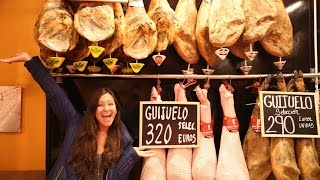
Often like 4 x 4 cm, if you can even get it that sort of size. Like, that's the perfect size and as thin as you can. This is the Jamon Iberico, top grade one. You may have heard of pata negra, which is black hoof. There's also serrano ham, which we'll try. We've also got some other sort of pork products, all from the Iberian pig as from the cheese as well. Go with me.
Ah.
No.
I'm holding the ham cutter's knife, which is a big deal. They have to train for, like, two to three years to be able to do this. It has to be super thin and perfect size. I think you're doing pretty boy boy. Now.
My mind has been blown by the hamon. We've learned so much about it since we've been here. There's this ham called ibierco, which is, like the really expensive ham, but it's expensive because the pigs, like, roam wild and all they feed them is acorns. So their fat turns from, like, Saturated fat to good, like nut fat. And it cost €187 per kilo. It's crazy expensive and crazy good. He's taking us into the dungeon of the ham shop.
You have a lot of jamon.
Muchos amazing.
The rune dryer right here.
No.
It smells so good down here. Thank you so much. Thank you so much.
On to the next stop. That one's gonna be really hard to beat though. That jamon was ins.
So you've got a very complicated wine, but it's from like half an hour away in little Bodega in a cute little town. And it's a local Madrid wine, so you're not going to find this really anywhere else.
This restaurant was very overwhelming with deliciousness. So first of all, we had a white wine only in Madrid. Then the little round, little meat stuff thing was cow tail, deep fried. Awesome. And then the tomato salad. I never knew that tomatoes could have so much flavor. Like they were so good. And it was just olive oil and some onions and salt. I think that was was incredible. And now we're going to the next place.
They have their own olive oil, which they've got there in olive burrows themselves. And more importantly for us, they have their own wine, so they have their own reds and their own white. So we're going to try three reds and do like a little. I know it's hard with this voice, but try and do a non pretentious wine tast.
I just learned so much about wine, it's blowing my mind. So they poured us these three glasses. We had no idea what any of them were and we had to taste them and think about what they smelled like, tasted like. And there's all these options like grass, licorice, char, wood, leather. So we had to smell them and taste them.
They're all so different. He told us they're all the same grape from the same region, same bottle, but they were all just aged differently. Some were aged in the bottle longer and then they rolled for just a little bit and stuff like that. The coolest thing I learned is that if you sip an acidic wine and then do this really awkward thing where you lean over and open your mouth, you'll salivate. If it's not acidic, you won't. So this one.
And then we get 4pm so he.
Can work through.
And literally the spit almost falls out of your mouth. And then this one not at all.
We are definitely ending on a high note getting to try all these new foods. Two of the most interesting ones are these potatoes. Apparently the secret is to find a restaurant where they make their own sauce, because it's very tricky. And also these green peppers, apparently, it's like playing Russian roulette, but with food. Sometimes they're super hot and sometimes they're not. It depends on the season and the time.