YouTube travel video (Nate & Kara Buchanan with guide Carlos) documenting a Bolivian desert/altiplano day trip including visits to the Stone Tree rock formation, Laguna Colorado (flamingo-filled red lagoon), fumaroles/volcanic crater above 16,000 ft, a green lagoon (arsenic-colored), rock valley, and local quinoa fields. The video mixes on-site descriptions, altitude notes, natural-history commentary, and casual travel narration.
Chapters
Sa.
Another one of the places that entered the top 50 of the nature wonders in the world. It's called the Stone Tree. It's a volcanic rock formation that due to the minerals that it's contained in the rocks, iron in the top and silicate in the bottom, has been carved just on the bottom. So this rock is very particular, almost gravity defying. We estimate that it weighs about 30 tons, but it is still there, standing like a tree.
Today is our third day of our Bolivian adventure with quota travel.
We were up well before the sunrise this morning because today we have a huge day. We just made it to our first stop, which is the Stone Tree in the middle of the desert.
The most common mineral in the Andes is the borax. This mineral makes straightest structures. It helps uniting with other minerals, creating very, very straight structures. And that's what has been creating these kind of rocks that break in very, very straight lines, like perfect walls.
So all of these fell down suddenly because of.
So we just got to Laguna Colorado where There are over 20,000 flamingos in a 6 kilometer wide red lagoon. We are currently at 4300ft. It is freezing this morning. It's amazing to me that the flamingos just hang out in the water when it's this cold. I picture flamingos being in warm tropical places, not freezing cold mountains.
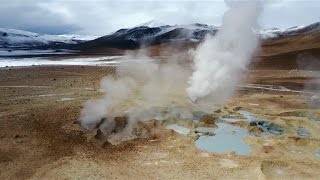
Next we are driving south and up an elevation to an old volcano crater. And it has these permanent geysers called fumaroles.
So thank you.
So these are the fumaroles. Sol de manana. The meaning in English would be morning sunshine. And it's because during the morning they are always stronger than in the afternoon.
We are at the fumaroles. We are currently above 16,000ft, sitting in the middle of a volcanic crater. And apparently these are here all the time. Unlike geysers that like shoot up every once in a while, this is happening constantly.
Sam.
Sa.
This one is the hottest, which seems pretty crazy when they're snow, like right here, boiling.
So we just reached the highest point that will be on our entire trip. We are at 16, 200ft and we're not even off road, or at least that's what Carlos says. I would kind of consider this off road. We've just been driving through like dirt in the desert, but I guess technically it is a road. I'm feeling surprisingly good for 16,000ft. We slowly worked our way up. We started in La paz at like 12,000, then last night we slept at 14,000 and now we've made it to 16. I wish I Could remember what Everest base camp was, Just to, like, give you a comparison and help you appreciate the elevation that we're at right now.
We just made it to the green lagoon. The reason that it's green is because of the arsenic in there, and nothing can live with arsenic, so there's nothing that lives over here. And it's such a pretty color.
Beautiful as usual.
We are about three hours into our drive back to Ya Nui. This is where we were supposed to be stopping, at a lagoon. We were supposed to be, like, driving and then hiking, but the weather's not exactly cooperating. So we're heading to our next stop, which is the opposite side of the rock valley that we saw yesterday.
We made it to the rock valley, and it's not raining here.
Yay.
We're about to climb up this giant rock because it sounds fun.
Sam.
Successful climb, Successful last drone flight. Hearing some thunder in the background. So it's probably a good thing that.
We got down and now we're going to drink some coffee. They've learned how much we like coffee the last few days because we drank it all, so they stopped and got some more. Back to you, Nui.
We're getting into the quinoa field.
This is the red quinoa. When all the seeds become red, it's going to be ready. What they do is to take all of the plants, and they pile them and they wait for them to dry. When they are dry, they shake them so all the seeds fell into blankets. The next thing they do is to shake it into the wind. They wave it and wave it and wave it and wave it, and it has to be coordinated.
That's so cool.
That's the way they peel them, and then they take them to the processing centers to be used.
Since quinoa is one of my favorite foods, Carlos, let us stop and get out and look at the plant up close. The way it's made is so fascinating, so I love it even more now. Now we're for real. Going to uni.
Yanui.
Yanui.
It's right.
Uni.
Ooh, Uni.
Oh, Yuni. I think I just said uni. You'd think I'd know by now. It.