WHAT IT'S LIKE INSIDE CHERNOBYL (is it safe?)
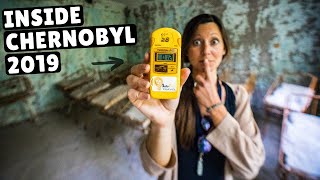
Nate and Kara Buchanan tour the Chernobyl exclusion zone with Geiger counters, visiting Pripyat and the reactor site. They measure radiation hotspots in the Red Forest and evacuated towns, compare contamination levels to Kiev's background radiation, and document ongoing containment efforts.
Questions this video answers
Reactor four (number four reactor).
April 26 (described as occurring '33 years ago' in the transcript).
36,000 tons.
About 0.11 (on their Geiger counter).
Chapters
Just because it's close to the ground, very concentrated.
I don't know how I feel about this.
That sound just makes it so intense.
It does now seem likely that sometime in the last couple of days, there's been perhaps the worst accident in the short history of the world's nuclear power industry. The Russians may have been hoping they could contain it without having to release the news, as they appear to have tried to do so in an earlier accident in the Urals 19 years ago.
The accident was at Chernobyl, a town of around 50,000 people about 50 miles due north of Kiev in Ukraine.
33 years ago, on April 26, the number four reactor in the Chernobyl nuclear power plant exploded, causing a massive amount of deadly radiation to be released into the air.
The Soviet death toll stands at just 31 people immediately following the accident. While the final number remains in dispute, research now shows that the long term death toll ranges between 9,000 and 200,000 people.
Today, some parts of Chernobyl still contain high levels of radiation. However, there are some areas that are considered safe to visit.
So this morning we were getting picked up by a local guide in Kiev and spending the next two days in the Chernobyl exclusion zone.
So we are about to head to Chernobyl and we've just been given these Geiger counters. So this is what measures the level of radiation. And just one important thing to understand before we go is that there's always going to be like, some level of radiation. We are pretty much in the Kiev city center and it's measuring 0.11. So you kind of are always exposed to, like, some level of background radiation in your life. And I don't think the radiation that we're experiencing here in Kiev is any different than like any other major city in the world. So just something important to note as we're carrying these around today.
So we've just made it to the city security checkpoint of the exclusion zone, and there's no filming here for obvious reasons, but they're just checking our passports. And then we had to sign some forms basically saying that we would follow all the rules while we're in the zone. A couple of which were interesting. No eating berries, mushrooms, starting fires, bunch of very common sense things. We're putting on boots, long pants, long sleeves, pretty much the idea is just to cover all of your exposed skin because there's a small risk of radioactive poison particles attaching to you. And from what we've learned, it actually takes some force for them to be, like, blown into the air. So the weather's pretty good today. He said it worse, like maybe something would stick to your shoe just in case, being on the safe side.
So from what we understand, this little USB looking device around our neck is going to tell us how much radiation is building up in our body over the next two days.
Hey, y'.
All.
This was a jam packed day with a ton of information in many different locations.
So.
So we've put this map together to hopefully help you follow along. This black radiation warning symbol represents Reactor four. And you can use it for reference as we explore the exclusion zone.
So we've just entered the 30 kilometer exclusion zone, which means that we're 30 kilometers away from reactor four where the explosion happened. And the Geiger counter is showing 09, which is actually less than it was showing in the center of Kiev when we started this morning.
As we've been driving in, we've been passing these white signs on the road and they have information about the villages that were evacuated. So how many people used to live in them when they were evacuated? The name of the villages. And we've just stopped in our first one, going in the.
Original.
So we're just entering the town hall of one of the evacuated cities. Super eerie feeling. It hasn't been touched in almost 30 years except for maybe like looters who have come in here and stole stuff. And on the stage back here behind me, you can actually still see old Soviet propaganda.
The ground here is just covered in old camera film. I mean, it's obviously totally ruined, but how cool would it be to be able to see the pictures that were on this.
What.
So crazy.
And residential area, the five stored buildings. A little bit further will be two stored buildings, dormitories for the workers.
So if you've seen the HBO series Chernobyl, you may remember the trial towards the very end of the series. And we are currently looking at the courthouse where that trial actually took place. It's not actually where they filmed it, but this is like where it took place in real life in 1986.
7.
7. 1987. Okay, so this is probably the craziest thing that we have learned all day, and that's that there are still over a hundred people that live inside the exclusion zone. So like just people walking around here going about their everyday life. So at one point the government started moving people back to some of the zones that they felt like were safe. And then the Soviet Union collapsed and they stopped the program. But there are about 100 people who have permission to still live here and who live Here full time, which just sounds absolutely insane. But we have our Geiger meter and it's reading 0.1, which is less than what it was reading in the Kiev city center. I don't. It's just. I mean, I guess like it's science. It makes sense that you can live here, but it just seems absolutely crazy. And like this purple house behind us has a sign on it and it says the owner of the house lives here. So like people know not to mess with it, not to come inside. The workers here won't come and take anything.
I won't go look in the window.
So we've just entered the 10 kilometer exclusion zone. And looking at the Geiger counter, it is still point one one, which is pretty much exactly what we were experiencing in the city center. I thought for sure by this point it would be going up. Still nothing.
We're gonna use mine.
Yeah.
Okay.
0.1, 0.2 and start to grow.
So we're currently standing where the first village was inside of the 10 kilometer exc zone. The houses here were all made out of wood and there's pretty much no way to clean radioactivity out of wood. So what they decided to do was pretty much just bulldoze the entire village and bury it underground. So this is one of the many burial sites for radioactive waste that are located inside of the exclusion zone. And just walking shortly off the road, the Geiger counter went from 0.2 to 0.5. But he said it just like skyrockets if you keep going any further.
Selfie stick just in case.
Wow.
Just because it's close to the ground.
Just because here the spot very concentrated.
I don't know how I feel about this. That sound just makes it so intense.
1.9. 1.7. 3.1, 3.5.
Is the beeping noise telling us like it's not safe or is it just letting you know that the levels are rising?
Noise starts if it's more than 0.3. 10k meters on will be all the time more than 0.3. So we move it higher when it's more than 3.
So we just pulled over to the side of the road and stopped in the first village inside of the 10 kilometer exclusion zone. And we are inside of an abandoned preschool.
It has to be one of the creepiest places I've ever been.
Oh, it's a little cots for nap time.
Everything is just so.
Cute and little.
It's crazy. It feels like they set all of this stuff here on purpose, like to create what you would See in a movie scene. But apparently the people who left were told that they'd be coming back in three days to a week. So they just didn't take anything except the necessities with them. So that's why you're seeing, like, baby dolls, school papers, notebooks, pillows. They just left it all behind because they thought they were coming back.
The crazy thing is, even though the school is just right down the road from where the explosion happened, they weren't evacuated until six days later. So the explosion happened on a weekend, and the kids would have come back to school that week with all of the radioactive stuff in the air.
We are inside of a laboratory where they were studying the effects of radiation on fish from one of the cooling ponds that's located close to one of the nuclear reactors.
I'm currently standing as close as you can possibly get to reactor four, which is the one that exploded. And my reader is saying 0.86. So to put that into perspective, if you're on an airplane, it could be between 2 and 3. So I'm getting less radiation next to reactor 4 than I would be on an airplane, which I don't know if that's a good thing, because we spent a lot of time on airplanes, but that's pretty crazy. We're only 300 meters away. But what I thought was also really interesting is if I set this behind this concrete memorial, the number goes down even more to, like, 0.35. So it just shows how big of a deal, like a barrier is to keep the radiation from coming out.
Also, the silver sarcophagus that you see above the reactor was put there in 2016. It weighs 36,000 tons, and it's the largest movable structure, the largest constructed, and the heaviest movable construction in the world. They built it away from the reactor because obviously they couldn't build it above it because there was too much radiation. And then they just slid it over top, and it's used to confine all the radiation inside because the goal is to eventually dismantle and bury everything in there that's radioactive, which is the whole thing. So that was the old one. So that's what we.
The first one. So it. We must have seen it, like, before 2016.
That's what it looks like now.
That's how it looks inside.
Wow.
It's at 14. And in the car a second ago, it was 0.5.
Just from there to here.
So this is the start of the Red Forest, which got its nickname because all the trees died. And it turned this Hue of red. And it's because when the reactor exploded, this is the way the wind was blowing. So it pushed all of the radioactive material into. Into this forest. And it's still a place that is highly radioactive today. So we've just entered the town of Pripyat, where the majority of the people who worked in the power plant lived. And it's also the closest town to reactor four. So it's the one that was damaged the most when it exploded.
Somehow our guide has timed it perfectly. Everywhere we've gone today to completely avoid the tour buses. We've had so many groups of people and somehow we've had every place all to ourselves. We're in an abandoned town alone.
This is an old furniture store in the town of Pripyat that's just been completely abandoned. The only thing left in here is the wood stuff because it's cheap and everything else has been stolen.
So after being here hundreds of times, I feel like you might grow an extra finger.
I hope it will help. But again, like reduce and not so scary if you stick to the roots. And if you doesn't do something crazy or stupid in such an area, follow.
The rules and you'll be okay.
Yeah.
We are currently walking through the big, beautiful, hip and happening town square, which now looks like this.
We've just come into this theater. Currently standing on the stage looking out at the audience. This giant light fixture fell from the ceiling way up there.
He was the leader of the Soviet Union at the time of the disaster. And this is a poster celebrating 60 years of the Soviet Union.
Radiation have any kind of barriers?
Wow. That's the highest weight. 58. Wow.
So that round metal piece on the ground made our reader go up faster than anything that we have seen seen so far. Apparently they don't know what it is, but whatever it was that was super radioactive right there, it was easier to just cover it up.
Now we're in a grocery store, shopping carts everywhere, refrigerators.
Wow. We're driving through pretty much the middle of the Red Forest right now. And even through the car, the reader's at 5.77. So this is where the all of the radioactive debris was blowing after the reactor exploded. And so it's one of the most highly contaminated areas. That's crazy. And just like that, we're out of it. So we're about to leave the 10 kilometer exclusion zone. But in order to do so, we have to go through a radiation check. Not sure what that entails.
The wheels and under the car. So if something stick to our car.
Okay, the car passed. No radioactive molecules are attached to us.
So just turn to the side, put the hands.
And it says clean.
Yep, Clean. Clean.
Y clean.
Tonight we are staying at the only private hotel inside of the exclusion zone.
I had no clue you could do this.
All right, we have about a two hour. Oh, there's a car.
So, from what we understand, these little USB devices that we're wearing around our neck are going to tell us how much body. How much body. How much radiation.
And apparently they live here for free water and electricity. It's all free if you work here.
And you get paid double.
So you want to go apartment shop.
Without which scientists couldn't work for the vodka.
Scientists fuel vodka.










