2015 07 08 16 31 Building the Disciplined Mind for Managing Uncertainty and Risk
Randy Howell explains why most traders fail: biological self-preservation instincts trigger hesitation and early exits. He outlines a program using breathing, mindfulness, and memory-restructuring to trade from probability instead of seeking certainty, with success rates around 2-5% among traders.
Questions this video answers
Randy Howell (Traders State of Mind).
July 9, 2015.
Between 2% and 5% of traders.
September 9th.
Chapters
Welcome everybody. My name is Randy Howell of Traders State of Mind. And I am delighted that you have chosen to be here and to have this time together. And I'm particularly amazed always by the people from Asia and from Australia that show up. It's just an ungodly hour for you and I deeply appreciate it and I'm really honored. Now we're here to say, you know something? How do I actually build a disciplined mind? I know that I need to have a disciplined mind. I've read that a hundred million different places, I've probably looked in different ways of how to do it. And yet when I get down to the thick of it, right into the midst of really not knowing, discipline seems to fly out of the door. We're going to be taking a look at that and we're going to start diagnosing how that doesn't happen for you, how it flies out the window and what you really need to be doing in order to be able to build a mind that manages trading. And you're going to discover something. Trading mind is a very, very different mind than the mind that brings success in business and in corporate life. One last thing, in terms of like housekeeping, I always take questions at the end. You're welcome to write them in, type them in. And Dolores is my producer. She will answer a lot of them just right off the bat as we go. But the more, the more trader psychology, the self development type of stuff, performance type of stuff. If I don't cover it during my presentation, I will answer it then. Fair enough. Okay, let's go. What I want to do is this, you know something. So many people know how to trade, they got it down and they know it's right around the corner. They know it seems so close, but have you ever felt like this fish that you're right there at the sea but you can't get there? You're so close you can taste it. Yet something, something is stopping you. Where you might start is saying, what are your fears? Okay.
What kind of mind are you actually bringing to trading?
Okay, what kind of success thinking do you employ? We're going to be looking at those and we're going to be saying, you know something, if all this success stuff worked, why, why am I not producing success? Success in trading? You know, is it that I'm ignoring my fears? Is it because what is, is there something there? What are the actual barriers that stop me from one moving from one area of competence to a higher level of competence of performance in trading?
The truth is, is, you know really only, oh, somewhere between 2 and 5% of traders really make it. That. That means when you start learning how to trade numerically, the numbers are incredibly stacked against you. But.
The person who gets into trading really believes that they're going to make it. They're hard working, they're pretty smart, and they just really put in the hours and yet they underachieve. Even though they know how to trade after they've got their master's degree, after they got their PH degree in the college of hard knocks, they really ought to know they work hard. And so a question I get all the time from traders is, what's wrong with me? Why can't I make this work? They don't understand why and they say, stuck in the same old place.
And my question to you is, what has a hard work attitude done for you in trading?
When you get around really good traders, you discover is that they do work. But as a guy that I worked with in Singapore said, you know something, Randy, my brother works hard. He's a project engineer and he works really hard. I've seen him work. I get tired just watching him work. I like being on the 24th floor of a building in air conditioning, looking out on the harbor on Singapore, and all I'm really doing is pressing my finger on a button. I like that. What you discover is he's no longer working hard. He's transformed the notion of taking action, working hard into the work of patience.
And it just so happens that the work of patience is the work of trading. That's the whole key. But let's start someplace else. Let's start here. What are you not seeing that keeps you stuck at your current performance level? What's the glass ceiling that you look and you see people have made? They make good money at this. Okay. And you're thinking, I work as hard as them, I'm smart as them. Why aren't I doing that? Why can't I do that? And the truth is, most people have pushed away.
The very barriers out of their awareness. So they don't see them. They are so ubiquitous, they're so familiar, they don't see them. You just absolutely don't see it. And the truth is, most people don't have the eyes to see the problem right in front of the face. And even if they do see the problem, even if it's pointed out, they don't see it as the problem.
At the same time, your trading account is constantly going to be waking you up, knocking on the door and saying, I am the exact barometer of the quality of the belief system that you are bringing to the management of uncertainty in trading. If I'm healthy, you have a good virtual simulation. If I'm not healthy, the beliefs that you're bringing about success are not working. You need to rethink. And out of that, ultimately when you start breaking through that barrier.
What happens really.
Is you have to take your mind and get it out of the comfort being comfortable, okay, with certainty and you have to get it comfortable with probability and taking risks, okay? And this is a hardwired bias, okay? It's not like it's going to go away. It's self preservation. And ultimately what happens is when you will experience it, this bias for self preservation, this bias for certainty, this bias for wanting to control outcome, you will see it in hesitation.
When you're having, you know that or what. An email I got the other day was this, this entry thing, this pulling the trigger thing. They know how to trade, they know how to, they know what a setup looks like, they know all that stuff. Yet when it comes down to it, they hesitate. And yet they couldn't see that actually self preservation on a biological and a psychological level won that moment by not allowing you to get into the trade in the first place. It's, it's one survival on a short term basis, it's lost long term benefit of managing probability. But the emotional brain can't think in probability anyway. It won. And as long as you stay blind to that hesitation, what's behind that hesitation and the fears behind that hesitation, you stay stuck in familiar pattern and do it. Same thing with.
Getting out early. You know when you get a little profit there and you're scared of losing that profit, you jump out and then the dang thing hits target and does everything you want. And it's a pattern. You see it, that's scarcity thinking. It becomes a pattern, a highly ingrained pattern. It's easier to stay comfortable with getting a little bit of profit than risking, oh my God, what if I lose everything.
Left at your own devices, your mind will avoid uncertainty and risk and will opt for safety. It's going to do that how much money you have to spend or blow up or bleed to learn that, Go ahead and do it. It's an important lesson. And you don't or you just bleed out however you want to do it. The thing is, is the thing that you have to accept is the brain is built to seek certainty and control of outcome on a short term survival basis.
And what you also need to understand is that your emotional Brain makes a decision.
Okay? Your rational brain, that left brain produces an explanation that's going to support that decision no matter what the decision is, good or bad, hesitation or going in on a valid setup. The emotional brain is that powerful.
This is the mindset, this need for certainty, control over outcome that has to be conquered to be able to move from a certainty controlling outcome basis to a probability based mindset. Okay? This is the thing. And what happens is that mind understand biology is against you. Okay? It is, it's totally against you. You have 50 million years worth of biological programming that just pops and it's all about short term survival, uncertainty and managing outcome.
It's against you, it's against probability thinking of trading. If you want to become a successful trader, most likely your psychology also supports that position. Most likely your psychology learned and adapted to stay out of risk or to take too much risk, but not to learn the balance. So you've got it, you've got this duking out stuff. And the key is, why is it so hard? You know, most of the people I'm talking to right now have been trading for more than five years. They darn well know that what they're doing is not working.
To the level that they need it to work. They know it. And 95% of them are not going to be making money. They know what they're doing is not working. Yet somehow they keep doing the same darn thing over and over again. Hopes that it's going to work next time. And it never does.
Understand this, the brain mind prefers the familiar and safe over the unknown and potentially dangerous. It will stay there doing that. And it would rather have the suffering that you're familiar with, all that hesitation getting out, making dumb decisions than to risk learning new behaviors and new perceptions. That's what you're up against now. I want to tell you just, guys, we are having a serious thunderstorm come in and if we get a lightning bolt that wipes us out, we're gonna just click back in again and we're gonna be okay. But this is very common in the area we live. We live in an area that we call Storm alley. And it's doing its thing right now. So we're gonna, we're gonna let probability roll, okay? So what we understand is this.
Self preservation.
Gets so established, it becomes so familiar that you don't even see it's there. It just kind of like hypnotizes you. And before you've noticed, you've made the same dumb decision over and over and over again. That's the key. And that's what has to change. Otherwise what you have to the whole thing. It's much easier to stay stuck in the familiar pattern than to risk failure of the unknown. That's survival. Okay? It's easier to assume that there's a saber, the two tiger behind every bush out there in the Serengeti than to recognize that, you know, it's only 1 in 10,000. But why would I risk going out and doing something when I could with very low probability.
Get hurt? That's the way the brain thinks. So there's your first law and self preservation and trading mind just simply do not work together at all. This is what you're going to need to learn.
So here we are. Here we are.
Ultimately there you are in your comfort zone. That's what we call the perceptual map that your brain developed you to be in in the environment. It produces survival, it doesn't produce thriving. Ultimately, you're going to have to decide you're willing to step out of that comfort zone and experience discomfort. And instead of turn away from the discomfort, turn toward the discomfort. Manage that discomfort so that it becomes comfortable. That's what learning how to have a mind built for managing uncertainty is like. So now we go. Mmm, okay, now I'm beginning. What are the tools I need? What you're going to need is first you're going to have to do recognize the same old thinking is going to give you the same old results. And you have to come to a moment of how much money do I need to leave on the table? How much money do I need to lose? How much time do I need to squander before I find out and get really, get really with it, that I'm gonna have to change the whole mindset that I bring to trading and not just about talking, but I'm talking about really changing the mindset I bring to the performance of trading. It's time to adapt. Are you there? Okay. You will know if you've done this, if you have a healthy trading account. That's what, that's what the professional traders have figured out. The key is are you ready to adapt? Are you ready to sit there and say, you know something, I'm taking full responsibility for my trading. And what happens, I realize I can't bulldoze my way through this thing. I'm gonna have to learn a very different way.
So if you've come to this, how do you go about changing your mind? I mean really changing it? I mean, surface change doesn't work. What you'll do is you'll look at a lot of people who practice nlp, tapping, hypnosis, positive thinking, positive visualizations, affirmations. And then what you discover is that it sounds good, it feels good, but in the heat of performance, it fails.
They're trying to solve a deep core problem about what's happening in your brain and your psychology on the surface of the lake. It's not going to work that way. You really have to learn how to work with a much deeper level. That's what we need to be doing. What we need to do is we need to learn a very different understanding of the mind brain. One that frees you to design.
The mind that you bring to the management of uncertainty and risks. And this is where we start is my invitation to you is to listen to what I'm about to tell you about the brain and the mind, okay? Whatever preconceived notions you have, what I'm about to say is based on basically the last 10 years of neural biology research, is that the brain itself as an organism, what it is, is that the community of rival programs.
That duke it out for control of the brain and whoever wins is the are the programs that organize you into a particular self that is able to survive in a pro, in an environment, okay? I want you to hear that there are very specific programs living in the brain that are constantly in competition with one another and also in cooperation with one another, making deals and coming together and producing a particular brain that function in the environment and allows you to survive. Interestingly, if you take that definition of brain, then say, well, what's going on with mine? Hmm? This where it gets interesting. The mind.
Is where those programs.
Have been given voice as your thoughts, okay? The behavior of the emotional programs is electrical behavior, okay? It's electrical activity. Neurons is just running on a 20 or 40amp load. However, when you become mind.
The behavior of mind are thoughts. Suddenly you don't have a community of rival programs. But what you have as mind is a community or a committee where these forces, these programs have been given voice and say so in your head. And some of them are dominant and, and some aren't. Most people do not come equipped with a brain mind that has the right programs running and awareness to manage probability, only certainty. So what happens is you have to build the mind that's going to do this. Now we have an idea, okay? And what we know, this brain mind that we've been talking about, shaped by the forces of adaptation, attachment, okay? Socialization, thinking, all that schooling, having to Achieve and not making a mistake and circumstance. Bad things happening are not bad things happening. All these come together in a brain built and wiring you into a self for self harm, for short term survival. Okay. The ones that are most noted in trading are the alpha. These are guys who have had experienced good success in corporate or business where they have made things happen. They want to be number one. They know how they can be girls too. Most are, 90% are guys. But you run to the alpha. I now call them alpha. I don't call them alpha males because I started running into plenty of alpha females too. So I just reduced the term to alpha. That's the ones who have to win. There's the one that wants to take action. Those are the one who wants to control outcome by willpower. I'm going to make this happen. Those are all the also the ones who blow themselves up because they have a bias to act. And what they do is they get in trading and they start chasing trades. I mean you've got to be trading to be trading, right? You've got to be doing something to be doing something. No, not in trading, not in trading. The same thing. On the other side of the alpha is the perfectionist, the one that says, you know, I don't make a mistake, I won't lose, I won't be wrong. And yet it works real well in corporate. It works well often in business. I want my CPA thinking like this. Yet if you bring that mind into trading.
No matter what you do, no matter how right you are, you can still be wrong a good bit of the time in trading and you start seeing that these two ways of controlling outcome do not work. And you have to find a different way. Ultimately what you discover very quickly is this. You come to a fork in the road.
The brain that you brought with you.
Does not separate biological threat from psychological discomfort, much less concern. The mind that you're going to need to develop to manage probability and risk successfully.
Turns toward discomfort. Psychological discomfort, recognizing it is not biological threat. There is not a psychological saber toothed cat about to six to stick his six inch fangs into your neck. There is only discomfort based on your belief system and your belief about performance.
Okay? When you learn that you can turn toward that and work through that and you come to a moment of where the mind that you're bringing to the management of uncertainty, one focused on concern and you should be concerned, you're risking capital. But there's no psychological discomfort, there is no biological threat setting off the alarm bells. You have concern. This is what we have, and it is combined with humble confidence. This is when you know that you're arriving. So what we have to be able to do is we have to learn to tolerate discomfort. And often what you discover is that you blow things out of proportion. This is just a trade. It's not stepping off the side of a cliff. It's one act. And yet you will have invented it as horrible things happening. Chicken Little with the sky falling, discomfort literally becomes your teacher. You don't try to push it away and you certainly don't try to deny that it's in your presence. You don't sit there and say, well, I'm going to positive reframe this thing so that I don't feel the discomfort. No, you're turning toward the discomfort because it's telling you exactly the barrier that you're not seeing. It's showing you exactly where it's at. And until you learn to master that barrier, you don't get to the next level. So this is a totally different thing. Instead of avoiding or attacking, what you're doing is you're learning how to approach very powerful stuff.
Ultimately, what you discover though.
Is that all thinking is emotional state dependent.
This is the 180 degree whammo that emotional intelligence work brought to the cognitive community. We believed at one time that thought happened and emotion happened afterwards. What we now are clear on that no emotion happens. And out of emotion comes thinking. The quality of thinking that you do. So when we do this.
When approaching uncertainty, most people have to learn.
A whole new journey is that they have learned to avoid fear.
Or to conquer.
What they have to do is relearn and say, you know something, I need to calm down. I need to approach the discomfort and I need to learn. It is my teacher.
And what happens is you do not have. What you do not have is freedom from emotion. That's what a lot of people, you know, that's the pop psychology stuff, is that we trade without emotion. Just try to do that. Try. It's impossible. Is that you are an emotional being attempting to produce an emotional state rooted in logic and reason, which by the way, are two emotional states.
You are not a rational human being trying to control their emotions, okay?
As if you could live outside of emotion.
Reason and logic are simply two emotions that you don't know are emotions. When you start realizing that they don't live outside of emotion, you have to manage the emotional nature. You don't have freedom from it, but you have freedom of the emotions. You can learn to produce the emotional cocktail that Allows you to think rationally and logically in the midst of uncertainty and risk. That's what most traders, 95, 98% of traders don't do. They don't know how to do and they're too scared.
To learn how to. So they stay stuck giving money away to some of the really fine traders. And one of which is I knows in this room tonight. And he, he will teach trading, but he will also take your money if you want to go, if you want to go down, if you want to go.
Wager money and risk money with an unstable mind. There are plenty of professional traders who will play that game every day. And they're not gambling. They smell blood. So you've gotten that. And we know that we have to learn how to manage these things. And what you get very clearly is this emotions are biological. They are not psychological. They take over psychology.
And there's one other definition I want to give and I'm going to explain what this thing is here because you really need to understand this is a very powerful, this is a very powerful graphic. The thing about emotion is that it is not touchy feely, it is biological. And it is triggered by any deviation to a standard sensorial pattern that the brain has already established for homeostasis to keep you feeling okay, okay, hesitation. What do you think that's all about? What happens is you're sitting there, everything's fine, everything. Then all of a sudden these squiggly lines start coming together and there is a recognized setup and it starts having confirmations. Oh my God. There is a, there is a deviation to standard pattern pop. Automatically an emotion is going to fire. The only question is which one. If you let the default programming run it, my promise to you is your biology and your psychology most likely are going to have you in fear of loss. And all of a sudden you're going to be looking for more confirmation. You're going to be looking for all sorts of things. Suddenly you have to go to the bathroom there, you have to answer an email. There's all sorts of things you have to do. And all you, all you realize is that, oh my God, my brain just played another trick on me.
And I wasn't wise enough to catch.
Was very successful behavior for short term survival. You know, if you never got to the game to risk anything, then you've won. The same thing with trade management. When you're, you know, you've, you know that, that trade's been whipsawing on you. It's not done what it's classically what it's supposed to. You've been in the red. Oh my God, you. Am I going to lose it? Am I.
Am I going to get stopped out? And suddenly it reaches, suddenly it hits the black. You start making some money and you still see that. Oh man, oh man. I'm a long ways from my target. But you know, so what if it, what if it reverses on me again?
You take your money and run. Then watching it hit target.
To the brain on scarcity thinking, that's very successful. It didn't lose money. It had a little money left over, enough to pay the broker. Okay? That's how this stuff looks. What I want to do is I want to explain how this autonomic nervous system works. Autonomic is composed of a sympathetic and a parasympathetic system. The sympathetic system is when you see threat, when you see something and understand the amygdala, or what I call orphan, looks out and it's looking for threats. Okay? The amygdala, by the way, is an anatomical part of the brain that basically is a center of fear and emotional response to environmental threats, okay? And to also attachment. And it is a very primitive brain structure and it does not separate biological threat from psychological discomfort. It does not do it. Everything's a saber tooth tiger to it. Ultimately, when it sees a threat like you see this snake, automatically the fight flight response is triggered and suddenly you start feeling your body rev up, you start having this accelerated thinking and your brain is just absolutely turned putty. It is incapable of rational, logical thought. It is about aggression. Or is it about fear, avoidance or aggression? That's all it's all about. And you will notice your physiological state, your blood pressure goes up, your heart rate, pound. Starts going through the roof and all that stuff, okay? I had a trader, I have a trader, right now that we are training to go, he's sizing, he's sizing up. He's going from one to two contracts. And it's a big jump for a young trader to be making that jump. And he's very successful at one, but he has to size up to make money. And ultimately what happened is that what he discovers is that his normal heart rate is at 60 beats per minute. What he was doing is failing. All of a sudden he's just losing his stuff. And what we were discovering, put a heart rate monitor on him. We discovered that he was working at 80 and 85 beats per minute, okay? When he went to two contracts, upon entry, he's already in fight flight. He's already Got fear, okay? He's already scared, he's already tense, he's already running.
Now, the way the fight flight response and autonomic system works is that once you run and you get away from danger, you're going to find yourself a place to hide, to cool down, to calm down. And then all sudden you fall into this thing called rest digest. Suddenly you're calm, everything's, everything's fine. And it is the exact opposite, unfortunately. A lot of times when you see heart rate variability stuff and you're using it and trying to get it, and they will show you coherence, they have you too calm to trade. There is a sweet spot between the sympathetic and the parasympathetic of where your mind is alert, it's focused, it's ready, but the body has not been activated yet. Okay? That's where you want to be. That's what you have to learn to do or the default programming is going to fire all over you and beat and beat you. Okay, so now we've gotten that. So now we're going. Okay, well, what does this look like? Once the fight flight has triggered, a whole process starts happening rapidly.
And this is where you first have to start disrupting pattern. The first thing that happens is arousal. You will experience arousal as heart rate increasing, tension in the body increasing. Suddenly you're holding your breath or you're panning, stuff like that, you become fixated and you just feel the building and building and building. That's dangerous friends right there. You have to disrupt that. That is the emotion growing and about to spin you out of control. You still have a chance to do something about it. Okay, you can disrupt it a little later. We'll talk about that. It's emotional regulation.
If you don't, there comes a moment when it reaches a particular threshold.
And a little switch is flipped. Suddenly.
That emotion is no longer revving up, it's coursing through your body, its hormones and its chemistry. Suddenly, cortisol is there, the fear. And that is what's altering thought. Suddenly you have. Your brain is toast, your mind is toast. You are on fear or on anger if you're a revenge trader.
Now, once you've reached that threshold and feeling is in you, okay, then comes, well, what is that emotion telling you to do? This is emotional motivation.
Is it avoid? Is it attack? Is it approach?
Avoid or attack or with a fight flight Approach.
Is with rest digest with the parasympathetic. What happens is that this is the thing where all of a sudden when you hesitate, what you've done is you've reached avoidance. When you attack and revenge trading, what you've done is you've, that's attack motivation. When you experience curiosity.
And turn toward the discomfort, that's approach and that's what you want to learn how to do.
Then the big one, the big one that glues the biology to the mind together. Belief, ultimately.
Belief will be wired into the emotional complex. And that belief will be about. And here it is. I want you to mark this friends. It will be about your ability to manage uncertainty.
Okay? If it believes that you can't manage uncertainty, well, you're going to do wrong. You're not going to, you know, you're inadequate to get it done and stuff like that. It's going to choose to avoid fear, okay, Rather than approach like humble confidence. What do you believe.
About managing uncertainty? And I'm gonna tell you, don't believe what you think you think. Your trading account will tell you completely about that. Okay.
So what we have here, and by the way in that belief ultimately is this is a neurobiology. What you hear is this that you, the self you are, have never experienced reality. The stuff out there you have never experienced the markets, never. What you have experienced, friends.
Is your brain taking the sensorial modalities.
Like seeing what you think you're seeing out there and all that stuff and forming it into a virtual representation.
Based on your beliefs. That's what you're seeing. You're filtering everything through your belief system.
You know you're not seeing and then believing. You are believing then seeing. And this is where it comes down to what beliefs do you really hold about your ability to manage uncertainty, to manage ambiguity, to manage the unknown.
You're seeing it in trading account all the time. Not what you say you say, but your trading account's revealing it to you all the time. More about that a little later. And predisposition we're going to be talking about because that's biological. It's genetics. Some of us are just more risk oriented, some of us are more anxious oriented and it comes out as a genetic thing. But what we want to do is start with this emotional regulation stuff. Remember when we were talking about the emotional arousal? That's your first place to start disrupting the pattern. If you let it get out of control, if the fire of that emotion keeps burning to the point where it becomes a feeling state, you're cooked. However, if you can cool it down, if you can cool the intensity of that emotion down, you can maintain order of the mind. But unless you can Produce emotional regulation. There's no sense about talking about the mind because the biology of the emotion has overwhelmed everything. So that emotional regulation, which you know, basically, if you go through my trainings, you discover you do it, learn how to breathe very differently, you learn how to bellows breathe, you learn how to reduce tension. And you learn, in fact, that you can control the intensity of an emotion. Once you do that, Once you do that, what you do, that's the first skill. You got to have friends. You got to have it. It's not. This is not optional. It's gotta. The second skill is this.
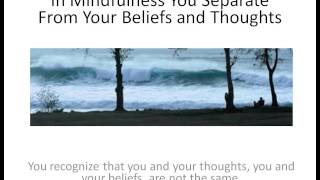
Emotional regulation by itself is not going to change beliefs. However, if you can't manage the emotion, you never get to the door of the mind anyway. You're hijacked long before you ever even get near the door of the mind. However, we have to develop a tool that allows us to open the door of the mind and see these beliefs running inside the mind that are whacking your trading performances up. Very interesting. This image is. I was looking on the Internet for the. For an image about mindfulness, and I found this image. And it so happens it's a photograph I took in Hawaii several years ago. And it's out on the Internet.
As an image for mindfulness. Amazing. Ultimately, in mindfulness, you discover that you have a faculty called the observing self. And when you awaken that faculty, you discover something that you and your thoughts, you and your beliefs are not the same. Your thoughts, your beliefs are just one particular organization of itself that these programs organized you into.
Even beyond that.
You don't have thoughts and beliefs. They're having you, the history you're born into a history like soup. You're born into a soup, and you become part of that soup without ever even knowing you're part of it. And it's wired into you. And you never know that you're in this soup of distinctions that allow you to see only what you see.
That's what mindfulness can do for you. It can take step you back and see, oh, my God, I'm just drifting in a whole sea of distinctions that weren't even mine. And in mindfulness, you get to step back and go, wait, wait, wait. You know, I can reorganize the thoughts and beliefs.
Into higher functioning. Now we're talking. Because in mindfulness, what you're able to do is you start becoming an observer, a witness to the way you're thinking. In this particular cartoon, what you have is you have a dog and a person walking into a beautiful scenery, and the Dog is present in the moment with his beautiful scenery as his, you know, his tail's wagging and he's, oh boy, this is a lot of fun. Meanwhile, the human is not even in the scenery. The human is someplace else. And their anxieties, they're in the future, they're in the past, but they're not here now. And what you're going to learn very quickly to produce the Trader mine, the one that really works.
You'Re going to have to be in the here and now. If you're in the future looking at your dang P and L statement, sitting at the top of your computer, you already cooked.
If you're back in the past worrying about what might happen, are you going to do this again? You're cooked. Your mind is not in an organization that allows you to work in the moment of performance and manage probability. Okay, so this is where the power becomes. And you begin to realize what I'm beginning to realize. You know, we talked about this, these, these emotional programs being a community and duking it out and becoming a dominant force when it becomes mine. What you're looking at in this illustration is you're looking at the different parts of the self, these emotional programs, and you're beginning to go, well, you know something? Oh my God, these forces are running around in my head whether or not I like it or not.
I better start waking up and paying attention to them because some of them are highly destructive. Anybody here blown account up? Yeah, that's it. Highly destructive. Some of these forces are scared to take a chance. You know that one. All these are different parts of potentiality. But because the observer hasn't awakened, you haven't been seen. Being able to see anything but them and the self preservation is blinding you to other possibility. This.
When you wake up from this sleep, you realize that you've really mismanaged the mind. It's nobody's fault. It's been happening forever. It's not your parents, it's nobody, it's not histories, it's just, this is just the human condition, or as the Hindus would say, the wound of your existence.
But this is where you can become the designer.
Of the mind that engages uncertainty. This is when you wake up and you begin to realize, oh my God, I can design the mind, I'm bringing to uncertainty. And what I need to do is I need to have some rigorous self honesty here so I can see the destructiveness. And instead of ignoring it and bring out the other stuff, what you discover very quickly.
That these programs and the committee Members can be developed. The challenges of uncertainty, of probability.
Of the unknown are going to always be there. They're going to be there. Whether or not you have a chiseled, wonderful mind for trading or whether or not you have a fearful mind, the challenges are going to be there. What's changing is the mind that you're bringing into the moment of performance. When you look at these guys right here, what you're looking at is these guys are being challenged. You know, they're having to write this boat. They're having. They're having to sit there and go, you know something? We're all having to work as a team. If we flip out, this thing's going to be bad news. That's the uncertainty of it. However, if we work together in unison, the probability is that we're going to have one hell of a good ride here, friends. That's what you have to do with the mind. A couple years ago, I had a guy and he. He had been flight engineer on a C5. And for those of you who don't know what the C5A aircraft is, it's a cargo jet that. I call it the flying football field. You can put.
Gazillions of tanks of men into these things and you can fly them 5,6000 miles and there. It's insane. It also takes seven men to fly. It takes a very highly coordinated team of people that have very specific skills that allow them to fly that plane. Okay? What Gus had done is he had assumed that because he had done this for 30 years, that he had the discipline, he had the confidence internally. Okay. What he came to realize as we were working is that the Air Force had very carefully put this group of guys together and trained them very, very well. But it had been external.
What Gus realized is that his mind was a fractal of that external team. And what he didn't have, he didn't have the players.
Internally that he had in the Air Force. Externally, what he got was that the players were there. The potentiality of the players were there, but they had never been spotted, they had never been nurtured, they had never been developed. So they had not been brought into the awareness of the mind that was engaging uncertainty in the unknown. And yes, he learned how to internally produce those elements to produce the mind. When you're doing that, what are you doing? You know, when I say that, what are you actually doing?
Let's talk about George Washington for a moment. You know, George Washington had an enormous amount at risk in the Revolutionary war of the United States. He was already rich beyond belief. He had married one of the richest women in the world.
And yet he was Virginian. And what happened is the colonies begged him to lead them. And he didn't really want to. He really didn't have the skill sets of being a general. But what he was able to do is he was able to assemble a team around him.
That allowed him to beat the most powerful standing army in the world at the time. And Navy, I might add. What you're recognizing is this, is that George Washington found the inner strength as a ruler, as discipline, as the emotional program, discipline. He became highly disciplined, and people.
Could feel his discipline and through him could maintain their own order under pressure. This is an emotional program that you can learn to fire. It's not like visualization and thinking, oh, I like this. No, it lives within you. I teach people how to do this all the time. You also find that courage as an emotional program is called warrior. When symbols are added.
Within you is the courage that allows you to face your fears, to face your discomfort. These are all emotional programs that are there. You have to learn to access them, not through fantasy. I actually use a process called memory restructuring, where we take actual experience of when you have been challenged and you were able to push through time higher ground. And what we do is we rarefy those moments and really isolate the emotional program so that you feel and see that it was there.
You also, probably the most understated, underappreciated aspect is self soothing, is self compassion. The truth is, you take a lot of hard bumps in trading. You do a lot of suffering, you have a lot of pain, and if you beat yourself up, it never helps. Yet if you start having compassion for yourself, acknowledging that boy, that hurt, oh, man.
And you regulate, you soothe, you nurture, and you calm down, you get back up on your feet a lot faster. That's called caregiver friends. In the same way, with the impartiality, the clear thinking that's required.
Is. Clear thinking or impartiality is literally an emotional program. Unfortunately, it's a high cortical program that doesn't work very well around fear at all. So you have to soothe the fear.
You have to be able to have the courage to face your fears, and you have to have the discipline to maintain order. When you do that, you get traitor's mind. You develop the mind that no longer needs certainty, no longer needs control outcome. And you discovered that that was an illusion anyway. What you discover is this. You develop an intentional mind.
You develop a mind that you Intentionally develop for the management of uncertainty. You no longer think, well, I'm just going to pick up my mind on the way to the trading room and whatever's there. Hey, hey, hey boy. I just. Everything's hunky dory. No, you don't do that. What you do in the same way is that a star athlete goes through a process of getting his mind together. You take a look at a great baseball hitter, they're in the on deck circle, you can see them going through a ritual that allows them to get into the state of mind that can hit 100 mile or fastball. Once they get out of that batters that, that on deck circle, they get in the batter's box and they have abbreviated version of the same thing. They've been doing it since little league. That's what they're doing. They found a process that gets them into that mind and they're praying probability. They know they're not going to get hit every time. But the thing is the possibility, the probabilities are still there. That's what you're doing. So what happens is suddenly what you're doing is you're managing risk from a disciplined impartiality rather than from fear, anger or greed or euphoria. Completely different. Completely different. This, my friends, is the psychological edge that you're going to need to run your method edge. The method edge is just knowledge, friends. You have to have that method edge working in the heat of the battle. The heat of the battle. You have to be able to regulate, you have to have the mindfulness to be able to develop this intentional mind to drive that methodology. Okay, so what great traders are doing, they're letting go of the illusion of control over outcome. They realize that man, that's just, that's absolutely not the place to be. They're not looking at how much money they're supposed to be making today. They're looking at what is it I can really control? What they can control is the mind that they're bringing into the moment of performance, their process.
What they realize is that if they have a working methodology that gives them an edge, they know that if they focus on managing the one thing they can control their process. What mind are they bringing? Are they bringing discipline, impartiality, self soothing, encouraging? Are they bringing fear and greed?
Professional trader is bringing the discipline, the courage, the impartiality and the self soothing.
And they recognize that most people don't do that and they're taking money. So anyway you master that, you master the moment of performance and you have got your elusive edge.
So ultimately, this process that we've talked about here, it's not an event, it's not something you read a book and you just grasp everybody would be good traders if that could happen. Okay, it starts with emotional regulation. Then you learn mindfulness. Then you use that mindfulness to spot the internal dialogue that's blocking your process. Then you're using that same mindfulness, that same observer to get at the historical emotional programs that allow you to achieve at a higher level. Then with that new intentional mind, you go back to the internal struggle, you go back to the challenges of ambiguity, of uncertainty. But you bring it with a probability based mind rather than a certainty based mind. That's success, friend. You become intentional. So the thing is, what I want to ask you is this. I'm inviting you to become the change. What I want to ask you is how much money do you need to lose or leave on the table before you have lost enough to recognize that until you change the mindset you're bringing to the management of uncertainty, you're stuck. You're going to be giving money to professional traders. When you decide to change the mind to a probability mind, the movement toward professional trader allows you to start taking away from the idiots who are coming in and trading from greed and fear. It's been that way for a long time. If you're interested.
The first thing is go to my website, get my free ebook, go through the 40 plus videos that I have posted there, go through the God knows how many articles, really dig in, and then you're going, okay, this is going to make sense. Get my book. It outlines the process I use. But when you get to that moment, you have to come to the moment where you say, you know something. What do I want to do about this? What do I really want to do? Do I really want to continue doing the same dang thing that's costing me time and money? Or do I want to invest in building the mind that can manage uncertainty? If you come to that moment, you're ready to act. What I want you to do is this. The very first thing I highly recommend our individual course. It is highly comprehensive. It is highly personal. You get into things that you would never ever tell to other people. You really get into the ooze of what's stopping you from reaching the next level. You really find that out and you learn. And I'm basically mentoring you, taking your hand and leading you through the forest to the other side. You're teaching and learning from me. Because what you're also doing in that is you're getting 10 sessions with me over a period of three or four months that's leading you through this powerful stuff. Okay. Otherwise, what you may want to do. And by the way, all the materials you get in the individual course are yours to keep. They're yours. Okay. If you were to say, well, you know, I don't know if I'm ready for that. I don't know if I can afford that. Ready, you know, I really know I want to change. What can you do? The next thing is the group course. The group course teaches the basic skills, not all the really not the comprehensiveness, but the basic skills you need to build a mind for the management of uncertainty.
It's five sessions in a group setting. You have a virtual classroom, and you get well over 24 hours worth of programming that you're going to be learning from. Okay? Our next class starts September 9th. It is. It's an enormously successful and popular class. Okay. And the truth is, if you're interested and if you're really asking the question, you know something, I need to. I know I need to develop myself. I need to develop the mind. The mindset I brought is not working. I want to talk with Randy. I want to find out this right thing to do. Ask for a free consult. You go to our concept, you hit contact us, you email us. Dolores finds a time for us to talk on Skype. And we really, we really look deeply into the trading mind and what's missing in your trading powerful stuff. Or you can stay the same. You can spin your wheels and you can pretend and you can say, how much money do I need to lay down on my trader education to finally get that, I need to change my mindset. Powerful stuff, friends. Powerful. Now, if you have questions of me, please type them in. We have one right now. And let's just see where we go with this. Okay? Can I harness my higher heart rate effect to lose some weight?
That's totally irrelevant to what I'm teaching. Okay. Obviously, if you raise your heart rate, you have moved your metabolistic rate up. And therefore, theoretically, yeah, you should. But the thing is, if you're talking about trading man, I'll say you really have to manage the biology of arousal. You really cannot allow.
Once you get five to eight beats above your heart at rest. In trading man, you are so on the edge of getting into fight flight stuff. That boy, you need to manage that. Okay? Can trading from home environment comfort zone affect the psychological comfort zone, make it harder to break and confront the historical comfort zone could be the. One of the problems of retail traders, the home environment. Thank you, Randy. It can be.
It's one of those things where this is that I know, I know retail traders who go out and say, what I'm going to do is I'm going to make this a business. I'm going to go, I'm going to get, I'm going to have an office that I go to every day. I'm going to set up patterns and they don't do any better. Okay. At the same time, I know retail traders that once you understand this is not, this is about, this is literally about breaking out of the comfort zone, your mind on uncertainty, okay. The avoidance of uncertainty. And from my standpoint, I know lots of traders who are quite successful working out of their homes. Okay. I know lots of traders who are quite unsuccessful working out of their homes. I know traders who work in.
Offices who are not successful. I know traders who work in offices who are successful. The major thing is that. Are you listening to your trading account? It is showing you your comfort zone. It is showing you where you need to look. Okay? So I'm not trying to avoid your answer, but the answer is yes and no. It can be, or it can be a really great asset. You know, the thing is, if you have a home office, you're not paying $1,000 a month for some office, some other place, and your nut that you have to crack every month goes substantially down. You know, actually the biggest problem with retail traders and home offices is boredom and not having social contact with other people. That would be to me a harder problem. Okay. That I don't see anything else. So, friends.
No matter what you do, my hope is this.
Hold on. Door said there may be one here.
Can your trading count give you a false illusion as you are breaking rules? Sure it can if you're getting lucky. Okay. On a short term basis. You know, put it this way, you've seen these ads, you know, hey, I'm up 120% in a month, three months, I'm up making a whole bunch of money. And you can feel the adrenaline roar through the system. You can feel the dopamine just produce euphoria and you go, I want to do that, I want to do that. And I have plenty of traders who go on streaks where they just start winning and then they start letting their stuff down.
And they talk about how much money they're making and then they blow it up. Okay, Is that the real key is that in trading.
You do not allow yourself to experience fear, okay? You do not allow yourself to experience euphoria. Euphoria, you know, you feeling good, okay, is you would think that feeling good is something you'd want to feel in trading. The truth is when you're trading, when you're actually in the moment of performance, it's all discipline, impartiality. If you're thinking from euphoria, you're setting yourself up to manage risk very poorly. That's what happened to the whale and JP Morgan a few years ago is that their risk manager got sick and wasn't there. And you have these high octane testosterone, dopamine traders out there. And what happens, they started getting euphoric and they might have started making really stupid wagers that other traders around the world going, what the world is this guy doing? Is he trying to give me money? The whale wasn't trying to figure out how he was going to give everybody $2 billion. But what happened is he didn't realize that he was under the soup of testosterone and dopamine and euphoria, okay? It sucked him dry.
How will doing this process help me in life in general, not just trading? Well, the truth is this course was not designed initially for trading. I, I started having traders come to me and we started applying it to trading. The reason that I got really focused on trading is that trading had the trading account, okay. And it was a black and white litmus test that was going to tell you the truth about your belief system and the invention of your reality, whether or not you wanted to hear it or not. You are not going to be able to have a new age positive spin on anything because your trading account was going to tell you the truth of the effectiveness of your belief system. So what I would say is, what most people say is that when they take this course, they started out doing it for trading and they realize that it's impacting their life in a very big way. They're learning how to, you know, ultimately, once you recognize that there is no such thing controlling outcome, there is no such thing. On a long term basis, there is no such thing.
GM is no longer the machine they used to be back in the 50s. The key is what you can manage always is the mind that is engaging the probabilities of life. In quantum mechanics, there is a way of understanding that everything exists only as potential. There is no such thing as mass or energy or anything like that. What exists is potential. The observer of that potential is what brings form to the potentiality. Imagine beginning to have control over the observer that's observing potentiality. Okay? That's what this course teaches. Another way of saying it from a quantum mechanics point of view is, and Schrodinger said that the very act of observing an experiment does in fact change the course of the experiment.
When you begin to realize that you begin to. This is all about observer emotional regulation. Observer and what observer you are experiencing and in the moment experiencing life.
This is, you know, what I teach is almost essential for one way or the other in trading because the results are so fast. It's like instant karma. Boom. It's there right in your face. In real life, it's so much slower than trading that you can get away with deceiving yourself for a long time. Eventually it catches up. But imagine if you had the tools to step out of self deception, okay? And creating from a much more powerful place of observation, powerful stuff. So it's going to be much more powerful. Friends, we are five minutes over and I like to keep these things to an hour. I want to thank you for coming. And if you come to the moment where you go, you know something? I need to train my mind. I get what Randy's saying. I get that. I know how to trade now. I need to learn how to develop my mind so that I can trade under the. In the environment, probability and uncertainty. That's the tickets, friend.
Good luck to all of you. I've had a great time. Thank you for coming.
It.