2015 09 02 16 31 Breaking the Habit of Over Trading Learning how to Stick to your Plan sponsored
Randy Howell explains overtrading as a habit driven by dopamine and testosterone, fueled by FOMO and the urge to make money now. He teaches process goals over outcome goals, emotional regulation through breath work, and a six-step program to build a disciplined trading mind.
Questions this video answers
September 9 (year implied by video: 2015)
Approximately $240 total, charged as five payments (about $11.95 every two weeks mentioned but inconsistent in transcript)
Chapters
Welcome everyone. My name is Randy Howell with trader state of mind and I know that first of all I want to tell you Brian Railer out of Trader Shark is one of the classier guys in trader training and I thank you for being here. Whether or not you work directly with him, whether or not you follow him, he truly is one of the guys that I refer to a lot of and I am, I'm very delighted that you're here with us. Now what I want to do, we're going to be taking a look at this subject and I know that a lot of folks don't have the problem of over trading, they have a problem of under trading, of hesitation, of being able to pull the trigger, that fear of missing out. The thing is what I want to do today we're going to be looking at this specialty of what do you do with over trading? You know, what's behind it, what's this habit business that I'm talking about? And the truth is overtrading probably causes more pain than any other trading problem. And what we're going to do is we're going to explore what's behind over trading and maybe even more important than that is what can be done about it. Now one of the things that I do, I traditionally do this is I complete my presentation before I take quit questions simply because over time I have discovered that many of the questions that people ask get answered in the process. So if you want to type in questions, do okay. And Dolores is here, she'll and if they're operational type of questions, she'll answer them. If they're more about trading psychology, I'll be answering at the end. The other thing exciting for you guys and for me is we're going to be doing a poll today. It's something that I do occasionally and it's something that is very revealing about what's behind the ever trading business. But.
Let'S move on from there. Let's start. And the first thing is a lot of people in trading, in retail trading have been successful in other careers before trading. Whether or not it's athletics, whether or not it's business or corporate, they bring in some skill sets that have produced success over time. Then they get into trading and they try to apply those very skills that brought success into trading and they discover that not only do they not work, they are in fact counterproductive. That's what we need to be looking at. So the thing is is we don't see the hidden assumptions in our decision making that produces overtrading and that's what's so dangerous and what we don't see about our predispositions, okay, sets us up for getting blown up. It sets us up for overtrading, for taking trades that aren't there when you're back in a successful mine. So this isn't a. This is an alliance. This is a course or a show about.
Not having enough knowledge to trade. If you've been following Brian for long, you realize there's plenty of knowledge there. That's not the problem. The problem is applied knowledge. And that application of that knowledge involves emotional intelligence, which I'm going to be covering more about. But it's really more about how do we go about finding what makes us tick and how do we go about reorganizing it so it produces success in trading. So that's where we're at. And we begin this thing by going, you know something. Over trading is habituated neural circuit, that short circuit, logical thinking at untimely moments.
Most traders I know sit there and say, you know something, I'm not going to do it this time. This time I'm going to stay straight. I'm going to have, you know, I'm going to keep patient. I'm going to be there and I know that I'm going to deal with this stuff and I'm going to follow my rules and I'm going to. I have my plan and I'm going to trade my plan. And then they look just like this guy and wham, it's gone, they're over trading. And the deal is this. There's more to over trading than just the behavior of pulling the trigger. Too much and too much and too much. There's a whole mental process, there's a whole emotional process, there's a whole belief process that we're going to be getting into.
To the broker. They love it. By the way, over trading is called churning. And it's something where it brings up a lot of commissions for them. So you're not just by. Just by noticing that, you're going to realize that brokers probably not going to be a bunch of help, okay?
And the truth is, is most traders are going to try to double down their effort believing that they will work harder, okay? Just like they have in the past, and that working hard is going to solve the problem. And then they find out, darn it, by working harder they set themselves up more for over trading and more dollars fly out the window. So tell me something. Have you ever noticed a sense of urgency or excitement that starts the process of over trading. Have you ever noticed that? Okay, have you ever noticed that? You'll be sitting there, everything's fine. And the problem is, is that that sense of urgency, that sense of excitement feels good.
Because of that. Because it feels good. You don't notice that that is dangerous, and you end up flying toward the sun and getting, getting your money burned up, okay? That's the point. And what we have to do is we have to go. You know, ultimately, the real barometer, the real barometer of being able to trade well is to learn from your trading account. Your trading account is going to be the only thing around you that's going to tell you the truth, whether or not you like it or not. But if you've ever thought after, after a round of trading, you say, what was I thinking? What happened? Where was that? You know what it's like. And then you'll find yourself beating the self up, okay? And you start going, you know something? I'm going to beat myself up and that'll make me trade better. And who in here has found beating itself up to make them trade better? If you do, just type it in yes. I've been asking that question for four years and nobody types in yes.
Yeah. Finding out that beating yourself up works, okay? Ultimately what it does is it digs fear. Digging deeper it, the fear behind, the fear of missing out that's lying behind over trading gets dug deeper, so you have less and less access to it. And what we really want to do.
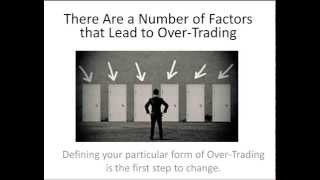
Is what happened to your thinking and all that knowledge? Okay? What happened to it? Ultimately, it's both a biological and a psychological problem, and it's actually as much biological than anything else. I actually view that your psychology is coming out of your biology and your experience. So we're looking to say, you know, what creates these impulsive actions? Because I view, I view over trading as impulse problems, okay? If you have impulse problems, you're sitting there, you're fine, you're fine, you're fine. And then you jump and you do something really stupid. Because ultimately that's stupid, is that you chase trades, okay? Traders get locked into their outcome goals and they lose sight of the process of trading. They get so caught up. You know, the thing is, man, I say I can see, I can see the financial independence. I can see the time independence, man, I am so there. And they set the goals. But unfortunately, what they don't understand is outcome goals do not make the foundation of a process goal, okay? And not understanding that, you set yourself up for a lot of problems. So the key here, there's actually a number of factors.
That lead to over trading. Okay. And we want to take a look at several. And as we go through this list, this is that this is the little thing that I promised you. I want you to type yes or Y to vote for your favorite and you can vote for more than one. Okay? Oh, she, Doris has a poll to put up and what I want you to do is to vote for the ones that speak to you. Okay. And in doing this, what we're going to do is we're going to take a look in this crowd of literally where the problem lies. So the polls open and so let's start going. Okay.
Okay. The first thing is this.
Who has a misguided notion of effectively taking action? You know, I need to be doing, I'm gonna, I'm gonna take action. I'm gonna, I am going to make things happen. And you end up jumping out unprepared like this guy has. And all of a sudden you begin to recognize that a lot of traders and whatever you're doing before that busyness, doing something is equated to effective action. If I only work hard, then the outcome is going to happen. No, let me know if that you fall into that. Okay. The next is this and this. The next one is a big one, is that there's a need for excitement, to feel alive. You know, there's nothing. You're just sitting there, you know. And you know, the thing is, is all of a sudden things start heating up. You know, you get some confirmations, you see some things, your juices start really going and you know, you just have that need. You're ready to chase something, man. You're ready, ready to get something done.
And do you remember that rush that trading can be? And that's also the danger. You know, it's interesting, several years ago I was, I was teaching in China to really high end trading firms and investment firms and I said that, you know, the thing is, one of the more dangerous things, particularly for traders who have past fear, is that the danger is euphoria. Danger is the rush that you get the feeling good of when you win and just, you know, want to getting in there and really kind of going there. And literally some people look at me and says, what are you talking about? You're saying we can't feel good when we trade. I said, you do not want to trade from euphoria or excitement. It's going to alter the way the brain thinks, sees and perceives risk. And just like at JP Morgan, and the whale that lost six to eight billion dollars a couple years ago, what happened is that they got so caught up in excitement that they were no longer capable of rational decision making at all. Okay, so that's the second one. Let's go to the third one.
The third one is I've got to make things happen, man. You know, here there's some money I need to do things. You know, sitting here on my hands isn't doing anything. And that you have a belief that work is doing something rather than work as examining what work is in trading. Have you ever equated with work as doing something? You know, you're sitting there and you know you're trading. You got to be trading, right, Instead of just sitting there. You can't make money just sitting there. And so the logic is, I need to be doing something. Who falls into that one? Okay, the next one. Now we go to the alpha. An urgency to be in control. You know, if I can control things, I can make things happen. I can make an outcome happen. I've done it in business, I've done it in corporate. I have made the. I have dominated. Okay, who in here lives in this illusion that you can actually control outcome? Alpha. Okay, how are we doing? How we hit any of the problems that you have and over trading yet? But let's move on.
Who believes that? You know, that I'm not really comfortable with my thoughts, you know, you know, it's just. I just really don't like them. And you know, the thing is, is they got some. They got some stuff in there I don't want to do. So I. I have to be doing something to be trading. You know, I just can't be patiently watching stuff. I have to be doing something because otherwise those pesky thoughts keep showing up about what if I lose? What am I doing? Am I going to make it, all that stuff. But if I'm doing something, I no longer have to deal with this thing, thought life that's driving behind it. Okay, that's number five. Let's go to number six. Who in here has the fear of missing out? Foma. Okay, you want to do it now? Now. Now you want it now? And particularly when you see a move happen and you miss it and you feel like, oh, my God, it's getting away from me. I need to get in there. Okay. A fear of missing out on the trade. That's a big one, friends. You, you know, you just have this fear. It's sitting there and you go, oh, my God, you know, I can't let trades get past me, never recognizing that they're going to always be valid setups showing up. If you miss one, there's going to be another one. But you have to get in that thing. The other one, the next one, number seven would be paying. Catch up. You get behind a little and you start getting a little motivated. You start having to try harder to start breaking even. You're not doing revenge trading. You're not trying to really so much make up for prior losses. Like, you know, I've got to get angry. No, this is like, no, I need to get in there. Yeah, maybe. Maybe I'll bend a rule or two and be able to get this in this trade. Because you know something? It's getting toward the end of the day, and I really need to start, you know, I need to make sure I don't. I don't have my losses. Who has that? Okay, the next one. A desire to make money now. Okay, you can just feel it, you know, you can feel that rush of that money coming out. You can just taste it and you feel this dream of this money, and you got that dream going and you want to make money now. Okay, who's got that? Let's go to the last one. And I love that one. I love this next one is dealing with boredom. You often hear about, you know, what do you do with this boredom, Randy? You know, the thing is, you just sit there and you're twiddling your thumbs and you're not doing anything. And it's like this thing. Tired of being bored. Because being bored is boring. And ultimately.
One of the most underrated problems in trading is this problem of boredom. You know what? You know, the thing is, you're left with your thoughts when you're bored, you know, and, God, nobody's comfortable with that. You know, there's a recent survey in Scientific American where they discovered that people would rather who are sitting in.
A room with no stimulation. You know, it's just a blank room. They're sitting in a seat and they have a little button that they can use to shock themselves. Okay, 64% of the men within 20 minutes chose to shock themselves electrically rather than to sit alone with their thoughts.
That's how allergic to Boredom men are now 64, 2/3 of men, and by the way, a quarter of the women. So we're looking at this, and now we've got this thing. What's your source of overtrading, the one that you most identified with? And go ahead and put in your votes. And we just want it this is really for all of us. We want to take a look at within this group, which are the dominant ones that really speak, because I'll probably end up spending the rest of my time focused on that. Let's do this here. This is pretty. This is really interesting. Okay. 20% have a misguided notion of work. Yeah, that's, that's. Yeah, I can see that. 40% a thirst for excitement and to make something happen. Yeah. 80% desire to make money now. 20% an urgency to be in control. 40% to escape boredom. Wow, that's some pretty interesting numbers. I want you to take a look at that big number. 80% a desire to make money now. Let me ask you something. Who in here.
Knows whether they're going to win or lose when they enter a trade to make money or to lose money? Who in here knows? What you know is, that's uncertain. And what you also know is that if you have a good methodology, you have an edge in probability, but you have no idea what's going to happen. What I want you to see is that actually.
The desire to make money now is actually an outcome goal. Of course you want to make money. That's why you're in trading. However, the problem is when the outcome goal becomes the process goal.
That'S the big deal. And ultimately I'm going to give you a story about this, and I think this will set it up. Okay. A couple years ago, I'm watching a track meet, an Olympic track meet, and I particularly like the high hurdles. And part of it is that I know how hard it is to run the hurdles. In high school, I attempted to. And I could never get the body and the mind together to be able to hit those hurdles and run and stuff like that. It just wasn't in me to be. To train and. But I ended up with a deep appreciation. Well, anyway, this American sprinter is there and he's just. The, the, the journalists and the announcers are just waxing eloquently about this guy, how he's the best thing since cream cheese, how he's going to win everything since set goal records. All this stuff, all this stuff, all this stuff. Meanwhile, what you do is you're watching these track stars getting ready to do this race. And you know, they're all doing their routines, they're all getting into their blocks. They're all having that really determination. They're all focused on their goal man. And then the gun goes off and they start racing. And sure enough, this American sprinter just absolutely leaves everybody behind. And the Journalists and the announcers are just talking about, we knew this, we knew this, we knew this, we knew this. They knew the outcome before it happened, okay? And so at the end of it, here's this racer, he's sitting there getting his breath back, heaving and humming. And then he's got his stuff enough so that these journalists and the announcers coming up to him and they're sticking microphones in his maze in his face, and they're saying, what was it like? What was it like? What was it like? And he's looking at him like, what, what, what, what? He says, when did you know? What were you thinking when you crossed that line, what were you thinking? And he finally looks around, says, do you want to know what I was thinking when I was racing the world Wants to know, were you thinking about winning the goal, setting a world's record? What were you thinking? He says, okay, I'll tell you what I was thinking. 1, 2, 3, 4. 1, 2, 3, four. 1, 2, 3, Four. 1, 2, 3, FOUR. Which is the process of his body moving through the hurdles. There were these four incremental elements that his body had to be doing that. No doubt that his track coaches had been teaching him for God knows how many years. There's no doubt that a sports psychologist had taken that same 1234, 1234, and built peak performance psychological incentives into those moments. No doubt about it. But what I want you to recognize is he was not thinking about the future. He was not thinking about winning goals. He was not thinking about making money. He was thinking about process. He had a process goal of that. You know something, I can't control how fast these other people are running. I can't control what the markets are doing. There's a lot of things I can't control. But what I can control.
Is the mind that I bring into the moment of performance.
That's what he can control. That's what he was totally focused, focused on. Now a little later, he's on the podium, he's getting his gold medal and he's wrapped a flag around him. He's taking a lap around the, around the arena and he is jubilant. I mean, he is just so euphoric and everything is fine. And after that, they're interviewing him and he talks about how he and his coaches had set goals of winning goal of setting world records and of doing this kind of stuff. And these were outcome goals.
That's what making money is in trading is an outcome goal. It is the process goal that you can in fact, control. You Cannot control whether or not you make money or not. Why in the heck focus on it? Why not focus on what you can control? If you control performance, okay, which you can control, the money is going to take care of itself. In the same way with this track star, money took care of itself. And what I want you to recognize is 80% of you guys identified with making money. Now that's a, that's an enormous flaw. The way you go about managing your mind that you bring into the trading arena, okay? The truth.
Is that a mind that's not used to produce patience, okay, Feels very uncomfortable with their thoughts in the same way I was telling you about this experiment they did. That's the whole point is people are uncomfortable with their thoughts. Yet in trading, what do you do? For most of the day you are sitting around with your thoughts, alone with them, and then all of a sudden you can see where, if you haven't learned how to turn toward the discomfort, okay, of whatever's showing up, the fear of missing out, oh, my God, I'm losing money. What am I going to do? Is my capital going to last before my education ends? All those things. What I want you to do is if you do not turn toward them, they linger in the background of your mind whispering into your consciousness. And that's what you're performing from. So ultimately what you discover is this.
Is that over? Trading is really a response solution to problems that you have proven successful in the. Back in the past in. And now they've been habituated to trigger the moment you feel that discomfort, okay? That's where the problem at. The habits of success that you learned outside of trading that are so familiar to you, those are the ones that you need to examine. Yet they're so habituated, so familiar that you go, yeah, this is success. I know how to produce success. Yeah. I've done this all my life with the pretense that it's for success. And hey, I've been able to manage an outcome because of this. What I want you to recognize is that those assumptions don't work in trading. And I don't mean that they're bad assumptions. I'm not saying they're bad at all. I'm just saying that they don't work from whatever endeavor you were in, whatever field you were in. When you translate it to a game, to game theory and a game of chance like trading, because ultimately what you have, you have a methodology that gives you an edge, okay? The only way you're going to make money when there is real risk on the table instead of simulation is that the mind that you're bringing to that moment is prepared to work in probabilities, not in fear, not in desire to make money, but in the performance right there of recognizing that if I execute really well, probability is on my side and then that is enough. Okay?
So what was effective at one time is not going to be effective now. And the circuitry of the pattern.
Is set, you have. And then conditions in the trading environment trigger the response. But it's no longer effective. But that's all you know. This is when you go, you know something I need to rethink, re examine the assumptions I'm bringing, okay? And if what you were doing is no longer effective, it's time to change. So here you go.
The, the problem.
Of the mind of the other trader.
Is tough because the chemistry that precedes over trading feels good. It's the same chemistry that's with addictions, with gambling and over trading. They're very similar. Okay? Over trading, fundamentally this, it's got too much testosterone and too much dopamine. So testosterone is all about taking risk and lowering the risk. Ramp the risk parameters. Dopamine is feeling good, okay? It's kind of like the closest equivalent to the drug world of dopamine is cocaine. Good in the short term. Problem is it's got a headache in the back term. So what you're looking at.
You have to truly take. If you stay in the old mindset, the house wins. The whole key is can you move from a certainty based mindset into a probability based mindset? Okay? That's really the key. And this is where we're going with this. Because the thing is, is that the reward centers just don't want to change. And yet at the same time, it's this very blindness that's brought you to this place. Okay? The thing is, is that your trading account keeps telling you over and over and over again that you know something. The beliefs that you're projecting onto the markets are not working right now. Okay? You need to re examine the beliefs and you keep getting hijacked because you keep chasing trades. They look good mindlessly. You see stuff, you look at these squiggly lines on your charts and all of a sudden you start seeing things because you have this urgency. And the truth is the urgency, it's like this, is that the anticipation of the chase, you know, like these lines right here, they're getting cranked up, they know that, they know that they're ready. But the problem with trading is this. You get cranked up. You start doing that and all of a sudden you realize there's some very smart zebras out there that are literally know how to make the hunter the hunted and then they just take your money. Those are the emotionally intelligent traders and they're banking on you being either feeling good and making dumb decisions or feeling fearful and jumping out of positions just at the wrong time. That's what they're depending on. So.
In here, what I want us to take a look at in this graph right here, everybody knows about the physical self, okay? That's all this flesh you got. But it's your breathing, it's the tension in your body, it's your heart rate, it's your blood pressure, it's your variable heart rate, it's your skin conductance, all those things that are feeding into the arousal component of your physiology. Then that mental self is composed of the emotions that are being triggered, okay? They're being aroused and all of a sudden you're beginning to figure out something is that my God, my body and my mind are so deeply interrelated that if I don't observe my body and the arousal of the emotions, I lose my mind. I lose the mind, the trading mind. Because you ultimately discover is this is that all thinking is emotional state dependent. And your job is to put the right emotions together to manage uncertainty, the unknown. There's this other thing you see back there, the observing self. This is going to be something I'll be talking about a little bit more a little later. This is the powerful piece. This is what makes you different than a smart animal. This is what allows you to literally take a different perspective, to look and you can begin to observe the body very differently, observe the mind very differently and you can become designer of the mind that you bring into the moment of performance.
First thing that whether or not it's fear of missing out or just the need for excitement, the need, the very first thing you're going to have to do is you're going to have to decelerate the emotion. You're going to have to, if the emotion reaches a particular threshold, it's no longer revving up, okay? It becomes coursing as chemistry through your body. When it's doing that, it's altering the way you think. Too much cortisol, you have fearful thinking, too much testosterone and dopamine, you have excitatory thinking and you can no longer gauge risk very, very well. Ultimately, emotional regulation skills have to be learned. And what I teach them as is breath, intention and I teach you how to Start managing breath. Because each emotion has a signature breath, each emotion has a particular tension, each emotion has a heart rate. You can learn.
You can learn how to manage this stuff. Okay, the first place that you really start is right here. You begin using mindfulness to spot the thief that's running around in your mind. And this occurs because you've been able to calm emotion down and you begin to open the door of the mind. Look in and this is where it gets really interesting and it's where it gets past a lot of the stuff you've been learning in the psychological self development of people performance trading. So what we're doing then is we're saying what you learn very quickly is this. You and your thoughts are not the same. You and your beliefs are not the same. In fact, you are not having thoughts and beliefs, they are having you. And until you learn to step back, you never start noticing. Hey, when I look at a half fill glass, am I seeing it half full or half empty? How do I, how do I do this? Ultimately, trading is going to expose the beliefs that you bring to the management of probability, of risk, of the unknown. And what you don't know is in fact going to hurt you. What you can be sure of is your trading account is trying to show you, trying to tell you all the time. So the first thing is this, is that what you have to learn how to do is you have to learn the first skill is you have to learn how to produce emotional regulation. The second skill is you have to learn how to step back out of thought and quit identifying yourself with all these thoughts. You are not having thoughts, they're having you. You need to wake up and realize that your mind has been absolutely been running havoc without you showing up. You need that observing self. So ultimately.
This is where the external struggle and over trading is really hit what you have. If you take a look at this guy's forehead, you see this internal conflict going on within him. What you'll discover is that there is an inner critic. There is a judge saying you just missed out what you're missing out. Get in, get in, get in. You hear that urgency or you're going to lose. You know, you don't ever take advantage of this. Look how stupid you are. That's the inner critic, that's not you.
The truth is the brain is a community of rival programs that has organized you into a self. When that brain generates a mind, that mind becomes a place where those, those emotional programs are given voice as your thoughts and what you're seeing. I Call that the committee of the mind. And what you're discovering is that man, it's, it's poorly organized. This was the cards that you were dealt a long time ago that have to be reorganized for the new world called trading. You have the, the critical voice in there, but you also have your fear. You have your fear of missing out on the trade. You have the fear of your inadequacy. You have the fear of like, you know, do I really matter? I have to make a lot of money and then all matter your worth. Oh my God. Am I really, you know, I have to work hard for my money or my powerless. You know, the gods of the trades are just, they're out to consuming. This is the conversation of beating up. This is the conversation of getting into trades early. This is a conversation of hesitation.
Okay? It's an untrained mind is what it is.
How do you go about really changing the beliefs that shape your reality? Does anybody remember this woman?
She got on a bus.
Do you think, oh, Rosa Parks. When she got on that bus, do you think she was scared? Oh, absolutely. Do you think the inner critic within her was saying, don't get on that bus, Go to the back, go to the back. Whatever you do, stay small, stay small. But what happens is this. In the same way that there is criticism within the brain, temptation within the brain, and fear or grandiosity in the mind, there's also discipline that maintains order under pressure. That's what Rose is doing right here. There's also courage to stand up to your demons. That's what she's doing right here. She's also self soothing. She's calming her fears down so her fear does not trigger and take over mind. She's also thinking very clearly. This is something she's been planning for a long time. This just wasn't something that happened overnight. The heroic nature is there, friends, okay? It is there. The key is, is that have you developed it? And the truth is, very few people have. I have a process that I use to get at this through, through memory. Not through visualization and not through affirmations. We use the memory of a time when we darn well know that you were pressed and you didn't know outcome and you were able to push through it. You had to calm your fears down. You had to fire, have the courage to walk into fire. You fire. You had to keep the discipline self there. You had to do all this stuff, you know, it's there. And what we do is I teach you how to bring that forward and to Create a mind out of it.
So you have a choice. You can find the four heroes living within itself or you can stay and hope for the best. And out of that, out of that.
Particularly with overtrading is what you discover is you begin to practice a patient mind that leads to this one. And what you discover is this knowledge is never going to be enough in trading. You know, the truth is, is.
There are a lot of very knowledgeable traders who have great knowledge of trading, but they can't perform live in the same way. There are a great number of traders, I mean of golfers who know how to putt, they know how to drive, but you put them under pressure and they can't do it. You'll see that on the, you'll see that in professional circuits, you'll see it in the amateur circuits. So you've got raw talent, okay? But it's got to be developed into a skill. The discipline, the courage, the patience.
Excuse me, the impartiality is there as emotional programs. It's just that you've never trained yourself to calm the emotions down, to get at it. You've never developed the observer, the self mindfulness, to be able to spot and to pull these forward into working awareness. And you've never had the intentionality of organizing them to go into the uncertainty. You can't control uncertainty. You can't control the challenges of trading, the internal struggles of trading. But you can control, translate. You don't know if you're going to win or lose. You can control the mind you bring into the performance of uncertainty. It's the difference between bringing a fear based mind into the performance or a grandiosity mind into performance, or a disciplined, impartial mind into the performance of trade. This friends, is where you make the difference. This is where you build a new mind to engage uncertainty. And when you do that, what happens is you let go of trying to control outcome.
Do you think this skier who's going off the side of this mountain is going, oh shit, oh shit, oh shit, oh shit, oh shit? No, he's there in the moment. He's not in the future where he could have a wreck. He's not in the past of things that might have occurred and occurred. He's there now. He's controlling what he can control. He, he's controlling his performance. He doesn't know what's the other side. This is the missing edge. This is the flow. This is the zone that you can learn to bring to trading. I want you to imagine that if you were able to maintain A disciplined, impartial mind. What it would mean to you, okay? What it would mean to you. Then take it one step further.
What does a successful trading mine look like? And I give you the cougar. I don't know if you know very much about cougars, but they hunt by ambush. They don't hunt by stalking. They don't hunt by chase. And if you were to see a cougar on a ledge or in a tree waiting for the deer to show up, what you would see is this cougar sitting on the left. He looks pretty lazy. He looks like he's sleeping, napping, not doing much of anything. No, what he's doing, he sees. Practicing patience. It's part of the way. It's part of his hunting strategy, okay? He's not chasing anything. He's allowing. He knows the conditions of the deer. He knows the habits of the deer. He knows how they set up. He's poised, he's ready. And literally, what? When it's ready? When the deer is set in the trap, he strikes.
Okay? No chasing. If the deer gets away, the deer gets away.
Boom. He's an apex predator, okay? The trader also uses patience just like a cougar. The good ones do you. If you're over trading. No, you're not.
If you're under trading, most likely you don't either. You're scared to execute. The key is this is to be learned. And there's a process to it. It's not really hard, okay? But it's not magic. My promise you is this is not magic. You know, this is a process of change that nearly everyone can do with coaching and practice, okay? The truth is.
It'S not an event. You're not going to go to a class, and all this knowledge is poured down into your head and you walk out. No, you have to change the neurology of belief. You have to change the whole thing. You do a lot of practice. You really take the neural plasticity of the brain, you're reorganizing it into so that that organ of yours that makes you so different performs differently in that environment. It's pretty easy. It's actually six steps. First thing is you have to get a hold of the. You have to get a hold of your emotions. You have to acknowledge they're there, which is the first problem with a lot of traders. They don't acknowledge the emotions there. You have to learn to emotionally regulate the emotion. That doesn't solve the problem, friends. But without it, you never get to the door of the mind. When you get to the door of the mind. You have to develop a tool of mindfulness so that you can open the door and look in and see how the mind is organized and the forces in that committee of the mind, how it's been mismanaged. And you have to look at what you don't want to look at. You got to look at this, this adapted voice of fear or grandiosity. And you have to look at the inner critic and you have to go, oh my God, this has been running the show. No wonder I've been having a hard time trading. And then you go, well, I also need to awaken my heroic tendencies. That's the very, very important thing. How do you go about doing that? Ultimately I teach out how to do that. Everybody can do it. It's very dumb. But that's not enough. You have to develop that committee of the mind so that it becomes the new normal.
Until that happens, nothing is going to happen, friends. You have to be able to do that. The sixth thing is this is you have to become intentional. You have to become so that you're just not going to show up one day at the trading desk and everything's fine. What you're going to do is you're going to just like a really great baseball hitter. When you're looking at them on the own deck circle, they're going through a process that allows them to get into the mindset that that hits the 100 mile an hour fastball. Not just any old mind is going to do. But then they get in the banner's box and they had an abbreviated version of that. Not any old mind is going to do. They have a peak performance mind that they have developed over years. That's what you have to do. You're just not going to go in and say, well, my mind's just fine. No, it's not your mind. I promise to you, no matter how good your mind is, it was developed for short term outcome success. That's the evolution that we've gone through the last 50 million years. The mind that's going to be successful in trading is a mind built for probability. Completely different animals. My promise to you, unless you're one of the lottery genetic lottery winners, that's not what you're going to bring to trading. And you can set your price at how expensive. The lesson to recognize that is I know people who spend $10,000 on losses and they say, well, you know, I need to do something about this. I know people who spend 50,000 and go, you know something? I've taken a lot of stupid losses. I really need it. I know people who it's taken half a million, $5 million to get to the moment where you recognize, oh my God. I need to develop the mind that trades, okay, I've got the skills, I've got the tool, I've got the, I've got the knowledge. I have to develop a mind that uses that.
Okay? That's the real deal.
And my question is this, is that do you want to learn, do you want to truly learn how to overcome over trading, overcome the problems you have in your trading? You can break the pattern and you can create a new pathway. And you know, there's several different ways of engaging us. You go to our website and that's my trader state of calm. And first of all get the free ebook and there's a lot of free stuff on there. There's free articles to read, there are free videos that you can watch. But ultimately you got to get past all the free stuff and you get the book. You start really beginning to see that book is written from a trader's mind. How they don't know what they're doing. And finally, as you go through the book, they begin to wake up. But if you want to learn how to do it, there are two really strong options. We're having a group course starting this September 9th and it teaches these skills, these six skills that I was just outlining a few moments ago. It teaches it over a two month period where there are five group sessions and you go to a virtual classroom and you learn the skills. You have the guided meditations and we walk step by step in the development of these skills. You learn how to emotionally regulate yourself. You learn to produce mindfulness. You learn to actually see what you've been avoiding, this inner critic that's been beating you up.
You learn the fear. And then you learn how to develop these emotional programs that you need to be present to manage probability. And then you learn how to come back to the internal struggle that's been the problem. But with a new mind, the internal struggle is always going to be there. The key though is what mind do you bring? And then the intentionality. That's how you do it. And the course is $11.95, I think it says every two weeks there's, it's 240 bucks. And out of that, every two weeks you charge that. So the end of the two months, two months, you know, it's spread out over a long period of time and there's five payments of it. Very powerful and if you're looking to produce change, there is no more cost effective route. The other route is if you're more of a. You're really serious about your trading and you have the assets behind you. You're just waiting for your mental skills to catch up. Is. I encourage you to take the individual course with me. It's got 10 sessions with me on Skype and it's a much more comprehensive, a much more personalized approach to doing it. Very powerful. Both of them are great. And if you sign up for the group course before this Friday at 12 o' clock at night, you get a free $200 gift from me that takes. It's a. It's a webinar about emotional regulation. It's a very powerful piece.
We want you to take. We want you to sign up early because we want you to be prepared when you hit the course. That course assumes you have been studying the emotional regulation parts of the course before you get there. This is not. This is not a course for people who are lazy. It's for people who want to learn and are motivated to learn. So those are. Those are what I would recommend and I would hope to see you there. And if you have questions, I will be happy to answer them for you. So you just type them in and I will read them off as best my bifocals will let me do at a distance. So let her rip. And if I've answered everything so great, then we get. We get to leave a little early. Okay. So while I'm waiting and see if there are any questions is that I want to thank you for being here. I want to thank Brian Railer. Great guy. He's an excellent, excellent trading coach. Out of that, when you take a person with Brian's skills, you learn the methodology.
With a guy like me, what you're learning is you're learning to keep your head screwed on straight so that you can use that methodology under pressure. That's really what the big thing is. So I don't think I see any questions so out of that. Brian, it's been great. I thank you for this opportunity and we will be signing off. And I hope you will. No matter what happens with you and me, my own hope is that you find prosperity and that you have a really great life. So take care and we will see you when we see you. Take care. Goodbye. It.









