2015 09 02 18 01 The Biggest Obstacle to Making Money in Trading
Randy Howell argues that traders fail not from lack of technical skill but from money narratives and self-limiting beliefs, especially the need to make money now and scarcity thinking. These beliefs shape how you perceive market uncertainty through emotional programs. The fix is emotional regulation, mindfulness, and deliberately activating discipline and courage to design an intentional mind for trading.
Chapters
Welcome everyone. My name is Randy Howell with Traders State of Mind and we are here this evening to really take a look at what is the biggest obstacle to making money. What is the biggest obstacle to making money in trading? You know, is it skills that you haven't acquired yet? Is it just what is it, what is it about your performance in trading that gets in the way?
We already know what kind of outcomes wanted, but something just keeps getting in the way.
We often don't look at our own trading problems though from a performance perspective and that's what we're going to be looking at today. If we do that.
It opens up a whole new thing. Now for those of you who are familiar with the way I operate is I have a presentation and at the end of that presentation I'll take questions. You are welcome to go ahead and type what questions you have as they occur. But I'm going to get to questions at the end. So you can either save them or you can write them in as they come. Okay, so with that, let's really get started. Very interestingly, something that I have found, it's kind of stunned me. In the last couple months I started doing surveys and another one of the, another one of the presentations. I work and I work on reasons that generate over trading and ultimately one that I really didn't think was relevant, the desire to make money now ended up being the most powerful motivator of over trading and becoming the biggest obstacle to making money in trading. It's interesting.
You think about it and go, well, why wouldn't it be the most obvious thing? Of course, you know, everybody wants to make money. They wouldn't be trading.
The answer though is counterintuitive because ultimately the very, the very desire to make money in trading becomes the reason you don't make money in trading.
Let's actually take a look at what happens when you start desiring money. Okay, the first thing is you end up losing patience and you over trade. Okay? Lots of people have that problem. Then you feel the urgency to trade. I know traders. One of the amazing guy he went through, I worked with him for a while, but he literally could not. The moment he could have a very stable mind. Then he started seeing the charts with all the squiggly lines on them and suddenly he just jumped into trades. There was an urgency for him to act that got in his way of actually using the knowledge that he had of trading.
Then another big one is that traders will think they have to be doing something to be trading instead of just sitting there being Bored and stuff like that. Don't you have to do something to take action? Don't you have to make things happen? Okay, in trading, what you discover is, no, that's not really true.
And then what happens is we also have a chasing mentality. We have this need to chase. We don't have a patient mind. We all hear that we need to have a patient mind, but we end up being wanting to have a chasing mind. Particularly like for instance, if one gets away from you, you know, you don't catch it when at the right place and then, you know, you're just looking again. I'm not going to miss it. I'm not going to miss it. I'm not going to miss it. And there you are. And then you. Often traders will trade from excitement rather than patience. It's a big deal of these, most likely, you know what I need to do next time I do this presentation, I'm going to do this and we're going to actually, we're going to actually see what percentages. Yeah. Take a poll of this and find out actually what the biggest ones are. That would be a great thing. But today that's the ones that we got. Okay, now.
The key is why can't you really control where you make money or not? You know, this is where the brain gets involved and you really begin to recognize the brain that you brought to trading, the one that was built to control outcome. Okay, it was built to control outcome. Usually one of two ways, one of being in control. That's what I call the alpha. Making things happen, building things and making those things happen, or by being a perfectionist, not losing, having, doing everything right. And ultimately if I do that, then what happens is that this is what's going to happen. I can manage probability, I can make things happen. But truth is, it's when you enter a trade, you don't know if you're going to make money or not. So the outcome has never been under your control. However.
What happens is the very mindset about making money that you've brought into trading is not going to be the mindset that produces success. You're going to need to become the performance, not the outcome. I'm going to give you an example of this. A couple years ago, I'm sitting at a traders expo. This guy comes up to me and he hands me his business card and he literally has a photograph of gold bullion. And he, he, he sends, he said, he gives me the card and he looks at me and says, I want to be worth my weight. In gold.
And I said, well, how's that going? He says, not so good. Ultimately, what you discover very quickly, those outcome goals give you direction.
But when you put an outcome goal in charge of performance.
You lose the performance edge. You lose the process edge that you had. And actually being to execute the trade. The real game winning question really is, this is who do I need to become.
To make that vision a reality? That guy that I was talking about, he had no idea, outside of acquiring knowledge, how he was going to make that happen. He already had the knowledge. His problem was in performance. He couldn't perform his knowledge under pressure. And that's where we start getting closer and closer and closer to where we want to go. The truth is learning how to trade a lot more than acquiring knowledge of how to trade. It's a lot more. And I'm going to give you an example of how backgrounds, how ways of thinking get in the way. Okay? And understand this. This is about submerged beliefs that you kind of push away and you don't want to deal with because they're uncomfortable and you don't want to deal with them. And that gives an enormous power.
What's common with me, and I'll give you an example. Woman comes to me, she has a problem in trading. She's a professional trader. And the proprietary firm is saying, you're just leaving too much money on the table. You need to be getting more. And, you know, Nancy's going, you know, look, I'm already a good trader. This isn't the problem. You're just not getting enough is what they're saying. If you look into her background, she grew up on a farm in the Midwest in the United States, and a loving family. You know, it's like one of those things where, you know, this is not the story of dysfunctional families. This is a story of a farm family challenged by the gods of agriculture, the gods, the gods of weather, about whether or not they were going to have enough.
Produce to be able to have enough money to pay their bills, to have a wife. And what she remembered was her father sitting at a table paying bills and just kind of sweating, just going, oh, my God, how am I going to do this? That's where she learned scarcity, thinking.
Very, very healthy family. And then when she grew up, it found her. It found its way into trading. And she's very good trader. Yet at the same time, when she's in the trade has profit. She has a fear of missing out on that profit. That's what we're talking about here. So what we want to do is we want to see what the submerged beliefs are. And we also are beginning to recognize that, you know, what happened back then is just, I call it the hand that you were dealt and the way the brain organized you into a particular entity that allowed you to survive an environment. Good. And what we know, a lot of that's about hard work and not making mistakes. And what we know is that when you form that and then you take that mindset into trading, we know that it doesn't work. The other thing is what we're really trying to look at is about your capacity to handle the unknown. You know, when you were faced with the unknown, okay, and the outcome is not certain, what happens? What kind of story do you make up? Are you making up a story about how it got away about, you know, this and that? The other you're making up a story how you're going to make it happen. Are you making up a story of this narrative of where you're engaging the unknown from a disciplined, impartial mind? Big deal.
It just so happens that the beliefs about your making money become a window into your trading mind. And what I want to tell you, this is something I want you to understand. We're not talking about the beliefs that you say you have. Okay? I can't tell you how many traders come to me and another very well respected trader, psychologist has laid out the kind of beliefs that you have you've got to have in order to trade well. And they just parrot them off. This is what I believe. This is what I believe. And my response to them is, I don't know about that. I'm sure that's what you're saying you believe. But the performance, belief in the moment of where treads hitting the road is shown very effectively in your trading account and the health of your trading account.
So what you discover very quickly is your trading account is your only reliable barometer of the beliefs that you're bringing into the management of uncertainty. Okay? That's what we want to look at. It's a brutal friend, but it's your best friend. And what we want to see, instead of all the hype about the desire to make money about you got to do this, you got to do that. What we really want to see is what your view is about managing the one thing that you can manage in a trade that you could actually determine, and that's the mind that you engage.
The uncertainty with. Interesting. And it starts early, friends. This really starts early. Just like this woman, Nancy, I was talking about.
She'S born into a family. It becomes normal for Meliar to fret about money, about not having enough.
What are the gods going to do? The gods of ecoculture are going to take money from us is to it going, going to be a good year. And it's just one of these things like that. The truth is your brain, you are born into a narrative about money, okay, that shapes your trading.
This is what I call the voice of your ancestral mind. And my friends, something that's really important for you to understand. You do not have this ancestral voice in your head. It has you. That's the big thing you need to understand. And it is so ubiquitous that you don't even see it in operation. And it does become a very childlike perception. It's just like when you talk with Republicans and Democrats. You know what happens is the moment they start talking, before you know it, they're in an argument and it's very childlike, very stupid. The thing that they're saying and each will accuse the other of being illogical. It's that kind of stuff. It's really deep illogical. Just past conscious belief systems that we want to look at. And the truth is often, like with the woman Nancy I was talking about, it's called the script is hold on to what you've got or you could lose it. Scarcity thinking, and by the way, just to let you know, is the opposite of scarcity thinking in my book is not prosperity thinking. I know plenty of people who bring that into trading and lose that, lose money using that thinking too. I would call this probability based thinking. This is what we have to really do, is we really have to increase our capacity to manage uncertainty. And it has to be generated in the here and now. Okay? So the real key is, and this is something, if you're up to it, if you have something to write with, write down what you learned about money, uncertainty, risk, power, and your ability to manage uncertainty in your family. Okay. I grew up in what would be called a good family. I also grew up in a family that had a bankruptcy in it, where my father went out after World War II, tried something, tried to start a business, and it fell on us. It just really failed. And after that, you know, we ended up working, being a really great aeronautical engineer and having a good, you know, family life and stuff like that. But what happened is he was always scared of the unknown after that. And we grew up in this thing of going, oh my God, what would happen? Even to the point where I, as I became an adult he would walk into my home and say, Randy, when are you going to get a real job? You know, he just didn't, he didn't see the risk of an opportune error as being real. What do you learn about that? Okay, this is what we're really asking. So as we go along then we want to locate the historical narrative you have about money. Okay? And let's do this. Let's start with scarcity thinking. Did you feel, did you grow up in a situation or do you currently feel there's never enough money? Do you believe that if you had more money you'd be happier, you'd be more respected in charge? Or what I would say is that is your mattering attached to how much money you have. If it is, you're in for trouble. In trading.
Do you believe that rich take advantage of the poor? Okay. Do you believe that you have to work hard for your money? Your sense of worth has to come from this puritan work ethic. Do you believe that? Do you believe that everyone in the markets are out to get you?
Do you believe that if you risk, you lose, it's better to be safe?
Or do you believe I'm only worth so much? For instance, I worked with a guy who traded with a high six figure account, very successful trader in that, but every time his account moved into seven figures million dollars, he would lose back down into six figures again. And this had been going on for 10 years. Ultimately, after a good bit of work, what he really discovered is that the narrative he grew up in was that you can never make a million dollars. You're not worth a million dollars, nobody is. And literally all he was doing, this was just destiny. This is something, a self fulfilling prophecy that he had been told before he could even think that he was perpetuating into the future. That's what I want you to see, is that it's this whole money script. What is it with you and how are you projecting it into trading? Okay, because until you conquer that, until you conquer that, the money's going to fly away.
What you're going to be seeing is yourself only beliefs about money, okay? And you're going to see those beliefs the way you manage the uncertainty in trading reflected in your trading account. And all these self willing beliefs, friends, it's really interesting.
You push them away but they keep showing back up. When you beat yourself up, when you, when you do your reviews, when you're hard on yourself and what you really ultimately do, you find out ultimately there are four self willing beliefs that traders have that they have to master to become consistently profitable traders. The first one is inadequacy. How many times you hear when you're beating yourself up, I'm inadequate. I'm not good enough. I'll never be good enough to do this, of not mattering. Who in here has equated their mattering with how much money they make? You know, people will respect me if I make good money. You know, I can, I can. You know, I've got to do that. I've got to make money to prove myself or unworthiness, like this guy who couldn't go beyond the million dollar level. I have to work hard for my money and I just can't. I can't do it. For some reason, I keep blowing myself up because I don't believe I deserve to be making easy money like this. Our powerlessness, you get into a trade, you know, once you're in that trade, you're committed. And you know how wild those trades can be. There's nothing logical about them. They whipsaw you. They just. They just go back and forth and back and forth. And all of a sudden you feel the surges of powerlessness where you start really losing your mind and you do stupid things. These are the four that all the narratives are rooted in. These are the four that have to be transformed into higher functioning because ultimately it's really like this is they are going to be the beliefs that you see through or what you see as reality. There's another way of saying this. It's really interesting. In neurobiology, there's a saying that you have never seen reality translating and trading. You have never seen the markets. What your brain has really done is it has taken the sensorial modalities, organized it based on your beliefs, okay? And that becomes a virtual representation of what you see out there. That is what you're projecting, that is what you're interpreting market data through. Very interesting. Ellie is. A number of years ago, I had these two clients who both traded for the same hedge fund. One was kind of the star, the other was, well, we'll keep him around, but, you know, it's no big deal if you were to leave. And ultimately, it's interesting, they had the same machines, they had all the same signals, they had the same indicators, they had the same pack, everything. They were best friends, they talked to each other. They were always discussing about who took what, why, and all that kind of stuff. Ultimately, the only difference between them was the beliefs. One, coming from an accounting background, was always trying not to lose.
And consequently he was projecting not to lose onto the markets and seeing a lot of reasons not to get in and to get out early. Okay. The other guy was recognizing that this was all really probability. And as long as he kept his act together, he knew that his system was going to work. He was very confident and he knew that his job was to stay very disciplined, very impartial and to take the trades that came to him and to work the trades. And as long as he knew that he was performing well, he knew that the money would take care of itself. Okay, that's what I'm talking about. These are the beliefs. The very first thing you have to do is you have to learn how to acknowledge the beliefs that are running your trading.
And then you have to acknowledge that they're not going to get away just simply because you would like to click your heels and for them to go away. And then you realize that they're not going to go away with something simple like some simple solution, like a tapping, like NLP hypnosis, that ultimately you're going to have to deal with the belief structure that you're projecting onto the markets that allow you to see what you see and do what you do.
This is the challenge of trading. So ultimately what you're looking for is are you trying to prove something by making money? Are you focused on performing well? That's the big thing. And if you're focused on performing well, the good news is that you should be a good trader. So there we go. Then it comes down to, you know something?
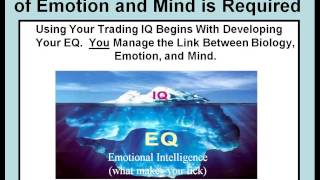
Most people don't come to this understanding that it's their self limiting beliefs that's holding them back and holding them prisoner until they're running out of money or their employer is saying, hey look, I'm going to tell you something, this isn't cutting it, you're going to have to do something. It's also why trading tends to be a young man's game on Wall street is they burn out of this. They get caught on this up and down thing, up and down thing and it blows them out. The real key is how do you break free of the self loving beliefs? Even if you acknowledge them, how do you begin to break three of them? This is where we start applying emotional intelligence and trading. The very first thing that you need to do is to recognize that cognitive dissidence is real and that you will resist change to your comfort zone. Okay, you do not. Your, your biological system, once it finds a system that produces successful survival in an environment, it will do, it will resist change it will resist change. You will keep doing the same thing. You will keep doing the same thing. This is the whole thing that you hear about stuff. Yeah, yeah, yeah, yeah. I need to really change. But the truth is, is I keep doing the same old thing. It's that it was successful back then. I'm just going to keep doing it until it becomes successful again. That doesn't work in trading. It doesn't work when you're going from a certainty based system of trying to make things happen to a probability system of where you're letting things happen. Very big difference. So we understand this, we know that there can be some resistance and ultimately what you come to have to do is you really have to come to a very different understanding about EQ emotional intelligence and IQ knowledge. Intelligence. Okay? Everybody, well, not everybody, but a vast amount of people have excellent IQ knowledge of trading. The problem is very few traders, very few traders have very much emotional intelligence that teaches them how to command the emotions that they engage in certainty with. Okay? This is the difference in the brain and the mind. And just to let you know this is that you do not have emotions, okay? They have you. The only time that you don't have an emotion is when you're dead. The whole key in emotional intelligence is not to get rid of emotions. The key is to use emotions and to manage them well, to create the mind that you engage uncertainty with. That's really the thing. And what you're really doing is this is you're acknowledging that the brain really the really core of emotional intelligence work is recognizing that the brain itself is a community of rival programs, okay, Rival emotional programs that has organized you into an entity that, that can survive in that world. Once it's organized that way, if you take the, if you take the organism out of that world, it keeps trying to force that environment to happen again. That's why the woman marries the alcoholic man four times over and thinking, of course I don't want to marry an alcoholic guy. And it keeps doing it. It's the pattern sitting there of where it's become habituated in brain. And there you are. So we know, we know emotional intelligence is actually going to teach us what makes us tick. Not what we say, but actually what makes us tick. And ultimately how do you go about producing long term, deep seated change about the belief patterns? The very first thing that you're going to have to do is you're going to have to learn enough about emotions so that you can regulate them so that it just don't absolutely hijack the mine and steamroll you so that you don't become.
A runaway freight train in the midst of a trade, so that you don't become frozen when you need to be acting. That's what's going to happen. You're going to have to learn to do that. Okay. And fortunately I do definitely teach that. The second is you're going to have to develop mindfulness as a tool. Mindfulness by itself is not going to solve the problem. You'll be really good at watching, thought, having, you know, starting out of nothing, having a life, then going back down. You're still being hijacked. The key with mindfulness is you start waking up and observing your money narrative and you start observing how in the world it grabs you in moments of pressure. That's the big deal is you always revert back to familiar pattern under pressure. And that's the problem with trading. You produce a lot of that stuff. Then what you're going to have to do in order to build new patterns, highly effective patterns, you're going to have to discover this brain that has these, all these emotional programs. You're going to have to find the ones that you need to manage probability and you're going to need to be able to pull them forward into working awareness so that those are the ones that are engaging uncertainty rather than the biological.
Evoluted. Evoluted, I don't know if that's a word, the ones that have evolved over time to manage uncertainty.
The key is that's not enough though. What you're also going to have to do is you're going to have to become very intentional about the mind that you're bringing into any particular moment. No longer are you just walking around in a moment and saying, okay, this is the mind that I've got here and I'm going to start sitting down here and I'm going to start working with uncertainty. That is the way to disaster. What you're going to learn to do is become highly intentional so that you are bringing a disciplined, a courageous, a self soothing and an impartial mind built from those emotional programs that create the thinking that your mind's doing. That's what it does. And as you go into this, you begin to recognize something, is that emotions are biological friends. They are not psychological. What they do is they take over psychology. If you take a look at this graph.
What you're basically doing is you're seeing the three vectors that create the training mind. You're seeing the brain and the way it's organized. You're seeing Emotion that creates thinking. And you're looking at your biology, okay? These things are all working together, okay, as one organism. They're not separate from one another. And out of that comes the working model of the mind that you have, that you bring to trading, okay? And that brain is born into a history. These are the circumstances during the formative period that kind of lock in particular ways of saying, like I was talking about Nancy and the scarcity thinking, okay? And then at the same time, you have to produce adaptation.
The brain is going to produce adaptation. And as it adapts and habituates, that becomes the invisible hand. That's the invisible hand of your beliefs about your ability to manage uncertainty. That's, that's the key is the difference between you and a smart animal. The smart animal cannot design the mind that they're bringing into a moment. Human beings can. And what I would really love to see, okay, is more eq so that more people in trading become really competent managers of the mind that they're using to manage uncertainty with, to manage the unknown with, to manage probability. That's the real key, and let me tell you something one more time, is the way you manage probability is reflected in the health of your trading account. You can say all you want about what your beliefs are, about the way you are supposed to do things, but in the clutch.
When there's pressure.
That'S when we see what you really believe. At the core, we're seeing what you really believe, and you need to change that. So, you know, the thing is, we see this thing and we have this notion of an emotion. And by the way, an emotion to a neuroscientist, literally is any deviation from the status quo. Anything, there's any change in the environment, any change in status, an emotion pops up regardless. It is a biological action potential.
And here's something I ask you to really listen to. Once you understand what an emotion is composed of, you begin to see a framework for working with emotions and working with mind. The first thing, the first component of emotion is arousal. You would know this by your stiff muscles, the halting breathing, the racing pulse. Those are not physiological signs that you're feeling discomfort. Those are physiological signs of a biological emotion. Revving up, getting ready to steamroll you. You need to learn to catch them, then observe them, then to calm them down so they never sweep the mind away. The second thing, the second part of an emotion is feeling.
Feeling is not touchy feely, friends. It's the subjective experience of the emotion. And what you're experiencing in that subjective Experience literally the chemistry of that emotion flooding through your body and your brain altering thought. This is when you recognize that oh my God, all thinking is emotional state dependent. What are the feeling states that I'm working with? Hey, I'm a man, I am pushing away feeling states. I'm not going to deal with them. What you're doing is you're hijacking your mind. You're basically saying okay, I'm going to ignore the presence of the emotion and, and I'm just going to let it absolutely ambush me. So you go, oh man, oh man, I need to start becoming a much better student of the feeling states that I'm in to be able to manage the mind that I am bringing to the management of the unknown. The third thing that happens once the feeling's there and by the way, if you want to, you can't control it at the moment of feeling, you're toast. Or what you can do is you can get up from your computer, you can exercise and burn out the chemistry rather than sitting there and letting the chemistry alter thought and you make really stupid decisions based on your beliefs then motivation. What is that emotion telling you to do? If you're a hesitator, it's telling you to avoid danger. If you're a revenge trader or an over trader, what it's telling you is to chase or to be angry and to be aggressive.
If you a trained trader, you discover it's about approach where you approach with curiosity, you approach with concern, but you do not approach from anger, you do not approach from revenge, you do not approach from fear.
Ultimately the concerned patient mind is the kind of mind that you need to be able to observe what the markets are willing to give you rather than what you can try to take.
The fourth one is meaning this is where those self limiting beliefs about you have about money and power, that's where they are. They're all part of an emotional basis, emotional cocktail. And the key is, is that until you decide to change it and actually actively go and start working to change the emotion, it's not going to change. It takes about a month, at least to a month and a half to two months to change reactive pattern. And that's by the way why my group course is set up to last for two months. It's why my individual course is set up to last for three or four months. It gives me more time, it gives me the minimum time that I need to teach you how to change an emotional reaction and also how to improve it to higher functioning Temperament is the genetic Predisposition, that's past my pay grade. That's not what I do. But once you understand this, you begin to go, okay, now how do I use this knowledge? How do I use it to become a better trader? The first skill very seriously, it's emotional regulation. You know, when you're looking at uncertainty and you don't have the unknown, your brain reads that as a biological threat. You know, it views it just like this guy sitting here in front of the saber toothed cat. That's what it's designed for. Your brain, when it, when it's on uncertainty, okay, does not think in probabilities by itself. You have to load it down because ultimately the course is this. Uncertainty begets ambiguity. Ambiguity begets confusion. Confusion is linked directly from a biological standpoint to fear. Now you think about what happens in trading. You're always working with uncertainty. You're always working with confusion. You never know for sure. There's always an element of confusion. Your job is to shift.
The dialectic between confusion to fear. And you are going to build a new circuit that moves from confusion, uncertainty, to concern. Completely different.
Completely different animals. But when you're looking, when you're looking at the arousal phase, you're gonna see this. When's the last time? Check, check how much tension is in your body when you're trading tomorrow. That's, that's basically saying, if I don't calm this thing down, what I'm going to do is I'm about to get hijacked. Check your breathing. You're going to notice that you're breathing. You're not doing diaphragmatic breathing, which is a combine that you need. You'll be breathing with the top part of your lungs or not at all. Check your heart rate. Most likely you have already activated the fight flight syndrome. You know, if you have a, if you have a pulse at rest of 60 and you pop up to 72, you're already moving toward activation of the fight flight, which means you're either going to attack or avoid the perceived threat. You're back here with this man, avoiding the saber tooth tiger. We need to calm it down so that it becomes concern but not fear. Okay? And then we need to learn how to calm those furies, okay? You need to manage.
The intensity of the emotion so that you don't beat yourself up. In this image, what you're really looking at is something going on within this guy's head, and it's called the Furies. And I had to put that lightning bolt there to keep it. So that everything was clean. But the point is, as you ultimately see, if you beat yourself up, you're having. You have to calm the body so these furies do not beat you up. So that's the first thing you notice, the breathing and attention signature, and you learn how to change it. You learn how to interrupt the emotion before it's got the critical mass. This is chemistry, friends. This is chemistry. And you're only using a biological methodology to get at something that is biological chemistry. It has to be done, or you're never going to make being good trader. Okay, then, once you do this, understand the problem with emotional regulation is that people say, well, golly, if I can produce the relaxation response, which is what it was called in the 80s, then I should be free and good to go. No, what happens is what emotional regulation will do. It will stop the hijacking. It will land you at the door of the mine, but you will not look inside the mine, just with emotional regulation. To do that, you need to develop observation. You need to be able to step back out of thought.
Okay.
Everybody'S done this. By the way, have you ever had the sensation of kind of stepping back and getting a better perspective, maybe that you've said, you know, I need to take a drive, I need to take a walk, I need to take a vacation, and you're able to see things from a fresh perspective. That's observation. The problem is you haven't got enough time to go on a trip. We need to learn how to take that faculty.
And do it in the moment to be able to step back and say, oh, okay, who's in my mind right now? What parts of the self are there? And suddenly what you really discover is this. You become aware of the embedded biases and beliefs that you've been operating from but didn't know about it. You become aware that you and your thoughts are different from one another. You become aware that there is an observing self that literally steps back out of thought and is independent. You know, it's kind of like you're both a participant in a trade, but you can also step back and watch yourself. And it's a powerful facility, faculty, and it can be taught. The next thing, that's not good enough. Understand that these first two skills I've talked about, emotional regulation and mindfulness, I consider fundamental skills that you have to have in place to do them, to do the higher work, at least in the. In the work that I do. Once you have the observing self, what you want to do is you want to really tune in and start saying, okay, I'm stepping back out of thought. And what I'm going to do is I'm going to start observing all this internal chatter that's going on inside of my mind and recognize that it's not just noise, there's substance there. Okay? This is where you discover that the mind that you've brought.
Into trading is not the mind that's going to produce success in trading. You're going to have to use your emotional regulation skills and your mindfulness skills together to be able to look into the mind. This is where you see the self limiting beliefs. And you also begin to realize, oh my God, my brain was born into this. This is not me. This is the adaptation and organizing and the organization of the self that I became. And this is where you discover, okay, now I'm beginning to understand what makes me tick. Ooh. And this is when you find your money narrative. Okay? This is where you start realizing the internal conflict. The symbol money is so deeply related to power, to worth, to mattering, to adequacy, okay? And it's the management of this internal dialogue that has to be matter material really mastered to trade well. And so when you look at it and all of a sudden you realize if you've ever beat yourself up, and I'd be surprised if there's any trader in here right now who has not beat themselves up. What you're listening to is the internal dialogue. And what. These are not your thoughts, friend. As a matter of fact, what you discover very quickly is this, is that.
You discover that there is an internal struggle between two powerful parts of the self. Okay? And this would be between the inner critic and the adapted voice. And go back, let's go back to this. Beating the self up or hesitating, you know, you're sitting there as a traitor. You're alone with your thoughts most of the day. And what happens is they really start kind of marching out. And the main thing is imagine cooling down, stepping back and watching this, this parade of thoughts come by and start identifying, you know, something that's a very critical part. That's the part that I keep telling myself that I'm not going to make it. I'm not going to do it. You know, here's this fear that's keeping me hesitating, this fear from not letting me go to target or this, or this euphoria that says, you know, I can make, I can make this happen, I can make this happen. And all of a sudden you realize that, no, that's the adapted voice. It can show up as a victim, it can show up as a pleaser. It can show up as a fraud. You lie to yourself. It can show up as a saboteur where you keep blowing yourself up. It can show up as a rebel that says it's not fair. I'm going to show you. And that's how you revenge trade, by the way. Okay?
Or it can show up as a rebel, I mean an Alpha. I've got to win. I can control outcome. I can make things happen. And you realize, no, this is not, this is not you thinking in the Committee of the Mind I'm going to talk about in just a second. This is the inner critic and this is the adapted voice. That's all it is. It's no more. But you have been so, your observer has been so asleep, so locked on this that it hasn't acknowledged anything else exist. Existing outside of that internal conversation while under pressure, this is powerful. You are born into these self limiting beliefs. They are not you. You don't have to remain stuck there. Then.
The fourth skill.
Is literally developing indwelling resources within you. In the same same way.
That you have fear and judgment living within you and temptation, you also have discipline. You also have courage to face your demons. You also have self soothing that allows you to calm your fears down and be patient.
You also have the impartiality of a sage. These are just simply emotional programs that are already burned into your DNA. They're burned into your genome. You just haven't learned how to awaken them and have them operating in working awareness. Okay? This is the key. This is how you transform this internal dialogue. And the first thing, as you begin the inner game, you realize that the mind really is better seen as a committee. Okay? In the same way that the brain is a community arrival program that's organized you, the Committee of the mind is really where these programs are given. Voice is thought. And you need to learn to observe them. Because some are highly destructive and some are very constructive. The Chinese had a way of saying it of the Yin Yang. The destructive and the. And the constructive, they both exist within you simultaneously. Same here with us. Most of us have been so asleep in the trading mind that we have not become the designer of the mind that we bring into the management of uncertainty. So therefore we get history, we get a lot of destructiveness and scarcity. Thinking at the same time though.
You can stay in the old way or you can build a new mind. And as you start building the new mind and what you discover.
And it just so happens I use a highly specialized method of getting at these programs that I don't use visualization of wishing that I'm going to have these things. And I don't use affirmations that again, wishful thinking about. I'm a disciplined trader. I'm a disciplined trader. The moment you hit pressure, I know you're not anymore if all you're doing is mouthing this stuff. But internal to you there is the courage of a warrior. Okay, you have the ability of facing your fears and walking through them, but you have to conjure up that strength within you. You also have the discipline of ruler. You know, in the same way George Washington, when you see this famous picture of him crossing the Delaware and you know he's got a ragtime army, he's about to go attack the most well equipped army in the world and the best fighting machine ever. And at the same time his job is to maintain order of this ragtab army so that they can go attack. And what you're seeing is that people believed in him, he was able to maintain order under pressure. He becomes the symbolic value of discipline. Another, you know, Merkel right now is my favorite one in the world. You know, it's just like she's just, just an amazing leader. Of course now if you're German, you don't like what she's doing, or if you're Greek, you probably have a different opinion. The thing is, you start seeing these personified traits that resonate with your emotional programs. You're learning how to pull it up. You also have the impartiality of a sage, kind of like a spark, you know, Spock. And you also have the self soothing of a caregiver. These are all images planted and they also have, they are emotional programs that you can learn to pull forward. It's easy. It's not easy. This can be taught. And so ultimately lasting change.
You have to become intentional. You have to become intentional about the mind.
That you're living with, that you're bringing into the management of uncertainty. You know, the old mind that you evolved into, adapted to, that's not going to do the job with probability, survival, certainty. Yeah, yeah, it works. Not in probability, say. And so the real question is, you know something, who's going to populate your trading committee? And also when it really comes down to it, you know, I often hear this thing is that, you know, how much money do I have to lose or how much money do I have to leave on the table? For me to recognize that ultimately I have to design the mind that's using my methodology. That's the missing piece. Okay. Ultimately, it's this way. It's something that Louis Pasteur said.
Is the uncertainty of trading never goes away, but chance.
Favors only the prepared mind. Okay, do you get that? If you're losing it in the middle trades, you do not have a prepared mind. If you're hesitating during trades, you don't have a prepared mind. If you're jumping into trades.
You don't have a prepared mind. When you get this, and it's a, it's chance, it's probability, this is the difference maker. This is what you're ultimately going to have to learn how to do. So what I want to do is on the left side, you see the mind that you brought, the historical narrative, money narrative, and you're seeing how it's performing. Okay? And you're seeing how it's performing based on the health of your trading account.
You truly end up with a very limited scope of what the mind is, of the players in the mind, of the forces in the mind. But on the right, what you begin to see is you're beginning to see that you're no longer. You're really developing an intentional mind. You're developing the discipline, impartiality for the management of uncertainty. You're developing something that is concerned as an emotional state, but not in fear or aggression.
Suddenly what happens is that in mindfulness, what you're doing is you are controlling what you can control the mind that you are bringing into the moment of engagement, of uncertainty. That's what you're doing. And that mind is going to be down here where you're going to have the discipline of ruler, and it's going to be maintaining order under pressure. And then everybody else, these other programs fire based on your relearning how to get to them. They're there. And it just depends on what mind do you want to bring. That's the real key. Next steps, let's look at them. You know, for people who are just getting into this and they're just finally beginning to figure out that, well, you know, maybe, you know, maybe the mind has something to do with trading. And I'm just not going to just kind of magically get on the other side. What I ask you to do is go to my website. It is chock full of free information. Get the free ebook. You can. There's lots of articles there that you can read. There's lots of videos. A lot of people will literally look at those videos every day before they trade you know, they like that connection. Then they, then you can buy my book Mindful Trading. You have a series of guided meditations, the workbook, all sorts of stuff. But when you become really serious, once you begin to figure out, oh my God, you know, I really need to change this thing, there ultimately becomes two big different ways of engaging. One is through a group course and the other is through our individual course. And ultimately what happens with us is that the group course, by the way, it's starting in a few days, the 9th of September. And the group course is powerful, highly effective and it's, it's got the best bang for the buck. You know, if you're really watching your dollars, this is the route to go. The key is you learn how to do these six qualities I was talking about, from the emotional regulation, the mindfulness to the historical dialogue, generating the empowered parts, the intentionality and really bringing a different mind. It does that. It meets five times over the period of two months as a group. And it is, you have a virtual classroom that you have unlimited access to. It's powerful, powerful course and it's pretty darn inexpensive. You know, it's like $11.95 to, for the whole thing or 240 every two weeks for the four or five times powerful stuff. It's affordable. The other one is my group course, I mean my individual course where basically the major difference is this is you're meeting with me 10 times over a period of three or four months on Skype and we're going through a protocol, basically a graduate level course that starts with the basic stuff that the group course learns, that goes on and is much more personal, it's much more comprehensive, powerful stuff. And if you're thinking about that and you're just simply wanting to figure out what's best for you, ask for a free consult. You go to our website, you hit the contact us and you ask for a free consult. It's very powerful and what I want to share with you. And you know, ultimately people live in the delusion that they truly can control outcome until they run out of money. Okay? That's how most people do it. That's why only 2 to 5% of people in trading make money. They hold on to that old mine so long that they no longer can afford to train the mind. If you have capital left, I really hope you invest in yourself, invest in the mine that trades. Once you have the knowledge you need to develop the mind. So anyway, I want to thank you for coming and I'll answer any questions you Have. And I already see one right here. Question. After trading for a while, I often get tired. Can you give some tips on how one might recharge yourself quickly so I can then go trade again at peak performance? Yeah. You know, to be honest with you, most of the things that I teach is that about every 30 to 45 minutes you need to be taking a break anyway. Because the kind of thinking you're doing just drains the heck out of the glucose in the brain. It burns it up. And what you do is you experience a kind of tiredness. You know, your mind's no longer there. Basically you've run out of gas and you need to go do something completely different. I have guys who. People who go just walk around the block, they take a run, they do all sorts of things. They just rest. They do something that allows them to replenish the glucose stuff. And I've had a lot of people who are really high energy who said, you know something, I should be able to think and work for three or four hours at a clip. No, you can't. Not in trading 30 to 45 minutes is what I encourage. A lot of people want to know where the recording will be tomorrow. Can you tell them? Yeah, a lot of people are asking about the recording tomorrow. You will see it on our website. No, wait. Oh, it's gonna be on YouTube. Okay. And. And actually, tell me something. Should we have it as an embed on our.
We can do that. Actually, I tell you what, you go to my website tomorrow, midday, and we will have. We will have a link to YouTube. Okay. That will take you to this thing.
Oh, wait a minute. One way we could do is that we can, we can, we can.
We've done this before. I don't know why this is so hard. Basically, we will send you. If you're here, we will send you a link.
Yeah, we will send you a link. But understand is that I. It has to get rendered and then I have to get it up on YouTube. So it's going to take a little bit, but we will. The people who are here, we will send you a link to it. Okay?
Okay.
The real measure of your wealth is how happy you would be if you lost all your money. You know that that's a really nice.
Saying. There is. The evidence shows this, is that happiness and money do in fact correlate up to a particular moment. Okay. Where all the.
Basic needs are being met, then money and happiness do not correlate. And I, I see evidence of that is back when I was actually a licensed Therapist practicing is. I worked with wealthy people and they had a lot of money, but they had very little happiness. At the same time, there is levels of poverty that create misery that a little money could really help. So it's in the right direction. Okay. The instinct. The instinct from listening to you is to try harder, which leads to being impulsive. How do you balance this out? First off, if you're getting an instinct from me to try harder, then clearly you're not listening to what I'm saying. Okay. In my work, you are learning how to produce. Patience. You are not trying. As a matter of fact, trying harder is going to get you in big, deep tapioca. In trading, what happens is you are a surfer.
And you are in the ocean working with big waves. The truth is, is that the surfers not trying hard.
The surfer is in tune with the wave. The wave does not know it's even there. Could care less. But in the attunement process, without very much working hard, what you see is a person on a board being able to ride that wave and navigate that wave with very little effort. That's why those guys can do it all day. It's not that much physical effort, but there is a lot of attunement energy that's there. So this is not about hard work. This is about the mind that you bring to a moment. Okay. Do you see a good number of your clients start making money consistently? Yeah, the ones in particular in my individual program, Yeah. I mean, I keep up with them. We're very directed at where this has happened. And with my group clients, I get a lot of. I get a lot of feedback from them saying they're doing well, they're profitable, and working like that. But on my individual clients, absolutely. Yeah.
Would you repeat the cost of the group course? It's $11.95 if you were to pay it in full. And what that does is that that gives you access to all the classrooms immediately so that you can start working through them. If you take it.
If you take it. The payment plan, which is what most people do, is it's 240 per every two weeks for five weeks.
Ultimately, there are five payments of 240. I think that's. I think that's 1200. Okay. And what we have found is that that's.
People who sign up early and want to get a head start.
Will. Will pay the 1200 because they want to get past the emotional regulation piece and they want to be in mindfulness before we hit, before we actually start doing the classes. Would you recommend not trading while you're learning these new skills? No, not at all. I, I, I might ask that a person, if he's trading live to take back the number of contracts or size down for a while. I'm looking, what I'm looking for was when you feel the stress. Because ultimately, if you're not trained in the environment that you're going to be acting in, you're not being trained. If you learn in a classroom and then attempt to go and apply it in practice, you're not going to see the same thing. Okay. Now I am looking for you to, I'm actually right now working with a guy who is moving up his sizing. And you know, it's a tough thing. If you've ever tried to size up, you know exactly that. You know, there's a big, you know, it may be, it may be just more zeros, but in your brain it's there. And he has to be trading at the new sizing for us to be managing this thing. It's the same thing with breathing. It's the same thing with mindfulness. You need to demonstrate the skill under pressure. That's the real key. Okay. Besides deep breathing, are there any other ways to improve oxygen intake as pumping pure oxygen into my training room to improve my peak performance? I wouldn't, I certainly, I don't have any comment to that. I do know that it is the diaphragmatic breathing, it is the muscle relaxation that adds that. But understand that is emotional regulation.
It's going to produce a calm mind. And I have worked with traders. The moment that they got the regulation stuff down, their trading improved. Not many traders do that, though. What I want you to understand is what I said is emotional regulation is not going to be the difference maker. Emotional regulation is going to get you to the door of the mine. Okay. It's inside the mind where that's the difference. But if you don't do the emotional regulation in the beginning, you're not going to get the door of the mine. Okay.
Hi, Randy. Hi. Why do you believe that we are wired in such a way that the inner resources that empower us and serve us well in trading and other areas in alive lie dormant and underdeveloped? Thanks. That's a good question. I appreciate that. What I will say in the domain of trading, you may have developed leadership roles as a salesman, warrior roles, and if you're like a therapist, caregiver roles, and in disciplines outside of trading. Okay. What we're looking for is can you pull those things up in trading under stress. Okay, that's the, that's the thing is that if you see, if you're trading and if you know how to trade and you're not producing the mind that can manage probability, then the emotional programs are dormant in the domain called trading. Okay? So I'm not necessarily saying that the emotional programs are absent. But the thing is, is that the skill of an attorney means nothing. I mean, he's. He can be a great warrior, he can be intuitive, he can be a lot of things. But when you take that to trading, I know very few traders, very few attorneys that make good traders. You have to take back, you have to reconstruct the warrior because an attorney is built to argue and to win. Okay? In trading, the markets don't care. It's irrelevant. Okay? And out of that, another way of saying it may be not lie dormant, but to, but to remake so that they become successful as part of the mind in trading. That's actually a very good question. Thank you for that question. Okay, friends, we are a little over and we. It's time to go eat. I want to thank each and every one of you for coming. I have enjoyed myself enormously. I hope that you have come away from this with information that can help you either whether or not you and I never see each other or whether or not we engage with one another. My own hope is that you learn and that you evolve as a trader and you truly do learn how to produce the mind that manages the moment of performance. And you realize that that's the edge. And out of that, I hope you achieve your outcome goals in trading. Thank you very much. We will see you later. Bye bye.









