2015 10 20 16 31 Conquering the Eight Roadblocks to Peak Performance Trading
Randy Howell identifies eight psychological roadblocks that keep traders from peak performance, arguing emotional intelligence matters as much as technical skill. He covers ignoring emotions, fearing uncertainty, needing to be right, and offers practical fixes like mindfulness and emotional regulation to rebuild how traders think.
Chapters
Welcome everyone. My name is Randy Howell and I'm with Traders State of Mind. And I would like to thank Peter and Sean of Jigsaw Trading. This is. I'm delighted to be here. I'm delighted to see everyone here and what I want to do is just cover a couple little things in housekeeping. And the major thing is that you are welcome to write and ask questions and just type it in. However, what I do is I hold questions toward the end. Now I'll have a question and answer period, but feel free to ask questions as we go along. What we have found over time is that many questions get answered due to the nature of the organization of my presentations. Okay, so from there, take a look at this. What are the roadblocks that actually stop traders from having a peak performance mind to engage trading with? Okay.
You know, literally what traders discover after trading for a while, and that's usually two to five years at least, is that.
There'S some things they don't understand and.
They recognize that all that hard work.
Somehow isn't helping them. Okay. They're still stuck in a place and they don't understand. In fact, you know, they're going, often their trading is not getting better, it's getting worse or staying the same. And often they've lost a significant amount of capital or they've bled slowly they go, you know something, I'm working hard, what's the problem? Well.
Two to five years is about how much it takes to learn how to trade. That's the deal. What we're going to be looking at are some of the assumptions that most traders have about success. And we're going to be looking at something deeper about the disconnect between what really creates an effective mind for trading. What you're going to discover is that emotion and mind are closer than you possibly ever imagined. As a matter of fact, what you're going to discover is this, is that the rationalistic mind that you thought was good for you and holds that there is a world out there.
And you can literally conquer that world by having knowledge and understanding it. And ultimately what happens is that you begin to understand that emotional intelligence is far more important than knowledge. Because suddenly you have to realize that there is a world in there, okay? That's creating the way you interpret the world out there. And you desperately need to understand what makes you tick if you're going to become a successful trader. Because all you're doing when you're blowing yourself up, when you're bleeding yourself, all you're doing is you are Again, seeing what makes you tick, but not knowing how to take advantage of it. The bottom line.
Is the wise mind, the trader's mind works both by combining the emotional brain, emotional mind, and the rational, logical mind. That's how you get to this mind that can think abstractly, that can think impartially, but at the same time can maintain order, emotional order in the mind, so that you can think in a probability based mind. This is the big key. And what we're going to be doing.
Is really looking at these assumptions. I know that it takes two to five years of learning to recognize that knowledge is not the problem. Applying your knowledge under stress is the problem. And the real key for traders, and this is really serious. And I ask you to answer this inside yourself, okay, how long do you hold on to faulty assumptions? $50,000 worth a couple hundred thousand dollars worth? Half a million? I talk to people every week that have blown up this much of their capital working from faulty assumptions and beliefs, and only then do they get the point where they're going, you know something, I need to examine this. There's something wrong going on inside my head. It's not my knowledge, man. I can ace the test when there's not pressure, but when I put pressure there, I keep making the same stupid mistakes over and over again. That's what we want to look at.
Because unless we can do that, what we discover is this. We truly can't see the forest for the trees.
Traders do this all the time.
They can't see that body, emotion and mind are deeply interconnected. And really when it amounts to emotions are us. It's really the intelligent trader knows how to use emotions. That's what we're looking for, okay? But what we're having to do.
Is first look at this belief that you and your trading are separate, that you can approach trading without emotion.
We need to look at this and we need to see what's going on. My friends, I promise you this, if that pop, pop psychology term were accurate, there would be a lot more successful traders. But if you start searching around, you start talking to people and get past their bravado and you start asking people, hey, are you making money at this? And what you're going to discover is very few people are. And the question is, are you willing to do something about the herd that you're following so that you can take advantage of the herd rather than staying with them and getting fed on by others? Ultimately, what you're going to discover is this. There's really three components to successful trading. Two, you are already going to know and you're gonna know all about them. You're gonna know about that platform. Oh man, you got that thing and you know about your method. You've got all that risk management down and man, in a vacuum, you can do well. The problem is there's a third leg to the stool of trading success. And it's called trading psychology. Ultimately, what mind are you bringing into the arena to trade your beliefs? What mind are you bringing into the moment of performance that allows you to manage probability effectively?
Many traders manage probability ineffectively. What we are, we want to say is so really when it comes down to it, if you would look at yourself as a race car team, you know, the driver is only one element. You know, you have a platform, you have the car, you have all sorts of things, you have networks of help around it that all function as a team. Yet without the driver, all that technology, all that know how is useless. They still have to be able to run a machine at high rates of speed under pressure. That's the same thing with you. And this is why 95% of traders are simply going to continue losing money. They don't get it that they've left out the emotional mind. Yet no matter how much it's costing you to ignore the emotional mind, you still pretend you can.
And that brings us to the second roadblock to your success is believing that hard work is going to produce success in trading. How many of you have worked hard? How many of you have taken hard work and perfectionistic thinking, not losing, doing everything you can not to lose, and applied it to another domain and another endeavor and done well with it in business and corporate. And then you came over here into trading and said, you know something, I'm just going to apply this same hard work, you know, I'm going to make things happen. Gonna really bull myself here. I'm not gonna make mistakes and I'm gonna produce. I'm gonna. You know something, I'm not gonna be one of those 95% people. I'm gonna be one of the 5% that make money. And here you are five years later. That's normal. Friends. Ultimately.
Hard work makes you feel good. In the short term, you've got to be doing something to.
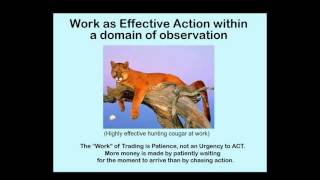
Wrong. Not in trading. Trading. In trading, busyness is the enemy. Okay? But that whole notion on hard work and that urgency to act to make something happen is in fact the kiss of death in trading. And what happens is what does it look like though? You know, I'm going to show you, I'M going to show you here is an American cougar hunting.
Does this big lion look like he's got really, does he look busy? Does he look like he's just hanging out? Yet this is one of the best ambush predators the world's ever known. Interestingly, he does not work hard. He works patiently. I live out in the country.
Less than a quarter of a mile from me, there is one of these American cougars down on the creek.
She's had cubs, she's had stuff like that. We have abundant deer here. And what she does, she climbs a tree, she gets on a limb just like this cat right here and waits. She knows the pattern, she knows the setup that the deer is going to get in. She's waiting for the setup.
Patiently. Then when the moment's right, she seizes the opportunity. She doesn't go after the deer. If you've ever seen a cougar attack on a deer, it's over in a moment. There's none of this big huge struggle that you see with African lions.
They come down full bore, steam, use their paw to snap the deer's neck, and the deer just simply drops. If there's a mistake and that doesn't happen, the deer gets away and the lion just starts the game over again. Does it sound like trading? Yeah. I want you to see though, it's not about hard work, okay? This is really about distinguishing opportunity that comes to you, not making opportunity happen. And if this tendency can't be corrected, you're not going to be able to trade. It's really simple. The third roadblock is to live in the illusion of the myth of the rational markets, which is something that was done for years and years and years.
My promise to you that we are not rational beings, we are emotional beings.
Not in control of the emotions that we deny. That's what we are. Ultimately, what you're doing is you're looking at this thing and markets really are full of anger, of greed, of fear and overconfidence. Those are what drives markets, okay? If they're not rational, you take rational mind and put it into trading and they'll lose money. Then what you're really seeing.
The big deceit, is actually believing in the supremacy of rationalistic thinking. And you start realizing the brain itself is set up to self deceive. In this particular case, these two guys are both arguing. They see four. No, they see three, they see four, they see three. And depending on how you want to look at that, you. You either see three or four posts. The same thing happens in Trading. Let me give you an example. A couple years ago I was working with two traders in a hedge fund. Both of them really knew their stuff. They had the same machines, they were best friends, they had the same feeds, they had the same indicators, they had everything, yada yada yada. And they talked a lot, they talked about their trading. One by the way, had been a client of mine, just outperformed the other guy and the other one did okay, understand that. But this one just over formed what's interesting, what they were both doing.
They were both bringing their beliefs and projecting them onto the markets. But only one of them knew that he was only projecting his beliefs, he wasn't projecting the truth. The other one thought, you know something, I'm being rational and I know how not to lose money. And by virtue of that, what he did is he didn't make much money. The other guy began to see this is all probability. And as long as I stay in the moment in my process then the money is going to take care of itself and he's pitch rated without any, you know, just he, it was like kind of boring act for him. So you begin to see that depending on how you interpret is what you see.
Now the fourth roadblock is actually believing that rational thinking is going to solve your problems in trading. Karen Horning is one of the ancient masters of psychology and there is I love her saying is rationalism may be defined as self deception by reasoning.
It is this particular self deception that keeps traders stuck and losing. And it's the fear, the greed and the overconfidence, the anger drive the markets, not rational. And as long as you're trying to pretend they're rational by bringing a rational mind to understand a rational market when actually it's an emotional mind trying to work with an emotional market, you begin to see and you begin to say how long have I been doing this? There must be an easier way. If the markets aren't rational, they must be emotional, not irrational, just emotional. So you begin to, you begin to see that as long as you begin to look outside of the self, success is going to elude you until the emotional brain is acknowledged as the driver of thinking. What we say in neurobiology is that all thinking is emotional state dependent. You can't, your thinking is always dependent upon whatever mood, whatever emotion you're in. Okay? You will always be at a disadvantage in trading. This is your beliefs being projected onto the markets. And the ones that are important, my friend, are the ones that you from not talk about and the ones you act on are about the ones about how well do you feel you're going to do in the management of uncertainty? The reason most people stay employed by people they don't want to be working for in corporate America is because they are uncertain about their ability to manage the uncertainty of life and self employment. Okay, it's the same thing here.
Now what we're doing though is we're saying let's take a look at those beliefs. Because the fifth self limiting belief, the fifth roadblock is actually avoiding the fear and the anxiety because you view them as oh, that's really uncomfortable. The truth is fear and other negative emotions that we don't want to see about ourselves have to be turned toward, have to be approached so they can be dealt with, not denied. The truth is you're going to get to know yourself in trading more than with any other place, any other thing that you'll ever do in your life. The speed of trading is so rapid between your beliefs into action, the results in your trading account, okay, that you can't self deny. You know, my dad smoked Camel unfiltered cigarettes for 52 years and everybody would say Howard, you know you're going to kill yourself if you keep doing that. But he didn't see himself being killed in that moment. He was able to deny it and put it off until it was way too late. This is the big thing in other endeavors in life time so slow that you don't have to really fess up in trading. You can't talk the talk for long. Well, you can talk the talk in a trading room and stuff like that, but your trading account is going to tell you the truth whether or not you like it or not. I actually know people.
Who did not tell their spouses that they were their house was being foreclosed on because of their inadequacy. They just pretended it wasn't happening. That's how big this can be. So we know that we need to turn toward it. And why is that? As long as you fear fear.
Friends, this photograph is how your untrained mind experiences uncertainty. Your mind was designed.
To perceive all uncertainty as threat.
To self preservation. And it's going to have reactiveness, okay? To be able to avert that. Your job is to be able to take the connection your brain has so cleverly wired between uncertainty.
The unknown and fear. Okay? Disconnect it so that uncertainty you can regulate. It doesn't get to fear. You generate concern. You need to be concerned, you need to be alert, you need to be ready. But you don't need to have fight flight triggered because you're toast if that happens. So now we're looking at this. We're going. Okay, now I'm beginning. I hope you understand how rational thinking is just swept away. You know, it wants to be. I mean, your rational thinking has been around for maybe 150,000 years. Your emotional thinking has been around for 150,000 years. Go figure. Actually, either 6 or 7 million years. So let's do this. Let's say, you know, I'm beginning to understand that what we really need to do is we need to understand emotion so that we, by understanding emotion, we can start using it to apply to our thinking so that we can use the kind of thinking that we think in. Probabilities rather than certainties. Yeah. First of all, what is an emotion.
To a neurobiologist? Any disruption to a standard sensorial pattern, okay. That the brain's already created an emotion automatically arises to you as a trader. You're going to notice emotion as a result, it's a disruption. And I don't know, you could be. If you have problems with entry points, it would be where, you know, you're just looking at that, those wiggly lines and you know, they're not saying anything. And all of a sudden one starts forming. A setup starts forming. You get confirmation on it, then you get more confirmation. Suddenly, a standard sensorial pattern has been broken. Automatically an emotion's coming up, and if it's not trained, it's going to be fear. What if I lose?
It could also be at the tail end of a trade where you're managing the trade and you finally get into black after you've been whipsaw, and you go, I'm going to get out right now while I still have something for it taken away from me. You know, there it is, there it is. There's a disruption to standard pattern. You want to get out with your scarcity thinking it may be that what happens, you see something coming up, you see a setup beginning to set up, and you jump into it because you want to make it happen before the setup was there, before there was any information there. Homeostasis. You get it. So there's a disruption to standard sensoral pattern. Then. A lot of my programming is built on understanding these five elements of an emotion. The first is arousal. Arousal is literally the emotion revving up. You would notice it by tense muscles. You would notice by the way you're breathing by holding your breath. Tomorrow morning, if you check out your trading, watch yourself in a mirror videotape yourself. Just put, put a. If you have a Fitbit or something like that, put a heart rate monitor on you. And what you're gonna discover is you're a loose cannon. You're gonna start noticing that the emotions there. You haven't been noticing it. And by not noticing it, you can't intervene into it. So that's the first thing you have to do. Feeling, feeling. Not touchy, feely stuff. Feeling is literally.
The emotion revving up and coming to the moment where it's no longer revving up, it's spilling out into your brain, into your body. The emotions on the loose, man. The adrenaline's in the system, the dopamine's in the system, the cortisol's in the system. And your thinking is now compromised. One way or the other is compromised. Unless you're in a calm state.
The best thing you can do once the feeling states there is to get out of the trade. Go take a break. This is what happened to the whale, JP Morgan, when he evaporated all his billions of dollars. He was in euphoria, overconfidence, and he didn't even know that he was in overconfidence. And the risk manager wasn't there because she was sick, and he just got overconfident. And by being overconfident, he minimized risk. And before you know it, J.P. morgan lost anywhere between 6 and $8 billion. That's how tricky it is, and that's how you have to become very important in understanding it. The third one is motivation. Really important. The basic motivations of an emotion is attack, avoid, approach. You guys will know attack and avoid. Really easy. The moment that heart starts beating, that there's muscle tense, the breathing stops or starts panting, you already in attack motivation or attack avoid motivation, you're already there. The fight flight syndrome is triggered. What happens is that's not a way to approach uncertainty. You approach uncertainty by approaching, not by viewing the uncertainty as a threat. You view it as. Huh? I'm curious. Let's take a look at this. We need to be concerned, we need to be curious, we need to understand, and we need to be able to calmly move through it. Big difference. The fourth and really powerfully important, the meaning that gets wired into the brain about the emotion. It would be your belief systems about your ability to manage uncertainty. And most of us, we're never good enough. We grow in a culture where there's always something wrong. You got to do better. You've got to be number one. You bring that kind of thinking, these kind of beliefs into trading. And you know, the truth is, is the markets don't care if you want to be number one. The markets don't care. If you don't want to be wrong. You will be in probability, you will be wrong and you will be right. But can you manage the emotionalness of being right or wrong and being in calm with it? That's the meaning that we're going to be looking at a little later. And temperament is your genetics, it's your predisposition. It's beyond my pay grade, friends. So now we've come a long ways, we look at the roadblocks and now we're looking at the emotional gap between the mind that you brought to trading and the mind that needs to be there. So what we're really doing is this.
While you're trying to be rational and without emotion, this is what's really happening to you, okay? Your brain's a negative assessment machine already, okay? It's going to look, it's going to look to the bad before the good. And it does not distinguish uncertainty from fear by itself. You're going to have to do that. It organizes you to avoid uncertainty and fear. That's your comfort zone that you don't want to get out of, okay? Then it forms these self fulfilling patterns that react immediately when it sees a trigger in the environment. There you go, it goes on automatic. There you are. The moment you hit uncertainty, you start panicking, you start going to anxiety or you start aggressively trading, bam, bam, bam, bam. Okay? So the thing is, is you're gonna have to learn to unravel that, okay?
Have you ever done the same stupid thing over and over again and you said, you know, I really need to change this, I don't understand why it's happening. Well, this is why it's happening. And it's not going to happen just because you come to another belief you say you have. It's not going to come to another belief because you have another power. Saying it's not going to come that. You're going to have to learn how to regulate the impulse, you're going to have to regulate the emotion, you're going to have to change core beliefs. And here's friends, here's the cost of fear based mindset. Again, that's what you brought to trading.
Or you wouldn't be listening to me right now. Okay? And it starts with the emotional state that you bring, then your state of mind that you're thinking, then the perceptual merit. That's what you see as possible out there, okay? And all sudden there's the actions you take, the reality that you're creating, and then the emotional regulation feedback. Do you do anything about it? Until you develop mindfulness and emotional regulation, this process continues unabated. But you can stop it. That's the real kook. That's the real key. The real good news is this, you can learn to manage your biology, okay? The biology of emotion, so that you're able to truly begin to have a lot of influence about what mind is going to show there.
The world of trading requires a probability based mind, okay? Nothing like when you're looking at this thing from that hominoid to that Homo sapiens. That is a certainty based mindset that has evolved because it was very successful in allowing us to survive and grow into the particular organism we are in the world today. It is not going to work in trading. It's good for survival in this world. It's not good for thriving in a probability based world. That's what you're going to have to learn how to undo. You're going to have to learn how to use the emotional brain to create the kind of thinking that you need. And it's not going to be the one. It's not going to be the emotional brain that you inherited from your ancestry. It's not going to be the emotional brain that you inherited from your history or your culture. It's going to have to be different. You're going to have to redesign, rebuild that mind. And this brings me to the sixth roadblock, having to be right. How many times I talked to people and said, you know something, I had to be right. You know something, I knew it was going to happen. I just knew, you know, the markets were wrong and I doubled down. I knew that thing was going to come back. He wasn't able to take the loss when it was small. No, he had to be right. You have to let go of certainty. When things don't go according to plan, you get out of the trade.
So.
The markets don't care.
And if you've got to be right, you're taking this stuff way too personally. You're mattering your sense of mattering. Your sense of worth, your sense of your sense of adequacy are too wrapped up in being right in trading. That's something you can't do. So this whole instinct.
Of mindless self preservation is going to really drill you as a trader. You're more comfortable with the self learning beliefs than developing new ones. That's what the problem is. Okay? It's kind of like the demon that you know and are comfortable with is easier for you to deal with, the one that might be around the corner. You have to. You have to. If you're going to change the belief system that you're seeing the world through, you're going to have to change that whole thing. Because ultimately.
Beliefs are not true, okay? No matter how much you want them to be. Even faith in your beliefs does not change your trading account's health. The markets don't care. What ultimately happens is that your trading account is telling you every day how effective your belief system is. Okay? And as you listen to your trading account, rather than going, oh my God, it is going to tell you where to look if you're willing to listen. This is powerful because ultimately this external world interviews inter hangs out with this success model and its inner map you have. And until you can get that inner map working to show you that your beliefs that you're managing uncertainty with are in fact effective, you're going to continue investing in self funding beliefs. So listen to your trading account for goodness sake. Now the seventh roadblock. This one is the really big one, is actually believing that you are your beliefs. What you discover in mindfulness.
Is that you and your thoughts are not the same. You and your beliefs are not the same. They're just the ones that showed up. Okay? And this becomes the prison of your comfort zone. It's so easy to believe, well, this is, this is who I am. No, it is just a particular organization of the self that the brain has organized you into. Currently.
You can change.
In neurobiology, it's called neuroplasticity. You have to become the designer of that plasticity rather than just wishful thinking. It's going to happen though. This is what you really have to do. This is what you have to become if you want to free yourself from your current comfort zone and jump out. So ultimately this is where it comes down to, okay, is there are two powerful fundamental skills that have to be developed. You're going to have to develop emotional regulation skills that allow you to manage the intensity of an emotion biologically. That's with your breath, that's with tension reduction, that's with learning how to observe your body. Like for instance, I will have heart monitors on a lot of my clients because what happens is they can see the heart beginning to shoot up. And they know that that is, that's showing them that arousal is happening. And they have precious few moments to catch that arousal before it starts flooding the system as a feeling and altering thought. You have to become an observer that you have to be able to calm it down. Okay? These are the tools you're going to have to have, okay? And you're gonna have to understand this. This is a. This is.
In neurobiology. We would say that you have never experienced reality in trading. We would say you have never experienced the markets. What you, in fact, have experienced is your brain taking sensorial data from your senses, organizing it through your beliefs into a virtual representation of the markets that you believe is the truth, when in fact it's a virtual representation. That's what you're trading, friends. Your trading account is telling you how effective or ineffective that virtual representation is about being able to extract capital from the markets. It's not true either. It's just that it's showing you how effective your current belief system is. Your virtual representation is about extracting capital from the markets, which is what we want in trading. This is something you do through mindfulness training. This is something you do through learning how to regulate the emotions so that you stay calm, present.
In the moment, in your trading, rather in the future, worried about what's going to happen, or in the past about thinking, oh, my God, what did happen? And out of that, out of that, you start reconstructing what I call the historical self for peak performance. You know, ultimately.
What you really happened with you is you were born into a soup, okay? It's called your community. It's called your web. And your brain organized you to exist in that soup, in that environment.
And it organized you into a particular self that was able to negotiate survival with that, with that environment. That's the you that you brought to trading.
What you're going to have to do is you're going to have to redesign it. Because here's the magic here. The brain itself, from a neural biology standpoint, is really a community of rival emotional programs.
That has organized a self, an entity, a biological entity, to survive. That's the piece I want you to hear, is don't take this too personally. And what I want you to recognize, this is a brain organizing you into a self. And it's the historical self, and it's the one you woke up to. It's the one that you think, oh, yeah, this is me and mindfulness, you discover, no, this is just the historical self. That's all it is. It's one potential organization of the self, but it's not the final one. Then what happens next? This is when it gets wow. This is the wow factor for me. When those emotional Programs in the brain, okay, when it creates mind, something magical happens. Suddenly. Suddenly those emotional programs are given voice in your mind as thoughts. Suddenly those emotional programs are acting as a committee of the mind, kind of your boardroom. Okay, this is, this committee is where you find all these forces. And the ancient Chinese had it down really well. You know, they said that there was a highly destructive element of the self and a highly constructive element of the self, the yin yang. Well, this is happening in your brain all the time. When you beat yourself up, you're definitely really acting from that destructive element. When you're calm, you're cool, and you embrace the uncertainty and whatever comes, as long as you perform well, you're embracing the constructiveness. The Cherokee Indians had another way of saying it. There was a good wolf and a bad wolf that lived within man's mind. And they held. The one that won.
Was the one that you fed. Okay, this is living in mind. And all of a sudden you're going, you know, I need to wake up to this. I have a committee here. I have been asleep at the wheel, but through mindfulness I start waking up and I realize, oh, my God. I realize that what I've got going on here is I have a. I have a mutiny going on.
This is my ship and the forces within me have taken over and they're getting me to jump off the plane, but the ship's sinking anyway. So what we're asking, this is the human condition. This is what must be faced to become effective in managing probability and uncertainty in trading. So you're beginning to get it. You're waking up, you're going. I have to get control of my mind. There's nowhere around it. I have to acknowledge that my body and my mind are interconnected. The body, emotion and mind are so deeply interconnected that I need to start watching my body, I need to start taking care of it. I need to feed it well, I need to exercise it well. I need to have it, have sleep. Because if I don't do that, I'm not going to be able to produce the mind that can trade anyway. Then I have to go back and I have to really take a look at my belief systems that are creating the way I respond to the pressure points of trading. What beliefs do I really bring to the management of uncertainty? What are my beliefs about inadequacy? I can't be wrong. You're mattering. I have to make a lot of money to be. To be matter your worth, you know, hey, I have to work hard for my money. Otherwise I don't deserve it. Or you're powerless. It's. Oh my God, it's just going to sweep me away anyway. The human condition, friends, this is where you have to reorganize the committee of the mind. And learn. And learn, friends, to have an intentional mind.
Just going into squaring up with uncertainty with any old mind that you came to business with. I don't recommend. It creates a lot of suffering, particularly in trading these emotional programs. This is a moment where emotional program meets the mind. And in the mind you create these symbolic representations of these emotional programs within you. In the same way that there is fear, in the same way that there is criticism that lives in the mind, there's also the courage of a warrior. There is the courage program, there is the symbolic representation of warrior. There is the impartiality of an emotion and the.
In the symbolic representation of Sage Spock. Okay.
There is the emotional discipline as a program. There is a symbolic representation of that program as ruler. That ruler, my friend, is the part of you that can maintain order under pressure.
That has to be developed. That's discipline.
These are programs in the brain. They can be activated through the use. I use personally, I use memory. Being able to go back and isolate periods where these were active in the mind and actually seeing and feeling what the experience was, how that emotion feels. You create the emotion, you create the thinking. The most important one really with change is the self compassion of a caregiver. Though the antidote to your fear is not courage, it's not willpower, it's compassion. It's understanding. It's having compassion for the suffering that goes on. And you know, if you've been trading a while and if you lost some capital and lost time, you definitely know what suffering is. Having compassion for it opens the door to change a circuitry of beliefs rather than all that tough guy stuff. So out of that, this is the mind that can be changed. This is the mind that can be reorganized and the whole stages of long term stuff, okay, it starts with emotional regulation. You have to be able to learn to cool the intensity of the emotion down. If you can't do that, and most traders can't, you're never going to get to the mine. You're just going to get hijacked. You need to develop mindfulness to be able to open the door of the mine and look inside and see all these beliefs running around masquerading as you.
When you develop that skill, you look inside and the first stop is you find the internal dialogue that's what you've been avoiding. That's where this critical part of the self is telling you're not going to make it, you're not going to do it, you're just stupid. Blah, blah, blah, blah blah. And this fearful part of the self, you have to observe that and start noticing. Man, this just isn't in trading. It's in other areas of my life too. It's just that I can't avoid it in trading. Dang.
How do you change it? You start developing the empowered elements of the, of the self. You start finding the discipline, you start finding the courage. You start finding the self, compassion and the impartiality. Their programs, they're on the genome, friends. You just have to learn how to access them. Unfortunately, I teach you how to do that. You reorganize those elements so that the working mind you have is not rooted in fear and criticism. It is rooted in discipline. It is rooted in impartiality. It is rooted in patience. It is rooted in courage. That's the mind you bring to the management of uncertainty. That's how you get the edge in working with probability. That's what the great traders have.
That's how you reorganize the mind and, and you start it all again. That's how you do it, friends. So my question to you is, who's in charge of your committee? Okay, it's going to be populated, okay, no matter what, are you going to be conscious? Are you going to be mindful about its organization so that you can command the mind that engages uncertainty?
You're not going to control outcome, but you're going to control the mind that you engage uncertainty with.
This is the deal.
The empowered mindset is what you need to manage probability.
So ultimately what you see on the left is the mind that you brought to trading. It's impulsive, it's fear based mindset and it produces mindless trading. And you keep doing the same stupid things over and over again and you just stay stuck on the same wheel over and you just grind it out over the years. If you're happy with that, if you have the capital, keep doing it. It's a great hobby. And you're organized, your mind's organized around inner critic and the adapted voice. Or on the right side, you start discovering, I'm going to have a mind designed for trading. I'm going to emotionally regulate, I'm a calm, focused mind. I'm going to start commanding the mind that shows up to manage uncertainty. You start having these elements create the mind and suddenly your Psychology gives the methodology, delivers the edge that it really was giving you. Now you can use your platform, your methodology from a high skill level. In psychology, you have the performance edge. You are focused on literally that moment and performing, you know, that's what you control. You don't control the outcome. You get rid of that P and L statement telling you how you're doing in the moment. You, you are focused on performance. That's how you do it. Friends.
The last roadblock is very simple. It's just being a mule. You know there's a saying is that you can lead to, you can lead a horse to water but you can't make him drink. And in the south we say and you can't even lead the mule to the water.
It's our own stubbornness to change that keeps us locked into these self limiting beliefs and these spirals that keep us stuck in mediocre trading. It's really up to you. Most traders will come to me after they have really lost significant money. How about you? Does your pride get in your way of developing yourself as a trader? It's okay, it's your money, it's your capital, it's your life. But my hope is that you have enough passion for trading that you're willing to change.
And so here's, here's what I really recommend. If you're a beginning, go to my website, do a lot of reading. There's a lot of free stuff there. Get my book. Okay. And.
Then, but if you're more than that, if you've been around a while, start looking at the programs that it takes to change. Take a look at our group course. Take a look at our, at our, our individual course. And I also want to note is that I have not changed this slide. It is actually WWW my trader state of mind.
Rather than traders set of mine. We had to change our website. We had to add the mind because we couldn't get the trader state of mind to transfer. Okay. But anyway, so what I want to do, okay. Is what you discover ultimately after all is said and done, after you get past the free reading, the pre videos, all that stuff, there are lots and lots and lots of that on there. The free ebook and my book, my workbook and all the.
All the little things. What you really come down to. There are two basic routes. There's a group course and an individual course. The individual course is for serious traders. It's for people who say, you know something? I realize that a mentor is a heck of a lot faster route than for me to take this course through the woods by myself, it's highly comprehensive, it's highly personalized.
Lasts for three to four months and ultimately comes with 10 sessions with me over that time. And we follow a graduate level course, curriculum by curriculum, point by point. Powerful, powerful, powerful. The group course is kind of the affordable one. It's there, it's a virtual classroom. There are five group sessions and you get all the basic skills, okay. You learn the skills that we've talked about today. You learn how to really build the mind. You learn to have a trading plan that merges methodology and psychological planning. Powerful stuff. And if you're serious, I encourage you to get a free consult with me if you're sitting there going, you know something, I am going to make a career out of this thing and I recognize that I am the one in my way. That's pretty big of you. I want to tell you when you do that, it opens up the possibility of mentorship, of where you can build a new mind that engages probability rather than cringes at probability. And also I invite you, there is a free ebook right now that's going to be unfree this after Friday if you would like this. It's 163 page book if you would like to get it. I would get it right now rather than past Friday because it will not be available after that. And it's found at www. My trader, stateofmind.com. so I thank you for your time. And if you have questions, we've got some time, I'll be happy to answer them for you. And well, I'll give you answers to them. I don't know if I'll answer your question, but I'll definitely give you answers to them. So, and I, again, what I want to do is I want to thank Jigsaw Trading. I want to thank Peter and Sean for their time. They're great guys, they're wonderful to work with. And let's see if there's any. Let's see if there's any questions.
Let's see if I can read this here. Okay. What audio video app do you use with Skype to record your individual sessions? Thank you. You know, when you find that out, please tell me because right now I use Camtasia. And you know what happens is not everybody has Camtasia. I have used WebEx, but they have changed what they do. So I am not recording the individual sessions. Though I do have clients recording their own sessions and reviewing them afterwards when we're doing the group sessions, they're all recorded on Gotowebinar and what happens is each group session, people are sent that video from GoToWebinar and it's sent as an MP4. Okay. So I hope that answers your question. But I'm still looking for a better solution because I do videotape my individual clients. Okay. Where we're looking for expressions of micro expressions of emotion during particular moments in trading. And I had a solution in Webex and they changed everything on me. Okay, I think that's it, my friends. Well, what I want to do is this.
Is no matter what happens, my hope is that you find prosperity in trading. I hope you find what you need and I hope you develop yourself into being a successful trader. I hope you learn the skills of both methodology and psychology to be able to drive your platform and to be able to become a successful trader. And with that, I again, I thank you. And if I can help you, contact us. If you're looking for the group, other free stuff, like I said, go to the website. Got a ton of stuff. A lot of people go there just to, just to. Because there is so much information on there that you can spend. You can spend hours reading. But take a look at the individual course. Take a look at the group course. They're powerful, powerful, powerful courses. So take care and.
May you be prosperous. Good night.









