2015 10 28 16 31 The Biggest Obstacle to Making Money in Trading sponsored by Traders Accounting
Randy Howell argues that most traders fail not because of bad strategy but because of their money narratives and emotional programs. He explains how childhood beliefs about scarcity and unworthiness sabotage decision-making, and teaches emotional regulation and mindfulness to retrain the trading mind.
Chapters
Hello, everyone. Welcome. My name is Randy Howell with Traders State of Mind, and I would like to thank Traders Accounting and Raven for this opportunity. We like these people, we like working with them. We both have, we both have very interesting ways of serving our markets and, you know, it just works well. But what I want to do here is let's start asking a real fundamental question. What's the biggest obstacle to your making money in trading? Is it the skill level? Is it knowledge?
You know, we all know what outcome we want. We want to make money, but something keeps getting in the way.
And the truth is we often don't look at our trading problems from a performance standpoint. We look at them from an outcome standpoint. What if I did this? What if I did that? What if I put this piece, what if I got this piece off the shelf and plugged it in? Would that solve the problems? But we don't look at it and say, well, what's causing the performance problems? Today we're going to. What you're going to discover is that I like to hold questions toward the end. I'll have a period of time toward the end of the workshop that we will take the questions, any that you have, you can write them in, you can type them in and they'll be held as we go along, or you can hold them to the end. It really makes no difference. It's up to you. But let's take a look at this question. What's the biggest obstacle to make money in trading?
It's not what you think it is. You know, it's really the very act, the very desire to make money while trading that gets in the way and stumbles your whole cause, you know. But if you think about it, though, wait, wait, wait. I want to be making money. That's the reason I'm trading.
At the same time, though, what if it's not about making money? What if it's about your performance? What it's about the challenge of being present in the moment, of the mind that you're bringing into the moment. What if that's it? Unfortunately, what happens is, I know that this idea of.
Not wanting to make money driving you seems counterintuitive, but that's not really it. The truth is wanting to make money is an outcome goal. You need that, but you also need a performance goal, a process goal that drives your ability to make that end meet. The problem is when you're looking at the outcome goal of I want to make money now, you're putting it into the future and you're Putting it in front of you and suddenly you're judging yourself rather than saying, who do I need to be in this moment to drive this performance? If I drive that performance, I know that I can win. Unfortunately, it's the tunnel vision that all of us find ourselves in that doesn't see the link to between outcome goals and performance goals. So today we're going to take a look at that. Okay, what happens when you really desire to make money? When it sets in and suddenly you're there? Have you ever noticed that you easily lose patience and you over trade? Have you ever felt the urgency to trade? Hey, I got to be doing something. Be doing something. If I'm going to make money, I have to be doing something. I just can't be sitting here. I gotta make money. I'm behind the game. I haven't my quota for today. I need to be making money. Do you begin to see this? Then you start thinking that you need to be doing something to be trading. Yet what most great traders know is often the act of not doing something is some of the most powerful trading that they've ever done.
Then as you get into this urgency to do something to make money, what you discover is that you move from patient ambush.
Of opportunity to chasing trades. You're toast at this time. And then you trade from excitement. Got to make money. Got to make money. Boy, it's going to feel so good to make a lot of money rather than from patience. And it blinds you to what it really is, needs for what it really needs. What we really. Excuse me. What we really need to perform well so you can make money. That's the real key. The key, though, as we go on with this.
Can you really control whether or not you make money or not?
No, you can't. You really know. And they have no idea what the trading gods are going to do. And yet now what you're doing is you're giving that need to control outcome the power to define what kind of mind you're bringing to that moment. You become so focused on what you can't control rather than on what you can control. Do you see this difference? This is the brain that brought you to trading this need to control outcome, one that is built to control the outcome, but it's not the one that manages probability. And until you have a mind that's built to manage probability, you're not going to achieve the outcome goal of making money.
So really, what it really boils down to what mind are you that begins to trade?
Is it focused on effectiveness? Okay. And that effectiveness or ineffectiveness is going to be found and judged by, by your trading account. And the real key is you need to be asking what do you need to become?
Is the performance not the outcome of a trade? You know, a number of years ago, a guy came up to me and he had this business card and it was kind of like this, and he had literally like a, he had a ton of gold bullion as a photograph on there. And he said, this is what I want to be worth. And I said, well that's really great, that's wonderful, but what do you need to become to make that a reality? And he just looked at me and had no answer. No, he just had that visual goal that says, you know, I'm just going to focus on my goal and the goal is going to approach me and that's all I need to know. That's not the way the law of attraction really works, that's the way it's sold. But the truth is, once you see a vision, yeah, it becomes possible. But it's asking what do you need to become to make that vision come forward? If you want to make money, that's an outcome goal. But the thing is, what do you need to become to make that money a reality? That's the real key. It's just not going to float new agely right into your banking account, I promise you.
So now we come down to this thing of going, you know something.
Learning to trade is a lot more than knowing how to trade.
Knowledge and performance beliefs have to be aligned with one another. Okay, let me give you an example. Because this is really about having knowledge and then being able to apply that knowledge. So this is application. Just having knowledge in a classroom is really great in theory, but you know, when things are rough in practice, can you apply that knowledge in a disciplined way? Let me give you an example is that most of the traders I work with either fall down into two kind of veins that really block them in their trading. One group come out of fairly dysfunctional families and the truth is they really have a block to winning. They don't think they're worth winning, they're inadequate. The other group come out of the okay, enough families, loving families. However, they grew up in scarcity thinking. Let me give you an example. I worked with a woman, she was already proprietary trader, good trader, except that her firm saw her leaving too much money on the table and they didn't like that. And they said, you need to do something about this or we're going to have to part ways. So in Working with her, what we discovered is this.
She had the knowledge. But the problem is that when she was in the black, finally, old patterns started emerging back from her formative period where she grew up on the American plains, to a small farm family that really didn't know what in the world was going to happen that year. They were always living in perpetual fear that things could be taken from them, that the crops going to fail, the money's going to fail, am I going to be able to pay my mortgage, are we going to be able to buy clothes, all that stuff.
And she remembers Lily seeing her father cringe, trying to pay the bills. And there was scarcity, scarcity, scarcity. What happened when she tried to apply her knowledge? This pattern, this old, old pattern.
Would rear up and it would say, I'm going to take the money away from you. You better watch it. This is fear of missing out of profits.
So what happens is what you're really seeing in your trading is your beliefs about your capacity to handle the unknown, okay? And Nancy became a very fine trader. She, she ended up being able to hit targets a lot more regularly in the whole nine yards. And her firm was very pleased with her. But the key is that she had to get past that pattern.
So when it comes down to it, the beliefs that you have about making money become a window into your trading mind, okay? It's not the beliefs that you talk about. I mean, you get into a lot of these trading rooms and you hear a lot of, you hear a lot of junk. But what you know is in all those rooms, that 95% of those traders aren't making money.
They talk, but they don't walk their walk. What we're looking for is the performance beliefs revealed in your trading account. Okay? This is where you begin to go, wow.
If you believe anything else other than your trading account, you're deceiving yourself. It's a brutal best friend, but it will show you point blank where it's missing. And this is the whole key, okay? What you believe about your, about your having money.
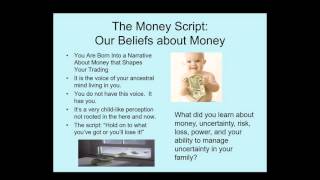
Is going to show up in your trading account, okay? And the money script very interestingly starts really early. I told you about Nancy, okay? The thing is, if you get it, is that was. She was born into a narrative of scarcity.
Okay? That's literally the voice of her ancestral mind. She grows up and she didn't even see that it was there. It was so familiar, so ubiquitous that she didn't see it in operation. It required somebody else to be able to see it and help her Work through it. And it is very childlike. It's very primitive, really.
Then you also get to a point where you can realize, well, what if it's just not scarcity? What if it's, I'm trying to prove myself by, you know something, you've got to make money. You know something, my parents and my family just fell into a horrible situation. And the thing is, is what I want to do is I want to make a lot of money so that I'll never be. I'll never be in that situation again. I don't want to ever feel powerless. And then you see these people blowing themselves up. You see them over trading, you see them impulsively trading, and you see them revenge trading. This is what it's like. This is all coming out of literally what you learned about money. Uncertainty, risk, loss, power, and your ability to manage uncertainty in your family and your culture and your education, I might add, okay? And this is where I want you to start looking at your trading and start saying, well, you know, what is it I really need to be looking at? Because what we need to do, we need to locate that historical money script, okay? Much of our identity is being shaped by our notions of money power and our control of the self, okay? If you get into scarcity thinking, you also find out that worth becomes tied to money, okay? And I get people all the time that saying, Randy, the truth is, what I've really discovered is that, you know, I have to work hard to deserve my money. And if I'm not working hard, I don't deserve it. So therefore I blow it up or I don't deserve to be making seven figures. What happens is I'll blow myself up. My worth, my net worth has become my self worth. Do you see how that happens? And do you see the way it gets built into you long before you can think? The truth is, is that if you viewed yourself more like a soup and suddenly ingredients get put into that soup and you all get stirred around, you become an indistinguishable part of that soup.
And it's the soup of meaning, the soup of distinctions, the soup of the narrative you grow up in. You don't even know to ask, well, what is this stuff? I believe this is the question we need to look at, okay? Because ultimately, when it comes down to it, what you're going to discover is this, is that you do not really. You've never experienced reality as neurobiologists, that would say, as a, as a trader, you would say you have never experienced the real markets Instead, what you have experienced is your brain taking all that sensorial or modalities, organizing it into a virtual representation of the markets. Not the real markets, but a virtual representation based on your beliefs about your ability to manage uncertainty.
That's what you're trading. You're not trading the truth. You're not trading with rules. You're not doing something like, well, trade what you see, not what you believe. Well, good luck. Everything that you see, you. You believe, then see. You do not see, then believe. And you're beginning to recognize. You know, I need to examine how I see something. What am I seeing and what makes it true. And you discover, wow. What you discover.
Is that problems in trading boil down to four huge self limiting beliefs. You may push these away, but they stay in operation. And they hit you like a submarine. And the only thing that you can trust is your trading account to help dig them out, do the detective work to pull them, and here they are. Okay, inadequacy. You might be saying, you know something? I just can't win. I know, I'm just not good enough. Who told me I could do this? I hear traders saying that all the time, not mattering. You know something, if I finally make a bunch of money, I'm gonna really be the big dude. I'm gonna. They're gonna see I matter. I've got to make money. If you want to see a setup for impulsive trading, that's it. I work with them all the time. They call them alphas. And what they do is they think they have to win. They think they have to make things happen in trading. That's just not success. Success is patiently waiting for the ambush to occur. Then that unworthiness kicks in. Okay, am I really worthy to be making this money? Then? Powerlessness, that's when everything goes to hell. It's just going crazy and you lose your stuff and you become a horse.
A bucking horse in a burning barn. That's the powerlessness. These are the things that keep people from trading at a higher level.
If you're smart, you listen and say, oh, this is what underneath this? I've been trying to produce a masquerade so I don't see and have to deal with those four fundamental beliefs. I keep thinking I'm looking for the Holy Grail out there. Hey, maybe the truth is the Holy Grail is not out there. The Holy Grail is inside me. Yeah, now you're talking. And the problem is the Holy Grail is a diamond in the rough. And I'm gonna have to Do a lot of buffing and a lot of work in order to make that thing shine and work well and become profitable for me. Now you're talking. Otherwise it's just gonna fly out the door. So the money narrative.
Is in fact the biggest obstacle to your trading. I gotta make money now.
Okay, Are you trying to prove something by making money or are you focused on performing well? The really good traders are not looking at their P L statement fluctuating through the day. That puts their mind into the future.
They want to be right here, right now managing performance. They know that with the methodology they have, they have an edge. They know with their platform that really helps them. You know, the platform is not blowing them up. What they know if they bring the mind ready to use that platform, ready to use that methodology, they in fact statistically do pull out capital out of the markets. They're looking as. Okay, it's not ruining or losing. The truth is, is that losing is simply landing on the wrong side of probability.
Winning for a good trader is simply landing on the right side of probability. The real question is, did I perform well? If I perform well, then I win. I know that if I perform well I will over time improve, extract capital out of the markets. That's the key. Look at the focus. They're no longer focus. Am I making money now? Which by the way, I did a survey a couple months ago and 60% out of a room of like 200 folks in the in there, literally the biggest thing that they had on their mind while they were trading was making money. Now.
That means that 66% of the people were already starting from a mental position at was going to make it very difficult to make money. They were not focused on my performance. Where is my performance right now? Am I totally in this moment? Am I bringing the mind that can manage probability into this moment effectively? That's not what the question they're asking, can I make money now? So the question is we want to take a look at these self owning beliefs and we want to turn them to trading success and we got to acknowledge them. But that's the first step and that's one of the hardest steps because the second step beyond that is then you start asking the question, why do you break free of these self limiting beliefs? Okay. And then most traders just simply don't come to this moment until they have done serious damage to their capital. It's very common. As a matter of fact, the last people who have decided to work with me respectively have lost 200,000, 500,000 and $550,000. And only after that capital drain they realized that, you know something, I'm in retirement. If I lose any more, I'm not really sure what I'm going to do. They came to a moment of where they had to cut through their bs. They had to cut through all that stuff. These were all successful men in businesses and retired well. And here they are just blowing through cash and they're having to go, well, how do I break through this? And it comes down to most traders will do anything not to look at the real problem in their trading until it's too late. That's why only about 5% of the people are going to make successful traders. They refuse to look at themselves and see their complacency as part of the problem. So ultimately.
The very thing.
That you don't want to hear is the very door to becoming a better trader. You've got to recognize those self limiting patterns, okay? And not dwell in them, but look at them and recognize, okay? I know that when I see these patterns, I know, I know the self filling prophecies. I know that it's so easy for me to fall into self, into cognitive dissonance where I just simply ignore the reality. Don't, don't, don't, don't, don't confuse my beliefs with facts. I don't want to see what the trading account is telling me. I want to believe that I'm just right around the corner for making money.
I meet plenty of those people and they can no longer afford my services. They've blown through their capital, gone through their time and now they're awake. Oh yeah, well, I'm ready to go, Randy. Problem is, can you spare some change? So what I want you to hear is my invitation is for you to wake up early. Not for my sake, but for your sake.
Is that trading can be a wonderful career that can give you financial freedom and can give you freedom of time beyond anything else. But to get there, you're going to have to redesign the mind that you brought to trading. The mind that you brought to trading, both from an evolutionary standpoint and usually from a psychological standpoint, has been decide it has been designed.
To control outcome, to predict outcome. Okay? That works in businesses, that works in survival. By the way, that's why our species is such a dominant species on the earth. It works in a lot of endeavors. But when you take it to trading that controlling of outcome either by effectiveness, by taking action and doing things and making things happen, or by not being wrong. Perfectionism, you know, I Have to. I'm a perfectionist. I'm not going to make mistakes. And if I don't make mistakes, then I win. All that works so well outside of trading. But when you bring it to trading.
It blows you up. It blows you up. One group, the perfectionists, hesitate. The other group, the alphas, blow up their capital by taking action. So now we see this and the question is we really need to have a different understanding of emotion.
Rather than thinking that emotions are psychological, we need to really think about, hmm, we need to develop eq. You guys already have the knowledge. You already have the iq. We need the eq. And by the way, you do not have emotions.
They have you. You do not leave your emotions at the door.
Otherwise you're dead. You are an emotional being attempting to be rational. You are not a rational being.
Okay? That's trying not to have emotions. Descartes was wrong. I think therefore I am. The Buddhists were more accurate when they said, yes, I am, but who is this I? Ultimately, the brain and the mind have to work together as a brain. What you discover in neurobiology, the brain is really seen as a community of rival programs, emotional programs that duke it out to build a self that survives in the environment that it was born into. Okay. That's what a brain does. When that brain becomes mind.
Those programs are given voice as your thoughts. So you begin to see, oh, these are not my thoughts. These are the emotional programs. Thoughts are popping up in my mind. This is where my self doubt comes from. This is where I beat myself up. This is when I get scared. This is when I have really terrible internal struggles. Yeah. And you've got to know what makes you tick if you plan on changing it and becoming the trader that you could become. Okay, how do you do it? How do you go about changing deep seated patterns? Well, fortunately, it's not that difficult. The first thing is you're going to have to learn about emotions. Then you're going to have to learn.
The first thing you're going to have to do is you're going to have to learn how to do emotional regulation. Calm the emotion down of fear and impulse. Got to do that. The second is you're gonna have to develop mindfulness, being able to step back out of thought and saying no. The truth is my awareness exists beyond thought and I need to start wondering who these pesky little thoughts are running around in my head that seem to have, that seem to collapse when I need them most.
The third thing is you're gonna have to wake up and Start tuning into the money narrative or the historical internal dialogue, okay. That causes all the problems in your trading in the first place. The fourth thing is you're going to have to learn how to awaken the empowered elements of these emotional programs that are in your brain. You're going to have to learn how to wake them up so that they are present in your awareness so that you have the emotional control. So it's not like you have freedom from emotion. What you have is you have the freedom from, of emotion to bring forward the emotions that give rise to a mind. Okay, because I'm going to tell you something.
After that. I'm going to talk a little bit more about that emotions giving rise to mind in a moment. But the truth is the last thing you're going to have to do is you're going to have to become intentional about developing an internal dialogue. Specifically performance and trade for performance and trading. One of the biggest mistakes a lot of people when they're working with me do is they get to the point where, hey, I can do this man. Hey, no problem, I can do it. Big mistake.
They stop doing all the things that allowed them to improve and then they have to bash into the side of the cliff again and they say, no, I have to be intentional about the mind that I'm bringing. I just can't let any old mine, you know, if I'm not fit to trade, man, I need to know about it and I need to know how to produce a mine that's fit, ready to trade. This is a process, friend. This is not overnight change. This is no magic wand. This is no holy grail.
You know, it's just like, you know, getting rich quick, I'm gonna make so much money. Doesn't work. Change is process. But this is the thing where I want you to also get, is that emotion is biological, okay? It is not psychological. It takes over your psychology. As a matter of fact, all thinking, the very quality of thinking that you do while you're trading and doing other stuff is dependent upon the emotional state you're in. Like for instance, have you ever. Do you remember all that self doubt you have when you're trying to enter a trade? When you have a problem of entry pulling the trigger? You know, it makes sense in the moment that you're having problems about questioning about the entry. You know, you see all the confirmation, but at the same time the emotion fear has gripped you and the only thing coming out of your mind is fearful thinking. You do not have control of the emotion. Managing uncertainty. It's trying to avoid the mistakes of uncertainty. So then you start looking at it. You realize that the brain, your biology and your emotion organize together to produce trading mind. Okay, listen, more, more eq, okay? And you discover is that.
Wow, all this is is a virtual representation. I have no idea what I'm seeing, but I know that if my virtual representation is effective, I'm extracting capital of the markets and my trading account is showing me that fact.
Again. That's your barometer and you're going, I know that, okay? I can't ignore my emotions. I can't ignore my brain. I have to see my brain, my biology.
Emotion. All is one thing. Creating a mind. There you go. Now you've got something. Then you say, well then, Randy, what is an emotion? Okay.
An emotion to a neuroscientist is any deviation disruption to a standard sensorial pattern that the brain has already established. Like if for you hesitators out there, everything's copacetic until confirmations start coming and a decision has to be made. The confirmation disrupts the standard pattern of well, I can ignore entry or even in. Then is that if you already have dread about pulling the trigger, that disruption occurs when you wake up and all of a sudden you realize you're going to have to trade, you're going to have to start risking capital. Do you see that? Powerful, powerful, powerful now? So the key is.
Arousal. That's your body cranking up friends. That's how you're breathing, holding your breath or panting. The tenseness in your body getting ready to either attack or avoid.
That's the feeling state of where it's just ramping up, ramping up. And suddenly you have that sinking feeling, you have that gut feeling, you have that heaviness, you have that anger turning red. That's the emotion turning into chemistry in your body, taking over your mind. That's what it is. When it gets to that point, you're cooked. Your job is to learn how to use arousal, to learn how to use all that stuff to produce the right set of feeling states. Because ultimately, at the moment of motivation, you're either going to attack something that's all you're venge trading or overtrading. You're going to avoid something that means you're going to get out early, you're going to hesitate, not even get in. Or if you've really learned how to do this stuff, you're going to learn to approach uncertainty not from fear, but with disciplined impartiality. That's the one that allows you to really cool It. So now we've gotten this stuff. We've already gone over meaning. And temperament is not something we talk about. The first skill you're going to have to learn, friends, is emotional regulation. You take a look at this guy. Do you think he's holding his breath? Absolutely. Do you think he is frozen in his fear? Yes. He's in avoidance. Do you think his muscles are tight? I bet he is. Do you think his heart's pounding? Yes, he is. He is cranking his emotions up to fight flight. This is what you have to learn, how to disengage. You're going to have to cool fear triggers. You're going to have to cool the fight flight syndrome. You're going to have to cool fear into concern, okay? Because concern you can approach from a rational mind. Fear is going to take over rational mind and heart rate. And suddenly you're going to be thinking from fear and you're going to be avoiding. And personally, if you videotape yourself, it's just fascinating. You videotape yourself and what you're going to discover is that you were compromised long before you thought you were. Just look at the arousal, look at the tension, look at all that stuff and you'll see that. Oh, man, I can see I can do something about this. Then you have to still calm the furies. Beating the self up doesn't work. You have to calm it down. You learn to observe the body, you learn how to manage it, and all of a sudden, it's no longer taking you over. When that happens, friends, something. Emotional regulation does not solve the problem. But what happens is this. It gets you to the door of the mind. And this is where you begin to see. You know something? I can start developing mindfulness. I can start understanding the mind very differently. Rather than being really ignorant of the mind. I can begin to see the mind as a committee. And I have to start asking, who's running this committee? Who are these funny thoughts running around in my head? And I'm realizing they're emotional programs, but who's running them? Is a sense of discipline running them or a sense of fear, a sense of judgment, like everything, you're never going to win a sense of hope. You have to decide that.
Tell me something you've ever had the sensation of, like, stepping back and getting a better perspective. That's what mindfulness is, friends. And when you do that, you realize that you and your thoughts are not the same. And you recognize that you do not have thoughts. They're having you. You need to wake up with this Awareness, step back out of them. And out of that, what you get to do is, is you begin to recognize is that there is no one organization of the self. Okay? What you discover is that this whole concept of neuroplasticity where literally different parts of the networks of brain can learn new tricks. Well, what you learn is that the brain, the mind can be reformed, reorganized into higher functioning. You learn that the I that you say you are bringing in, that's just one organization. You, you can bring a higher organization of mind to the game. This is where it's powerful. Once you get the observation down, what you discover is the big deal. You start observing the mind, not just body anymore. You start observing the mind and you start seeing and making a distinction between internal chatter and the internal dialogue. And you begin to get to see the mind that you brought to the performance of trading. This is powerful, friends. You have to use your emotional regulation skills, okay, to turn toward that discomfort and start really saying, well, hmm, Instead of attacking it or avoiding it, I'm gonna turn toward it. I'm gonna take that fear and I'm gonna learn from it. Okay, you're gonna go, wow, this is. Now I know what makes me react. And now I begin to see that I have given enormous power.
Over my mind. The truth is that I needn't have given it any power. I could have done it very differently. But the truth is when people first do this, they discover this money narrative and they start discovering that the truth is there is destructive quality within all of us as there is a constructive quality. The ancient Chinese call this the yin yang. The Cherokee Indian called this. That man was composed of two wolves, a dark wolf and a light wolf. There's all sorts of different ways of understanding it. The key is when you begin to see, oh, this internal dialogue about struggle, the way my mind organizes around challenges of uncertainty. The truth is that I can either have the more destructive part guide me through that or a more constructive part. And this is when you begin to realize this is your brain's negative assessment machine.
And you start realizing that this historical dialogue has an inner critic quality. Where it criticizes, where it judges. That's all that's not good enough. You're never going to make it. You better take profits now or it tempts you. Get in, get in. All this money, all this money. And you discover there is an adapted voice, a fear based voice that is either acting out of anger, acting out of fear, acting out of impulse, or acting out of euphoria. I'm gonna prove Them I'm approving, man, I'm on a roll. Your job is to see this internal dialogue as, not as who you are, but as only one particular organization of the self that you have become. And the difference between you and other smart animals is as a human being, you can design the being that you are. My dog is going to stay a dog. My cat's going to stay a cat. You and I, friends.
We can design the possibilities that we live in. We can develop the mind that can engage probability highly effectively. It's up to you. This is the dance, it's your dance. And, and this is where the fourth skill comes in.
Fortunately, you have untapped strengths that when trained, can change the whole story, change the whole narrative, change the whole way you see and enter the conversation called money. In the same way that there is criticism living within you, that destructive quality, same way that there is fear or anger that lives within you, there is also discipline as a program. There is also courage as an emotional program. There is self soothing as a program, and there is impartiality, that logical thinking, that spark like quality that exists as a program. However, if that program is going to work, fear has to be taken offline. That's where you have to awaken this stuff. And yet it's there. There are emotional programs, of course you can. And ultimately what you begin to see is your mind as a committee where you're trading your beliefs. What if you were able to restructure this ruling committee in your mind? What would be different? What would be different in your trading? Because suddenly what you're discovering is because these are emotional programs literally on your genome, they're going to be there and you will have been dealt a particular card, set of cards, a hand of cards that you call the historical self. But when you start waking up in mindfulness and you start saying, wow, man, I have been asleep at the wheel. And this committee of the mind is just absolutely needs to be whipped into shape. And suddenly you're discovering, okay, I can recall stuff, I can reform this mind, but what are you going to reform it into?
Remember those emotional programs?
Biologically they are emotional programs, but when that biology becomes mind, we call them archetypes, suddenly.
There is beyond shadow of a doubt, the courage of a warrior living within you.
All you have to do is tap into the emotional program.
And by the way, I actually teach how to do that. You don't visualize in wishful thinking, you don't mastermind it, you don't know. What happens is you go back to real Memory of when you have experienced that emotion and you allow the memory to pull forward the feeling and that's what changes the kind of thinking you do. But you also have the discipline of a ruler. You take a look at George Washington here. Do you think when he was crossing the Delaware that he was not challenged himself to maintain order under a lot of pressure. All those men in the water, on that ice, you know they're going and they're about to confront the world's greatest army. And yet there they are, they're leading, they're following under the leadership of a guy who is maintaining order under pressure. That's the discipline of a ruler. Then there is the impartiality of a sage. This is where you can think clearly, okay, like a sage would. But what happens is that sage desperately needs for warrior to show up and take care of the fear. It needs the order that the ruler part of you can give. It also needs the self soothing of a caregiver. Self soothing is probably one of the most powerful programs that's misunderstood.
How many times has beating yourself up ever done you any good? When you've taken a loss? Never.
This is the time you need compassion. You're suffering, you need compassion. And the truth is you'll find that self compassion is the antidote to fear. Not courage, not stiff upper lip. It's compassion. You learn how to put these together and their symbolic representations and you start being able to build the capacity.
To bring those programs into working awareness. That, friend, is what you're doing. You're not changing the fact that things are uncertain. You're not changing that there's a struggle going on. You're not changing that there are challenges. What you're changing is the mind that you're bringing into the moment of challenge, into the moment of uncertainty.
That's the big deal.
And this is when you have to decide, am I satisfied with the way my mind is organized now?
Okay, you look at your trading account and look and say, am I satisfied with the health of my trading account? If you're not, you're saying, then I need to reorganize the way my mind functions under pressure.
So the question really becomes.
Well, it's not going to go away. The struggle is not going away. And the real question is, what are you bringing, what mind are you bringing to this moment of the unknown? That's the real key. And how much money would it be worth to you to be able to design that? How much money have you already squandered because you haven't had Control of the mind you bring into the management of uncertainty. And the key is you are going to have to organize and you are going to have to, you are going to have to populate your committee, whether by default or by design.
The truth is it's kind of like Louis Pasteur said, you know, chance favors only the prepared mind. Without preparing the mind for the challenges of trading, you stay stuck in self limiting beliefs, their performances. So the real key is, is that once you finally get that, there is no external holy grail. Once you get that, there is no magic bullet that's going to make everything get up. And once you get that, everybody has been in self deception. You know, I was at a work, I was at a conference with a lot of people from the trading industry and they were just building all these products and here I was, out of all these people, I was the only trader psychologist there. And I started asking all these trader trainers, tell me something.
This 5% rule that only 5% of people are actually making money, does it apply to the way you work with people too? They said, yeah, we can, but you know, the truth is they don't want to hear about that. So we just teach them how to trade. I said, wouldn't teaching a person how to trade entail teaching them how to manage the mind and uncertainty? Nobody wanted to hear about that. And the question is, do you if you want to become a successful trader? I have, I hope so, because ultimately from my standpoint, there's really two choices. On the left side, this is the mind that you brought to trading. It's based on a historical money narrative. It's going to stay the same until you force it out. And most likely you're going to burn through a lot of capital doing it and you stay unaware of your potential. You may stumble finally into the mine that can extract capital out of the markets. People do that. I generally work with people who've been trading for at least five or 10 years. And what they have is they have stumbled, but they have not stumbled into nirvana. They have finally, but they've stumbled and said, you know something, I'm in enough pain, I've lost enough money that I know that it's me. It's not all the stuff that I have, it's me that's the problem, I need to fix it. On the right side, you see the mind that you need for trading, the one that's built for probability. It's rooted when it's facing uncertainty. It's rooted to trigger, to discipline, impartiality. This is the mind that you need and you have command of the internal dialogue. You don't have command of what's going to happen out there. You have command over the mind that's going to execute. And suddenly these parts of the self that provide the ability to engage uncertainty from a level of concern rather than fear take over the performance, friends. That is the edge.
And here's what I. A lot of people think, well, Randy, this is really interesting. This is really fascinating stuff. What do I do? Well, here's. If you've been depending on where you are in your trading journey, if you've been around the block long enough to recognize that you haven't got, you're still trying to learn a system, I recommend coming to my website, getting all my free stuff. Okay? There's lots of it there. Get my book. But if you've been trading for a while and you've gone through the thing as you've gone through the different teachers, you've gone through, you've gone through the indicators, you've gone through all the stuff, and you have a pile of stuff hanging around, and it's still not putting you into consistent profitability. What I want you to do is really think, yeah, you know, I need to do some exploring. But what I really need to do is I need to think about how do I get myself trained? Okay, how do I get myself trained? And here's what I encourage, okay? Because ultimately this is really about. This isn't about going well. You know, I can read some people and I can find out what the mind needs to look like to trade. Yeah, there's, there's several people that can do that really well. What no one's doing is teaching you how to build the mind.
That you need to have.
I have two basic courses. One is the group course that's coming up in January. It's based on a five session where the five group session, you go to a virtual classroom. And literally what you were taught is you were taught the emotional intelligence, you were taught the emotional regulation, you were taught the mindfulness. You're taught to observe the internal dialogue. You were taught how to bring forward these much more powerful elements of the self that can manage uncertainty. You end up creating a trading plan that merges your method plan with your new psychological plan. Powerful stuff. All this stuff is put together.
You can read it, read about it. The virtual classrooms open 24 7. It is a great, great thing. And if you do. And what we've discovered is a lot of people want to sign up early. And the reason they do it is they want to head start. Because my promise to you, come January, this thing starts, man, I'll tell you, it starts fast. What they'll do is they'll start early and they'll say, you know something, I want to, I want to get this thing so that I've already gone through the program before class starts so that when I get there, I'm ready to roll. And I've already been through the first time because I know the first time is going to seem like 150 miles an hour. That's what I suggest. Friends, go to my website, take a look at that. We also have an individual program that is really built for serious traders. People say, you know something, I know that mentorship, individual mentorship just simply takes the climb the hill so much faster. If you're interested in either of those and you want to talk about it, ask for a free consult. It's powerful. It takes to the point where you go, you know something, which one of these is better? For me, the individual course is far more comprehensive, far more personalized. I am walking with you.
You know, step by step into recreation of the mind that trades. It's a powerful advantage, friends. So those friends, my wish for you is prosperity. What I also know is the vast majority of traders will get stuck and losing and stay that way. And what happens is that it doesn't have to be that way. And if there's any questions right now, if you will type them in, we will look at them and we will answer several. And if I have done so, well, we can get off a little early. So give me your questions, I am ready for them. I look forward to them. So type them in. And otherwise what I'm going to do is say.
I have really enjoyed having the opportunity of speaking with you and I hope that what you have discovered.
Here is hope. I hope you actually see that there is a way of taking this. What's going on here. I should be able to win, I should be able to do this, but I'm not what's going on. I hope you see the glimmers of hope that say, you know something, there is a way out of this. There is a way of building the mind, not just wishful thinking, but actually building the mind for higher performance.
That's what it amounts to. So, friends, we're not seeing any questions. So what we're going to do is we're going to cut this short. I am going to wish you prosperity. And I thank traders accounting, I thank Raven. It's been a lot of fun. And my wish for you is tomorrow start applying what you have heard and seen here today. So take care, my friends, and we'll see you next time around.









