2015 11 03 16 31 Mastering Your Emotions for Highly Effective Trading
Randy Howell argues that only 5% of traders succeed because training ignores psychology. He teaches emotional regulation through mindfulness and belief-restructuring, framing trading as needing three legs: platform, methodology, and psychology. Howell offers group courses and mentoring to build the psychological foundation most traders lack.
Questions this video answers
About 5%.
Group course: five sessions over 10 weeks; early sign-ups get a free emotional-regulation webinar valued at $199.
About three to four months.
Chapters
Welcome, everyone. My name is Randy Howell with Trader State of Mind, and this is our November segment of our monthly educational webinar. And tonight we're looking at how in the world do you go about mastering your emotions for highly effective trading? How do you do that? You know, it seems like it should be easy, but ultimately you start discovering there's only about 5% of traders who actually become full time, consistently profitable traders who can support themselves by trading. So we're going to be looking at that. The only house rule we basically have is that I hold questions toward the end of the workshop. You can type them in now or you can ask them a little later, it's fine. But I find that a lot of questions get answered in the course of my presentation. So you just type in your questions and we're going to be rocking on, and Dolores is going to be here and if you know her and if you know us, you can go ahead and talk to her and just ask questions and, you know, be merry. But what we want to do. Let's take a look at this. You know, it's amazing how trading really does look on the top of it. You look at it and say, you know something, I get it. If I follow these rules, if I learn this stuff, I can apply logic and, you know, I can make money doing this. I can do that. I can see it then after all that training, and I was talking to a guy today who spent $55,000 getting himself trained, and then he went live and got crushed. Okay. He'd been trading in simulation, really doing all that stuff. He was ready, went in there and just got kicked. What most people find out, okay, is that they feel prepared, they're ready, and then they get crushed. Emotion of just loss of control happens and discipline collapses. And all of a sudden you find out very quickly, the game changes. The game changes. When there's real risk, there's real consequences, and somebody's going to pay the piper, it changes. And at that moment, what happens is that all the hype that you were taught about trading and about how to be successful in trading just blows up. And you start looking at, well, this is what they were saying way up here at the tip of this iceberg. But the reality, oh, man, you know.
What in the world's going on here? Okay, did you happen to read that disclaimer that all trading companies tend to put? Yes. Methodology prepares you to know, to have knowledge, but it does not prepare you to apply that knowledge. Okay? That's the problem. And it's this inconvenient truth.
That really blows people away. And there's a problem here, okay? This inconvenient truth in trader education is minimized and it's kind of like trader educators just don't acknowledge it. I will admit there is a, there is a trader in here today who does teach trader training. It's David Debay, and he is an excellent trainer and he recognizes the value of, of the psychological end of being able to perform. That being said, the vast majority give lip service to it. They say, yeah, it's really important and you know, get your act together and we go on. But the truth is nobody talks about it. They pretend not to see it and then it blows up in the face. I'm going to give you an example. Recently I went to Denver to a conference with an indie trader platform. Great conference. Lots and lots of people are three or 400 people there and they're just everybody's jazz. Everybody's talking about building the better platform, getting all those indicators in there, getting all the every, everything that you need to get yourself empowered and ready to go. Except for one thing. Out of that three or 400 people, I was the only trader psychologists when I started asking around, said, you know something, tell me, do you recognize that only 5% of the traders are going to actually become successful traders? Yeah, yeah, yeah. That's the rules. Yeah. And we teach them everything they need to know. But I said, don't you see that if they're not prepared mentally and emotionally for trading that they're actually not trained very well? Well, you know, we just can't do that. What you do is you see them just absolutely glossing over it like with blinders on and it's not their fault. What I want you to recognize is, is that in this industry, it's like a conveyor belt is constantly bringing fresh supply of prospects. Okay? The market keeps expanding. So why in the world should trader training change? There is no motivation there. The people keep showing up, they keep showing up, they keep falling for the same old story. Okay? And part of that is like, you know, they want the story and so we don't have any. I mean, we're giving them the knowledge they need of trading, but they're not giving them the training they need to use that knowledge. So it's interesting what you get. It's like the blind leading the blind. And after two to five years of bouncing around, looking around for the holy grail, some really begin to start waking up. Amazingly, I had two of these incidences this past week. I had a kid, 21 year old kid who's going through training and stuff like that. And he says, Randy, what I realized is that the moment I started trying to trade live is that it wasn't working. And I knew that if I'm going to make a career out of this, it's very clear that I need to get this emotional side, the psychological side down. So I'm here for training and I thought, when was the last time I had someone show up at my, you know, and talk to me about this? Like, like this, 21 years old, it's exceptional. Another guy comes in, he's gone through all this training and he immediately goes and he starts trying to trade live and gets blown away. He immediately thinks.
Obviously I haven't got my head screwed on right for trading. I need to get it, I need to get it screwed on right. And I'm going, these guys are not following the blind. They, they realize they don't know, okay? But they, they know what they need to know and they recognize they're not going to get it from where they've been looking.
So anyway, we are going with this. I want to give you, I'm trying to give you an idea of what the problem is and why this keeps happening and why so few people in trading make money.
You know, so here you are. Okay? How is it you can be so unprepared when you have been so well taught, understand.
Is that it's easy to fall under the spell of easy money. If you want to believe.
Okay? As Barnum said, there's a sucker born every minute and two to take him. People are easily led astray when they're deceiving themselves. And this is one of the problems you discover in trading. For some unknown reason in trading you believe that, you know, you should be able to do that yourself and you should learn how to do this. And everything's going to roll. Practically every other profession from tennis to golf to any professional sports to being an attorney, being a cpa, being a scientist, being a therapist, you all have to have continuing education to keep current, to keep there. In trading, there is none. And yet you discover very clearly that without emotional training, you're under the gun. And what happens is that your left brain, knowledge is simply not available when emotion, the emotional brain is being just stoked by pressure. And so without the emotional trading, what do you think is going to happen to the aspiring trader? What do you think? Okay, knowledge and applying that knowledge are very different. And what I hope in here is that, you know, I used to See that most of the people that came to me had been trading a minimum five years. What I'm actually beginning to see now is some younger folks showing up and are recognizing early that they can't believe the old stuff. And they realize that there's something different here. What they don't want to do, what they don't want to do, okay. They don't want to walk blindly off the side of a cliff, okay, that everybody else has been doing. So as long as the supply holes. Change is not going to come to trader training. This is where you have to step in and you have to become the agent of change yourself. You're going to have to say, you know something? What I recognize now is the limitation is that I can get method training, I can get all sorts of training, but in order to be a complete trader, I'm gonna also have to build up my mind. Now why isn't everybody telling me that?
Well, the truth is this is trading in and of itself is really like a three legged stool. There is that stool of where you're gonna need a platform like all that ninja trader stuff, that trade station stuff, you know, they spend an enormous amount of effort and engineering that platform to be able to whiz, man, just absolutely cook. Then you're going to have to have a methodology that manages risk.
That allows you to be over time being able to extract capital out of the markets. You know that man, I'll tell you something, they're on that too. But nobody talks about trader psychology, okay? They talk about it, they give lip service, but it's not included in their training. It's like we're just gonna absorb this by osmosis. Leave your, the pop psychology concept of leave your emotions at the door. Just hey, just deny them, push them away. They're not useful in trading. Well, the truth is the problem with trading.
That emotions are not optional.
You are the embodiment of emotion. And until you get that, until you learn how to work with it, you're also their victim. You don't know how to use them. So when it gets in hot circumstances with capital at risk and the, and the outcomes uncertain, you're gonna go bananas. So my question, what is it that you're missing that keeps you.
From getting to the next level? I have people that come to workshops like this and they'll come for years and they keep looking for that kernel of knowledge that's going to change their trading. And I'm to be honest with you, I'm frankly baffled because what I recognize is that There is no kernel of knowledge that's going to change overnight your trading. Ultimately what you're looking at is changing the brain, not overnight. What you're doing is you're changing the neural circuitry of the brain so that it activates and produces a different perceptual map of what you're working with. That's what has to be done. And it takes a while to do it. The truth is though, ultimately the very first thing you have to get is the mind that you bring to trading.
Unless you have won the genetics lottery is not going to be the mind that's going to bring success in trading. That's not discounting how good of mind you have. You could have been very successful by controlling outcome, by making things happen. That whole urgency to get things done or perfectionism where you, you're making sure you're not wrong and that you're always right works really well like in corporate America and businesses accounting, all sorts of stuff like that, engineering, airlines, pilots. But when you bring it over to trading, it blows you up. Okay? This is what no one talks about. And this is the problem that keeps standing out all the time. And you start seeing it. People don't want to talk about it. They don't want to talk about the miserable outcome, goals, outcome stuff that happens with training their traders, okay? And ultimately what it really boils down to this is it in this very easy little graphic here, the brain mind that you brought to trading is really evolved over the at least the last 6 or 7 million years. For short term, self preservation when faced with uncertainty, basically it's like that dice the outcome, you know, whatever happens at that time, you're either happy, you're sad, bam, bam, bam, that's it. The probability based mind is more like the one on the right. It's all probability, okay? Behind each door there can be different things. And the truth is you don't really know. No matter how much you have calculated, no matter what you've done, you could easily be wrong. And unfortunately your brain is designed to be right to control that outcome. Whereas the mind that you need for trading is comfortable.
With probability. In fact, the really good trader, he's not worried about being right or wrong. He's not worried about winning or losing. His concern is what mind is he bringing into performance, Is he performing well? If he's doing that, he knows the money is going to take care of itself. He's not looked at that stupid pin l statement going up and down, up and down, up and down. He's not thinking I got to make money. Now he's asking the question, am I performing well? Have I got my mind here in this moment? I'm not in the future, I'm not in the past, I'm right here. This is the brain in mind needed for effective trading. It is very long term based, probability based. It can take loss. It's just simply part of the way of doing business, you know. To the, to the old brain, loss means death. So there you go. Now let's take it one step further. Let's go farther than that. Let's actually take a look at this. All of us come out of the African savannas. Somewhere about 35,000 years ago, there was started to be a migration out of the plains of Africa, up into. It just went all over the world. It went up into Europe, took out the Neanderthals, it went into Asia, it finally got into the Americas, it went down South America. All those are common lineage and they actually now have the genetic map that can actually show the genetic links as that, as that, as that movement, as that migration occurred out of Africa. The thing is, understand that ancestor of iris and understand this is not long ago, this is just 35,000 years ago. Just a bl blink in the eyes. Genetically.
That human or humanoid.
Was built to save survival in the moment. It was about controlling outcome for short term. Preservation versus probability.
That's what, that's genetics that you carry in you, okay? In trading, that has to be rejiggered. It has to be. You have to recook that so that you end up with a modern mind that blends both left brain and left brain and right brain together so that you can deal in probabilities. But if you can't manage the emotional nature of your being, of your body, you're not going to be able to manage knowledge under pressure. It's that simple. So we're looking at this and going, wow.
So where does it begin?
It begins by learning how to let go of reactivity, okay? Of this need, this trait to control outcome for survival. It's called emotional regulation. You have to volunteer, you have to volitionally be able to control, okay, the emotion so that they don't sweep you away. This literally is emotional regulation. And what you discover very clearly is that we, you know something, we actually, we are actually.
We are actually the embodiment of emotion, okay? And what's happened is that until we come to a moment of where we can really begin to say, you know something, I understand this reactivity now. I understand the biases that my body and my brain have and how my emotions work to create short term survival. I understand that ultimately I'm going to have to use emotional regulation to calm the emotion down before it takes over the mind and has me reactive. And if you've ever hesitated in trade, you know it. If you've ever jumped in and did revenge trading, you know this reactivity. If you've ever jumped into trades not knowing why, you know this thing. If you've ever said, I am going to be a disciplined trader and you get into trading, before you know it, you're trading outside your plan. You have run into the same phenomenon, okay? So what you're looking at is you can take a hominoid brain, that part of you still has that hominoid brain, and you're going to teach it, okay? To trade in probabilities. Friends, I'll tell you something. That's why people don't succeed in trading. This is work.
Trading is one of the most difficult endeavors to become masterly in that you could imagine. It is literally a paradigm shift. So here's the deal, okay? This is all of you, and don't ask me to prove it. Don't take my word for it. Take your trading account's word for it. Look at your trading account and let it become your brutal friend that tells you the truth about how you're performing. Until you tame the insensual mind, you will continue to get hijacked. Ignoring, denying just simply doesn't help. It just sets you up to be ambushed. If you don't believe me, go back to your revenge trading. Go back to your impulsive trading. Go back to your fear of missing out and jumping out of trades when you darn well know it would have hit target. Just go back to not getting in trades at all. You see it there. The caveman, the hunter gatherer is in the backseat. You may think you're smart, but your smarts mean nothing unless that part of you is managed okay? And the truth is, is that you just simply can't leave emotions out of the equation. Their logic is the last of the emotions that came in place. And it is an emotion. It's easily contaminated by fear. And remember, Spock, as logical as he wanted to be, he was absolutely having an internal struggle all the time with his emotions. Emotions and thinking work as a unit.
You do not have freedom from emotions. What really good traders learn is to have freedom of emotions. What they recognize is that literally the mind that they trade with comes forward out of the emotional cocktail that's in their brain. What they do is they manage that so they have an emotional cocktail that produces a mind that can trade in probabilities comfortably. You got it.
To do that, friends, you're gonna have to have a paradigm shift.
Truly, the mind that you brought to trading, and I hope it's a good one, it's rooted in the belief and rationalism and is blind to emotion. And the truth is Rene Descartes was wrong. He even acknowledged it. But man, that was too late. Everybody jumped on rationalism because it seemed such like a good idea. And now we're beginning to question it because what we do is we rationalize. We rationalize really irrational decisions. We just use rationalism to get at what the emotional brain is thinking anyway. Okay, so now that we understand is that in this shift, the major thing is that there is no control over outcome. You know that ancestor of ours that came out of the African savannas and basically has this need for short term survival, that's not the character that's going to make a successful trader.
No matter how successful that ancestor of ours was for producing the human species and dominating when it comes to trading, it's a brave new world and it's not prepared for that. So you can be and understand.
And this is the tough part to the perfectionists, you can be right on everything in trading. Everything can be down to the number and you can still be wrong. That's the kind of frustrating part that, that traders have when trying to use O line stuff. So anyway, what you discover very quickly.
In the new world of neurobiology is that there's not a world out there.
Waiting to be found as an object. What there is is a virtual simulation.
That it happens like this. Your brain, okay, takes all this sensorial data from the outside world out there and it organizes it into a virtual representation of that world out there. It's not the world out there. It's a virtual representation of the world out there and it is built around the beliefs that you project onto the markets. Okay? And what you discover very quickly is this.
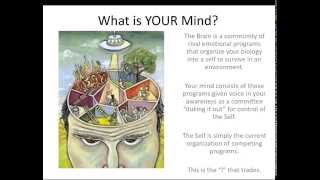
The only way you can test your beliefs about what you're really projecting on the markets is to look at the health of your trading account. If it's growing, you have an effective virtual representation. Not the truth, but you have an effective virtual representation that allows you to extract capital out of the markets. If you have an ineffective virtual representation of the beliefs that you're projecting about your ability to manage uncertainty, then you're going to see that as a stagnant or a deficit. You're growing in the wrong way. So here it is. You got there. So what's going on in there in the mind, in the brain is definitely influencing what you see out there. And then you come to a moment where you say, okay, well Randy, this is really weird, but what is mine? What's going on here? Let's talk about the brain and the mind as one in the same, okay? In neurobiology, we now hold that the brain really is a community of rival programs. And they're emotional in nature. That based on circumstance, based on, you know, the circumstance of where you were born, the family you were born into, the culture you were born into that brain. Those programs duke it out for control about organizing the future. You, you're organized long before you can think. But it's just one organization of a self that could be. And unfortunately you don't know better. And you think it's you that's the mind that you bring to trading. Now.
When brain becomes mine, okay? Something magical happens is that those programs that are duking it out are no longer just emotional programs running around in your body. They become, they are given voice in your mind as thoughts. So now when you beat yourself up, you can really hear those. You can hear the programs really living in living color. When you're having self doubt about entry or staying in or what you're listening to are these programs given voice in your mind? You're not listening to you friend.
You are listening to these programs that have been given voice in your mind and are in control of what I call the committee of the mind. More on that later. And the self is just a current organization of these competing programs. That's what you're doing in trading. Once you grasp that there is no you, this becomes a lot simpler, okay? Because ultimately when you're out there looking at your charts, what you're doing is you are literally creating your world as you're doing it. You see a world created by your own beliefs. You're not seeing the world out there you are not seeing. And then believing. You are believing and creating what you're seeing. Let me give you an example. A couple years ago, I worked with two hedge fund traders. They sat side by side. They were good friends. They used the same system, same computers, the same feeds, the same indicators, the same levels, the same methodology. And they were good friends.
One was a high performer, the other was a mediocre performer. Both ended up being clients of mine as it, as it. The first one came in and began to recognize, oh my God, this isn't about me. I'm not. I'm taking this far too personally. This is about probability and I can let go. I can let go of me needing to be in control and making things happen. What I can do is I can see what the markets are going to give me and I'll just take that. He became a top performer. The other guy was more of a perfectionist. And what he didn't want to do was lose money. So he was very ginger about his entries. He wanted a lot of confirmation. And he also had a tendency to get out of trades when he had a little bit of profit. And he didn't be. He didn't let his runner, he didn't let the winners run. So understand, everything's the same except for the beliefs that are being projected on the markets and used to interpret for action. That's it, friends. That's the world you're creating. And the thing is, is until you realize that you're the one creating these realities, you have to decide, well, am I? You know, I need to be more forthright about the reality I'm creating. And ultimately when you do that, this is really about how do I go about producing change? How do I produce the kind of change that allows me to work from higher levels of effective performance? How do I do that? This is the question that I hope you're asking yourself.
If, if you're not, you need to go back to square 101 and start again and start saying, you know something, the markets aren't against me. What happens is I'm creating this reality and I need to change the you that's doing the creating. Okay, I need to reorganize the mind. To do that, you're going to have to start with emotional regulation. This emotional reactivity that happens that blows people up and has them over. Trading, trading from anger, revenge trading or fearful trading basically is that ultimately.
An emotion is just simply a disruption to any standard pattern that the brain's already created. And automatically an emotion pops up. It's only a matter of which one.
And most likely by trait, by evolution and by history.
Reactions are happening that are not good for trading. They might be good for survival and it's functional family. They may be good for survival and growth in a dysfunctional business all down the line. But in terms of trading, where the markets just don't care and they don't play the same game, are they effective there? Are you using your emotions? Are you being used by them? That's the question. Remember, you don't have emotions. They have you. So we know that. And why is this so important? Because ultimately you're going to have to learn to manage your emotions so that you get control of the locomotive, the emotional locomotive, before the train wreck, before you go, what in the world just happened? Man, I was minding my own business, I had a good plan, I was planning on having a good day and all of a sudden I'm in this wreck over here. How did I lose that money? How did I lose control? Most traders when I start working with them have no idea, but they've lost control of themselves 15 or 20 minutes before they realize they've lost control. They learn how to observe emotion and body and they recognize that, oh my God, emotions are not psychological, they're biological. And they take over mind and you begin to see, I need to observe body and mind in order to be able to calm it down. And fortunately, fortunately, emotions can be calmed down. You know, we call it emotional regulation. You learn how to breathe differently. Every emotion has a signature of breath.
Of tension and of heart rate. And as you attune yourself and start using these tools of being able to breathe in such a way that allows you to maintain calmness, letting go of tension that doesn't allow you to kick, kick start, fight flight. And then you start watching your heart rate monitor and start realizing, oh man, I'm out of control. You can do a lot to alleviate just getting wiped out. That's first part of my training. But when you do that, you go, wow, okay, I've got some emotional control. Things still aren't changing. No. What happens is emotion, when calmed simply gets you the door of the mind. Okay, but the thing is, is learning how to look into the mind and finding the self limiting beliefs that you've been projecting on the markets. This is game day. This is when you go, oh my God, something's interesting. I don't want to look at what I don't want to look at. But I'm scared not to look at what I don't want to look at. Because if I keep not looking at what I need to look at, then I'm going to keep in the same stupid pattern of frittering money and time away until it's all gone. That's what 95% of traders do. And it's just a matter, do you want to be one of those sheep or do you want to be like these two young fellows who said, hey, look, I've got it, I need to get the psychological training down, I'm ready to go. Those are my kind of guys. So when you do this, you go, okay.
You have to learn to produce mindfulness. All my traders go through this training and.
You start recognizing there's not just irrelevant thoughts running through the mind, there's not just self talk running through the mind. No, there is an internal dialogue happening in your mind. And that internal. Right. Dialogue represents who's in control of the mind based on those emotional programs having conquered the mind. And you say, wow, my thoughts and I are not the same. My beliefs and I are not the same. I inherited these beliefs and thoughts from history.
Okay? Whether or not I wake up and decide I need to observe them and change them to change the reality I'm in, that's the difference. And if you can't understand the language I'm talking, then you're not there yet. What happens is that I hold that the Cherokee Indians really truly had it on the head. They held that there was a dark wolf and a light wolf that lived within man's mind. Depending on which one you followed, your life ended up being pretty destructive or pretty darn. Okay. What they held was this. This is what I like about Cherokee philosophy is the one that won.
With the one that you fed total responsibility on the individual for the reality he's creating. And if you're working with probability, that's what's required. No excuses. So you're looking at this and you're going, okay, my thoughts and beliefs, oh my God, what's going on? You learn how to do this and the first thing you start doing is you start observing this internal dialogue. And all of a sudden when you start listening to yourself beat yourself up, you start having self doubt or you start over trading and you start seeing all that, you see all that stuff and you realize, oh my God, that's me being sucker punched by a particular organization of the self that's been on destruction.
You start going, you know, I need to start listening to something that I call the inner critic. That's all the judging that goes on, the criticism, the temptation that goes on just absolutely lampooning you. And you're sitting there trying to ignore that discomfort. I don't want to, I don't want, I don't want to acknowledge that voice. Well, if you don't acknowledge that voice and manage it, it's going to destroy you. Okay? It's destroyed 95% of traders so far. The herds keep coming and it keeps massacre them and it keeps on and on and on until you learn today, look at that and going, you know something, I need to start listening to the voices, who am I going to feed? And this is the internal struggle. The internal struggle is permanent. It's part of our human condition. It's part of the challenges of not knowing, of uncertainty. The difference is that you have to change the mind.
That engages the uncertainty, that engages the challenges, engages the internal struggle. It was always the VM there. You know, my stuff does not. It's not a Hollywood sunset where you go off in sunset and live happily ever after. No, what you do is you are able to build a mind that engages uncertainty and suddenly you're no longer from a fear based state. You're from a disciplined, impartial state that can manage impartial that can manage probability and be accepting of it. Sometimes I win, sometimes I don't. But in my losses, I'm going to keep them small. In my wins, I'm going to let that thing run. So you're looking at this and you're going, wow. Suddenly you discover through mindfulness to the observer that you can begin to free the mind to manage probability. You can begin to recognize that you can build a mind, you can reconstruct your beliefs, you can decide what emotional programs are going to actually be there. Powerful stuff, friends, Powerful, powerful stuff. This is a long ways from falling off the side of the cliff believing that, yeah, all you have to do is run this system and just ignore your emotions and man, you're going to be good to go. And you know, and just notice these disclaimers we have at the bottom of our pages. The truth is there's always an inner game here. The difference is you're moving from an external team to an internal game. And you're beginning to realize the mind that trades is a committee. That the mind actually is a committee formed by these forces. And you have been asleep at the wheel because you haven't had an observer. And building that observer, you begin to see my God. In the same way that there is destructive qualities within me, Yin Yang, that there are judgmental parts of me, criticism parts of myself, tempting parts of myself, and fearful and angry parts of myself. There is also disciplined parts of myself. There are also courageous parts of myself. There are also self soothing parts of myself. Absolutely necessary. And there are impartial parts of myself. These are the emotional programs just waiting for you to tap their potential and turn them in from being talent into skills. And ultimately when you do that, and I use a process called memory, I rebuild memory. There is no such thing as real video memory. What there is, is there is fluid memory of where the brain takes and experience it and encodes it in a particular way based on the emotional state and the observer. You are into a memory. And what I do is I go in and teach you how to operate, alter the way the brain initially encoded the experience so that you get at the empowered parts of the cell. And what you discover is that within all of us is the courage of a warrior. You do have the courage to face your fears and to really face them down. You really do. You do have the discipline, the ability to maintain order under pressure of a ruler. Again, these are emotional programs. They're not.
They're not fantasies, they're emotional programs. You also have the self compassion of a caregiver. My friends. The antidote to fear is not willpower or toughing it out. The antidote to fear is compassion. Until you have compassion for the suffering that you have. Like, you know, you, you drop, you know, you take five straight losers and you drop a ton of cash. There's pain. You have to have compassion, not pity, compassion to be able to cool the fear down.
Then you reorganize into the mind again that can manage probability rather than act from fear. So this is what happens. You learn how to do that. And the darndest thing happens, you actually build a new committee of the mind built for the test, built for the management of uncertainty. When you're looking at this image, you know, you know something, these guys are in serious water. And you see that team of the mind all acting in coordination with one another. There's knowledge there, there's self soothing going on. There's courage to face this event. There's the discipline of a ruler there, maintaining order. And they're managing. This is trading. This is the trading mine. And ultimately it's really interesting, a couple years ago I had a client who used to be the flight engineer on a C5 aircraft, which. The C5 is a gigantic air transport, air cargo jet for the Air Force that's about the size of a football field, requires seven men to fly the thing, okay? And what Gus made the mistake of is thinking, you know, I am disciplined. I am confident. I've been doing this for 30 years, I can do this. What he had mistaken was the Air Force had chosen teams and trained them well to be able to fly one of these big machines, okay? And he had mistaken that what the Air Force had done on the external was a representation of what he had already on the internal. He finally got it and said, oh, he said, you know something, I need to have a flight committee. I need to bring my Flight plan together. I need to have each one of these parts that I had because the Air Force put them together. These are part. These are fractals of my own brain, my own mind. I need to nurture them into being. I need to bring them to help so that they're flying my plane. They're the ones in charge of the aircraft. This is what happens, friend. This is when you become the master of the self, the trades. You let go of the need to control outcome, which was an illusion anyway. What you do is you claim control of the one thing that you could control, the mind that you bring to the performance of execution. Okay, you come into the moment of where what you're really doing, you're saying, I know how to execute my plan, I am going to maintain plan. I know that if I maintain plan, I can't predict whether or not I'll win or lose each time. But what I can do is I can be comfortable with that over time. I know that I'm going to extract capital. And what I know is that if I win, that only really means then nothing to get excited about. Just means I landed on the right side of probability. That trade. If I lose, it only means that I landed on the wrong side of probability. Okay, that's the trader's mind, friend. That's the self. That's master of the self. Okay, it's the performance, execution. So friends, here it is. Ultimately.
There'S going to be a committee of the mind trading anyway. Whether or not you like it or not, it's there. You have a choice. Just like the Cherokee Indians of which one do you want to feed? Do you want to build and design a committee of the mind for managing uncertainty or do you just want to keep creating excuses and keep hoping that things are going to improve? The real question is this is who is going to populate your trading committee? It's real simple. How much money would it would you have in your pocket if you had the right mind there? Okay, how much money would it save you? How much money would it make you? That's really when it comes down to it. So ultimately what you've been presented here is what you should have been taught in trader education from the beginning. It's not going to happen, friends, not until there is a demand for it. And right now most of the people coming into the market, you aren't demanding it. So you're not going to get products created for it. Okay, this is the part that's been left out, but it's also the part that separates you from the promises of success and trading and it really becomes is.
Are you ready for the challenge? Are you ready to say, you know something, I get it, it's a three legged tool. I've got two legs and I keep wobbling and I keep falling because I haven't got the trader psychology end of it. I haven't got the performance psychology end of it. And believe me, you don't have to believe. You can keep moving at your own pace and you can prove it to yourself. We get people all the time who have come in and just absolutely blown through the retirement capital and stuff like that and they say, randy, I thought you were full of it. And then after losing all this money, I realized that the truth is that most trading really, once you know how to trade, it's all in your head. It's all about the game you play in your head. I wish I had known that before. I do too. I wish they had known before. I wish they had enough sense to know before. And what I hope of you is that you wake up to the sense and build this because it's there, it's possible. But you got to really work at it. How do you become the change? You know.
If you've, if you're here, you've probably been to my website. If you haven't been to my website, for goodness sake, go. If you haven't been to my YouTube channel, please go. There's just gobs and gods, hours and hours and hours of videos, of articles of free literature there. The key is, is once you get past all that free stuff and you go, you know something, how do I really go about building mine? Here's two things I encourage you to do and I'm talking about seriously consider them. Think about our group course that's starting in January. It's powerful. There are, there are five sessions over 10 weeks that you, that I'm there, I'm lecturing, I'm talking to you. It goes across, it literally teaches a protocol about how to build the mind that we've talked about here. It is powerful. You go to a virtual classroom, you have access to it all the 247 and it's really powerful. And if you sign up sooner rather than later, you're going to get a free gift from us that's valued at $199. It's emotional regulation training. It's a webinar that's been pre recorded ready for you. It's a powerful thing. What people have started really noticing and what I've really noticed Is a lot of people from Europe notice this, and a lot is that they sign up early for the group course that starts in January. They want to be prepared and they want to have gone through it, they want to have exercised it. By the time they get there, they are ready, they are primed. Because what happens is people who wait to the end. I start these courses, man, we're hitting the rubber, we're hitting the road hard. I will have expected you to have already done the emotional regulation sections and we're going to start there. It's not this, this course is not for people who don't want to work, who don't want to really engage themselves and invent themselves. What we're having is a lot of people who will take the course started early, okay? So that when they get so they. They're not all thumbs when they get to the lecture parts and when we're really working and pushing this stuff, and particularly when we get into the heavy duty parts of where we start creating the mind, not just the emotional regulation stuff, but when you go, oh my God, these, these talents are here and now I've got actually the ability to pull them forward and build skills. So that's the first one. The second one, if you're really serious about this and if you know that you know something, I need to do this and I have the capital to do it, take the individual course. It's enormously personal in a way the group course can't be. It's enormously comprehensive. Ultimately, what. It's a course that lasts for three or four months. And more than anything else, it comes with me. I become your personal mentor for those three or four months walking you through this course. Basically, what in walking through the trouble you have, the good times you have, it's powerful and it is, it is literally for traders who really know that it's time to get on. It's time to get their game on there. It's not, it's not for people who say, I don't know. Well, no, it's for serious traders and they realize that it's time. It's time to get the game on. So this is. If you're thinking about either. My invitation is to ask for a free consult. You go to our website, you click free consult, contact us and Dolores will end up arranging time for you. Okay, so friends, this is if you want to create the mind that can trade in probabilities, this is the best I've seen done. Both are great courses and I encourage you to look deeply at Them. So now if you have questions, write them in. We just have a couple minutes and I don't have a clock in front of me, so I don't know how much time that I have or how much time we have about 10 minutes. So if you have questions, type them in, be happy to answer them or at least give you my answer to your question. And from there, you know what I'm gonna do as we wait, see if you have questions. I want to thank you for coming. Okay. There are some questions. Well, actually, no, no, I'm sorry, I already took that one. Hang on. Okay.
Okay. Yeah. Do you evaluate, do you do evaluations of trades? Like days worth of trades? We evaluate, I'll evaluate trades with people. What I'm doing though, it's in the individual course. What I'm doing is we will go through what's going on in a trader's mind during those trades. And what you'll also notice we end up with a lot of heart rate type of information where we're looking and saying, okay, what we're looking for is performance breakdowns. Okay. And so we're evaluating them that way. And I spend a lot of time evaluating them that way with trainers. And.
Basically it's more than just the evaluation. What you're looking for is the breakdown in performance mine before you even get into the tendency. Okay. That's what, that's actually what we're doing. And that would be what I call micromanagement of the mine. But I'm teaching you initially how to build the mine. And then what we're doing is we're taking you through step by step into a process. I break a trade into nine different processes. And what we're doing is we're evaluating what mind is showing up in those moments. And that's usually where the problems are. Okay. Okay, next question.
Have you ever worked with Pristine? No, I haven't. I'm not sure. I seem to have know that name. I, but no, I haven't. I've never worked with Pristine.
Do you look at core beliefs? My value of money, my value of self, what do I fear? Value? Oh, absolutely. That's the whole, that's the shooting match, my friend, is that, you know, ultimately I, I actually core it down to four core beliefs that people seem to have, particularly on the self limiting basis. I'm looking for the self limiting beliefs at first and they, if you're human, these are going to be very present with you. One is a sense of inadequacy. Not good enough. The second is a Sense of not mattering for who you are but only for what you do. That was the people who have to make a lot of money so that they can feel good. A sense of unworthiness. You know, I don't deserve to make good money. I have to work hard for my money. I don't deserve to make a million dollars. Also a core belief of powerlessness in my work. I'm teaching you to regulate those but I'm getting you to understand that your life has been organized around those four self limiting beliefs. And if you beat yourself up, you can hear it. If you hesitate, you can hear them. What I then teach is that I get at what I would call inherent value where I have a way and I use both from a humanistic standpoint and a spiritual standpoint of getting at inherent value of the human being.
What I'm doing is I am separating.
Your competence and performance from your competence as a being. I'm separating being from doing. And that's where the big problem is. So. So yes, I definitely do that. I've been trading for the past year. I doubted my 20. I doubled. I doubled my $25,000 account within the first few months. Then I lost all my profits and more. I'm still hanging in. Hold on.
We're having problems getting the hanging in there but.
Just got desperate. I just got desperate and thankfully found your website and have watched pretty much all of your YouTube videos. Yeah, my brain is. And all the meditations slowly turning around. But I can tell there's some progress. And although I've come to the end of my time and money before I get a job, I'm going to take your course. Hopefully sooner then later. Blessings to you for, for doing this. The most fascinating thing that I'm constantly practicing is that I am not my thoughts. Well, good for you. And there's. And that my emotions are biological. Yep. What I'll say is this, is that you're very typical in that you know, you get a lucky streak and you double something, you feel all that euphoria which basically is dopamine and then you get the biology kind of sticks into a pattern. And the problem is that you have so much testerone and dopamine leading the way, you blow up everything. Then you run through your capital and you have to get a job.
That's pretty much the herd mentality and you are. One of the reasons that.
That I really wish the trading industry would change the way they train is that there's a zillion of you and it didn't have to be this way. You could have been well trained but you weren't. I'm sorry. I really am. Do we get some tools to manage the mine when we're in a trade? Oh God, yeah.
In the classes you do, that's what everything's about. You end up with incredible tools. And if you and.
People. As a matter of fact right now my, my group class is.
They'Re having to do a trading plan, a psychological trading plan where they are telling me how they're going, how they're using their tools and how they're going to implement their tools and in what time and where in the trading process. So yeah, you, you develop a lot of tools. You develop an enormous amount of tools.
Perfectionism is a symptom of what core belief, inadequacy.
You've got to be right, you know, you can't be wrong. And it's a very excellent. If you happen to be an accountant or an engineer or an airline pilot or something like that, it's actually a really good trait. Okay. Up to a degree of course. And it's really about being able to control outcome. If I'm right all the time, if I'm never wrong, then I feel adequacy or I will show everybody that I'm lovable. And it all folks goes in that way. But in trading again you can be perfect and still be wrong easily happens all the time. But it's usually about inadequacy though. It can move into a sense of worth and that kind of stuff. But usually it's almost always about to be good. I have to, I can't make a mistake. And you're just, you don't even have to worry about making mistakes. You can do everything right and still be wrong in trading. Okay, how are you similar, different than Van Thar? You know, I get to ask that question and what happens is the first thing probably is that when you're taking his courses you're not taking, you're also not trading live at the time. And I believe that you're not being trained unless you're in live action. Okay. He is more of an NLP person and I simply believe NLP is semi useful and that's it. Other than that.
You know, listen to his lectures, listen to that stuff and just see where you go with it. I, I am, I am an emotionally and intelligence teacher. I teach emotional intelligence. I teach that mind comes out of brain. I teach that body is emotion.
I can't really say that much more. I just simply can tell you I'VE had a number of people who have taken these courses and have reported less than, you know, what I got out of it was not as much. You walk out with a definite core set of skills with me that, you know, you. You can use them to convert talent to skill. You have to have the motivation to do it, though. But.
I've seen discussions but where traders have talked about this stuff.
I consider him to be one of the old guys and the old guys one of the.
Early people in this trade stuff. And they. There are now, there are trader psychologists in this game, me in this game that are just playing at a much higher level. Okay, Randy, I mean no disrespect. Oh, my goodness, am I going to be criticized with all my questions? It seems, it seems like there is a lot of theory and conceptual terms. Can you get into how you apply these concepts and theories into practical improvement in trading? It seems like I am missing the connection. To be blunt, how do you turn talking about feelings into trading improvement? Well, pretty simple, actually. The very first thing you do with me is you learn how to observe emotion and you observe it biologically. Tomorrow morning, for instance, if you were a client of mine, you would be observing what your body is doing as you're trading before you trade. You would be observing how you're breathing, you would be observing your heart rate, and you would be learning how to monitor that and actually take it and move it back down into regulation so that you're within a very tight sweet zone to keep the physiological zone of the trading in the right place. That's step one, friend. And that usually when I'm training, that's the first two to three weeks of my training. Because what happens is you will have decades and decades really poor, poor habituation between your breathing, your tension, your heart rate and your emotional states. You will be emotionally ignorant, and you have to learn how to manage them. That's the first thing. The second thing is I teach the mindfulness where you first start observing body, it's much more concrete, it's much easier to see. But then I get you observing mind, okay? And you begin to recognize, oh, my God, I just have a torrent of thoughts running in my head. And I teach you how to slow the thoughts down. I teach you how to literally, as they slow down, to begin to question thought. And you begin to realize that there is enormous amount of generalized assessment running through your brain that you have never examined, you have never questioned. Okay? The third thing is you. You start examining how these emotional programs really show up in your Thoughts and you start being able to connect the emotional state with the quality of thought where you literally are beginning to say, okay, I can spot the inner critic. Now I know that it has a critical edge to it. I can spot the orphan, my Norfolk in nature because I can feel the fear. And you'll be able to say, oh, those are parts of myself. As you grow in my work and you start going through the memory enrichment work and stuff like that and you start developing access to discipline, to courage, to self soothing and to impartiality. I am teaching you how to take a memory and to reorganize it to access the feeling states of those emotions. And what happens is that as you access the feeling states, you are literally producing the emotional cocktail that produces your thinking. We will take that and we will tag it to symbolic representation where we will take that feeling state that you've learned how to do and we will put a symbol to it so that you take the imagination mind and you take the instinctual brain together and you have a much more powerful thing. Then you start learning how to take those different programs, organize them into mind that literally suddenly you have, you really truly start having different thoughts. You're going, okay, I understand that's the discipline, the ruler part of me, I understand this is the sage. I understand this is the orphan telling me he's scared. And I have an enormous amount of control and management about what's going on in my mind. People are able to do that in the midst of the chaos of trading. I teach it every day. So it moves from theory to real practice all the time. That is very, very skills oriented. If I can treat ptsd, violent anger and at risk youth, how to calm down and not blow up, I can handle traitors too.
Yeah. And if you really want to know more, ask for a consult and talk to me. The thing is, yeah, there is very solid theory that goes behind this, but this is all about practice. If you can't take what I'm teaching you and apply it as you trade, then you're not learning and we're going to find out why. Okay. But no, this is all skills based. You're listening to theory because this is what this is.
If you want to get into the actual practice of what it looks like in reality, talk to me. Take the course. You will see. Okay, last question folks. Okay. Could you repeat the fourth emotion? You mean the fourth? Probably. That's the belief of doubling belief. Yeah. Okay. It's inadequacy. Okay, yeah, I'm going to repeat all of Them the first one. And there's no order to this, this is just simply the order that I learned from, from Stosny, who is one of the basically fathers of emotional intelligence work, Steven Stosny and I worked under him and it was a mind blowing experience at first. The first one is a sense of inadequacy of where I'm just not good enough, I'm never right or I have to be right. The second one is a sense of mattering. And you will see, particularly males.
They truly will make money that makes them matter rather than their being, that makes them matter. And as long as you're trying to make money like in impulse trading and stuff like that, and if you're saying, you know, if I make a lot of money then I'll be, you know, man, they'll, then they'll know what happens is you are giving, you are giving your power away to a very cruel master. The third one is worth, and you see that a lot literally with people who say, you know, I just have to work really hard for my money. You know, I've got this puritan work ethic. I have to, you know, if I'm not working hard, I've got to be doing something to be doing, you know, to be trading, I've got to be doing something, you know, I've got to make money. And the truth is most people that are really good at trading, they make money not by doing. They make money by being very patient and waiting for the trade to come to them. They listen to the market, they don't try to make the market happen. The last one is powerlessness. That's what I would call the bucking horse and the burning barn is that if you've ever like, if you've ever been in a trade and the thing's just really whipsawing you and going up and around and you just absolutely being torn to pieces. You know, powerlessness, okay? And ultimately these, it's all about the beliefs that you have about your ability to manage uncertainty. That's what all these things are about. And we're not talking about the ones that you talk about talking the talk, we're talking about the walk and the walk, these are the ones that are being expressed as you trade demonstrate it in your trading account. Every one of every person are going to have manifestations of those four self limiting beliefs in trading. Every person, I've even had guys who trade with eight figure accounts and what they're doing is they recognizing that they're leaving too much money on the table. And they know this is about their sense of powerlessness, about their need to be able to control outcome.
And they go, I've got to learn how to get that stuff because I am missing a wad. I'm leaving a wad of capital on the table every day. Anyway, friends, I so thank you for coming tonight and if I can help you, I am the one that's blessed. If you've listened to this, go to my website, really check it out if you've been doing that for the last year or so. Anyway, take, take the next step and make a decision about whether or not this is the time that you're going to take charge of your destiny.
Are you going to continue the same old, same old believing the same old stuff, producing the same old results? Are you going to learn how to literally.
Manage emotion so that you can get to mind and then produce mindfulness in the observer so you can start really understanding mind and reorganizing the mind to move away from trying to control outcome, which you never could do anyway, to managing probability? Okay, if I can help you, I would love to. And friends.
I encourage you to take advantage of this group course and the individual depending on basically where you are in your life until that time.
My prayer for you is that you prosperity and that you really truly feel prosperity in your lives. And as you come up to Thanksgiving, give thanks.









