2016 01 06 17 01 Do You Have What it Takes to Get to the Next Level in Your Trading
Rande Howell explains why most traders stay stuck just short of consistent profits. The problem is biological: your emotional brain evolved to avoid uncertainty and hijacks your decisions under pressure. He walks through how to build a probability-based trading mind through physiology work, emotional regulation, and deliberate practice.
Chapters
Welcome, everyone, to 2016.
How many of you are still having a little problem writing? 16 in the day. I found myself today still having trouble wanting to write that. 15. But I'm working on it. I am delighted that each and every one of you are here, and I'm looking to have a really good time. And I'm looking. I'm really jazzed about what we're going to be presenting here, because I'm beginning to take this work. And this is not for the beginner who's never been touched by this work. This is really for people who've been watching me for a while. They understand the emotional nature behind all this. And so if you catch yourself in a place going, where's the background on this stuff? Go to other presentations I've made where I do more basic emotional approaches about how the way the mind, the body, emotion work together to produce perception and trading. Okay, I have a question for you. Oh, first, a little housekeeping. I hold questions to the end and I'll answer them then. However, that doesn't mean that you can't write in questions. And Dolores will be here. If they're operational type questions, she can answer them. Otherwise, what happens is we'll hold them to the end of the session and then I'll take questions for a while and we'll see where we go. Okay, Fair enough. Well, here's a question I really want to ask in this room. How long. How many of you have been almost there? Okay. And then all of a sudden what happens is that something just gets in there and you go, you know something, and you begin to have doubt about what it really takes. Can I really make it in trading? And yet, at the same time, I've been trading long enough. You know, I'm almost there. I can almost know that consistent profitability is right around the corner. You know, I'm almost there. It's so close I can taste it, I can smell it, but yet it eludes me.
And for years at a time. Okay.
So this is what we're going to be focused on in this particular session. Okay? We're going to be really focused on the chism that exists between knowledge chasm that exists between knowledge and applying that knowledge under pressure. That's the big deal. Friends. Okay, so let's get started.
First.
The thing is that trading is unlike any other endeavor I've really been. It's so black and white. It literally presents traders with something that they aren't prepared to see. They don't know how to see, they don't know how to work with it. It's really alien to them.
They don't understand what blocks them from being almost there to being there. And honestly, they don't have the eyes to see what they don't see. And what you're going to see today.
An enormous opportunity for you to see what's blinding you to the rest of your potential. So we're going to take it from there. The truth is, is that we have to really begin to look at our emotional nature and not the emotional nature you thought you had. This is going to be a cutting edge emotional nature.
Because initially, what will happen if you're like most traders, traders initially look in all the wrong places and get blown up a lot. Okay. And I'll ask you this, how much stuff do you own? How many tricks have you tried? How many, how many indicators, how many courses, how many promises? All that snake oil, promises that are made about, try this gimmick, try this, and it's the magic. And you fall for that initially. Over the years, though, and then you finally come to a moment of realizing you know something. None of the truth is in all those stupid simple fixes. You know, somewhere in here I can begin to see that maybe there is something else wrong here. Knowledge and stuff are never going to be enough. It's working with emotion and certainty. That's the deal. That's where you really have to come to really understand it. And it's the one thing that your mind, your brain, without you ever knowing it doesn't want to go. That's where it doesn't want to go. So ultimately, what it really boils down to is understanding emotions and perception. At the core of the problem, you stay blind. It's kind of like the blind men leading blind men. They're sure to run into and fall into a hole. Okay. Emotions are simply not what you think they are, though. But without emotional competence, you're really blind to how to develop the mind that can actually trade. Well, trade consistently, produce consistent profitability.
Really more than consistent profitability, consistent performance.
Okay. Most people.
Most people when they're trading are trying to make money now. Yet the very act of them trying to make money right now. And what else would you be in trading for? Right? In fact, the glitch that stops you from making money.
Most of you may be going, huh? And that would be because you're one of these guys in these images in a box and can't see. We're going to be talking about this. More fundamentally, this, the illusion of control.
Okay? In our daily Lives we rarely have to deal with.
However, that illusion of control, when we take it and move it into trading, produces an entirely different dynamic and the slowness of real life. You know, you can, you can huff and you puff and you can be an alpha. You can make things happen, you control people, you can control outcome, at least on the appearances, or you can be a perfectionist and you can do everything. You can control outcome by not making mistakes. Yet when you bring those same skill sets and you bring them to trading, it blows up in your face. All the action strategies, all the success strategies.
Don'T work here, something else does. Ultimately, you're going to have to learn to be comfortable with the unknown and you're going to have to learn to detach from the outcome. Instead of saying that I got to be making money, I got to be making, I'm looking at my P and L statement. It's going up and it's going down. You've got to detach yourself from that. If you're doing that, you're still, you're still a fan. You're a novice and you're not, you're not anywhere even neat. Being near an amateur who's serious, much less professional. We want to say, wow, you know something? What's going on here?
So what I'm saying is not accepting the lack of control over outcome is the trader's undoing. Sounds weird, doesn't it? Don't you want to control outcome? Don't you want to be able to predict outcome? Don't you want a system that's accurate 80% of the time? Don't you want to be right every time? You can't be. That's the whole point. Why is it such a big deal?
The truth is this. Your brain evolved, okay.
To avoid uncertainty. Now, what do you think you're managing and trading here? You have a brain who grew up in an enormously dangerous environment. They were really saber toothed cats. Just 12,000 years ago, there were big animals that looked at us as food and man. I'll tell you something. If things were uncertain, if we didn't understand the lay of the land, if we didn't understand where we are, we were in danger. And if we got built in to avoid this stuff, and yet at the same time, it's easy to do. It's easy to think you're in control when you're in an environment where I can look it out, I can see trees, I can see the leaves, I can see my neighbor's house, I can see all that stuff. But what if you're in an environment where all you're looking at is charts that are representational of some abstract concepts?
Do you think your emotional brain is possibly going to be able to digest that? No.
So there you go, you're sitting there. The unknown was dangerous. So ultimately, you begin to get bred into you over time this trait of avoidance of uncertainty. You're going to avoid it by either fear or by anger. You're going to control the threat by anger, by diminishing it, or you're going to avoid the threat by running, freezing, okay? And then you go, wow. You know something? It's interesting because what happens is now what I'm hearing is that my brain has organized myself into this thing called a comfort zone. You might know that comfort zone as your fragile ego. Okay? If you're a guy who has to have his ego stroked or just your ego, and ultimately.
This is what has to be worked with. Because what happens, that ego really wants to maintain itself. That comfort zone really wants to maintain itself. It has great survival value. You know, it's made everything work. Why should I want to change?
That's the dilemma here. You're discovering that what you used to do in whatever endeavor you were in, whether or not it was corporate business or whatever, it was successful. Then. Then you come over here into trading and you discover it's not. And even though you keep discovering it's not, you keep doing the same stupid things over and over again, expecting something different.
The markets don't care.
Okay? The markets can't be intimidated. They can't be out thought. They're so vast, they're so huge that you're just simply dust in the wind. It. How do you learn to work with that? You learn to recognize that I have to get out of my comfort zone and I have to learn how to reorganize myself, transform myself into a self that can, in fact, thrive.
On working with uncertainty. The very thing that your brain would design to avoid at all costs. Do you see the dilemma that we have here? Friends understand at the bottom of all this. This is not a psychological problem where you have a fear of losing, a fear of missing out, all that stuff. No, this is biological.
It has been built into your genome for millions of years. It just takes over this personality of yours, this comfort zone, this ego of yours, and you see that, but you don't see the biological problem. This is what we want to look at, okay? So here we go. The big deal is this. You keep going. Well, you know something?
This is just. You Know, this is just uncertainty. I should be able to wish, just push through this.
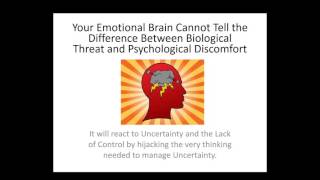
That's easy for you to say. It's impossible for the emotional. So the mammalian brain to accept. Your emotional brain cannot tell the difference between biological threat to its organization, self preservation and psychological discomfort. It wasn't built for that. And if you don't know how to manage the emotional brain, it simply is going to hijack the thinking brain, the thinking mind that you need desperately to be able to trade and thrive with uncertainty. This is the trick, friend. This is not something you're going to read my book and you're going to say, oh, this is the specialized knowledge on these. No, you're going to actually have to go in and rewire.
Stimulus and the responses that have been there for millions of years. There's no trivial thing. This is why trading is easily one of the most difficult endeavors that you will ever learn to be successful in. You have to change the whole dynamic of biology and psychology here to do that. So we've gotten that. And what we recognize is that this reactivity to uncertainty and the lack of control simply triggers the impulse by design of the thinking mind. So there you go, boy, you've got a problem going. How does this manifest? A few examples. Okay, first is, you know, for those of you who have a lot of freezing and avoiding behaviors, do you realize that to the emotional brain, this is highly successful adaptation? You're about to get in to something where you can be losing money, okay? In the short term, the best way in the world that you could get out of that is by hesitating and simply freezing up and not being able to pull the trigger. If you don't get in, you can't lose, right? That's how that works. You have triggered the autonomic nervous system. You have triggered it to fight flight. And it has taken flight as a way and is simply avoiding the threat be damned. With a thinking mind.
That was blown off the water minutes.
Minutes ago. That's how important this is. Or let's take it from another thing. How about this? If you want to know why you keep doing the same stupid thing over and over and over again, here it is. The brain is designed to say, you know something? My comfort zone. In my comfort zone, I am used to this particular level of performance. You know, I don't like it. It's not very good. But you know something? If I were to change what I'm doing, God knows what the future would bring. I would rather have the demon that I'm dealing with now. Than the demon that may come. Doris and I saw a beautiful example of this in a movie we saw last Saturday night where, you know, in this fictional account, this family was caught in a coup that happened in an Asian country. And they were in the. It just so happens in the coup, the coup leaders were going around killing every foreigner they could. And this guy had blonde hair and blue eyes so that they were a target and they were white. And ultimately they came to a moment of where they had to jump, and they were about 20 stories up in a building and all these skyscrapers, and they were going to have to come to a moment of where they had to leap from one building to the next to evade the people who were trying to kill them.
You look behind them and you could see this mob killing people, hacking them to death and gunning them down. And yet nobody wanted to jump to the other side because the demon that they had right now was better than the demon of jumping. It was safer in the emotional brain to stay there, even though you're watching people die and you're next, rather than to jump and to think, I may fall down 20 sores. That's how powerful this instinct is. So now we're going, whoa. This is what's in operation while you're trading. It's unavoidable, and unless you know how to manage it, then you're going to be its victim. Or for those of people who like to do impulse and particularly revenge trading, this image is right on target. You know, here you have a coyote trying to sneak a meal off a big, huge eagle. And what happens? Doesn't it make you feel good to feel very powerful when you're doing this? You, this is really short term. And, okay, I'm getting them back, I'm getting them. I'm gonna take back what's mine.
And everybody knows the drill with revenge trading. You get into revenge trading, and after the smoke clears, man, you've cleared your account.
Okay, Those are all biological underpinnings to psychological conditions. The biology was there first. It created the psychological organization, the comfort zone to act in a particular way. This, friends, is what has to change.
Now let's take a look at this way. Let's talk about poker for a moment. You're looking at this and what happens? You think of poker and you immediately start about gambling and stuff like that. But I can promise you, if you've ever played with a professional poker player, or if you've ever worked, in my case, with a professional poker player, what you get very clearly is they're not gambling.
In fact, they're playing probabilities and they are playing a tighter frame of probabilities than you are in trading. There's a limited number of possibilities that occur when you're looking at two kings and you're looking at cards out there and you're looking at that stuff, you're looking in probabilities and you're seeing what other people have and you're measuring probabilities of what could happen and you're acting on them, not gambling at all. Yet at the same time, if you do not think in a probability mindset, then you're going to be seized by fear or anger or stupidity. So this is what we're looking at. So you're looking at it going in the same way that, that a professional poker player isn't gambling. Neither is a professional trader.
He's not a novice, he's not an amateur. He's depending on novices and amateurs. That's what he's depending on. He's depending on them gambling. That's what it is. So what you're doing is this.
The biggest obstacle to your becoming a consistent, profitable trader is that you were never taught. And all this knowledge you have that you are not a trader until you can manage the mind that trades, okay? You're not, you're not a trader. You're. You're somewhere between a fan, a novice and an amateur, but you're not a professional trader. There's a lot of wannabes out there. The key is, is this.
Traders are not taught.
Knowledge that is accessible in the heat of the moment.
Okay? They're taught on these beautiful screens and these workshops and these things. But what happens is that you're not moving into the moment of heat. You, you're not moving and you're not, you're not being taught. Well, yeah, okay, well, watch me and do as I do. No, no, no, that's not what's happening with you is. The thing is, how do you develop the skill sets that allow you to calm your nervous system down so that you don't trigger to fight flight? That's what's not being taught, friends. Until then, you will always, by biological definition, you're going to have the tendency to trigger toward fight flight, which means you're going to be gambling. So here we go. So if you can't act effectively with knowledge in the environment.
That you're going to be operating in.
You'Re not trading.
You haven't learned how to trade. You have knowledge of trading, but you can't apply that knowledge under pressure, therefore you're not trading as a professional. Okay, so now we're looking at this and going, hmm, well this is all very interesting. How do you go about building the probability based mind from the survival based mind. This is where it gets interesting. Because the emotional brain is built for short term survival, self preservation in the moment traders mind is built, designed, developed for long term probability.
As victory. Okay. In the odds. Do you see that distinction? Do you see that need that you're literally going to have to override biology and psychology.
In order to be able to develop the mind that trades. Yeah, you're going to have to get rid, you're going to have to learn how to deal with the fears psychologically and all that stuff.
But you're going to have to learn to unravel the automatic adaptations that have become traits in your biology that gave rise to the psychology in the first place. That's the deal. What happens is that hominoid over there on the left is still working in that human brains on the right. And until you learn to manage it.
Okay, what you have is a caveman in your head trying for survival in the moment against a saber toothed tiger rather than a homo sapiens.
Managing probability.
Okay, Completely different animals. This is your choice. The problem though is this. Man has inherited a need to control outcome as a survival trait. This is, you might see this more by control, by doing and acting, making things happen. You got to be doing something. To be doing something. I've got to make something happen today. You know, I've got, hey, I have so much money I have to make today and my God, I didn't make it this morning. I have to make up for it to afternoon. That kind of thinking, okay. Or controlled by perfectionism. You know, if I learn not to lose, if I, if I do everything and I'm so right and I minimize my risk completely, then I have to win. That's all the people that graduate. Summa lauda, summa cum laude. Thank you Dolores, because I didn't do that in college. The thing is they make good grades, but they can't apply what they've learned in the environment that they're trained for. This is what has to be rewarded, friends, is that the control that you were led to believe that you have does not exist. And that leading to believe happened both biologically and happened also in a world and in a culture that really believes that you've got to win, you've got to be doing, you've got to make it, you've got to be number one in trading. No, no, it's not, not true. That's not true at all. What happens is that you have, you can't beat somebody else. You're not playing against anybody else. You're playing against yourself.
Okay? And here.
The next really big thing is how you start rebuilding the mind.
What we have here is an image taken from the movie Inside Out. It is a powerfully great movie. I wish every one of you would get the DVD.
And doesn't have anything to do with that. We have lots of Disney stock. But it's a great movie. What it does is it a cartoon about the mind of an 11 year old child that's going through some significant loss. And what you begin to see is how the brain and the mind organize. What you're looking at here are the different emotional programs that everybody has and they're being given life and form and animation. But ultimately what you're looking at in this particular case on the left, you're looking at sadness. In the middle, that red guy is anger. The green girl is disgust. Joy is the ethereal guy. And the one that just weirdest stuff that's taller is fear. These are the basic programs that run a child's mind.
They give rise to whatever kind of mind that can show up. Once you grasp that your brain is a community of rival programs that have duked it out. The winners have organized you long before you could think into a self that you come to believe is you. This is what friends you bring to trading. Okay, and here's where you get it. Is that what you discover very quickly.
Is that the left brain, all this high thinking power that you think you have, you know, this rational, rational thinking and all this, you know, I'm going to follow this procedure. I'm going to use only rational stuff. All it does is produce an explanation for what.
The right brain, the emotional brain, these characters right here have already decided. And ultimately the emotional program is already giving rise to thinking. They control thinking.
Einstein once said.
The rational mind is a wonderful servant.
And the intuitive mind, the emotional brain is a wonderful leader. But he said, in this world, what we have done, we have made the servant master and we have made the master a slave.
Now what I want you to grasp is this, in this particular thing, you know, here you have this cartoon of a guy saying, yeah, I really like your very rational viewpoint. But the truth is what I'm going to do is I'm going to believe what I believe anyway. Despite what you say, no matter how much facts and evidence you Have. I don't really care about that. I'm going to believe what I believe. Friends, we're doing that all the time. And then what happens is that your thinking brain makes up an explanation to support that. This is the danger that occurs every day in trading. You actually think you're being rational when your mind is simply rationalizing what your emotional brain has already decided and what you're going to fundamentally come down to. When you begin to watch stuff, you begin to see, well, tell me something. I'm looking at the same thing. But, you know, one observer looks at it and says, you know, the glass is half full. The other looks at it and says, the glass, glass is half empty. Which is true. Both are true. The observer, though, unfortunately, observer creates the reality. And I'll give you an example. I worked with two traders one time in the same hedge fund, good friends. They same, they, they, they, they traded the same system, but they had radically different results. One was like, boy, this is the great guy. We want him on our team. The other was marginal. They kept him around, but the difference is they saw the world through different lenses. The first one saw through perfectionism. And I'm going to abate loss. And what he did is he didn't lose much, but he didn't gain much. That's the world he saw through his perceptional lenses. The other one began to see. He learned how to see everything as probability. He knew that he had a very strong chance of landing on the right side of probability more often than not, and he was comfortable with that. And it showed in his results, in his P and L growth. Okay, so what you're beginning to see is, okay, I am. Whatever you think, think that is, that's really your beliefs in action. There's no I. There's no final I out there. What happens is the beliefs create your perception, and you see from there. So now you cut from surface, talk to the real McCoy, and all of a sudden, what you're beginning to really see is this. You, as an observer, see through your beliefs.
Your beliefs create emotional reactions with the environment of uncertainty, a probability. And that is your perception. That's what you're trading every day. Your beliefs create the observer that you're observing through. And you see the same script and you create the same emotional responses and you're glued into a particular way. This is why you keep doing the same stupid thing all over again. In neurobiology, it is said is this. And I want you to listen this and listen to it very closely, because this is one of the big things of being able to distinguish biology that creates a mind and a world out there that we're getting to know. Okay, in neurobiology, what we would say is this, is that you have never experienced reality.
You as a trader have never experienced the markets. What you have experienced is a brain taking the sensorial modalities, you know, your sight, your hearing, organizing it into an explanation called a virtual representation based on your beliefs about your ability to manage uncertainty. That, friends, is what you are projecting.
Onto your charts, onto the markets. The feedback loop is your trading account. It's the only thing that's honest and it's telling you the effectiveness of your virtual representation. It's not telling you if your virtual representation is true or not. It's telling you if it's effective at with extracting capital out of the markets. We don't listen to it because we don't really want to hear what the trading account is telling us. We don't want to hear that our beliefs are bogging us down because they're so comfortable that we prefer them.
And the suffering they cause.
Than to risk changing the comfort zone into a higher functioning, higher functioning ego, higher functioning mind self that can interact with the markets more effectively. And this is where people stay stuck. This is why people who are almost there stay stuck and almost there for years and years and years.
So.
What we're now getting is this.
What emotions create, the mind that engages uncertainty. For you, this is the question, what are the beliefs behind the emotions.
That cause the emotional reactions? Remember, emotions are really biological action potentials. They are literally built to move your organism through the environment successfully in a short term way. That's what they're doing, okay? And along the way they alter your perception. What we know is this is what you see is being generated by your beliefs about this ability to manage uncertainty. And the guy who actually invented the concept of yin yang in Chinese philosophy would say, do you fear the unknown or do you embrace the unknown?
In the slow speed of real life.
You can talk to talk.
And time is so slow that you don't have to pay the piper for a long time. And you can make yourself believe that, yeah, I'm really engaging, I'm in control. But in the speed of trading, it's like instant karma, man. You get feedback immediately, good or bad. And what you're doing is you're beginning to see every day in the way you trade. Do you fear the unknown? Do you embrace the unknown? If you're listening to this webinar, most likely you do not Embrace the unknown or you don't know how to become confident in embracing the unknown. That's what this work is all about. So now we're down to beliefs and we're realizing that it really doesn't matter whether what you tell me, what you tell yourself, what you tell others, what really matters is what your trading account is telling you or demonstrating. Fundamentally.
This is what's going to have to happen to retrain a move from almost there to being there.
Understand this. Your brain and body evolved to fear the unknown.
And all your psychology has done is followed that dictate in whatever form by being an alpha taking over things, or being a perfectionist or a victim, whatever. But the thing is, you're going to have to develop the skills to embrace the uncertainty of the unknown and to be comfortable with it.
Think of all those people who are scared to even turn on their machines. Think of the people who have a hard time committing to a trade. Think of the people who get out early because they don't want to risk losing what they've got. Yeah, that's the fear of the unknown. That's not embracing the unknown. That's the fear of the unknown. That's what has to be conquered.
But how do you develop a mind for the management of uncertainty?
What I want you to do is remember how long you've been almost there. It's that mentality that keeps you doing the same stupid things over and over and over again. Not just for days, not just for weeks, not just for months, but for years. What I'm inviting you into this year is to change that pattern. Understand it's biologically embedded. It's not psychological. It becomes psychological. This is really a biological problem. The first thing that's going to have to happen is you're going to have to recognize the default programming of the brain and the mind that is going to resist change every step of the way. Every step of the way. And it's going to rather accept what it's already got than to risk what could be okay. By the way, it's called cognitive dissonance. The second thing is you're going to have to regulate emotions. Remember when we said that your emotional brain can't tell the difference between biological threat and psychological discomfort? Well, to the brain, when you're trading and risking capital, your brain is looking out there and it's not seeing probabilities, it's seeing a viper out to bite you and kill you. And it's short circuiting the higher mental circuits and getting into the limbic circuits and producing reactive behavior long before the thinking mind ever showed up. The thinking mind shows up about a half a second later. After nanoseconds, the limbic system, the emotional brain's already made a decision. Who do you think is going to win that fight? And then what you discover, it's even more. It's a little more difficult. And this is something I do in more my advanced stuff is that ultimately you discover on a physiological level that there is a very small sweet spot of where.
You need to be slightly aroused, the emotions need to be slightly aroused. You need to be alert, you need to be focused, you need to be ready. But you cannot allow your body to become tense. You start seeing that in fixation tomorrow when you look over and see how fixated you are leaning over the screen. What happens is it is a very small spot. When I'm training traders and say they have a pulse, a resting pulse of, say, 60, what they discover is they the optimum performance, mental performance. Pulse rate is somewhere between, oh, 65 and 70. When they get beyond that 70, they're kicking in the fight flight syndrome. The autonomic system is just firing. And suddenly the moment that it hits the fight flight, you're in trouble. You begin to have a compromised mind. You're not just alert and focused and ready anymore. You're triggering to attack or avoid.
This is how absolutely necessary it is to train yourself so that you can manage biology before you manage mind. So ultimately, when you're doing that, what you're doing is emotional regulation becomes just essential. You know, emotional regulation has to be mastered before the door of the mind can be approached.
And yet most traders don't even know when an emotion is struck. They find out later, usually 10, 20, 30 minutes later, that if they had only known what to look for and how to manage it, they could have disrupted the emotion from growing and taking over mine. It's the emotional intelligence that was missing and then the practice.
But once you do that, the third thing that's going to have to happen is you're going to have to awaken the observer of the self. This is called mindfulness. And what you discover is that you are really born into a soup that your brain organizes you to survive in. You become part of this soup. When you get taken out of that soup and put in someplace else, you recreate the soup, okay? And it has to be effective in trading.
Not in where it originally came from. And that's the problem, because ultimately what you discover is that you are not your thoughts, you are not this organization of emotions, emotions, programs. That's only one way the self has been organized to be a survivor in an environment. Unfortunately, it was not built to be a survivor in a trading environment. That's what you have to learn to do.
Then. But you come to see this one possible organization of the self as you as that comfort zone as ego. And the truth is, there is so much more that can be worked with. You can develop the emotional programs so much more powerful. But with the observer, as you step back and recognize that there is awareness outside of your thoughts and of your beliefs, begin to say, okay, I can begin to see how my brain organizes through these emotional programs itself. And that it was really good. It effectively helped me get to the moment that I'm at now. It's just that that organization is no longer effective and it needs to change that. Friends, is when you start really realizing, oh, there's multiple possibility out there, and I can reorganize myself. Unfortunately, what happens is that.
You put blinders on and you don't see what you don't see. And until you learn to take those blinders off and to see a much greater sense of probability, then you don't reorganize the self that manages uncertainty. You take the default programming.
Faced in the avoidance of uncertainty and try to get it to manage uncertainty. That's how you keep losing money. This is what you bring to trading, and this is what you have to learn how to deal with and work with. The fourth thing, you have to develop an empowered self from these emotional programs. You learn how the mind works and how the brain works, and you learn how to develop it.
The emotional programs that create the self are given voice in your thoughts. Okay, you're not listening to your thoughts. What you're listening to are these emotional programs. Like, if you go back to the slide from inside out, those are the emotional programs. All of them have voices. All of them are either trying to conspire together or they're trying to. They're trying to be competitive with one another to take over the direction the little girl works. An accident. That's what's happening to you when you trade. And you have to become the designer, okay? If you don't, you stay stuck where you are at. Almost there. So ultimately, what you're looking to do as you begin to manipulate and grow and develop and nurture these different emotional programs, what you're doing is you're beginning to hear a different voice in your head as you trade. The voice of self doubt is no longer seen as me. It's just one organization of the self that is highly dysfunctional to effective action in trading. And what you're looking for, at least in the work that I do, you're looking for the emotional programs of discipline as ruler, as courageous warrior, self soothing as caregiver, and impartiality as sage. These are the programs that you're looking to bring forward into working awareness. And fortunately, I've worked out a pretty cool way of getting at those programs and building the mind. Because ultimately what happens is that once you grasp that all thinking is emotional state dependent, an emotion is expressed chemically. Once you recognize, okay, I can produce that feeling state, if I produce that emotional cocktail, then I am producing the kind of mind I need in a particular instance. That's what I teach. So you have a different, you have a. You have a different megaphone inside your head, okay? Not the one that you came with, but the one that you need. So ultimately, here's the deal.
Managing the challenges of uncertainty is never going to change. As you're going to be dealing with uncertainty. This does not mean all of a sudden that you're going to win all your trades. No, this means that uncertainty is approached with a calculated mind that knows how to work with probabilities and is comfortable rather than the old default programming that you got stuck with from childhood or what I call your formative period. So there you go, you know, the emotional mind that you bring to the challenge is what changes. And friends, this is the difference maker.
You learn how to manage the arousal of the physical emotion. You learn to observe. You learn to recognize that the observer can start putting together the different voices in the mind, those different emotional programs in a different organization. So you have a very different committee.
Engaging the uncertainty. It's not scared to act.
It's calm and cool. It's calculated and it's thinking long term, very different. And my question is this.
What mind shows up when you engage the uncertainty of the unknown? Is it calm? Does it know that it's going to be okay? That this is only psychological discomfort? I mean, in the moment, friends, I don't mean when you're sitting there talking the talk to friends after the day is over, but in that moment.
Is it calm, is it focused? Is it ready and does it strike when needed? Or is it confused? And the question comes is if you know you can't control outcome and you recognize the only thing that you can control is the mind that you bring to performance. This is everything. This is everything.
And ultimately what happens is you give up being right. You Give up having to be in control.
What you grow.
Is controlling the mind that you bring into that moment of performance. And I want to give you an example. Okay, I have a. You're looking at a cougar and on the left you're looking at a cougar hunting. He doesn't look like he's hunting, but he looks like he's just laying there on a tree just hanging around, lolly goggin around. The truth is what happens is the cougar is an ambush predator. He's an apex predator. What he does is he waits very patiently because the cougar knows the habits of the white tailed deer. He knows to set himself up in a situation where the forest is going to reveal the opportunity of the, of the white tailed deer. When that happens, he strikes. But what I want you to get, all you alpha thinking males is you don't have to be a lion chasing down prey. That's that all that alpha making things happen, make it happen. I'm gonna hit a challenge. You gotta be doing something to be doing something. No. The trader's mind is like a cougars. It's patient.
It'S waiting for the ambush and it's decisive. When it strikes, it strikes. This is the change that has to occur. It can occur. You have to decide that you're ready for it though.
So ultimately I have a question for you.
Have you been stuck in the myth of almost there long enough?
Okay. Have you been stuck in the myth of long enough? Long enough to know, to know.
That almost there is simply a place people get stuck.
In their journey into successful trading.
If you're in almost there and you've been there for more than a year, six months, you're stuck. You're stuck at a developmental moment in the evolution of a trader. Okay. It feels good. It feels like you only need one little magic moment. And you're waiting. And you're waiting. And while you're waiting, time is spinning. Capital is either just simply not growing or you're losing it. Either way, what happens is that what I want you to recognize is Almost There is a typical place that traders get stuck in. And the question is, have you had enough?
If you have, can't you, can't you just see what that poor fish is? He's so close yet so far. You know, if you're interested, I mean, if you're really in the point where you're going, you know something, I really need to something to change with my trading and I know it's not my system anymore, you know, I've been through that. I've done all. I've done all that junk. I've done it for two, five, ten years. God knows how many years I've squandered capital. I've done all this stuff, and here I am. And I'm recognizing that, yeah, I'm almost there. But the distance between almost there and being there has to be bridged. If you're interested.
We'Ve got two things. One, we have a group course coming up soon. Next week, as a matter of fact. It's a powerful course, and it's for people who really want a very efficient, cost effective way of learning these skills that I've talked about. It's powerful, friends. It's. It's powerful. Pretty inexpensive. It's $11.95 for the course, or it breaks down to five payments of $239. Okay. Over 10 weeks, every two weeks. So we have done everything we can to make it affordable. But I'm going to tell you something. If you sign up before this Friday, what we're going to do is we give away for free an emotional regulation supplement that costs $199 on my website. And it's not to induce you to buy the product. The thing is, what I want you to do is I want people to. When you show up at the course, I'm expecting that you're ready. I'm expecting that you will have already done homework, okay? You'll have the keys to the first classroom. I'm expecting you to have done them. You're not going to show up in the class and think, okay, we're going to come up here, we're going to show up, we'll get our syllabus and we're going to leave. No, no, no, no, no, man. We're hitting the ground running. And this is an inducement to get you to run, to get yourself so that your action so that when you show up, you're ready, you're prepared. If I'm going to work hard and create a course that produces this possibility of change, I want highly motivated students. That's why that offers there. It's something that I really would like for you to take advantage of and think about it, okay? The other thing is the individual course. A lot of people finally recognize that.
Having a mentor that can really walk you through this jungle and understands the way from almost there to being there is really the highly most effective way of getting there. The individual course is far more comprehensive, a lot more stuff there, and it's also Far more personal. Ultimately, what happens is that you really have to come face to face with your own orphan nature, your own, what I would call your emotional brain nature. And it is very slippery. It is a lot harder than people give it credit for, but they're both ways. You know, if it came down to where you had the money, take the individual course. But I want you to look at both.
And when it comes down to it, I want you to ask the question, have I been at almost there long enough? Have I learned my lessons? Do I realize I'm stuck and that I need a push? I need something different that allows me to move from almost there to open the door so I can start going toward being there.
Friends, it's your choice. I'm hoping that in 2016, you're ready to truly get this thing going and do what it takes to become a consistently profitable trader. And this is my contribution.
Oh, there will be a recording of this available tomorrow. We will upload it to YouTube, but we will have it on our website tomorrow morning on our homepage. It'll be either the first video, the second video. It changes from time to time. But you can go there and review this. And I know a lot of people, a lot of people record these things. They have them in their personal libraries, and this is kind of the transition we've made. So, anyway, review it again. So I'm wishing you a great new year. And I'm also saying if you have questions, type them in and we'll get to a number of them if there are any questions. And more than anything, what I'm wishing for you is a great new year. And I'm wishing for you to find the courage to really embrace change and to really begin to ask the question of if I want to become the change that I want to see in my trading, where do I start? That would be the powerful thing. Okay, well, we are not seeing questions. That must mean that I have done such a thorough job that you don't need questions or whatever. The other thing is that I would like to say before I go is that if you're serious about this stuff, if you're saying, you know, you know, what I'm really trying to decide is what's best for me. I know I need to change. I know I really need some. I need some help. Ask for a free consult. You just go to our homepage, hit contact us, and you end up with we arrange a meeting between you and I that is 30 minutes to an hour long on Skype, and it's A very powerful device. But thing is, if you're going to use that, be serious. Okay.
You know, if you're a fan and you just want to get some information and talk the talk, I have no interest in speaking to you. You have not traded long enough for me to be interested in working with you. So anyway, friends, I wish you. Oh, we have some questions and let me see if I can get close enough to them to see them. Okay. I put on trades that do not have the edge that I define. What would you do? Why would I do that? Why would I do that?
If you're putting on, well, a lot of it is self sabotage. You know, when people put on trades that they know in their heart they shouldn't have been putting on, what they have to be looking at is, what is it I'm sabotaging. And often what occurs in there is a really, a kind of a fear of success is that, you know, thing is, if I, if I really get good, you know, I really need to, you know, what are people going to expect of me? Other people simply, they haven't been in them. I have worked with traders who had some pretty dysfunctional backgrounds and what they knew, what they learned to do was to blow themselves up to force attention to them. And you'll also find that in self sabotage. But ultimately what you have to look at is that in self sabotage, what you're looking at is a sense of worth or a sense of mattering. And you know, ultimately.
You have to look at your sense of worth and particularly, do you deserve to make money? Do you deserve to make the kind of living that trading can give? Not knowing who you are and knowing your history, that's as far as I'm going to go. Okay. Was there another one, Dolores? Somebody asked about the difference between the two.
The difference between the group course and the individual course. First of all, cost. Second of all.
The group course basically happens over two months. It is a group meeting happening on Gotowebinar.
And you are assigned lessons that are in a virtual classroom that you get keys to. You do the lessons, you do the study, and we talk about it. Okay. As a group. Okay. And it goes through the basic skills sets that you're going to need to become a proficient trader. The individual course is three or four months long, is 10 individual sessions on Skype with me. And it uses a graduate level course, multimedia course that you download and is yours. It's much more extensive than the group course. And it is for people who are really dead serious about the trading and that they see this, they recognize that $3,500. They've either lost that or they have not gained that simply because of their hesitation and their inaction. That's the, that's the major differences. Okay.
Next, next question.
Okay.
The. I guess, I guess what I am trying to ask is why is it so hard to follow the rules you set for yourself? Because.
Because you're under pressure. If you take a look at the way the U.S. army and the U.S. military wages a combat. What they do is they do shock and awe. The very first thing they do is they produce an enormous amount of confusion in the enemy and well trained soldiers break down and they become babbling idiots and become easy fodder. The same thing happens in trading is that you're exposed to uncertainty and suddenly what happens is your well tailored thinking mind's rules become absolutely unglued. And what you're looking at is the primitive beliefs you have about your ability to manage uncertainty. That's what you're looking at and I can tell you this is that it's not rocket science. It is literally the self limiting beliefs that you're going to have to learn to deal with and transform are a sense of inadequacy, not good enough. A sense of not mattering. I have to make a whole bunch of money in order for people to see what a great guy I am. A sense of not deserving, you know, I don't deserve to make a million dollars. You know, if I don't work really hard for my money, I don't deserve it. Or a sense of powerlessness. You know something, it's all going to go out of control and I'm just going to freak out. All those are inherent beliefs that exist within the probability and possibility of being human. They manifest in trading like crazy. And you are going to have to learn to transform them. Not just click your heels and decide you believe something else by affirmations or visualization. That's not going to work. You're not going to trick the brain into that. Okay, here's Dolores says it's a really good question.
While pursuing mindfulness training, etc. It sounds as if all trading should cease while undertaking that process. Would you.
When you. When do you resume trading? Well first of all, that's not true at all. When you're there or there. Okay, first of all that's not the way I. That's not the way I teach. I'm assuming, understand what I said in the beginning is that unless you can operate with your knowledge and apply them in the environment you're going to be operating in, you don't know how to trade. There are plenty of people who are incredibly knowledgeable about trading who can't trade. And they prove it every day in my programs. What I will do is I will ask, depending on what, depending on what their account size is and depending on what their sizing is, I will ask them to back off. I'm looking for the level of risk, the smallest level of risk that triggers fight flight in them to work with. That's where we work. No, I'm, I'm. No, you're going to be with me. You, you are going to be trading. If you're trading currently, you're going to be trading live, risking capital when you're training with me. I mean, if you're only in simulation or if you can't even turn on your screens, then we start there. But for the trader who is in the markets and is trading live, I will ask them to back off, but I want them risking capital because what happens is they have to be taught emotional regulation skills. In the environment they're going to be operating in, they're useless. You're going to have to be taught mindfulness. Mindfulness in a classroom is useless. It's the battlefield that the mindfulness has to be used. And even the US army now is recognizing that. And they're actually teaching mindfulness under battlefield conditions instead of classroom condition. So no, there's. There. You. What I see with traders is they, they back their risk down and as they get the skills and become more competent in them, they start sizing up. Okay, this last question, folks. This really. That was a very good question. Thank you very much. When revenge trading, which I rarely do but knew I was doing in a practice account today, I noticed that I had expectations.
That had limited probability of being correct.
But was more based on desire of being correct over the immediate.
Near term balance out of my previous mistakes. Well, what you're. He's not finished. My goodness gracious. But I noticed that the manager was not in control, but the orphan and Warrior seemed to be in control. There you go. Would this be the normal interpretation? Yeah. What you're looking at there is that you're looking at what I call orphan. This would be the patterning in your limbic system, in your emotional brain is. You know, the thing is it has lusted. It wants to take what's there. It may want to prove itself. It may want to get back what it's lost. It's all that kind of. That kind of Lusting type of stuff and you want to attack the threat that's causing you problems. That's the thing about revenge. Trading is the motivation between attack and avoid is attack and that is a way of dealing with threat. And on a short term basis you can understand that if you're cornered by. If you're cornered by an animal and there's no way out, you need to fight your way out or die doing it. Okay, the thing here is that.
Orphan will want short term success, short term.
Goal orientation of survival, self preservation. Okay. It does not see long term. And what happens again? Orphan can turn into an 800 pound gorilla really, really fast and take over the mine. Enormously fast. Unless you know how to cool it down. And you know, in my stuff, yeah, you learn how to cool it down. But more than that, you learn how to anticipate it being there and see it as a tendency that needs to be looked for. That's the big thing. That's a good question and thank you that it sounds like someone knows a little bit about my work. Friends, I want to thank you for coming. I've had a great time and this, like I said, this is the first time I've done this presentation. So you know, this is, I wanted to get at the core of the problem and to see now this is, this is really what has to be worked out. Okay. If I can help you, I am blessed to help you. If we never see each other, my hope for you is that you have a prosperous new year. That someday sometime we meet again and have a glass of wine, which I'm going to be doing here in a moment. Thank you very much friends, it's been fun. Bye bye.









