2016 04 14 16 31 Resolving the Conflict Your Emotional Nature vs Your Trading Mind
Rande Howell explains why traders' emotional brains sabotage logical plans and how to retrain both emotion and reason for markets. Your brain is wired for certainty and self-preservation, but trading demands probability-based thinking. Core skills include emotion regulation, mindfulness, and restructuring emotional patterns through sustained practice over months, not quick fixes.
Questions this video answers
Rande Howell.
April 15, 2016 (video titled 2016 04 14 16 31 Resolving the Conflict...).
Meets five times over 10 weeks.
$1,195.
$239 per month (payment plan).
Chapters
Hello, everyone. And I am delighted that you're here. And just as precaution, I just want to make sure that everybody can hear me. And so if you will just type in. Yes, yes, yes. And of course, if you can't hear me, you won't know to type anything in. So if you'll just type something in, let me know that you can hear me. Yep. Okay, good. Folks, have you ever noticed something. Have you ever noticed that we do everything in the world to have a logical, rational mind devoid of emotion? And that's what we want to trade with? And then almost every time, these pesky emotions just kind of creep in. And they actually just absolutely have at it and just make a mockery and contaminate that logical mind that is so needed for trading.
The key, if you really begin to look at what happens is you begin to notice something. There is a conflict between our emotional nature and our reason nature, our logical nature. What's not understood, though, is that both are needed. That's what we're going to be looking at, is you got to have the emotions. Because ultimately what you discover is that all thinking is emotional state dependent. Your left brain, that wonderful thing of logic and a reason, all it's really doing, it's producing explanations for what the emotional brain has already decided.
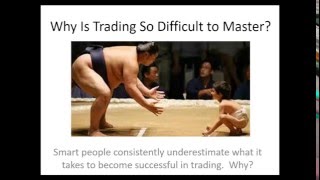
In real trading, that looks like not being able to make an entry when, you know, the thing is, I can't do it. I want more confirmation. And then after it passes, you look at it and go, that's a valid setup. Why didn't I take. Made an enormous amount of sense. It made sense. It was logical, reasonable in the moment. But when you back out of the moment, you look and go, oh, my God, my emotions took over. And then my left brain, all this logic was making up all sorts of crazy explanations about why not to get in that trade. That's what we're talking about, friends. And as usual in my webinars, I hold questions toward the end. Please. If you have a question as we go along, go ahead and type it in. There are some questions that Dolores will be able to handle. Procedural, you know, where do I find that? Blah, blah, blah, you know. But when it comes down to the fundamental educational questions, I'm going to hold them toward the end. Okay, fair enough. Let's take a look at this. You know, ultimately, nobody tells you as an aspiring trader that just how difficult trading is going to be, how difficult it is to be effective in the trading mind. They don't do that. Well, tell me something. Why is it so Difficult to master. Okay, despite all that vast knowledge, you read, you study. The people I work with generally are very well studied. They've been around for a while. These are not people who just fell off the pumpkin truck yesterday. And yet at the same time, with this vast knowledge, you would think that by osmosis almost that they would have learned what it takes to win at trading. Yet there they are. It doesn't. And why on earth do traders continually underestimate the journey into success? Okay, it's really a David and Goliath, just like this image right here. It's really a David and Goliath concept, is that when you first really begin to recognize what it takes to trade effectively, you realize, oh my God, I have been going up the wrong tree, the wrong building for most of my life. I wish I had understood that I really needed to turn toward my emotional discomfort, master it, so that I could use the emotions to create the kind of explanations that the left brain can give me. But that comes only after you've lost. For most people, you've lost your capital, you've ran out of time. So the deal is this. You know, just listen to traders talk about their trading in hindsight, okay, they're looking through the rear view mirror and it seems to work so easy. If they had only done this, if they had only done that, and it comes down to it, if I'd only been able to trust my edge. But then you start trading and discipline flies out the window along with your capital. How does that happen? How can a person that says, you know something, I'm going to do it right this time, I'm going to do it right, I've got it down, I know my rules, and then get in and they just are blown apart.
Do you call up more willpower and say, I'm a disciplined trader, I'm a disciplined trader, or do you look more fundamentally and go, what's going on here? I suggest the second. And what do you do when you fail? Well, you know what most people do is they're going to get up, they're going to try harder, and then they're going to try harder and they're going to even try to try, try, try, try harder to make success happen. This pattern goes on forever because it's worked in the past, it's worked before. They got to trading and now they're thinking, it's going to work now. But the truth is what traders see, that this pattern can go on for years and years. At some moment.
You have to, you have to acknowledge it what is really going on here. That's when a trader really has an eye to saying what is going on? What can make this happen. And then you start looking and you look and you look, but somehow you don't see the problem even when it's right in front of your eyes. Just like these dogs and this fox.
You don't see the fox if you're the dog because you don't have the eyes to see the problem. You just see the results in your trading account. You know there's a problem and you begin searching around. Very interestingly is the most powerful part of our marketing is through YouTube. People are looking, they know they have a problem and they are looking for solutions. We're not sitting there trying to talk them into a solution they don't want to find, they're finding me. What they're doing is they're saying, you know something, I don't have eyes to see the problem, but maybe I can ask a question that somebody has those eyes. That's what we're talking about. Even when you do that, the normal tendency is very, very easy. You try to trick the brain for years. You do all the quick fixes, man, all the quick fixes.
You know, and then I call this magical thinking. Do you think that taking your finger, index finger and tapping it on your head and then chanting something is going to change the way the brain at a core level interacts with uncertainty? Do you really think that some NLP is really going to solve the problem? From the surface of something to the very core of the cellular circuitry that produces belief that engages uncertainty? Do you really think that affirmations that you're going to lie to yourself till you can do something, do you really believe that holding something in make believe and holding it and saying, you know, I'm going to do it, I'm going to do it. I can see myself winning. I can see myself winning. I'm finishing the crossing line. And then you do it over and over again and you discover why don't these things work when engaging uncertainty? They work so well. They felt so good when I was in business, in corporate world, they still feel good, the trading world, but the technique doesn't work. Okay, so they should be working for us, but they don't. And you keep waiting and keep using them and you and you're just looking for that missing piece of puzzle. I don't blame you. I'd be doing the same thing. And I did. And of course, you know, in the myopic world that people live in.
They don't see that something is wrong with them. They look all around for a problem out there to be solved. And I actually got this. I got this very question last night in their presentation after explaining this entire process of basically changing beliefs at the cellular level and talking about it taking about three months. And it requires an entire process that just doesn't magically happen after all that, after I finished that explanation, the next question was, well, what's the special knowledge you use when you actually do that? Okay, do you see what I'm talking about there? This is a guy trying to find a problem, and he is certain that I am a purveyor of some specialized knowledge that is going to change things. If he only puts in that little piece of puzzle in there, suddenly the puzzle comes complete and he is able. He's got the magical thinking thing going. He's trying to put my work and make it tapping, make it nlp. And yet I'm saying no. It takes. Once you understand the process of change on a neurological basis, it still takes about three months to actually change one belief and into another belief that brings forward to another world. But, boy, do we ever more love the certainty. Okay? It's this certainty business that really gets us in trouble. Because ultimately, at the bottom of this, this thing really starts out as a biology versus reality problem. Okay? The organism that you are wants the feeling of certainty, the face of ambiguity, and it will choose a lie to believe.
Than to accept the truth.
That's. Magicians have been using this trait about us as human beings forever to pull sleight of hand on us because we are wired to believe. Certain things have to be certain ways. And it is so much that way that a magician can twist things around. And my favorite one is where the guy is asking you to be looking very closely for something. When you're watching all these cheerleaders and you're being asked which ones are guys and which ones are girls and are all dressed up as girls. So you're busy watching it. And then he asks this question after you've been watching it for 30 seconds, did anybody see the gorilla.
Walking through.
The cheerleader set? And only one or two people and the entire crowd see it. They're so focused on certainty of looking for what's the difference between the men and women here? They don't literally see someone dressed up as a gorilla walking through the scene. That's the reassuring lie that we're talking about. Okay, so you've got this thing and you want to change, but the truth Is, is how do you go about changing when you can't really trust the way your brain sees things? Okay? That's, that's the big deal. Where it starts.
Is all that stuff.
All that stuff that probably everybody's been doing, they've been putting a band aid on the dam. All that, all that tapping, all that affirmation, all that stuff, all that stuff that is supposed to have some way and the tonal stuff that's supposed to realign the mind and get it done and stuff like that, and suddenly you should be in harmony. What ultimately is not happening is you're not getting at the core of belief. And what we're looking at specifically is the beliefs that you're projecting onto the markets about your ability to manage uncertainty. That's what your trading account is measuring day in and day out. Okay?
Ultimately, we have to come to the moment of where we recognize band aids don't work long term because they brush aside dealing with the real problem, okay? And that's where we start looking and we start recognizing that the real problem is our need for control.
And again, this isn't like you and me. This is the whole species, okay? Is that your brain wants control over outcome through force of will or through perfectionism. It wants control over outcome. That's the whole thing of trying to find the holy grail. Friends and the trading gods don't care about your magical thinking. They don't give it, don't even, they don't even give it lip service. So ultimately, here you are, you have a brain possessed to be in control over outcome. And what we call that in neuroscience and.
The whole evolutionary psychology thing, we would call that self preservation instinct. You know, the whole key is many, many millions of years ago, when our ancestors were looking out over the African savannas, we were not fast, we weren't, didn't have cool teeth, we didn't have sharp claws. We didn't have a lot of things. We were just coming out of trees, just, you know, only 5,000 generations before. But what we were, we had a mind that was very keen, could look off onto the distance and it could make an enormous assumption that behind every bush there was a saber toothed tiger. And by doing so, we avoided the potentiality of being eaten by the tiger. And it really multiplied our capacity to dominate the species and become this incredible, incredible, incredible species that dominates Earth today. At the same time, it wired in a sense of going, you know something? I can control outcome by avoiding loss. Do you see that? How many of you trade not to lose Many of you, most of you, that trait was developed on African savannas 6 and 7 million years ago. Okay, here it is in 2000 in the 21st century. And it's, it's jumped from the African savannas into the way you trade, your trade in the 21st century. Powerful stuff, okay? So we know that that brain really wants to control. And at the same time we're sitting there. What's really required.
To work this stuff is the courage to cut through the deception and to acknowledge the breakdown. Okay, about, you know, this certainty based thinking just isn't working. You know, it's a nice, it's a nice piece of magical thinking and it certainly appears to be working in the real world that I operate in. All that business, all that corporate, you know, it appears to work there, okay, where the time intervals are much larger, but it doesn't appear to work in the trading world where the time intervals are infinitely smaller. And it's kind of like it's the difference between karma through lifetimes and instant karma in trading. What happens is that man, it is right there in your face, immediately showing you that you've just lost money. You know, you can see the old P and L statement pull up and you can see it leaves. The key is, when does this bubble of illusion of control pop? That's the key. Once you grasp that, you're going, oh my God, if there's no illusion of control, what am I going to do? Just give up and just drift away, you know, in the winds and drift into the wind. No, what happens is you're going to start learning about what is it you can really control. We've lived in this deception, this illusion of being able to control outcome either by predicting outcome, all that TA stuff. Okay, I'm a big fan of ta. Just to let you know, at the same time though, it's giving you probability, it's not giving you facts. So you're getting there and you go, wow, okay, what if I do start popping the bubble of certainty? What happens then? Well, this is where it gets really tough, friends. Because ultimately this is where trouble brews. Probability and uncertainty are concepts. You know, we can talk about them, we can intellectualize them and stuff like that. But vulnerability.
That'S really human. That's that you can feel that in your gut. Oh my God. I feel vulnerable. Oh my God. What's going to happen? What's going to happen, you know, is that money going to be taken away from me? Oh my God. What if that happens suddenly? You see the link here.
Probability and Uncertainty are mental concepts. Vulnerability is rooted in your body. And this is where the whole deal happens, is that in the way I perceive, I do not make a distinction between the body, emotion, brain, mind, and I would actually say spirit too. But the key is I don't make that distinction because I think it's a very dangerous false assumption. What I know is that vulnerability, I have to learn to deal with that if I'm going to move from a certainty based mindset that is trying to control outcome to a probability based mind that accepts not knowing, in fact, engages, embraces not knowing, embraces vulnerability.
Wow. Now we're, now we're beginning to. Now we're beginning to talk, isn't it? This is the part that makes you squirm.
Because ultimately.
Oh, you did. I didn't think she changed the slide and she did. Ultimately, anytime that there is a disruption to a standard sorial pattern, the autonomic nervous system triggers, okay? And out of that triggering an emotion is going to appear.
Vulnerability is threat, okay? It triggers the autonomic nervous system into fight flight unless trained, okay? So if you haven't developed the skills, you are toast at this moment of change. Because ultimately in trading, what have you got? You have uncertainty. You have really no control over what you win or lose. You have probability that you have an edge and that you might. You know, statistically speaking, if you keep your edge and you keep your act together, you're going to end up on the right side a lot more than you end up on the wrong side. But on each given trade, you don't know. And yet the brain's trained for the exact opposite, okay? Because you're toast because your historical programming is triggering and you don't know how to compensate for that except by willpower working harder. And that's not going to work. That's not going to work, friends.
Ultimately, the brain experiences vulnerability to a perceived biological threat. Remember, your emotional brain cannot distinguish between a biological threat and psychological discomfort. Vulnerability can't do it. And until you can manage that emotional brain, not control, manage, it's going to hijack. You have to get the emotional brain, the amygdala, trusting higher brain function. That's all that logic and reason before it will hand off the football to it and let you play ball with a logical mind. Otherwise what happens. Is this.
Your trading account? Okay?
Its help is always pointing to the beliefs that you're bringing to the management of uncertainty, okay? What you're looking at is a guy who doesn't want to hear the beliefs that are manifesting as thoughts, his head. I matter only when I win. I've got, I've got to win. I've got to win. I've got to get respect, you know, if I may, if I'm. If I win money, boy, I'm a big man in town. I'm somebody. You're. That's a loser. That's a person who blows up accounts. I'm not good enough. You know, if I make any mistakes, I'm not good enough. There's your perfectionist. I can't handle the pressure. I just seem to fall apart, you know, I can't maintain order under pressure. I really don't deserve success, you know, if I'm not working hard for my money, I don't deserve the money. Or I may not even deserve, you know, to make good money, to make easy money. I may not deserve it. Worthiness. What you begin to discover is this is ultimately what your brain is doing. It has never experienced reality of the markets. What it's done is it's taking your sensorial modalities, it's looking at all those inputs that you're looking at and doing all your charting. And what it's doing is it's creating, creating. It's creating a representation of literally what you're looking at. And it's based on your beliefs. If you believe that I'm going to trade not to lose because somebody's going to take my money, what happens is you see all sorts of opportunity for you to lose money and you get very conservative and risk intolerant. If you believe that, man, I'm going to make a lot of money. I'm going to do this. I'm have a. I have a client right now who's just gotten over the fear factor. He's managed through fear and now what he's done, he's discovered euphoria. Feeling good is just as dangerous to trading as fear used to be. He could not conceive that there was something beyond fear. Okay, thought, oh man, it's just going to be sunset and going riding off happily into the sunset and living happily ever after. And all of a sudden he realized that, you know, I can put really good days. I've made more money in the last two weeks than I have in the last five years. And he's beginning to feel good. And my caution is don't feel good. That's an emotional state that's going to get you in trouble. Because ultimately all of a sudden what's happened is making money starts having him going, look at me. Look at me, look at me, look at me man. Look how, look how important I am. The overconfidence kicks in, euphoria. And suddenly you no longer have the capacity of managing risk and reward properly with just a cold blooded mind.
Excuse me.
Yeah. The point here, and Doyles makes a good point here, is that ultimately a professional trader does not feel good while he's trading. He may feel, he or she may feel good afterwards. Go celebrate, have a great time. You know, they had a couple, really man, huge winners and yippee, let's do it. When you're trading though, what you do is you manage the emotions because ultimately you know that feeling good produces testosterone and dopamine and it's going to take you out of the mind. And remember dopamine is high grade cocaine. It's, it's in the pharmacy of the brain and testosterone just makes you absolutely, you know, you just can't measure risk anymore and you aren't making stupid mistakes. That is why often we say that we need a lot more estrogen based life forms trading, because all that testosterone drives pickups really well, but trades horribly lots of wrecks. So we're getting into this thing, we're beginning to recognize there's a link between the biology, beliefs and the mind that emerges, that engages uncertainty. All that information you're seeing and the probability of winning and losing and the threat. It appears to the emotional brain that oh my God, if I lose I'm going to die. That's what it's thinking. And then here's this guy saying, we want to know that the truth is I'm going to wish, I'm going to click my heels and I'm going to say no. I have read books and I know that this is only one train. It's a statistical edge, blah blah, blah, blah, that doesn't matter. Unless it's rooted in the body, it doesn't matter. You can't think your way through this. You have to change the belief system. So.
It'S these beliefs that become the key to your psychology of performance. Most traders trade not to lose.
And what they're doing while they're trading, they're trading to make money by not losing.
Do you see the flaw in that logic? Before they even start, their mind is compromised for performance effectiveness. Okay? They're not going to lose, okay? And they're going to make money. Out there.
You have no control over whether or not you're going to make money or not.
And now you have a mind that this guy is set up saying, I'M going to trade not to lose. I'm not going to go into bad trades. He's not thinking. Well, what I'm doing is I'm looking for valid setups. Okay? This is a valid setup. I don't know if it's going to be successful or not, but it's a valid setup and it gives me an edge. I'm getting in. Okay? Do you see the difference? Trading not to lose and trading what you know gives you the probability of an edge. And to do a mind that does that is going to require a disciplined, impartial mind that it's very patient, it's ready, it's poised, it's concerned, but there's no fear there. Or the fear is managed so that it has not escalated from concern into fear. That's when the vulnerability shows up. That's when all the linkage from uncertainty to fear is there. And you wipe yourself out. So you're there. And what you recognize is that these beliefs are in neurocircuitry. They're not just thoughts running around in your mind that are not rooted into your very being. Okay, this is where we actually have to start going. Okay? What I know is this.
And performance falters due to my belief system about my worthiness, my mattering, my sense of adequacy, my sense of power or helplessness while I'm in that trade, managing the uncertainty of life, the challenges of life, that's what's being revealed in your trading accounts, friend. This is what has to change. And the real key is how do you go about creating lasting change?
Well, friends.
The very first step on this journey of a thousand miles begins with you giving up the magical thinking of a quick fix or an easy fix and that you can control outcome. That's where it starts. You actually recognize I can't do that. And I recognize that I've got about 50 to 65 million years of programming biologically that it's telling me that I need to control outcomes, the whole species, the survival of the species depending on me. And you have to also recognize that it's really time to rechart your course to say, you know something, I really need to take who I am as a human being in a different direction. Because the way it has worked, no matter how successful it's been in the past, it's not working now. Okay? That's where it really begins.
You quit thinking, if only, if only, if only. Now what happens is you're seeing what if only will get you, and it's not getting you Anywhere it's a trap and you're going, well then what has to change? Your brain has to change. Then your psychology. Okay, there really has to be a shift.
From this certainty based mind that you brought to trading. And honestly I want to tell you this is nothing, there's nothing wrong with a certainty based mind. It has got us to where we are now. It has been able to control outcome in a way that has allowed us to become this incredibly dominant species and individually to produce for many of us wealth that would be unparalleled two or three hundred years ago.
@ the same time, though, that mind is worthless, is dangerous in trading. What's needed in trading is a probability based mind where vulnerability, which is the biological manifestation of probability and uncertainty is embraced.
That's a big one, isn't it? I can almost hear the lightning and thunder.
So what happens to make this turn in your biological heritage and in the psychology that rises out of that biology? You have to retrain the brain. You're going to have to move from a short term self preservation look into a long term. If you want to see what that looks like, go back to the person having problem at trade entry.
What you do is you see him failing to get into the trade. That's to the emotional brain, the survival brain. That's success.
By not letting you get in the trade in the first place, you don't risk in the short term. That's its logic, that's the emotional brain's logic. And all it did is it hijacked the left brain, all that logic and reason. And suddenly all that logic and reason was producing an explanation to stay out of the trade. You know, after the moment's gone, you got your wits back and you go, why didn't I get in that trade? It met all my conditions. Okay, well now short term preservation is not front and center. And the awareness of mine, it's back in the background again. This is what has to be controlled, this is what has to be managed. And prior success means nothing in trading. Trading is a completely different game, it's a different animal. And you have to build a new mine for trading. And I've actually had, you know, it's really interesting, I was talking to a very successful trader about this, this entrepreneur who had a Track record about 25 years of very success entrepreneurial work. And he was learning trading because he had a lot of money, a lot of cash, a lot of capital. And he saw trading as a way of using a capital intensive industry and learning how to do it and just learning how the rules. And he was just going to go on and produce another entrepreneurial success. And the trader says, you know, it's just a pity to take a perfectly good entrepreneurial mind and waste it on trading. At first I thought, well, that's a very interesting thing to say, but yet this is a very successful trader. And he went on to say, you know, the thing is the trading mind is all about waiting and patience and.
There is a whole emotional alchemy that has to occur. And you know something, it would be very difficult for me to become an entrepreneur.
And to be honest with you, I would hate to, I would hate to waste a perfectly good trading mind on entrepreneurship. But do you see the difference between these two worlds that's being talked about because ultimately, even though certainty based thinking was so successful that it became a trait, you know, it's transmitted through your genes generation after generation. The problem is in the world trading, it becomes a liability. So the mind that you brought to trading, no matter how successful it's been in the past, is not going to produce the kind of success you're looking for in trading. These are different animals, friends again, there's nothing wrong with the mind, most likely that you brought to trading. It's just not fit.
To manage probabilities. It's fit, it was built to manage certainty, self preservation in the moment. This is where most people burn and crash and die. Okay? This is the big deal. They don't grasp that. They don't move beyond that. They stay stuck there. And it's like, I know this has to work. I know it has to work. No, it's a completely different world. You have to step out of that comfort zone and go to a completely different world. Because ultimately what you're going to discover is this.
Is that the only thing that you can trust.
The only friend that you have in trading is your trading account. And he's brutal. It's brutal. Your trading account is your truth meter. It is going to tell you whatever virtual representation of the world you have created and are projecting and interpreting the market through, it's going to tell you whether or not it's effective or not in being able to extract capital of the markets. Notice, I did not say that the trading account is going to show you whether or not it's the right and the only way of seeing the world. No, what happens is, is it an effective virtual representation of the markets to the degree that it can extract capital out of the markets? That's the only question. That's what you're looking to Build. So like Pinocchio here, the truth is, is you can tell yourself lies, but your trading account doesn't care. And ultimately, when you start listening to the trading account and start wiring down to these four beliefs that I've just talked about and wiring down to the reactivity into the biology of survival, you begin to recognize, oh my God, I'm going to have to do some change here. Yeah, you are. And the truth is, is that it's mandatory. But after you even decide that, how do you go about changing, how do you go about getting on this wild horse of a brain you have that is this adaptive organism that pretty much adapted you very well for survival in a world that no longer exists? In trading. Okay, how do you, how do you go about.
Okay, how do you go about trying to teach something.
Something very different, to become wiser? Okay, how do you do that? How do you, how do you get this emotional brain that has been so successful in the past in this world that no longer exists? How do you get it to start trusting you, trusting your judgment, trusting that you know what you're doing, trusting that you're not going to get it in trouble? This is the real thing and this is where people miss it really bad. This is about neuroplasticity. This is about changing the beliefs that drive mind. This is about literally taking the emotional programs of the brain and reorganizing the ones that won the first race. You know, the ones that organize you into a self. It's talking about going, well, you know, that was really nice that, you know, that was before I could think and observe and stuff like that. I need to go back and I need to retool, retool the emotional programs for a new world, not the one that I grew up in, but this world called trading very different animals. So what are the core skills of this probability based mine? Okay, the first thing we want to say is understand that the mind needed for trading is not natural to biological survival. That's the main thing you need to get. You're going to have to really revision the relationship that you have with a caveman living within you. Okay, that caveman, that cave woman does in fact live within you. And if you don't listen to him or her, if you don't learn to manage the world that it perceives, then you're not going to be able to manage the probability world because ultimately your job is to learn to be able to organize these different programs. And by the way, the movie Inside out is one of the best examples I've Ever seen how emotional programs create a mind? If you watch the movie and a lot of people, and I actually assign it to my individual clients. So, you know, if you want to get a heads up, get the movie, watch it with your kids, but look at it with different eyes. Look at it going, oh, my God. This is the way emotional programs create mind. They're duking it out. They have different. They have different conspiracies, they have different cooperations with one another. They're competitive with one another. They create power teams. They take over mine and do some really dumb, stupid things. Okay? What happens is that the job one is literally to start learning how to regulate those emotions. You have to take the biology of the emotion. Because ultimately, emotion is biological. It exists as a biological action potential. Anytime there's a disruption to standard soil pattern, so it's going to show up. And the key is, can you start regulating it so that it doesn't hit and take over and trip from the autonomic triggering of an emotion directly to fight flight, which is called the sympathetic nervous system? Can you regulate it so that it doesn't take over mine? In my work, that's done through breathing. Because breathing is part of the emotional signature of an emotion. It's done through relaxation. That's also. Tension is also part of emotional arousal, part of an emotion. You're doing that and all of a sudden you realize that biologically you can manage the emotion as it revs up. It does not have to become so intense that it takes over and hijacks mind. That's the first step. Okay? Second step is pretty easy. Not really, though. You have to develop what is now known as metacognition. What I call awaking. The observer, very interestingly, is there are other animals that can observe themselves in a reflection.
They can observe, okay, they can see that they're looking at a reflection. They can trace their head. They can see. I can observe and know that I'm a self and that that is a reflection. If you've ever had robins, male cardinals, come to a window, you'll notice they can't do that. They see the reflection and they see a male interloper. And that male cardinal will have a fight to the death with its reflection. My cats used to love this. They'd go to a window and watch these robins just going at their reflections, and the cats would just go nuts. The problem was, is there was a pane of glass between them and the cardinals. But the cardinals were so revved up, they didn't even see the Cat.
We on the other hand have the ability of thinking about our thinking. We can step back out of thought and not just identify, oh, that's a reflection there. But we can identify how we're thinking about our thinking.
And friends, that's the ticket. When you develop that skill and it's a skill, friends, it's a faculty of our humanness. When you develop it and get past these what the advertisers are advertising to and you develop this capacity of self observation, suddenly you realize, oh my God.
Oh my God, this is amazing. My brain is a community of rival emotional programs. And my mind is a place where these emotional programs have been given voice as my thoughts. Wow. Now I'm gonna tell you something that's a huge jump. And then the other thing that you discover is this, that there is no single I. There is no single me. What there is is a brain or a mind that has organized because of circumstances that it was born into. It organizes through these emotional programs a particular self that met the conditions of survival. Remember, self preservation.
That's what you brought to trading. Friends, it's not the only particular organization of a self. Personalities can morph over time. The way you go about engaging things can morph over time. And you have that capacity with this metacognition you literally begin to start choosing about which emotional programs do you want to be present when you're engaging uncertainty. Friends, this is a big big deal. And it does require.
Change. It requires recognizing that emotional intelligence is far more important.
Then knowledge. You begin to recognize the emotional programming creates the mind you bring to trading. And you begin to recognize that as you cool emotions down, as you begin to understand their circuitry and that you can change these things.
The major emotion of profound change in the areas of a sense of worth, a sense of mattering, a sense of adequacy and powerlessness, compassion, self compassion. It is powerful. Nelson Mandela used it as a weapon and took down the Afrikaner government with it. He used compassion. Imagine turning it on yourself and using compassion to get at the self limiting beliefs that are holding you back and trading and rewiring them and finding that your sense of worth, your sense of being and your performances are completely different. Performance is only a performance. It's about your competency as a performer. It's not about your worth as a human being. Imagine getting to that moment where you can actually know that and start having the ability to work with the programs that create mine. Friends, this is when you begin to recognize.
That there is vast potential to be tapped into and awoken, okay, you become what Nelson Mandela call the captain of your own destiny. And ultimately you really do begin to realize that surface change doesn't really work. It's like trying to change the direction of the Grand Canyon. You know, you may change, divert a little bit of water, but I'm going to tell you something, those are very deep roots and ruts and it wants to go that way. And it will come back and go back into those channels. And what you really truly begin to recognize, as Einstein noted, is you can't solve the problems with the same thinking used to create them.
This is certainty based thinking needing to be transformed into probability. Probability based thinking. This is where it's at.
And ultimately you come to this again. What you have to recognize is there's no magic here. There is no control over outcome. That's what you have to give up. That's scary to people. Okay. What you can control though is the mind that you bring to the moment of challenge. That's what can change.
That's the holy Grail, friends. It's not in all those indicators you bought and all the stuff you've done. No, it's this capacity to recognize is that the only control that you really have is what you really needed all the time. You can control the mind that you bring into the moment, the now of performance.
This is where it's the game changer. You move from the fear of a certainty based mind to the calm, disciplined curiosity, a probability based mind. Everything changes. And ultimately what you discover is this.
This is the real question. There are many manly men who cower when forced to face their demons.
These self limiting beliefs. They want to be fraudulent. They want to drive around, smoke their Marlboro cigarettes and drive around and, and really big pickup trucks. At least here in North Carolina, where I live, okay, the thing is, is that you develop these skills to turn toward the demon, to turn toward the discomfort. And you begin to recognize that you're like this person in the middle between the left brain and the, and the right brain. What you're doing is you're pulling them together so they can function together.
This is the edge, friends. This is the edge that few traders are, will not, they are not willing to forge. They never master themselves. And because they do that, they never master trading, they lose. This is where it's at. It can be done. There's skills. Ultimately.
These programs are part of your humanness.
Is literally who you are and who you can pull forward and nurture into awareness. Ultimately in the same way that you experience fear Say trading not to lose, the way you experience.
Just when you beat yourself up, all that criticism, those are parts, those are emotional programs and those are easy programs to get to. They're deeply laid emotional patterns that easily trigger up. However, discipline is an emotional program.
As is patience, as in partiality, as is courage. Those are programs that I literally, I have a process that I teach of getting at that by restructuring memories and getting at material that the brain did not.
Encode in the original memory. And we get at it and we recognize it really did happen. It's not make believe, it's not visualizations, it's not affirmations. No, it's real. It really did happen. And you learn how to get at that feeling state, create the chemistry of that feeling. And suddenly what you're doing is you're creating an emotional cocktail.
An intentional cocktail that now produces a mind that can manage probability. Remember, all thinking is emotional state dependent. This is when the big things happen. This is what has to be learned.
To be able to make that shift from certainty based thinking to probability based thinking. And friends, I want to tell you something.
The process is fairly simple. You know, you can read my book, you can read a lot of the stuff I do. You can see the process. It starts with emotional regulation, then it goes to mindfulness. You have to develop those tools before anything. Then it goes to applied mindfulness. You use your mindfulness to begin to say, what's the historical dialogue running in my head that I got born into, but is worthless, is dangerous in trading. Then you start realizing I can interrupt that, but I need, through applied mindfulness, I go and I start waking up these other emotional programs that I need to produce the probability based mind yet. And it can be done. People do it every day. I see them do it every day. And this is what you do. And the real question, are you ready to make that change happen? You know, the truth is, time is of the essence. It's your capital.
And it's your life.
Ultimately, this is about once you see something is not working, once you see that this is really that you, you inherited a certainty based brain. Nothing wrong with that, friends. But if you're gonna really trade, it's gonna require probability based mind. That's gonna take time and effort and work to rewire the circuitry of belief of the emotional programs that show up in your working mind to engage the challenges of uncertainty. The only question is, are you ready to do it? Do you want it? If you do, if you want to become that change.
I've got some news for you and I really hope that you'll take advantage of it. Two things. We have a group course coming up. I think it's next month. Is it? It's June. I'm sorry. And it's our summer version of our group course. It's a very powerful, reasonably priced group course that allows you to learn the basic skills that I've talked about in this thing and you walk out. Yes. You learn how to regulate the emotion. Yes. You learn how to become mindful. You learn how to access these, these programs that have been waiting there for you to wake up to.
And nurture them into working awareness. You learn how to do that meets five times over 10 weeks. It's a very fast paced course. It's 1195. And what most people end up doing is they, they pay full price. And then they go to and they say I want all the keys. And they start practicing long before the class starts. Other people decide, you know something, I want the payment plan where it's 239amonth and you get the keys to the first session. You work with that. Okay. It's up to you. I just have noticed over a trend over the last two years is that people go ahead and paying for the whole course up front so that they can be practicing. Because my promise to you, when we start this course, we're going to hit the ground running. And people who are not prepared find themselves in catch up mode. This is for serious traders who want to learn the skills for building a mind for probability. Okay. The second is my individual course. And that is a much more personalized, much more comprehensive course that is with me, it comes with a different program. There's more materials in it, but more than anything it comes with 10 consults with me where it's over Skype. No matter where you live, we're going through this curriculum. And what I want you to understand both these courses, this is not showing up and talking about whatever we want to talk about. There is a curriculum, there is a process that we're going through that drives the teaching, drives our relationship. That's, that's the main thing. The other thing, if you're depending on where you are in your life, is visit the website, get the free ebook, for goodness sake. It costs nothing. Okay.
Get my book. Look at the free videos. Read the articles. They're free too. There's enormous amount of material there that starts people and gets people cranked up. Go to YouTube. You can get to YouTube from the videos on my website. I've got about 70 videos out there I have. You can spend hours. Okay. But the main thing, I'm doing everything I can to equip you with the tools to make the change that's required to produce a probability based mind. You're gonna have to have that for success in trading. The question is, when do you come to the moment of saying, you know, I finally get it. I've been almost there for five years and I'm tired of being almost there. I need to, I need to see what's blocking the progress. I need to be able to take those blocks down and I need to rebuild the mind so that I am there. Okay, friends, I want to thank you for, for your time. I've enjoyed myself. If you have questions, let them rip because we've got some stuff. Okay. Can the fee for the group course be applied to the individual course if later I decide to do the individual course? That's a good question. What we do.
Is we give the student a $500 discount. Okay. Nearly half, basically nearly half the course. And what that does is that it gives them. It's a very good thing. And a lot of people do that. A lot of people will do that, particularly when they're going, who is this Randy? How old is Neil doing? You know, I've been burned by so many of these trader psychologist people. They'll do that. They'll find out that no, I'm real and that I've, I've priced my courses very reasonably for what you're getting and it's real. So I offer the discount, the $500 discount and I would say, gosh, I don't know, 15, 20%. The people who date the group course course do convert to the individual course because they realize, oh my God, there are some things that the group course just can't do.
That requires the intimacy.
Of a relationship with mentor. So that's a good question. Thank you.
Okay. We're getting a lot of the course be applied. Okay. Being taped. Okay. Well, it appears as that. I don't see any more questions. Dolores is going through them.
Okay. And Dolores thinks somebody typing. Well, I'm going to start signing off and if another question shows up, I'll answer it. What I want to do is thank each and every one of you. I understand that.
Trading is mind boggling. As you get into it, you begin to recognize that there's just something different about trading than anything else you've ever done. And it requires really a reorganization of the mind. I admire anybody that once they've gotten past that first bend in the journey, and they recognize, oh, my God. I'm not in Kansas anymore. My God, this is. Man, I had no idea what I was getting into, but I'm here now. I admire anybody who faces up to that and does that. And if I can help you, I really hope I can. Okay? I hope that you come to me, and if you're really serious about this, just go to the Go and get a free consult with me, okay? That's what we do. Again, I wish all of you prosperity. And if I can be a help on that journey, I'd like to be able to help you. So, friends, have a great life.
I hope to see you one day in one of these courses, get to know you, and get to understand your personal story. And I thank you, each and every one of you. Good evening.









