2016 07 13 16 31 Discipline in Trading is Different from What you Believed it Would Be
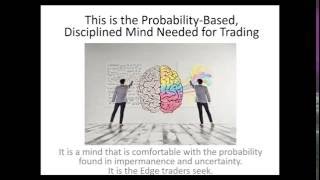
Randy Howell explains why discipline that works in other fields fails in trading. Markets are probability-driven, not controllable, so traders need to retrain their nervous system through breathing, mindfulness, and emotional regulation instead of relying on willpower and outcome control.
Questions this video answers
July 13, 2016
Group course starts September 15; meetings are at 4:30 PM Eastern and run 60 minutes (every other week).
Advertised price: "$11.95 all at once" (also offered as payments: $239 every two weeks on a 10-week schedule).
Early sign-ups receive a free emotional-regulation piece valued at $199 and a free eBook of articles.
Chapters
Welcome, everyone. My name is Randy Howell with Traders State of Mind. And we're here to look at discipline. And what I want you to do is let's put on your thinking cap and let's start thinking about the way you think about discipline. You know, there's lots of. Everybody has this notion of discipline in trading. You know, the disciplined trader. We want to be disciplined. You follow your plan, you're a disciplined trader, everything's going to work out, and people truly bring their notions of discipline into trading. And then somehow somewhere along the line, discipline evaporates and all sorts of crazy stuff takes on. Okay. What I'll do before we get started, though, just want to make sure one is that my tradition is that I do a presentation and I take questions afterwards. You are welcome to write in questions as we go along, and I will get to those after I finish the presentation. We've just found that many questions are answered during the course. And also it kind of disrupts. I'm a very simple person and it disrupts my kind of thinking and stuff like that. So I have to stay on track. So forgive me. Okay. This is what we're going to be exploring, this whole. This whole thing of discipline in this webinar. Okay? So get your thinking hats on and let's get going.
So the first thing is.
You know something? There are many people who have really produced discipline over a lifetime, and it has brought success to them and that they. They're so disciplined, they've been able to really make things happen. They're able to stay the course, they persistent, and they find that that leads them to success in many of the endeavors in their life. Okay.
And I really think, you know, this mental and emotional toughness gives rise to confidence. You know how to win and you know how to make things happen. Of course you do. And it's just logical that you would bring this kind of thinking into trading. It's just logical you'd want to do it. Okay. I mean, after all, trading is just another business, right? So why wouldn't you treat it just like a business and that the discipline that you developed in another domain and another endeavor that produced success there and gave you the confidence to get into trading, why wouldn't you bring it? Why wouldn't you bring it to trading? It's just there and it's worked before, of course, in trading.
It does until it doesn't. The real notion is this, is that people bring a lot of preconceived notions of success and discipline to trading with good reason to believe. That that notion of discipline is going to pay off in trading. And yet what we discover is that's just simply not what happens.
The truth is discipline in other domains just simply doesn't translate to trading very well at all. The mind that you bring to trading is simply not going to be the mind that brings success in trading. No matter how much success, no matter how much discipline and confidence you had in other endeavors, it doesn't translate well to trading. Controlling emotions just doesn't work here. You have to learn to manage them. That's the real deal. Otherwise you melt down like this poor guy right here. And I've seen a lot of these guys and those meltdowns can take years to occur and you die the death 1000 small cuts or you blow up accounts and you discover that what happened to that discipline? What happened to that discipline? And you know, your biology wants to control the surrounding environment. That very biology gives rise to a mind that through past success that believes it can control outcome, even if you have to fake it till you make it. Everybody's heard that saying. You come in and you go, okay, I know I can do this. I know it's possible. I know that ultimately I can go in there and tough it out and be tough and be emotionally tough and I can make this happen. I can will this thing. I can make myself successful.
And the truth is, it really has everything to do with your perception of control, whether or not you're going to be successful in trading or not. Because ultimately.
Discipline in other domains has been used to control the outcome. In a very small world, your personalized world, this is the mind that traders believe will bring them success. So it's so normal to them that they should not even think about it, not even question the form of discipline that they're bringing into trading. Why would they question it? It's been successful for. It's the frame of reference they use and have used to produce confidence and success in the past. Of course, of course it's going to work. Or that's the Alpha's viewpoint. If you're the perfectionist, you know, it's kind of like whether or not you take it from the alpha or from the control freak who's a perfectionist. The concept of not being wrong or being right is there. You know, the thing is, and what happens if you have the need, the need to actually win? What if you think, okay, I have to win? That's what discipline is all about. The truth is he has learned, either as a perfectionist or as an Alpha, he has Learned to be able to control uncertainty, okay? Unfortunately.
The trading gods just don't care.
If you got everything lined up right or not, because the worlds are completely different. One lives in certainty and the other lives in probability. And you're trying to control probability with skills that were built and learned to control certainty in a much smaller pool. So ultimately, what you've been, people who have used their discipline to produce success in another world, ultimately what they've really been is a big fish in a small pond, okay? And then until exposed to a very different world, the alpha and the perfectionists don't see that their control was really just being the big fish in a small pond and that actually their control was very dubious from the beginning. Okay? So this is the frame of reference, okay? This whole sense of being a big fish in a small pond and not even seeing that you're the big fish, it's just the way it is. I've used this system of discipline. I've been able to make it happen. But this is the frame of reference that causes you to interpret the world as you do because of past success.
It generates a certain frame of reference, okay? And that traitor coming from the success in another world doesn't see it any other way. They're not even looking for a different explanation. They know what success is. They're going to apply it to trading, okay? And what happens is that what works in that small pond doesn't work in the vast ocean of the markets. So what do you do? You try harder, okay? And when your mindset doesn't work to produce the success, you don't see the mindset as the problem. You see working harder, more control, the answer. That's the whole point. You get harder and harder. You say, no, I have to be more disciplined. I have to be more disciplined. And the truth is, the more disciplined you try to be in that way, the worse you get in emotional control and being able to move and shift from a certainty based mentality to a probability based mentality. Ultimately, the rules that govern the vast ocean of the markets are just simply different, very different than the rules that govern the little pond that you came from. Instead of being the victor in this new world, you become the victor. Instead of being the hunter in this new world, you become the hunted. Okay? How many of you people have seen where the big boys are just sitting there waiting? You can see them setting up and taking advantage of people. You, you can see them saying, okay, we've got them in this corner, they're going to flush, they're going to go nuts. We can get them. And you can see that. You can see the market makers doing it to you. And yet you keep doing the same thing over and over again, but trying harder, trying more discipline to be there. And yet the sharks are still eating you up.
So ultimately.
It is the very frame of reference or the paradigm that you're seeing through that is the problem, that you have to learn how to give up. You have to learn something different. You have to be able to recognize that the illusion of control was just that it was an illusion of control over outcome, and that it was no matter how successful it was in the small pond you came from, the vast ocean of the markets is just more huge. And ultimately what you discover is the very paradigm of discipline that you're bringing becomes a time bomb as you walk through the markets, as you trade the markets. Because the discipline just simply starts not working. And it triggers the autonomic nervous system to fight flight. And then you're in trouble, my friends.
So.
What happens is we have to come to reckon with this lack of control over outcome. Really hard to do. I mean, the point is, is that you have to explore what it means to be in control of yourself.
In the mind that you're bringing.
To the sea of uncertainty that you're attempting to navigate. Okay, so the point is the whole notion of discipline is going to have to change. It's going to have to shift from a sense of control over outcome, either by being alpha, the one making things happen, or perfectionism, not being wrong. And your discipline is going to have to be a way of getting at self control of the inner game that brings forth the mind that you're engaging in certainty with. This is where it gets really interesting and this is the puzzle that you need to solve. Ultimately, this is where traitors fail.
No matter how trained in knowledge they are, they really don't understand emotional discipline from the inside out. They think it's external control and it is not that anymore. The need for control over outcome is so deeply ingrained that it is not going to willingly give up.
This is the fork in the road that few traders make. And it's also why the vast majority of traders fail. They refuse to give up a paradigm, a notion of discipline that is clearly not working according to your trading account. You may in your mind have it that it's working, because this is what I know to be true. This is what's produced success. It did in that domain in another world. But we're testing it.
By the logic and by the rules of this call, this ocean called trading of the markets, okay? And there it doesn't work. And the question really becomes, am I going to see that discipline, my notion of discipline doesn't work and change my notion, or am I going to continue working harder and harder and harder till it's all over?
And just because you cannot control outcome in the vastness of the markets doesn't mean that you cannot control the mind, okay.
That you bring to navigate and the currents of the markets. Ultimately, you control performance mind, not outcome. This is the big thing that people don't get is that you don't have control over outcome. That's why this trading is a probability game. You never know. What you control is the mind that you bring to manage uncertainty, the ambiguity, the absolute uncertainties of the markets. So you're doing that and you're going, oh, okay. So after I learn all this knowledge and after I've been sold all this stuff about, you know, just take this, that just this course, my way of teaching, my way of understanding the markets. This indicator, this signal, this read this, this. No, ultimately it falls back down to once you have that knowledge, you have to develop the mind that's going to apply that knowledge.
That's the holy grail, friends. So you've gotten that and you're going, okay, well, shoot. The brain and mind can be trained to engage uncertainty very differently than evolution. Evolutionary pressure designed us understand. We are creatures that grew up on the African savannah where life and death were really serious and we were not big creatures and there were plenty of predators looking for us. We had to learn how to trigger, to fight flight very quick. And we had to assume negative intention, okay? That was built into us. You look at the news and what you see is you see this. You see how you're drawn to negative stuff. That's why they give you all this negative stuff. There's great stuff. I mean, you know, I read the Wall Street Journal every. And what you're looking at is they're talking to you about possibilities. They're also talking about bad stuff, but you're also seeing that they're talking about the way people are seeing things. The people that, what risks people are taking. And they have a different view upon a regular newspaper or regular nightly news where they're talking about the latest guy who got murdered. But it draws the brain to it because the brain is attracted to that danger so it can avoid it. This is what happens. This is the brain that you bring to trading, okay? It takes conscious and intentional effort to change this mind. But the truth is, is that it's very obvious. It can be retrained.
So the first thing that happens is you go, okay, the body and the mind. I understand now, Randy. The body and the mind are going to resist this new way, engaging uncertainty. I get it. And what I also get is that I'm going to need to have a different mind that engages uncertainty and engages probability. And it's going to take work and effort. Okay. Because ultimately, what it really boils down to, this is the question that's answered in my courses, in my work. How do you build the probability base mind from the survival base mind you brought to trading and friends? The truth is, is that it's not an option. It's not an option. You see that every day. You recognize that 90 to 95% traders are regularly losing money and that most traders have burned through their capital in three years. Whether or not it's by ignorance or whether it's just simply refusing to change, ultimately what you see very clearly is they are not changing the mindset about discipline that they're bringing to trading.
Even when the trading account is demonstrating that it is not effective for extracting capital out of the markets, they continue. They're trying to be disciplined, they're trying to be persistent. They're not going to give up. Well, the truth is, at some moment you have to recognize that the trading account is your best friend. It's telling you how effective are the beliefs that you have about your ability to manage uncertainty, how effective they are about being able to extract capital out of the markets. That's what you're seeing every day. Once you know how to trade. So you get in this, you go, wow, I need to. Yes, you are going to have to build this and what you're going to have to undo. Every time your biological system engages uncertainty and perceives potential loss, this is what happens without training. You see that? You see that dog? You see those two dogs? That's fight, flight. You see aggression and avoidance. Yet at the same time with training, what you're also looking at is a human being engaging a lion. It's really interesting. One of these stories about the Buddha is that they were traveling in an area of India that had a very dangerous tiger in it. And that tiger was man eating. It had already switched over and they heard this tiger was in the area and everybody fled except for the Buddha. And the Buddha sat, the tiger came and the tiger walked right past him and nothing happened. The truth is the Buddha had a mind that was managing fear. He was not giving Off. He was not triggering to fight flight. In fact, he was controlling himself so that he was in the parasympathetic sympathetic nervous system and wasn't giving off the vibes, the smells of fear. This is what has to be learned and it can be learned. Okay, this is the deal.
Oh, freeze is anytime. Basically the motivations are like this is that once fight flight triggers the fear responses, the motivations of fear in particular are to freeze.
To run, to hide, to submit. Those are called the four sub motivations of avoidance.
Which is the fear based response rather than the attack based response. And what you're looking at in the other picture over here is the German shepherd is in the attack motivation, whereas the cocker spaniel is in the flight motivation. The thing is, is all those things, the freeze is simply a part of fear in the association that your brain, that your emotional brain is sitting there and it's interpreting the facts as that this is a danger. It's a danger to life itself. I'm freezing just like.
This morning. I was on a walk and I was with my dog and my wife and we saw a rabbit. And what happened? The rabbit froze. My dog didn't see it, nor did he smell it. And a rabbit has a very neutral smell. So it's not like you're going to sniff out a rabbit. So he froze. So understand that in the fear response to threat that the rabbit was having, he froze. It was very useful. Okay, it got him. Not chased by my dog. At the same time, in trading, there is no biological threat. The there is psychological discomfort. And freezing in the midst of the uncertainty does not bode well for you taking effective action. You're back there with this poor dog right here. The cocker spaniel hasn't chose to submit, hasn't chose to freeze, hasn't chose to run. It's sitting there in that nanosecond moment before action occurs. In the other scene, you're looking at the ability of a man to regulate the emotional response to incoming information. He's not reading it as threat. In fact, he's manufactured it and he's developed himself to read. Calm, patient, curiosity, very different mind. Okay, so here we go. And that's a good question, by the way. The next thing is this, is that.
Traders, when they see this response, the thing is that most will avoid doing this. Unfortunately, this is the trap that sinks most traders capital. The truth is that you already have a fear response and you don't take care of the fear. You try to ignore it and push it away. You don't learn to regulate it and work with it, then you take some serious losses and then you have trauma, okay? And everybody's experienced it. You've experienced, you've experienced fear of missing out. One of the guys I work with right now, and by the way, for you, for those of you who don't know, FOMO is the fear of missing out, okay? It's very common for traders who have finally gotten to the moment of break even or scratch traders where what they can't do is they will come into, they will come into a trade, they will finally get into the green and they just absolutely, this fear of missing out just grips them and they want to take that little bit of profit that they have rather than risk it hitting a target. And it makes sense at the time, but it's an untrained mind and I get a lot of the traders like that and they often think, well, if I can only get the fear of getting in, I'll be okay. And then they find out that it just goes another place. But avoiding it isn't working. Okay? It is this link between uncertainty and fear and aggression that has to be reconstructed to build a probability based mind. And again, it's not really a choice. If you've ever revenge trade, you know what it's like to blow up perfectly good capital if you've over traded. You've seen the aggression, the lust to make something happen. You've seen it turn against you with the fear, the freezing or the avoidance. You see that all the money that was just sitting there waiting to be had, that you left there because you couldn't act. So the key is it really boils down to it. How do you go about changing this? Okay, there is a lot of talk about changing. I see it all the time. You know, you're supposed to do this, you do that. You know, there are people who can describe what the mind needs to look like on trading really well and they give you these prescriptions for visualizations and affirmations and you know, might as well throw some Hail Marys into it. The point is, do you think your emotional brain cares if you have affirmations and visualizations about success? No. It cares when it's in the midst of being threatened by that financial loss. It cares to trigger, to fight and to flee and it will take over the mind that you need to trade in a heartbeat. So there's a lot of talk there. But the truth is, how do you go about really changing, changing your sense of discipline, changing how your emotions respond, threat, respond to Uncertainty, how do you actually do it? Okay. And it just so happens that you've come to the right place, okay? Because what we want to do is here.
Is that.
Logic serves emotion. You need to get that in your head really well. We all see ourselves rationalizing something, okay? This is simply the left brain logic producing an explanation for what the emotional, the right brain, emotional brain has already decided. Think about it. When you're, when you're deciding not to get into a trade, when you asking for more confirmation, it seems right at the time.
That's because the fear circuits and the cortisol has produced a fear based mind and the logic is serving fear. Oh my God, what can happen if I get in? I could lose. And so therefore you rationalize not getting in. Same thing with when you chase traits. You look at it and suddenly you start saying, oh man, you feel the lust, you feel that need, you feel the greed, you feel the need to chase. And there's all sorts of logic circuits that go on and say, yeah, yeah, yeah, get in, get in. Then it really blows up your face. So.
You experience all this stuff going on in trading all the time. What most people are trying to say, you know, is like, you know something, you know, you just don't have emotions when you're, when you're trading. Well, that's impossible. The only time you don't have emotions is when you're dead. And the emotions that you're in is producing the kinds of explanations your left brain is going to make. So this, friends, this is the, this is the fork in the road. This is going. Okay. I know that without emotional state management and understanding that what my biology is going to do and how my mind's created out of that biology. I am a sitting duck if I don't train myself for these new conditions in this vast ocean. A sitting duck. And if you're okay with that, I'm fine. But the thing is, if you're going, oh my God, I'm listening to what Randy's saying and he's basically saying is you need to get your emotional ducks in order if you plan to be a successful trader. And it's not going to happen without you doing that. There is no magic bullet.
Though lots of people will have you believe that and they keep on making it your fault. Oh, if you just follow this plan, you can do it. Well, if I could follow the plan, I wouldn't need to be even in your, in your class.
Emotional state management, friends. So it gets here. It starts with basic emotional regulation right there. I'M going to give you an example. The other day I was watching a client of mine trade on Skype and he was at a moment where he was literally having to make a decision about whether or not he was going to stay in that trade and potentially get a really nice, really nice profit or get out of that trade and take a small loss. I'm looking at him and all of a sudden his breathing stops. I can see that his shoulders are tense. I'm seeing him just riveted onto his screen. He chooses to stay in the trade and loses. Okay, that may have happened anyway, but what I want you to notice in the stopping of breathing, in the rigidness of the muscles and at the fixation of the mind, what he's done is the autonomic nervous system has gone to fight flight. He's ready to fight and he's retired real estate developer, so he jumps into a lot of stupid things, okay? So you're looking at it and you see that he did not practice emotional management in the moment when he needed to be. Whether or not he would have chosen to stay in or out of that trade, I don't know. But I definitely, I was sitting there looking, going, well, this guy's already decided to go down fight flight. He's going to logically produce an explanation from a mind that is aggressive now, okay? And it cost him. So that's the first thing. And of course, in my work, the very first thing that you encounter is you learn to, you learn emotional regulation, skills of breathing and attention reduction in what I call the classroom.
And then what you do is you begin practicing them not in the classroom, but in the real environment of trading, where you're going to have to learn to change the way you're breathing, change the way that you allow the body to just go get hammered. Because ultimately your mind is part of that body. And if you're not managing your body, you're not managing your mind. And if you're not managing your body, you're going to be compromised with the mind that you bring to the management of uncertainty. It's that simple, friends. So that's the base. That's the first skill you're going to have to learn. The second one is mindfulness, or what I would call metacognition. And this is when you learn, this is powerful too, is that you and your thoughts are not the same. You are born into a history, okay? And you, your brain organizes you around that history and you begin to speak, that history begins to speak. You, thoughts are having you, you're not having them long before you can think. This, my friend, is the mind that you're bringing to trading. This is the link that has to be deconstructed and rebuilt to move from self preservation thinking to probability thinking. This is where the magic's at. This is when you begin to say, my God, you know something, I need to take a Look at this 3 1/2 pound of convoluted gray matter and white matter and I need to really rethink it and I need to, you know, I need to start seeing that it's just not some monolithic mind going on. No, this is. Your brain is an electrical organ. There is electricity going on in there. Everything, I mean they, even the brain, even each circuit, neural circuit is actually wiring and the brain actually coats it and insulates it so that it's not. So the other electrical influences don't influence those charges. And ultimately what you discover in there is that your brain is a community of rival emotional programs that has organized you into a particular self. And if you want to see a great rendition of this, get the movie inside out they show you and it's neurobiologically, it is an excellent movie and a depiction of how the emotional programs form a mind that goes out and does things in the world for better or for worse. And then what you recognize in this miracle that occurs between brain and mind is that somehow, through a miracle beyond my reckoning, suddenly those emotional programs are given voice.
In your thoughts, in your mind. And suddenly you realize that there is no singular self in the mind. There is a community, there is a neighborhood that you have left untended, unattended.
And there are enormously destructive qualities in that mind. And there are constructive qualities, but because you have not been an observer to it, it's run wild on you. And in trading.
There is no, there is no give way. You are either going to learn to manage that mine and reorganize it into higher functioning or you're going to blow your capital. It's only a matter of time. And this is what I like about trading, okay? So ultimately, until you're willing to warm up to this concept, it's going to be really hard to develop the trading mind, okay? Because this is based on a multi self mind, okay? And you're looking at it and going, okay, I get it, there's some bad guys in the neighborhood of my mind. There's some good guys. And what happens is I've been blind and I need to wake up from my slumber and my sleep and I need to clean house and I need to organize my mind so that it can function properly with probability. You see the difference there? You've left it alone. And certainty based thinking has dominated. And here you are needing to change.
And it's not like this mind that you brought to trading is wrong.
It most likely has produced a lot of success over time and it's served you well, particularly in the area of survival. That's what its job is. And particularly in other endeavors when you were a big fish in a small pond. But now we're in trading, and that mind just doesn't work in trading, okay? Survival emotions are dangerous in trading. And it doesn't matter how much you want to win. It doesn't matter how hard you're willing to work. What matters is can you manage the mind that you bring to the management of uncertainty. That's the only thing that ultimately matters. And that is when you develop a performance mind rather than an outcome goal oriented mind. It's a big difference. Okay? So if you want to bring caveman around, you can. But the deal is this.
The trick is in training certain emotional programs to come to the forefront of the mind when exposed to uncertainty rather than the historical survival ones, your caveman brain, okay, this. Trading is the key word here. This training is essential. I can tell you this, is that.
Trading presents the antithesis of what the brain as a survival organ was designed to do. So literally, it is going to require retooling. Don't believe me? Believe your trading account though, okay? You can either be sitting there and having thunderclouds and everything blowing up around you, you try to manage uncertainty, or you can begin to see the light of knowledge and realize, you know something. I can win at trading. But the truth is, the I that I'm bringing to trading has to change.
So the point is this.
Engaging uncertainty with a disciplined, impartial and patient mind, very different than engaging it from a fearful mind.
As a mind that has something to prove a need to win.
This is the edge, friends. This is the mind of the hunter rather than of the hunted. And you're recognizing that you know something. What I've done is I've been living in this illusion of control. And what I'm recognizing is I never had control over outcome, not even in my real life. You know, happens all the time where you think you're in charge, you're large and in charge, and you know, all of a sudden something will whack you. And you know, life. Life is what happens when you're busy doing other things, and suddenly it shows up and you realize you didn't have nearly as much control as you thought you did. You know, it's interesting as I. I see a lot of men who work very hard in their careers and they're in control and they're making things happen. And they have in their mind, they're doing this for their families, they're doing this for their wives, and they want to get this thing, and they're out and they're doing this, and they're large and in charge. Meanwhile, what happens is their wives and their children grow apart from them. And all of a sudden what they discover is, yeah, they had been dry, yes, they had been climbing the ladder of success, but it was on the wrong building. And they recognize that they really never really had the control they thought they had. Trading simply forces you to accept that you never had control in the first place. Not over outcome, okay? But you do have control over the mind that you bring to trading. This is the big key, friends. And all of a sudden you begin to realize, hmm.
How do I learn to do that? Well, the truth is, in the same way that there is an inner critic in your head that's telling you that you're not going to make it, that's telling you you don't have what it takes. That's saying you have to make a lot of money to matter. That's saying that, you know, you'll feel really good if you make a lot of money. In the same way that you have a fearful, childlike quality within you that is scared, that freezes.
That's part of that mind. That's part of that community of the mind. And unfortunately, what happens is most traitors. That's the only. That historical dialogue is the only dialogue that runs in mind under pressure, under stress.
Because they have never learned to access different emotional programs in the brain. In the courses that I teach, what you learn to do is you first learn that. Know that inner critic, that criticism, that judgment, that temptation of that inner critic is never going to go away.
Never going to go away.
The fear of the orphan, the need to prove the self of the orphan nature that you have, it's not going to go away either. However.
What you can do is develop other emotional programs intentionally. You can develop the discipline of a ruler. You can learn literally to go. And I actually teach it in a very specific way where I'm using the way that the brain takes an experience and. And encodes it in a particular way into a memory. And what we're doing Is we actually go in and we deconstruct that memory and we find where the emotional programs of discipline.
Of courage, of self soothing impartiality were in fact part of the performance mind that allowed you to move through and manage uncertainty. We actually find those programs that, and I teach you literally how to pull those forward and to say, well, you know something, I can either face uncertainty from the mind that I came to trading with, which isn't working at all, or I can develop a new mind that engages uncertainty from this disciplined, courageous, self soothing, impartial state of mind. And what you discover is, oh my God, I suddenly have the discipline to maintain order.
Under the uncertainty that governs trading. You're no longer in control of outcome, but what you've done is you've found an inner control that allows you to trade your plan. And at that particular time, if your plan does in fact have an edge.
You'Re able to capture that edge rather than blowing up that edge.
That's the trick.
So if you've had the time and the money to do it the hard way, the markets will oblige you. Okay. You know, eventually it may be that you can learn how to do this though. I talk with people who trade for 5, 10, 15, 20 years and they're at best scratch traders or they're minimal traders. They're not producing what they know can do. They finally come to the moment going, yeah, something I was fooling myself. What I recognize is that I really, truly need to develop this emotional side of my mind because it was driving the cart anyway. I just deluded myself into believing that I had the cart before the horse and the cart was actually going without the horse. I'm going to grow up, I'm going to recognize that not getting anywhere without self development of the mind that I bring to trading. Okay? Professional athletes have sports psychologists. Most truly good business people have coaches that help them move from one area to the other. Why in the world wouldn't a trader, and I'm going to say this really blunt to you, how stupid could you be to think that you can move from one echelon to another one without developing the emotional talents that allow you to perform at a new level? Okay, that's what I'm challenging you to. You got to do it, okay? So. Or the markets will be very happy to teach you, you know, and.
You, or you can take a shortcut. Okay, you can learn to become the change. And here's my invitation to you. First of all, let's get to the point where you Actually, I'm not trying to talk you into a course. I want to open the eyes of your mind to recognize that you're going to have to redevelop the mind for probability thinking. There's nothing wrong with your mind. Okay. However, God did not create your mind to manage probability. It was created through evolution to manage survival. You're going to have to take that leap and intentionally develop it. And if you want to. Okay.
We have a very powerful group course that is starting in September. It is, people say it is the most cost effective way that they've gotten this and it's highly effective. And what it does is it meets five times in group settings and you have a virtual classroom that you go to and you work through a progression where you literally learn the skills of emotional regulation, then mindfulness. Then you turn and use that mindfulness to open the door and find the internal dialogue that has been blocking you from performance.
Then you learn how to find and use the emotional programs of discipline, of courage, of self soothing and of impartiality and to develop the mind that way to engage. And then you turn back to the uncertainty, engage from there. Powerful stuff. And it's $11.95 all at once. Or you can get it as a on a payment schedule of where you start. You start with 239 every two weeks and it's a 10 week course. It's very, very powerful. It teaches you the basic stuff that you nearly need to know to be able to produce the probability baseline. Okay. It's powerful. And if you sign up early, which we recommend because this course starts like the tread hits the road, full speed, I will have been expecting you to already be engaging the emotion regulation work at least for a week before you get to the first class. If you sign up today, you're already two weeks behind. What's very smart and what's very. One very smart Romanian guy did is he said I don't want to wait that long, I want to start working on this. He said can I buy the course now and be working on it and then, then take the course when the course actually opens up. And I said, well, I wish I had thought of that. That's a really smart idea. And people get a head start. That's what we recommend. Okay. The other is the individual course friends. The individual course is for people who are very serious about this and are saying, you know something? I know that it's really better to have a mentor and that I need a mentor to guide me through this mind stuff because I obviously haven't been doing it very well. And what you discover about it, it is far more comprehensive. It is far more personal than the group course. But for most people, it comes down to money. If you can't afford the individual course, the group course is a phenomenally good value and you will learn truly good skills. So how do you decide? If you're really looking at it and you're saying, you know something, I really need to do something about this. What I suggest is simply saying, you know, I want to talk to Randy about this. We'll get a free consult. And all you have to do is you go to our website, you hit the free consult or whatever, you know, talk to us something form.
The contact us form, and. And you simply ask for a free consult with me. And we. And we design it. And also, again, if you sign up early for the group course, we're going to give you a free gift because we want you to be ready. And it's an emotional, regulation piece that is in addition to what you're going to be learning. And it's $199 value. If you go to my website, people buy that $199. I'm willing to give it to you free because I want you to get started on this course and I want you as motivated for you to grow as I'm motivated for you to grow. That's why it's there. Okay? And the other thing is that you might also, when you're there, go ahead and get my. I have a free ebook. It's a free gift. Come and get it. It'll get you started. It's a number of articles I've written, and you really begin to see how this works for people who are just getting to know my work. It's a great thing to start with. So I want. Here's the challenge I ask of you. I encourage you to seize this moment, this day. The opportunity is open right here, right now for you. Okay? It's your potential that's calling out to you. You're going to have to decide whether or not you're going to develop it or whether or not you're going to hope your ship somehow comes in.
What I'm asking of you is, do you answer the call? That's really the deal. Now, if you have questions, please type them in. We have a few minutes. If you have questions or observations.
About my work, what I've said, the courses.
Let her rip. We've got a few minutes. And what I'm going to do as we Sit here and see if anybody does have any comments. I'm going to be signing off. And.
The first thing is I want to let you know that I really am delighted that you showed up. I really enjoy talking with people and sharing this information, this whole new way of viewing the world with them. And I love people's eyes being opened up to new possibility. It is to me one of the most powerful things. It brings great joy and meaning to my life. So. Okay, what I'm. I'm not seeing any questions, so I'm guessing I did such a phenomenal job or not that all your questions are answered. And what I'll say is, is there is a recording. Okay. And what happens is you will be getting, you'll be getting a recording, a link to, to this recording. So as you know, if you want to review it, think through it, it'll be there for you. Okay. Here, oops, here's a question. How do we know it will work on me?
You don't. In the same way that when you trade, do you know you're going to win? Of course you don't. What happens is that you, you were thinking from a certainty based mind. I'm asking you to realize that if you're going to be successful in trading and in making decisions, you're going to have to use a probability based mind. If you come to the moment of really needing references and things like that, I'll be glad to give you plenty of references of people who've done this work and know the value of it. Be happy to do that. I get a lot of people who actually say, well Randy, can you fix me? The answer is no, I can't.
What I do is I teach skills that allow you to transform the mind that you currently have into something new. But the thing is if you don't do the work, then no, nothing's going to happen.
So will it work for you? It's all probability, my friends. I would say that it's a high probability. I have people in this audience right now who worked with me and they can let you know what, what they thought of it. Okay.
What time are the group meetings and how long?
Okay, they're 4:30 Eastern.
An hour and they, they last 60 minutes and there and you get a recording of it. I think the date it starts in September 15th and then every other week after that. And the thing is, is that a lot of people, we have a lot of, you know, this being working across the globe. Everybody's time challenged, everybody's time zone challenged. And what we discover is the recordings are enormously important because a lot of Aussies, a lot of people from Hong Kong and Singapore.
Just simply can't make the meetings. Okay.
And what happens though is you end up getting recordings of them and they're yours for free. We send them to you, you keep them and you listen to them as many times you want. And a lot of people do that. And that's the way a lot of people work with all that time zone stuff. Okay. You know, ultimately if you're in the trading business, everything somehow ends up revolving around New York times. And so 4:30 is. You can see that where that's at. How does the probability mind translate back into non trading world? God, it opens up possibility. Most people discover that as they learn to develop this probability mind, they're no longer seeking control. What they're doing is they're seeking what probabilities, what possibilities are showing up around them that they never saw because they were trying to control things. Reports to me is that marriages get better.
Relationships with key people, their ability to think, their ability to produce effective action in other domains enormously improves. And actually this work, I used to really be more of an executive coach and it's just that this trading stuff just took off like a rocket and you know, and I started specializing and getting the language is there. But the truth is now this thing you discover very quickly that the probability based mind, once you grasp that you never really had control in the first place, is that this allows you to let go of that nonsense and open up to a very powerfully new way of being and living and inventing in the world. That's actually what I would much rather see. Okay, so friends, I think we're through.
So.
Oh, oh, oh, oh. Now I understand. So anyway, I thank you for your time. I thank you for the generosity that you have given me to share time together and to share this moment together. And with that I wish you all well no matter what happens. And at the same time I challenge you. Is that what are you going to do with your trading mind now that you have all this knowledge about trading and you realize that that's not enough, what are you gonna do? Check my stuff out. Okay, Check that group course out. Check if check. Get my book. Get the free book. You go to my website and it, it's accessing an enormous amount of free content. Okay? I have 75 videos on YouTube. People have libraries of my stuff and they listen to me constantly. The thing is explore, learn how to retrain your mind for probability thinking. Okay? With that, I thank you and I wish you well. Be well, and may prosperity find you. Okay, thank you.









