2016 09 08 16 31 Invisible Walls Turning Your Trading Fears into Personal Power
Webinar-style talk (Randy Howell, Traders State of Mind) about psychological barriers (“invisible walls”) that keep traders from realizing trading potential. Howell explains how instinctual survival programming (amygdala/limbic responses, ‘caveman’/‘800‑pound gorilla’) sabotages probability-based trading, and presents a skills-based remedy: emotional intelligence, regulation (breathing, tension management), applied mindfulness, intentional rituals, and vigilance. He describes group and individual courses (10‑week group program with recorded virtual classroom; individualized mentorship over months) and practical guidance such as optimal focused trading windows.
Questions this video answers
10 weeks, with five group sessions and access to a virtual classroom and recordings.
Access fee mentioned $11.95 (one‑time access to virtual classroom); alternative payment plan: five payments of $239 every two weeks.
Approximately $3,500 or three payments of $1,200 (over ~90 days).
About 80 videos on YouTube.
Typically between 45 minutes and 1 hour 15 minutes.
Chapters
Welcome, everyone. My name is Randy Howell with Traders State of Mind, and I am delighted that you're here. And wow, it's September. How did that happen? We're like heading into the fall and. Are you ready? Okay. That's what I want to really want to do is we're going to be looking at invisible walls. You know, the kind that just keep popping up and holding you back from your trading potential. You know.
We'Re gonna have to really begin to say, you know, what is trading? What does it take to become an effective trader? Well, you're gonna be seeing something here that I hope you really take to heart because this is one of the necessary things. It's one of the biggest things that are missing with traders, and I can't understand why. Before we get started, I just want to make sure is that I see my voice, but I would just want to hear if you would just type in and say, yep, I can hear you, Randy. Just type in. Yes, of course. If you can't hear me, you won't be putting in. No, will you? Okay, we're good to go. Okay. As usual, I am going to hold questions toward the end. I find that I cover the material better and people have more reasoned questions at the end. So you ready? Okay. You know, ultimately.
Traders start out their trading journey as a quest of knowledge. They sit there and say, you know something, I am going to arm myself with this knowledge and finally I'm going to come to the moment where I break down the walls, I climb, I climb the stairs to victory. And believing that knowledge will set them free, okay, that's the whole deal. But as they settle in for the long haul, what they discover is something different, that they're invisible walls that separate them from success. And they start going, well, what is this? Is this more knowledge? You know, do I need another teacher? Do I need another system? Do I need a needle, whatever? And finally, after two or three years, what they discover is that.
The invisible walls don't go away no matter how much knowledge they have, and that success they're seeking is still elusive. How many times have you thought that was success was right around the corner, that all you needed just a little bit more, you almost had it, only to find that there's something you're not seeing. In yourself, no less, that is the invisible wall between you and what, you know, you can be doing in trading. And it's kind of like going, you know, I can't see it. I'm behind bars. I don't see the bars. You know, if Only had one more insight, one more thing, and ultimately what you really begin to discover is that truth is in the eye of the beholder. You're looking at a graphic where a number of blind people are examining an elephant. And because they're myopic in their vision, they can only see a little bit of that elephant. They come away with a very, very small understanding of what they're working with. Your beliefs and biases are blinding you and keeping you stuck in a way of seeing the world that keeps you stuck, much like these people. You know, the thing is, is that, wouldn't it be great? You've heard that expression, you've heard that expression that you know something, Trade what you see, not what you feel. Well, the truth is you cannot see unless you're feeling something. Just like these blind people who are examining the elephant. They only see the. They only perceive one small element of the elephant, and then they describe the elephant as if they're seeing the whole. That's what happens here. So what we really want to do is we want to start looking. What we realize is that we see through unconscious beliefs and biases. That's what gives form to your world. The only thing that you can trust that will give you really solid feedback about whether what you see or not is effective or not is your trading account. It will be brutal, but it will tell you point blank whether or not the beliefs that you're projecting upon the markets are in fact effective enough to extract capital out of those markets. That's what we're looking for. Otherwise, you've got an invisible wall staring you in the face and you don't see it.
And truth is, you don't see those beliefs and biases, but you know they're there because of the sabotage of performance that keeps on happening. You know, I just, just. I'm almost there. I'm almost there, but I keep sabotaging it. I keep sabotaging myself. I don't understand it. What am I not seeing? The truth is, you're not seeing a lot and you keep torpedoing yourself. Just like in this example, the submarine and the torpedo. The problem is you don't see that. You're doing it to yourself. We're going to take a look at that and we're going to be able to start seeing what we haven't seen. For instance, right here, Is this a duck or a rabbit? Why do you see what you see? Under the pressure of risk and uncertainty, struggling traders see a different world than elite traders. As a matter of fact, elite trader may Say, I actually had this guy say this to me. He says, randy, I don't really, you know, I trade blood. I trade, I see what other people are doing, I see what novices are doing. And I realize that it's easier to trade that blood than any other thing that's more than technical analysis. But the truth is, is when I look at this particular graph, it constantly goes from rabbit to duck, rabbit to duck, and it totally confuses my mind. It wants to make something happen. It wants to see a black and white reality. But the truth is, is that.
It'S ambiguous, you know, and you begin to allow it to be ambiguous and you start seeing it flip through, then you notice the discomfort. You really want it to take form. But what if that forcing it to take form, tasting, forcing it to look concrete, like something is in fact the problem. Because ultimately it's not the information that makes the difference.
You know, a lot of traders have great information.
It's the observer of that information that makes the difference. Particularly when old thought emotional programs are triggered by risk. Because what you're going to be discovering here, that your survival brain, your emotional brain and your higher brain order do not have the same interpretation of risk as you do. Okay, and I'm going to give you an example. A couple years ago I was working with two traders at a hedge fund. And one was. Both were initially having trouble and one started working with me. And over a period of time he became quite a trader. The other guy, not so he was profitable, but not on the level of this new trader. And ultimately what happens, they were best friends, they were side by side, they used the same system, they used the same feeds, they had the same indicators and they talked the trades together. Yet one was really profitable, the other was marginally profitable. The only difference was the observer observing the information.
That's what we're talking about here. The invisible wall.
Is the observer that you bring.
To the interpretation of information. That's the big difference. So ultimately what you discover, it's not really the IQ of the trader that matters.
What it really amounts to. It's the eq, it's the emotional intelligence. Traders ignore what their own trading account is telling them all the time. They just don't want to listen. They will ignore it all the way to the poorhouse. And you know, it's really interesting, I know that a number of traders have also been through the AA movement. And here's the deal about aa, they actually call this the white elephant in the living room. There's this big elephant in the living room of a family. And what they're doing is everybody's ignoring how tough it is to get around in that living room. They keep quiet, they make up lives, yet they're pretending not to see what's there. In trading, it's going to cost you money. Okay? Your trading account is saying if it's not performing well, it's telling you you're not seeing something you need to be seeing. And it's right in front of your face. And it's about the beliefs that you're bringing to manage uncertainty. That's the kicker. That's the kicker, friends. And ultimately.
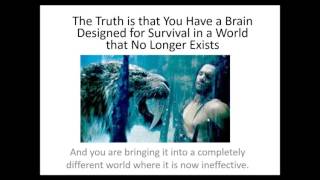
The truth is that your brain, the one that this marvelous brain that you have.
Was designed for a world that no longer exists. It was a very dangerous world. It needed to be very instinctual. Okay? And ultimately what happens that instinctualness is, that's what you don't see. You don't see the survival programming firing right in front of your face. Yet that instinctual.
This is bypassing your thinking all the time. And ultimately what traders are doing is they are trading with an emotional brain that's not connected to their thinking brain. Left to its own devices, the emotional brain is going to be taking feed from the brainstem, all the information coming in from your sensory modalities and your heart rate and stuff like that. And it's going to be making lightning quit emotional decisions that do not include thought. Okay? That's why, for instance, if you have this great trading plan and you're gonna follow it and you've got these, you, you've got a set up evaluations and you know when that trade's warming up and you know when it says I should be entering and stuff like that, and you find your finger frozen on the mouse, what you're doing is you're, you are actually experiencing this survival instinct. It has taken over. Without your awareness, without your thinking, your thinking mind is still saying, what am I doing? What am I doing? Why can't I pull the trigger? Meanwhile, because you don't have connection to your emotional nature and to particularly to your instinctual nature. You're sitting there, you're missing it. The thing is this, is that.
Your emotional brain, your instinctual mind does not make the distinction between that saber toothed tiger right there as a threat to your, as a risk to your biological existence and risking capital, and that caveman in that photograph right there is with you every moment of your trading life. If you don't know that caveman, then how are you going to spot and differentiate the Saberthrough tiger and the risk that it means and the risk of managing capital. There you go, friends. That's it.
Ultimately, the survival programming is what keeps you tripping up. Remember, it was built for another time in another place where there was a very dangerous world. When was the last time you saw a save with two tiger grab you through a screen? Never. But you've experienced a survival instinct. Feeling risk of capital and thinking that you're biologically under threat and grabbing you and throwing your thinking mind away and spitting you out. This survival programming.
Is tripping you up. Unfortunately for you, it's on automatic and acts outside of your awareness. And until you start learning how to. Man, I've got to start really figuring out where this is. I need to start going, you know something? I realize this instinctualness in me.
It happens. Precognition. I'm going to have to learn it. I'm going to have to learn about my emotional nature. I'm going to have to learn how emotions run. Otherwise, the unconscious mind with all that programming for survival, you know, fight, flight, freeze, submit. Okay, all that anger, attack, revenge, trading, all that stuff takes over the mind in a heartbeat. Meanwhile you're sitting there pretending it's not there. Meanwhile, caveman.
You'Ve ignored him and he's blown up. He's blown up your trading account. This is what we need to be looking at. So ultimately.
This is the 800 pound gorilla every trader is trying to ignore or the elephant and you keep falling for it every time. The thing is, is that the gorilla is there, he's in the room. What are you going to do about it?
I know it's really interesting is a client of mine said, you know something, Randy, I am really, really pleased with the progress I've made in working with you. And interestingly, I went to a guy who struggles just like I was struggling and I told him about you and said, you know something, you really need to talk to this guy. He's made all the difference in the world. And he said, oh no, oh no, oh no. Nobody's going to get inside my head.
You know, interestingly, first of all, I don't get anybody's head. But what I want you to recognize, this guy actually chose to continue to destructive trading patterns, survival patterns, rather than to change the comfort zone and to reach for a different plane. He wouldn't deal with the 800 pound gorilla in his midst. Why is it so important to. Well.
It'S here, it's called what you're looking at down at that in that graphic. When you're seeing fear, you're seeing brain stem. When you're seeing the amygdala and you're also looking at the limbic system, that's the emotional brain, what you notice is that there is a direct feed going from the information from the brainstem into the amygdala. The amygdala has already made decisions about fear based content. It's already made decisions about risk as a biological phenomenon rather than as a capital risk. And notice is that.
The thinking brain hadn't even got involved yet. That's how clueless most traders are. If you want to maintain that. My hope if you and want to make a small fortune in trading is I hope you start with a large fortune. Because ultimately you're not understanding what you're trading. You don't understand trading at all. You may have knowledge of trading, but you don't have the intimate knowing of trading that allows you to to be able to manage emotion, to bring emotion to the head, to create the mind that engages uncertainty. So you're looking at this and you realize that you know without partnership you're never going to learn to trade. That's just the simple thing is most people, particularly men, ignore their emotional brain at tremendous risk. Before they got into trading they could and they got away with it. But when they got into trading, things really changed is that that survival instinct kicked in because you could no longer control outcome. Because you could never control the environment in trading and for the perfectionist in you is no matter how right you were about your decisions, you could still be wrong. It was all just probability. You are throwing the emotional brain for a loop and you keep pushing it, pushing it, pushing it, not recognizing that man. Until you get this emotional brain under management, you can't think under pressure. Otherwise survival instinct takes over. That's the deal. So there you go and all these.
You know, ultimately this.
Absolute manifesto against uncertainty. Your brain is so against uncertainty that it will prefer a reassuring lie to the truth to stay away from uncertainty. Understand when uncertainty triggers, what follows is vulnerability. You feel it, you feel vulnerable, just like that caveman did facing that saber toothed tiger. The moment that you feel vulnerability, you're experiencing discomfort.
And we people in the 21st century have so gotten away from the experience of discomfort. The truth is, is you should be feeling uncomfortable. And you need to build a completely new relationship with discomfort. That's the whole deal. We don't know how to do that. And because of that, what triggers from discomfort and is fear, now we're into the biology of it. Okay, now we've got biological threat. The moment fear triggers, guess what, friends, Survival instinct triggers. And all of a sudden, thinking mind is hijacked and you're acting on impulse, you're acting on reactivity. You are literally reacting on default programming from 65 million years ago or 6,7 million years ago, depending on when you want to define mammalian into human. So you're looking at this going, now this, this caveman is your partner. You're bringing him or her with you every day into your trading mind.
And yet have you accommodated and said, you know something, I need to integrate this thinking part of my brain with this caveman part of my brain, because, man, if I don't, the 800 pound gorilla shows up. But ultimately, from fear of loss to fomo, fear of pulling the trigger, all those fears, fomo, I'm sure everybody in here understands it's a fear of missing out on profits. That's when you jump out. When you first get, you know, you get a little bit, you know, you finally, finally get some profit there and you want to take it because you know, you have this voice yelling in your mind saying, if you don't take that profit right now, it's gonna be taken away from you. The thing is, is all this stuff.
All these fears, psychological fears that we distinguish in trading come down to an instinctual fear of the unknown. Hence.
You need to control, okay, control the environment. You don't experience the uncertainty of the unknown. You want to not lose. You want to be perfectionistic. And you'll even sit there and have negativity where you'll find every reason not to get into something like a good trait setup when probability is on your side. The thing is, the brain's already negatively biased to say, no, that's a bad trait. It's a bad trait. That's why you stay out of the traits. You're working from your limbic system. You're working from survival instinct. At that time, you're no longer in thinking line. Okay, wouldn't it be sweet to train yourself out of that? Hold on to that. So the bottom line here is you're going to have to learn how to distinguish between psychological discomfort, which is normal, which you need, it keeps you alert, and biological threat. Because ultimately, at discomfort, you can be in command of the emotions that create the mind that engage the uncertainty at biological threat. All bets are off. You're back to instinct. And that's not going to sit pretty for your trading mind. So what we want to do here.
Is say, you Know something to produce success in trading.
The programming, this programming that you came stock with is going to have to be cracked, maybe even hacked and reprogrammed. Because the truth is, the default programming that you brought to the management of uncertainty is fear based. Okay? It did us a world of good. Either fear or conquest bases. It did us a world good. It made it a dominant species. But it was built on the assumption that we could control outcome. When we get to trading, suddenly we're no longer this big fish in a small pond that can live in the illusion of control. We get into the markets that are so vast that we literally become a little fish in a massive ocean where we become face to face with the fact that we cannot control outcome. We cannot control the environment. The only thing that we can control.
Is the mind that we bring to engage the uncertainty. And friend, that is what's not being taught. That is not what struggling traders bring to the game.
This is a huge fix. This is a problem. Okay? We know it needs to be reprogrammed. It's got to get hacked. You're gonna have to begin to see it and you're gonna have to say, yeah, I'm gonna have to reprogram this thing, man. This, this, this thing between discomfort and fear, man. I want to tell you something, that's bad default programming. Yes, it is.
But if you were In a jungle 30,000 years ago, it'd be a great thing. Okay? It's just that in the modern world with all the lion, tigers and bears gone, there is no danger like that. We need to be able to separate discomfort from fear. Okay? You're going to have to do that yourself. It's not going to happen for you. It's not going to happen magically. You're not going to take some little weekend course and magically get past that walk on coals and master your fears. You're going to have to get down to the very programming and reprogram the sequence of what it's like to engage uncertainty, to engage vulnerability, to engage discomfort, so that it does not trigger to fear and then to instinct. You want to take that discomfort and you want to train it to open up to something I call concern. You better be concerned. You've got capital at risk. You need to be on your best game, but you don't need to be acting from fear.
That's what all our courses teach. So ultimately what you get very clearly is this, is that the survival instinct of the emotional brain does not work in trading. And on thought, it works on default.
It'S default programming. And once triggered, it just simply encountering uncertainty, it simply bypasses thinking. You experience this every day when you kind of go nuts when you finally see that, oh my God, I'm committed to the trade, order filled. And you're sitting there and your heart starts racing and stuff like that, and you start oh my God, oh my God. And the thing and the trade starts going all sorts of place. It goes against you, it goes for you. Whiplashes around. You are now triggered to fight flight. Man, you're toast. You have to be able to manage that so that that discomfort of uncertainty does not hit. Fear, biological threat. You have to manage it so you stay concerned, but you stay cool, focused, ready.
You don't do that naturally. You have to reprogram that. Friends. Okay, so, so ultimately we know that, we know that hurricane can happen. And ultimately you bring monkey mind and thinking mind together to trading every day until you can master the reactivity of the monkey mind. What you're going to get is a bunch of clacking, claiming things exactly when you don't need it. You have to have a real chance, okay? You have to have that guy who could sit in rational thought while everything is uncertain around him rather than having the clanging clongs of monkey mind. This is what we're about to learn how to do. Otherwise you really haven't become a traitor. Okay? Ultimately.
What used to be a very successful program for survival in a dangerous world is now a liability. In the world of probability of trading, safety.
Has to take on new meaning. There is risk, but it is not biological. Your brain, your mind has created a comfort zone. Its job is to keep you safe. Its job is to keep you alive another day so that you can breed into the population and perpetuate the species.
It did a wonderful job. But the thing is that it was not built for the trading world. Two completely different animals. The trading world is built on a model of probability. Risk has to be seen as part of opportunity.
To the caveman that was in front of that saber toothed tiger wrist, did not look like opportunity. It looked like 6 inch incisor teeth staring you down. So first of all, we got this bubble we have to pop, okay? And we're going to have to learn to bring new meaning, new meaning to discomfort. Okay? And ultimately this is where it gets really interesting. If you have ever wondered why such, asserts such a smart person like you is having so much trouble duplicating success in trading, you now know that's what we've been over what you're about to see is how you can learn to master this problem. Literally what we want to do now, and this is, this is something, what we're about to see are skills that we teach in our, both our group course and our individual course. What you're going to see is how to rewire the brain and reprogram the mind for probability based thinking. Okay? The very first thing, first thing.
Is you're going to have to understand that emotion and uncertainty are not optional.
You're going to learn to work well with your emotional nature. You're going to have to understand it very differently than you do now. And you're going to have to be able to use emotions, not deny them. They're there for a purpose. They're neither good nor bad. They have survival value. Your job is to take the default programming that they were organized as and rebuild them into higher functioning.
This is where it gets interesting. You are creating your responses to uncertainty and risks. They are, they are friends, not you. This is what has to be reprogrammed the second. That's the knowledge that you need of emotional intelligence. Okay? The second necessary skill is emotional regulation. All thinking is emotional state dependent. Friends, there's no way around that. There's no thought outside of emotion. Literally the emotional state thought arises from that emotional state. You know what you've experienced that you know what fearful thinking is. You know what it's like not to be able to get in a trade. And you think of all sorts of good reasons based on your fear. Okay? Or when you're, when you've gotten lustful, you've been thinking, oh God, I'm going to get into this thing, I'm going to clean up. You have too much testosterone and dopamine running around in you. And what you do is you just, you no longer managing risk and reward well, and suddenly you're thinking about how the good times are going to roll on forever. That's emotional state dependent thinking. Both those states are horrible states to choose to bring to trading to manage uncertainty. So.
So this is the first order of business, is to regulate emotions to get to this place where we can do this. So you're going to have to regulate the emotions. How are you going to do that? Well, friends, I want to tell you something.
If a gorilla can learn diaphragmatic breathing and cooling himself down, so can your inner caveman. Okay? Breathing and muscle tension are part of emotional arousal. Most traders ignore the growth of emotion until it's overwhelmed them. In our courses, what we often do is we start saying, okay, where did the. When do you start noticing the emotion? And they'll give me a point in time somewhere in the trade process. Okay, let's just pick a point. When the trade becomes profitable, then they say, I was seized the moment that it became profitable. I was seized with the fear of missing out on profit.
I took the little bit of profit I had, and then the thing went on up and hit target. How many times you've heard that? Okay, what you will have noticed is that you will have stopped breathing.
You have forced the brain into not thinking.
Your heart rate will have accelerated, preparing you for fight flight. You have become fixated. You have become all these things. Yet if you were to force intentionally diaphragmatic breathing at that moment, you would interrupt that entire process and you'd become like our gorilla friend here. Okay, I'm going to do my diaphragmatic breathing and I am going to calm down. No sense in getting mad. Okay, this is what you can do. Primitive reactiveness can be managed by mastering the way you breathe and hold tension. This is the first part of both the individual course and the group course. And a lot of people say, well, Randy, I take yoga. No, you don't. You have learned yoga in a very safe studio. And your job is to produce really, this really tranquil mind. We're not looking for a tranquil mind in training. We want you to have an alert, focused, ready mind. So there is some emotional arousal in there. Your thinking's kicked up. But the thing is, is that your body is still relaxed. That's the key. That's the sweet spot that you have to learn how to produce physiologically. When you do that, okay, when you do that, what happens is you come to a moment of where.
This isn't going to solve the problem. But what happens is emotional regulation gets you to the door of the mind. And what you discover when you look inside the mind, this is when you get to watch your biases and beliefs in action. You begin to see that there is no singular I inside the mind. What you begin to see is that literally what you really are on a biological level is a community of biological emotional programs that has duked it out to produce a potential self. If you've ever seen the movie Inside out, that's exactly what they're depicting. It's a brilliant movie in the way they take emotional programs, put them in mind, and then create the mind of the little girl. Beautiful thing. The difference here, though, is this. This is powerful. There is no single self friend. There is a Community of rival programs that have duked it out and organized the self that you have brought trading. And it was a good self. There's nothing wrong with that self. It's just ineffective in trading. And what you discover.
Is that you and your thoughts are not the same. You and your beliefs are not the same. They're malleable.
We call that.
That's. It's one of the most wonderful things in the world. And it's literally this.
Neuralness of being able to regenerate, being able to re. This plasticity of being able to reorganize the brain that creates the mind. It's really interesting stuff. And ultimately these programs are given voice in your mind. This is when it's really interesting. Suddenly you're no longer listening to random thoughts in your mind. You're realizing, oh, these are emotional program in my brain that in the building of a mind, suddenly they have a voice. I'm listening in this dialogue going on in the mind. I'm listening to the controlling committee of the mind. And what you discover, it's the wrong committee in charge of probability. It needs to be worked. And here, what you're looking at, you're looking at this brain. And as they're putting in, they're putting in risk, a new relationship with risk. Okay, what you're really seeing here is that, you know.
These programs are going to have to be hacked out. They're going to have to be reprogrammed to change the relationship between survival instinct, that's what you came to the party with, and risk.
That's what you're going to have to learn if you really want to become a great trader. It's not about physical safety anymore. It's about managing the risk of probability.
Calming the self down, building this new mind. Stepping back and realizing that I do not have to fuse to any particular thought.
I can step back and I can begin to be the arranger, the designer of thought. This, friends, is where the magic happens. This is when you're going, okay.
I can take that comfort zone. I can bust the bubble of that comfort zone. I know that there's going to be discomfort there. I'm prepared for that. My EQ's gotten there. I regulate it so that I am working with it. And suddenly what I call applied mindfulness, you start saying, okay, I have an open mind now. I'm going to start retraining it. In our courses, we use proprietary knowledge to retrain what emotional programs respond to uncertainty and we don't want the ones you brought. We know those aren't working and the beliefs about being able to manage uncertainty. This is what happens is suddenly you begin to realize, I understand the survival instinct is king until we learn how to regulate it. I understand that my mind is going to be safety based, control based and want to control outcome. And yet I'm going to have to design a different set of emotional programs to give rise to a mind that lets go of control. It was an illusion anyway, but can in fact.
Being in control of the self that performs an uncertainty. Friends, that's the ticket. That's the ticket. Fifth thing.
You have to become intentional. Okay? In our work, you are taught a process, okay? It's not an event.
And ultimately that process gets you into the zone in the same way that you would look at a great hitter as he's going through, going through a process that he's had probably in place since little League. You're seeing him in the on deck circle going through this, a fairly elaborate ritual that gets him into the mind to hit 100 mile an hour fastball. It didn't happen accidentally. He played, he pissed it, he put it together and he puts himself his mind in the zone, ready for the ball. Even when he gets into the batter's box, you will see him doing an abbreviated version of that each time the ball's thrown. This is what you're going to have to learn. You're going to have to learn to produce an intentional mind. Okay? It has to be day in and day out. Otherwise unfortunately, the default programming is there and it will go back. I see that all the time. I'll see guys who walk out of my programs, they've got their act together, they know what to do. They and they start thinking that they.
Don'T have to do the work anymore because they have it. They don't understand is no, you have a process that you've learned that allows you to pull forward certain emotional programs that give rise to a probability based mind that can manage uncertainty and not trigger to biological threat.
That's the deal, friends.
Okay? Now we've looked at this. What I want to do is I want you to understand this change is not an event, it's a process.
You come away from our work with the skills to change the mind that engages uncertainty and manage it. And I want you to take a look at it. It's pretty simple. It's actually very deceiving, deceptively simple. Okay? The very first thing is you develop an understanding of the brain and the emotions that really kind of go, wow, I had no idea there's no freedom from emotions. There is freedom of emotions. And you begin to see that no emotions are there to be used to create mind. So mind and emotion literally need to become partners. And you're going to have to be the one that forges that link between the two. To do that, you're going to have to learn to regulate emotion. You're going to have to recognize emotion and then regulate it. We teach that. Then you're going to have to develop the observer of the self. That's when literally you begin to step back and all of a sudden you realize, oh my God, there's a bunch of crazy thoughts running through my mind. You know something? And the truth is, is I used to identify with these. But now in stepping back out of them, I'm going, my God, I've been allowing this junk to run through my mind all while I'm managing uncertainty. Oh my God. No matter, no wonder I was having problems. Yeah, you're beginning to see the white elephant, the gorilla in the room, and you're going, you know, I need to manage that 800 pound gorilla. Then.
After developing the observer the self, you start saying, okay, it's what I call applied mindfulness. You start learning to use the brain's emotional programs to create a very different mind for probability management. And it's really, it's this cool thing when you realize that, oh my God, by creating emotion, I create the kind of thinking that I can do. And what I've been doing by default is I have been bringing a brain and a mind biased toward fear or conquest to the management of uncertainty in trading where I cannot control the outcome. Golly, how stupid was I? Well, waking up, you start going, you know something? I need the emotional programs of discipline, maintaining order under pressure. I need the emotional program of courage turning toward my fear rather than away from it. My God, turning away from it just gives it all the opportunity to sabotage you turning toward it.
You know what you're fighting. I need self compassion. Compassion, friend, is the antidote to fear. Until you bring fear in line with compassion, the survival instinct is still going to trigger and take over. When you apply the compassion, you cool yourself down. If you don't believe this. Let me ask you a question. For all those of you out there who like to beat themselves up when they make a mistake. Has it ever helped?
No. It digs the problem deeper. If you apply compassion to that, that amygdala, what I call the orphan, calms down and it becomes teachable. That's what most traders don't Ever learn and it's why they blow up their capital.
But even no matter when you finally get this together, you're able to trade from a what I call impartial mind. It's no longer bled by fear. It has discipline, it has courage, it has self soothing. That is bringing to the management of uncertainty. That is a perfect mind for managing probability. It wouldn't have been very good back in the jungle.
But it's great.
Wherein all the lions, tigers and bears are gone. And you have a trading mind based on probability. It's perfect for that. The last thing probability is that ultimately, I mean, I'm sorry, intentionality is that what you basically learn is you cannot depend on the mind that you bring to trading from your past to be successful. What you have to do is you have to become, you have to become intentional about the mind that you bring to manage uncertainty. I have guys when they finally working with me and they come to a moment of where if they cannot get into the zone, okay, and you do you learn how to get in the zone. Until. Until you're in the zone, you don't trade.
Trading is far.
Too.
Tough of a task without the mind tuned of exactly what it's supposed to be. So you become intentional just like that baseball player. And the last thing is you develop vigilance because you realize that this is not you. This is a process that has allowed you to organize a set of emotions to create the mind that engages uncertainty.
You're no longer in control of outcome. You're in control of the self that trades. That is what gives you the edge, friends. That is what gives you the edge. And it's what's missing in the vast majority of traders repertoire of trading. They've got the knowledge but. But they'll never really become successful traders because they don't have the emotional intelligence to use that knowledge in the emotional environment of risk that's found in trading. Friends, it's really up to you. Okay, so now we've looked at this.
And what we really begin to recognize.
To stay the same. Say, Randy, this is really interesting stuff, but you know something? I think I'm going to spend a couple more years throwing down more and more money at uncertainty and doing the same stupid things over and over again. The truth is, is that change requires courage. It requires looking at yourself and saying, you know something, this isn't working. What I'm hearing what this guy say is that there is a way that I can build a mind that works with probability. Yes, there is. Okay, you have to decide that it's not easy. You're gonna have to work. Your brain was not programmed for probability management. It was programmed for instinctual survival. That's what it was built to do. You have to, you're gonna have to overwrite. You're actually gonna have to hack and crash that program and rebuild a new one to be able to trade the way you need to be able to trade. It can be done. We can teach you. So tell me something. How do you do, how do you become that change? Well.
It'S pretty easy actually. Okay. There's a lot of you. When you first getting to know my work, I thoroughly encourage that you look at all my free stuff. Lots and lots of videos. I have 80 videos on YouTube. Go to my website and start from there. I have articles upon articles upon articles, okay? Lots of mental.
Mental stuff to chew on. Okay? And then I've got books, I've got guided meditations. I've got all that stuff that people who are timid and just, you know, I don't know, geez, what if he gets inside my head? I don't care about your head. I care about your performance. Okay. Finally it comes down to two big deals, the group course and the individual course. And it just so happens I'm inviting you to really consider the group course.
What it is. It's a highly cost effective teaching that gives you, teaches you all the skills through a lot of guided meditations, a lot of stuff, a lot of repetitions of building the probability baseline. It operates over.
10 weeks where we meet five times in group session. There's a virtual classroom you go to to get all your lessons, to get a get at all the guided meditations, all the videos that teach you how to do this stuff. Okay? It's powerful. And getting in early is really important because the course starts fast. Okay. And ultimately the big things is that we've always wanted to make this thing affordable.
As one a one charge, it's $11.95. That gives you access to all the, all the classrooms at one time. So you can really, you can move and move, move around. And also we have it at $239, five payments of $239 every two weeks. That makes it enormously affordable to almost anybody. And what I want you to grasp is that it teaches you the skills, the tools to build the mind to get outside of your instinctual survivalness and into probability management. That's the piece you need to get. Okay. And yeah, and it starts really soon. And if you go ahead, if you go ahead and jump on this thing. I hope you will. I'm going to give you a $200 free piece that is about, is a, is a workshop on emotional regulation. I want you to get started. I want you to be ready, okay? I want you to come ready to engage yourself, ready to work, ready to learn. Now that's that. The individual course is different. It's highly comprehensive and it's much more personalized. It's for people who are very serious about this and they realize what they want is they individual mentorship. And ultimately you meet with me over a period of, gosh, two or three or four months. You meet with me on Skype. It's literally we're looking at each other, okay. And it is like a graduate level multimedia course. You get there Is, there is DV, they are, there are MP4s, MP3s, there's guided meditations, there's audio. The audio version of the text. It is powerful. And if you're looking at this and you're thinking about it, I encourage you to ask for a free consult. Just go to contact us, ask us for a consult and we'll line it up. And the cost of the individual program is basically $3,500 or three payments of 1,200 again over 90 days. We try to break it up, we try to make it very affordable and workable for you. Anyway, I want to thank you for your. And if you have questions, just type them in and we will take, we will take a couple questions and we'll see where we go. But I want to thank you for the time and just simply I get a joy out of working with folks and seeing people's eyes light up. So here's a question. What is a realistic window of time that a pro can stay in the zone of. Of a probability based mindset versus triggering to uncertainty? Well, what I teach is this and I work with a number of, a number of pros. I have found that.
Most traders at around somewhere between 45 minutes and an hour and 15 minutes need to break away. Okay. And they need to do something totally different than the cognitive function of trading. That doesn't do it really has more to do with glucose in the brain. That's the gasoline that fuels the brain is that trading is enormously heavy cognitive.
Upsurper of energy of the brain. And ultimately is what you discover is that if you look at it in 45 minutes to an hour and 15 minutes in that zone, then what you're looking at is something where you can step back and you can replenish, refuel. The other thing is, is that you need to check in on yourself numbers of times. I have guys who will literally, they, they. They have. They have things that chime every so often that allow them to check in to see if their. Their physicalness is right, if their mind's right, and whether or not they're tiring or not. And these guys have become really good managers of mind.
They've learned to observe their body as basically telescoping what's going on in mind. As you start noticing tension, you start noticing the way you breathe, you start noticing how sweaty your underarms are and all that kind of good stuff, you start recognizing, oh, that's showing up in the mind. But anyway, the key is, from my standpoint, is that being able to stay in that optimum zone. It's usually between 45 minutes, an hour, and 15 minutes a person. I've seen some people do it longer, but not. You know, you're kidding yourself if you think you go longer. So. Are there any more questions? Type them in if you have any. Otherwise, hey, we get to. We get to go. We get to. We get to go have supper. Okay. Is anything here?
Hold on. We're trying to. You know, I tell you, these boxes are hard to get at. Okay.
Something'S coming in. Okay.
This may be our last one. Okay, here we go.
Years of countless losses. No winning. Well, not a pro. Okay. Not a pro. Just want to be. Just. Okay, hold on. Not a pro. Just want to be a successful investor trader. Have years of account losses. No winning years. Will this be appropriate? Yeah. My God, I wish you had come years ago. Okay. I mean, this is. It's kind of crazy. A lot of people, when they get into the programming and they start recognizing is that this is not rocket science, friends. They realize, you know something? I was only kidding myself. If I'd only done this earlier. You're not going to divert a lot. And I literally began to see that this is something I can do. Okay. Do you think the traitorous mind you speak of is something that can be sustained over a period of years without further training? I wouldn't. I'm going to take your question apart a little differently. The thing is, without further training, ultimately I know plenty of people who they've, you know, I'll talk to them two or three years after I've worked with them, and they're still doing fine. And what they've done is they've built a ritual. What they recognize is that, you know, the way they get up in the morning. The way they sleep at night is very important. And they recognize that it's not them that's making all this success happen. They're taking care of the body that's built that where the mind comes from. And they stay. They. They stay very rigorous with the process. Okay. And in staying that, it's like what I actually do in both, and particularly in the group. The group, it's very. It's very, very prominent, is that people design a psychological trading plan. Because what I don't want is that if you just sit there and say, okay, I got it. Yeah, I've memorized this stuff, your brain's gonna drift, your mind's gonna drift off, and before you know it, you're not gonna know what in the hell's in your mind. What we do is when you write a trading plan down, a psychological trading plan down that merges with your methodology plan, what you can do is you can see when you start going off and you can see, oh, yeah. And that happens often, a lot is that I see that good bit with people where I just saw one the other day where the guy is saying, you know something? My need to worship a hero. His trading coach has gotten my. Got it. Got. Got me again. And what he did is he said it's literally in his trading plan is don't do what Pete does. And he found. He found himself doing that. He's back and he's got himself under control. Okay. Is it true that a person cannot get angry without first feeling fear? Well, it depends on how you define both anger and fear. Understand you're looking at a person. I come from the emotional intelligence arena, so I'm going to. My definitions of fear and anger are probably going to be different than yours. I look at anger and fear as responses to threat. And what you look at is when you trigger to fight flight, you are actually having a fear, fear response. Okay. And whether or not it goes down fight anger or fear depends on what your belief about managing that uncertainty, managing that threat are. I know people who trigger to. I'm going to beat you up. Okay? So ultimately the first. The first appraisal is threat. Okay? Even a bully feels threatened and has to go out and beat up people to feel unthreatened. So fear is the mother of emotion. Anger is a secondary emotion coming forth out of fear. But it's a. It's a. It's a primal emotion. Okay. It is a primal emotion. Okay. Is there more. If. Is this more effective attending the sessions as opposed to being at some and just watching the replays. You mean watching a webinar like this?
Look, this is a webinar and what happens is I am giving you information.
The courses teach you how to re engineer the programs that are laid down in your brain in circuits. Okay, Reading a book, listening to me talk is not going to do that. What I'm hoping in my talks.
Actually happen is that you come to a moment of where you really need training. Like in my group course, you have access to the virtual classrooms for just about forever. And I'm imagining that.
Oh, referring to the course? No, the actual course. Then let me review the question again.
Sessions as. Okay, is it more effective attending the sessions as opposed to being at and just watching the replay?
Oh, okay, I get it. I got you now, you know what I'll say is this, is that in a perfect world, okay, of course you would be there for all the sessions. But what and, or at the same time though is understand is that we finally come to the moment of realizing that 4:35 o' clock Eastern Eastern Time, New York time is about the only time that we can get the whole world together. Okay. And lots of people from Australia, Singapore.
Ultimately they're going to watch the recordings of the other group. Okay. Because it's just really hard for them to get all the stuff. Is it more effective? Yeah, but the thing is, is the main thing that you're gonna be doing in the recordings is you're still gonna be going to the virtual classrooms where all the materials are. Okay. And also when you're in the classes, you have the ability of emailing me. Okay. So you're not, you're just not out there. I get plenty of people who really are asking clarification and they ask for stuff like that. So you know, you take advantage of the group setting. But yeah, in a perfect world, be nice for you to be there. But what I, what I also know is I get plenty of people that actually take the group course as self study and they take the, they take the group course as self study because they get the, they get the recordings.
In the group whereas in the self study they don't. And when we have an active class, the recordings are really dynamic because I'm getting questions and observations out of all the clients and it just makes all the difference in the world. I hate sitting there, sitting there talking when I know that there's perfectly good questions and this is really difficult material. So anyway, I hope that answers your question a lot better. Okay. This is Scott with risk aversion. Being a natural way of being vigilant is vigilance. Okay, let me read this again. Okay. With risk aversion being a natural way of being. Of being. Okay. Of being. Yeah. Okay.
Vigilance is a lifelong necessity in order to prosper in life and trading. Okay. And by the way, that's Scott DeMars. He's a fellow who's been through our group, and he's here tonight. And he's a wonderful. You know, if you know Scott, he.
I love. I love to see his writing. He. He's a. He's a really good student. And the truth is, is. Yes. What happens is your brain is built for risk aversion as a biological way of coping with the world. That vigilance is absolutely necessary because that default programming, man, it's going to go back to home base. You need to retrain yourself. Friends, I hope you get your free gift. I hope you come to the group course or consider the individual course. But no matter what, this fall, make a difference. Make a difference and realize that, you know, I can continue doing the same stupid stuff over and over again, or I can start really realizing that I need to learn to manage myself emotionally, get a hold of my instinctual nature so that it doesn't keep killing me. If I can help you, I want to. Friends, it's fun. Take advantage of this stuff. I hope to see you in the group course. I hope to see you around whatever. No matter what. My hope for you is prosperity. With that, I wish you well and I'll see you next time. Good night.









