2016 10 06 16 31 Cracking the Code Reprogramming Your Gut Response to Fear
Randy Howell explains how traders' survival instincts trigger fight-or-flight responses that sabotage decisions. He teaches retraining techniques like breathing and mindfulness to let emotion and reason work together, plus building emotional programs like discipline and courage through individual or group courses.
Chapters
Welcome everyone. My name is Randy Howell with Traders State of Mind. And we are going to be looking at a new webinar where we explore cracking the code. Where we really think about how you go about reprogramming your gut response to fear. And it needs to be reprogrammed if you're going to produce consistently profitable trading. And most people do that. What I want to know first before we do anything is can everybody hear me? If you'll just type. It's a few folks just type in yes and make sure that I'm just not talking and having a wonderful time. Yep. Okay. Thank you very much. Okay. And also for any of the folks who live in the Caribbean, who live in Florida, who live in Georgia and South Carolina and even North Carolina, where Dolores and I live, we hope everything goes well.
With the storm coming in and the hurricane coming in, I know that there were places that had 120 to 140 mile an hour winds and it was serious. It was a serious hurricane. And our thoughts and prayers go out with everyone and we hope this works. Anyway, as most people who have been to my programs before, you realize that I hold questions toward the end. Okay. And it's the same thing here, but please write your questions in. We'll be keeping a log of them. And if there's some things that can Dolores take care of as I talk, she'll be taking care of that. Okay, so let's get started. So here's the deal. Everybody wants to win. Everybody. And most people come into trading and they really know you know something. I know the odds are against me. I've read all that. But something inside me says that I can win, I can make this have happened and, and I can defy the odds. And the truth is what you're going to apply are time honored techniques of hard work. You just have that attitude, you're going to do it. Unfortunately, what I want you to recognize is why. Have you ever seen the actual numbers of the lack of success of traders? No. We have guesstimates that only 5% actually make money. But what we discover is brokers really don't want to report how bad it is. A lot of people get in, they think trading is something that they can bull their ways through and learn. And what they discover is this. No, they can't. And what we want to do is we want to say what is it going to actually take to be able to do that? Well, let's start taking a look at that. And I'm hoping that each and every one of you.
Has discovered by now that something is really missing in your trading. Okay, that's the place. And something is stopping you from being the victor of the king of the mountain and living the lifestyle that you're looking for, having personal freedom and financial freedom. That's why people learn to trade and they enjoy trading. But what's actually stopping you? What, what goes on with a smart human being that's highly motivated to learn how to trade? What is blocking them from that success?
First of all, it's here fundamentally, your notions of success are killing you. They may have been very good back in business, back in corporate, back in athletics, but those very notions of being able to control outcome, making things happen, like this kid here on the beach, they. This is exactly what gets you in trouble in trading. Trading requires a very different kind of mindset and this is what we really want to explore. Instead of like, er, I'm going to make it happen. You learn to retrain the mind to be comfortable with uncertainty. And friends, that's one of the hardest things that you will ever do because. Because it's not training your mind that you're doing. You have to retrain your brain, okay? Ultimately, traders have to focus on winning and not losing. And this is part of the success attitude. It's taught, you know, if you're in sales, if you've been around Zig Ziglar, if you've been around Tony Robbins, all this stuff, and you get this stuff and go, okay, I can overpower this. I can have this solid attitude. I can have positive thinking. I can will it to. And then most traders just simply keep traumatizing themselves and then they end up with a bigger problem than they have. Because ultimately the big rub is this.
You can't control outcome, okay?
That's exactly what the caveman limbic system brain was designed for. You experience powerlessness automatically. Very, very primitive emotional programs pop up and take over mine the moment that you feel powerlessness. Like for instance, anytime you think, oh, I could lose or oh my God, money could be taken away from me, oh my God, it's robbing me, it's taking me, I need to get my money back. All those, those are what we're talking about. And so what we really want to do.
Come down and say, what's really wrong? Well, I'm going to tell you what's really wrong. There's a rub. Your brain is not built to trade. Your brain is built to control outcome, environment, and produce safety, okay? That's what it's designed to do. Particularly the emotional Brain, that limbic system, and, and it's been thrust into a brave new world where there is no way to control outcome. There is no lying that you can lie yourself into believing that you can control outcome. There's no hocus pocus. The NLP falls apart, the affirmational thinking falls apart, the visualizations fall apart. And what's left is what mind are you bringing into the moment to manage uncertainty? If you're bringing your historical mind that comes back, comes out of the African savannas, you're bringing a mind that's not fit to trade.
And if you're going to be successful, you're going to have to crack that program and you're going to have to reprogram fundamental pieces of your neural circuitry to be able to do it. Now, you would see that as the way you think and perceive. But all this stuff, your mind is coming out of a brain, okay? And so we get it. And this is, I can't tell you how important this is, okay? Traders consistently come in and they think that they're going to get all this knowledge and do all this stuff, they're going to find some system and they're going to make it work. And ultimately trading requires a mind that is comfortable with uncertainty. And here's the rub. How many thousands of dollars have you spent on trader education? I mean, thousands.
There are some people that will pay 40, $50,000 for a light loan trading situation where they're, okay, I can come back, I have got my online trading academy stuff and I, and I get these really good education, they've put in 40, $50,000 to start with. That's not including all the fancy gadgets, all that stuff, all the feeds. And yet what happens, you're sitting there and as well trained as they are, you discover that trading requires a mind that's comfortable with uncertainty. And it just so happens, unless you have, have come to a moment where you have retrained the limbic system, okay, which I'm pretty certain you haven't, you cannot build that comfort because the moment your brain experiences.
Uncertainty, it produces vulnerability. Vulnerability is going to produce discomfort. To an untrained emotional brain, that discomfort is going to produce fear, okay? And then you're off to the races. What has to occur at that level of discomfort? You have to train yourself to not trigger to fear, but to trigger to concern. In fact, to a highly, highly grouped of emotional programs called discipline, impartiality, that is the mind that can manage probability. So understand, there you are, you've got a brain that's designed to view uncertainty as danger. And it's a glitch that's not going to go away. You spent thousands and thousands of dollars and as a matter of fact, if any of you really cared, type in how much money you have spent on trader education alone, okay? And we might even get a feel for it. I started to do a survey on this, but I thought, well, let's just see then.
Another question. How much money have you expended trying to make money? Most people have lost minimally, 50, $75,000. I work with people regularly that have lost half a million.
$150,000 off. That's just losses.
25,000. Yeah. Euros. 20,000. Let me get over here so I can see. 10,000. What? That's cheap. 3,000. Boy, you just gotten started. 500,000. €10,000. USDA 25,000.
Lost 20,000. 180,000. Okay, friends, what I want you to notice is this. I'm not trying to make to trigger you to shame. What I'm asking you to do is recognize this. That's a lot of money, folks.
And ultimately what we're seeing is even with trader education and trader losses, we've spent these thousand thousands and thousands of dollars, but we're still stuck and almost there.
And you come to the moment where you recognize this really serious truth is that the problem.
The problem is with you and it's letting go of the illusion of control. And that's, I'm going to tell you, to the brain, I'm not talking about, to your psychology talking about is you as a biological organism that you have been wired to have this illusion of control over outcome that's led to us becoming a very powerful species. You're gonna have to let go of that, okay? And suddenly what you discover is that.
Most people trade as a smart animal and they never learn, okay? There are very few people who are really tapping into their human potential and recognizing, you know something, I can't do things the way I've been doing them. They obviously don't work. And my trading account is telling me point blank that the beliefs that the skills that I'm bringing and projecting onto the markets are in fact not working in that environment.
From my standpoint, it makes pretty darn good sense that you need to look about how do I train myself and my mind and my brain to be able to deal with this uncertainty and probability that is demanded by trading? Okay? So we're sitting there, we know, okay?
So the more I'm exposed to this lack of control, the More agitated I become, the more agitated I become, more I trigger to uncertainty. Uncertainty triggers more to discomfort. Discomfort triggers to more fear. Fear triggers to the fight flight response. That means that you're having problems getting in trades, you're having problems getting out of trades, you're doing revenge trading and you're, and you're getting, and you're, and you're doing compulsive trading.
So you begin to see, wow, I really need to get to the point where I'm not triggering that fight flight program. Absolutely. It's there for short term emergencies where the brain believes that there is a biological threat to existence. In trading there is no biological threat to existence. But there is a lot of risk management that needs and psychological discomfort that the brain has to be retaught to work with. And it's not, it's not like, it's not like there's something wrong with your psychology.
It's something, there is a glitch in the way your brain creates psychology that manages the environment. The brain that you came to trading with was an exquisite brain that allowed you to work in an environment and survive very, very well. It's just that it's not the brain that produces a mind that is going to be useful and successful in trading. It's trading is based on probability. Survival is based on a belief in certainty. This is the piece, this is the glitch, friends. That has to happen. And why do you have to, why do you have to master this? Well.
I'll show you right here. Okay, on the left side you see that little thing called the amygdala, that's kind of like the, that, that's the kind of, that's the center point of the limbic system and it's the one that really is in management of your fear and anger. React to environment. Okay, now over on the right, what I want you to see is this is that there is, you will see two different loops and one is called the low road, one is called the high road. Ultimately what's happening is sensorial input is coming into the thalamus and that is that, that's just like the.
That'S kind of like, that's mammalian brain. Okay, that's a, that and it's getting it. And what happens is if it deems that if it appraises that information as dangerous, it's not going to even send the information to your thinking brain. It is going to automatically take the low road and send it over to your amygdala and you will have an emotional response based on that sensory data. Now, what does that, what does that look like in trading? Have you ever had a problem pulling the trigger? Okay, for those of you that have, there's your problem right there. You have, basically the sensorial data has come in, the appraisal has come in and it doesn't believe. It says, oh, you could lose. And what happens is that the thinking brain doesn't have anything, a dang thing to do with the decision anymore. It loops right over to the amygdala and suddenly fight flight's triggered and you're sitting there with a frozen finger on your mouse. Same thing like with. If you're in a trade and it starts going against you and you're going, oh, my God, I can't lose. I'm getting. And you start doubling down, you start doubling down, you get angry. I'm going to get it back, I'm going to get it back. What's happened again? The high road's not being taken anymore. It's the low road. Friends.
This is. You're not going to affirm yourself out of this. You're not going to visualize yourself out of this piece of biology. You have to train yourself out of that. A little bit later in this presentation, I'm going to show you how we teach that. But the thing is, is that if you're not being shown this when you're looking at psychology, this, friends, is exactly what the problem is. And until you learn to be able to moderate this and to work with this so that.
So that, that thalamus is allowing sensorial information to go to the thinking brain, and the thinking brain becomes part of the decision making, you're going to mess up every time. It's a clutch thing. Every time you're under pressure, every time the brain thinks, oh, my God, it's a biological threat. You know, if you're in a good mood and if you're doing something, you look at it and say, no, this is just uncomfortable. Not, not to the limbic system. The limbic system is viewing this as life and death.
This is what has to be overcome, and this is what sabotages your efforts right here. And for those of you who know me and have gone through any of my courses, you know, I spend an enormous amount of time teaching you, getting your skills up to par to be able to manage this little part before we work on beliefs, it's that important.
So now we know, we know where the problem's at and why is it a problem.
In this graphic right here, what you're looking at Is the emotional brain. The emotional brain on uncertainty. It just absolutely comes on unhinged. You're sitting there, and in trading, there is nothing but uncertainty. You can have, you can have, you can have everything line up and say, oh, this is a really high probability trade. There's very little risk here. And you get in the trade and all of a sudden everything goes against you. So much for certainty. And literally the emotional brain feels like this situation on the right, it's just coming unglued. A wild animal is attacking it. It's impending death. Now what do you think is going to happen? The fight. Fight response is activated. Your survival instinct is triggered, and your thinking brain has just absolutely.
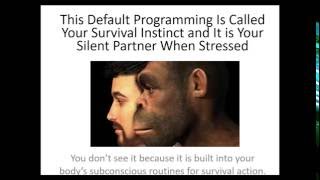
Been blown out of the water. This happens every day, day in and day out, to more than 95% of the traders who trade. Very few of the traders are smart enough, wise enough to recognize that they, in fact, are the problem and that there's no reason to be ashamed, that there is biology to be rerouted that can create a new psychology so that this doesn't, this default programming doesn't predominate your trading mind. It's up to you that. Okay? And I want to show you this as a graphic. Now, what you're looking at.
In the foreground, you're looking at one of our not too distant ancestors. And in the background, you're looking at a Homo sapiens. What I want you to notice is, is above the. Above the hominoids eyebrow. All of a sudden it kind of almost shoots back like a flat top. Okay. What that's telling you is he has very little thinking brain. He has very little cerebral cortex. It wasn't that big of a deal. He was a smart animal. Okay? But what was running the show was the emotional brain. This circuitry that I was showing you between the thalamus and the amygdala, okay? And the hypothalamus. Now then, when you look back on with the guy with a little cool mustache, you begin to realize, wow, you know where his brow is? It just goes straight up. That's because over the intervening 6 million years, that cerebral cortex, that tumor that started in the emotional brain, has grown enormous. And it can do calculations beyond belief, calculations that this hominoid could not do. That hominoid is the caveman who's living in you, though. I want you to understand that it's your limbic system. As long as you don't recognize this caveman living within you, you are a sitting duck for survival instinct kicking in the moment that you experience uncertainty, vulnerability, and discomfort. You're a human being that you can train yourself. My dog can't train himself out of this, okay? My cats can't. We're human beings. We're not stuck in one particular organization. We can rebuild the way we perceive reality in the markets. This is what's so cool.
And ultimately, here's what you're looking at. I want to make this really clear is this scene on the left Was a scene that could have easily have been there 10,000 years ago. There were big bears. Even when Lewis and clark were trying to cross them. The missouri river. In the 1700s, there was groups of grizzly bears on the other side of the river. Hundreds of them. And what happened is Lewis and Clark realized they didn't have enough ammunition to kill them all. And they decided to find another place to ford the missouri river. Just that short time ago, there were animals, there were predators, There were apex predators that did not see human beings as a threat. As a matter of fact, saw them as a meal. So you're looking at a group of these.
Cavemen and again, not too long ago, and they are they living in a dangerous world? They adapt to that dangerous world. They see the stimulus, they make the appraisal, and they're in fight flight, as they should be. When you go to the right, what you realize is that.
That same caveman still in your head, okay, do you know how to cool him down or cool her down? Do you know how to communicate with that emotional part of your brain? Because if you can't, it will continue triggering to fight flight when you experience uncertainty. So now we've gotten this thing where.
This survival instinct that you saw in play in the slide before Was so absolutely essential just a short time ago. And that it just absolutely has had everything to do with. With environmental pressure producing who we are today. However.
However, in the same way that that survival instinct allowed us to become an enormously powerful species, now it's holding you back. It's focused on short term survival. I mean, those guys fighting that bear.
They might not, May not last this fight. You know, when you're, you know, the big thing in trading is trade. Trade for another day, Trade to survive, to trade another day. Completely different animals. You're thinking of probability. This is what has to happen, okay? This is the training that has to happen. So what I want you to do is, again, look at this. There we have information coming in, okay? And what happens is that all you're seeing is information coming in. Whether or not it's data, Whether or not it's whatever. But what happens is that. Who is that observing the information? There are not such things as black and white facts. What happens There is an observer of phenomenon, and that observer is what's going, ah, this is dangerous. This is good. This is that. And all of a sudden you get to this thing where there's that thalamus, it's making a decision. Is it going to route the central information to the cerebral cortex and you're making a logical, rational decision, or is it going to route it through the shortcut over the amygdala in fight flight? Right. Now, if you're listening to this webinar, my promise to you is you're having too many of this shortcuts take on or you wouldn't need to be listening to me. And you've already shown that you've lost some, a little bit of money, some. A gargantuan amount of money in both training and in your actual trading. And this is, this is what's happening to you. So you're looking at it and going, well, what do I do? How do I reconstruct this? You know what, you know, gosh, the deal is this. When you take a look at Spock and Kirk, one was very logical, the other was very emotional. And the reason they were so successful together is they worked as a team. They work. You know, the thing is, Spock, in your brain, your left brain really wants to take control. It wants to think it's the center of attention. It wants to think that there is no such thing outside of rationalism.
In a case with Kirk and Spock, the emotion and the logic work together to produce a phenomenal team. This is what has to occur with you. You have to learn. You have to become emotionally intelligent, get past your ignorance of emotion so that you can use emotion to create the mind that engages uncertainty. Because ultimately all thinking is emotional state dependent. Your job as a traitor is not to not have emotions. That's impossible. You'd have to be dead to achieve that. Your job as a traitor is to create an emotional cocktail that allows you to think disciplined and impartially as you're engaging uncertainty. Okay? That requires the partnership between emotional brain and thinking brain. That's where we're going now. Okay? We're gonna have to. We know we're gonna have to do some heavy reconstruction. And the question is, this is, how do you go about developing this emotional awareness that allows you to build a disciplined mind? How do you learn to turn toward discomfort, not freak out, and not try to avoid it? Well, you don't have to. But if you don't want to, don't trade.
Because every time you experience uncertainty, the default programming is going to trigger discomfort. The question is, is that, what emotion are you going to bring forward that meets that uncertainty? You know, if you bring fear or anger, you already know what that does. But can you learn to build a mind rooted in discipline and impartiality? Yes, you can. I can show you how to do that. And the first place we start is right here.
This is the way your brain works. Okay? What I want you to look at is over here on the left where it says concern. Put in your concern. Most of you have a fear of loss. Okay, that's my concern. Oh my God, I can lose. I can lose. I, I'm going to trade not to lose. Do you hear that concern? Absolutely. Having, then a stimulus happens is that you get in the trade. You're looking at, you're actually looking at, oh my God, here's my entry point. I actually need to pull the trigger. Okay, there's your stimulus. The appraisal. The appraisal are the beliefs and the biases of your ability to manage uncertainty.
Biologically, it's called fight flight. We were very small creatures compared to the kind of predators that were after us. Today we get this psychology, you know. Ultimately you discover that most traders have a problem with self limiting beliefs called a sense of inadequacy, a sense of not mattering, a sense of unworthiness, or a sense of powerlessness. That's the appraisal of that happens in the thalamus. And after that appraisal, either it's routed to the logic circuits or the thalamus routes it to the amygdala and suddenly the emotion that emerges is fear or anger. Fight flight. Rather than the logic and the disciplined mentality that you need to trade. This is the key. This is what you have to learn. And of course, the training that we do with really focuses in on this and it really takes you into the minute and literally, literally watches you and says, okay, this is where it happens. You're going to learn how to manage this rather than avoid this. You're not going to man up or woman up it. You're going to turn toward it and say, man, this mind that I'm bringing into this appraisal is going to have to change. Otherwise I am just going to blow out this account again.
So that's what an emotion is. Okay, Is any disruption to a standard sensorial pattern that the brain has already established. So then this Thing goes on automatic. And all of a sudden what happens is this, is that you don't see the enemy. You know, you're so. You're so focused on not seeing. I don't want to see the threat. I don't want to see the threat. I don't want to do that. I don't want to do that. There is the line right in the midst of you, ready to spring. And you're going, but, well, how did it happen? Because you didn't see the emotion actually triggered later. In my courses, we're actually in it going, Most traders recognize an emotion 20 or 30 minutes after it's already triggered. They don't catch it when it emerges, when you can do something about it. They catch it once it already has a head full of steam and nothing can be done about it. But here you are. This is the glitch, friends. This is the survival instinct that's happening below conscious threshold that literally hijacks the logical mind. If you're going to learn to trade successfully, this is what has to be worked with. So once you do this, you go, wow. Well, okay, Randy, I'm still with you.
Here's. We take a hyper jump and we actually begin to recognize just the gifts that neuroscience has given smart and alert traders. To a neuroscientist, the brain really is a community of emotional programs that are in rivalry with one another. It's really depicted very well in the movie Inside Out. Here you're looking at emotions of anger, of disgust, of joy, of anxiety, and of sadness at the control panel of the brain. And what you're beginning to recognize is that they're having a struggle. They're having a power struggle about who's in control. In this particular case, they're trying to throw out sadness, the little squat blue emotion. And unfortunately, that unbalances everything and throws it out. And they finally learn to recognize they have to bring sadness in. It's part of living. And they learned. And the girl learns to use emotions wisely rather than trying to say, well, I'm not going to feel sadness, I'm not going to feel risk, I'm not going to feel fear. You know, what happens is you're better because if you feel it and you're observing it, you can do something about it. If you're blinding yourself to it, it just ambushes you, okay? And that's what happened in this movie. So we know that basically what's happened in your brain is a series. Emotional programs duked it out and the winners created a self. There Is no such thing as I. I is just the winners that organize you into a self. And you haven't woken up your observer to be able to say, oh, this is just one potential organization of a self. And it was really good for survival before trading, but it just absolutely will not make it the management of uncertainty, of trading. Okay? That's when you recognize, oh, I am the problem and I need to do something about it. So now.
Now what we recognize is that on one level, the brain is a community of rival programs. And even thought is actually a biological electrical behavior. And by the way, it's running at 200 miles an hour through your brain and it's got a voltage of three to five volts. Okay, so what happens in this miracle that occurs between brain and mind? Somehow these emotional programs are given voice in this newfangled thing called mind. And suddenly that's when you start hearing inner arguments. That's when you start beating yourself up and you start. And you start having you question yourself. You're doing all that. My promise to you is you're not crazy. My promise to you is that you are crazy. If you don't notice that there is an internal struggle going on within you among the different communities of emotional programs that have voice in your head. And if you don't start learning how to manage which ones show up to engage life, to engage uncertainty, then what happens is you're not going to make it in trading because you know, you can. You can lie to yourself in real life for most of your life and get away with it. You really can. My dad did. He drank. He know he smoked Camel cigarettes for 52 years and he didn't see himself dying. And then one day after 52 years, the doctor said, well, Howard, your life is pretty much over. And then he freaked out. But thing is, is no, he never listened. The key is. Here you go. Okay. Oh, my mind actually is a committee where these very powerful emotional programs are duking it out. Yep. And you have been asleep at the wheel, not seeing the mutiny going on. This is where you really have to wake up and you have some work to do. And how do you go about doing that? The first thing, you gotta take this survival instinct of the emotional brain offline. Unless you do that, there ain't no getting into the mind and reworking it. You have to work on that biology first. You literally having to cool the electrical circuitry. Otherwise you're not having control over that low road and high road. You may want to. You may have some really great things that you Announce to yourself in the mirror with your affirmations and visualize success. But the truth is all you're doing is you're getting into a context where there's stress and suddenly the triggering just goes low road rather than high road. And all those fancy affirmations and stuff like that are just blown out the window. Now we have to figure out how do we cool the system down, otherwise all you're going to do is get hijacked. And this is where in our courses we teach breathing and relaxation as a way to calm down.
Excuse me. Yeah, that's the very first skill that you learn and what you discover. And again, next time you trade, I want you to watch yourself. I want you to watch how you're not breathing. I want you to watch how much tension you have in your body. I want you to watch how fixated you are on the screen. This is all, this is all saying, I am revving up an emotion. I am so near fight flight and I'm sitting here and I didn't even notice it. Well, unless you manage that, you're going to stay triggering to fight flight. And this right here is actually a painting from. There was a time the Buddha was working with a group, traveling with the group and there was a man eating tiger in the area. And everybody else left the camp because they were scared of the tiger. The Buddha stayed and the tiger did show up. What the Buddha did is that he was able to regulate his fear. Understand he's looking at an apex predator and it's natural for the human being that he is to trigger to fear. But what he's doing is he's managing the fear, he's calming himself down. And what happens is the tiger does not smell, does not perceive the fear of prey and the tiger sits down with him. That's actually a true story. So what happens is the very first thing that you're going to have to do, and if you work with me, you're going to do it, is you're going to learn how to retrain the way you breathe and retrain the way you hold tension in your body. And what you're fixated on, that's not going to solve the problem. But until you do that, you're not going to get to the mind. Okay, so let's say you do that and you quit doing it in the yoga studio and you actually learn how to do it in the environment of trading in combat. Okay, so you've got that down, you can begin to regulate yourself. And then something, a miracle happens. Then you can start getting someplace, then you can start opening the door of the mind. And you learn that you can step back out of thought, you can step back out of emotion, you can step back out of belief. And you begin to realize that your awareness is separate from your thoughts, from your beliefs, from your biases, and that in fact, they're just flowing through mind. But they have not been examined. They have not been worked with. They have global assessments running through mind, and you haven't known how to work with them. That's the second thing that you're going to be learning to do. You're going to start recognizing, oh, my God, I can step back out of this vortex and not get sucked down. Yeah, you can. Yes, you can. It's a valuable thing to do. Ultimately, this is the whole thing is when you do that, you're taking the switch and not flipping it. What you're doing is you're literally in a position of where that high road, low road thing is, that switch. You begin to realize through applied, through the mindfulness and through the motion regulation skills that you learn. You're learning how not to flip that switch because it's on automatic. It wants to flip. Okay? It's been built to flip for the last 6.5 million years. And you're gonna learn to say no. What happens is I can't let that thing flip. Otherwise, I'm way over here and I'm no longer trading my plan and planning my trade. I'm gambling again. Okay? So here you are. You've gotten that down. Okay? The truth is, the emotional brain is never going to be able to discern the difference between biological threat and psychological discomfort. You're going to have to reprogram it. Okay? And.
A number of you were honest enough to reveal that. Man, you have gone through some cash. And the question becomes, have I learned that I really have to work with my mind? Have I learned that I have to reorganize emotion and understand it differently to produce a different mind? If you have, then what? I would say it's been worth the cost. If you're still living in Yaya land and thinking that success is around the corner, just understand that the brokers don't give out the numbers of how many, how many traders they run through every year. And you're setting yourself up. So then this is when it becomes interesting, because this is what I call applied mindfulness. You begin to recognize that. Oh, my God. Inside my head, inside my mind.
There is a committee that I have been absolutely.
I've been at Deficit about working with. But now that I have an observer and I can begin to observe this, I can see these emotional programs in play and I can see how I have given certain emotional programs carte blanche control. And that the truth is, is that I need to refigure the committee because ultimately we have a power struggle in this committee of the mind, okay. And that that power struggle is not leading to success. I need to reorganize who sits in that committee and who has power. That's when you really begin to really see the stuff. And ultimately what I teach, the very first thing I do is I teach people.
To separate from what I call the historical internal dialogue. And a lot of you say, what's that? What are you talking about? If you have ever beat yourself up, do you remember calling yourself names and judgmental, you're never going to make it, you're an idiot. What do you think? And there's this real fearful, down, shameful part of the self. You are talking to the inner critic and you're talking to your orphan nature, your amygdala, okay? And ultimately that part of you has had so much control over the committee of the mind that you think it's you. You come to these beliefs that are unconscious, that you really can't do it. You know, the thing is, is if I'm really honest with myself, I really can't make it. That's why I really don't want to have to look at myself. Well, the truth is no, you better look at yourself. Because the truth is that the way you are right now is just simply one potential organization of itself. As you learn to observe and you see these emotional programs, you're going to awaken the programs, you're going to nurture and you're going to build them. And what you're going to do is you're going to recognize is that you can transform.
The management of your mind from losing in trading to being successful in trading. Wow. The truth is, same thing we were saying is that so far you've only had one possible organization of the self for engaging uncertainty and that one's not working. What we're wanting to do is we're wanting to change who's doing the appraisal. Okay?
That's the difference. We want to change the committee members, the emotional programs and what I also call archetypes who are managing the mind that shows up in the moment to engage appraisal and action. That's what we want to do.
Ultimately in order to develop a probability based mind for the management of uncertainty. What you do as you start observing potential, what you discover is this. Is that in the same way that you were looking in the inside out cartoon thing, there are a number of emotional programs living within your psyche. What we have to learn how to do is we have to learn how to access the empowered ones and bring them forward. We have to go on what I would say, the hero's journey. Okay? And in doing that, you're going, you know something? I may have pushed the ruler, I may have pushed my discipline aside, but I can learn how to pull that forward. And what you're looking to produce in our courses is discipline as ruler, courage as warrior self, soothing and nurture as caregiver, and impartiality, clear thinking as sage. These are emotional programs. And I use a unique way of going into memory of the way the brain has encoded an experience. And what I do is I get people to deconstruct the experience, the way the memory, the way the brain encoded the memory, and I get the brain to re encode it. Because we're looking for a time when you actually experience uncertainty, work through the uncertainty, and land it on higher ground. So you know the programs are there. And I teach you how to access the emotional program and to produce the feeling state which produces the mind. Very sophisticated technology, friends. Okay, but you do that. And what you do then is this is you end up something very different. You have this limbic system that we've. That's been doing all your fight flight training, trading for you. And we have this frontal lobe, and we have cerebral cortex. Suddenly, what happens by being able to cool that limbic system down? The feed you're getting from brainstem is by definition now going the high road. It's going up into the frontal lobes. You're able to calm the survival instinct that the limbic system the emotional brain is built on to incorporate the thinking, the sage, the ability to maintain discipline. And what you're doing is now you have that Kirk Spock thing going. You have emotion and reason working together.
And the truth is what you're discovering is that all the left brain was doing with all that rational stuff, it was producing an explanation to support what the limbic system, the emotional brain, had already decided.
Here you're getting them in partnership, and you have reorganized the deepest biases, the deepest beliefs that you have about your ability to manage uncertainty. Friends. This is when you're cooking.
This is what you learn. And so ultimately, what you discover is the challenges of managing uncertainty and risk remain. They're challenges. Okay?
It's creating a disruption to a standard sensorial pattern. Emotion is going to show up whether or not you like it or not. Except in this case, you're going, okay, I know that I, I don't have freedom from emotion, but I have freedom of emotion about what emotions are going to show up to engage the uncertainty of trading. And friends, that's the holy grail.
You converting. You're converting the limbic system's short term survival instinct into probability management and risk management. That's the power, friends. It can be done. You learn to regulate the emotions. You learn to observe. You learn to recognize what's the default programming and reorganize it so that a different organization of those emotional programs creates the committee of the mind that trades. That's when you can swim with the sharks.
And friends, this is the edge you've been seeking outly, but it's not out there. No, it's going to take hard work. It's going to take real emotional lifting to go and say, you know something, I don't like this. I have always tried to stay away from emotions. But what I'm discovering is the only time that I'm not having an emotion is when I'm dead. I better learn how to use my emotions and intelligently. This is the, this is when you reprogram the default programming of the survival instinct into a calm, disciplined mind. This is how you do it, friends. And that's what we teach. So here's what I ask particularly for those of you who have been around the block, who've been around for two to five years at least and have discovered your investment in trading is far beyond what you ever thought it was going to be. Here's the deal.
I want you to think about the current mind that you have that engages uncertainty. I want you to recognize that there is going to be an automatic appraisal, okay? And I want you to think of historically by default, which one triggers. And if you've lost money, you know it's not the right one. What I want you to recognize is that in that automatic appraisal of uncertainty, vulnerability and discomfort are going to show up on a biological level and it becomes psychological. Okay? But first it shows up on a biological level. The real question is this. You darn well know at the moment of vulnerability and discomfort an emotion is going to trigger. No doubt about it, that's the biological system that you are. Emotions are biological. They take over psychology. Friends, this is the step I'm asking you to look at. Do you want to stay the Same. Keep wishing and hoping for your ship to come in and almost being there. And have that emotional triggering go down to fear a threat to your survival. And then into fight flight continuing the same darn thing no matter how close you are. This is the glitch, friends. That has to be cleared up. Or would you want at that emotional triggering for you to trigger to concern? You better be concerned. You're risking capital and you have risk. But the thing is, is your body does not become involved in fight flight. You're not that tense, you're not that breathing. You're not, you know, you're not fixated. What happens is you have an alert, calm, ready mind, but your body's. Your body's under management. The emotions are under management. You experience the psychological discomfort, but that psychological discomfort moves into an emotional organization of discipline, impartiality, where you calm your fear down, where you confront all these crazy negative beliefs you have that have no basis. And then you get into performance management. You're no longer trying to control outcome at all. You're not trading to win. You're trading to perform. You can't control winning, okay? You control the mind that you bring to performance.
If you do that probability.
If you have good methodology, probability is now on your side and you're measuring yourself about the way you perform rather than whether or not you win or lose.
Friends, that's when trading becomes calm. Some people would say boring, and they're just knocking it out and they're extracting capital out of the markets. What do you want to do? Okay.
Of course you can bet that if you are interested in really becoming that trader, you know, you can be, you know that there's an inner trader in there waiting to come out. If you've listened to this program and you recognize, oh, my God. I actually, I actually see the place I'm stuck at. And I know that I have to really work with my beliefs in order to convert them, because my trading account is telling me how effective the beliefs are that I'm projecting on the markets. Okay.
If you're ready. If you're saying, okay, yeah, I've spent enough money, I realized that, you know something? I can continue. I could continue shelling out cash like this for a long time. Or do you want to make an investment in being able to reorganize the brain and mind that you bring to the management of uncertainty if you choose that. Let's talk. We have an individual course that is enormously highly comprehensive and very personal, and it's very tech savvy. Where you end up literally having heart rate monitors that are monitoring the fight flight process. And you can pinpoint stuff and you have a system built so that you can really powerful things. But it takes a lot of training to get there. It's a complete media multimedia learning system. It's got text, it's got videos, it's got audio recordings, it's got MP3s, guided meditation. It's a, when you start getting downloads, you go, oh my God, this is a lot of stuff. It is more than anything, you get 10 one on one consults with me over a period of three to four months where we are programmatically going the, through the syllabus of this thing and we're moving from one skill to the next skill to the next skill, building and building and building so that you end up as a confident trader learning how to build a mind that can trade. We also have a group course, the next one's in January. But it is a, it's, it's a webinar based. It's really powerful in that you learn the basic skills that you need to know to be able to do this. Okay. And you learn it within a group context. A lot of people say it's a very, very efficient way of learning. And a lot of people go, you know something, I just can't afford the individual course. But God, this one's really good. And you can sign up early, you can be doing the course as a self study. And then when the course starts, you're ahead of yourself. And otherwise what I ask you to do is at least go to the website, get your free gift, it's a free ebook, but also explore it. But I really want you to ask the question, have you spent, have you invested enough money, have you lost enough money to recognize that you're gonna have to do something about you.
Because ultimately trading is about.
Is about the platform you use. It is about the risk management. They use methodology and psychology. They have to work together. Friends, I really have enjoyed my time. And if you have questions, write them. And if you, if you really want to explore this and are serious, go to our website, hit contact us and you get a free, and get a free consult with me. But really think about it and study it and recognize that, oh yeah, without the psychology, none of this stuff is going to happen. So this is from Christine. Hey Christine, with the survival instinct so strong, how do you get the new thought process to stick and be part of the neural pathway? Well, the neuroscience says the neurons that fire together wire together. That's the simple answer, the more complex thing is that if this is the Christine in my group course is what happens is you listen to those stupid guided meditations hundreds and hundreds and hundreds of times. You read. And then what you do is you just don't listen to the guided meditation on the stupid guided meditation. You start applying it under the context of trading. And what you discover is it may take you two or three weeks in the group course. It's two months long. But the truth is most people realize it takes about six months to get through that course. That's why I give you access to it throughout for basically forever, you know, so because I know that you're gonna walk. Man, we're cruising through a lot of material Christine in that group course. And what I know is that it's way too fast for you to incorporate it into your neural circuitry in this, in the speed of the course. That's why I want you to have access to the course, to the whole stuff. And you, you learn how to do that. You learn how to do that stuff. You, you, you learn to do the internal struggle. That's how you do it. But you, the neurons that wire together, fire together. That's how you do it. Okay.
Outstanding webinar. Thank you. Excellent job of giving the big picture in a clear and understanding way. Well, thank you. Thank you for that comment. I didn't even have to pay. Zan.
Zan. Hi. How you doing? Okay. Just like any person cannot become a doctor or an accountant or a lawyer, surely not everyone become an FX trader, even if they do manage the discipline and emotions. You're right. One of the major things that I found is that unless you have passion for trading, you're not going to have the motivation to do the internal work. Okay. To reorganize mine for trading. That's the first thing. And I get a lot of people who think they're going to come into trading and they're going to learn how to do it. They're going to make a million dollars. And the truth is they don't have passion for trading. They just want, they want an easy. They want quick money. And this trading is a terrible way to make quick money. The second thing is there are those people who have, as a predisposition, high, high, high worry level, and they do in fact, have trouble. No matter how much regulation they do, there is still that level of worry and anxiety that is sitting there. Okay.
What I can tell you is this, is that people who are not introverted.
Tend to not make very good traders. Also because you're going to be spending a lot of time alone and if you're a guy who really wants to be our girl, that really wants to be around people and just absolutely starts going nuts when you're not, it's going to be difficult. Okay. Also, if you are a person who cannot give up control, okay, then you're not suited for trading because you have to give up control of outcome. I actually had a guy that I worked with a couple years ago and he, he had sold a company and had an enormous amount of liquid capital. And he talked to his brother who was a trader and Matt thought, oh, well, yeah, okay, it's a business and it's a capital intensive business and I've got the capital. All I need to do is learn the rules of trading and then I'm going to make a lot of money because I already have capital. Three years later, he was not successful. He took a course with me and he thanked me for the course. And at the end he says, randy, the one thing I've discovered is that I'm not a trader is I want control. And as a serial, very successful entrepreneur, I want control. And in trading I have to give it up. So you have to. Yeah, those are the three things that are.
Excellent course, as always. Do you have a distant course? I live in Miami, Florida.
Well, I work Skype. I have people who live in Miami. I have people awaiting the hurricane in Jacksonville right now. I have people, I have people all over the world. I have them in Australia, I have them in Germany, everywhere, Dubai. Okay. The key is, is that we work with Skype, okay. And we find places to be able to find the time zones that work. Okay. I even do that with Australians. And in the, in the group course is that we do have a set time, 4:30 that we, we have the course, but they're all recorded. And what we know is that if you're, you know, if you're in Australia and you're 14 hours behind or, and stuff like that, we know that you're not going to make many of the classes. But when you, when you get the, when you get the recording of where people are interacting and stuff like that. And like Christine's in one of the group courses right now and she and another guy just make the course beautiful. I mean, what happens is they talk, they ask questions and they just expand the course so that I'm teaching into their concerns rather than what I think might be their concerns. So anyway, the thing is, Miami, Florida is nothing. But I really hope you're doing well.
Can we let go of the self altogether as the Buddha taught, it is just a construct that creates suffering. Well, I'm not a Buddhist, okay. And I come to the moment of where I hold this is that we can learn to become much more of an observer rather than a participant in our dharma, if that's what you want to call it, or even our suffering. The key is that we cannot approach life through the organization of fear. That's very, very common with human beings. That's what I mean. We were built off of fear as survival. So what I'm interested in, I have found that people who just.
Become disinterested and step back, what's required, and this is a rub I have with Buddhism, is that I do not believe that there is a place where emotion is not present. And the key is how do you go about organizing the emotion that's interacting with phenomenon.
And what I would also say is that.
Life is struggle.
Suffering is optional. I differ in the Buddha on that. Where he made the statement that life is suffering. I don't agree with that at all. I have find I am much more. I recognize that there are challenges every day. Life is very challenging. And what depends is what mind are you bringing into those challenges? And that's where I'm at. So I don't hold that Buddhist point of view, okay. And I have a respect for it. I honor it. And if you get around my work, you discover that a lot of my work is deeply embedded into Zen Buddhism. So.
Last question and then we gotta go. Losing money is a part of trading. Yeah, that's true. How do you get yourself to accept that as a normal part of doing it? You become a good loser, most likely you already have a bias running around that you don't want to lose. Okay. The truth is, is that in my work there is a distinction made between outcome goals, winning and performance goals. The mind that you bring into the moment, okay. And what you start recognizing, particularly with really high end traders, is that it really doesn't matter whether or not they win or lose. You know, when I do a survey, 66% of the people in that survey are saying, what am I thinking when I'm trading? I'm thinking about winning. A really good trader is not thinking about winning. He's thinking about performing. He's thinking about is the mind that I'm bringing into this. Is it calm, is it patient, is it ready? He has a methodology that he knows if he follows, probability is going to land on his side a lot more than on the other side and he has risk management, a really good trader. I was actually talking with one the other day, says, yeah, Randy, I get into a trade and within the first 10 minutes I'm looking, I have these three minute charts that we're looking at. And, and at the third chart, at the third three minute chart, we know whether or not our hypothesis is right or not. And after the third one we're going to be getting out at the smidgen on the fourth one and we'll be actually getting out, you know, our stop, we're actually cutting our start shorter. And because the truth is that been a moment in time, we know we're gambling. And what we're doing is we're cutting, we're cutting the loss. Okay, right then and there and we're moving on. And what you hear is that they're not thinking about winning or losing, they're thinking about performing. And that's exactly what I teach is that I'm teaching is that you're going to have to let go of this notion of winning or losing. One of the worst things I see is, oh, I have to make $500 today. I have to make 500, I'm down, I have to make money. Then you're bringing a sense of urgency into trading and all you're doing is going to kill yourself. What you're doing is you're moving into a moment. You're saying, am I performing well? What mind am I bringing to this moment? And at that particular time, you're managing your performance in that trade as well as it's possible. You don't know if it's going to be a winner or a loser. If it's a loser, it's just, well landed on the wrong side of probability. If it's a winner, well, look at that. Landed on the right sum of probability. They don't get hot and bothered. It just landed on the right side of probability. That's all that happened. And that's how you train yourself. And it's very, very alien to traders who haven't been around very long. Okay. But it's something where you have to train yourself into probability mindset rather than certainty mindset. That's it. Anyway, friends, I have enjoyed myself enormously. Thank you, thank you for coming. And again, I leave you with this question. When have you blown enough money up, spent enough money for you to recognize that it's not out there? The problem is inside me. I need to get that worked on to be able to make this trading system work. If you come to that, and you realize, okay, that's that place that on that slide that Randy was showing me that you can reprogram. But it takes work. It does. Okay. When you come to that moment and you say, you know, I really do want to learn how to trade, I'm gonna. I'm gonna. You know something? I'm gonna check this out. I want to talk to you. If you. If you. If. If you've come to that moment, I want to thank all of you. I've had a great time. I went a little over today. Sorry about that. And I hope to hear from you. If you're serious about trading, if you're serious about potential becoming the trader, you know you can be. Okay. Thank you. Thank you very much. Have a great evening.









