2016 11 03 16 31 Breaking Free from Fear Based Trading Mastering the Enemy Within
Randy Howell explains why traders crush it in simulations but choke with real money: fear circuits in the brain hijack reasoning under risk. He outlines a four-step program using emotional regulation, mindfulness, and probability-based thinking to reprogram the mind for live trading.
Chapters
Welcome everyone. My name is Randy Howell with traitor state of mind. And what we're going to be looking at today is how we break free from the fear that kind of binds us and holds us prisoner. And ultimately what we're saying here is that there is an enemy within us. It's not out there, it's inside. And that's what we have to learn how to deal with. It's not gonna be easy, but at the same time, hey, you're a trader, you chose one of the most difficult ways to make easy money the world's ever known. So just a small amount of housekeeping one is I hold my questions toward the end. However, if you have a question, type it in now or as you go along and we'll get to it. Okay? I do that all the time. And otherwise, let's take a look at this fear based trading. How do we break free? How do we start really mastering that enemy within? Let's take a look at that. The first thing is let's really look at the big, huge burning question. Many people can trade in simulation. Many people can just ace it. Yet when the money's real, things fall apart. And, and if you happen to have come from a background such as engineering, being an accountant, being an airline pilot in particular, you will have been trained to not make mistakes. Most of us, if you've grown up in education, if you've gotten yourself educated, I hope you have, what happens is you'll discover that the entire focus is not making mistakes. It's not teaching you how to live, it's not teaching you how to solve problems, it's teaching you how to not make mistakes. This whole learning process, a brain has been lulled into a pattern of not making mistakes.
Otherwise you can also be on the other end. You can be on the other end of being an Alpha says, you know something, I am big, I'm strong, I'm tough, I'm going to make things happen. It's not like I'm going to make mistakes. I am going to do everything perfect. I am going to overwhelm things. All those, all those people, which about 80% of the people get into trading, come into trading with a mind like that and they go, okay, now I'm ready. Then they get in front of the real prospect of not just uncertainty.
Say the way simulation is, but where risk of capital is involved and suddenly they fall apart. Where is all that patient discipline when the capital is at risk? Where is it?
And you know, often.
What I've discovered is that people buy my books they buy all this stuff and they get to know the problem really well. When I talk to them, they know themselves as if they've been in Freudian analysis for 10 years. They can talk about the problem. They can. They know the problem really well, but the problem is that they don't know how to change. They keep talking about the problem, but at some time, you have to become a difference maker. You see the repeating patterns, okay, that keep you stuck in mediocrity. The thing is, is changing that pattern, it's what it's all about. It's not staying in the pattern, waiting for things to change. I see plenty of people like that. I see people who have been following me for years, and they keep saying, well, Randy, I just don't think this is really real. I just don't think trader psychology really has that much to do with it. And then after they've blown their capital.
And really have been humbled, I get a lot of stuff. Randy, you know, you were right. I really began to see how psychology really is important. And, you know, now that I've finally seen this, I'd like to work with you, but I have no money. And I'm sorry. You know, the thing is, is that what we want to do is while you have money, what we're actually doing is saying, what we need to do is you need to learn. You need to learn how to deal with this gap between performance when there's not capital at risk, and performance when the money's real. We want to see what does it take to become a difference maker. And the first place we really need to stop is right here. Many traders are just absolutely convinced that really emotions have nothing to do with it. As a matter of fact, dampen the emotions. Really just, you know, the thing is just what you want to do is you want to stick with your platform, stick with your methodology, and keep emotions out of it. The problem is this, is that emotions are the elephant in the boardroom. Everybody's doing everything they can to ignore the elephant in the boardroom, but there's the elephant. You know, people blow up things, they mess up and they keep doing this, and they keep saying, well, I need to trade without emotion, I need to control my emotions. And what happens is that nobody acknowledges that you can't control emotions by willpower. You can't control emotions by denying them. There has to be another way of doing that and learning how to do that. This is the first step, is to actually acknowledge that the elephant's in the boardroom. The elephant's in the mine, it's not going to go away.
However your capital may. And ultimately this comes down to a decision about do you really want to become a trader or do you want to be a talker about trade? Okay, everybody has their moment of having to face their demons, face their fears if they're going to become a real trader. Yet most people don't do that and they keep pretending they don't have to. As a matter of fact, you in here, what you discover is that trading really, it's like a three legged stool. It is very true that the trading system, your platform and methodology, the way you manage risk are enormously important. But what constantly is undersold is the importance of trading psychology. How do you manage the mind? How do you manage the emotions that give rise to mind? Because ultimately.
You'Re not seeing information out there. What you're seeing is information filtered through your own perceptual feel that you say is reality. What we want to do is we want to produce a psychology that allows you to use platform and methodology in such a way that gives you an advantage.
Currently, particularly if you've been trading and you look at your trading account and it's going, it's not going anywhere or it's losing, what you're doing is you are not giving an advantage to yourself. You're thinking, I can do it without mind, I can do it without emotion, I can do it. No you can't. Are you going to listen to your, are you going to listen to your performance measured by your trading account? Are you going to listen to what brings you comfort? That's really what it comes down to. And most people discover that developing the mind that can really work with probability can work with risk and uncertainty. At first it requires reorganizing that mind and that's not comfortable, it's uncomfortable. And so people shy away from it and say, oh, that psychology stuff is crazy until it's not. So ultimately most traders.
Stay clueless.
They keep harping, keep focusing on platform and methodology, but they don't see what drives that platform and methodology. They don't see their beliefs, they don't see how they react to uncertainty driving that. They're trying to take away everything emotional when really when it comes down to it can't be done. However, what you can do is you can build the emotions, use the emotions to create the mind that transforms itself from short term survival instinct to probability management. That's when you're no longer clueless. That's what we want to take a look at and the truth is, is that all of us can look at the cost of your cluelessness. You look at your banking account, you look at your trading account, and who has a positive return on investment?
Very few people. You see that declining or saying stagnant. And what you're recognizing is that I'm being clueless. I'm being a bull in a china shop. I'm refusing to acknowledge the obvious. And particularly, friends, if you've been trained through the educational system, through things like engineering schools, through being a doctor, being any of those things, an accountant, airline pilot, where losing means bad stuff, or if you've been trained to be an alpha, where you want to win, you want to make things happen, and you begin to recognize you do not have emotional intelligence. You do not have what it takes to build the driver of method and platform. And yet how long do you want to stay clueless? How long do you want to keep losing money? Put it down into that terms. How long do you want to continue to stay stagnant or lose money? If you've been doing it for over five years, it's too long. You need to rethink or continue losing. It's up to you. Ultimately, what it really boils down to.
By not understanding and using emotion effectively as part of your trading mind, not ignoring emotion, but literally going, how do I use emotion? You become your own worst enemy. Because ultimately your ignorance may make you feel better right now, but your emotional ignorance is going to suck capital out of your trading account. Don't believe me? Look at your own experience and make a decision. Is that okay? Do I really want to be a pretender? Okay? And I want to continue this and I can talk the talk and I can hang out with all my trader buddies and these different communities and you know, ultimately we can talk all this talk, but the truth is we're all sitting there chewing fat and not producing substance. Or I can say, you know something, I need to face this stuff. I need to actually build it. I need to become my best friend, okay? Because ultimately when you do that, what you discover is this.
You discover is that you are bringing an entire history with you. You're bringing a caveman emotional brain that has evolution going back to at least 6.5 million years. And it was totally built around fear and short term survival. Ultimately, you know, we used that. We were very smart animals. We became human beings. And ultimately we still have that hominoid brain. It's called the limbic system, it's called the emotional brain. With that data feed from the reptilian brain, the brain stem that's making lightning fast decisions, okay? And you're sitting at a computer now, but the truth is that hominoid sitting there with you. And this is a thing that you're not just going to decide by snapping your fingers or saying a couple really cool words or your affirmations or visualizing. You're not going to change that amount of evolution. You're not going to change that type of brain and mind that you bring into the present. Because ultimately it hasn't changed that much. You're the one that's going to have to change because ultimately. Let's take a look at this thing more closely, okay.
Here. What are we really talking about? Okay, when you take a look at a reptile, okay, you see that pink stuff? That, my friends, is the brain that a reptile has. It has fight flight instincts, okay? But it doesn't have evolved emotions. And literally what the brain is doing is it's either fight flight, avoidance of threat, or attacking in order to get what it wants. Later, much later, with the rise of the mammalians, this green part showed up. This and that little white loop around that green part, that's the emotional brain, that's the limbic system, that's the seat. And this is where, oh man, something totally new happened. Suddenly there was a data feed up into this emotional brain that was able to make lightning fast decisions about how to dance, how to be in harmony with the environment, for better, for worse. Then reactive patterns got wired. Okay, all this occurred before there was a thinking brain. Then you see this gigantic blue spot, this blue thing that is the last hundred and fifty thousand years, last hundred thousand years, maybe the last 75,000 years.
And ultimately it's a kind of a tumor. It's kind of an add on to that emotional brain. And this is where we get it wrong. That new brain so wants to believe that logic and reason rule the day, but the truth is they don't. Logic and reason don't rule the day. I'm going to get to that a little later. But this is how. This is the brain you've got. And I promise you this is not the brain that's going to produce success in trading. You need a lot more integration between that emotional brain and the thinking brain. You need for the emotional brain not to trigger and hijack that brain to be able to stay in probability management rather than survival management. This is what is happening every day in your trading is survival management trumps probability management and it blows everything. The data feed, it's the Same. Okay, so we've gotten that and then you're going, okay, well what, what's, what does this look like on the left? You're looking at what fear looks like firing in your brain.
You've got these neurons, you've got these axons, those, those, those chemical reactions you see as lights are cruising around at 200 miles an hour. And what they're doing is their focus is about organizing pattern for you to survive. And it comes directly out of what's on the right.
Just a few short years of geological years. This scene right here.
This was all over Europe. There were big bears and they saw us as beasts. And notice how big the bear is compared to the Homo sapiens. And what you see is they had every right to have a fight. Flight fear response to dangers in the environment. And the dangers in the environment were plentiful. They happened every day, okay? Unless you're living in a war zone, the dangers of environment don't exist. Okay? They're just kind of like little things that kind of happen. But they understand is the moment that these men beat that bear, they learn a pattern, a reactive A pattern of being able to attack. And about the way they do it, it becomes wired into that neuro circuitry that you see on the left. And suddenly it comes alive. Do you remember the. Do you remember the photo, the image of where the hominoid evolves into the human who finally ends up in front of a computer? This is where it's at, friends. Ultimately, those reactive patterns are still with us. The moment that you experience uncertainty, okay, the biology is going to trigger to fight flight. That's its normal course. That's typical. Unless you intervene. That's the key, is we as human beings have this enormous gift that we can intervene in the way that our brain has evolved the programming of the brain and how that we can. We're the ones who can reprogram historical default programming. That is the coolest stuff. So the thing is, is this. Let's take a look at why you have so many problems.
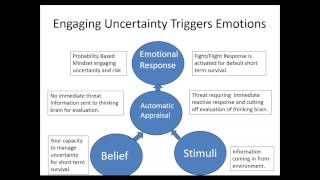
You're looking at a chart here that describes what happens when you have an emotional response to something. It starts with something happening in the environment. That's the stimuli. That's what you see at the bottom. Okay, that in the environment of, you know, you just saw that the slide before these three guys run across a big, huge, giant brown bear. That's the stimuli. Now those brown bears are dead. They've been gone for generations. Yet the moment that you turn on the computer, you start ramping up Risk. And all of a sudden you have uncertainty and capital at risk. You have a stimuli coming in as data through your reptilian brain. Now it comes to this moment of automatic appraisal. And this is important because this is where belief becomes part of the decision. Your beliefs about your ability to manage uncertainty are part of the automatic appraisal that happens. Okay, like for instance, how many of you, before you start trading, you know what you do? Okay, I'm gonna, I've got my plan, I'm gonna trade my plan and plan, plan my trade. And then you get in there and you don't do anything such, it just goes out the window. What happens is stimuli happen, belief happened, automatic appraisal happened. And suddenly your emotional response hijacked thinking. Okay? So there's information. If you look in the right side of there, you're looking at information coming in from the environment. You're looking then at threat, okay, Requiring immediate reactive response and cutting off evaluation and thinking of the brain. And then you go to the fight flight response and bam, there you are. You're either attacking the threat if you're an Alpha who wants to attack and revenge trade and impulse trade, or you end up in avoidance. If you're one of those engineering types or those accountant types where you're, you're saying, you know, I want to be right, I want to be right and I'm going to avoid the conflict because ultimately.
Those beliefs really are about your ability to manage uncertainty for short term survival. That's good in that it allowed us to become the human beings we are. But the thing is, we need beliefs about our ability to manage long term probability.
If there's no immediate threat.
Information is actually sent to the thinking brain for evaluation.
That's the way it should work because that would be a probability based mindset where you have this, the emotional brain and the thinking brain working together and the thinking brain not being hijacked. But this is what's happening. And if you want to, it's that automatic appraisal. And if you want to see that automatic appraisal in real action and what it, if it's really going on, positive or negative, look at your trading account. You will see exactly what the, the automatic appraisal of your brain is that gives rise to the mind that trades in uncertainty. Don't trust what you think, don't trust the. All the reasons you give trust your trading account to reveal what the automatic appraisal is. This is the power. Because this little thing right here, this is the. In this next slide.
This is the problem right here. This is the problem that traders have. What you're looking at right here, if you take a look on the, on the left side of this diagram, what you look is that you look at first at this presentation of dangerous situation. That's any situation where there's risk and there's uncertainty. It's just trading is boom right there. What happens is that information goes into the thalamus. The thalamus makes the decision whether or not it's going to go.
Send that information to the thinking brain and make a rational, logical decision in addition to emotion, or whether or not it's going to hijack information going to the thinking brain and take a shortcut to the amygdala. And out of the amygdala, you're going to have fear or aggression response, okay? And this is where it's happened. You're not going to wishful think yourself out of this, okay? And it is a problem with your trading if you're not trading really well. This is real. It doesn't change because you click your heels. It doesn't change because you say some affirmations. It doesn't change because you're going to use neuro linguistic programming and reroute the circuitry. No, you're not.
Those are cheap Jedi tricks compared to the power of neural circuitry. You're gonna have to learn how do I work with that shortcut business so that I stop that shortcut from happening and I start using the reasoned mind. And that's what my work is all about. Gonna be learning more about that. But now we're seeing this thing and ultimately you have a moment here. Short term survival instinct versus long term probability management. Okay? If you want to become a trader, that second piece has to come and you have to learn to reprogram the short term survival instinct. Have to. It's not optional. Okay, so we've gone from there, and then we go. Okay.
If you're listening to me, what you're saying, what I hope you're saying, that I've got a caveman in my brain and that if I do not acknowledge that caveman, I'm in big trouble. Yep, you're in big trouble. That caveman will sabotage you every time. Every time you risk capital with uncertain outcomes and you sit there and can literally realize, oh my God, I can lose that brain of that caveman. Cannot tell the difference between biological threat those bears attacking and psychological discomfort comes with having to manage uncertainty. But this is what you've got, friends. Do you want to Learn to make friends and work with your inner caveman. Or do you want to continue ignoring him and having him hijacked? That's the whole key. Now.
Ultimately, the key is this. Hold on.
Ah, sorry about that. Ultimately, on the left side here, what you're looking at is the way the brain organizes a virtual representation and then projects it onto the markets. You do not see the markets, you do not see information. What you see is an interpretation based on beliefs that you project. Just like what you're seeing on this on the right side with the woman having all this projected onto her. That's what you're doing every day with the markets. The real key is that you have to be in control of what you're projecting. You have to be in control of the belief structure, the perceptual map that the brain has organized to create the mind that perceives otherwise. You get stuck in short term survival instinct. And. And there you go. Ultimately, this is when you project your beliefs about your capacity to manage uncertainty and risk onto the markets. You're measuring its effectiveness by your trading account, okay? And if it's not there, then you better do something about it or you're going to continue the same pattern. That's the way it works. So ultimately.
You'Re not trading the markets. You're trading your beliefs about what the market reveals and understand. Your biology is conspiring against you. Your biology is already biased to believe that it's a negative world out there and the world's out to get you, okay? And you're looking at it and going, okay, it's out to get me and I need to protect myself. Well, as long as you hold that belief, you can't trade. This is what has to change. And you literally are talking about, how do I move this thing from short term survival to long term advantage. It's not natural at all. You're going to have to literally reprogram. You're going to have to reprogram this thing. You're going to have to reprogram this thing and the brain's going to resist you. It wants the status quo. It wants the comfort zone. You need to reprogram it to become the mind that can become successful in probability management. And ultimately, until you do that, your emotional brain effectively is your worst enemy. You're sending out the troops to attack your own self. Okay.
It'S an evolutionary glitch if you want to see it that way. But the truth is the communication between the thinking brain and the emotional brain simply has a lot of glitches in it. There are more communication going from the emotional brain into the thinking brain than from the thinking brain back into the emotional brain. You have to use what communication there is and put it on steroids to manage that emotional brain to get the mind that you need to manage uncertainty. Otherwise it will default and go back to short term survival and become your worst enemy again. In the world of trading. That's, that's just the way it is. Now what I want to do is, who would have thought a science fiction writer would have come to this jewel? Robert Heinlein obviously is a stranger from a strange land, very famous guy. And this is the key. This is the huge mistake that people make. They think, oh, I am being rational. No, you're not. All thinking is emotional state dependent. All that reason is doing is producing explanations that supports whatever the emotional brain has already decided. There's good reason to stay out of this trade. You know, I wanted more confirmation. Blah blah, blah, blah blah. In that moment. Then you look at it go, what was I thinking? The emotions took over and you reasoned from emotion the wrong emotions. But Hyneman goes on to say, he is a rationalizing animal.
That's what has to stop, friends, is that you can rationalize this thing for I don't know how long till you have capital that no longer can be blown up. So here you are. The, the key is you're not a rational animal. You're a rationalizing animal. And once you recognize this, you go, oh my God, I've been really walking around in deception. Yes, you have. How do you start building a mind that doesn't fall into rationalizing whatever you want to see in the short term. This is where it becomes really, really big.
So, well, you know, you know, this is that the brain will rather take a reassuring lie. That's all that talk that traders do. They talk and they talk and they talk about this and that and the other. They kick tires, they do all that stuff. And you even ask them if they're making money. Yeah, yeah, I made a whole bunch of money that I made it trade. What happens? They're all lying for the most part. They don't want to look at the inconvenient truth of going, my brain is not designed for this unnatural thing called trading. I'm so uncomfortable by what my brain experiences. I'm going to start accepting lies and telling lies to myself instead of going, you know something? My brain, the mind that I brought into trading is not going to be the mind that's going to produce success in trading and the truth is, is I'm just going to have to change my mind. I'm going to have to reprogram it. But the truth is the revolving door of trading there will always be. As long as there's people who are still looking for short term gain and thinking they don't have to work hard and change, there will always people be people wanting to go see the reassuring lie game. The truth is though, it sucks capital out of you. So here's the deal. What I want you to do is take a look at this thing.
This is the only survival instinct that your emotional cave brand can do. This, this thing right here. Because ultimately what I want you to see is the sequence here. There is uncertain outcome event. That's trading. You know, you could be in the trade wondering when you should take a profit or whether or not it's going to actually, you know, you know, whether or not it's going to hit a target, there's profit or loss, it could be getting in the trade itself. Then you have the appraisal of the limbic system. And I just had a woman hand in a trading plan where it's really beautiful. What she was doing is she was listing all the, all the conversation that goes on of a negative nature, what I call the inner critic inside her head. And she's listing all the appraisal by the limbic system. There's every reason in the world not to get in the trade. There's every reason in the world to get out of the trade. There's every reason in the world.
Every place in the trading, in the sequence of trading and the process of trading, you discover that the limbic system is taking short term survival over long term value every time. And then when you look at that, the reason it's doing it is because that uncertainty is perceived as vulnerability. Life and death. Just like those cavemen were fighting the bear man. They're vulnerable. And what they're doing is they feel that discomfort. And out of that discomfort is triggered the fight flight response. They fight the bear because otherwise it's going to kill them, kill their clan. They have to fight. It was useful for survival back then. It's not useful in your trading efforts now. It sabotages.
The mind that you need for trading. And you need to decide you know something, am I willing to tolerate this? Am I willing to keep rationalizing that it's going to get better when I darn well know it's not, when I'm being honest with myself. If you come that moment I can help you so.
The deal is this.
Is the train going to leave without you? Are you going to get on the train?
How do you move from this understanding of your predicament to being able to change the very programming that engages uncertainty?
This is where traders fail consistently. They only learn in hindsight and it's too late.
You know, that's why they're saying that 95% of traders don't make money. They lose money. And in three years they burned out their capital about the time they finally figured out that, oh my God, the mind is really important, it's over. They didn't. They would not look at the truth. They would not see the need to really, truly change the way the brain and the mind operates in the environment of uncertainty.
This is the deal, friends. Do you want to get on the train while you still can, or do you want it to pull off and run and try to catch it at the very end? My heart breaks because I see a lot of people try to get on when the, when the train's already left the station and the guy's trying to run to jump on it. The problem is he's in a vulnerable position. He's burned through his capital, he's burned through his education, and there's very little left. The key is, why not do it before it becomes this late? Why not look and recognize, you know, I need to change. How do I do it? Well, we have a four step process, okay? And it's all rooted in emotional intelligence. You need to understand emotions, you need to learn how to use emotions, you need to learn how to manage emotions.
And particularly you need to learn to perceive emotions. What I find in my practice is most people do not perceive the emotion until it already has them in its grips. They don't perceive the emotion when they could have done something about it. And that's what I teach. Okay? So the thing is, let's start with acknowledging your emotional caveman and the power of the survival instinct of the emotional brain. That's the first place to heart. It's not your fault, okay.
That you've inherited this brain. In mind that we're very successful in our evolution as human beings. It's just that it's gotten you here, but it's not going to get you to success in trading two completely different worlds. One is short term survival, the other is probability management. We have to have a totally new way of dealing with emotions, working with emotions to do that. Because ultimately this is what you finally learn, is you do not have emotions, friends. You don't have to Worry about having emotions. They have you.
And the truth is there is no such thing as freedom from emotions. You literally are the embodiment of emotion. Your whole body, your whole central nervous system with all those nerves that go down to the. Your. Even your tippy toes. That's all your nervous system, all your emotional system, your brain making decisions emotionally and reacting in step with the environment. We just need to change that to work in step with the markets. The markets are not like the real world with those ghastly bears. So here we go.
Okay, so the first real thing is we have to learn how to use emotions to create a psychology of trading instead of just showing up and getting slaughtered, okay? Instead of fighting emotions, which is a losing proposition, I mean, you know, you're not going to do it. We are emotions. What we want to do is we want to use emotions to our advantage. You're not going to stop the uncertainty of trading. What you can do, though, what you have control over, you have control over the mind that you bring to manage that uncertainty. Friends, that's the holy grail that you've been looking for. Outside is inside you're going, okay, I've been trying to control environment, control outcome, which is what a good caveman tries to do, by the way. That's impossible in trading. However, what I can do is I can control the emotions that give rise to the mind of performance and working with uncertainty and risk. Amen. Now you've got something. Unlock and unleash your power. The first place you start is emotional regulation. Most people, for some unknown reason, are just flabbergasted to discover that both breath and tension in the body are part of an emotion. They are. You can alter the emotional intensity. You can alter the emotion itself by the way you breathe. Tomorrow when you trade, take a look at what happens when you get scared. Take a look at what happens when you have impulse. You'll find yourself either breathing rapidly, using on the top 30 of your lungs, or holding your breath. And then you're going to start noticing that you're gripping that mouse so hard that you're fixated on that screen so hard, man, you're toast. Yet if you go back to diaphragmatic breathing and maintain that and retrain the body to use diaphragmatic breathing rather than this way you've learned to breathe. That promotes anxiety and fear and anger. What happens is that you learn that you have an enormous amount of control over the emotional nature that you bring to trading. A lot of people, when they first hear this, they go Geez, Randy, is that all there is to it? I can do that. No, that's not it. What happens is I get a lot of people who think, oh boy, oh boy, I've learned how to breathe. I've done. I know yoga. I do yoga stretches. I've been doing this for out and how long. And they're bad traders.
Breathing and relaxation are part of emotional regulation that calm the emotion down. What it's going to do is get you to the door of the mind. It's not going to change the beliefs that are within the mind. But without it, you never get to the door of the mind in the first place. But understand what it can do for you and what it can't do for you.
It's not going to be the change all to everything, but it is going to give you a way of controlling the intensity of emotion so that you're not so easily hijacked. But this is when it starts getting interesting. Once you do that, what you begin to recognize is that I need to be able to develop mindfulness. I need to be able to develop a way of stepping back out of my beliefs, stepping back out of my thoughts, and recognizing that, you know, I am not my thoughts, I am not my beliefs, they are occurring within mine. And I don't even know where they come from, but they take over. And I have been so identified with them that I've never examined them. And what I teach is a way of literally slowing down thought, stopping it, and beginning to recognize there is awareness outside of that thought. And all of a sudden you realize you know something by awakening this observing part of the self. What you discover that you begin to have an enormous amount of control over the quality of thinking that you're doing. And you begin to notice things rather than to react to things. But this is where you begin to see the patterns. And you begin to see, oh, I begin to see that my brain just showed up in an environment. The brain adapted me to that environment. And that's a historical presentation of self. It's not me.
It's one potential organization of the self and you've mistaken it for you. But with observation, you begin to recognize, oh my God. Identity is fluid. I can redesign.
I can redesign the mind. Yeah. Now this is where it begins to be interesting. And the first stop is this.
You begin to start looking for the enemy within you. Okay. You begin to start saying, wait a minute, wait a minute, wait a minute, wait a minute. You know something, there has been an enemy. And the reason that enemy has so much Power. And a lot of people call this, yeah, my evil twin, my evil brother, my evil sister. This, this. They have lots of different names for that part of the self. I call it the inner critic. And you begin to recognize that, oh, my God, you know something?
Once I disrupt that, I begin to realize that, you know something, that part of me was telling a bunch of lies. They were telling a lot of untruths. And because I didn't have the ability observing, I believed it. I just took it hook, line and sinker. Not as a potential organization itself, but as me. Because ultimately this is when you begin to recognize, I've been avoiding this fear. I should be turning toward it. And I'm recognizing, yeah, it may be uncomfortable, but the truth is it's only one potential organization of itself.
And trading just brings it to the surface like no other. Okay. And you begin to recognize I need to deal with its internal struggle. I need to. Because what's happened is it's exposing all the conversations in the mind. Suddenly I start recognizing the mind is not some monolithic structure. The mind is a we, the mind is a community. And what happens is you have to reconstruct that community into functioning into a different world rather than the one you got born into. This is the powerful stuff. What you want is to construct a new mind for the challenges you face. You recognize that, no, the challenges are going to be there. Uncertainty is there. But the big deal is once you let go of the illusion of control, you begin to recognize, oh, the thing that I can control is the mind that I bring into the moment of management. Yeah. That, my friends, is when things start getting interesting. Because what you discover in the same way that the brain is a community of rival programs that has organized you into a particular self, the mind is where these programs have been given voice as the thoughts in the mind. And suddenly you begin to realize, you know something? They just. I don't like the way they're organized. I need to go in. I need to do a. Need to take back the organization of me. I need to be the one organizing myself rather than history. And you begin to go, wow.
It'S going. Trading is going to show you where you need to work. Your trading account is going to show you exactly what shows up. What parts of the self are discipline, our courage.
Self soothing, our impartiality. Showing up to engage uncertainty or fear or anger or lust or greed. Okay, These are all things that you have say so about. And ultimately what you're going to discover is this.
There are four basic fears that drive mediocrity in trading, that keep the survival instinct in play and that do not allow you to grow a probability based mind. The first is a fear of inadequacy. How many times have you heard yourself or others say you know something, it's just not in the cards for me. You know something, I'm just not good enough. I have to accept it a lot. How many times have you thought or others you've thought, you know something, if I make a lot of money, I'm going to really show that I, I matter to people. I'm going to be a big guy man. I'm going to, you know, I'm going to get all puffed up under. Underneath that. You're trying to make the markets pay you so that you feel as though you're worthwhile. It's not going to do it. It's going to blow you apart. The other is not worthiness. I don't deserve to earn big money in short time. I don't deserve that. You know something, I have to work hard for my money. If I'm not working hard, then I don't deserve it. Or you know something, I was always told in my family that it's just not going to. You're just not going to make it. Your scarcity thinking that so infest the minds of traders. You know the thing is is that oh my God, it can be taken away from me. You know.
I need to be careful. It could be taken away. The fourth one is helplessness, a sense of powerlessness. You get into trades, you get whacked around, you lose and suddenly you become a horse in a burning barn and you destroy yourself. I can't handle myself with the, with the. On the shoals of uncertainty. This is within everybody.
It's just in trading you can't lie to yourself forever. The speed of trading gets you to the results. It's like instant karma. It gets you there so fast. Whereas you can lie to yourself in real life for a long time. Trading does not give you that luxury. You're going to have to deal. These are just beliefs. They're not the truth. These are beliefs that you've come to accept as true and that you're going to have to learn to unprogram. And that's a lot of what my work is about is you discover that you are competent, you can do that. You do matter, you are worthy and you do have power over yourself. You don't have power over it. Outcome. But this is how you, this is the thing that's Happening and the reprogramming is all of a sudden what you're realizing is that when you have those four beliefs, you're projecting and just are sitting ready for fight, flight response. What you're learning how to do is you're learning how to reprogram that into higher performance. You're beginning to recognize I don't have to prove anything to anybody. I'm worthy because I'm inherently worthy. I'm not having to prove, prove my worth to a mom or a dad who's dead or to a society or anything. The truth is this is just a performance. This isn't about trading, is not about my character, it's just simply about my performances. And I can get better at my performances. So ultimately what you discover is this.
In this learning, we don't change.
The fact of uncertainty and probability. What happens is we go, you know, something. Approaching uncertainty from a position of fear or anger is simply not going to work. It's going to keep survival instinct in place. However, what we teach in our courses is how to build a mind rooted to discipline, rooted in courage, rooted in self compassion, rooted in impartiality. It's this mindset rooted in these emotional programs that gives rise to the probability based mind. And this is when you start really being able to control both brain and heart, emotion and mind, and you begin to realize that this I can control. This is the mind that I'm bringing into the moment of performance. I don't control outcome, I control the mind I'm bringing. And I can choose, I can become intentional about the mind that I'm bringing into that moment. That's power, friends, that's power. And for every engineer, forever accountant, for every pilot or forever Alpha who's come from business, this is the difference maker right here. Almost all these trades have taught you to not make a mistake. In the case of the engineers and pilots and the doctors and on the other side is that you've got to win. That's the attorneys, that's the Alpha business people. The truth is, no, what happens is you have to build a mind of performance. You can do that. You're not trying to prove anything, you're just simply intentionally bringing forward a mind to manage uncertainty with. This is the power. So ultimately what you discover is that yes, you can reprogram the emotional mind. And it's a process. It doesn't happen overnight. You can do this. It's really easy. The first process that we teach is emotional regulation. Second part is mindfulness. Then we start disrupting the historical adaptation that keeps, keeps messing you up. And then we start building the probability based mindset. And after that we start teaching you to become intentional. You never bring a mind into the management of uncertainty. That's not intentional. You just don't trade with any old mind. You create the mind that manages uncertainty. That's what we teach. So my question is very simple. Are you ready to learn to reprogram the instinctive mind for probability management? It's not easy. You'll have to work and you're gonna have to learn the skills. And it's not gonna be magical. You're not gonna get some download of magical thinking from me that changes everything, like tapping. What you're going to do is you're going to learn how to rewire the programming that you came by historically into a new mind. It can be done. I see it all the time. And my hope is that you decide to do it before you run out of capital. Fair enough. Fair enough. So here's the deal.
You ultimately have to become the change. What I truly recommend if you, you know, if this is the first time you've heard me, go to the website, get all the free stuff, watch the videos, read the articles, get my free ebook, read, read, read, read. And recognize that this is really good stuff. But you're going to have to change things on a cellular level. When you go through all that, I want you to look at my individual course. It is highly comprehensive and personal. It is the meat that gets that change. You get to really work with your fear based nature. You get to work with that impulse, that nature that wants to win. And you begin to learn how to develop it. It's very powerful and it's more than anything, it comes with 10 consults with me over a period of three to four months. It is really powerful. And if you're thinking about it, if you're really thinking about do I really want to become a real trader, do I want to keep talking this talk? What I would encourage you is get a free consult with me. If you're serious about I'm going to become a good trader, I need to do that. Get a free consult. Let's talk. You go to the website, hit contact us, let's, let's talk. Second thing is group course. The group course is very popular course. It probably is the most cost effective of everything. We have another one starting in January and a lot of people start early simply because they can be practicing, practicing, practicing and they hit the road running. Yeah, we already have people registering right now for the January course. And the key is if you go ahead and register, you get access to the virtual classrooms, all the exercises, all the stuff that you need to really begin to develop the mind for probability management.
It's really a great course.
Now also, if you're going, well, what should I do?
Take a free consult. Talk to me, find out what's best for you. What we've discovered here is pretty simple. It really boils down to money. A lot of people end up taking the group course because they simply don't have that much capital. And this is the best way they can do because it's the most cost efficient. Other people, when they look at the individual course, they know that, yeah, I want to hang out with Randy for next three or four months. I want him. I want him walking me through this program. And these guys are very serious. And at the same time, they can afford the $1,200 per month for three months or the $3,500 up front. They can do that. So go to the website, get your free gift. Okay. It's a collection of articles by me. It's in a book format, and those articles will never be reprinted again. So anyway, if you have questions, let them rip. I have. We've got a few minutes. I went a little longer, but this first time I've ever done this presentation. And I just. I got on a ride, got on a roll. So there you go. Okay. This is a comment from Scott DeMars. When I figured out I was trying to prove myself in every trade, that is when everything really changed. Scott is, you know, interesting is. Scott is a very good example. He's. He's not an individual client. He went through the group program. And what he's. He's giving you solid advice. This is a guy who really took the group course. He really got serious about it, and he made major changes in his trading. So thank you, Scott, and thank you.
We are recording this as we speak. And what happens is you will receive an email later. As soon as I get this thing rendered and put up on YouTube, you will get a. You will get. You will get access to this webinar again. Yes.
Okay. What would you have to say about someone who trusts their trading plan while trading on simulator, but when trading live, they start.
Having second thoughts and hesitation about their trading plan and executing. Yeah, yeah, you're normal.
Yeah, that comes to that. That's exactly what it comes about. It comes about the way of avoiding uncertainty on a biological level. And you will have those in. You'll have one of those four beliefs or all four of them. Incompetence, our sense of powerlessness, not being able to handle it. But ultimately what you're doing on a biological level is that, understand what I said is that the brain cannot tell the difference.
Between biological threat and psychological discomfort. Okay? Unless you train it, and this is the problem that you're having, unless you train it and reprogram it differently that brain experiences on simulator, there's no risk.
Okay? You know, that's like in video games. Yeah, there's lots of blood and gore, but there's no risk. Nobody dies. The moment that there's an end game, the moment that you can lose capital or die, things change dramatically with adding the risk. When the risk comes real, what happens is your limbic system is firing and just hijacking your thinking mind. And it's going to do that until you figure out how to reprogram it. It's not going to change because you try brute force. That little fear part of yourself can become an 800 pound gorilla in a heartbeat. Okay. And it will hijack mine. You're a perfect candidate for this work.
I'm looking for people who can in fact trade. They can't trade under pressure though, when risk is real.
Because ultimately I will get a lot of people that think they know how to trade. They get into my course and they discover that there are some massive holes in their methodology that they need to cover up. They not cover up, they need to fix. So it's more than just psychology being the problem. Yours is pure psychology. You know, that's the good news. And you can learn how to do that. It takes some work. And if you, if you can take the individual course that is a lot better, a lot more direct route because you're going to get to know your fearful nature and you're going to be handheld walking through it to be able to, to master that. So but yeah, that you're, you're a typical trader. About 60%, 66% of the traders, retail traders, do exactly what you're talking about.
Anything else? Let's see.
Hi Randy. Have you had clients from the UK previously? Oh yeah.
We have dozens. We work all over the world. I have right currently clients in Australia. I don't have one in Singapore anymore. All over the United States. Germany's common. I have a couple. Dubai, UK is very common, particularly around, particularly around London because all the financial center and stuff like that. But yeah, yeah, I've gotten used to that funny form of English you guys speak. Yeah, I can do that.
Okay. Another question, does it help to reduce the fear by reducing the risk. Position, size, trade small.
For a while. You know what happens is that you can reduce it to one contract and you could do micro contracts and you can be risking what, 5, 10, $20. And that may soothe your inner caveman. But the thing is, you're not gonna make any money is that the key is, is that it's very common for me to ask people to check back their risk level, the capital level they're risking. All I'm looking for initially, when I'm working with a trader is for them to. I want them triggering, I want them to feel the grit, you know, and usually that can be done with micro lots and stuff like that. And at some moment in time, once you build up the psychology to be able to manage that, you start. You start sizing up because ultimately, you know, you need to be trading enough so that you can build a sustainable income out of this. And, you know, if you're risking 10, 15, 25, maybe 50 bucks, no, you're not going to do that. But it helps.
As a start.
At that level. But the thing is, don't fool yourself. It's not like you're going to. You're creating a comfort zone, a biological comfort zone that when you, when you do that, the moment you start trying to size up is, well, that's a monster. A lot of my business, a lot of the work I do, the consulting I work I do, are people who know how to trade and they're successful trading at a particular position. Size. Their problem is that they need. They need to size up to make a living, a good living. And they realize that, oh, my God, the moment I start trying to size up, everything starts falling apart. That's usually because they don't know how to size up, that they just, they just kind of jump in there. They don't have a process that allows them the best, optimum scenario for that. So the answer is, yeah, it helps in the beginning, but at the same time, you still need to face the demon and you still need to. You still need to master that fear so that you can live to the potential of what trading could be and what it can do. Okay, I think that's it. And I'm over a little bit. Cool, thanks. Well, thank you. I want to thank all of you guys for coming. I just love this work. I love when people start this work and they start growing and they reach this place where they go, aha. I can see now, I can actually see how this works. And I can begin to See, this is a practice. This is not something that I magically appear at. This is a practice where I come to a moment where I re change. I literally reprogram the brain over time so that it's functioning at a higher level in the area of probability. And I have this caveman brain that is so fearful of survival instinct. I have it under management and it's not just absolutely eating me alive. I want to thank you. Thank you very much. And if I can help you, just hit the contact us form. If you're new to me and you're going, who is this guy? What in the world is he talking about? This is crazy stuff. This is like, wow, it sounds really cool. But who is he? Go to the website and start reading there. I have a content.
Oh yeah, our YouTube. I've got 90 something videos on YouTube. So the website or YouTube, you know, everything goes back to the website though, because I also write a lot. So start that. But the thing is, is you have to get past all the writing and stuff like that. Knowledge. Knowledge is not the answer. Okay? Yeah. You have to build the emotions to be able to use that knowledge under pressure. That's the deal. It's not going to be natural in trading. You're just going to have to. You're going to have to change the mind, you're going to have to change the brain. So I want to thank you. I've had a great time and I'll see you next time. Take care.









