2017 01 10 16 31 Achieving Emotional Control in the Midst of Trading Uncertainty
Randy Howell explains why traders fail: the brain evolved for survival, not probability. Trading needs three things—platform, methodology, and psychology—but psychology breaks most people. He walks through how fear hijacks your thinking and five steps to rewire it, from breathing exercises to building a probability mindset.
Chapters
Welcome, everyone. Welcome to 2017. How on earth did that happen? You know, here we are at the beginning and we're beginning to go, you know something, we've got one year behind us. And my question to you is, what are your resolutions? What are your goals? What's going to be different this year than last year, particularly in regarding trading? Because that's what we hear. What's gonna be different? What do you need to do that can make a difference in your trading over the course of a year? To be honest with you, my hope is that you're here to actually address that question. What can you do? And we're gonna be looking at it. The thing is, we're gonna be looking at how do you go about achieving emotional control? How do you really do it? You know, is, am I just gonna put the stiff upper lip? Am I just gonna just get myself just. Am I just going to let the emotions overwhelm me? What am I going to do? Well, what we're going to be learning is emotions are there to be used. They are there to be managed. They're not there to be your enemies. They are there to say, how do I learn to use.
These particular biological agents that allow me to produce a particular mind?
Big deal. That's what we're going to be looking at this evening. And the very first thing, for those of you who don't know me, my name is Randy Howell. I'm with my Traders State of Mind and this my webinars. I go through a lecture and at the end I take questions. I don't interrupt the presentation. So if you have questions as we go along, please type them in. And if you know us, Dolores is here. She'll be writing to you. Be happy to. You know, if you have technical questions, ask her. If you, if you want to know something about the psychology of trading, that's mine. That's waiting. And there'll be time at the end. So questions toward the end. So let's get started.
You know, here we are in this beginning of this new year, and, you know, we dream of financial success and everybody when they started looking at trading, you know, the thing is, what always gets people, what seduces people is they start realizing, my God, man, you. You leverage this thing up and you can really see how you can make a lot of money. You can have financial freedom and you can have personal freedom in a way that you've never known. And you go, wow, you know, I need to explore this. You start doing it, you start saying, you know something, I'm A smart guy woman. And I can, I know that if I work hard, I can do this. That's all I have to do. I can beat the odds. Even though I read all the time about how few make it, somehow I'm different. I'm gonna beat the odds. Unfortunately, friends, your bias, and that's the one you come with, not whether or not you like it or not, is to see cause and effect from the perspective of a rational world. Okay, that's just being human, right? But when you're engaging the randomness and probability of a world behaving from uncertainty, that's trading. Do you see the huge gap? Do you see the.
The cause and effect world that we want to see? You know, we want to be able to predict at the same time, we live in a random world or a world's very random and is uncertainty and works on probability.
Friends, what you're going to learn is the brain wasn't set up for that. And to go beyond that, it's going to take some work. And where we start is, you know something, at first you get that really strong work ethic and you say, I'm going to work really hard, I'm going to learn this, I'm going to develop the knowledge, I'm going to have so much data that I'm going to learn how to predict, I'm going to learn how to control outcome. But this is the entrapment in your rationalistic world trying to impose reason.
On uncertainty. Okay, that is the, that's almost like going in and saying, I'm a drain swamp. And then as you start draining the swamp, like this bull is understanding, he comes to drain the swamp, but then he finds a bunch of alligators. Actually these are crocodiles or maybe even cayman. But the thing is, is what you discover is that what you thought the problem was going to be is not the problem. And you have to start looking at what is the problem here that's stopping me from, from achieving the level of success that I want. Ultimately, unfortunately, because you're human, you have a brain and you literally get locked into a loop that keeps you from achieving the dreams that you know are possible. But what's the problem? What's the problem, friends? Is it you, is it the world, is it trading or what is it? Well, let's take a look at this.
Ultimately, people stay.
In self limiting beliefs for most of their time in trading and most bust out. 95% of the people bust out of trading. And what they do though.
Being locked into this rationalistic tradition becomes the Very roadblock to your success. The very thing that has given us science, the very thing that has worked so well in problem solving. You know, taking data, really massaging it and seeing the cause and effect actually becomes the roadblock. It becomes the stone that you can't turn over. Okay, this is the roadblock to success we want to look at. It's actually when you apply rationalistic thinking to probability. Something's got to give.
And friends, for most traders, it's the trading account. The trading world doesn't care.
That you have rational thinking on your side.
It's a world of literally randomness, uncertainty, and probability that you got to learn to manage. And it doesn't have rational roots. So the real question is, what if the problem in trading, it's not all the data that you have, not all the knowledge that you have? What if the problem's you and your brain? You know, your brain wants order and it wants control.
And by the way, it's worked. We're a very dominant species on this earth.
And ultimately, where there is no control over outcome.
This becomes a problem to the brain.
We keep looking for a causal relationship between what I do and what follows. But in trading, what we get is we get a probability. We don't get that causal effect in the same way that we do in science. Suddenly we begin to look at game theory and probabilities, and even if you do everything right, you can still be wrong. So ultimately, what we're doing.
All traders come to this moment in time where they have to start looking at their rationalistic thinking and their buy in their bias toward the rationalistic tradition. And truthfully, what we have to recognize is that Rene Descartes was wrong. That's the father of rationalism. That's the guy that said, I think, therefore I am. Ultimately, rationalistic thinking does not work in trading. You will be overwhelmed. And probability is the thing that has to be organized around, not reason.
So we come to this fork in the road, we're going, well, Randy up. You know, rationalism has been pretty. It's probably everything I know. But I'm discovering, if you're honest with yourself, that it's not working. In my trading, I can see that. My trading account's telling me that every day. It may have been telling you that every day over the last number of years. The question is, if you see that the rational, logical thought that you're applying to trading isn't working.
What'S there? What's left in your bag of tricks? It's time to rethink whether or not. Rationalism by itself is such a big deal and a good deal in trading where probability runs. And if you do not have a probability based mind, you're going to freak out your rationalistic mind and you get it hijacked.
Why is this so important? Why can't I just load up on data, load up on knowledge, get myself a good platform, get myself a good teacher and go down the market? Well, the truth is is that success in trading is really a three legged stool. There are three powerful legs that have to balance your platform. You really do have to something that runs that stuff. You have to have screens that are up there, you have to be able to enter, you have to get out, you have to, you can't sit there and something just absolutely screw up and blow up. You can't have that. You have to have a system that really works. Then you have to have a methodology that gives you an edge in risk.
Notice that methodology is not necessarily saying it's going to give you an edge in predictiveness, in cause and effect thinking. What it's doing is it's going to give you an edge.
In risk management. It doesn't say it's going to control outcome. Then that third leg which almost everybody in their right mindset going to ignore because it's so touchy feely and because nobody wants to deal with going, you mean I have to look at my psychology? I mean there's something wrong with me. Oh no, I'm going to hide that from everybody. Not, no, there's nothing wrong with me. Yet your trading account is saying there's something really wrong with the mind, with the virtual representation that your brain has created and is projecting onto the markets. Something's really wrong with it. And it's, we know that because it is not healthy, it is not growing. As a matter of fact, it's giving back money. Which is the definition of whether or not your psychology is working, whether or not your trading system and you are working together. Okay? All these methodology, platform and psychology are required. However, psychology is Achilles heel because nobody wants to deal with it, okay? They just want to say, oh, that's poo poo, that's really soft stuff. Well, the truth is as long as you're locked into a rational world of cause and effect, it's going to blow you up all the time.
Psychology has to change to meet the conditions of trading and probability. And your survival brain doesn't want to have anything to do with it. You've got a big chore in front of you. If you're going to be successful. The truth is most don't do it and most end up failing. In trading, you have to decide whether or not you're willing to change from the inside out to be able to manage in a probability based world rather than in a data driven cause and effect world. It's up to you.
So you want success, okay. But are you willing to change to make it happen? Most of us.
By no fault of our own are stuck in a rationalistic mind that wants to predict outcomes, wants to be in control of the environment. That's what you're sold on. Oh yeah, man, you, this is 60%, 70%, 80%. All you have to do is follow the rules, you're gonna win. Why can't I follow the rules?
Because something's not right. And the rationalist says rationalistic mindset that you bring to trading, it's not stable in an environment of uncertainty. That is what has to be changed. Friends, 10,000 hours is not going to make it. It's the mind that you bring to the game. That's what has to change.
Fundamentally. Again, I want to go back the way, the way trading is presented to people. I have seen them, I've been at traders expos and you see these guys talking about that. It just seems so simple. They, they produce the rational stuff where yeah, all you have to do is this, you know, you just, all this stuff, it's all probability and you're going to be able to, you can see right here that you're going to average $500 a day, blah blah, blah, blah, blah blah blah. And they start going average $500 a day, average $500 a day. And they don't see that. No, what happens is, no, this is not, this is not a linear line. This is a distribution of randomness that they've drawn into a line. And friends, you have to gauge that. The trick that you fall for is this predictive model, these predictive promises that you only have enough information. If you only have enough data, you're going to be in control to be accurately predicting what's going to happen. The truth is, as they tell you, more is less, more is less. When in truth the traders who get through this stuff.
Reorganize their mind for probability thinking, recognize something is that no, the truth is less is more. They realize that at some moment the predictive quality of data starts really just falling off the cliff and you get so bogged down to it that you end up with paralysis by analysis. At some moment you have to have the ability of going now. This is probability. The truth is I don't know what's going to happen. And I'm comfortable. I have an edge. And if my edge is wrong, I know how to minimize that loss.
That's the probability mind. But ultimately what you were doing is you're taking a caveman brain, okay? Even, even with neocortex been around for the last hundred thousand years, you're still taking a caveman brain and you're putting it in front of a computer. And, and that caveman brain was all about survival in the moment. Get past just this deed right now and we'll survive for another day. To a probability world. Think about the quantum jump you're asking your brain to do, okay? Be rational about this and recognize, wow, I'm asking my brain that was built for a world that's no longer here, where there was danger and survival was, you know, a serious threat. In the short term, yeah, I got through. But now I'm trying to apply the same thing and I'm trying to apply it to trading. It doesn't work. So ultimately what traders discover is this.
Is it as seductive as it sounds.
As much snake oil is presented, his knowledge is not going to bring success.
Many traders end up with so much information that they do have paralysis by analysis. Everything is good until the money is real. Have you noticed that? And that's a big factor because ultimately one of the things I like to talk about is I'm looking for traders who can be successful in simulation, that they know the platform, they know, they know a methodology that when the money's not real, when the profits are paper.
So stress the threat of risk, of probability is not there, they can do it. We know.
In that case, that's ecology. So what we know is that knowledge.
Is really only knowledge when it can be used effectively under the challenges of the trading environment. And that appears to be something that's really missing. So how do we, how do we, you know, why not, why can't we use all this knowledge.
And make trading success happen? Because ultimately you are asking a brain designed for controlling outcome and environment in a dangerous world. Remember 10,000 years ago, we were looking around our backs to see if there was a saber toothed tiger there. Really? Okay? And we are asking it to embrace the unknown calmly and coolly in the pursuit of probability. Friends, that's not going to happen without retraining.
It's not about how much you know, friends, it's about.
How you can literally use data. The heat of battle, okay? Most people are lured in by false sense of security. Then they get in the heat of where the money's real.
And there's a change in the way you see the world and suddenly your money is threatened just like your life was threatened 10, 20, 30,000 years ago.
And you lose it. You fall into fight flight rather than staying into approach motivation where you're focused, you're ready and you have control of your faculties. Okay, so what I want you to get right now is this.
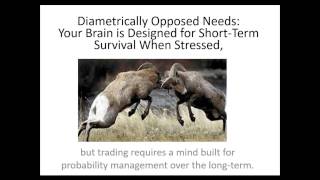
There are diametrically opposed needs going on here. Your brain is designed for short term survival. When stressed. That's it. I want you to hear those words. When stressed, when challenged, your limbic system is going to see those challenges and going to see danger. It's going to feel vulnerable. It's going to want to trigger to default programming to fight flight. You will experience that in various ways. The thing is.
What we're asking, what you're trying to make your mind do in trading is not a natural mind. It's really unnatural however. But it can be built, okay, but it's not going to be built by will. It's not going to be built by thinking positive. It's not going to be built by just saying I think I can, I can, I can, I can. No, it's going to be built because you understand the dynamic of emotion and mind and you know how to manage mind, manage emotion and change the underlying belief structure that's engaging the trading world. And friends, that doesn't happen overnight. That doesn't happen by reading a book, getting a little more knowledge. That is literally changing your belief structure at a neuro circuitry level. That's what's required of that.
So.
Here we go.
No matter how much logic, data, predictiveness that you bring to try to control outcome, you're still going to find yourself having to embrace uncertainty. And you're going to have to be successful at engaging a mind that literally what it knows. It control.
Is literally the moment of performance, not the outcome. The moment. So literally when I was talking a little earlier, when I say check reality, check ahead, what I'm asking you to recognize is that if you're western in particular, you are going to come from the rationalistic tradition. You'd call that scientific mind. The thing is, if you're bringing that into trading, you've got a serious problem. Which means the vast majority of people that get in trading have a very serious problem. You're going to have to shift that paradigm of the way the mind and the brain that gives rise to that mind perceive the Phenomenon of the trading worlds.
In neurological parlance, what we would say is you have never experienced reality.
What you have experienced is your brain taking data from your sensorial modalities, building a construction called a virtual representation of the world, and then projecting that representation onto the world, onto the trading. And it is driven by your beliefs about whether or not you believe that you can engage the unknown and come out a winner, come out surviving, come out better. That's what your trading account is really measuring, and that's what you're going to have to learn to do. Because ultimately most of us fall into the illusion of linear thinking. Okay? Talk is really cheap. Have you ever been in a.
Trading room and you're listening to people talk, doing the job thing, and they're talking about how they're just talking trading, talking trading as if they knew what they're doing, as if they were competent and they're, you know, people are listening to them and they're, you know, they, people actually would be willing to pay them because they're so good at prediction about what's going to happen more than market turns and stuff like that. But then you see them trading and you realize the talk is cheap. The moment that the risk are real.
All that logic, all that analysis is thrown out the window. And what you have is, you have a scared little kid there. Okay? Money talks, the trading account talks. Are you listening? Ultimately, knowledge gives you a huge false sense of security and confidence. Okay? You feel confident. I know this stuff. Do you know it in the real time? Do you know it in the arena of combat where it. You have to do it? That's really where you know it or you don't know it. So ultimately what we're talking about.
If you're going to be successful in trading, there is a real need for reorganization of itself, of the mind, okay? That engages the phenomenon called the markets, and particularly before the money runs out. Okay? Okay. It's always that thing about the learning curve which is greater, how fast you get at the learning curve or whether or not the, the curve of your money gives out? You know, ultimately what we're doing, here's the thing that we have to finally come to accept. And this is something where maybe you're not there yet, and I'm perfectly okay with that. Spend some more time risking capital in the markets and let's see where it goes. But ultimately, the mind that you brought to trading is not going to be the mind that brings success in trading. That old mine was built for a very different world than the world of trading. There's nothing wrong with that old mine. It's just not built.
By evolution to engage probability. It wants certainty of survival in the short term so it can breathe back into the population and project into the future.
And it has been very successful in doing that. So there's no reason for it to change.
And we don't have enough time for evolution time to change anyway. We've got maybe five years, depending on how much capital you have. So now we know that ultimately it's about change from the inside out that needs to occur.
Because ultimately the default programming.
Is going to grab you every time. The moment that uncertainty and risk coincide in the same moment, you are wired to feel vulnerable.
Wired. Think about just a few thousand years ago that there was danger around everywhere. There were big cats, big bears, there were all sorts of things that were get bump in the night. And we had every right to see when we were vulnerable that we would trigger to fear, we would trigger to fight flight. Okay? And that's, that's built into default programming. It's not your fault, but it's your responsibility to redevelop the mind for probability if you want to hang around trading successfully without making other people's rich by being able to extract more capital than you invest into it. So the thing is, we know this is going to have to happen. And we know that we're going to have to be able to move from the survival instincts of the limbic system to being able to calm that system down and allow our new brain that's capable of rationalistic thinking to be able to engage risk without being contaminated by the fears, by the vulnerabilities. The old emotional brain, the limbic system. This is the task, friends. This is really what you need to do to learn how to trade effectively.
And here's the question. You know that everybody looks at this as man, I get that psychology, there's nothing wrong with me. Well, you know, you tell, you start looking at top line athletes, you take a look at Olympic athletes, you look at these people and you recognize they have coaches, they have psychology coaches. What they realize at the level they're competing on, the difference is in the mind. It's not in their data, it's not their knowledge, it's not in their ability to perform. You know, at the top end of golf, everybody has the capacity of winning that day.
What happens is that you have to go out and play a game that's unrelated to all the other variances going on, the probabilities going around because ultimately you don't know if you're going to win, but you know you can play well. Ultimately, will, will never. Willpower will never make it. Ultimately, the same reason is that weight loss. Most people regain the weight that they lose 95%. The same thing with exercise. They start out in January with a big idea. By February, March, 95% are gone. Smoking cessation, same deal. This 95% factor keeps showing up. And ultimately what people do is they really, they don't understand that you have to bring the body along with you because the body brings forward the mind. If you do not know how to work with the body, you don't know how to work with the mind. And ultimately the other thing though is because we don't know how to deal with the body that produces a mind. On this second picture, we start realizing that the temptation is always there. You know, that we call it euphoria in trading. You know, that overconfidence. Boy, this feels so good. It feels so good. Winning. God, I'm going to you know something? Wow, I just won that one. And you go in and you do not have disciplined mind. You don't have a disciplined body. It's in celebration. You bring that celebration. The next trade set up or you're sitting there and you just, oh, my God, what if I lose? What if I lose? What if I lose? Don't get in. Don't go in. Go in. You survive another day.
But you survive short term, yet you forfeit the future. This is an internal dialogue going on inside your head. And the deal is the body and the mind are deeply interconnected, which is something we're going to be looking at because emotion is biological. It takes over our mind, it creates our mind, it creates the thinking in your mind. And you're going to need to learn how to deal with it. Two of the primary factors. This is something I want to ask you guys, okay?
When we experience the stress of uncertainty, the challenges of uncertainty, the challenges of I could be wrong, Ultimately your biology is just absolutely wanting to trigger, to fight flight, to cope with the challenging circumstances. And my question is this. Which one are you? You know, suddenly you're going through all these market gyration, you're experiencing all this volatility, okay? You're in that volatility thing. And you know, it's the volatility. That's where you make hay at the same time, are you the one? Oh, no, oh, no, oh, no. Oh, my God, I could lose. I could lose. What's going to happen to me? Or are you the one More, more, more, more.
One is fight flight, the other is euphoria. It's like being on cocaine while trading and you're going, you know something, I get off on that adrenaline, I get off on that testosterone, I get off on that. But the thing is, is that's not the kind of mind that trades. Well, just ask JP Morgan. When they evaporated $8 billion and the whale, one of their best traders evaporated 2 billion, it was euphoria that was the problem. Way too much testosterone.
And the risk manager was gone and they jumped into it, more, more, more. And they blew it up.
Understand? Which one are you? Are you one or the other? Are you both? Do you alter it through? It's really important. Are you fear based? Are you euphoric based? If you over trade your euphoric based, if you revenge, you're both. You take a loss and all of a sudden you're gonna make, you're gonna make the markets pay. You know, if you're a fear based trader, you have a hard time getting in. You have to force yourself. Oh my God. More, more confirmation, more confirmation. Oh my God, oh my God. At the same time, when you don't go in and the opportunity passes you, there's relief there.
The limbic system has stopped you from losing. In the short term you feel some relief. The reward centers in the brain are locking in the habituation. Now try to get out of that one comes to me. I can teach you how to work with that. So we've gotten that. Which are you? And go ahead and type in. Which one are you? Are you the fear guy or are you the overconfident guy? You know, this is all reactions to the challenges of trading, to the challenges of stress and trading. Both these things and people kind of flow on either side. Let me know which one you are, which one, which one best describes the situation you find in your trading? So just write me and let me know and we'll, as we move through, we'll fear.
Fear, probably both. Fear. Overconfident. Yeah.
Euphoric guy. Yeah. Yep, yep. Alpha guy. Yeah.
Sometimes both. Yeah, that's what I want you to hear. Guys, what happens is that if that is happening to you, you're so far out of the trading mind that can actually extract capital out of the markets, you have to make a decision. Am I going to train my body and my brain and my mind to be able to produce a discipline, impartiality that neither falls into euphoria. Winning. Oh my God, I feel so good when I win. Or fear have to be right. There you go. If you have to be right, you're, you're trading from fear because I can promise you it's that the really good traders recognize they're going to be wrong a lot and they promptly admit it when they are, you know, and then, and they get out.
So now do you want, do you want to know what's happening.
When this occurs? When this hijacking right here, what you're looking at is a hijacking. And until you solve that problem of that hijacking, you don't really, you don't. The door to success in trading is not open to you. It's not easy because all the dang habituation that's going on, it's going to take you time and effort.
Training to be able to get through that. And here's, here you go, let's take a look at this thing. This is a, I just have, you know that I just did this slide and it's something that I want to map out what is actually going on in emotional hijacking, okay? And this is for all the people who think they're rational. What I want you to recognize is this. If you start over there, the left hand side where encounters uncertainty is threat, okay? At that particular moment, encountering the uncertainty with threat can be both from overconfidence and from fear. The major thing is like if you're an alpha type trader where you're chasing trades, you're overconfident, you jump into trades too early, you over trade, what happens is you're sitting there and you're going, okay, I see the deer, I want to get it, I'm jumping in, I want it now. If you're fearful, you going, oh my God, what if I'm hurt? What if I miss? Ultimately, the moment the brain encounters uncertainty, it's going to perceive it as threat. That's our history, that's our biological history. What happens then? Survival evaluation in the limbic system at the thalamus takes place. This, friends, is the big, big thing. This is the place until you learn how to slow this reaction time down. And this is happening in nanoseconds and it has to become microseconds if you're going to become successful. Because ultimately it's at this moment that there is a sensory override. And suddenly survival instinct, there's an activation of those survival instincts and suddenly you have the amygdala hijacks.
All this data that was going into your rational mind, your cerebral cortex for sensory evaluation. Man is hijacked and suddenly you're back over that the amygdala, that's the one that has, that's your fear, that's your aggression and it's hijacking reason. And suddenly you become reactive.
This is going to happen until you learn how to decode it. Deprogram the way the thalamus is actually producing the evaluation. Being able to calm the hyper vigilance of the amygdala down so that it doesn't trigger either to fight or flight. And that aggression of fight is your, that's, that's your over trading. That's your jumping into trades. That's all that stuff. That's the revenge trading, the fear, that's not getting into the trades. Becoming powerless and doing crazy things in the trade. What you want is that the value at the point of evaluation of the thalamus, you want the calmness to be able to surround all that sensory information to be evaluated by the left brain. And that's what I call in my. In my business sage. Okay? So this is the problem that needs to be solved, friends, okay? And you're going to experience it in various ways. And I'm just gonna list these, okay?
These are the common ways of experiencing that little graph I just showed you. Fear of entry, fear of loss, fear of not being right, fear of missing out that need to be right. Chasing trades to make things happen, revenge, trading, overconfidence. You know, I've got to win, okay? All those are evidence of literally what's going on at the limbic system of that where that thalamus is doing the evaluation. And what happens until you learn to retrain that you're going to constantly have that thing of that shortcut where the thalamus is jumping the whole cart over to the amygdala. And boy, that, that's just not good for trading. Good for short term surv, bad for long term probability instead of sending it to the brain. That's what we've got. So ultimately we have to start rethinking is it conquering that we want or mastery? You know the guy on the left, wrestler that he was, he's a. He's a dude. Now the truth is, is that to become successful in trading, you have to master your fears rather than overpower them. Hiding behind data is not going to work or logic. The deal is, is can you turn toward the fear with the skill sets. And by the way, we teach you those skill sets with the skill sets for you able to calm the fear down and get at the core belief and to decode it, to deconstruct it and to reconstruct it into higher functioning mastery. Not conquering. My promise to you is the limbic system could care less. Your emotional brain could care less of you attempting to conquer it. It just simply flips the switch and hijacks your thinking like in the previous slide. The key here is how do you produce mastery? Okay, now we're going to be looking at a completely different phase of what we do. This what we're about to start discussing now, this mastery business, what we teach both in our group course and our individual work. So pay attention. Okay? Ultimately.
You'Re going to have to master emotions and the underlying beliefs that drive your trading. Know thyself Socrates, how many years ago. And yet the same time is we can get away with not having to master the self until we get to trading. We have the illusion of control. We have a lot of things at work. But when we get to trading that trading account, darn it, it's going to tell us the truth about our effectiveness whether or not we want to hear it or not. And the thing is, is, are you being honest with yourself? Because otherwise the trading accounts can continue to point out what you refuse to acknowledge. And I can promise you this, the thing that ultimately that has to happen, men and women have to come really up person close.
With the the major four self loading beliefs that drive poor performances in trading. One is a sense of inadequacy. I'm just not good enough. I can't do it in the clutch. A sense of mattering. You know, if I make a lot of money, then I'm going to really matter. I'm going to be a big guy and people can see that I really matter. You have confused mattering as self worth with net worth. And it's a dangerous concoction in trading. Also a sense of whether or not you deserve to win, you deserve that success. A lot of people actually do not reach higher levels, particularly the ones who keep reaching a particular level. And they can't go beyond that. They hit a threshold, they can't go beyond it. What they do is they don't believe they deserve to win at that higher level. And they have to get at that sense of worth. Okay, you have to decide, you know something, where is my worth being derived? And I don't have a business. If it weren't for a bunch of guys in their 40s, 50s, 60s and 70s still trying to prove to a parent who's dead that they matter, that they have worth. And the last One is a sense of powerlessness. And if you don't think you experience powerlessness, notice what happens when things are going wacky on you. Once you're in a train, you're trade, you're committed, you know, and the thing is just bouncing around and you just feel all that flux going all sorts of way and you're a horse in a burning barn. Well, that is powerlessness. That's what you have to get to know.
Then next what you're going to have to learn is how to manage and use emotions. In particular, you're going to have to learn how to. That little almond shaped guy down there in the pink is the most powerful little piece of the brain that every trader is going to have to do. That is the source of your fear. That's where your fear and aggression go. When it, when the amygdala experiences what it perceives as threat, you are going to have to reroute, reprogram what it sees as threat so that it begins to trust higher brain function. And friends, that is a trick and I teach it. So ultimately.
It starts out by recognizing that emotions and the mind work together and they can be managed. What I teach in my courses is this, is that you have to learn how to breathe and you have to learn how to relax the body because emotions are biological. It just so happens that the way you breathe and the way you hold tension in your body are part of the emotion. You can alter the intensity of the emotion by the way you breathe and by the way you relax your body. Most traders will find that they are holding their breath, they're breathing very lightly, they become fixated and have a lot of tension in their body. What you're saying is, oh, I'm really arousing my fight flight response and if I continue doing this, it's going to hijack me pretty soon. Or you can learn to manage that by breath and relaxation. That's the first thing that I train. The problem though is regulating emotions is just the start.
Regulating emotions gets you to the door of the mind. But it's the fixation, it's the tunnel vision that we have literally strapped on and see through. This is what has to be really managed. We have to be able to deconstruct that tunnel vision. We have to be able to say, you know something? I now see that if I only took these stupid tunnel vision binoculars off, I would be able to see the world very differently. And that's what we have to learn to do. And we do that by developing the observer.
That's the next thing that happens in my work that we start developing an observer of the cell. Everybody will exit, experience the observer. And if you ever had the experience of, like, you know, you just kind of, like, you kind of step back and you look and you go. You take this perspective and go, you know something? I'm. I'm noticing that there are thoughts running in my mind. And yet at the same time, I don't have to fuse to them. My thoughts and I are not the same. My beliefs and I are not the same. Those represent but one organization that the brain organized me as to become a self. Yet when I step back out of that, I realize that just like the brain is very plastic, so is the mind. The mind can be reorganized into higher functioning. You can have different emotional programs producing the kind of thinking. That's the power of the observer. And if you want to, if you're looking to create change in yourself, the development of the observing self is enormously important. It's something where some people have problems, other people don't. But you're going to learn how to do that. And it's the place where you open the door to the mind. You can look in and you can objectively start looking at the beliefs and thoughts in the mind. Not it's who you are, but it's history. Powerful stuff. Friends. The second thing, the next thing is that you come to recognize whether or not you like it or not, that there is an inner critic that lives within all of us. A judge. It's that judgmental voice in your head saying you're not good enough. Who thought you, who said you could trade that was the stupidest thing in the world. Or conversely, get in this trade. Prove it. Prove it. Get in. Get in now. Get in now. The temptation, the truth is, is that until you learn to recognize this operating it's an emotional program in your brain, it's not you. You have to become.
Disconnected from it, to step back out of it and to recognize that, oh, my God, it's just absolutely a voice in my head and it's been so loud, it's been in so much control that I have never examined it. Well, you're going to learn to do it, and you're going to realize that it's been running the show and yet it's been making a lot of edicts with very little proof. This is the first thing that happens. Most people never do it because they don't want to. They don't want to acknowledge that there is this truly negative, destructive part of itself. Going on yet you better. Because ultimately.
You don't come from a mind built for trading, but it can be developed. This inner critic and your fear together form a tremendous roadblock to the development of your mind for trading. If you view your brain as a community of rival emotional programs that can be reshaped. And if you view your mind as a space where those programs are given voice as your thought, you begin to say, wow, I need to show up. And I realize that I have a committee running around in my head and I have been asleep and I need to start taking. I need to start taking control of my mind. I need to organize this mind for functioning. Because ultimately what happens is if you take a look at this image, this is kind of a fractal of what your mind really looks like. There you have this guy looking, and there's all these competing voices trying to get on the stage, trying to influence the observer that's projecting onto the. On the stage of the self. What happens is you need to learn to manage this process. Most never do, Most never make it successful in trading. What you discover in trading is you discover there's a lot of voices in your head that you don't need to be listening to. And you need to develop the voices that really give you the edge in probability thinking. They're there.
But they're gonna have to be developed. They're not the default programming. All this other junk, you see this guy being involved is the default programming. You have to start going, I need to weed this out. I need to rearrange the committee of the self so that I can have a brain of much higher functioning.
So here's the deal. What I'd like you to do, and this is really for you. I would love for you to write some in, but these are thought clouds. What I want you to write down. And you can write it down just for yourself first or for some fun. Write it in here. We don't know who you are. Just write it in and say, what are the thoughts that run through your mind while trading when you're in conflict? Okay, what are the thoughts that come and are duking it out with one another? Because I can tell you a lot of it will be about adequacy. A lot of it will be about God. Really, do I matter? Do I really deserve this? What if I'm wrong? You know, I need to take. I need to make this. I need to prove myself. I need to prove myself. Those kinds of thoughts, okay, write them down, send them in, type them, hit that send. Let's just see what kind of thoughts run through your mind. Have to be right is a good start and I'm going to move on. But I want you to. And if you don't write them in and send them in for us to kind of share. What I ask of you is this is. I want you to write them down and start seeing it. Okay? Get. Gotta get back to even. Oh, yeah, boy. That's a famous one. I don't say something. My edge doesn't work.
I'm going to lose money. I'm terrified.
Yeah, you got it. Who's feeling? I feel sick.
We're having a hard time getting a win long. Terrified of going down big. Yeah.
Because you believe it will because you believe it will come back. Oh, yeah. Boy. Boy. Talk about temptation. Talk about just absolutely being deceived by the devil. If I take this trade and I'm wrong, I'm going to feel really stupid. Well, you know, there you go. I want you to listen to this. What? I want you to love this one. The market can read my mind. There you go, boy. I tell you. What I want you to recognize is what magical thinking is going on. What little control you have over literally the parts of the brain showing up and controlling the mind that's created. Friends. Wouldn't you much rather have an in control mind? The truth is you can never control outcome. But what you can control is the mind that you bring into the moment of performance. What you're demonstrating with these thoughts is I'm not in control of the mind that I'm bringing to the moment. And my question is, do you want to be you better?
A new mind.
Can emerge.
That can respond to the challenges of trading a lot more effectively than the mind you brought. Okay, again, instead of trying to control outcome, you control the mind you brought into the moment. You take a look at this gymnast and you really see that he's in control of himself. That's it. Okay. He's not control over the outcome. And it's really interesting is what we do is we besides teaching the observer and beginning to observe the voices not as who you are, but as basically an adaptation of the emotional programs. We also teach how to pull forward the internal resources that you have not developed to be in the moment of performance. We teach you how to pull forward real discipline, real courage, how to self soothe fear and stay impartial. These are emotional programs that were never taught as part of performance. You were always taught not to lose, not to make a mistake, not to. Nah, that's crazy thinking what you're wanting is that in the midst of performance, what can control you control the mind that you bring.
That's the edge, friends. That's the edge that drives methodology. So we've gotten that and here's the deal. What is this process? It's pretty simple actually. And this is taught both in my group course and my individual course first. It starts with a new understanding of the brain, emotion and mind. The stuff I've been talking about, you got to get it clear, is that your brain and your mind are deeply interconnected emotional regulation. Learning how to manage emotions, my God, that's important. Yet most people just get whacked off every day by the emotions. Mindfulness training, you learn, you've got to learn how to observe the mind that's performing. Like all these thoughts that you guys were talking about, my God, yeah, they may show up, but are you observing them? And do you have something, do you have a way of creating a different mind? Speaking of that, the discovery of the default programming, of the internal dialogue, that's all those thoughts that were very destructive. And then the discovery of your undeveloped heroic nature. Every one of us and I actually use memory, where we go back in and we take memory, I show you how to get in and recognize the brain did not encode the information that we want into certain kinds of experiences. And I show you how to break through that code, get at the feeling of empowered emotion and teach you how to bring it into the moment of performance. Very powerful. It's not affirmations, it's not visualizations. It's actually something that did in fact happen. So you know it's in you. It's your job to bring it out. Then what you discover is that you start reorganizing that mind into probability based mindset. That's what we teach friends. This would be a heck of a gift to give yourself.
So my question is this, is that.
If you know how to trade.
I ask you to listen to your trading account, okay? And when I say know how to trade, you have the knowledge, you have the data. But what happens is you find yourself that your mind is getting in the way. All those thought bubbles and stuff like that that you were talking about, those, they're getting in the way. Would you like to do something about them? If your answer is yes, then boy, have I got a solution for you. I am inviting you to become the change. Okay. It starts with a group course. It starts in a couple weeks. And the group course is a very cost effective way of learning the skills, the basic Skills that I teach that you're going to have to have to be able to reorganize the mind into higher functioning. And on this slide you'll see it's got five group meetings with me. It's in a webinar format. You have a virtual classroom that's open to you 24 7. There's a lot of stuff there. Okay. And ultimately.
You move literally from, you literally move from learning how the mind works to learning emotional regulation, to learning the observer, to learning how to really spot this internal dialogue, reorganize that internal dialogue and build a plan that teaches you how to do that. And interestingly, it's 1195 that gives you access to all five classes immediately. A lot of people do that because they want it, they want, they want to work at their own pace. Or 239 per session. That would be five times that over a period of. It's five payments over a period of 10 weeks. It's a two month course, very powerful course. I recommend it. And if you go ahead and just go ahead and say, you know, I need to do this, what happens is we're going to give you free an emotional regulation workshop that if you go to our, if you go, if you go to our website, you can pay a couple hundred dollars for it or you can get it free next several days. For those of you who are going, you know something, Randy, I really like the idea of a group course, but the truth is, is that. Tell me about your individual course. That individual course is far more comprehensive and it's far more personal. It really, it's for people who really are serious about this stuff and they have a little bit of extra capital that they can invest and for the training of their mind, it is powerful. The major thing that happens with it, besides being having a lot of stuff that you yourself own. It comes with 10 one hour personal consults with me over Skype over a three to four month period. Big difference. It's a powerful thing. Now, of course, it's the first time I've ever done this webinar and every time I do that, every time I create a new one, I end up going a little bit over. I want to thank you for being here and I'm really asking you is that do you really want to become a trader? And if you're one of the ones who said, you know something, I really recognize these thoughts are running rampant in my mind and I don't have control over them, friends, it's not going to happen because you wish they're going to change. We have a program that teaches you how to change your thought life, change the emotional base of it and change the basic emotion, the basic beliefs that give rise to the emotion and give rise to the mind that engages uncertainty. That's the trick that has to occur. And I encourage you to really look at this.
Take it and move on. 1 and now, do you have any questions? We've got a few minutes. I've hogged all the time, but we'll take a few minutes. If you have questions, I have responses. I can't say that I have answers. I have responses. So I hear one person saying, yes, I know. So are there any questions that you'd like to ask of me?
Good opportunity.
Going once, going twice. Well, I'll tell you what, while we're waiting to see if anybody has the courage to ask.
I just simply want to thank you for being here tonight. I want you to say, you know, thank you for saying, you know, I'm interested in trading. I really want to know what's going on. And.
Here'S a question. What is the difference between I think I'm gonna.
And the individual?
And that's Mort. Mart. Martin. Martin. The major difference is this is your access to me. That's the major part of it. In the group course, you know, I am going to have five sessions, hour sessions, and I will talk and coach anybody who asks questions and things like that at the group. But I'm not accessible outside of that group. I mean, I'll email, you know, I'll do some emailing and stuff like that. And it's the, the, basically it works off the virtual classroom of where you're going to our, our virtual classroom. You're going in, you're watching all the videos, you're listening to the MP3s and you're going through all that stuff and people and you have access to that for a long time.
And you end up learning basically the same things. In the individual course, it's much longer.
It generally is three to four months long rather than two months long. And it's a personal journey with me.
Most people want the coach, want the mentor. Ultimately, it's also more comprehensive. There is more in the individual course, particularly toward the back, where you start being able to measure stress responses with heart rate and learning how to work, to work the physiological arousal levels into an area that would be peak performance mind. Okay. But the major thing is it comes with 10 consults with me. That's the major piece where. Yeah, and we dig, we dig very deep that's the major thing and it's for people who are really serious. It's from Ellen. Loved hearing your voice again. Thank you, Ellen. I recommend this to everybody. Changed my life. And by way, Ellen is, you know, she's out in Utah right now having a great time on the beautiful powder that we don't have with the snowstorm we had here. But yes, she, Ellen was. Is a great student. It's one of those where what most people discover is that this is a lot more than just about trading. This is really about how do you construct a mine. Okay. And.
What happens is it has to do. I ended up choosing trading simply because there is a truth meter called the trading account that cuts through all sorts of BS that occurs with people when they start talking about self development. What we know in trading is that if the trading account is not growing, then what happens? Your self development is not growing. And there is a payment plan for the individual course. It's three. Yeah. Okay. Have a wonderful year. Thank you so much for today's webinar. Have a wonderful new year. You too, my friends. And let's stop right there because.
My throat's getting dry and it seems like a good place. And I want to say this is that all of you, I wish you well. All of you, only the best. And my hope is that if you really are choosing to be on this journey into trading, I really hope that you find a way to develop the mind for probability. It's not easy otherwise everybody be doing this. And yet it has to be done. If you're going to be successful in trading. If I can help you, I would love to have the opportunity of serving you. Thank you. Thank you. Thank you very much. Have a great year. Goodbye.










