2Cracking the Code for Maintaining a Disciplined Mind Under the Pressures of Trading
Randy Howell explains why trained traders fail under live risk: your amygdala hijacks decisions faster than your rational brain can respond. He maps five mental skills to rebuild a probability-based mind, from emotional regulation to mastering performance over outcome, with timelines and client examples.
Questions this video answers
June 5, 2020
$3,500 (or three payments of $1,200)
10 sessions over approximately three to four months
$1,195 (payment-plan options mentioned, including installment schedules)
Initial reprogramming can begin in ~3 months; meaningful solidification may take about a year (Randy aims to open the door in 3–4 months in the individual course)
Chapters
Welcome everyone. My name is Randy Howell and we are here with. It's either trader state of mind which is the official name of the company or my trader state of mind when we had to go back and buy the domain name. So anyway folks, what I want to do before we get started this evening is just make sure that you can hear me. If you just simply, if a few people just type in yes or yes so that I know that I'm being heard will be yep. Okay, there we go. Now let's take a look at this. You know how on earth do really smart people, they get into trading, they get themselves trained and then what happens is that they sit there and go what in the world's going on? What in the world's going on? I can't seem, I can't seem to trade my mind that I know that has the knowledge of trading but I can do it when the risk isn't there. But something just absolutely goes crazy with me. That's what we're going to be exploring tonight and what you're going to discover is this, it's pretty simple, is that first of all we have to understanding this is that we're looking at emotional hijackings here. We're looking at something not about the thinking brain per se, but ultimately what you guys are all taught is, is how to use the thinking brain. That's what the world does now that's called rationalistic thinking. And we think that rationalism is king. Yet what we find out in trading is something is really wrong, yet we keep doing the same thing over again. It's almost predictable exactly when things are going to go wrong, I mean what are the scenario? A lot of people just simply freeze on that trigger, they can't make entries. Then what happens is they just get in and all of a sudden they start having self doubt. The trade goes against them and they bail out, they go crazy. Or then what happens is they finally get to the moment where they get some profitability, they take that money and jump out of the trade and only to watch it just absolutely go to target. And then they revenge trade. They start saying I'm going to make up those prior losses, yeah, I'm going to get it back. There's all sorts of things that go on and you keep doing the same thing over and over again. And that's the thing is do you see it's not working. And our good buddy here, Albert Einstein and saying you know something that's the definition of insanity is you keep doing the same thing over and over again. But getting different results. Well, yeah, and expect different results. The thing is is that the trading is full of this. So what I want you to see is there's something going on here that's not working.
And ignoring it. Trying to keep doing the same thing and then trying to push through it harder and harder. What I want you to notice is it isn't working. And we keep having these urban legends about the guys who just seem to be able to do this and they, they go in and they train well and all that kind of stuff. And we've got one of those guys in the audience tonight, a good friend of mine, David Tabay runs Polaris Trading. He's got his group here. And David, you know, he was just a born traitor. You know, he started all the way through and you think, well him, well, David is like one in a zillion. And what about the rest of us that have what we call typical emotional architecture? That's when you discover something. And this is the great truth that traders don't figure out for four or five years is that everybody has a trading system or at least you better. Okay? Everybody has a methodology that is supposed to be able to help you with set of trading rules that allow you to be able to manage risk and keep those losses small and keep the winners big. And we. Nobody notices that there's anything else to trading other than that until they keep losing or leaving a lot of money on the table.
And they finally come to the moment, you know, this psychological thing it seems, you know, I see I keep getting scared. I still, I still have, I still over trade, I do all this stuff. Maybe this has something to trader psychology. And that's when you start discovering is that trading really, there is no separation of the beliefs that you bring to trading and the performance, particularly in your trading account. And you recognize that those beliefs that are embedded in your psychology and your biology, I might add, influence greatly the trading system and the methodology that you trade with. And yet everybody ignores this. And even if they start recognizing that.
Yes, trading psychology has something to do with this, yet at the same time it's blown off. Oh, and by the way is that I defer questions to the end. If you write those questions in as you go, I'll answer them at the end. Okay, I really will. But I'm kind of one of those guys that what's. If I start getting distracted, I lose my train of thought and boy, we don't want that. Okay, so here's the deal. When you take a look at this Graph, it starts letting you know something and it clues you into some. A great, great truth is that what you discover among really great traders is they recognize that trading is about 80% in the mind. They realize that that's the trick. Everybody has to learn to play the game, but it doesn't mean that you can play the game and play on a high level.
You know, mediocrity kind of kicks in there and most traders stay at a pretty mediocre level, hence the 95 to 98% failure rate in trading because they don't adapt to what the trading accounts telling them. So we take a look at this and we go, wow. And we begin to come to a big deal. And what that big deal is is that you, you have a brain that was designed for another time and another place and not right now. It's designed for short term survival and it's not designed for literally probability management. It can't do it. As a matter of fact, what you're basically doing with your brain that evolved over vast tracks of time in a very dangerous world and had to make lightning fast decisions. Lightning fast decisions. Okay, what you've got it doing is you're in. Every time it engaged uncertainty, it fired these lightning fast decision. You're taking that brain that did a great job of making you a survival species. And what you've done is you have given it its worst nightmare. We're going to be talking more and more about that. And what people haven't done in trading is this. They have not taken into account the survival instinct programming. And I'm talking coding. It got coded into the way you think and behave of the emotional brain. That emotional brain was there a long, long time before your thinking brain. And yet today what happens is we think the thinking brain's kingdom. We think, oh yeah, we've got these emotions and we need to kind of push those out of the way. No, the emotional brain actually determines the quality of your thinking. So the thing is, is you may have great knowledge of trading, but the moment that fear touches in that primal fear, okay, it kicks in. And what happens is all that knowledge is useless. Practically everybody gets to experience that at one time or another. And what you discover is this. Your emotional brain truly sits beneath conscious threshold. I don't like to say that that's unconscious, but it is subconscious. And that subconscious is your limbic system or the emotional brain, or what I actually refer to as your orphan nature. And it's learning, it's learning in an amoral way about what works for short Term survival. What you're familiar with is that little bitty part of that iceberg that says conscious mind. You're not looking at 95% of the decisions that you make are done at the emotional level or what we would like to call the subconscious mind. What we're attempting to do here.
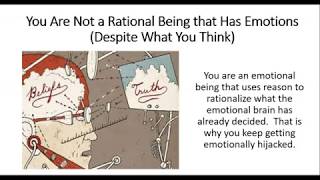
Is we need to make that subconscious conscious. We need to take your implicit beliefs that are driving your performances, and you'll know if those implicit beliefs are accurate and effective or not by the health of your trading account. That's the bottom deal here, is that with me, everything is about the health of your trading account. It's the only friend that you're ever gonna have. You may not like what it has to tell you, but it's gonna tell you the truth rather than your lying mind. And my promise to you is your mind will lie to you every time. It is built to lie to you. So you're getting this going. Okay. So, Randy, are you telling me that the emotional brain is actually what we're calling subconscious? Yeah, absolutely I am. It's not subconscious in Freudian way, no. It's subconscious because it doesn't have a language, it doesn't think, it emotes. It builds solutions to problems that experiences as dangerous or threatful. And what it does is it produces learning. It becomes automatically. Emotions really are biological action potentials that coordinate action between you, the trader, and the environment, the markets. When there is a change in the market, there is an emotional triggering in you. And the key is, is that it's all happening on a subconscious level or otherwise. Everybody would be successful traders. They have the knowledge, they just don't have the functionality of their emotions to produce the mind that can trade in probabilities. And therein lies the problem. What we have, my friends, and when you're looking at this graphic here, what you're looking at is that the modern man sitting there with that little egghead type deal of his thinks he's in control. Yet what happens is he doesn't see, he doesn't even think to look behind him and to see the subconscious or the emotional brain. That's where 95% of the decisions are being made in today's world. What we know, particularly in advertising and marketing, is that we videotape. When I was in advertising, I did a lot of quantitative and qualitative study. But this stuff they're doing today is they've actually learned how to read the eyes as a function of emotion. And what they're doing is they're looking at emotional reactions to different offers, to different products and stuff like that. That's how they're doing such incredibly great advertising now compared to what when I was in the advertising industry in the 80s. They're activating the 95% of the decision making that's done on the emotional or the subconscious level. That's what they're doing. Friends, you are acting from that whether or not you like it or not. That's not the key here. The key is am I going to learn how this little caveman brain of mine works? Because it's absolutely, it's, its survival instincts are killing my trading. And until I learn how to deal with that emotional brain, that limbic system, I am going to run into these hidden biases, these assumptions that the limbic system made. Never clued the thinking brain in. And then you discover the limit. The thinking brain is only making up alibis, it's making up stories that supports whatever the emotional brain's already decided, even if it has to lie. Yeah, that's us. That's human beings ultimately what you're looking at and what I'm trying to do. If you want to crack the code.
That'S absolutely blowing out your trading from its potential. This is what we're talking about right now. I want to, I want to repeat it one more time. You have a brain that was designed for something completely different than what you're trying to force it to do. And when you're doing it, you are putting it into its worst nightmare. It's built for certainty of short time survival and you're putting it into probability of long term gain. That's not what it was built. Far from out of those beliefs that develop in the emotional system, you begin to see the reality. You see the truth. So the truth really is observer generated. Whatever the beliefs are in that observer, that is what you're seeing. How many people do I know that says, you know, the markets are against me? They're not against you. You're just walking in. There's plenty of people who make, well, not plenty. There are, there are people who make good money, exceptional money trading the markets. They understand the markets aren't against them, but they're not for them either. And what they learn to do is they learn to read and see what the market's willing to give them rather than having to be right, having to be in control, that's the big deal. But I want you to get that. You, you, you see, when you see data, it's data. But when you see it through the beliefs, the biases of the emotional system, it becomes the truth, or Stephen Colbert would say truthiness. So we come there and let's take this one other time. We have all these, this sensoral information coming out, okay? And it's all coming in to the brain stem, what's known as the reptilian brain. Then it goes to the sensory thalamus and it's evaluated and a decision is made based on at that level, literally the perspective, the beliefs, the values, the memories, the biases, the assumptions, the past emotional learning that that brain has discovered. Decisions are made.
Maybe not so good if, if, you know, if, if it was a limitation of probability. And all of a sudden you behave, you know, suddenly when that trade goes against you, you just absolutely lose your control and do really crazy things and you find yourself totally out of control or you freeze any of those fight flight responses. You know, the over trading, the revenge trading are just, you know, taking those profits way too early, all that stuff. And the key is what I want you to understand. You do not see information and then make a belief out of it. No, my friends, you believe and you force the facts to. To fit that belief, no matter how outrageous. Okay? One of the big beliefs that we all bring into trading, we're gonna be talking about these a minute.
People get sucked into trading because they believe that there is a. Either a gold mine or a pot of gold at the end of the rainbow in some fashion of that. And they jump into trading and they, they don't even assume that fundamentally you have to become an incredible manager of luck, of probability, to be a winner and trader. It's kind of like poker playing is that when you, when you play a really good poker player, what you discover is he's not gambling. He understands the potentiality based on a given setup in hand. He understands the potentialities and the probabilities on almost every one of those. But there's also wild cards. There's also wild stuff happening. That's where the luck accounts for. So you're looking at this and you're going, wow. So everything I'm doing, I may think in one particular unstressful moment that I've got my act together. But then what happens is all that information gets filtered through my brain and its biases, and suddenly it sees threat or it sees opportunity and has the need to hunt the thrill of the chase or develops fear and you end up with fight flight behaviors. Wow. But I want you to get it, friends. You do not believe and then see. You believe, you see and then believe. No, no, no, No, I said it all wrong. You believe and then see. And therein lies the problem. You know, you, when you're emotionally drunk, you think you're making rational decisions, but actually reason serving fear. Reason is serving lust. Reason is serving fear. Our anger, our lust. That's what, that's what happens. And before you know it, you're making really crazy decisions. So this is what it kind of looks like the moment that you hit stress. Okay, Suddenly what happens is that your emotional brain totally takes over and all your ability to reason falls to the wayside in a rationalistic way. And that's when you discover 95% of the decisions you make. Bam. That's where they're coming from. They're coming before thought. And the thought that finally shows up, it's just time to rationalize the decision making process. The whole thinking, that big huge glob of stuff on the right side of that guy with the brain is disabled. And that little itty bitty thing called the amygdala is controlling everything.
That's why, that's what you guys keep pushing the brain to do. And until you learn how to work the problem differently, it's going to keep happening. What I'm going to do, this is a schematic and I use it a lot. And what I want you to do is to see it, because this is literally how you get hijacked. You know, we were looking at that, all that emotional information, that emotional stimulation, it's coming into the sensory thalamus that's on the bottom left hand of the graph. And in that sensory thalamus there is an air traffic controller or a traffic cop, that traffic cop or the air traffic controller having a hard time pronouncing that. That is where all those biases of the emotional brain are. It's by history it has already come to certain beliefs about the danger or the opportunity that that's sitting with a given situation. And out of that, out of that past history, out of that past limbic learning, it's going to make a decision about sending information either to the neocortex, that sensory cortex or, and that's the high road. And by the way, it takes 0.25 seconds for the electricity for the behavior to actually the information as behavior to get from the sensory thalamus to, to the neocortex. Meanwhile, the information is shot over to the amygdala when, say when that air traffic controller says, man, we've got trouble out here, we've got an emergency, we've got a threat, and by the way is that the limbic system can't tell the difference between a biological threat and psychological discomfort. It doesn't know about psychological discomfort. It's all threat did. It's a saber toothed tiger on your tail. That short route, that low route takes 0.003 seconds to get to the amygdala and the firing of the fight flight response. And that's the memory you get when you see that hippocampus sitting up there. What's happened is that you're making. I can't tell you how many times I have to work with traumatic memory from where a guy is just absolutely blown himself up. And what he does is he's operating out of a particular memory that has been.
And ultimately we have to go back and reform that memory to be able to find different ways to force the brain into reinterpreting the experience back into encoding a memory. That's what it really boils down to. But that that air traffic controller man, he's everything and he's the one ruining your life. And you have to rep. That's what you have to reprogram. The way he responds to uncertainty. That part of you responds to uncertainty. It's encoded by your survival instincts. To be see it as dangerous or to see it is like the hot zone. I have to go get it. That's over trading and boom, before you know it that decisions made and you're already in behavior. You're already having an emotional behavior response to whatever's happening in the markets before.
The neocortex even gets the information.
That's a hijacking, friends. Happens all the time. So.
What I'll ask of you is understand this is that you perceive facts according to the emotional beliefs about your capacity to manage uncertainty. Your beliefs lie to you. You literally make up stories friends. And I want you to hear one more time. Is that your emotional brain, this subconscious stuff we've been talking about cannot tell the difference between psychological discomfort which that's the experience of uncertainty. You know, you're not really sure, you're uncomfortable. You've got a debate running in your head. There's at least two sides of the argument about get in, get out, get in, get out. Which is the best argument being made. Ultimately, the observer that you are somehow has to make a decision once all the facts are laid out and you make the best decision under the circumstances you can. Unfortunately, a lot of the information coming to you is being the police are causing lies to come to you. Literally you're lying to yourself. Friends, believe it or not, that's what's happening. And what I want to do is this next group of slides is really about what we get from our evolutionary psychology. This is not, this is not you as an individual having a psychological little glitch in you. This is our whole species, friends. So from your, from, from this place, you come loaded with distorted beliefs. And remember what we've just learned about beliefs. They lie. They lie to you. Okay? And the first one is the easy one is that you, you believe you're going to win against all odds. Go back, you believe you're going to get against all odds. You believe that there is that you believe that somehow even though you've heard these guys talk, yada yada yada, that most traders, they blow through their capital in three years and are gone. Yeah, yada yada yada. But there's me. I'm the rocky, I'm the guy who's going to win all against odds. There's all, there's something there. And what happens is you get, you just absolutely get drunk on the prospect of making it rich quick. I can't tell you how many times.
A lot of the really slimy snake oil trading organizations, what they do is they feed on that. They darn well know that that's part of your evolutionary psychology. At one time it was very useful. We had to believe against all odds we were going to survive. And it wired into us at a trait because it was adaptive and it was very successful. However, you also believe that you can make up for prior losses. The casino knows you can't. And I can't tell me when I'm working with traders, even after they've been working with me, they say, yeah, I just, you know, I just wanted to get back to break even. I just want to make up for those prior losses and I'd stop and what happens. Of course they can't stop. Of course they, they're in a mood now where they're angry. They're, they have that fear, anger complex going. And what happens, they make very poor decisions and they self sabotage themselves.
And this is just an enormously. And again, the casino knows that, you know, and that's what really good traders know. They know, they know that what happens, you think you can make up for prior losses and you're going to jump back in and try to make up for it when in fact you can't. Yeah, that's what happens. And then this is another, and this is part of your evolutionary psychology. This has nothing to do with you. As an individual, you actually believe that you can control outcome or predict outcome.
You can, you can make things happen. And if you happen to have been successful in business or in a corporate world before you got into trading, it's doubly so because you think you're going to win. You think you have the juice to win. You think you can make things happen. And what happens is that you discover very quickly is that believing that you can control the markets, control outcome is, boy, it will teach you fast. So here we are. And understand this is a bias that you can control I outcome. And here you are working with it now, God knows how many generations later. And it's totally lost its capacity to be helpful. Because that's the one thing that you can't do in trading and you can't do in life, I might add, is who could have predicted covis, you know, so the key is suddenly it's here and all that sense of security and sense of power, it's gone. And ultimately you can't control outcome. And it's the hardest thing for an Alpha Kappa guy or girl to really get their hands around, but it's totally necessary.
The other thing is, did you believe that you're going to be a winner? And the truth is, is that you don't control winning either. And that the other thing in particular is that a lot of the people I work with believe that their sense of mattering is tied up with their sense of winning and making money. And as long as those things are tied together, the casino has enormous odds against you. Because the moment that you're not winning, you know, you're sitting there looking at that P and L statements going up and down, up and down, up and up and up and down. And you're looking at it, you're freaking out because you know, golly, I'm losing money. Well, you're losing money in a second and you're looking at something in a short time period. You're not looking at it over time. You know where I'm looking at? Are you making, are you profitable on a weekly or a monthly basis? Okay. That's the way you begin to start getting into probability and to get into larger timeframes in which to evaluate the health of your trading account. So.
Let'S get it, we're going to put this thing up, is that the brain's built for certainty of short term survival. You know something, you can be just sitting there having a wonderful moment and you're on that wave and you just feel exhilaration and all that stuff and you don't see the shark beneath the water. You know, there's always that danger lurking out there and your brain is built to look for that. It's called anxiety, it's called worry, it's called all that stuff. But this is what the fear based brain is built to do and it's what you bring to trading. It's what you bring to trading. Now you may have learned to deal with that fear by aggression but ultimately you're dealing with the aggression by, you know, you're dealing with that aggression is to take away the threat, to tone it down or the aggression is sitting there getting you to take advantage of opportunity and make things happen. Seize it. Get that woolly mammoth down. Yeah, we can eat for a long time. And plus if I, if I help bring down the woolly mammoth, I have great status in my clan and that, that, that gives me access to the best roles, to the best babes and all like that in the same way that women had another set of rules that if they were able to perform it would give them the best access to the best guys. So you're seeing this as natural selection and yet the brain's built for something very different and we're trying to force it to be a probability based machine and that's not going to happen. So friends, this is the biological and psychological programming that you're going to need to reprogram. It's nothing personal. That's what I want you to get, is that your survival instincts and your evolution of being able to work and survive in a world, look, I'm going to tell you it's highly successful but they're not built to work with the uncertainty and the randomness of trading. It wants certainty. And what you have to do as a trader, you have to become incredibly comfortable with the randomness and the uncertainty and the probability of trading. You begin to work in probabilities rather than certainties. And that is just something that your brain, that's not what it's been programmed to do. And you're going to have to reprogram it. That's the coding that you're going to have to crack. That's the coding that you're going to have to recode if you're going to be successful. So when we get this thing down, it all comes to this, you know, how do you reprogram that? And you know, suddenly you have this guy. Oh yeah, well you know, it's falling off the edge of the world, off the roller coaster. Oh, we're just Having a market correction.
What you really truly need to understand is the brain experiences confusion when it engages uncertainty. That's the big thing. When the brain experiences uncertainty, it becomes very confused. It really doesn't. It becomes life and death. You just don't want to be uncertain. When you're around a saber toothed tiger, you know what his game plan is and if you have any uncertainty at that moment, you're a meal. And so we're going, wow, wow, wow. That confusion leads to vulnerability. Then that vulnerability is what triggers that fight flight. That's what triggers that, that, that traffic cop to send that fast signal over the amygdala under stress. Yeah, with capital online, that's where we're at friends. That's, that's the brain you brought. And the real thing is how do you, how do you get past it? Well, the first thing is realizing that you're, you're, you, you are going to be calculating risk all the time. And if you define gambling as basically calculating risks and basically putting your bets on the best options, you know, you're looking at a person looking at three doors. The thing is you look at, initially you think, well that's a 33% chance either door. At the same time, you don't know what. And at the same time, depending on your technical analysis, depending on literally the way things are, each of those may represent different things, but they're all uncertain.
Okay. The truth is you have to get rid of abundance thinking, this positive thinking and what you want is you want probability thinking, you really want it where you begin to recognize and it's a big deal that winning, all this powerful stuff about winning is just landing on the right side of probability. That's all. There's no reason to feel good, it's just landing on the right side of probability. Losing is simply landing on the wrong side of probability. And so when you get a really good trader, when they may, and they may look at it and say, well I did lose money at the same time is that, you know, I manage this trade, there's really nothing I would do differently. And they take that as a victory. They realize that's just putting up numbers. And the more numbers they put up more valid their, their edge, their strategy is that's what they understand. They're not looking at it from a short term survival standpoint, they're looking at it from a long term probability standpoint. So bottom line is that we have to rebuild a fear based brain into a probability based mindset. And it starts right here. It starts with an acceptance that what you're doing is not working. And like Einstein said, if you keep doing it, it's just a proof of your insanity. And what we want to do is we want to change the brain's reaction to uncertainty. That is what has to be rebuilt and why. Well, here's a little graph that's been around. This is called the Yerkes graph. And it's been around for well over a century. This is how long they've known about the effects of stress on thinking. You'll take a look at this and you know the, the more the stress increases, that's the bottom axis. What you notice about the top axis is that the performance at first goes up and then all sudden it collapses and you start getting anxiety and all that kind of good stuff and you start having. That's, that's where the emotional meltdowns happen. You actually need a little stress in trading. It's called eustress. And you know, you're not looking to be completely flatlining it where you're completely calm. You actually want the mind to be active. You want it alert, focused and ready. But you do want, do not want the body aroused. You don't want it experiencing the stress because that's leading you toward fight flight. But you want a certain level of where you have that increased intention, you have the interest, you have all that kind of stuff, you're ready to go and it pops out at a peak performance mind. And that's what our job is to help people to do, is to build that. So the very first skill that we teach in our work.
Is emotional regulation. We know that stress is going to be there. You know, if you're dealing with a brain on uncertainty, stress is going to be there, friends. The thing is it going to be distressed, which you don't want, are eustress, which you do want. And the key is, is that what we discover is that your breathing and the muscle tension in your body are parts of the biology of that emotion. That's the very first thing you have to get is that in emotional intelligence work you're going to have to find out very quickly that emotions are not psychological, they are biological and they are built around, most of them are built around survival instincts. So it's not going to be natural for you to learn to manage stress of trading. But, and it may be unnatural, but you better learn how to do it or you're never going to be able to make the kind of decisions you need to make while under pressure. That's, that's the Deal, my friends. So we know that, and we want you to do it before you make a whole bunch of damage to your trading account. And after you learn that that's not enough. Ultimately, emotional regulation will get you to the door of the mind, okay? It will not change the beliefs that exist encoded into the circuitry of the brain or in the evolution of the mind. However, if you can't get the emotional regulation down, you're never going to get to the. You're never going to get to the beliefs that are driving your emotional reactions to uncertainty. That's the deal, my friends. With that, we teach mindfulness. Mindfulness is another way of saying it is recognizing that you and your thoughts are not the same, you and your beliefs are not the same, and that the observer that you are, and we actually teach you how to develop the faculty of observation. For you are able to still step back out of thought. Instead of being like on the left of the left part of this, this picture you see caught up in thoughts, you have fused to the thoughts, and they are you on the right side. You start noticing there's an observer mode. That you realize that, yeah, all that junk's going on in my mind, but they are my thoughts, they are not me. The thoughts represent only one potential organization of a self. You do not have to buy into it. You do not have to be swept away by that organization. As a matter of fact, because of the capacity of our ability to observe, you can begin to reorganize the very emotional programs that give rise to the thinking and friends. That's where the major part of my work is. And there you begin to go, my goodness gracious. What happens is I have many different perspectives, my mind. And what you discover very quickly is this, is that there are. We call it. In neurobiology, we'd call it spheres of influence. You know, I like to call it voices in your mind. You know, when you have an internal argument and you can hear these people, this thing shouting back and forth, Those are the voices. Those are the emotional programs of the brain that have been given voice as your thoughts in the mind. Powerful. What happens is that in learning how to use the observer, being able to use applied mindfulness, you begin to become the organizer, the designer of the mind that you bring to the management of uncertainty rather than the one that you inherited from history and friends. That's the ticket. That's the ticket. And what you discover really quickly is this is the brain is a community of emotional programs that really duke it out and learn how to cooperate or compete with one another to create itself, that engages the environment. That same brain gives rise to the mind. And that's where we like to say the mind really becomes a, it becomes a board meeting where there are different forces, factions in that board that want to take the company different ways. And the problem is because your mindlessness, you have been asleep and waking up, you realize that you have a mutiny going on. And you realize that there's some really competitive forces. I mean, you take a look at this boardroom here, you know, you get, you get two guys and all their alpha ness and there you can see it, you know something there that, that corporate self hasn't decided which way it's going to go. And here's the argument about which direction. And it's only which one's going to win, which one's going to, which one are you going to feed. And that's really the key. This is the space, your mind, where these things get going. And what does it normally look like? Well, it looks like this. Who, who has ever experienced the temptation? Yeah, dude, this. Take it, take it, take it, take it, take it. God, this is a great setup. No, it's not in your plan to take it, take it, take it hard. Or you know, say, hey, you could lose, you could lose. What would you, don't lose. What would people think? You begin to see that and you see on the other side, calm down, calm down, you know how to do this. You know your rules. You begin to see that, oh my gosh, these are voices running in my head. I'm not, I'm not crazy for having the voices. I'm crazy for trying to ignore them and thinking that it's bad to have voices in the head. No, you're not. You're not insane at all. What you are is you're very sane. When you start realizing, oh man, there's some highly competitive voices going on in there. And the truth is, is that I've fallen into this stupid trap of thinking that they were bad to have voices in it. No, you need to become commander of those voices, okay? You need, you need to manage the committee of the mind, the boardroom of the mind. Otherwise what happens is that what you discover very quickly is that it's very easy to self sabotage because the organization itself, particularly that historical one, the one that you bring to trading, you know, you're putting it into a position where of course it's going to get fearful, it's going to start having self doubt, it's going to start having aggressive moves toward potential Opportunity. And there you are. By not waking up to how the mind works under stress, you're actually sabotaging the skill sets needed.
To be a winner at trading. It's crazy, isn't it?
The fourth skill, you know, it's interesting, is that we also have enormous, enormous strengths living within us. And probably one of the best places that you can ever go to see the archetypal.
Symbolization of the emotional programs is the movies Lord of the Rings, I can't tell you.
Aragon over there, you know, he's lost his, he's lost the privilege of the ruler class and he's earning it back. He's the ruler, he's the one that brings Middle Earth back. Then you have the elf who is the healer, but then you have Gandorf who's the sage. And you have the courage of a little, little hobbit. You begin to see these. Wow. Wait, wait. Living within me. The discipline of a ruler. Living within me is the courage of a warrior. Living within me is the self soothing of a caregiver. And living within me is the impartiality of a sage. What you realize that these are also emotional programs that somehow the limbic system did not opt in on and they don't show up every time. What we do is we actually teach you how to access these programs by variety of different ways. We actually go into memory and reorganize memory so that you can have access to literally times that you did have these and pull them up as feeling. We also get into the moment where we find symbolic representations, archetypes that are able to resonate with those emotional programs. We have powerful ways of getting at them and we bring them into working awareness. So out of that what happens is that in the same way that you have that fear of what I would call your orphan nature, the criticism and judgment or temptation of that inner critic part of yourself, kind of the destructive part of the self. You also have these powerful, powerful traits that make up the probability mind. And that's what we're trying to build. We're trying. We know that the old way doesn't work. It's survival's instinct oriented. Whereas we need probability based. And these are the four pieces. The discipline of a ruler, the courage of a warrior, the self soothing of a caregiver and the impartiality of a sage. Those are the elements, those are the emotional programs necessary. And again these can be. You can learn to bring them up under pressure. That's what we do. So that they engage uncertainty as an emotional cocktail rather than the old emotional cocktail that you learned in the past.
So the fifth skill, you learn to turn toward your fears and to master them from the inside out. You're not looking for another toy that's going to give you an advantage. You are the holy grail, but you're a diamond in the rough. You have to learn to bring those strengths and you have to hone them into the powerful human being that you can be. As you engage uncertainty, then you face your dragons.
There will always be. You will never have complete information. You can do everything right and you can still be wrong. But what happens is you learn to have confidence and your ability to make the best decision under the circumstances that's possible. And you would do it again. You played the probabilities right, doesn't mean you won. It means you performed well. And friends, that's the edge. You're not trying to control outcome. You're controlling the performance you bring into the moment. That's what you're controlling. And friends, if your system has an edge to it, that's how you manifest that edge. So here we go. Wow, this is interesting. So suddenly, and I love this image. This is a, you know, you think about it, this is a crew of people. And these guys are in rough seas. They are being challenged.
Up to their necks. And what you look at is everybody's doing their role. The ruler's got the discipline.
He's managing literally the mind that he brings into that moment. Each one of those people on that team have a specific role, and they're doing their role under the auspices of that ruler. And what you're doing is, yeah, these guys are in rough seas, no doubt about it. But what happens is they're functioning, the mind is functioning as a team and they're pulling together, which gives them enormous opportunity. And this is the mind that can be built. There's always going to be stress there. There's always going to be stress because you don't know what's going to happen. You may want to predict what happens, but the truth is it's only a hypothesis. And to be honest with you, it's.
It often is not right. And to the skilled trader who is working probability management, the moment he sees he's not right, he doesn't take it personally. He. He gets out at a small loss. He's managing the randomness. And then what happens? He keeps working the program. He keeps working the program, he keeps the mind right and realizes that winning also is only landing on the right side of probability. So he doesn't get Euphoric. He stays disciplined, he stays impartial. So there you go, friends. So ultimately, this construction of an emotionally based thinking is focused on performance, friends. And.
In this flow moment, when you're taking a look at a performance like this, that that skier is one with his environment. There is no separation between the act he's doing and the person doing it. You begin to see that flow moment and he's not thinking about what bad things can happen. He's in the moment, he's there. That's really what happens with the trading too. So where does this all lead us? This really leads us to a place where you go, you know, do I want to become the change that is going to have to be necessary in order to be able to develop being a consistently profitable trader, or do I want to continue the same stories, the same things, and how long do I want to do them? That's really what it comes down to. A lot of people usually takes four or five years for people to recognize, oh my God, you know something. I need to do something about the psychology that I'm bringing into this stuff because just knowledge by itself is not working and I can't stuff the emotions. I have to learn how to master my emotional nature. Only by mastering myself do I master trading. So how do you do this? Well, the first place we start is an offer where first of all, if you don't know very much about my work, get my book, read my articles that there are tons and tons of them. Go to YouTube, watch hours and hours of the videos that I've done there, get acquainted with this emotional intelligence work of trading and really begin to understand, oh, this is the missing piece to the puzzle between me being able form at the levels that I need to be or staying in mediocrity. That's really the big deal. It's done it as a group course. We, our next one will be in in September. If you know, it's a great course.
It teaches you the basic skills you need to be able to be able to rebuild a mind for probability management. It's a great course for that. The other one is that it's the individual course and it is for people who are dead serious about this and they realize that.
The individual mentoring something that they value and realize that they need to be able to do this. Okay. And what they do is they realize, oh, gosh, I have the opportunity of having 10 sessions with Brandy over a period of three or four months and we get to go through a program that is a lot more comprehensive and A lot more personal than the group course. And it's the, it really gets at the meat of what you're. That you need to be able to find that holds you back and redevelop itself for trading. It's powerful. And if you're, if you're really considering what option, I invite you to a free consult. I really, I just simply don't have enough time just to talk to people, just blah, blah, blah, blah for an hour. I can do that all day long. But we, you know, when you're in the, when you're in a place of. You're saying, I need to make a decision, is this for me? Which one of these is. It would be best if I did decide to do it and I would like to be able to help you. And sometimes be honest with you, you're taking my courses is not necessarily the best thing for you. A lot of people find that they really shouldn't be trading, you know, and that's a very good piece of information to understand. But the thing is, is that if you want that free consult, if you're really considering this stuff and realizing this is the missing piece between. That separates you from the potential you have in trading, just hit Contact us, go to the website, hit Contact us and then ask for a free consult. And you'll need to go. I'm sure if you type in this, this, this address, it will also show you my trader state of mind. But, Doris, would you please type in my Trader at state of mind web address so that.
Okay, they go to Trader state of mind. See what I see what I know I did. I'm the teacher, so I don't have to know all the ins and outs. But we have a few minutes and if you have, if you have any questions, I would be very happy to. I'll be very happy to answer them for a few minutes here and just let me know if you have questions, just type them in. And otherwise what happens is.
Oh, yeah, when you go to the website, what happens is most people see it is they say, God, what a bunch of information is. There is, like I said, there are dozens and dozens of articles. There is, there is. There is access to hundreds, literally hundreds of videos, and there's just a lot of information there about what to do. And there's, there's things where, if you just want to kick tires, there's very inexpensive things to get. There's also, you can sign up for our, our free newsletter. You know, there's lots of things where you can connect and start really Beginning to make a study of this. So let's see. Well, I don't see any questions. Okay.
What are the costs of the one on one? It breaks down into two different ways. The total cost is $3,500 for the individual course or three payments of 1200 and so you know, over 60 days. So basically it's three payments when you decide to do it and then a month later than a month later. And like I said, it's. A lot of people look at it and say Randy, I can't tell you how much money I've lost in trading. I can't tell you how much money I have left on the table. And they look at it that way and they see the cost benefit of it. And it's, it's like I said, it's a highly personal.
Oh, the group course is 1195 or three payments or five payments of 239 over two month period. Five. I think it's five payments, correct? Yeah. And a lot of every two weeks. Yeah.
Randy, are you recommend the self study course as well as the non English speaker guy for non English speaker guy. What. I'll tell you what I have the, what I would do if I were you is I would actually for $200 more you can sign up for the group course. You can do it as a study at your own pace. And what you get with the, with the study at your own pace course is you get the recordings from the sessions. They're invaluable. Okay. And it also, it also gives you access to the entire virtual classroom forever. I would, I keep, I honestly keep thinking about taking down the self study and not offering it. But we just, we get that. I can understand.
I can understand the, the desire to do the self study, particularly if English can be a barrier. But the, the thing is, is that the, the, the at your own pace.
Is just so much more powerful and much bigger value. Yeah, it's just, it's a huge value compared to that. So.
You know, looks at me, I'm recommending one over the other. But I would, I would spend the $200 and get a, get a better value. That's what I would do.
Okay. How long does it take to retrain the survival brain into probability managing? Oh boy, what a question. I have seen, I have seen people, I have seen people take my course and in two months have their brain completely retrained and.
Stunning.
Return on investment improvements and stuff like that. I have seen people take a year. I would actually, you know what we're looking for in the three to four months in the individual course, we're looking for you to open the door, get inside.
Really begin to see change occurring. Okay. That you know, if you do the homework and if you actually do the work of the individual course, change is going to happen. Okay. So how long we. I am from, you know, I'm from the clinical side of psychology and I have worked with lots of addictions and things like that. And what we discovered, it takes about three months to start reprogramming the brain. Then it takes about a year to be able to really make that solid. And that's the same model that I use because what you know, basically in addictions training, what you're doing is you're, you're first getting them stable and not having to use a drug and then you're teaching them to use much more powerful skills. Do you have the program for living life in peace and self control instead of trading?
It's coming. I am now working with consultant because what I kept getting is I can't tell you how many people end up taking this course not for trading but for basically self mastery of their, of their own potential. And I basically had a consultant come to me and said you got to do this. And he's. We now are actually writing the book and beginning to the programming that will take this out of the context of trading and put it more to the, more to the development of potential. So it's coming. Group versus one on one high level overview.
What's the difference? Ultimately the difference is me is that in, in the group course what you get is you get access to me for.
An hour, hour and 15 minutes every two weeks.
For a period of five times with, with the individual, not, not access to me individually but as a group. Okay. With the, with the individual course, you and I are going to have 10 sessions together over a period of three or four months and I'm holding you accountable to the work and I'm also, am. I'm working in collaboration with you and that just doesn't happen in the group course at all. That's, that's the. And yes, it's also much more. You'll. You'll find a lot more stuff in the individual course. But more than anything it also, it also is directly pointed with a mentor with you going into the mind at the beliefs that are stopping you from trading at a higher level. It's very personal. It's very personal. Okay, can you please share one success story briefly? So you would. How have many. I know you would have. Well Actually, I tell you what one is David Debay. I don't know if he's on right now, but David Debay runs Polaris Trading and he's an enormously successful trader. And he's been, he's been a client of mine and we're deep. We're close friends now. He would be the first one. And basically he was already a successful trader. He just learned to be a better trader. What is a very common thing is, I'll give you, give you an example of a pharmacist I work with out of Washington State. And he started, you know, he was, he, he fit the Asian model of impulsive trader. You know, he did all that stereotypic type stuff. And as Charles and I work together, he is now running. We're at the. He's actually slowed the course down because he's, he's already successful. He's consistently profitable now. And that, that's the main thing. And he did it. And he just, he was a natural student. He is a natural student. And he got, he understood what I was talking about. And like I said, he, he works with a.
He works with about a $50,000 trading account. So it's not huge, it's not small, but.
He'S seeing that 60 to 90% return on investment now. And what he's done is he's reached that level. And.
That was more than he was expecting out of the course. And now what he's doing is he's turning it and saying, okay, now what I want to do is I want to size up. Because there is a natural thing is that, yeah, you want to size up. And all of a sudden you don't realize that the brain just simply not going to. It's just not going to be friendly to you if you just decide to size up and just jump. And all of a sudden your sizing is much larger and you haven't prepared the brain for it. Now he's actually in the sizing of it. We have a lot of people that, as they get through the course, you know, they're.
It comes down to if you do the work, if you become people who do the work, what they do is they're not scared of a little hard work. They realize, oh my God, I finally have opportunity here to work with a person who understands this stuff on a. Literally a cellular level and can teach me how to, how to build that mind. And what they do is they jump on it and they really just dig into the program. And those are the people have success. If you don't work. It's not going to work.
How do you know if you should or should not be trading? Well, first of all, do you have passion about it and what are you trading for? If you're trading to make a bunch of money, then you probably shouldn't be trading. Okay. If you're trading because you have passion, you just love this stuff and you just, you just want to learn. But when you start seeing if you. I have found that people with ADHD just really shouldn't do it. I mean, it's just the, I have never, I have seen people slow down their adhd, but you have to really slow down that hyperactivity, that impulsiveness and it makes it difficult. The other thing is really black and white thinkers, right or wrong thinkers, tend to make very poor traders because they, it's hard for them to make the transition to probability management. That would be the thing is that if you, if you just, if you believe there's a right and wrong, you know, heaven and hell, that kind of thing, then you're probably going to make a really poor trader. Because, man, I want to tell you something. Trading is all gray.
There's probability everywhere. Okay.
Do you give advice on trading strategies? Absolutely not. I'm a trader psychologist. I do not that, that just the strategy is there. There are plenty of, you know, David Debay is a good example. There are plenty of good people out there that teach great strategies. The problem is, is what David will tell you if you talk to him is that no strategy is worth anything unless you have the mind that can drive that strategy. And unfortunately, that's what traders don't. Have you mentioned about hard work in the program. Can you give an example of what that means? That's kind of work is involved. I have found people who really do exceptionally in this course lay out somewhere between two and four hours a day for their homework. And a lot of that is reading, listening to audiobooks, watching videos, doing, doing all the guided meditations.
But it's, it's also, it's also recognizing that your trading itself is actually homework. And a lot of people, they will do their, they will do their homework, but they won't do it while they're trading. I'm not ent. You know, I'm not interested in you learning how to do things in, in a yoga studio where everything's serene and beautiful and calm. I'm interested in you doing it in the combat situation of live trading and like when you're learning to regulate emotions. I want you, I want you to learn how to use breathing and muscle tension relaxation. But I want you to apply it directly to you trading. I would be expecting you to be able to tell me that you are being able to calm down the intensity of emotion while trading and that generally that's just reps tradings. And the guys who really make fantastic progress are the ones that don't mind spending three or four hours a day. Now those are going to be, those are not the type of guys who have a job and they're coming home and doing some trading or they're working from home and doing a sideline of trading and stuff like that, that they're realizing that they're going to make the time to make this course work. That's what I mean by that. But in an hourly thing, at least two hours a day. And the guys that I've seen that really just absolutely take this thing. It's not easy. What I'm asking people to do.
I'm asking you to change the way the brain evolved. Now think about that. And that's not easy work. You're going to do that by.
Basically the intellectual property I bring to the game, but you're also going to do that by knowing how to work with the brain. And a lot of my work is about understanding that the way you've been working with the brain just simply doesn't work. You just can't use visualizations and affirmations and expect them to work under pressure. You have to learn how to basically build real experience and tap into real times that you were able to manage things rather than wishful thinking. And that comes to practice. So I can tell you somewhere between two and four hours is a day or catching up on weekends and stuff like that is the requirement. And people, you know, like I said, they.
They, it's just amazing. People don't mind the hard work. That's what I mean by hard work. Okay, friends, I want to thank you for being here. I have really enjoyed myself and my hope to you is that you have at least learned something from this that allows you to become.
A better trader and organized in the potential who you are. And what I also hope you understand is how the biology has to be included as part of the psychology. And this is, this is something where you have to redevelop the brain. And yes, I can teach you to do that or I can teach you the skills you have to, you actually have to do the learning. And if you want help, let me know. Meanwhile, I wish you well. I hope you great trading and I'll leave you with one tip tomorrow, if you want to take a look at this. When you trade, what I want you to do is either have a video feed or a mirror. I want you to watch yourself, and I want you to watch yourself not breathing and holding muscle tension. And recognize every time you do that, what you're doing is you're blowing up your trading mind. Okay? Or panting, or holding your breath. But mainly, look at where you're holding attention. It'll be your jaws, it'll be your eyes, it'll be your gut, it'll be your legs. Just notice that what you're doing is you're producing emotional arousal that's going to eventually lead to an emotional hijacking. Just notice that. Friends. Okay, so, friends, have a great evening. Or whenever you're listening to this. And have a great life in trading. Take care.









