90% of Traders Use VWAP WRONG! (Here's How to Do It Right)
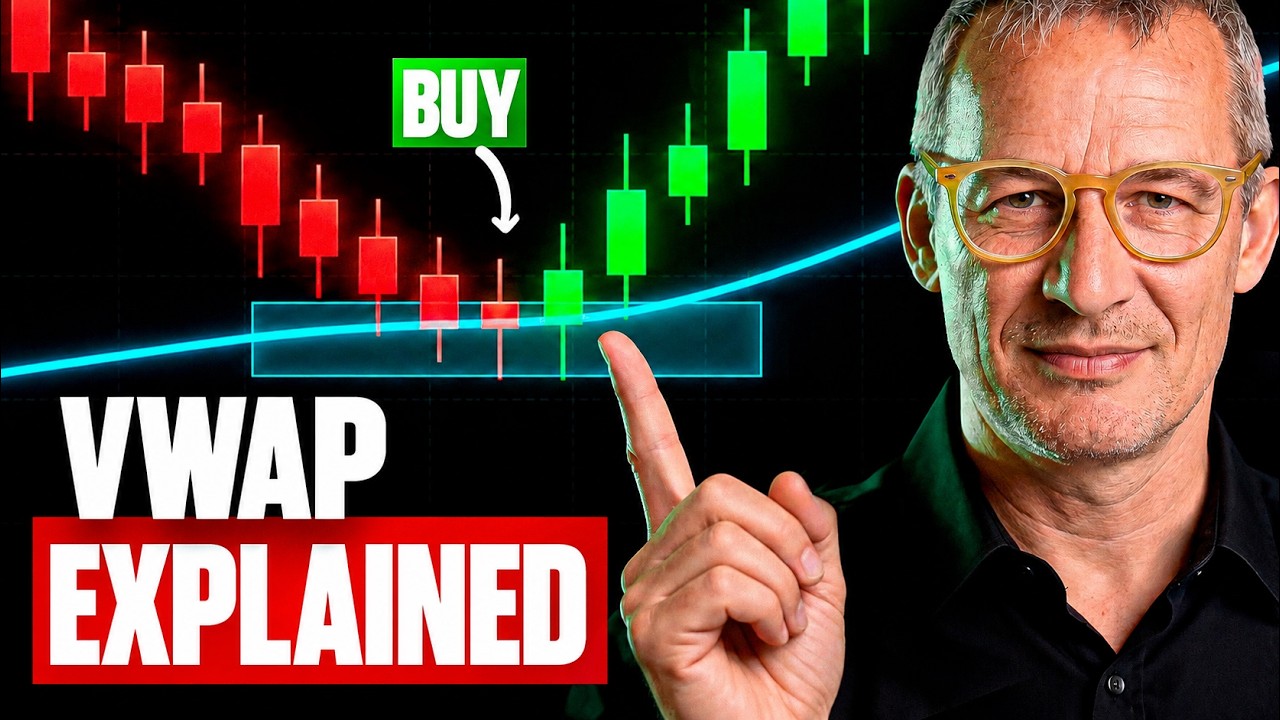
VWAP is a daily-reset indicator that shows the average price weighted by volume. Most traders use it wrong because they ignore market context. Use it for trend-following pullbacks in trending markets, counter-trading with dynamic targets, or scalping ranges when VWAP moves sideways.
Chapters
The only VWAP video you'll ever need to truly understand how institutional market participants use this exact indicator to evaluate: does it make sense to enter positions in the markets right now, or does it make more sense to sell off positions? What strategies can we traders derive from the VWAP for ourselves? Where exactly do we use these? When is the VWAP really useful, and when is it more of a hindrance? That's exactly what you need to know to use the VWAP in a way that allows you to perform. And this is precisely the path I'm sharing with you today. And stay tuned for what awaits you there. The VWAP, yeah, what's it all about anyway? How does it help us? For many people, the VWAP is ultimately nothing more than an indication of where the market is above fair prices, below fair prices, or in between. And here lies the biggest problem with the whole story. The VWAP shows us nothing other than the volume-weighted average price of today. That means with the VWAP, I'm able to see where I am right now relative to the average volume of today. And then of course, the big question is, how can I apply all of this? And we're going to take a look at that together now. Look, I've put it in here for you. The VWAP ultimately doesn't look much different from a moving average., and it's an indicator that shows you where the current average price of the turnovers for the underlying period stands. And you have to know that the VWAP is recalculated for every single day. That means when one day is over, there's the next one, and then it starts again, essentially at zero, right? You just have to know that. That's very important. So you don't have an indication for long-term time periods, but usually it's set for the current day. But how does that help us? Sometimes it works to use the VWAP as an indicator for trend-following trading. If you say, whenever the market is far above the VWAP and it runs back to the VWAP, then I have the opportunity to make a long trade. So we know the following: if the market is stably trending, we can use it. But now we also know that markets are only about 30% truly stably trending. And about 70%, they're just not. And if it's not the case that the market is trending right now, then you have situations like this here. Then you have situations like this here where you can simply see that the market is permanently above the VWAP, below the VWAP, above the VWAP, or even sits on it sometimes where it actually fit. So you'll hit a lot of stop losses if you don't have a way to look at the context correctly in addition to the VWAP. What do I mean by context? By context, I mean, how can I evaluate, for example, this sequence that's coming up here, whether I'm looking at more of a trend or more of a sideways-weighted market? Because just imagine this, if we were to use the VWAP as a tool that we simply always use for counter-trading, then I'd have 7 million stop losses here. So that doesn't work. So first rule, very important: the VWAP must be based on a trend. Only then can I see if I might enter my trade based on counter trades on this VWAP. Because you have to know, many institutional traders look at the VWAP, they say, is that the VWAP and is the price currently above it? Then they're more bullishly inclined. If the price is below it, they're initially more bearishly inclined. But again, without context, you'll just keep getting punched in the nose. So let's move on and take a look at the whole thing. If I'm someone here, for example, who prefers counter-trading— so the first one is the counter-trader— and I'm looking for a trade for the VWAP, well, then I have to wait until the market shows me no more liquidity in some way. For example, up here And then I have the VWAP as a profit target, for example. But now I have to be careful, it keeps moving up with it, and then I also have to adjust my profit target dynamically accordingly. If I see the whole thing as a trend following trader, I have to wait for a long trend and can wait until the VWAP gives me a pullback. But I absolutely must be able to classify, hasn't it hit some target areas before that caused the market to completely collapse now? And for that I need some further help. And this help is, for example, how is the market opening formed, the open. And if the open tells me the market is going to be very trendy today, yes. And if the market tells me this is the VWAP, for example, that's running along, then I can choose this trade for myself and can say, okay, here the VWAP is really a help to me. So the open fits with the variant that it's trendy, and I have the possibility to use a trend continuation sequence here. But what I don't have yet is a corresponding setup that one should use. You should then definitely only look for a trend continuation setup here. So that's the possibility that you can use for yourself as a trend follower if you want to correctly view the VWAP as a benchmark, as a context provider. For that, you simply need to know a bit more than just where the VWAP is. So, at the end of the day, you can always do the following for yourself: You can define so-called price ranges from the VWAP where you expect a reaction. And if you go ahead now and are a counter trader, for example, well, then you can plan this sequence. If you're a trend-following trader, you can wait until the market reaches the VWAP and then trade the trend continuation accordingly, a completely different location. Than the counter trader who trades from above towards the VWAP and the trend continuing trader who trades upwards. So now there's another variant of traders who might find this appealing. Let's take this sequence here and look at what the VWAP did here. Look, the VWAP is basically running sideways here the whole time, and from this sideways-oriented thing, you can already see balance. And if you're a scalper, for example, you can brilliantly search for short trades here in these price ranges, and you can search for long trades down here in these price ranges. But how far do they always run? And that's the great art of it, cuz if you need verifiable numbers, then you need profit targets. And if I were to only ever take the trade up to the VWAP, I can already see those are very modest profit targets. And where do I have to set my stop loss? So where do I give up on my trade? And there you already see the risk-reward ratio for such, let's call them, intraday scalpers. Intraday, yes, they're scalpers cutting out small sequences. In terms of the risk-reward ratio, it's very modest, but you can localize it depending on how the VWAP is currently structured. What's more likely to be an option. And that's just very, very nice. So in a sequence like this, you mustn't trade a trend continuation. You absolutely have to go for counter trades. And that's the most crucial thing if you want to use the VWAP as a scalper, that you go ahead and say only if the VWAP is currently oriented sideways and I can't assume a maximally brutal breakout now or a trend day from the market open, then I can use this whole model for myself. And so we have 3 wonderful things. On the first side, we can use the VWAP for trend following trading if we understand the context is long, and the open variant is also suitable for a trend. Then we use the VWAP for trend continuation scenarios and can plan accordingly with a trend following setup using this VWAP as an indicator, as a guide. Point 2: If we want to use the volume weighted average price, or VWAP, as a counter trader, we can look at whether the VWAP is very steep, for example, and if the price is running extremely high, then we can define the VWAP as a profit target. In this case, the VWAP can serve as a helpful reference point for taking profits, under the assumption that the market always likes to return to its equilibrium price. But be careful here, because this level will continue to shift upwards as long as the market has stability or achieves some short-term balance. So you don't have the opportunity here to establish a predefined risk-reward ratio very well. So you have to know your hit rate, and then through your hit hit rate and the minimum usable risk-reward ratio, you can know I have to trade at least up to here, otherwise the whole thing makes no sense. So you have to be able to look much deeper. And last but not least, if you're someone who does very dynamic scalping, then the VWAP can be very sideways oriented, and from the opening trade variant, the market should also be more sideways weighted, for example non-trend or something like that. Then you have the opportunity to keep looking for shorts at the top and keep looking for longs at the bottom until a reversal of the market environment eventually occurs. That way you have the opportunity to play counter-trading. But please always pay attention. Should the VWAP suddenly start to go lower and lower, and thus the price, the average price of the day shifts downwards then the probability increases that a trend continuation downwards will occur here again, or even a breakout. And those are exactly the possibilities that in my view are feasible with the VWAP. And yes, it was a pleasure to present this to you today.









