ATAA Presentation
Randy explains why emotions drive trading decisions and how to manage them. He maps the Yerkes arousal curve, identifies limbic triggers in the amygdala, and walks through four self-limiting beliefs traders hold. The fix: breath work, exercise, and reshaping your core performance beliefs.
Chapters
Who in here? And by the way, that's one bright light. That's what I tell you. You guys are all little blue spots in my, in my vision. Who in here has heard the pop psychology axiom, hey, do you want to be a good trader? Just leave your emotions at the door and you're good to go?
Yeah. Tell me something. Who in here has been able to do that?
Well, there is one specialized case that that becomes true. Do you want to know the time that you do not have emotions.
When you're dead? Okay, so my own hope is that we're not going to have that particular. I hope you're not so motivated to get rid of your emotions that you're willing to face the, the big thing. But what I want to do is let's take a look at becoming a consistently profitable trader and say it's a journey. And what I ask you to do is to look at where you are in the journey. Are you over here as a novice trader who are still trying to figure out how to master the fear of entry and just absolutely going bonkers when things go bouncy bouncy on you? Or are you an experienced trader that has hit that place in your career where you know how to trade and in fact you are a scratch trader, but you haven't been able to get beyond the glass ceiling into that consistently profitable thing where you can extract capital out of the markets? Or are you a professional trader where entry and management is not the problem? The problem usually with those folks has to do with taking profits too early because they have a tendency to say, well, you know, I'm being measured against this benchmark. And what happens is they get really upset and they want to make sure they're doing okay. And so they, and then the company comes to him and says, look, you're not taking, you know, look, you need to extract more. You need to be, you need to be exiting a little later. You need to be hitting your targets or they get euphoric. And by the way, I was in China a couple years ago and I'm talking with this group of guys, it's about like this. And of course they're all Chinese rather than all these Caucasian looking faces. And I said, and the one thing that you don't want to do is to feel good while you're winning and stuff like that. And these people looked at me and said, are you telling me that we can't feel good when we win? I said, but not when you're trading.
We like feeling, feeling good. And I Said, well, good luck the next time there's a market correction. The key is that a professional trader has a problem with euphoria that he has to learn to manage. The whale is one of the most famous characters where euphoria.
Overtook him and he melted down $2 billion. The testosterone and the dopamine cocaine were so high that he was no longer capable of, of making good risk reward decisions. And when tested, he would say that he was flatlining it. He didn't have emotions. The neuroscientist who was actually studying this group recognized that these guys were so drunk on testosterone and dopamine that they were incapable of rational thinking. And that's also. They blew up $8 billion of good proof. So what we want to do is say where you're at. So wherever you are in this trading cycle, just listen to it from there.
The truth is, the blindness to emotion is basically just running off the side of a hill. Fundamentally, there is no such thing as freedom from emotion.
What there is, though.
In the area of self mastery.
There is the freedom of emotion. Why is that important.
Fundamentally, is this. I used to be a cognitive behavioral therapist. That means that thought occurred and out of thought came emotion, blah, blah, blah. And what I did is the first time I engaged emotional intelligence work, I discovered how wrong I was. In emotional intelligence work, what you discover is emotion is first and thought comes out of emotion. As a matter of fact, all thinking is emotional state dependent. If you don't, if you don't know what that means is for those of you who have hesitation problems.
Have you ever noticed that the fear base is there, the anxiety is there, and the thoughts come to say, more confirmation, more confirmation, more confirmation. Or if you're, if you're, if you have anger issues, have you ever noticed that when you, when you make a mistake and the market takes money from you and you get angry and you say, I'm gonna get it back, and you go, and you've seen the cycle of blowing up. Did you happen to notice that you were angry first and you had this crazy, crazy, crazy thinking afterwards? All thinking is emotional state dependent. Fundamentally, what we're trying to do is this is. We're trying to say, what emotional cocktail do we need to produce that allows us to produce the mind that can manage uncertainty without going bonkers?
In fact, the cocktail that causes a mind that allows you to maintain discipline and impartiality in the midst of managing uncertainty. That's what we want.
In trading. What you're looking at is three interlocking pieces and I ask you to even think of it this way as platform, methodology and the actual belief of the trader himself. I ask you to think about a Formula one car. You know, that's an enormously powerful car, a driving machine. If you put me in a Formula one car, it would be dangerous to me and everybody else around me. Okay? It would be. The driver of a machine like that has to have a certain set of psychological skills that are incredibly honed. He has a methodology, he has a car, he has a platform, he has all this team working. And what happens is the driver.
Drives the methodology and platform.
In trading, your psychology is actually a reflection of your beliefs that you're projecting onto the markets. More about that later. What you're measuring, what your benchmark is measuring, what your trading account is measuring is the effectiveness of the beliefs that you're projecting onto the markets to extract capital out of the markets. And what you'll discover if you look at it and say, well, you know, my trading account is not so cool, but I know how to trade. No, you don't. You have knowledge of trading, but the driver of the knowledge, not so good. The knowledge cannot be used in the environment where extraction of capital can in fact happen. That's what we want to do, is we want to go, well, you know, I know this. Most traders, the experienced trader, they've got an effective platform, they have an effective methodology. What they don't have is an effective psychology that drives all that. And that's what we want to look at.
So this is for people. And here's the question, do you know how to trade?
I measure it with retail traders by saying, if you're in simulation, are you profitable? And a lot of people say, yeah, you know, it takes about five years to do that.
However, when they go from simulation to live trading and start risking capital, you see a fall off of their effectiveness. What you're seeing is their beliefs in action. They know how to trade, but they cannot manage the emotional beliefs they have in performance.
That's when we know it's all psychology.
If you can back test or if you can do simulation and you can produce success to the degree that you're looking for, then you know, the psychological component, the driver of the system is the part that needs to be worked on. And to be honest with you.
I look at trading a lot like I look at golf on the PGA Tour. Every one of those golfers can putt like crazy, they can drive like crazy. But have you ever noticed that there are very few money players that when it comes down to the holes of actually winning the game, there's only, there's only 10 of them around that are really winning the big money. It's the same thing is that at that particular point, it's no longer that everybody can drive, everybody can putt. It's really what psychology are you bringing into the moment of performance. And that's what your trading account is saying. What I would also claim is this is most people I know that I work with come to me and they're trading with half a brain. And I literally used to use this image of literally half a brain. And I don't anymore. Fundamentally, Descartes and Newton were wrong. You do not think, therefore you are. The Buddhists had it a lot closer. Yeah, you think, but who is this? I. That's a more interesting question. And fundamentally what we want to look at is, is left brain knowledge and we want to harness it. We want to tether it to emotional brain development. We want to be able to take the emotions, produce the mind that can use that knowledge under pressure. Otherwise what you're doing is you're shooting yourself in the foot. So we're going to be gauging from here on. We're going to be taking a look at emotional intelligence about how do we develop the emotional intelligence to be able to use the knowledge. The good news is cognitive intelligence is pretty much fixed. Okay. Unfortunately, I'm stuck with my little brain and its ability to solve problems just the way I am. Unfortunately for me and everybody else, however, my emotional intelligence is not fixed. It's very developed. It can be developed so that I get to know what makes me tick. I get to be able to figure out how to reorganize.
Emotion and meaning to produce a different self that uses the limited amount of knowledge I do have more effectively. That's what we want to do. And this is everything to do with your performance in trading.
Here. What you're looking at.
There is this, this particular graph is the Yerkes graph. It comes from the early 1900s. It's been known this long. The more stress you experience, up to a moment it's very useful. And then it gets over and you start, your performance starts failing. Fundamentally what you're looking at is initially.
The autonomic nervous system is there. Anytime something triggers, you're either going to trigger to fight flight or you're going to trigger or fall back into what we call rest, digest really calm, very sedate, just really doesn't want to go anywhere. Unfortunately, fight flight is about anger and about anxiety producing thought and perceiving things, unfortunately, rest, digest, you're so relaxed you can't trade. What we're looking to do. Yeah, it's true, what we're looking to do is to produce a certain level of stimulation in the central nervous system so that it's alert, it's focused, it's patient, it's ready. But the body has not been cranked up. And you're going to be discovering that your body has been cranked up a lot. I will promise you. I videotape my traders and it's not a pretty sight. Friends.
People are like this, they're like this, they're tapping their pencil, they're tapping their legs, they're doing all sorts of things, they're showing all sorts of arousal that they don't know they're having. And what they're really doing is they're already over in fight flight and are incapable of proper emotional management. They're already gone. So we're looking at this and we're going, okay, now what we know is there's a sweet spot. We can't be so aroused that our bodies are. Just remember it. This is, this right here.
This is the work of a trader, okay? This is the physical work of a trader. How aroused do you have to be to be able to do that folks?
Okay, I actually have a client in Singapore. He says, you know, I grew up in this hard working family where everything had to be worked. And I finally have come to a moment where I've changed my whole notion of work from doing being to randy. I've actually found yours is pretty effective. And I call work the coordination of effective action.
This can be highly effective work. It doesn't have to be tiring, tiring, But a lot of people believe they have to be working hard to deserve money. And if you're going to do that, you're going to end up with one of these Forex traders who are trading 24 hour days and seven days a week and you know, oh my God, the London is opening. There's New York and there's Shanghai and, and I can just do all this stuff and blow yourself up. What we want to do is find the sweet spot.
Where physiological arousal of an emotion is at a particular level that allows you to produce an enormously alert mind. But it's not cranked. It's capable of dispassionate, disciplined thought and analysis. It can turn toward its discomfort and can use it for information rather than reactivity. So we're doing that. What do you need to know about Emotions.
First of all, emotions are not what you think they are. Emotions are biological. They're not touchy feely, they take over mind. They are actually biological action potentials. And they are being triggered by circumstances in the environment based on your perception. They are wired into circuitry to trip, okay, and blam, you're there. That's the thing about hesitation. You didn't have anything to do with it. And besides that, you actually thought you were being rational when you were making more confirmations. And you discover that rational.
Simply serves emotion.
Just simply serves. It's highly overrated. So you're looking at this and begin to recognize that the quality of thinking that I do is actually coming out of the emotional cocktail that I'm in. And you don't have freedom from emotion. You have freedom of emotion. If you're going to become the kind of traitor you could be.
I was talking with Ian just before I came up, and he says, you know, the hardest problem is that, you know, you have to have a plan. You have to stick to the plan, you have to trade your plan. And yet what happens is you'll get in a crowd and you'll find out, well, tell me, are you sticking to your plan? No, I try to. I know what my plan is. I know what it should be. But then I don't do what I know I should be doing. Why is that?
There's an emotion that triggers it, pollutes thinking. And you're no longer in the mind that can follow plan. You're now in a mind that is either panicking or becomes grandiose, lustful, and is seeking opportunity. If you're a perfectionist, what you're doing is you're trying to not lose, and you're altering your plan so that you might not lose. And, you know, you just keep. You keep tinkering with it. If you're an Alpha, what you're doing is, you know that I have to take action to make things happen. Despite what my trading plan says about what I'm supposed to be actually analyzing, I need to be taking action. And those people end up chasing trades and blowing up accounts. That's why a lot of people who are enormously successful in corporate and business before they come to trading, the same skill sets that brought trading in those environments end up being the kiss of death. In trading completely different animals is in trading, it's not about doing, making things happen. It's about patience. It's about letting the circumstance come to you, letting the markets come to you, rather than forcing that completely different mindset that has to be developed. Fortunately, we can do that.
So understand this. The emotional brain, by the way, the ones that we share with deer, the ones that we share with lions, any social mammalian, that part of the brain that we share with them, okay, it does not distinguish between uncertainty, ambiguity, confusion and fear. As a matter of fact, confusion is fused to fear. Now think about it, that's been going on since the African savannas. It got wired that way and it's allowed us to become an enormously successful species. However, that's Newtonian physics. That's big object physics. Trading the market are quantum mechanics. Suddenly it's small particle stuff and all of a sudden what was successful, then you bring it into this area of trading and all that stuff, you discover the fusion between confusion and fear has to be redone. What we're looking to do is we're looking to be able to regulate emotion, recreate emotion so that when confusion is produced, okay, what doesn't show up as fear. What shows up is the emotional state called concern.
You may have psychological discomfort, but it is not a biological threat. That's the way the emotional brain is going to interpret it at the level of psychological discomfort. You turn toward the discomfort and you learn from it because what it's doing is, it's revealing to you the self limiting belief driving the discomfort. That's what you want to know about.
So when you do this, and I'm going to give you one quick tip.
It'S really easy. You really don't have to go to a therapist. You don't have to spend days and weeks and months and years working with a Freudian analyst to find out that everything, everything boils down to four self learning beliefs in performance and trading. One is a sense of inadequacy. When you're beating yourself up. Have you ever heard yourself say, you know, you're not worth a thing, you're never going to make it, blah, blah, blah, blah, blah. Everybody has a sense of mattering. If I only make enough money, I'll finally, man, you know, I'm going to make enough money, I'm going to be somebody mattering.
Worthiness. I know traders who. One particular guy that I've worked with was a six figure trader. And every time he bounced over into seven figures, what he would do is he would lose back down in six figures. And the cycle had been going on for 10 years. Ten years. Finally, when it comes down to it, what we discover is this is really worthiness. He really didn't believe that he deserved to be a Seven figure trader. This was about deserving.
This is performance beliefs. Now this isn't like what you're telling your friends. This is what your trading account is demonstrating to you. Probably things that you prefer not. You know, it's much easier to knock down a few beers and just medicate that and just not deal with it. The other is a sense of powerlessness. And you would experience powerlessness if you've ever been in a trade and it really starts going against you and it starts bouncing around, you've almost been stopped out. Then it goes one way, then it goes to the other and you just, you have this thing as it's like you're totally out of control, you know, you don't know, oh my gosh, this is totally, I'm just, I'm panicking. I'm a horse in a burning barn. And then it finally gets a little bit into the black and you say man, it's going to be taken away from me, I need to take it right now. That's powerlessness. So there's your four that create the whole thing.
Don't believe me.
If you can't come to that conclusion on your own by really becoming. Recognizing the only friend you have in trading is your trading account. It's a brutal friend, but it's going to tell you the truth when you look at it. And you're going to have to decide whether or not you want to change that underlying belief structure so that you're going to be able to produce a very different outcome. Totally up to you. Ultimately.
The amygdala.
Is a little almond shaped piece in the limbic system of your brain. It's very, very primitive. It's been around for 50 million years. Your neocortex, this really cool thing that we have that makes us so human, has been around anywhere between 500,000 to a million and a half years. So understand huge difference. And the amygdala has enormous influence over what the rational mind is going to do. Ultimately it's all about fear. It's all about reactive patterns. It sets up a pattern that's successful in the short term. Like for instance, hesitation. Very successful solution to the limbic system is to avoid the trouble in the first place.
Okay, not good for the traitor. But to the limbic system that doesn't have a neocortex, really good plan. Once it does that, it becomes a successful solution, short term solution to the problem and then it's wired into adaptation and it becomes habituated. And then every time that you start thinking you're Going to get into a trade when everything. The setup's coming and stuff like that. An emotion triggers. It's based on fear. And suddenly you're over here. Boom, you're over here. In avoidance. By figuring out how to not get in that trade and hesitating and it goes on for years. So we've got to figure out how to do this. Basically the patterns go one way or the other. I've just talked about hesitation. That's the guy scared to do anything. But also reactive. Patterning also is about when you see anger or revenge trading or if you see over trading. What you're seeing is. I would not necessarily call it greed. I would call it lust. Greed is an emotion that is very ancient and is neither bad nor good. Greed is an emotion. And when we were much different, when we were hominoids, we didn't know where we were going to get our next meal or when we were going to get our next meal. So when there was the opportunity in front of us to take what you could, you did.
Okay. That's the basis of greed.
You know, along comes a mind and along comes trading. And you have this ancient emotion driving psychology and game theory. Bad deal. So you find out that both fear and greed have to be managed. They need to be listened to, but they need to be managed. You need to find out what's the appropriate level to take. Okay. Greed. You have to find the appropriate level to say, you know something. I need to back off. I need to move. They're very helpful. I know. I will teach a trader to turn toward the discomfort. To honor the discomfort. Not act on it, but honor and say, okay, I'm going to check it out. Okay, I've checked it out. This is a high probability trade. We need to be in this thing. I understand your concern. We're going to move. You know something? I really missed something. I'm really glad I'm discomfort. I'm really glad you were there. It helped me to be able to be a much better, effective trader. Thank you. That's the kind of stuff that has to start happening.
The main thing in emotional intelligence. What you have to do is you have to acknowledge that we are bringing a hominoid mind into the 21st century, to the 22nd century. But what happens is we need to be able to modify that reactiveness that the brain set up to do. And to say, you know something. We just can't say. Emotions. I don't want you.
Reactiveness. I don't want you to be here. Pattern making. I don't want you to be here. The truth is that's deception because ultimately what happens is it's going to be there anyway. The real question is, instead of saying, stop following me, what I'm asking you to do is say, well, how do I use this? How do I organize this? What can I do? How do I tell tame this beast? And how do I allow this stuff to really help? First thing.
I used to play this game as what is an emotion? And what I finally said is, no, I'm going to cut to the chase. I'm going to tell you what an emotion is. Okay, you ready? An emotion is any disruption to a standard sensorial pattern that the brain has already created. What does that mean? That means going back to this hesitation example.
You know, before anything when it's just a bunch of gobbledygook up there and all these lines are sitting there and nothing is formed and nothing's there, you know, you're pretty okay, everything's fine. Suddenly there's this pattern that starts becoming organized into. Wait, wait, wait, wait, that's a setup. Oh my God, that's a setup. That right there is a disruption to a standard sensorial pattern. What do you think happens? Then? An emotion shows up. The only question.
Is which one? To an untrained mind, the very first thing is the amygdala is going to want to avoid threat. It doesn't know that that discomfort. It doesn't know that that uncertainty is not a saber toothed tiger. It doesn't know.
So right then and there you have the opportunity where you say, this is where I need to learn to manage. Any change in status quo produces emotion. If you're not aware of the emotion, you're cooked. In my training, we will discover that the emotion actually triggers usually about 20 minutes before the person even knows that they've been hijacked.
Because of basically their lack of emotional intelligence. They're not learning how to observe body, observe mind, and see the emotion as it arises and when they can do something about it. When you can do something about it. In the five components of an emotion, arousal is the emotion revving up. You know when the next time you trade, I want you to observe yourself. Get either. The best thing is get a video feed so you can see yourself. If you can't do that, get a mirror so you can watch yourself. What you will see, you will see the tenseness in the body. You will see yourself absolutely holding your breath or beginning to pant or what you're doing is you are literally throwing gasoline onto an emotion that is smoldering, you're just egging it to take over mine, and you're not even seeing that. You're really a bull in a china shop igniting the emotion. So the first thing, arousal. That's where to interrupt an emotion. The second piece is feeling. And again, feeling to a neuroscientist is not touchy. Feely feeling comes out. Once the emotion arouses to a particular moment, it's no longer just arousing. A switch flips. The chemistry of that emotion starts flooding the brain, flooding the body, altering thought.
There it is, right there. When you feel the emotion, it's too late. You're cooked.
It's running through your body brain, producing thought. If you're cortisol, you're anxiety. If you're testosterone, you're making wacky decisions with risk management. If it's pure dopamine, oh, my God, that's your brain on cocaine trading. Not a good plan. Okay, so here you go. You go, well, there's feeling. Once the emotion has triggered, it's in play. It is going. The emotion or biological action potentials, they are going. They are emotions, from the Latin. They are literally going to push you in a particular direction whether or not you want to go or not. And those directions are attack, avoid, approach.
Okay?
Your job is go. Well, if that's happening. I work with a client who discovered that he was like every other portfolio manager. They were going nuts. By the time they reached the office, they were already nuts. They were all already cranked up. They got there, then they found themselves just glued to their screens, watching those patterns. And just like that, then the guy would go at lunch, he would run. When he came back, he says, you know, Randy, it's really amazing. I just make a lot better decisions when I've done that. What he's done, he's burned out all the cortisol and he's gotten back the mind that can actually observe and assess accurately. So literally, the solution with him was pretty simple. He took a run in the morning.
Okay? It was very simple. It wasn't all this high technology stuff you're going to be seeing in just a few minutes. The key, though, is he learned how to burn the cortisol that he had developed literally from the moment he woke up and got to the office and was incapable of coherent thought when he got there. Now, we also went back and we changed the whole pattern of him waking up. He didn't go to his phone and start looking at everything and just all this stuff. And he Ended up doing a meditation practice. He literally had. He built an intentional mind to go to work with, and he didn't let panicked people around him, which means he cloistered himself in his firm. But the thing is what we want.
In order to be able to do this thing. Let me go back here. The meaning. The meaning is the belief system that the assumptions that become beliefs and wired into the emotion that literally when something blows up, what you want in trading is when something triggers. You want the triggering in approach, and you want discipline and partiality. And you're looking at it, and you're going, well, okay, what are my choices here? What do I do? Because I know that I can ride this thing well. I know that I have the skills, I have the tools, and that I believe that I can manage this uncertainty in whatever direction and whatever it's showing me that I need to be doing. That's the kind of mind that you want, you don't want when the uncertainty happens, you don't want, oh, my God, what's happening to me. But that's a change in belief, okay? Now, and temperament is something way beyond my pay grade. That's genetics. Okay? So I just mentioned that the very first stage, that has to be learned. Okay? And my next talk, I'm actually going to be demonstrating some of these, what I call the fundamental skills. That's one of the major differences. It's going to have some theory, whereas this is a lot of theory, and we're going to see the application in the next talk. Okay? Emotional regulation actually means once you recognize that emotions are biological, that there are a certain set of components, and you start noticing that revving up. And you realize because of biology that a breathing signature and attention signature are part of the emotion. By doing that, what you can do is you can alter the intensity of the emotion. Like fear, for instance, requires this top breathing up here, or halting breath, it's halting oxygen going to the brain and pushing everything into the body for flight. Okay? And what you can do is by altering breath to Bella's breathing or diaphragmatic breathing, what you do is you disrupt the pattern of the emotion. If you disrupt it, what you're doing is you're no longer giving it any fuel. And what you can do is you can literally, you can calm the emotion down so that it doesn't hijack you. The same thing with tension is that in my trainings, you end up having basically a stress signature.
So that you're. Well.
You'Re well educated about what your body's Doing that produces an emotion and producing the arousal. And you're interrupting those things. Part of its tension. Start noticing where you carry the tension. Most people carry it in their neck, their jaws, their arms, their fists and they have that real. Have any. Have you ever noticed that rapid foot that goes on when you get kind of stressed? That is showing you, if you learn to observe it, you're looking at the arousal of an emotion. You're not looking at stress, you are looking at the arousal of an emotion. And if you get to it, then.
You don't have to get hijacked and do dumb stupid things over and over and over and over again.
That's done with breathing, that's done with relaxation. It's called the relaxation response. And it's something where I will train traders for three weeks before I ever even talk to them. Because I know that it's going to take at least that long to start rehabituating your responses to stress. And you're going to have to volitionally. And it's like playing all thumbs up. At first you're doing it and you're going, this just is totally unnatural. What in the heck is this guy telling me to do? It's like riding a bicycle. First time you get on the bicycle, it's really complicated. But soon it just becomes easy. First time you learn to drive a car, man, there's just so much going on. Yet over time, you can have a teenage daughter doing a little texting and running down the road, just having a great time.
For a while.
The key here is that as the body habituates it, it no longer has to be done cognitively and it becomes more natural. It has to be done though. Well, no, it doesn't have to be. You can maintain the same pattern that you're doing right now or you can decide to change the pattern. This is the first step that has to happen. This actually came out of.
A very great cardiologist from Harvard began to study Indian yogas because they were saying that they could manage blood pressure, they could manage the autonomic system that western science said they couldn't. And what he did is he took these yogas, put them in a laboratory, hooked them up and darned it, they couldn't do what they said they could do. Change western medicine completely. That relaxation response is a start, but it's not going to change the problem. So what we know is by controlling the way that you breathe and hold tension, you can manage the emotion so that the emotion does not take over mind.
That's Important, but it's not going to, it's not going to do, it's not going to complete the thing. You can regulate the emotions, you can do all the yoga you want, you can take it into trading, and you still don't get at the beliefs, you don't get at the mind. You have to find something that's going to allow you to open the door of the mind, to look inside so you can find the self limiting beliefs that are in fact a problem, and to be able to find the latent empowered programs living within mind that need to be activated. And we do that by mindfulness, or what I would call awakening the observer.
And here's the thing you need to know. This is something that some people have difficulty with and I'm sorry, they do. It's really a major piece of. It's in mindfulness work and observation work, you discover something. You and your thoughts.
You and your beliefs are not the same.
Your brain is born into a circumstance, a history. It inculcates those circumstances. And by the time you're three years old, before you actually start formally thinking, they're already writing as familiar patterns that you would never see. They're ubiquitous. You would never see them. They're already linked in our job. And you just assume, oh, this is me. No, this is just one potential organization of the self that your observer has fused to. And you call me. And unfortunately your trading account probably is going to tell you that it's not a very effective organization of the self and you need to be working on it. So the thing is, what we've talked about is also observing the emotion in the body, because the emotion in the body is also going to not just tell you the arousal of the body, it's also going to tell you about the belief system that's being triggered. Okay, once we develop mindfulness, okay, and again, I'm going to go more into this in the next talk, but once we develop this, we want to use that observer to look into the mind. And what you discover is this is the mind. Let's start with the brain. In neuroscience, what we would say is the brain itself is a community of rival programs that sometime cooperate with one another to organize you into a self for survival in a particular environment. The mind.
Is when this electrical activity that's running, by the way, at 200 miles an hour in your brain, between the synapses, it fires so much that we produce consciousness. And in that consciousness, those emotional programs become thoughts. Suddenly you start having a voice in your mind with thoughts and if you think that you don't have funny little voices in your head. Tell me something. Who in here. Not that any of you would do this. Who in here has ever beat themselves up after making a boo boo in trading? Okay. Do you remember any of the words that were being said in your mind about your performance?
That's the historical internal dialogue. No, you're not an idiot. No, you're not all these things. Your performance was wrong. But there is this part of the self called the inner critic that is telling you that you're not a piece of. You're a piece of junk. It's never going to happen. Blah, blah, blah. It's also the one that happens at hesitation. No, no, no, don't do that. Don't do that. You could get hurt. You could hurt. And you feel the fear. You feel the fear. And what you're listening to is a dance between something called the inner critic and what I call the orphan, which I use Jungian psychology to do it. This first and understand, this is the first time you're taking the observer and looking into the mind and you're looking for what you don't want to look at. This is the organization of a mind, of an untrained mind. And what you're saying is, okay, there's this inner critic. By the way.
In the Aramaic language, they would actually say this negative voice within the head was the prosecuting attorney. Okay. And they would say that you've got one in your head. Let me ask you something. Are there any prosecuting attorneys in this room today? Good. Tell me something. Have you ever read or heard or experienced a prosecuting attorney lying to make a conviction? Or is Australia very different than America? Okay. Have you ever heard of a prosecuting attorney who would tell half truths? Have you ever heard of prosecuting attorney that would tempt the witness to make mistakes and to do something stupid? Yeah. And you have running one running in your head.
The ancient Chinese would say Yin Yang. There is both destructive quality and constructive quality running in your head as a fractal all the time. The key is by ignoring it, you give it enormous power.
By saying, you know something, it's really complicated in there. And the truth is, I don't know if you guys have this. In Australia, we say the hood. A lot of people say, we'll talk. They will make the reference of their mind as a bad hood that we really need to take. We need to bring in some discipline. We need to revamp the whole hood so that we can redevelop it kind of like the community we were in. Now, understand this was a very different community a number of years ago. And a bunch of bikers and stuff like that. And here we have a bunch of skyscrapers on the other side of it. This orphan nature of ours, and that's a Jungian archetypal term, orphan actually from a biological perspective is called the amygdala. Basically.
When the inner critic is beating you up, you have this other perception of have you ever felt that sinking feeling? And like that, that's orphan nature. When you feel experience fear or anger or grandiosity, I might add, you're experiencing your orphan nature and it's the one that keeps blowing you up and up and up and up. If you're overtrading, you're trying to prove your worth, prove your mattering, if you're on the other end fearful of entry and of engaging things, you're seeing the fear end of orphan. This is the internal dialogue that produces suffering. Not just in trading, but the difference between trading and regular life is regular life is slow. My dad smoked Camel unfiltered cigarettes for 52 years and people were always saying, you know, you really ought to quit this. It really is not good for you. But it wasn't killing him in the moment. And when it finally had done its job, it was too late and he quit smoking. But it was too late. Trading is like instant karma. You know about it real soon. And besides that, there's no self deception. There's no lying to yourself. No, that money did leave your account. Okay, the fourth skill is this is actually developing the skills of the empowered self. The truth is this is that in the same way that there is in fact a prosecuting attorney in your head and there is this orphan nature of your fears. There is also the discipline.
Of a ruler. There is also the courage of a warrior. There is also the self compassion. Very important. By the way, if you're going to be a traitor and lose a lot, you know, you do lose a lot. And there is also the impartiality of a sage. It's getting antis that is so powerful. And what we need is a technology that allows us to be able to say, how do I reconstruct the mind that trades? That's what we want to do is we want to say, okay, this is the mind. This is the mind that I brought to trading. And you know, it's done pretty good. Maybe it's at this point and where you are, you know, whether or not you're in retail, whether or not you're A professional, you know you're going to have a different grading system of where you are in that thing. And you start asking, I know that there's a glass ceiling here that I need to get through. I need to reconstruct it. And ultimately what we want to do is we have to get at changing of the beliefs.
And the first thing you have to recognize is that you are in fact an emotional being attempting to be rational.
Rather than a rational being attempting to control emotion. Or what you will discover is that you're constantly being rational, but you're rationalizing. The left brain will produce an explanation that supports whatever the right brain has already decided.
Okay, Think about your hesitations and how much sense it seems to make at that time. Then you're doing a review. You go, what was I thinking? How crazy was that? Or when you go to pieces in a trade, and then you're doing review and you're going, what was I thinking? The whole point is, is that it made sense at the time. The rational, the left brain simply, simply is making an explanation to support whatever the right brain has decided. So this is why the right brain is so important.
Once you grasp that the mind is really a committee.
And it's composed of a number of forces, some are highly destructive, some are highly constructive. However, what you get at first is the one that you showed up with that's rarely the one that's going to produce the level of success that you're looking for. Then you go, I need to reorganize this. And the first place is you start with the internal dialogue. And then you go, well, how do I get at these emotional programs? I have developed a fairly unique way of getting at these.
Interestingly, is memory. You know, this factual stuff, you know, just the facts, ma'. Am, and you have this memory and you know it's right. Nothing could be further from the truth. Memory to neural science is the way the brain is taking experience and encoding it into memory. Then it's stored in different parts of the brain, and it's based on the emotions you're in, and it's based on the observer that you are. As to the way that memory is encoded.
There is no such thing as video memory. It's all fluid. For instance, eyewitness accounts are probably the worst form of accounts you can bring into court because they will be blown apart.
And they will swear on stack of Bibles if they're Christian, that it's true. It's not that. Once you realize that, okay, what really did happen in the experience, what I have learned that you can do is you. I'm looking for a memory that has in fact happened of a time when you were challenged and the outcome was uncertain and you pushed through it. But you did experience fear, but you did that. What we know, in order to get through that experience.
Discipline, impartiality, courage and self soothing had to have occurred or you would have been blown away and sucked away down the emotional vortex. But it didn't. What your brain has done is it's encoded that experience and excluded the empowered hora programs. What I do is I teach people how to go back into that experience and find the programs that clearly had to happen and to bring them forward as feeling states. Then the feeling states, what's creating mine? That's the power. And when you do that, what you discover is that truly there is a warrior within you that will turn toward your discomfort, will turn toward your dragons. What you also discover is that there is a ruler in you that will maintain order under pressure. Very interesting is I took a couple years ago, I had this slide right here and what I did is I was with these Chinese people and said, you know, I really ought to have a picture of Mao Zedong. It would be much more meaningful to you guys. And I had several of the traders come up to me afterwards. Don't do that, don't ever mention that again. We like George Washington. Don't talk about mousey tongue though. And I thought, I need to shut my mouth and I just need to keep on moving. I've touched touchstone here and I just don't want to, I don't want to move on there. But the key is what you will discover is that when you look at archetypes, when you look at the emotional program, the emotional program is the emotion, the archetype, the symbol. When you think of a person like George Washington, you guys are in Australia. George Washington did pretty much pulled off a miracle. He had an army that could not fight the world's greatest army at the time. And he figured out a way to maintain order and to keep those guys. And he produced independence against overwhelming odds. Of course he had a lot of help from the French. But you see this maintaining order under pressure, it's there. It will have happened to you. It's a matter of learning how to find it. Then you also find there is this self soothing component and a lot of people have a hard time with that. But it's absolutely necessary if you want to change core beliefs that are not functioning the highest level. The route is through compassion. There's no other emotional state that will do. You know, the Dalai Lama has demonstrated that with his monks that have been tested.
It's been that way forever. And when you are able to manage the fear through compassion and protect the boundary of the kingdom of who you are, what happens is this impartiality of the sage actually being able to carry out the plan that you thought you were supposed to be doing anyway. That's what becomes possible. You're beginning to realize that what we have put around us externally as a fractal is going on inside our mind. Really powerful stuff. And suddenly that's not enough. Just because you develop.
These wonderful skills, you still have to turn toward, you have to turn toward your internal struggle. There's always self doubt, there's always uncertainty, there is always ambiguity, there is always confusion. The question is, what mind are you going to bring into that moment to manage that uncertainty? Are you going to bring the historical mind.
That was developed for you? Are you going to bring a new mind that's based on probability? The old mind is based on certainty.
Your brain desperately wants you to survive and it's going to produce a certainty of doing that. It will sell out everything. To be able to do that, either by power or by, by safety, you have to develop a probability based mind. The probability, the emotions that are going to manage probability are the higher cortical emotions of discipline and impartiality. But you have to calm the fears and you have to stop this incredible criticism that's going on inside the head by that, by that inner critic. So you face it. And ultimately again, you still have rough seas. But the mind and the forces in the mind that are organizing you to experience that uncertainty, that's what's changed. That's what's changed. You can manage the toughness. You no longer, you honor the struggle and you begin to recognize something is that life is struggle and it's just put on a stage in trading. Suffering is optional, friends. And what I see every day is traders choosing suffering. They say, okay, I'm gonna find some trick. I'm gonna find. Oh, Randy, what I want to do. Randy, if I read your book, am I gonna have the skills to be able to make this thing? And I'm going, you're reading a stupid book. And it's a good book by the way. Okay, I really like it, but it's a book. Changing emotional pattern is not an event, its process.
And this, this is what you're looking at. So ultimately surfing is a wonderful example of this because what you're doing is you're coming to the moment. Left brain knowledge and emotional intelligence of the right brain are coming together and they're harnessed with one another. You know how you have the emotional intelligence to organize the emotions that you need to be in the moment and then you have the knowledge in that moment to use them. That's power, friends. And here's where it's at. At the moment of the putt, at the moment of like the money game, the money putt. The future has not happened. You're not looking at that stupid.
How your P and L statement is, oh my God, am I, am I making money? Am I making money? You're not in the past. You're not thinking about what happened past then. Do you think Tom Brady cares anything about being suspended for four games and having deflated balls? Of course, I'm in Australia. You might not have any idea of what I'm talking about.
But anyway.
The key is what you're looking at in the money game when the pressure's on.
You come to that moment with an intentional mind.
You come to it with an intentional mind. You don't come to the mind that, oh, well, gee, I hope my mind's okay. I hope I do okay. No, no, no, no, no. In the same way you take a look at an American, really great American baseball hitter, he does all the film work, he has all the knowledge, he has the batting coach, he has everything. But he will have also developed a ritual. And you will see that ritual in the batter's, not the batter's box, the on deck circle of him going through a ritual that puts him to the mindset, that allows him to believe that he's going to hit the 100 mile an hour fastball that's going to be thrown.
He's there. He walks in with disciplined confidence, calm. He gets into the batter's box and each pitch that happens, you will see him move out of and he will see a brief way of ritually coming back into that mine. And he goes back in. He does that each pitch. Traders don't do that. That's crazy. First of all, you better have an intentional mind. When you start trading.
You need to know the mind. You also need to say, okay, during particular moments during the trading cycle, I need to micromanage that mind. Particularly when you move from looking for opportunity, trade selection to when you're managing something completely different animals, the mind has to change from the opportunity to defending turf.
Most traders don't know how to do that. And by not doing that, they, forfeit performance. The only thing that a trader can truly control.
Is his performance in the moment of execution. That's what the great traders know. They're not trying to control outcome. They're not thinking about. Great traders will sit there and go, well, you know, the thing is, I win or lose, you know, how well did I perform in the midst of this moment? That's where they're at. Because it's a probability game. You're going to lose a lot.
And if you use the right mind moving into the moment, you're going to win a lot, you're going to win your share, you're going to keep the, you're going to keep your losses lower and you're going to keep your profits running. That's what happens in performance. That's the mind that you're building.
Okay? Because you're letting go of the illusion of control of outcome. And what you're doing is saying, well, the one thing I know that I actually can control is the mind performance I'm bringing into this particular moment. That's the power.
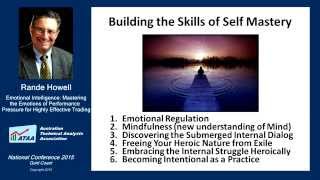
So what I want to do is, let's go over this. What I want you to recognize, I have described a process. It's not an event. And what you'll see is that there's a series of interlocking processes going on that are built one at a time. The very first thing is emotional regulation. Unless you can regulate the emotion, you're never going to get to mind. You're never going to get to mind.
The regulation of the emotion is not going to change the game.
But until you can regulate the emotion, you're never going to get to the door of the mind. But when you calm that and you say, well, it's time to look inside the mind. Don't want to, but okay, then mindfulness becomes very powerful. You need to be able to have this light that shines in and saying, you know, I know what I'm looking for. I have a new conception of what the mind looks like. I'm going to shine it in there. And the first thing I'm going to look for is this inner critic and this orphan character who keeps all this stuff that keeps blowing up my trading. The second thing is this or the third. This is actually the third thing. Then you're going to. When you find that smirch thing, you begin to challenge it. The fourth is you start looking at the empowered emotional programs. And what I want you to understand this is a lot of people say, well, Randy, you're talking about archetypes and are you saying these are action figures running around in your head? No, they are symbolic representations of emotional programs that are wired into your brain. They are circuitry. And the question is, are you going to learn to use that circuitry and adapt that circuitry, or are you going to keep it the same? When you do that.
You'Re basically releasing that heroic nature from exile.
But that doesn't, you know, in Hollywood, that's where they all stop and you go out and live happily ever after, and you walk into the sunset and blah, blah, blah. That's never enough. What happens is you will always have uncertainty. And what you're doing is you are building an intentional mind to meet uncertainty.
In trading. What you're doing is you're saying, you know something. What I realize is in the game theory called trading, I have a methodology that, if applied properly, will give me an opportunity. I'm the applier. I'm building an intentional mind that drives that Formula One car in a way that allows it to go at its peak performance. But the thing is, it really ends with this. It's really more about becoming intentional as a practice. If you were to see me wake up in the morning, I wake up, I'm actually scanning my body for where there's tension, because I know that tension is an expression of emotional arousal. And I want to know what's going on. I don't want to pretend it's not there. No, I want to know about it right now. I don't want it to bite me in the back. I am going through a process, a ritual that allows me to build a mind prepared to meet the day. Then what I'm doing, particularly when I get in working with traders, it's not just enough to build an intentional mind for that moment. If you're an Alpha, that intentional mind's good for about 30 or 40 seconds.
Because they're going to be looking to take action. You got to be doing something to be doing something. You've got to be trading to be trading. And they will start seeing setups where a rational mind would not see setups. And they start jumping into trades and over trading and get in trouble. But what you're doing is you're beginning to realize that everybody, everybody has certain tendencies to performance failures. And they're trading. And what you're looking at is going, I'm going to find out where in the trading cycle that's happening. I'm going to start practicing.
Proactively to meet that place so that the mind that meets that moment is a very new mind. Rather than hoping upon hope that maybe this time it's not going to happen. It's going to happen. The brain creates patterns. You fall into pattern, and the moment you hit uncertainty, the pattern triggers. And there you go. So this is the system.
And there we are. I want to thank you. We have a few minutes. And by the way, I'm actually doing a workshop on Monday. I have flyers back here.
If you start recognizing that there is a way that you can develop the brain and mind to be able to engage uncertainty very differently, it'd be interesting. But if you have questions, I'll be very happy. I got it. A minute and 50 seconds. If you have any questions, I'll be happy to address them.
So let's see. Not many, not many, not certain. That's the problem. Whether to ask a question. There is a question. David, can you just wait for the mic to get there?
Just.
Is that good? Just the archetypes. How long have you been picking on the archetypes? Because I've been working with a couple of coaches who use the archetypes, and I find that just really enjoyable to work with. To go. Okay, I'm pulling out my knight or I'm pulling out my sage. I think that's. I like the way you've done that. So let me. Well, thank you. I actually want to address that, though. Basically, I see the archetypes as mind. And mind is built upon symbol. Most people get stuck. And I would call that visualization and affirmations. And what you'll discover is that when you take visualization and.
Affirmation and put it under pressure, there's failure. I don't know anybody. Has anybody in here tried to use affirmations and visualizations to make yourself a better trader? Yeah. The thing is that the very first place is the emotional program, and it's biological. And if you don't feel the program, the visualization components, the symbolic representation of the moment is wasted. I actually have a worse word to use that you normally call that. But I'm in mixed company and I'm not going to use that. But the thing is powerful because the archetypes are the mental expression of the emotional programs. I think the tragic flaw is that most people try to stay mental on something that is actually intrinsically. Oh, my God, one second. This is it. That is fundamentally a biological process. And out of that biological process comes mind. And if you get the biology first. Oh, man, you have so much. You really have something special. Thank you. I want to thank you very much for your time.
So I just step off now?









