Awakening the Empowered Trader Within You
Randy Howell explains why traders fail: your amygdala reacts to losses in 0.003 seconds like they're life-threatening, but your thinking brain takes 0.25 seconds to catch up. He teaches breathing and mindfulness to rewire that survival response and trade from a calmer, more rational place.
Questions this video answers
September 7, 2022
About 65–72 bpm
Five group meetings (recorded, virtual classroom access)
Limited to 30 participants
Two slots left
Chapters
The broadcast is now starting. All attendees are in listen only mode.
Welcome everyone. My name is Randy Howell, trader, state of mind. And I so welcome you here. First things first, though, let's make sure you can hear me. If some kind people will just type in a yes into the chat box, that would say that, yep. Or the questions box, that will let me know that, yep, you can hear us loud and clear. Thank you. Got you. There we go. Well, let's think about this. Oh, one last thing is that for people who have been coming to my workshops for a long time, they know that I hold questions toward the end. That doesn't mean that you can't ask a question when you're looking at this thing. I don't understand this. Randy, can you help me with this? And that will make it so much easier to get to questions and things like that and having those awkward moments of where I'm asking for questions and there's nothing there at the end. So please, as you get questions, please bring them forth. Meanwhile, let's just think about this. You know, you have undoubtedly experience in trading this moment where everything just seems to fall together. It's like you can say, okay, I have been there. I know it's there. I've felt it. And for a lot of traders, only for a fleeting moment, but every once in a while they're in the zone. They get there, but then it's gone. And the real key is.
What'S going on, that you could somehow kind of, luckily just kind of stumble onto a zone like this and then never be able to replicate it. Let's take a look at that. So what we're really saying here is that if you've ever had that experience, you know that you've experienced the talent, you have the talent for it. However, bridging the gap between a talent and a skill is powerful. For instance, I am a. I am a. I like college football and my team team is Georgia, which over the last several years been pretty well American football. And they recruit like crazy out of high schools and they get a lot of the very top star stuff. And what happens is, though, even though they're talented in high school, it still takes some serious coaching. They have to have the talent there for the. For the Bulldog to be interested in them. But.
Taking that talent to a skill.
Takes two to three years and they finally break through the starting lines and stuff like that. So we're looking at this and going, okay, we have a talent. We've seen that. But what, what is holding me back? What, what are the kinds of things that I need coaching on that I need to be able to open myself to, to be able to bridge that gap. Well, where we start is the biases of the brain. I want to tell you something. Your brain, my friends, is not your friend when it comes to trading. It is your almost your mortal enemy. You have taken a brain that was designed to be in control of environment, not to lose. Because understand for the caveman brain to lose was to die. And it wants to win because that means it eats again. So you can begin to see this animal, this social mammalian brain of ours wants to be in control. And then guess what.
You bring it to trading. And my goodness, that brain and its biases, the assumptions, the way it's organized for short term survival, it just absolutely eats through you like crazy. So ultimately, one of the big things is that somehow the moment that you experience vulnerability.
Uncertainty, you're going to automatically trip the wires to fight flight. You see that every day, okay? Whether or not it's entry problems, whether or not it's staying in the trade problems, whether or not it's taking a loss, problems all over the board. You see that survival instinct, instinctual survival strategies operating all the time with your trading. And right now.
Unless you've been a really very interesting person, you don't have the skill sets to do it. Interestingly, I got an email the other day from a guy who is basically just got a funded account and he went through and he says, randy, I want to thank you for this. I don't know this guy, he got all this stuff off my videos. He said ultimately when it came down to it, what I discovered, what I never would have expected is I actually didn't think, I believed, I didn't think I deserved to win, to be very successful. And once I realized that was actually the problem driving all the other method problems, I was able to work directly on it. But this is the primitive brain on an alembic level. It's already built that you don't deserve this. It learned it most likely in family of origin. That's pretty interesting. Normal place, but. But also it can learn it in the social brain. So you're looking at it and going, oh my God.
I'm not in control. And all of a sudden everything's going bonkers. And my promise to you, what happens with me is it's very common for a person to work with me and just finally just wake up and go, oh my God, this is so possible, it's so doable. I want to go out and tell my friends that they don't have to suffer this way. They don't have to struggle. And what they do is they tell their friends and they tell their friends, and their friends look like this guy right here. They, you know, fingers and ears. They don't want to listen to it. They don't want to touch trading psychology. I mean, what if something were wrong with them, you know? But the truth is you experience these biases all the time. When you over trade. I wanted. I wanted. I want it. I want to prove myself. I want to prove myself. When you under trade. Oh, my God, what if I lose? What if I lose? When you get to finally hit the break even and you've got a little skinny profit there and you take the money. Scarcity, thinking, these are all biases that help the human being survive as a species. But the thing is, is that human brain was never built for the uncertainty of probability. And what we do is we come in and we look at the numbers, and we don't think about emotional brain. We think about thinking brain. And we just look at that and go, God, boy, you just, you know, do the numbers, man. You ratchet this thing up and boy, this is a big deal. And what we discover very quickly is that magic, that empowered brain that's so possible with you. Absolutely. Gets blown out of the water by what I'm about to show you.
What you are looking at here, okay, is not what's on my thing. I have a different one, but we're going to use this one. It's basically the same thing. What you're looking at here is your brain, your limbic system kind of acts like a traffic cop. Okay. This would be in the sensory thalamus and information. Just traffic is coming at this. It's a busy, busy thing. Then every once in a while, an emergency vehicle comes. And what that traffic cop does is stop everything and lets that emergency traffic through. That's exactly what's happening in your limbic system. When you see something that seems like a threat and understand to your caveman brain, risking capital is the equivalent to risking life. Caveman brain has no idea about money.
It knows about life and death. And it's equated money with power, with safety and stability, and all of a sudden, it's being threatened. And what happens is that traffic cop sees this emergency thing. Oh, my God, he could lose. Are the trades going against me? And suddenly he stops traffic everywhere and he routes that signal through to be able to get to the amygdala as fast as possible. In order to fight for the caveman's life. That, my friends, is what happens on most of the people who don't want to lose. They don't want to take that loss. They don't want to take that loss. Or the ones that just simply say, you know something.
I just can't get in this trade. I can't get it. I better take this skinny profit. It's all sitting there at the thalamus and the traffic cop making decision about whether or not the information is routed to your thinking brain, which, by the way, takes 0.25 seconds to get there for you to calculate it. And that thinking brain, I generally call in my work the impartiality of a sage. Meanwhile, that traffic cop has already routed the information.
Straight to the amygdala. Fight flight. Do you know how long that takes?
0.003 seconds. It's already in motion. It's already chemistry in the blood before the signal, if it even gets to the sensory cortex before it even gets there and starts deliberating, it's that fast. And you guys are coming in with skill sets that never prepared you to do this. It's kind of like when you see the way armies train their soldiers to work in combat conditions. There's a lot of training because it's not natural to take orders and work in a combat zone. And yet. And if I put, you know, if I ended up in a combat zone, I have no doubt that I would do something really foolish and end up dead. But it's the same kind of emotional training that you have to go through to be able to get to get to work with. Because this is the great divide. This is pretty much when you're under stress, okay, when you're being challenged. And the brain interprets threat and interprets vulnerability, confusion, all that stuff it's taking immediately to the amygdala. And what I'm asking you to look at, you're asking this guy right here.
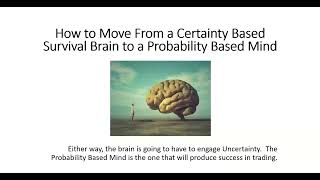
To trade without you training him, okay, to be able to manage uncertainty. And you wonder why I keep blowing up, why I do this? Because you're triggering, you're triggering that emotional brain. And you know, out of that, the emotional brain doesn't know how to do it. It's just working on instinct from 20, 30, 40, 50,000 years ago. And so the whole thing is, how do you move from a certainty based survival brain, that's your caveman brain, otherwise known as the emotional brain, the social brain, the mammalian brain. Okay, how do you convert that survival brain into a probability Based mind, the one that doesn't see losses as deaths. One to see just losses as landing on the wrong side of probability rather than a threat to life. Do you see that gap? That's the gap right there. So the question is.
Understand this. Your caveman or cave woman will always see uncertainty, loss as a threat to life. It will also see that when it sees a big, huge maston that could feed clan far God three or four weeks, what happens? They get all cranked up. They get all jazzed up. They get all. They're ready for it, and that's where they get that urgency to act because they get a lot of kudos. You know, they. They get respect. They get all this stuff if they're ever to do that. But the thing is, a lot of people die, but you need to get cranked up on dopamine to go do something stupid like that, okay?
So you're seeing this, and all of a sudden, at the same time, you still have this mindset. It's all mine. My life is mine. My life is mine. And you're losing that money, Losing that money, and your life is being threatened. Friends.
As long as you have a caveman brain, and I hope to your dying breath that you have a caveman brain because you would have died a lot earlier if you didn't have caveman brain. As long as you have caveman or woman brain with you, you're going to face this thing of your emotional brain seeing loss as a threat to life and the triggering of aggression or fear based on that.
And it happens so fast. Take a look. This is what happens. If it's all done on your left low emotion, okay? You got that higher cortex. It's grooving. It's taking business done. And what happens? That amygdala is cool and everything's fine. The information's coming in. There's no threats on the horizon. I can think clearly.
Then comes the threat, oh, my God, I could lose. You know something? Maybe if I get more comprehensive confirmation, a little bit more, a little bit more, a little bit more, and the trade's gone past you, then you're going, I got to get it back. I got to get it back. I got it in the back. Then you jump into trades that you don't know. What you've done is you have disabled. You've hijacked your thinking brain that you so desperately needs to be able to calculate all this stuff. And all of a sudden, the amygdala.
Is in charge of turning on fight flight. Friends, this is the high emotion. And this is what you have to learn how to really stop. You have to learn how to regulate this. We're going to be getting that in a little while, but a little bit more. I want to make sure that you grasp.
To put it another way.
If you take a look at this graph, you see a geeky driver thinking he's in control. He's an all modern man and he's read, he's done all the TA stuff. He knows how to do that. He's got a strategy. He can talk trading to anybody. Okay, he's in control as long as the risk isn't real. But the moment the risk gets real. And remember, caveman can't tell the difference between risking capital and risking life in the back seats. Caveman, caveman just hanging around. Okay, sitting there and all the. But what happens though, it's always sitting there. And that thinking brain, you, the ones that has language can't even understand the emotional brain in its language. We've got these language centers and we can think in symbols and stuff. No, the difference is that the emotional brain does not think in thoughts like that. It acts. It's a biological action potential. It acts and in the process takes over mind. And with the moment it sees threat, nanoseconds later it's chemistry in the bloodstream acting. So you can begin to see the dilemma. And out of this part of that dilemma is, well, what I'm going to do about it. And once that amygdala is cracked, this is what it's looked like. You know, big threat coming at you and what happens? Do you fight it?
Maybe. Maybe. Or do you run like hell? Maybe. It really depends on a lot of things. You know, one moment it looks like you're in control because there's not a threat there. The second minute that you don't think you're control and you're going to have to take over and you're going to either have to run or fight. One of the most powerful examples of fight flight I've ever seen was one time I was watching a dog chase a raccoon and it looked like the dog had the big advantage. The raccoon was trying to run and then it hit a corner in a fenced in area and the raccoon could not get up the fence. This is a 30 pound raccoon.
Then that fear avoidance turned to aggression. That dog just got torn up. So you can see is that both aggression and avoidance are just simply different responses to perceived threat on an animal level. On a social Mammalian level or politely on an emotional brain level. So in one moment you're control, the second you're not. And, and what we need to do, we need to be able to harness this thinking brain with this emotional brain and begin to learn how to pull them together and start recognizing that we're not going to trade without emotion. Well.
The only time that you don't have emotion is when you're dead. Remember, an emotion triggers the moment. There's a change in anything in the environment. An emotion automatically appears. So, so this is really about how do I go about training my emotional nature to respond differently to stressors in the environment. All these challenges we have with uncertainty. It starts with really understanding our emotional nature. And where I'd like to start is with one of my favorite movies of all time. I actually assigned this movie to people who work with me because this, this is Inside out by Dixie, Dixie by Disney Pixar. And it, they did a lot of research, they brought in neuroscientists because they really wanted to be able to understand the way thinking and emotion were tangled together. And this is the emotion emotional programs at the council control panel of the mind of a little girl. And you can see they all have different agendas. There's joy just going yay. There's sadness over there in the blue, there's anger, there's disgust, oh, everything's disgusting. And there's anxiety on the far right. These are just natural programs hanging out that in. This little girl never got trained very well because she was told to always be the perfect one to always be funny and all this kind of stuff. And what happened is she couldn't be sad, she couldn't, you know, she couldn't have her anxiety, she couldn't have her anger. And this is the first thing is when you realize that an emotion is not psychological in the least bit of the word. An emotion is biological. It has been defined as a biological action potential that occurs every time that there is a change in status occurring in the environment that affects the organism, the trader and the markets. So that's what an emotion is. At 100 neurons, a firefly, I mean a, a, a fruit fly does not have cognition to get in the way from an action potential producing action. Whereas you know, we've got 3 to 4 billion cells in our brain and all of a sudden cognition becomes deeply part of, of the emotional complex that produces stuff. But the thing is, the real question is, you know, what emotions are managing you or come forward in a moment of stress, in a moment of challenge. In a moment of not knowing. And the key is understanding this makes a huge difference.
Because the key is for you to understand that an emotion, the stimulus, is way over there on the left at the bottom of the bar. And if you'll notice emotions in time, that's a nanosecond or two. And you see the, it fires now when it's firing like that is becoming greater and greater and greater. And finally at the peak, what happens is a switch opens and that revving up is suddenly not revving up, it's pulsing through the body. Now what this results to is there's an activating event, a stressor. By that definition, an emotion is going to occur. What you first see that line going up is arousal. The body is getting ready for action. You might feel it as tension in your body, holding your breath, your heart beginning to race, all that stuff sweating. Okay. Then once it reaches a particular place, notice at the very top of that, it's almost like it levels off. No, it's reach a switch and the switch is on. It's no longer revving up. And that feeling, the chemistry, the emotion is in the body and it's taking, it's hijacking you at that moment. You're toast at this moment. This needed to have been stopped long before this. Then once it's got there, the emotion is going to have a direction. It's going to be telling you something do on a primitive level. It's fight, flight, approach, what you want to do. The most heavily traveled road is fight, flight. That's what we want to start. Stop. We want to have approach, we want to have curiosity. We want to be able to approach uncertainty with a disciplined, impartial mind.
That's a manufactured mind that is not normal at all.
But we can build it. And then what happens is what you also notice is the beliefs you hold about your capacity to manage uncertainty are constantly being revealed by your trading account. For better or for worse, the trading account is a truth meter. It doesn't care about the lies you tell yourself.
It's telling you. This is the belief that's generating how I deal with uncertainty. The act, the situation of uncertainty. And also at the very bottom, something I don't deal with is genetic predisposition. Some of us are just simply more nervous than others. Some of us have more risk tolerance. But the others are the ones that really show you what you're up to. And you take it a step further is what I want you to understand is that anger itself, neither good nor bad, it is a response to threat.
Okay, listen to that. Even a bully feels threatened. And what you're looking at is its aggressive response to threat. And its deal is it wants to attack to diminish the danger and you want to hurt it. And the thing is, is it could be from making up prior losses. It could be all sorts of things that you want to do. Are not taking a loss where you want to. You get angry, you're going to. Because understand, understand.
With taking losses, it's about, oh my God, am I going to be eaten alive here. It's not thinking money, it's thinking life or death. And then what you discover is there's also another one. Greed or lust? Not, things are a lot more lust in trading rather than greed. Is that, that lust is I got to do what I do. I want it, I want it, I want it. And that's when you just start doing really dumb stupid things. You have an urgency to act. The money is just drilling up dreams in you of power and mattering and a sense of deserving. And look at me, look at me. And the truth is, is that.
Neither of those emotions have any business at all in the trading mind while performing. Then we take a look, then we take a look at anxiety or worry. That's about future, that's about future problems. Is that you start dreading about, oh my God, what's going to happen in my trading? What if this profit's taken away from me? What if I'm wrong? You know, I need more confirmation. And then you miss the trade. Oh my God, that's a worry. But I want you to distinguish the worry or the anxiety from fear. Fear is imminent threat to the biological system. If you just had a drop and the trade really starts going against you, the saber toothed tiger might as well be taking it and just running you down. You have that sense of powerlessness. Oh my God. Biological extinction. So the thing is this is the stuff that you have to truly retrain. And unless you retrain, has no reason to change. And it's not going to change by itself. You're actually going to have to start working that needle that this you see in this graph back toward where you have. You can really get the stuff in my own, in my advanced trading, I'm actually using heart rate monitors and apps to be able to basically judge where your heart rate is as a function of emotional arousal and to be able to keep it down. And we would actually be able to spit. We'd be able to see that you're jumped out of the zones that you're supposed to be in. You would take corrective action. You're going to need to do that. And you don't have to do it so fancy like I'm doing there. But you, what you ultimately have to do is say, okay, how do I go about calming this biological plant down that has cognition in it so that I can produce a mind that can trade effectively? And then, well, there you go. The main thing is you have to start taking your neocortex, your thinking brain and your emotional brain, that animal brain, and you're going to have to start building a partnership between them.
The problem is the thinking brain doesn't even notice the emotional brains there until it's already hijacked. You. And the thinking brain doesn't seem to learn very well about the power that the emotional brain has over your ability to think and even the kind of thinking that you do. But this is what you've got to do. This is where, when you're having whatever problem you're having in trading, this is where it's at. You're going to have to examine the way your body is adapted. You're going to have to examine about, well, you know something, how do I go about retraining this? And what I can tell you is that what we do at our place, okay, is we've. This is a. We. We teach a process. We don't teach magic, we don't teach you. Oh, you're going to have these things and you're going to. I'm going to kind of download some stuff into your brain. You can be better. No, we teach a process. Actually, it looks a lot like Alabama or Georgia football. They teach a process and by really adhering to that process, they produce championships. But the key, the very first thing with us, you're going to have a really different understanding about emotions and realizing that, no, friends, you don't have emotions, they have you. You don't have beliefs, they have you. Once we grasp just how powerful emotions are on our cognition and who we are as a human being, we start saying, well, how do we start managing them? We start learning emotional regulation. Then we start learning mindfulness. We have to step back out of thought, quit identifying with it. Then we have to find the self looming beliefs that keep parading up. And I call that historical internal dialogue. Then we have to develop your inner strengths, which I call the good news, where you start realizing that you can build an empowered self. It's there. It just never got used. It never got built. And then you have to become very Intentional about managing the mind that you bring to trading. I have a saying in my work is that the price of freedom is eternal vigilance. And the key is that most people do not know how to produce eternal vigilance while trading. They just think they're going to make money. And by thinking that, they set themselves up for failure. The whole key is no, you're. You're going to be quite vigilant about the mind you're bringing into the moment. That's the key and where it starts. First, you've got to calm the emotion down. And in doing that, what you discover, once you grasp that emotions are biological, they will also have a biological signature. You get into one of my classes in the first three to four weeks that all you're going to be doing is retraining the way you breathe initially in the yoga studio where you're listening to guided meditations. Then you're going to learn how to breathe under the conditions that you're going to be using this technology in. You're going to be doing it while trading. And what you're going to notice is that you're breathing. You're having muscle tension in such a way that you're, you're just aiding and abetting fight flight to pop up and take over mind. And this is the first line of defense. You have to retrain the way you think. I mean, the way you breathe. For instance, with me, I check into my breathing and just kind of my state of mind about 30 times a day. It's that important to me because I want to be in the right mind to be able to deliver the kind of the message that I want you to hear. That instead of going off in one direction, I want to be very focused. I want to be very intentional. And it starts right here. Emotional regulation does not solve the problem though. But without emotional regulation, you never get to the door of the mind. When you get to the door of the mind.
That'S when things get really interesting. You begin to recognize is that you have been living in an illusion.
You have been identifying with thoughts and just saying, oh, these are my thoughts. Friends, you don't have thoughts. They're having you. They're creating your destiny. They're creating your experience. What you are is an unawakened observer. And we start using mindfulness to start waking up. That observing so that you recognize that you and your thoughts are separate from one another. Is that in stepping back from him, you no longer have to identify with them. Oh, this is just me. It's just Going to always happen. No, what happens? The observer that you are has been conditioned over time to react in a particular way. What we're looking to do is put you in observer mode where you step back out of thought.
Okay. And this is when your psychology really begins to pop because you recognize in this work that you can become the designer.
Of the mind that you bring into the moment of trading. You know, you don't have to accept whatever mind happened to show up because of past experience. No, you can become saying, oh no, that's not a good one to have being in part of the mind. I need to build a different mind for this moment. And that's called mindfulness. Then.
What you discover in mindfulness, that your mind is just not organized very well for good trading. And it's kind of like a mutiny going on and you have all these different people. And it kind of looks like a good photograph of add, doesn't it? ADHD kind of just tensions go all over the place. They're moving all over the place. And what you're doing is you're saying, you know something. At some moment what happens is the CEO of the committee of you has to wake up and say, you know something, I need to bring this committee back into shape so that it can play at game time. Okay? Just talking about the game doesn't work. But what you're doing is you're recognizing that the brain is a community of rifle emotional programs that is duked out, out to take control of the mind. And the mind is the space where those emotional programs have been given voice. And if you want to read about that, David Eagleman, a very, very, very excellent neurobiologist, that's the guy who comes, that comes from. But the thing is, is you get to say, I need to start managing this. But while I'm there, what's in there? And you find out that we all have this historical internal dialogue. And what you discover very quickly.
This self talk going on in there.
It'S not like you could go, well, I'm just going to start controlling it now. I want you to start listening to it. You're going to start discovering there's a lot of victimization going on there. There's a lot of anger, there's a lot of things, there's a lot of fear. And what you discover is that more than anything is the committee of the mind has both destructive and constructive aspects of itself. And you see it, I mean, kind of like take a look at the human beings of today is that scientists have been telling US that climate change is coming and you better watch out. But nobody would listen. They kept doing the same darn things and now here we are.
They only have a short term basis, humans. And what they do is they tend to think destructively. It just comes naturally for us to destroy things. You don't need to destroy yourself. You don't need to be like all the other human beings. You need to be. I would want you to be more constructive. And the first thing you're going to be, using this observer, you start recognizing that there is an inner critic.
That is very destructive. It will always criticize, it will always judge, it will always tempt, it will always try to just have you doing the dang, the stupid thing, backing off good ideas and stuff like that. And you're going to also discover the one that with his hands over his ears is what I call the adapted voice. That's the fear that's shaping your response to uncertainty, either by avoidance or aggression. What this guy needs.
Is mentorship, a way of learning about the deal. It's not like the inner critic is going to go away, okay? What we want to do is begin to understand how the limbic system responds to uncertainty, because it's just not. We like to think that we're in charge. And the thing is, the limbic system produces what is known as limbic assumptions that in human beings become limbic beliefs or.
Intrinsic beliefs that move us. And the truth is, it's because we don't look and say, I need to really take a look at what's going on in this limbic system. It stays unknown to us, it stays below belief level. The thing though, the key in trading is to recognize that your trading account is a truth meter about the beliefs that you're projecting all the time onto the markets and how effective they are about extracting capital from the markets.
That is a big, huge thing. And in learning that, you begin to recognize, oh well, darn.
If there's all that stuff going on. What you're going to also discover is that there's also an undeveloped part of yourself. There is the discipline, the ability to maintain order of a ruler. There is the courage, the ability to face fear and to protect of a warrior. There is the self soothing and self calming of a caregiver. And there is the impartiality, the clear thinking of a sage. These are just as relevant.
Okay? This is the empowered mind. They're there, they're on your genome. They're part of our human experience. But they are not what evolution has shaped us. To become.
Remember, the brain wants certainty.
That's what's been shaped. What we're looking at right now is.
The emotional programs give rise to the mind that can engage uncertainty and probability and work effectively. It's moving beyond the animal brain that we inherited. It's beginning to have the thinking brain to be an integrative part of your emotional experience with uncertainty. This is powerful, friends, and it can be taught.
And the key is you're gonna have to make a decision. This unobserved internal struggle that pops up on you and just oh my God, where'd that come from? I don't know what happened to me, Randy. I was just fine and all of a sudden went over the place. That's it. That's what we're looking for. It's gonna show up in your trading decisions in the heat of the moment. That's what we're interested in. We're interested in training you.
So that you become prepared to meet those moments very differently than you came game to the game with. And the way I really like to look at this, when you take a look at these emotional programs archetypes and I do use a Jungian system for doing this. Some of my favorite characters that fulfill these archetypal emotional programs, that of ruler under pressure. Pressure is this bulldog Winston Churchill. I probably would be speaking German as an American if it weren't for him. He somehow put.
Great Britain and the free world on his back and wrote it. He had the ability of pulling people together. And interestingly after the war he was de elected then. The warrior the courage to confront your fears. You know it's interesting is that in my own logos is a wolf is my warrior. And in a dream it saved me and protected me. You also have that caregiver and you know the Dalai Lama is good. I also one that I use, I use several. But the thing is you have someone can self soothe you. Because the thing is in trading you're going to have to self soothe a lot. You're going to be taking a lot of losses and you have to calm yourself. You just can't just logically look at it. No, you're going to have to take that orphan part of yourself and you can have to calm it down. You're going to have to soothe it. And then also I use Albert Einstein as a representation of sage of clear thinking. Not of when he was young, but when he was older and started gaining wisdom. These elements in their raw emotional program form live within you. The key is learning how do I pull them forward and start making them an active part of my regular mind that engages uncertainty. And again, that's what we teach. So we come down to this, and probably to me, the best archetypal movie that I've ever seen in my life is Lord of the Rings. I mean, you get a guy like Aragon who is basically, yes, he's a born king, but he has to undo what his ancestors has done. You get a guy like Frodo who has, he's an interior warrior of the greatest belief. You have Sam, who Frodo needs because he's a caregiver beyond anything you have. You know, you have the magicians, you have, you have, you have everybody represented. You can see them working as a team. These are the elements of self that can work as a team. So the real key is how do you cultivate this mind, the one built for the management of uncertainty? Personally, we generally use, more than anything else, we use a lot of memory enrichment. We use a lot of being able to go back and see moments in time and magnify them of where you experience these powerful emotional programs. Particularly, by the way, inherent worth. Inherent worth is that part of you that whether or not you win or lose, you're still inherently good. And we have several different ways of getting at that. But inherent worth is what allows you to stop judging yourself by performance.
A friend of mine, a guy who's made a mere $180 million in the last three years, said, yeah, it took me three quarters of a million dollars to figure it out, but I finally came to the conclusion that whether or not I win or lost really didn't matter. I was still good.
So. And that's what set him free to become the kind of trader that he is. But ultimately it all comes down to this, is that the struggle, the challenges of living are always going to be there. But instead of that disorganized committee that you saw a little earlier, what you're looking at is this committee has still got a power struggle going on between destruction and construction. But all of a sudden you're seeing that it's being well managed.
Okay? It's just not Helter Skelter and you're prepared. And what that does for you.
That gives you the ability of saying, you know, I'm going to start developing an intentional mind.
When you take a look at a batter like this in an on deck circle.
He'S preparing to hit the 100 mile an hour fastball on that end on deck circle, he's, he's using practices that he started in elementary School, Little League that has allowed him to get his mindset ready to get in that batter's box when he gets in that batter's box, what he does. And by the way, that's something that we teach. We teach how to get in that mindset. But then when you get into the batter's box, you have to do it like instantly. You can't do it. You can't take 10, 15 minutes. You need to be able to do it between each pitch. And when you get to that, when you get to that moment you're ready, you realize that you know something. You do not control outcome. You never did. You know, your great win percent really doesn't mean much of anything. Your ratio of winners to loser means a lot though. And what you realize is what this guy, he does not have power over the wave, the market. What he has power over is, is the mind that he brings in the moment of performance.
This is in the zone. This is in the flow moment. This is the intentional mind. And this is what you're going to need to develop.
To manage the rigors of trading. And yeah, we teach it. So what do you do with all this? The truth is I invite you to become the change itself. And we have various ways. If you've just got. If this is your first time.
Hearing this stuff from me, I encourage you to go to my website, get my free book, start kicking around, start looking at all the free stuff, go through my 200 plus videos, just start doing that stuff and saying, you know, son, let me learn about what this Randy Howell character is saying. It's just completely different place. But when you come to get through all that stuff, there really ultimately comes down to a group course that we have starting next Thursday. We have 26.
Oh yeah. We only have two more spots. Okay. So if you're looking to get in at this round, we would just as soon see you go ahead and get into course for the next one and start working with materials before you get there.
Evening. Because they have to pay and receive their.
Materials.
Yeah. And the thing is that we limit it to 30. Okay. Because it gets too out of hand after 30. So if you want in this, there's two slots left. Okay. Yeah, yeah, you're gonna have to act today. The key though is what also is that most people, well, more than half the people that take our group course start a month or two early or three months early. So they go through the materials and they get themselves. They realize that this course is not a joke. It starts, you hit the ground running that's the first thing. And it's, you know, so five group meetings with me and it's recorded. There's a virtual classroom. You have access to it 24 7. It's a powerful thing. There's also an individual course for people who say, you know something, Randy, I really like this. But the truth is, is that I want to work directly with you for that. There's the individual course. It is highly comprehensive and very personal. It gets to the meat of what actually holds you back from basically a greater expression of your empowered self. And main thing, whatever you do, take a really good look at that trading account of yours, your P and L statement, and look at it and say, what is this telling me? Not. Not what I want to hear, but what is it actually telling me about my performances? And most of the time, what I've tried to do is let you know that if you have a human brain, you just certainly did not show up to the game with the right brain to be able to deal with. With the complexities of trading. It's. It's nothing. It's not your fault, okay? But the thing is, is that it is your responsibility, okay, to build the brain, to build the mind that can handle probability and uncertainty and loss. And just say it's a loss. I landed on the wrong side of probability. Ah, it's a win. I just landed on the right side of probability. It's not an affirmation of your being. It's just probability, friends. Anyway, I want to thank you for coming tonight. We have a few minutes and I'll take a couple questions if you have them. Were there any that were left? Yeah.
Let me get close. My eyes are no longer what they used to be.
Okay, start with the blue. Start with the blue. Hey, Randy, it's me again, Moses. Thank you for complimenting me on my name. Another question I have is, am I supposed to stress inoculate in safe place, generate before every trading session or in the middle of trading?
Moses. Those your breathing and safe place are methods for you to maintain a particular arousal level.
And the brain has to be in a slight arousal level to be able to trade well or otherwise. It's too calm, it'll miss stuff. But your breathing and safe place are something that you should use to maintain a certain level of arousal. Like, for instance, in my advanced work, usually a heart rate of about 65 to 72. Okay. Is the arousal level that maintains a really good mind. Once it goes up a little, what happens is that you're no longer fit to trade. So there's a really skinny thing. I personally trigger to a lot of these things that you're using right here. I trigger to them numerous times a day. I've done it several times since I've been talking here because I wanted to keep my mind right. And I constantly have an image of a safe place in mind. I calm down and I pull my mind back to the intentional area I want. So it's not like you. This is what I'm asking you to do, is you actually start building ways of reading yourself biologically and psychologically and emotionally and saying, I need to calm the system down. It's got too high. And most people can tell from how much tension they have in the body if they're breathing correctly, if they're doing diaphragmatic breathing or if they're holding their breaths or if they're panning and stuff like that. But the thing is, what I'm really asking is we live in a world of enormous stress. Our Caveman ancestors spent 10% of the time in stress and 90% of the time in what is known as eustress, rest. And. And today the poles have rested in order to keep our humans from just blowing up with whatever. What you need to do is you have to learn to breathe and relax tension and use symbolic representations of safety and calm to be able to constantly move yourself back into that. Because I can promise you is the news outlets do not want you calm. They want you all bent out of shape about what's happening. So here's Alan.
When one has a series of losses, but then uncovering back, recovering back all the losses causes one to freeze, resulting in hesitating and taking new trades, what belief is causing the freeze? Well, first of all, let's not divide this into psychology and forget about our instinctual caveman brain. Is what you're basically saying is, I lost a good bit of money and I made it back. And what happens is my brain, my. My survival brain has decided, I don't want to go there. I don't want to. I don't want to get exposed to losses again. So I'm going to shut things down, okay? So you can look at it as a survival instinct. That's saying, I've already been tested. I finally got it back. I'm not going to go there and lose it. I have plenty of people who do that. And the main thing is a lot of it is just simply about the training, about taking losses. You know, I'm ta. I'm training losses. When you take a loss you know what you're doing? You're saying you ask a couple very direct questions. Is this a method mistake? Is this a psychological mistake? Or it's just. Just simply probability? And I would I take that trade again. If you answer the question, yeah, I take this thing again as probability, then a professional trader just not does. They don't see the losses, they just move forward. Okay. Because they're trading their system at the same time. That takes quite a bit to do it. And then you ask these two questions, is this psychological? And a lot of this could be psychological in that, you know, you've taken losses, you fought back, and then going, well, do I want to take all this stuff that. All this fight, and then you want me to go risk it again?
Well, that's caveman. And that's your psychological self. That's where heart and mind have to come together, my friend.
Okay, the second half. What belief is okay, when one reaches a certain money amount, can that cause a freeze? Absolutely it can. I worked with a guy. Hold on. What is the limiting belief? Why would. First of all, I don't know you. So I don't know. I don't know what the limiting belief that you particularly have. I mean, the guy that I was working with today who just blows up accounts, you know, ultimately he grew up in a. He grew up in a family where his father was villainous and his mother became kind of a victim, and everybody else just adapted in really weird ways. And what happened is this guy developed the defiance.
And he developed this thing as I can handle anything, I can defy that I can. And what he liked is he liked the fight, he liked the adrenaline, he liked the rush. He loved to compete. He likes to win. Because what happens is he convinced himself he could win in this really crazy family of his. And he's a very successful salesman who's finding out that being a really successful salesman doesn't have a dang thing to do with being a good trader. And what he's learning is that, yeah, it was an adaptation, him being defiant, but at the same time. And it also him wanting to win no matter what. But at the same time, what happens is that it came down to his powerlessness. This him being bigger than life was his response to uncertainty and the lack of power that he had. And he became this huge thing. So the point is, it really depends on each person. I can't listen to a person I don't know with no sense of history and say, this is self limiting belief. But I can tell you it's almost always about mattering. It's about deserving and it's about adequacy and sometimes lovableness. But the thing is that's what you're looking at. And so you really have the adequacy. This is, William, when I have been very bad, when I have a very bad trading.
The top. No, yeah, I see that you were telling me to go to the one above. When I have a very bad trading day, I will shut down my trades for at least several days. Even if still in the trade position, I will not look at it. That's pretty common. I've seen that before. Is this cooling off period a good thing to do or am I just hiding from the damage that I've done to my trading account? William, I tell you, I'm going to give you both sides of both sides of my mouth on this thing. Is that for a lot of particularly retail traders, when they've hit a loss limit, when they've had a fairly bad day, what they need to do is they need to back out, particularly if their psychology has just flipped out on them. And so I grant that I can understand why you would want to get out and I would prefer you closing all positions. It just simply say I need to get myself cool before I reenter. The real key though, William, for you is this, is that.
It'S one thing to have a bad day and you followed your rules where you looked at your trades and you said, okay, the truth is, is that I followed my rules, but boy, I just hit, I just hit some. I hit some probability that just really didn't hit my. Didn't hit me really well. And this friend that I've talked about, it's very common for him to be down quarter of a million dollars. It's not like he's trading really well. He's just down a quarter of a million dollars. Okay.
And here what I'm hearing is that what I would want to know is that when you're having a bad day, are you making psychology mistakes?
And if you're making psychology mistakes, why aren't you getting help? Okay, Is that.
It's something that.
I don't know very many people, I don't know very many people who come equipped with a psychology that can trade well.
And yet when you see that shutting down, as retail trader, you got it, you did the right thing, you kept yourself from really blowing up. Okay? But the key is that you're still there and you're saying, is this psychology, is this method, is this probability? Would I Take the trade again. Those are the four questions you've got to answer. And if you start looking at it and saying oh it's psychology, a hell of a lot of psychology, then you're saying, well what are you going to do about that? In the same way that you go to teachers and stuff like that and you invest, you invest. Well, if you can do it yourself and some people have done it, but I wish you well. But I like what you're doing on a retail level. Okay. And here's from Jordan. Working through your videos and meditations I came to realize that my work brain, police force, oh boy. Was massively affected by trading. I bet it did. As making a wrong decision in the police could mean life or death. Absolutely, absolutely. I carried this into trading and did not want to take a loss by making the wrong decision. I bet, I mean.
I have worked with a number of police officers who've had some really bad things happen and we had to work through them. I can really appreciate what you're saying. Your content is now helping me to unwire and rewire my trading brain to think in possibilities or probabilities and accept that losses does not equal bad things. Not in trading. In the domain that you were working in as a police officer they could and that was the right mind to have there. But in trading you have to develop a completely different thing. Huge thank you from the UK for everything you do. Thank you. Thank you.
Okay, the key here is that.
There is a, one of the traders I work with has the ability of switching from an alpha mine needed for running a business or say a police mind needed to, needed to do his job and not get killed. Okay. And the trading mind, it takes work and you know the thing is that's, that's something that can be developed. It's hard but you know, I'm assuming that you're a retired policeman and now you're. And you're discovering that you bring some of that with you into trading. So anyway, good luck and thank you. Thank you very much for that. Here's Joseph. Hi Randy. Oh Stephen. I'm sorry. Hi Randy. Once you catch yourself in a highly aroused state while in a trade and finding hard to self regulate back down, should we exit the trade and calm down? Yes.
The worst thing the world is think okay, I can ride this thing out. I don't want to take the loss and if I take that loss.
But yeah, if you're in a highly arise state, get the heck out of it. Just don't do any more damage.
Okay? Don't do any more damage. Nicola. Hi, Randy, My name is Nicola. My question is, do you recommend Kundalini breathing, which is pretty much, yeah. Exercise. And also how often do you recommend it? Do you recommend cold showers? No. Before a trading session. Thank you. The problem that I have with yogic breathing systems and trading. Okay. Is that yogic breathing systems depend and understand. Mine's a derivative. I use bellows breathing, which is coming out of yoga. And mine would have been from college.
Well, I can't remember Anamark training yoga. But the thing is that in most yogic trainings, what you're doing is you're learning to breathe in a yoga studio where the worst thing that's happening is it's hot. Is that what we're looking for is that you have to be able to translate being able to calm the system down to places where it's more like combat. Okay. Is when the uncertainty's there, all that's there, and you have to be able to use your breathing to be able to calm yourself down in a real situation rather than a yoga studio. And look, I've been meditating for well over 50 years. I get into very, very calm states. And what I know is it's very different than, say, if I'm doing something and I'm triggered and getting myself pulled back down and. But again, a lot of the bellows breathing, diaphragmatic breathing, I'm using, and I recommend it constantly. You're looking for a certain arousal level. And also the part of yogic breathing is when I was actually teaching that and using heart math, I was getting people too relaxed to trade. Okay. So there needs to be and yogic things. They really want you really deep down there. And what happens is you need a little bit of arousal, you're focused, you're ready, you're intentional. So you're going to need a little bit above that or trade's going to get past you. Brendan, I usually trade well when I'm under pressure and intentional, but the moment I relax, the emotional brain comes from nowhere. How do I. How do I go about this? Well, after you go through all my free stuff, I would recommend the group course. Okay. The thing is, is what you're again, you're looking saying I can work well under pressure where I know a lot of people that have to dig themselves a hole before they start trading well. And the object there is to figure out why on earth they fig they have to dig a hole first. The emotional brain does not work on logic, okay? It works on emotional learning. It Works on being in a particular area where for a lot of people digging a hole, it was just simply a family rule. Okay. That they learned and they're just really natural about it. I'm actually thinking of a guy where, you know, the whole thing is their family dug hole financial holes quite a bit. And that's exactly what Steve did, is that he would dig a hole, the $10,000 hole, and then by the end of the day he'd gotten, had a profitable day. But the thing is, he didn't get real until then and our job was to get him so he didn't have to lose $10,000 in the first place. Okay, last question. It's from Victor.
Limiting belief seems to be big issue in becoming profitable traders. Well, that's a statement and the answer is, yeah, they are. If you begin to understand that the beliefs that I'm talking about are limbic beliefs, they're not the ones that you talk about. Limbic beliefs are part the meaning or the belief about your capacity to be able to deal with uncertainty is wired in at that level. And so yeah, beliefs are simply part of, of the power of an emotion. And ultimately after you calm the, you know, have to calm the emotion down, stuff like that, you have to get it to belief. Okay. Because at best people who get into trading will have scarcity thinking from their, from their families who have raised them to get a job, to stay in the job and stuff like that, rather than to be out in the forest and see what, see what they can find. But yeah.
Getting at the true beliefs that are driving performance again, not what you think they ought to be, but what you actually see being driven in performance. That is what has to be worked with and changed to produce the higher accelerated training trading levels. So I want to thank you folks for being here. I love it when people have lots of good questions and stuff like that. And tomorrow I want you to really get into your trading and look at it. Get a mirror or videotape yourself and watch the emotions on your face, watch the tension, watch the eyes and just start really noticing. Oh my God, I had no idea this was there. And then if you're looking to move forward and say, you know something, how do I actually start doing this?
Go to the website, go to the videos. I know that some people obviously have video spent weekends with my videos. But the thing is that decide if you really want to be a trader and what you're willing to invest in yourself to change.
What evolution shaped you into to be able to become the mind that engages uncertainty. That's a challenge, friend. That's a big challenge. So, anyway, take care, and I hope to see you again. And happy trails to you. Goodbye.









