Breaking Free From Sabotage
Randy Howell explains how emotional patterns like greed and scarcity thinking cause traders to sabotage their own gains. He outlines a training approach: start with breath and muscle relaxation, build mindfulness, then rewire your brain to handle probability instead of survival mode.
Chapters
Welcome everyone. My name is Randy Howell with my trader State of Mind and we are here to look at something about the pattern of self sabotage. It's really interesting is that self sabotage is one of the most common problems in trading. And most people, most traders response to sabotage is to try harder to overcome. To overcome, okay. The problem is working harder to overcome. Sabotage actually makes the problem worse.
It's not the hard work we're talking about, it's the order of thinking that needs to change. And the way we observe our bodies, the way we observe our brains, and the way we observe our minds. And in particular, becoming really masterful.
Of being able to decide what mind is going to show up and at a particular moment in trading. That right now is something that very few people can do. And I see people making that progress. But that's what we're going to be exploring this time. And just a couple quick housekeeping rules before we really get started. First is that I hold my questions toward the end of the presentation. A lot of questions are answered during the middle and, and what I discover is that if I answer questions during the, during the course, I get really off track. And the idea is to stay on track. There's a message here, there's a teaching here that I want to get across. And I will acknowledge that I received an email from one of the people here tonight that had about 10 zillion questions in it. And I thought, wow, well, there's no sense in even trying to write an answer to this guy because I would end up writing a book to do that. So anyway, here we go and we're going to answer some of those questions and we're going to start looking at this thing. So let's start.
You know, the thing is, it's really interesting is people spend a lot of time almost there in their trading, but something keeps them from achieving their potential. You know, you double check, you triple check, you really, really, really press down on it and you keep looking for that missing moment, that missing ingredient. The truth is, when a serious student of trading really starts looking and starts noticing what's happening, they start looking for patterns, okay, that hold them back. And they're not looking to say, you know, I need to make that not happen. They're looking to say, no, I want to see what the pattern is revealing to me about the mind that trades. In this particular case, you're looking at an image of where the person keeps literally sawing the limb off from underneath him. So what is sabotage? Why does it happen? What I'm Asking you to do is to recognize. This thing starts with performance. This thing starts with the mind. And this thing starts with something that most people really have no idea about, how their brain organizes mind.
Okay. And then have you ever noticed that you end up breaking through this moment just like this? Jets moving through the sound barrier. And all of a sudden what happens is it all comes together and you're in that zone and it feels good. It feels really good to experience the confidence and decide you've got it, you've done it, you know how to do this.
Okay. How many times has that happened to you? If you're like most traders, a lot, you come to this moment, you feel you have. You have it together, You've got the winning days, the weeks, maybe even the months together. And all of a sudden you break through and there it is.
And you're so there. And then.
And then it's all gone in a flash. You sabotage yourself. It did feel good. However, sabotage patterns back there must be something connected with that feeling good in trading and the sabotage coming back. Okay. And suddenly what you discover here, you should see. You do see that sabotage pattern is back. And what you discover is that you take back defeat from the jaws of victory and you go, how did that happen? How did that happen? Well, before solving that problem, and we are, I'm going to show you how we deal with it. But let's take a look at what's behind sabotage. There are several very common situations that lead to sabotage. And let's take a look at them and see which ones resonate with your situation. And as we go through these, and you would have discovered, I talked about these both in the article and the video, that if you haven't seen that article and video, that would be a good place to help study and to take this to a different level. But we want to look into the darkness.
And that's from the newsletter. Okay. And you can find both the video and the article. My website, you simply go to the front page, you scroll down to the second video, and there's the video. You go to the articles, and the articles will be there. And.
This is the webinar based on that. But we want to look at this darkness. We want to take a look at really which ones resonate with your situation. So as we go along, I would invite you to put yes or no. If this one type in yes or no, if the one that I talk about resonates with you. And you may have more than one. But the thing is, let's start from the Beginning.
Ultimately, it often comes down to simply not managing emotions effectively.
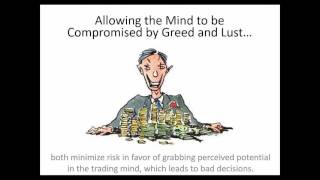
That's the biggest deal. And also not really understanding the impact of emotion to have on performance. Or it could go deeper. But the thing is, what we want to look at is like with this guy right here, what you're beginning to see is look at the impact that you're having that he as an emotion is having when money's all around him. Suddenly you begin to recognize that your understanding of your beliefs about money, worth, power and adequacy are all wound up. Sabotage. Okay, and let's start.
Let'S start with feeling good. Feeling good is not an option for trading, not at least for a good trading mind, it's dangerous. A couple years ago I was teaching in China and I was teaching with a group of portfolio managers and traders on a very high level. And I made this statement about you don't you're not allowed to feel good when you trade. And I had a number of these guys say, what are you talking about? We can't feel good when we trade. It feels good when you do something right. And my response was, and what happens after you feel good, after you do that something right? What happens to the actions after that? Because ultimately what you grasp from emotional intelligence theory is the emotion and particularly the feeling component, the emotion that feeling good causes you to think the way you do emotions. Well, all thinking is emotional state dependent. Suddenly the thought is, I've got it, I'm feeling good, I am king of the mountain. Hey. And then suddenly out of that, what you do is you start making really dumb mistakes, you start being excited, you start experiencing the thinking that comes forward out of excitement, which is dangerous, particularly if you happen to be impulsive or if you happen to be an alpha type of person where you really want to win and you want to do like that, that excitement really gets, it becomes very dangerous. So that's the first thing. Let's take a look at this. It's just simple, not being able to emotionally manage yourself when trading. Okay. The truth is, is that in my teaching is that you can feel good after you finish trading. You can whip it up, you can do all that. But the truth is when it comes to trading, it requires a very specific kind of mind to trade well. And feeling good does not make part of that team called the trading mind. But let's take a look. Let's go a little deeper now. Okay, again, this is cause thinking is emotional state dependent. You've got to manage them. Ultimately, excitement or euphoria causes you to Think that the good times are going to roll on forever and you start really mismanaging risk and reward. And literally, literally what happens as you move from a trading mind to a gambling mind, the truth is, is that a guy like this who's gotten excited about potential, potential money coming his way, suddenly what happens is I'm going to give that thing a little room, you know, just needs a little room and I can make it, you know, man, I've got it in me. I'm in the zone. No, you're not. What you are is a trading mind. And you're creating a particular observation of the markets that may be or maybe not good for extracting capital out of the markets. And for certain, an excited mind does not pull capital out of the markets very well at all. So we've gotten this thing where, okay, we know that excitement or euphoria is not good. But what happens is now this is, we're still talking about just emotional state management. We're not necessarily talking about the beliefs that lie below the emotions.
Also, what happens with a lot of traders is particularly the ones who over trade and revenge, trade, they're acting from greed or lust. And I want to explain this thing. If you've ever been in lust, I've known plenty of traders who say, you know something, this is exactly like when I was in lust over a female or a male. I have the same kind of thing. It's like I'm out of my mind. I'm not making good decisions. I'm seeing that potential. I'm just frothing at the mouth to get at the potential or the greed. You know, I can just take this, I'm going to take it. And again, what you're doing is you're not managing the emotions of the trading performance. This can come from a lack of maturity. Okay? And that happens a lot. There's a lot of people. It takes about five years for a trader to recognize that no, your excitement or euphoria or greed and lust just simply really don't need to be there. Most people burned out other capital for five years. Okay, I've got some words for people who stay around after the five years. But the truth is, is that it can either be coming from this lack of maturity, emotional maturity about how to manage the mind, or faulty beliefs. But again, that greed and lust really, really get. You start thinking, I can just take a little more. I can just take a little more. It's there, I'll go smell it. My intuition is telling me when your mind's fried it's incapable of thinking correctly now. But let's take it one, let's take it beyond.
The common problems of emotional state management. I mean, I've actually worked with traders where we when in the first part of my work, the very first thing that you do is you learn a lot about emotions. That's called emotional intelligence. But the very first thing you do is you learn how to manage the intensity of the emotion. And literally the moment that they learn how to manage the intensity of the emotion, their trading took off. They had it. They knew how to trade. They didn't know how to manage the emotions of trading. And once they figured out how to manage the emotions, that really blew up trading. They had a good trading mind and they really didn't need any more. Those are few and far between, but they're there. But this group of people, like the vast majority of you is consciously you want to make this money, consciously you want to have this success. But the truth is, is that.
Somewhere outside of working awareness, what we would call the subconscious, something else is brewing. Often traders don't believe they deserve to win. This is psychological problem, okay? They also hold beliefs that they have to prove themselves to matter. And my promise to you, the market is a terrible place to have to prove your worth. And yet constantly they're trying to do that. It's really interesting is I often will joke that Dolores and I would not have a business if it weren't for a bunch of men their 40s, 50s, 60s, and 70s trying to prove to someone that's already dead that they matter. And that would usually be their dad, okay? And you begin to see that they're trying to prove something. And again, trying to get the markets to be on your side is crazy. We have to take away performance from human value. That is a huge thing. So we've gotten this and we're going, okay, how many people have identified with this stuff yet? Okay. But the largest thing that I see, and people who've grown up in, okay, enough families and stuff like that, is scarcity thinking. Scarcity thinking is the greatest barrier to overcome and sabotage. You know, you start winning and suddenly you start thinking, oh my God, this could be all taken away from me. Oh my God. I start having to look around going, you know something, I need to be care. You know, I'm using larger numbers now, you know, what should I be doing? And all of a sudden that thing, that fear of missing out, that, that thing where you go in scarcity thinking, oh my God, it could be taken away from me. I need to be careful. Suddenly that wakes up and it starts being part of your trading mind. This is psychology, okay? And this is what has. This is what has to be built. Okay? These are the four big ones. I'm just wanting to know if any of these resonate with you. Now, what I can tell you is that 95 to 98% of the people that I work with, these are, these are big deals, okay? So nobody's keeping score here, Nobody's seeing, and nobody's going to know what you said. But I'm asking you, can you be honest with yourself at this particular time and say, yeah, this one relates to me. Because ultimately, until you acknowledge the problem, there's no way you're going to solve the problem. Yep, I can see that. There we go. Now.
What I want to stress to you is this.
No one brings the right mind to trading. Okay? Well, I guess there could be a few people, people who are high functioning autistic people who have some other conditions like that bring a completely different emotional architecture. And they really don't have the sense of like, dread when they're risking capital and stuff like that. But I want to, I want to go back to Charles Darwin here. I want to read this to you. What he's saying here. It is not the strongest of the species that survives, nor the most intelligent, but the one most responsive to change, the ability to adapt. And what I want to do here is throw down a gauntlet to you. If you've been around this thing for two to five years and you can trade in simulation and you're seeing yourself fall apart and sabotage yourself, what you're looking at is you're going, am I willing to adapt? Am I willing to change?
Instead of the markets having to be the way I want them to be, can I recognize that the brain that I brought trading, it's not going to be the brain that's going to produce success in trading. I'm going to need to change the mind. I'm going to need to redesign the mind. I personally am going to change the matter between my two ears. The markets don't have to change. They're fine. They don't have to be predictable. That's fine. They're just the markets. The problem is me. And am I willing to change or do I want something outside of me to change? If you want something outside of you to change, I encourage you to find a different occupation than a trader, because that's not going to work. And that's why the burnout rate is so horrendous. In this, this profession is ultimately, the ones who survive are the ones that change so that they can dance with the markets very differently, okay? Once you figure out that you need to change, are you willing to. So we know this thing about change, okay? And the real key is, are you willing to change? Are you going to be a very intelligent species that it may be very strong in your knowledge, but continues to fail? Remember what Darwin says here, the one that is most responsive to change is the one that survives, okay? That's the point. And also, smart doesn't have anything to do with it. It is really the cornerstone to success in evolution and success in designing the trading mind is that in evolution, it's happening by, by random chance. In design of mind, what you're doing is you're becoming the designer of your own evolution of your own change. That's what's going to be required, my friends, okay? And ultimately.
The odds are stacked against you because the truth is the brain has no reason to change what has proven successful over a long period of time. Emotional survival. The emotional survival brain will always hijack the rational mind in a heartbeat. And I mean literally in a heartbeat. I mean, what you. In my, in my more advanced trading, we actually are using a heart rate monitor on a person where we're actually looking at heartbeats and we're actually seeing where the emotion starts that hijacks, that compromises mind. And it actually comes down to an acceleration. It starts with that heartbeat and accelerates. Ultimately, what's happening in sabotage and other things is that information is coming in through all your senses and it is being routed and it first goes up into the limbic system where the amygdala is. A decision is made about whether or not that information is going to go to the higher order thinking centers of the, of the mind where you have rash, where you have all that reason and God, that's what you want to trade, or is it going to be routed into reactive emotions? That's the deal, friends, is that you have millions of years of adaptation that have a comfort zone, have a structure. And the truth is that your puny little brain, as big as it is, cannot tell the difference left to its own devices between discomfort, the psychology of discomfort, of uncertainty and ambiguity and a biological threat. So it's going to route it to the amygdala and fear and aggression every time. So this is where it comes down to, okay, so now you're going, okay, wow, you know, I'm gonna have to be able to redesign the relationship between My emotion, my emotional brain and my rational brain in order to become an effective trader. Yes, you are. And that is no small order. You're just not gonna pick up a, pick up a magic wand and presto, you're not gonna get some specialized knowledge that's gonna solve the problem forever. You're not going to read a book, even mine, that changes the core belief structure that triggers all this stuff to happen.
You're going to have to rebuild. Takes time, it takes effort. It's not an event. Change is not an event, it's a process. So we're looking to say how do we produce successful adaptation and how do you do it? It starts right here. Until your brain and mind become comfortable with uncertainty and ambiguity, it will not be comfortable managing probability. You're working from the caveman brain where it's a dangerous world and had every right to have a lot of reactive stuff going on. But if you're looking at this image, this is pretty much what trading is. Even when your hypothesis looks like it's right, you know, everything lines up and it just seems like this is it. Might as well, I might as well be getting T bills, you know, that kind of thing. What happens is ultimately what you discover is you don't know what's going to happen. You have to be prepared for the ambiguity. You have to be prepared for the uncertainty and just the market deciding on its own accord and you being left behind. That is a mind that has to be there. Because ultimately what you discover in trading is that you do not control the outcome.
If you keep doing that like a perfectionist or like an alpha wanting to win and make things happen, you're going to be a losing trader. You may win and win and win and then become sabotage and blow yourself up. But the truth is, is that it is this mind that can handle this maze not knowing that we need to be able to build. So we've got this huge obstacle and your brain is completely against you and most likely your psychology is not your friend. You're going to have to take the bull by the horns and you're really going to have to change it and it's going to take work. So ultimately you have to change the brain on uncertainty, okay? Literally, the brain on uncertainty literally looks like the brain engaging a sabitt toothed tiger at close range. And there's all sorts of crazy stuff going on. That brain has to be redesigned to see that the uncertainty is not a saber toothed tiger. It is just simply not being in control. And you're letting Go of control, you have to build a bridge from survival to probability. Otherwise the pattern of sabotage is going to stay in place in your trading. And of course, there's steps. And that's what we're going to start looking for. We're going to start looking. How do you actually, if you finally come to the notion is that the mind that you brought to trading is the problem, what happens is the good news. It's highly adaptive. You know, in neurobiology, we have this concept, neuroplasticity. Neuroplasticity is not just about stroke victims and therapists teaching the brain to do workarounds and learning how the brain can work around and produce behavior and get stuff back. Neuroplasticity also says that you can change the very belief structure that you bring to the management of uncertainty. It's plastic. It can change. Old dogs can in fact be taught new tricks. You have to build that ladder. You have to make that bridge that. And what we're going to do is we're going to start looking at what it takes to do that. Now, the first thing, okay, is recognizing to be outstanding, get comfortable being uncomfortable.
Ultimately, uncertainty creates ambiguity. This is the way the brain works. And the mind that flows out of an ambiguity produces vulnerability. The brain does not like vulnerability.
Vulnerability is seen as the fear of death. If it's not in control of outcome and environment, the human brain has a problem. And all you control freaks can appreciate this. The moment of vulnerability. What's triggered is the fight flight response. Okay? The parasympathetic, the sympathetic nervous system's on board. You never know in trading. So therefore, you're always on this edge of vulnerability, of an uncertainty. And you're on the edge, the cusp of the fight flight response. You're always there. And the truth is you do not have control of emotion, but you do have freedom of emotion. What that's basically telling you is going back to that neuroplasticity. No, the illusion of control is an illusion. You know, it works pretty well in other areas of life, but it still wakes up and you feel fine, that all that control was for naught. Ask all those people in 2008 at the same time if you recognize. The Romans were right.
The future favors the bowl. What happens is what matters very strongly in trading is what mind do you bring into the moment of performance. And here, this is where freedom of emotion happens, is that you can, you can decide, you can design what emotions are going to create the mind that moves into performance mode. That's what you can do. And that's the trick. That's really the edge. But to do that, you're going to have to get comfortable with being uncomfortable. So we're knowing that we're already going to have to go totally against. We're not going to be able to deny emotion. We're not going to be able to push it as size and compartmentalize it. We're actually going to have to say, okay, I have to master the emotion. Yeah, now we're talking. Now we're talking. Friends, ultimately, your first job as a trader is to control the intensity of the emotion.
Until you work with emotions and understand them, you don't understand how they take over the rational mind. Until this is done, there is no change to reactive emotion pattern. Sorry about that. Friends.
At&T decided to do a test and.
At any rate, we got zapped. I am very, very sorry about that. And. Well, let's find out where we were.
When we got zapped. If someone would help me on this is that right now we're sitting at a slide that starts talking about emotional regulation. Okay. And the slide before that. Go back, Doris. The slide before that was literally acknowledging the obvious, that you're going to have to learn to become comfortable with being uncomfortable if you're going to learn to be a successful trader.
Let me know if everybody got that. That one. Okay. This one right here. Okay. Bottom line. So we're going to start here. The thing is, the very first thing that starts is this. Once you get past what I would call the rookie mistakes of not just simply not knowing how to manage emotions, not knowing if they would hit you in the face, like when you. You get too excited when you're winning, and you start getting greedy and lustful and stuff like that. Those are rookie mistakes. And they're people, I might add, with severe problems with, like, with revenge trading and stuff like that. So they're not rookie mistakes, but they're ones for a lot of people, particularly the ones coming out of scarcity thinking that literally you have to learn to be able to take the emotion, acknowledge it, recognize it's there. And if you're not going to be able to deny it, you're not going to be able to compartmentalize it. You're going to have to say, I'm going to have to master this emotion, and you cool it down. And you learn that when I'm trading these emotions, these emotional responses to situations that I'm in and trading simply are not allowed. And you write into your plan and everything's copacetic. If that were the case, I wouldn't have any business. However, what happens, and this is where it starts getting more.
Really where we have to start talking. We really have to start going, I need to learn how to manage this. So what we're doing is this. We're saying the very, very first thing that we have to learn to work with is emotions so that they don't take over the rational mind. Until this is done, there is no change in the reactive emotion pattern. And this is really important. This is really, really important because ultimately emotions are going to happen. Anytime that there is a change in status.
Between the organism, that would be you, the trader, the environment, that would be the markets. So you can see that emotions are constantly firing as you're engaging because of the level of uncertainty. The uncertainty is going to trigger emotions as they come. You need to be able to work that. The way we teach that.
In our work is through breathing and through muscle relaxation. What we know is that both tension and the way you hold your breath directly correlated to the emotion. In fact, the breath style and the tension are part of the emotion. And what happens, you have a volitional way of altering the intensity that emotion by managing breath and by managing muscle tension. And we teach a system of bellows breathing and muscle relaxation and we start exposing you more and more to it in real time and real where money's at risk and you learn, and you learn to, okay, I have to manage the emotion as I'm trading. Not just, okay, I know how to do diaphragmatic breathing. Yeah, yeah, yeah. In the yoga studio, if that's where you're learning this stuff, keep it. In the yoga studio. You have to learn to breathe and hold and manage muscle tension in the, in the combat of the trading world. Otherwise it's not a learned experience.
So we've gotten there and we're going, okay, now.
We know that we're going to have to learn, and this is the first step in the trainings that we do, is you learn how to do this in real time under real circumstances of risking capital. Okay, so you're learning that. Then the next thing as you learn that, and.
Unfortunately is no matter how much we would like to think that managing emotions would solve the problem, it doesn't. However, if you do not manage the emotion, you never get to the door of the mind. Because ultimately what we're looking for is the belief structure that's linked behind the emotion, the physicality of the emotion, the fear response, the aggression response.
This is where you have to learn to observe. And what I want you to know in this situation, take a look at this image, is the very first thing that this person has to do that's in this state of being, observing the world, is that person has to be able to regulate emotionally.
Okay, if they cannot regulate emotionally, they cannot be in a mindful state. But it's this thing where we assume that we are thinking, that we assume that we are emoting. We assume that you're having your beliefs and your thoughts. And what you discover is that you and your beliefs, you and your thoughts, you and your emotions are different from one another. And the truth is, is that you don't have beliefs, you don't have emotions, you don't have thoughts. They're having you, they're creating your experience. And until you begin to wake up this observer, what happens is you do not have the capacity of looking at the structure of mind that you're bringing. Trading enormously important. And of course we spend a good bit of effort in this to be able to say, okay, we now know that we can calm the emotion down and we know that we can step back and begin to observe. And ultimately what we discover is this, is that when we observe the I, the self, what we're observing is one potential organization of a self that was that your brain organized you at another time in another place. And what you're discovering is that historical organization, what I call the historical internal dialogue, simply is not effective in managing the probability in trading. But at the same time, this is something that has to be established. And we have a protocol for being able to teach how to awaken that observing part of yourself. And you begin to see, oh, I am not my thoughts and beliefs. What happens is those are just one potential organization that I got locked into and I'm going to have to change, I'm going to have to change it in order to be a successful trader. So ultimately you begin to go, okay, well what's going on here is that.
In accepting that you're just one potential organization of a self, you begin to recognize that being able to change the organization self is really where the thing is. And just like Darwin was saying, it's who can adapt the best. Here we're saying, okay, who can change the belief structure. This is really critical because ultimately what this is all about is you are projecting your beliefs onto the screen of the markets all the time. You're measuring their effectiveness in your trading account. What happens is that you're going to have to learn to re change on a real cellular level. The beliefs that you're projecting, those beliefs will be about your ability to manage uncertainty, to manage the ambiguity of life or situations. That's what you're having to learn how to redesign. This is what we want to do, is we say, okay, we know the original adaptation, survival isn't working. It was good. But the thing is, is that, hmm, well, that's not working. And it's what's missing in my. It's what's missing in my trading. And this is where the sabotage is. So ultimately.
You begin to have to really begin to understand the mind very differently than probably you understand it. Now from a neurobiological standpoint, the brain itself is literally a community of rival programs that have duked it out. And one group has become the winner, and it defines self, and it becomes I. It doesn't mean there are others, that other emotional programs aren't there. But they didn't win the first battle. They didn't win the original battle. But what you're beginning to recognize is the mind can be put under construction. And trading is going to force that. Okay? No matter how you end up doing it, it's gonna force it. So you're looking at it and going, okay, now, these programs served me well at one time, at one place in my. In my response of being able to live in an environment. Usually that's called family and community and culture, okay? But those same. Those same conditions are not the conditions that I need to adapt for in trading, okay? Where outcome cannot be controlled. And everything is all about performance. The mind you bring to performance. So you're looking and going, okay, what I've really got when it comes down to it, after I've calmed everything down and I begin to observe, I've got myself a brain that was built to survive in another time, in another place. And I'm asking it to do things that it was not designed for. It's nothing personal. It's just that your brain was not designed to be looking into a computer screen, thinking in terms of probabilities. It was thinking in terms of survival in that moment. So that you can breed into the population, live and breathe into population, and have a say so about your species. That's what it was done for. So we began to, okay, now I get it. I'm going to have to. I need to shift from the given, from the default survival mindset, and I'm going to have to build a probability mindset. Yeah. And what you're going to do is you're not going to trust what you have to say about it. You're going to trust your trading account. It will tell you the truth all the time, despite how much you might lie to yourself about, I've got this, I don't need this. Blah, blah, blah, blah, blah. You keep looking at your trading account and it will tell you whether or not you need this or you don't. Because ultimately, what we want to do, what we understand is the brain is going to revert to basic patterns under stress. And this is when they show up. Suddenly there is that voice. You will have heard this voice on the right. You will have heard that inner critic. You would have heard it criticize you. It will judge you. It will tempt you to get into trade you shouldn't. And it's always harping. And you know it's going, what do you think you're doing? Who said you could trade? Why didn't you get that? You missed that. Do you realize how much you left so much on the table. There's not you do is good enough. And all of a sudden you realize that the mind with this voice in charge, all of a sudden there's all this dread, there's all this anger, there's this worry, this self pity, this fear. All this stuff is coming forward. And that's what you're trading from, friends. This is the mind that you brought to trading. No wonder you're having problems. No wonder you're sabotaging. The good news is that this can be changed. And the truth is, is that.
In sabotage, you are literally reeled back into the historical internal dialogue of self doubt or overconfidence. This is what's got to be broken, okay? That comfort zone of old reestablish itself and you're back in the same old place over and over again. And you push it, you push it. You get out right outside of the comfort zone and you're pulling, pull back in. That's the sabotage, friends. And it's nothing that you can just click your heels and change. It requires a good bit of stuff. But understand this. That's only one organization itself. The interesting thing about neuroplasticity is that there are other neural programs, there are other emotional programs that have that could be dominant, but simply weren't dominant at the time and place when you were growing up or during trauma. Okay, here, what you're looking at is an image. You're going, oh my God. There are many different parts of me. And ultimately what happens is I can reorganize. I can reorganize the mind. The parts of the self that show up in order to be able to, to trade effectively. That's true. That's what you can do. And again, what I'm asking you to do is use your trading account as the judge, not your personal opinion, because it's going to lie.
Now. So now what we're doing, we're saying, now we're at the place where we've got an observer. We recognize that there's an internal dialogue that's going to keep you in a comfort zone and keep you from probability mind. Now it's time to actually start building the mind that can tolerate and work with the ambiguity of uncertainty and not knowing all those question marks about trading ultimately, and here's the deal, friends.
In the same way that fear and aggression are part of the human condition of responding to uncertainty, now they're default. They're pretty deep programs. So are discipline, the ability to maintain order under pressure. Courage, the ability to turn toward discomfort rather than away from it. It's not the absence of fear, it's acting in the presence of fear. Self soothing. Instead of beating yourself up, which never works, you've learned to self soothe. Because what happens, you take a loss, you're going to feel horrible, you're going to produce suffering. You need self compassion. And then at the same time, if those, if discipline, courage and self soothing are working, you're going to end up with a calm mind again. And suddenly you have access to impartiality, reason, and there you go. These emotional programs are what's needed to manage the probability of uncertainty. They're there. You're going to have to work them though, you're going to have to nurture them, you're going to have to grow them like in a garden. And you're going to have to train them to be able to replace.
The old mind that you brought that was survival oriented. So you've gotten there and you go, okay. It's possible. It just so happens that.
We teach how to awaken these emotional programs of discipline, courage, of self soothing and of clear thinking. We teach them through a process called emotional enrichment where we're going into memory and we're beginning to find times when those emotional programs did in fact fire. So that when we're isolating them and we're deconstructing the memory, we're getting at the actual emotional program rather than our visualization or our affirmational what we wish would happen. We're actually getting at the program itself. And it's something coming out of direct experience. You darn well Know it was there once. We have that so that you have the ability of producing the feeling of discipline, the feeling of courage, the feeling of self soothing and the feeling of clear thinking. What we're doing is when we're saying, okay, now we're going to go from literally what's happening in the brain, that's the emotional enrichment work to what's happening in the mind, that's the symbolic representation where we're finding visualizations, we're finding symbols that actually activate that resonate with each of these emotional programs. Now this is a fairly complicated process. It's not like something you're just going to do it by voodoo. There's a training sequence through all this stuff that you learn. Okay, now I'm actually learning how to build the mind that I'm bringing into a moment. Yeah, yeah, yeah, that is the coolest thing. You're not just using any old mind, you're using a mind that you have prepared to work in a particular moment of performance. This friends, is when you're getting to the edge. When this happens and you have and suddenly what you discover is that discipline becomes something we call ruler. The ability to maintain order under pressure, that courage becomes a warrior, that self soothing becomes a caregiver, that impartiality becomes something we call sage. These are the archetypal energies associated with that. Suddenly what happens is this your mind becomes focused on performance, not on outcome. What happens in this image, what you're looking at is you're looking at a team. It could be your mind and literally everybody is well trained that when certain situations occur, ruler is going to say, this is what I need, these are the things that I need. And suddenly you're finding a way to balance the selling machine in a really uncertain sea. This is a trained mind in the same way that you train team. Because ultimately your mind literally becomes a committee where various forces are showing up and its observer. You're beginning to learn how to nurture and build teamwork between the parts of the mind that can manage probability, not the parts of the mind that can manage survival instincts. Do you see the difference? You came equipped with the survival instincts. But to be successful in trading, to get past sabotage, you're going to have to get to the moment of probability mind where you're in control of process, your control of your performance, not every outcome. And that my friends, is the big deal. Because ultimately this is what you're going to find.
If you try to man up on your fears. What's going to happen is you're going to battle fear forever.
However, if you learn to face your fears and to master them, you become free. You become free to choose the mind that you bring into the moment of uncertainty. That, friends, is what you're looking for. What you're recognizing is that you've created a new crew in your mind that manages life, manages the uncertainty, manages the challenges of life very differently, including the ambiguity of trading. And what you're also beginning to recognize is this, is that you're beginning to recognize is the brain. The mind has been reformed for managing probability rather than survival. Okay. Instead of having first up, bam. The survival instinct triggering to sympathetic nervous system and fight flight, what you're triggering is a patient, calm mind that is very disciplined. It is courageous. It can face uncertainty. It is cooling, calming of itself. It realizes that you have to keep things cool or you're going to trigger the fight flight response. And out of that what you do is you get the impartiality of reason and you trade. Well, that's how it's done, friend. It's a program that we offer for training. You have to train the brain. There's no way around it is that you know, don't, don't trust me. Trust yourself. Trust how long you've been trading, how long that you've been at this, what your trading account is telling you to be honest with you guys who have been trading 5 and 10 years find that they're lucky to be at break even. They, they've paid a lot for that. It's breaking past that. It's breaking past that performance barrier into the next level that requires the new mind. So ultimately what we're looking at is this. To design the mind is process, not an event. This is what we teach. We have programs that teach this process from a group standpoint, from an individual process. You know, in our different other offerings from our books, from our guided meditations, the first stop is with emotional intelligence. That's what you're beginning to learn here. And I'm learning that sometimes there are just the ambiguity of uncertainty and that there is repairment out at your AT&T box. And just so happens that at 5:00 clock in the afternoon he decides to run a test and knock us out. Okay. That's the inability to control outcome. What we can do is we can control the way our mind engages the process. And here we are again. And did we lose people? Yeah, we lost people. Of course we did. Are we going to figure out a way to work with that? Yes, we are. But the thing is, is what I want you to notice is how we responded. We responded with the empowered mind rather than a reactive mind. So it starts with emotional intelligence. You got to learn that stuff. The second is that you have to start with emotional regulation. You have to be able to calm the emotion down so that it doesn't hijack you. That's the first part of the training. The second part of the training is mindfulness. You have to develop this observer of the self. You have to recognize that your awareness and your thoughts and beliefs are separate and that they can be reorganized.
Powerful tool. Probably the most powerful tool there is. Because the first thing that we do as you accomplish that, we're going to have you start looking for the internal dialogue. And a lot of people get confused. They don't know what they're looking for. They're looking for this thing they call themselves and all of a sudden they wake up one day in Ohio and go, oh my God, this is just one potential organization of the self. My God, I had no idea. Yeah, that's when it starts getting interesting and you start realizing that, yeah, you're going to have to work through the comfort zone of change. But the truth is, if you don't get out of the comfort zone, you stay stuck in performance where you are. To get outside of the comfort zone, it's going to take some work. But you're observing the inner critic. You're observing that orphan fearful nature of yours and you're seeing how the pattern hiccup of sabotage keeps occurring. Then what you're taught is how to get at the emotional programs that you need to show up in the midst of uncertainty and by the memory enrichment, by the symbolic representation work, you learn to drill it into yourself so that when you're experiencing uncertainty, you need to have this patient, disciplined, impartial minds show up. You train to that it doesn't happen naturally. You have to turn toward that discomfort and you have to master that fear. You have to build these things. But that's not enough either. The war's not done. Ultimately, you have to recognize the price of freedom is eternal vigilance. What you do is you realize that a great baseball hitter goes through his process all the time. If he falls out of his process, he's no longer hitting with the same competency and he has to go back, he has to re establish process to be in the hitter's mind. It's the same thing here. So it's a six step process.
What you're doing, friends, is changing neural circuitry, not your opinion. That's the big deal. And this is how you do it. So what I'd like to do is this, if you're interested in actually becoming the change, actually making this thing happen. How does it happen? Well.
You'Ll discover on our website. We have lots of, we have books, we have, we have articles, we have lots of free stuff. We have stuff that are pretty inexpensive, a lot of guided meditation stuff to really kick the tires with. But ultimately it comes down to two major courses, the group course and the individual course. The major difference really, with the individual course, it's more comprehensive, personal. You get me with 10 sessions over three to four months where we go through this step by step process teaching you how to do it. And it's by Skype. I mean, it's. We're, we're looking at each other, we're talking to one another. Okay. Whereas the group course teaches. It teaches the basic things you need to know.
And it works from a situation where you're going to a virtual classroom. And we meet every two weeks over a period of 10 weeks as a group. It is powerful because what happens is it's very affordable.
The reason I designed that course was I had trader trainers saying, randy, we need something for people with not a whole bunch of money that are willing and want to learn how to do this, but just can't afford the individual program. That's what this is. Ultimately, both are. It's kind of like good, better and best. You know, there's nothing wrong. This is very powerful stuff for people who realize they're going to have to change. And what I'm doing is I'm teaching you the tools of how to change. This isn't using visualization affirmations in the hope of change. This is actually teaching you how to be in combat under live conditions and train the mind to manage probability. Deal. And if you're interested, get a free consult with us. Go to my website, hit contact us. Dolores will find a time for us to talk and find out what's best for you. Okay. Do you have any questions? And I'm sorry this thing got whacked, but it happened.
Okay, Carmen wants to go back a few slides.
Let us know which one. Carmen, I think it's that one. Ask her if it's that. Okay. Is it this slide? Carmen?
And Carmen, if you'll say what your question is.
Okay. And plus, you're going to be able to access this thing tomorrow. The major thing here is the major what happens with people is they think that if they just simply flip, fight their fears and that's all it's going to take. And the truth is, is that the fear just. That's adding gasoline to a fear. What ultimately happens is you face your fear and you realize that this is from Dave. This is from Dave. Instead of greed, what if we were to say exuberant hope? That would be a good one.
There was a central banker a few years ago who called this irrational exuberance. That would be a good way of describing it, too. But the point is that whether or not it's exuberant hope or irrationally exuberant, or greed or lust, ultimately what you're really beginning to see is there's no place in a trading mind, a successful trading mine, for that. If you're going to use that to guide your trading, you might as well recognize that you're gambling. And most traders gamble. They are not trading. It's the same thing. If you ever get around really good poker players, you realize that they are not gambling. And you better come to the game ready to play. Because it's a game of probabilities for them, and they're working probabilities. So are there any other questions? Okay, just type them right in and we will. I will take a few minutes for them. And I realize we've gone a little over because of our disconnection. And the AT&T people did apologize. I don't know what that's worth. Okay, let's see if there's.
Okay, here we go.
From August. Okay. How to get over greed. Outside of trading hours, there is impossible sometimes to avoid thinking of money. You know, what I would say is if you take these tools.
A lot of people when they take this course, they recognize that this is really not about trading. You're in the group course. That's right. The thing is, what I ask you to do is use the very skills that you're learning to look at your grade about money. Because ultimately, what you should be doing right now, depending on where we are in the group course, is that you should be going, okay, who's having this conversation in my head? And if it's about money, most likely it's about worth. Okay? And if I make a lot of money, people will really notice me. You know something, you know, and you begin to say, who's having this conversation? Who? The world says making money is the. Is the end that makes everything. This is all about performing. And you're recognizing, if I'm obsessing about money, what is it that I'm trying to gain by the money that will tell you all about your orphan nature.
This is from Mark.
What creates so much resistance? Your brain.
Understand you have six and a half million years of conditioning.
That doesn't want to change. It's been very successful.
It's been wired into traits that are passed genetically down from one generation to the next. I'll put it to you this way. When we were hominoids and our ancestors on the African savannas and we're looking across the savannah from a bluff and we're looking at all those bushes out there, what we learned.
Is that if we made the assumption that there was a saber toothed tiger behind every bush, that that fear driven response was going to be a survival mechanism that allowed us to perpetuate our genes through time. It worked better than recognizing that only 1 in 10,000 of those bushes actually had a saber toothed tiger behind it. So what happens is that negativity became incredibly entrenched partner of yours, of the flesh. And ultimately what you also discover is that your brain is a negative assessment machine. If you take a look at news, when was the last time they had any good news on the news? No, you tune in, you check your headlines and I don't watch TV news. Well, I watch pbs. I will watch public news because they really do in depth stuff that I think is really stuff. But I don't listen to news for headlines. But at the same time I will acknowledge that when I turn on my computer, I definitely scan headlines and I'm looking for what stupid stuff has happened overnight. My brain is a negative assessment saying it is looking for trouble because if it finds trouble sooner rather than later, it can avoid it. That pattern gets locked in and you're asking to change a comfort zone or what in neurobiology we'd actually call a perceptual map. And it's going to be highly resistant. And you know, to be honest with you, if it weren't for that resistance, you know, a guy like me wouldn't be necessary for a guy like you is that that resistance is enormously difficult to overcome if you don't understand how to do it. And what I've done is I've created a method over time, a process that takes it step by step, step by step, step by step to show you how to use the tool, develop the tools and then use the tools to be able to work that resistance into a new pattern. Okay, that's what you're seeking. And I would this follow up, I've been very successful and yet I'm getting more fearful over losses. Yeah, this.
There are some people, the ones, particularly the alphas, that they've been very successful in business and corporate and they have figured out how to win, okay? And they've learned how they can. They want to win. They put everything in their, their tools to win. And what happens is that when you're a big fish in a small pond, that strategy works okay for a while. Okay. However, when you get to trade trading, everything's flipped. The difference is that you are a minnow in a vast ocean and you have absolutely no control. So ultimately, your control issues are showing up okay in trading. And, you know, some people say, you know, I'm comfortable with my control issues, then what I say is, don't trade, Find something else to do. And I've actually had guys who have gone through my individual program, come to the end of the program and actually produce success and say, randy, this is the best money I've ever spent. I know that. I'm not a trader. I'm really an entrepreneur. I don't want to let go of control. And at first I was befuddled by that. But after talking with a number of traders, you know, what they said is, randy, you know something, Trading requires a certain mindset that it's awful to waste a perfectly good entrepreneurial mind trying to coax it into becoming a trading mind. They're very different animals, okay? And the entrepreneurial mind just has a lot of difficulty in the environment called trading mind. Okay? I would liken it to, like, when you take a look at an African lion, the way the African lion pride hunts. If you plugged an African lion pride into an American forest, they'd starve, okay? They're used to chasing and coordinating attacks in a forest that's really hard to do. In the same way that American cougar is a very successful apex predator in forests, and he hunts the white tailed deer mostly, and he's a solitary hunter. And he hunts by ambush, not by stalking the way the African lion does. Yet if you put the American cougar in the Serengeti, it starves. What you're seeing is two highly adapted animals, apex predators that couldn't survive in the other's environment. And the same thing here is that the success you've had, good for you. Okay? And if you want to learn how to produce a successful mind in trading, it's going to be different. It's going to be something where you let go of control. And that's really hard for people who've had success in business and corporate because they don't want to let go and they don't want to acknowledge, and it's hard for them to acknowledge that the only control they really have is over performance. What I will say is after you learn that the only control that you really have is over performance, you can become a really good business guy. But the thing is.
I would suggest you take a look at your need for control. And for me it's not good or bad, it's just that it's not. It doesn't work in trading. Okay. You are so right. Thank you very much. You're welcome. Probably the craving for winning what for me is impossible over the years making money in business is absolutely free of guilt and craving. Greed and craving. Okay, well, it may be. And the thing is that again it's the control stuff that's so much and I'll tell you though is that one of the most powerful personal development opportunity in the world is in trading because you're going to get to know yourself really well. Okay, I think that's it folks. I really appreciate it. I'm sorry about the breakdown here. It's one of those probability, uncertainty, ambiguity things. And who would have thought that some guy at 5 o' clock in the afternoon was going to be going out to my box in my neighborhood and doing a test and shutting down my Internet service. Sorry about that. Not much I can do about it. We're just going to let it go. Friends, if I can help you, I really want to. And if you really want to pursue this, I encourage you to hit and say I'm just going to have a free consult with him. I want to see what he's actually saying is doing. If you do get a free consult with me, I encourage you to read my book First Mindful Trading. It will help you a lot. It lays out basically what you're going to be learning and you'll have much. You'll be much better prepared for that consult. So friends, I thank you and we're going to be rendering this and we're probably going to need to cut a chunk of it out because there's just all this silence. But, but it'll be available tomorrow for you. Okay. Now thank you for the folks who stood around we dropped, but everything's good.
Oh, and by the way, depending on which tradition you're coming from or no tradition, may you have a great Easter or Passover or just a good weekend. Okay? So thank you and have a great, great life.










