Breaking Free from the Pattern of Giving All Your Profits Back
Randy Howell explains why traders lose profits to emotional hijacks: evolutionary survival wiring triggers dopamine and fear responses that override rational thinking. He maps the neural pathway from threat detection to poor decisions, then teaches diaphragmatic breathing, mindfulness, and deliberate personality development to build what he calls a performance mind.
Chapters
The broadcast is now starting. All attendees are in listen only mode.
Welcome everyone. My name is Randy Howell with Traders State of Mind and I am just delighted to have you here tonight. And we're going to be talking about breaking free of that really mysterious problem, this pattern of you're doing well and then you end up giving it all back and then some. But first, let's make sure you can hear me, please. Some people give me a Y for. Y for Yes, I can hear me in the question box, loud and clear. Thank you, thank you, thank you. Okay. The other thing is, is that I generally hold question answers to the end of the program. Okay. But what I would enjoy as, as we go through this and you have questions, go ahead and write them in and send them in. That way when we, when we finish and have this space that we can actually talk about it, we have some questions to begin with so everybody can get cranked up. Fair enough. Well, I tell you what, let's get started. Now let's say this. Why is it so hard to be. We're having problems here. There we go, there we go. Why is it so hard for you to maintain your performance? Okay, the thing is, is you've put some good days together. You know, you've done really well. You've got this thing going and you're going, you know something, look at this. I've really put on a good day, man. I've done really well. I've made some money here. And all of a sudden, whether or not today or whether or not it's a week, what happens? You continue trading and you're feeling, you're feeling pretty good, pretty good, you're doing well and all of a sudden something happens. You take a loss. Before you know it, you're revenge trading. Before you know it, you're just chasing and all of a sudden you blow up all your gains.
And then some. The key is.
What I want you to notice. It's, it's after experiencing performance success and ultimately what I'm asking you to start looking at is what is the belief behind that performance success and all of a sudden you start feeling good. You start, you start feeling confident. Whoa, this is really going my way. And friends, what I am telling you that because of that feeling good, it blinds you to the probability game that you're really in that feeling good. I'll get to it more in a few minutes, but that's actually dopamine. That's a reward chemistry for submitting patterns. And you're hitting that dopamine and suddenly the dopamine comes out and it has you feeling it's the good times, gonna roll on forever. That you got it. You've got that confidence. Yeah, I've got it. Yeah. And in trading, that's the kiss of death. Ultimately, what we need to do is go back to our, our deep ancestors from long, long ago, before a prehistory. What I want you to understand.
Is why it's dangerous for you is that you are programmed by evolution to win, to prevail, even if you have to deceive yourself. Let's take a look at this image right here. Now, that human being.
Is in all actuality about 5 foot 2, 5 foot 3, okay? That cat you're looking at is around 12 to 1300 pounds with 6 inch incisor teeth. And it just so happens that the servitude cats liked us. They like to be in our caves, they like to munch on us. Also, you're looking at something where that man has to have an irrational belief that he can in fact win, prevail over something like that. In fact, as a group, he can. But I want you to see how hardwired and even deceptive part of the stuff that says you can win, you can win against all odds, you can win. And if you'll notice that thing, winning against all odds is a very favorite movie line where movies are built around scripts like that. And here, every time you feel the chemistry of success, you trigger this ancient bias that makes you believe you are master of your own universe, that you are going to be in control. But contrary. To lose is to die, die to the emotional brain. Okay? Now you probably didn't know you were bringing all this stuff from your ancient emotional brain, your caveman brain, into the modern era when you decided to trade. Yet now you're here, that instinct is going to produce a euphoric mind, confidence, overconfidence, and friends, it is downright dangerous. And the thing is, then you've got all this stuff going, okay? You've got all this stuff going and you're winning, you're winning, and then you take a loss. All of a sudden there is a crash to that euphoria, that dopamine. And instinctively, you now believe that you're being attacked. And it's not euphoric. Everything's going fine, now it's being attacked. I have to either be aggressive, I have to fight to the very end, the last breath, or, or I have to run like crazy, hide like crazy. Yeah. Now we're beginning to see.
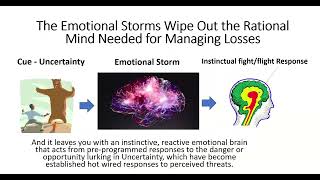
This is where the ancient Ancient, ancient emotional brain just builds a storm with lightning. And all of a sudden you find out your instinctual survival skills kick in and just push out the thinking brain that you so covet in trading. And there's nothing wrong with that thinking brain. You need it. You need it. You need to be able to do the calculations, you need to do all that stuff to be a successful trader. But at the same time, you're going to have to build that thinking brain and that emotional brain so that there's a new partnership. Otherwise you end up in a storm like this. So what I want you to do. Let's take a look at this. Okay, we are going to take a look at this and say, how does it actually. How does it actually look? Okay, here there's a guy, he's experiencing uncertainty. That uncertainty is a bear. And that bear is actually one of the predators of our caveman era, that which preyed on us. But also, you can actually look at this. And from where you're beginning to win, you're putting good days. You're putting, oh, man, I've had a great afternoon, man, I've made some money. What you're doing here is that to the uncertainty, facing that uncertainty, you suddenly have been buoyed up to believe that I can win. I've got it. I've got it. Either way, what you do is you create an emotional storm. Either you're producing stress, chemistry, testosterone, and the whole nine yards, or you're producing the dopamine. And all of a sudden, what happens over there? You see that, see the bear? You have an emotional storm. And then you go over to the last graphic there and you're seeing the instinctual fight, flight response trigger. What I want you to notice here is the thinking brain never got clued in. It got pushed aside so easy that you'd go, well, where was it? What happened? Why isn't it there? So the deal is this. If you were to take a look at it, if you have a look at this graph, what I want you to understand, it's between the guy sitting at the computer and. And the chimpanzee type guy at the very end of that line, there is 2% difference in genetic material. Yeah. Even today, we homo sapiens share 98% of our genetics with the chimpanzee. And they're a lot like us. They lead from aggression. Have you ever over traded, have you revenge trade? Yep, that's it. And all of a sudden you're looking at it going, oh, my God. And also, Jane Goodall, when Asked why, what is her favorite of all the animals? You would have thought Jane Goodall, with 50 years of experience working with chimpanzees, would have seen chimpanzees. And she said to the interviewers, think, you know, I know you probably think it's going to be chimpanzee. But the truth is chimpanzees are way too much like humans. They're aggression based and they're pretty violent group. And we are too. We see opportunity, we jump into it. We see, we see fear. And what happens is we're going to attack it, we're going to fight it to the very end.
The truth is.
It is this.
Quick, short time frames of day trading.
And this fear of losing, because fear of losing was not just losing a trade, it's losing your life. And just the fear of uncertainty that activate these primal responses that were there in this guy sitting at the computer millions of years ago and his ancestors. And because it was so successful bringing us forward as a species, that it got hardwired even into our genetics friends. That's where we are. So we get it. We go, okay, now, what's going on here? Well, this graphic gives you a really good idea. You think you're that geeky.
Egg smart guy sitting there thinking he's in control of the brain. He's getting there, he's driving, he's under control. He knows what to do. He's got his plan, he knows what he's going to do. He knows exactly how to produce that mind for performance. In the back seat is this caveman guy, okay? He's built to control outcome. He wants to be right to win. And that gives him a thrill. That's the dopamine and does not want to be wrong because that means death. And he wants to be able to predict future conditions. All you perfectionists understand, you're sitting there, you want to control everything. You want to be right about everything so that you control the outcome. Then you find out perfectionism does not work in trading. It works. As my airline pilot, I want him to be, I want him to be perfectionist. My accountant, I want her to be a perfectionist. The guy who builds the bridge that I drive across, I want him to be a perfectionist. At the same time in trading. If you sit that person in trading, that mindset is going to produce disaster. Because ultimately, the moment that you hit uncertainty, you have real risk involved. You've got some contracts, man, and all of a sudden you start seeing that trade turn against you. After all this good news, man, I'll tell you, it triggers like crazy. And it's this guy in the back, the caveman brain, your mammalian brain, that's triggering all this stuff.
And there you go. And that is what's happening. Understand? You start out, and maybe you had your mind right, or you got lucky the first several trades, things are going good, you've made some money, and you start feeling good. That's the general thing. And then you go on, and you may start falling out of that because you're going, oh, man, this is going too good. Something's got. Something bad's got to happen. It's going too good. Or you think the exact opposite, that dopamine kicks in, take a lot. Basically took a snort of cocaine, and you're sitting there going, everything's beautiful, everything's great. I've arrived. And then what happens is, boom. Okay? That's the way it works. You can sabotage all that stuff so fast simply because you actually think that your thinking brain is in control.
Nothing could be further from the truth. If you took a look at the emotions and thinking, and if you saw emotion as a locomotive, a big, huge locomotive, and if you saw the caboose behind that locomotive, you would understand that as a thinking brain, the locomotive, all the power and up directing that locomotive is the engineer. And that represents the beliefs that you bring to the management of uncertainty. You're seeing how effective those beliefs are for managing the uncertainty, for extracting more capital out of the markets than you're putting back in. That's what you're doing. No longer are you listening to your deceptions about you know how to trade, you know what you're doing, and you're looking good to your friends, friends around you. You're all talking shop and everything's really great. It sounds great. Until you get into a trade and there's money and the skin's really there. You've got skin in the game. And what happens is you trigger Mr. Caveman there, and you do not want Mr. Caveman trading for you. You do not want that. You want to have him calm, but you want him trusting you. So now we've gotten that far, and the next thing is understand your brain evolved to keep you alive short term. Why is that so important? Because danger alert around everywhere. Hardly few people lived 25 years old. You didn't even live. 95% of your progeny died by the time they were five or six years old. So you're seeing that you had to believe beyond all odds that you were going to survive. And the thing Though, is that caveman brain did not have a sense of future. It had a sense of right now. So it's short term. And danger, danger, danger. Will Scott to lose meant to die.
Understand they didn't understand money. They understand living and dying. And money was a representation of your safety, your power, your prestige, your ability to manage uncertainty. And if you had a lot of it, then you, you're going to be okay. However, when you get to trading, none of that's important. So you get this moment. And what I want you to notice is that goes against you. Suddenly starts things changing and you're at a point where you're going, oh my God, I have a sense of loss and I'm in confusion. It's at this moment right there. Your brain hates confusion. And take a look at this graph over here on the left. You have, you have a brain that's calm, you know, and you actually have access to the higher thinking parts of the brain, the higher cortexes and stuff like that. And the emotional brain is really calm, cool, and stuff like that. Then over on the right, what you're looking at is when this brain has now had an activating event danger signal. And all of a sudden the entire thinking brain has been disabled and that amygdala just goes.
And suddenly the thinking brain is nowhere to be found. It has been hijacked. This becomes an automatic response beyond your thinking to uncertainty. So you're looking at activating it in experience of uncertainty and out of that comes confusion, vulnerability, a sense of powerlessness and, and that triggers to fight flight. And you had been doing so good. But the truth is, the emotional intelligence you brought to that game did not sustain you. When you start seeing that winning and suddenly your emotional brain takes over and goes into euphoria, feeling good, feeling great. It's not working in the worlds of probability. You can train it for that. But the thing is, is most people don't. They walk into trading, they think they're going to make money. They don't look at the, the corpses on the side of the road and then they walk right into a minefield where they do not comprehend the brain they brought. They do not have an understanding. They just think, oh, I can learn all these rules and stuff like that, and all I have to do is like, throw my emotions at the door and walk in trade as if I didn't have emotions and everything's gonna be great. Well, the truth is the only time that you don't have emotions is when you're dead. Even when you're Asleep. You've got emotions. Have you ever had a nightmare? Yeah, there you go. So we're looking at it going, wow, I have really got some stuff going on. And if you're listening to me, you're recognizing this isn't your fault. This isn't about right now, about your family of origin, learning about who you are and your value as a human being and your families and your cultures and in your communities. This is literally about the brain you brought from the African savannas where you, you, you. A lot of people prayed, a lot of animals prayed on us. And we had to be an anxious type thing or we had to be able to. When uncertainty hit, we had to be able to attack. Okay, so here we go. We're seeing that. And the real thing is that the brain, when it finds a successful solution to a problem, okay, what it does is it locks it into pattern. And all of a sudden that pattern.
Forces the way you see the potential world as the only one. The truth is there are multiple realities going on all the time. A number of people are walking, they're watching their charts and all that kind of good stuff. And all of a sudden what happens is that suddenly scared money's there and a really good trader is going to see that scared money and he's going to take advantage of it. I had a friend, I. Well, actually client that was working with me on, on increasing his ability to trust his intuition. He didn't need me for psychology. And he was. One day, we're. We're talking and we're looking on, we're looking on our, our screens and he pulls up, he pulls up a chart and he says, randy, what do you think I see right here? And I said, I have no idea. What do you think you see? I see. And he said, I see blood. I see scared money. He did not see information on, like, data information on that chart. He saw emotions on that chart. And he said, what I'm going to do is shake him up a little bit. I'm a scare them. Scared money's going to run and I'm going to suck the blood out of them. And that's exactly what he did. What you're looking at is two patterns. He was an observer of the pattern. He brought into the moment. The scared money did not control the mind. The observer, they were, and they were able to be scared. So now you're looking at it and going, okay, well, now I see there are multiple worlds. But if I'm thinking I'm seeing at the one world, then what happens is you do not see things as they are. What you do is you see things as you are, okay? And your trading account is your only friend. It is going to tell you about what you see in those charts can extract more capital out of the markets than you give back in. If it can't, then that's an ineffective belief that you're projecting onto the markets. If it is extracting more capital, then you push back in. Then it becomes more effective belief. But this is where the thing is, is that you need to really look in. And I was working with a new age guy the other day and you know what happened is it was abundant life and all this stuff and manifesting money. And she said, oh, yeah, and we can change beliefs in two or three minutes. And I said nothing because I knew that she was full of it. Because I know that, I know that it's sitting there. And your beliefs are organic substrate with electricity running through them. And they are hardwired, they're highly insulated. And it takes more effort than a little bit of chanting and a little bit of something other than to change the belief. You could do it for like two or three minutes. But I'm talking about it coming back and taking over. And, you know, this is what we're talking about. How do you get out of this jar, this container that you've got yourself into? You didn't necessarily put yourself there intentionally, but you're there anyway. And you're going to have to figure out a very new way of seeing reality, seeing the world of your charts, probability thinking. And this is where it comes and what I want to do in this next slide, I actually want to show you what a hijacking looks like. Now, I got a graph here and stuff like that. So obviously it's not a picture of your brain going on, but what happens is you have emotional data, you have data coming in, being taken up by your senses. You know, it could be hearing, it could be seeing, it could be smelling, it could be all the stuff. And that information comes in. Like, for instance, when photons hit the eye, you have these two lenses that take them back to the backside, back side of the eyeball where they are transferred to a network where they're converted from vibrations, photons into electricity. That electricity has a signal that the brain has already created and made sense out of. It goes to the visual cortex and it looks at it. And based on its interpretation, based on its beliefs, based on its biases and assumptions, it creates a story about what you're seeing that's how it works. So you have emotional data coming in. It's going to the sensory thalamus. Which is the best way I know how to describe that is if you were an aircraft controller and you're sitting there and you have all these jets flying around and your job. And they're flying at different levels and different times and stuff like that, and your job is to direct them into landing and taking off. However, every once in a while there's an emergency, There is something really critical that happens. And what happens is that air traffic controller starts changing and sending people into weight patterns and deaths like that. And taking care of the emergency are the really important one. Like if the president United States were coming in on his jet, you know, they're going to change everything. They're going to move everything around for safety. And all of a sudden you're saying, oh, that's how the brain works. And you're looking at it going, okay, what happened is that Stalin is saying, okay, here it is. We are saying, oh, this is a very important thing. And it may be, oh, there's a trade set up, man, it's rich. I need to be going to get it. You're seeing the aggression taking care. Okay, the information is saying, we're going to. We're going to. Instead of sending it up the brain for further analysis. That's the long route. And it takes 0.25 seconds. We're going to go send it to the amygdala, which takes nanoseconds, and we're going to act on it right now from memory. That's the hippocampus. And you're going to remember, oh, yeah, I made a man. I just hit the jackpot on this kind of setup and this kind of thing. And all of a sudden you have been. That air traffic controller has cut off cognition. And emotionally, you're firing. It hits the amygdala, you get aggression, and you go after that trade. Was it in your plan?
Highly likely not. So then you're looking at it going, okay, now I get it. Is that this, this is the system that I'm working with, that when I'm looking at trades, there's. For a while my thinking brain is doing his job. But then something happens. Something feeds in something, something that some information comes in that produces an excitatory response, an activating event, and suddenly everything changes. Thinking is wiped out off the saddle. You are hijacked, and suddenly you. You're euphorically thinking that, oh, man, it's going to go on forever. And then you take a loss because now you're trading as if, as, as if it's going to go on forever and you can do no wrong and you take a loss and that just triggers that again. Triggers the controller to say, oh, this is the amygdala. It may be fear, but it needs to turn to anger because we need to defend ourselves against that saber tooth tiger. Yeah. The brain doesn't know anything about money. It knows about the survival power though. That's what it knows about and that's what money represents to it. So you're getting there and you're going, oh, this is what's happening in the interface between my emotional brain and my higher brain. Yep, this is what's happening. And what I want you to notice is that if the higher brain gets in the way, it's pushed aside. Now what I want you to understand is you desperately need the higher brain there to be able to make good decisions on probability management. However, if you ignore this emotional brain, it's going to become an 800 pound gorilla and just absolutely take you out. And that's just test it out. And it's kind of like this. This is exactly what it is, is that if the thinking brain happens, and that's the one that's being had, just been Pullman. And what you're doing is you're saying, you know something, these emotions really helped me to survive in the short term in an environment where there are multiple threats. And what you're looking at here is the emotional brain, caveman brain, has looked at it and said, the thinking brain is getting in my way. I'm Joyce, I'm going to beat it senseless. And he's saying he didn't understand the danger. Okay, you're sitting there going, okay, this is within my risk parameters and that stuff like that, and I'm okay with it. It's moving around within its range. I'm good. It's not, it hasn't hit my stop. It hadn't done anything. We're good. The emotional brain, if it's just, if it's come off another loss, is already primed and it's looking at it with danger, danger, danger. And that's when it hijacks thinking brain, beats it up and toss it aside. Now the distant future is just simply not a consideration under stress for the emotional brain. They are motivated to keep you alive in the short term. And when you start winning, it goes, oh yeah, it's going to go on forever. It's only thinking short term. So these emotions evolve long before cognition, and they color your thinking as you try to make effective decision. This is what you have to do. And here we're going to be taking a look at like, scarcity on a very primitive level. Scarcity ended up starving you. Okay? And so what we have to do is recognize this is all about how does the brain stop you from dying? How does the brain help you to survive? Breathe into the gene pool and project your genes into the future generations. That's what evolution, that's what biology is interested in. So just because you don't perceive the emotion doesn't mean that it's not there. A lot of my work with traders is about getting them to actually see the emotion trigger. And they had never had the skill sets to see the emotion triggered. If you see yourself not breathing, if you see yourself with tension in your body, the emotion's triggered, it's already powering up, and you better learn to calm it down quickly. The problem is you don't see it in operation. You look at all the dumb mistakes you make that cost you money as reflected in your trading count, and you'll see that these emotions are in action, yet you don't see them because you don't know how to see them. And without knowing how to see them, they blindside you. The good news is that emotional intelligence is teachable. Okay, Cognition, you're pretty stuck with an iq. Now, the cool thing to understand is emotions.
Are actually biological action potentials that coordinate relationship between organism. That would be you, the trader, and the environment. That would be the markets in which it's embedded. And here, you know, sabretooth cat comes upon two people. One, one's learning is, oh, my God, I'm going to run, get out of here. The other is, I'm freezing. These are instinctual programs that you have to reprogram. They're going to be there and know about, of being a tough guy, having a big, huge will, never giving up, being persistent is going to change that. You just simply deepen. You deepen the trauma. It's what you do. So if there's a change in the environment, your market, there will be an emotional response. Okay? There will be. And the question, are you built? Are you educated emotionally enough to be able to prepare yourself for that? It really depends on your mindlessness or your mindfulness of the situation.
Now.
The question is what emotional response activates with exposure to uncertainty. That's really understand. Not only is there fight flight, everybody knows about that, but it's actually fight flight approach, you know, and the deal is, is that approach is there. Like if you, when you fall in love, when you find you just something makes you feel right and you turn toward it, you're actually looking at approach, motivation, triggering in you. At the same time, we are primed for a lot of fight, flight, historical emotion patterns to uncertainty. Our ancestors made it into pattern. And it just so happens it's thriving now and it's moving there. But the deal is, when you take a look at what's going on with your trading, what you're going to see is a hardwired emotional response to your belief in your ability to manage uncertainty. Okay. And left to its own devices, you're going to have problems if you don't learn to build it. And the question is this. Well, Randy, I've been working on this for a long time. And you know something?
I've tried to build a winning mindset. I want to win. I manifest stuff. I think of the mind, I think of the goals I want. I get excited. I have a really strong memory of what I want to accomplish.
Doesn't mean a thing. And I'm sure that you've done affirmations, you've done visualizations, you've done positive self talk, you're setting goals, you work hard, you have n and pill tricks to do, you've done therapy, you've done prosperity thinking, you've, you've been tough. All from the perspective of the health of your trading account. These don't work under pressure. Okay? That's the deal. My, my training, I, when I was young, in my career as a therapist, I was working with really rough populations. I was running groups and my, my referral base was coming out of criminal court. I've actually worked in prisons. It was coming out of juvenile court, it was coming out of dss. And I was getting, I was getting populations that had to go through my courses to either get their kid back or to get their, to set probation contingencies and all that stuff. And the truth is, is it was really difficult. And the cognitive behavioral therapist I was at that time simply was not equipped for what was behind what I was staring at. And I could make people better for a day, week or two, but they would always revert. They would. And, and then I ran into emotional intelligence. And I began to understand that this is really about the emotions being the ground to your being, giving rise to the kind of mind that you bring into the moment. So you can't ignore emotions. What you have to do is you have to become enormously intelligent about the use of emotions and There are no bad or good emotions. It's just like we were talking about euphoria. Feeling good, confidence is, you would think, oh, that's a good emotion, right? Well, until you hit go peak and you get up into euphoria where you believe that, you know, you're, you become overconfident and you blow yourself up by making really dumb, stupid decisions because you don't think you're going to lose. Fear can also, it's your friend. It can tell you to keep out of stuff or it can help you to be, to make wise decisions about the risk you're taking. So we're looking at this and saying, well, you know something, I get it, I want to win. And what Randy's saying is that trying to win with the rules of success that I brought to trading simply aren't going to work. And the moment you attempt to control something that you cannot control, the markets, a trade, the brain experiences powerlessness. You're trying to control what you can't control and suddenly it proves it, which leads directly through the amygdala to your fight flight response. And then of course, what happens is you're not gonna, you're not a quitter. So you keep pushing and pushing and forcing your will on something you can't control. And what do you do? You create traumatic memory. And then you really get yourself into trouble. Because then before, as you approach a moment that is similar to other situations where you've lost big end, it's going to trigger the trauma, traumatic memory. And it's going to try to stop you from going over there and getting yourself hurt again. And it's going to overpower thinking, mind. Okay, so you think about, whoa, this is boy, I hope you're getting that boy. Boy. My brain needs a little reworking. And then we take a look at this and go, you know.
I get it. One of the big principles in emotional intelligence is control over outcome is an illusion. However, what you can control is the mind that you bring into the performance of trading. You can't control the outcome, okay? However, if you build the mind that you're bringing into the moment, you have, then a mind that has an edge that can extract in performance the edge that you have in your methodology. If you have an edge in your methodology, that's the game there. You're not going to win by power. You're not going to win by will. You're not going to win by trying harder. You're not going to win by never giving up. You're going to win because you Go, you know something, I've got this thing all wrong. I've been trying to try and mind over matter. And what I'm realizing is, boy, that's crazy. You have to come in and realize that what I can control is not what happens in a trade. I can control the mind that I bring and that is the performance mind. So the question really comes, this is how do you reconstruct the brain mind for that? How do you do that? Because what I hope you've got is this is the beliefs that you hold and particularly the beliefs that you don't even know you have, create your version of the truth. It's not really true, but it feels true to you. And you don't question it. You don't look at what you're, you don't necessarily look at what your trading account is trying to tell you about the beliefs that you're projecting onto the wall, onto the markets. I'm sorry, I'm looking at the wall of truth here. So it's these beliefs that we're hiding from that we actually need to see. Because the beliefs, before they were beliefs, they were limbic learnings, something that the limbic system learned by trial and error. And you finally came to the moment of going, you know, I don't think I want to go that way. There are too many saber toothed tigers. It's too easy to take a loss. I need to be going over this way where there's cleaner pasture. And then all of a sudden that limit learning turns into beliefs that drive emotional responses to uncertainty. Friends, you do not see and then believe.
You believe and then you see.
I want to repeat that you do not see something and go, whoa, look at that. I'll believe it. No, what happens is you have a belief and that alters the way you see it locks in the what? What you see as a perceptual map and what you're recognizing in trading right now is the beliefs that you hold cannot maintain the performances that you need to be able to be a successful trader. And I define successful trader as a consistently profitable trader that makes, you know, earns his money for his life. So now we've gotten this thing going. Okay, this is getting interesting.
And this all starts with emotional regulation. You know, ultimately, if you've ever felt tension in your body, if you've ever felt your heart.
You are looking at an emotion gathering strength, ready to hit a particular moment and then flood into the bloodstream and through the brain as chemistry altering your view of reality. And friends, the only emotions that you want during trading are discipline, our patience and our impartiality. Okay, that's the only ones that can be there. Otherwise.
The mind that comes out of other emotions, say, greed, say fear, produce a world where your perception of it is completely altered from the world that, say, a person who is seeing the world through the emotional ground of discipline, of impartiality and patience completely. And you see that in their trading performances. So, okay, we know that this is the first important thing because if you can't, if you can't control the intensity of the emotion, you're going to get hijacked and you're never going to get to the mind. You're going to get wiped out. And you're going to be wondering why. Well, I'm telling you why. And ultimately it's pretty easy. And I trained. This is like, for instance, with my group courses. People have to be doing this before they show up for class. In my individual classes, while what happens is they have to be doing this for three weeks before they show up. My first meeting with me, you have to learn how to diaphragmatically breathe. Not just from the guided meditations. You have to learn that going, okay, this is the way diaphragmatic breathing looks. Then you train yourself to diaphragm breathe as you are trading. Not easy because you're having to change the pattern your body has already established for dealing with the uncertainty. But this is the very first step. If you can't do this, the chance of you becoming a successful trader or in the nil group is you're. You're hijacked before you ever get to the mind of action. So that's where we start. Okay, Then the second tool that you're going to need is to be able to have a re understanding of who you think you are. Okay, me, I'm me. Well, quite frankly, to the neuroscientists and to the quantum mechanics guy, you exist as potential. You don't exist as you. You list as you. You exist as a totality of potential that the observer that you are.
Takes that potential.
Seasons, it works it together. And all of a sudden, you no longer are working from the totality of your potential, but you've shrunk and you've become smaller, but you can survive. And that's who the you that you bring to trading is going to be. Like this thing called you. There is no final you. An I only represents a sliver of the potential living within you as possible possibility. But if you can't observe, you can't See that potential, you get locked into a way of seeing the world that keeps you small. And trading, boy, is it going to show you that. Now, let me show you what I mean here. How many people can do this? Have you ever had this intrusive thinking business where all of a sudden you're kind of stressed out and you don't know exactly what to do, and all of a sudden all this erupts? What if this? What if that? Are you sure? Are you sure you can't do that? You're going to be stupid. You're going to fail again. Blah, blah, blah, blah, blah, blah. Oh, go take that thing. You can. You can make a billion bucks right here. Go for it. Go, go. And what happens is that.
The observer is totally caught up, fused into the thoughts, and they identify with the thoughts, and that is the mind they bring to trading. Over on the other side, in observer mode, these thoughts may be going on, but what happens, they're not you. You and your thoughts are not the same. And what happens is that you can say, you know something, as observer of this, I recognize these are conversations going on in the brain. They're not reality, they're potential. And if I fuse to them, I can bring forward those things into the mind that engages the phenomenon of trading. So now you're looking at it going, oh, this is. Can be done with mindfulness. Yeah. You can step back and quit identifying with the self that got you there. And you can start saying.
I need to find the greater potential that I need to be able to build the mind that can trade effectively. Then.
What happens is that observing the inner commentary, all that judgment that's going on into your side, all that deception going on inside, all that judgment going on, all that criticism, or all that goading you to jump in, oh, get them. I want you bored. Come on, get into this trade. Get out of your boredom. All that stuff you have to free yourself from. And that's the next step. It is so familiar, though, that it's hardly even noticed. It's just my thoughts. No, I want to tell you something. You do not have thoughts running in your brain. They're having you. And if you want to just stay the way it is, then you're going to live in there. Because ultimately.
There is a piece that I call the inner critic. It is that part of you that criticizes. It's the judges, it's the tempter. It's all that. And it's destructive. I would not call it evil. I call it destructive. And at the same time, There is an adaptive voice that in Jungian work is call the orphan. It's listening to that. And it just so happens that that adaptive voice gets shaped and all of a sudden it's like a small childlike voice. And you're going to have to learn to reorder this so that the inner critic element of your being is not the one having free access to that part of you that adapts to a moment. You want to build a completely different team, a set of different mentors than the one one you grew up with, the one that you brought to trading. So now we're going, oh boy, this is, this is crazy stuff. And the truth is, no, it's not. But also understand all this stuff I've shown you is potential. But I want to show you the other side of the potential, the empowered side, the good news. And here in this from Lord of the Rings, it is an archetypal movie. I want, I want to see that you begin to see that within you, living within you as potential is the discipline of ruler, the courage of a warrior, the self soothing of a caregiver. How do you think Frodo would have possibly have thrown that ring away into lava if it weren't for Sam? Okay. And you also have to have the wisdom, the impartiality of a sage, say like Gandorf. And all these are sitting as potential but have not been developed for the world of trading and what you can do in particularly. And this is one of the things I do, I have special processes that allow you to get into this and to begin to develop these elements of the self. You know, in my own case, I grew up in a military family where my father was retired colonel and was a high ranking civilian guy as a chief aeronautical engineer on a cargo jet that fueled the Vietnam War. He was, he was the colonel and nobody had an opinion except for him. He ordered the family around. And what happens is I got very clearly that the ruler within me was not he, that was not a good place for him. And he got pushed out of my development. And years later I was able to bring it back in. And now I operate from that part of my brain, that part of my psychology more than any other area. So you begin to see, oh, all this is living within you that you can develop. And in doing so you create a completely different world. You're bringing in a different mind into the moment of challenge than the one that you brought historically in, the one that is messing you up. So ultimately, here it is. This is what I call the organization itself. And there's going to be struggles. And here you're looking at a board of directors and you're looking at two pieces of power going head to head. The deal is, is that's going to happen, that's going to happen. The inner critic is going to show up and try to keep you shrank compared to what you could be. And your job is to bring that empowered mind into this internal struggle.
And do it under stress. This is the mind that the committee where a mind, a power struggle is going to go on under the challenges of uncertainty. Waking up to these aspects of your potential is necessary if you're going to master the mind that trades. And what you discover very quickly is in trading it's really about self mastery. It's not about winning and losing, it's about self mastery. So the deal is this, friends, the construction of this mind that I've just shown you can be built. I see it happens hundreds of times. I get off the phone, I got off the phone today with a client. I'm doing a follow up with finding out how she's doing and stuff like that. And her world has changed. She's smart and all that kind of good stuff. But what made the difference is she applied the work, she believed the work applied to work. And out of that she changed the mind that she brought into the moment. You can do it too. Now I'm going to leave, I'm going to kind of leave this with one particular thing is what I want you to know. If this is the inventor, the evolution theory, okay? And I want you to hear his words. It is not the strongest of the species that survive, nor the most intelligent.
Only the strong survive is not what he said, but the one most responsive to change.
And Charles Darwin wants to know if you're ready to be responsible to adapt to change to the conditions of a new world that you've entered. The old way is not going to work. But you have a moment here of saying I can adapt or I can stay in the old world and keep hammering at this and justify myself by saying I'm working hard, I'm really blah, blah, blah. But the truth is, is that the successful are the most responsive to change. So there you have it. That's evolution for you. And here's the deal.
The brain mind that you brought to trading, no matter how great it's performed in the past, simply is not going to work for the demands of trading right now for you. You are looking through a box that limits your vision to the world that you knew back Then it just so happens that the trading world is. It's kind of like the difference between large object physics and quantum mechanics. They're completely different worlds and the skills that Newtonian physics brings to the game will not work in quantum mechanics. And you're looking and saying, oh, what happens is I have to get with small particles and I need to learn what a quantum field is and I need to learn how to organize myself into higher functioning friends. That brain can be built. You can design the mind to move from your ancient survival instincts which are killing your trading by the way, to a new mind comfortable with controlling the mind of your performance. This is the psychological edge you need to be able to make your method edge work. Now what I want to say is that.
Right now if you're looking at this and going, wow, where did this guy come from? I want you to go to my website, I want you to go to my YouTube channel and I want you to dive into the material there, particularly YouTube. People spend hours and hours there and start really understanding what I'm saying. Because I know to a lot of people when I open my mouth and talk, it's like, where did this guy come from? He's speaking a completely different language. Yeah, I'm speaking an emotional intelligence language because that's the language that you can use to change the mind that you can build. You're not going to force it in change. You're going to have to know the deal. I can help you with that. We have a group course coming up. We got a couple slots left. Okay. And it starts next Thursday. Okay. A week from today.
Our first meeting. Yeah.
Personally, if I were you and you're interested in this, I would sign up for the spring course because these people have been working on their breathing as a practice for anywhere between three weeks to three months. And they're coming, they're coming engaged, they're coming ready. If you come right in that you're going to be behind and you're going to have to catch up. And we've designed a course so that you do catch up. But the deal is, is I really want you working with the early materials to be able to prove to yourself that you can regulate the emotional intensity and bring it back down simply by learning how to breathe in the presence of uncertainty differently and to relax tension in the body so that you're not so easily hijacked. But it's possible.
Yeah. The spring meeting will be in March and so whatever. But I just simply know that we're a couple away from filling up. We don't like, we don't want to overfill our class. You know, the thing is, is that we have a good balance there and we've got the right thing. If you really want to though, we can accommodate you. And the individual course, it's highly comprehensive and personal. It gets into how you got organized as a human being. It teaches you how to deconstruct that and to reorganize it into higher functioning. But again, if you're just getting into this thing, by all means, read the book, get my free book. Just do a lot of the tire kicking stuff and begin to really say do I really want to trade? Am I willing to love trading so much that I'm willing to change and adapt to the new world that I am now engaging And I want to thank you. We've got some questions. Okay. From Andy. Okay. In your experience, have you noticed consistent tendencies between introverts and extroverts? Does one personal type tend to do a particular thing compared to other types? What I'll say is that this is that introverts.
They'Re viewing it differently and I'm not sure if I'm actually going to be able to answer your question because I don't use Myers Briggs, I use archetypal indexes. Where I am, I'm looking at the, the amount of a particular archetype actually activated right now. There's no reason that introverts can't be successful traders. There's no reason that extroverts can't be successful, successful traders. One of our best friends is a phenomenally successful trader who is an extrovert and he got out of trading and got lonely and he went back and started another trading group because he wanted some pals to hang out with and deal with. I also work with people who are just introverts. They don't want people around them when they're trading. And again, you know, what happened is I'm an introvert. I know it might not seem that way but you hang around me and you find out that I'm quiet, I'm studious. I think I do a lot of. I'm pretty different. The thing is, is I like being by myself. I like that. I like the intensity of silence. And at the same time I'm married to an extrovert and we've made things happen. So I'm not sure if I'm answering it but the thing is, is that like I said, I tend to go to the granddaddy of the actual archetypal index. That was at the root of its Carl Jung rather than the Myers Briggs, which by the way it's also based on Carl Jung's work. But I tend to want to work directly with the archetypes. Okay.
Okay, two questions. How to deal with the fact that we can't know everything and the boredom of causing over trading when I don't have the results yet to do things I want to be do doing and not much of a social life because my old group of friends are, let's say doing the same old things. Well, that's the self development issue. The thing is, is that you are going to have to redevelop the self to be able to trade. And the thing is, is that you need to ask what is this boredom I'm talking about about? The truth is, is you're going to have to be a patient human being to be a successful trader. And what you're saying is, okay, I somehow did not learn one way or the other how to be patient. Truth is, is that a lot of people don't want to have to listen to the internal chatter going on in their heads. So what happens? They jump out of things or they want to win and they want to prove that they are tough stuff and superior by winning alphas. Okay. And that gets him in a lot of trouble. Okay.
So really it has to do with the ontology of what you mean by boredom. Boredom means, oh, he is avoiding the conversations that show up in the silence of patients. And that's where I would start, my friend.
This is Andy. Are there ways to develop the performance brain without the survival brain interfering or overriding? The answer is absolutely not. What happens is when our thinking brain started out as a tumor growing off of the mammalian brain, the emotional brain, and as it grew, as this cerebral cortex grew, what happens is intricate communication lines were developed from the emotional brain into the thinking brain. However, the thinking brain did not develop the same level of intricacy of communication back into the emotional brain. It's kind of like having a sophisticated communication network and then recognizing that 100 plus years ago they were using telegraph lines. Well, the thinking brain has two telegraph lines, 19th century teleph lines coming into the emotional brain. The truth is, is that you're going to have to learn to work and build a new partnership between those two. There's no avoiding it. Okay, that would be my answer to you, Andy Emmanuel. How do we calm the brain if an emotion is triggered when the market doesn't? Oh, okay, I'll say this is the fastest thing. Once the emotion is triggered and is chemistry in the body. That's what you're telling me is the best thing you can do is go get exercise, break, burn the chemistry, the stress hormones out of the body, and then what happens is you have half a chance of being able to recreate the mind. But the thing is, from my standpoint is, yeah, if you're in that thing, you need to go exercise, burn the chemistry, and then what happens? You need to learn how to pull forward an empowered mind before you go back into trading. Are you going to trigger again?
This here's Elias. When the market doesn't meet my criteria and makes a move I could have profited on, I feel like I'm not doing my job properly. What I would say is that your thinking is all messed up. Okay. The way you organize about. First of all, the markets cannot do you any favor. And the best thing you have is a guess of what the markets may do. And in successful traders, they take their guesses, their hypothesis, they go in and if they don't work out and they'll have criteria early in the trade that will tell them whether or not their guess is accurate or not or whether or not they need to get out. The truth is they don't see that as a failures, they see that as trading. What I would say is that you need to look at the beliefs underlying that. Okay. Because what happens, you're saying I need to be trading, to be trading, I need to make money. You know what, I need to control the markets. You can't. You can't. What you can control is the mind that you bring to engage those markets. That's the place where you're going to have to rebuild the mind that engages that. You're going to have to look at the beliefs at the very core of the emotion and you're going to have to learn to modify them so that you come to the understanding is that winning and losing is. That's not what successful traders are doing. Doing. They're performing. And if they're performing and bringing their edge to the game, they're going to extract more capital out of the markets than they're giving back. They don't have the same money. Conversation about money will make me powerful, money will make me important, money will solve all the problems. Money will give me worth. No, it's just transactions. Okay. Good luck. Muhammad. Even though I am aware of my own biases and I hear myself, what I'm doing, but my hand still clicks to jump into the trade. How do I change this? Well, what you're really talking about. You remember that slide I showed you where the geek was driving the brain and in the back seat was the caveman brain? That's you. You have to develop the capacity of getting into friendship and partnership with your emotional brain. Now, I call that getting to know orphan. Okay, what you're saying is I have an impulse problem. And what I will do is the orphan nature in me jumps because the inner critic is jumping all over the sky saying, you got to prove yourself. You got to do this. You got to make money. There's money there. Go, go, go. And what happens is that's going to. That is going to shoot you in the foot every time. The deal is, is as you come to know your orphan nature, you realize that it needs mentorship. It needs. But if you're going to ignore the caveman brain sitting in the backseat of your car, basically you've already lost before you began because you're not learning how to calm that part of yourself down. You're not taking the effort to get to know it and what makes it tick. And without doing that, your thinking brain is pretty useless. Your thinking brain, honestly, what it does, it creates alibis stories about what the emotional brain, that caveman brain of yours has already decided. That's how. That you need to take your thinking brain off the pedestal and recognize that until you. Until you see this as both and that you're going to have a very difficult time because you have to manage that emotional brain. Here's George. Do you know many successful traders that have taken. Fallen. Take. Taken themselves out of making decisions via an automated trading system? No, I don't. I know I have a Doris and I have a close friend by the name of David Dubay. He may be in the audience. He does that. And interestingly, he is an intuitive trader who runs a. He runs a program for traders and all like that. And what happens is that he one day he was telling me about, he had taken intuitive trade and his group, only a select group of people can take those intuitive trades with him. David's been doing this for 50 years. You know, it's just nothing to him. And he's using intuition as knowing something without knowing how you know it. And he got into this trade and it just so happens in the first three three minute bars he had, he knew that that trade was. It was mistake and he got out of it at small loss. The next day he comes back and these guys have just had the best. They've had the trade of the month, okay? And they're oh, David, you should have. You should have stayed in. He says, why do I do that? He said, it didn't meet my criterion. And so what happens is I get out of the trade. If it doesn't meet criterion, he's not ifing. He's not. He's not telling fish stories. What happens is he. He has criterion that he follows rigidly in order to be able to maintain the edge that he has, whether or not he actually has a planned trade or it's an intuitive trade. Okay, do we have time for one more?
Emmanuel, how do you replace the goal of money with the goal of performing?
Yeah, that's a great thing. Take our course. And what happens is that you're going to have to undo a lot of society training. I mean, everybody wants to win. Everybody. This culture in particular in America, boy, we are competitive like crazy. But every culture I've met is competitive like crazy. So what happens is that competitive model is just simply fairly worthless in trading. And you have to learn. Say, I am going to do this. I am going to work this program. And how do you do it? Is the best way. Look.
Both our programs are built to do that. And you've asked a question of how do you do it? And our answer is, once you come to the moment where you are the captain of your own destiny, you realize you have to build the mind for trading. You need to find teachers who know how to teach that. It's not like you're going to go and abracadabra and magically it's going to change. You're going to find teachers who can teach you how to do that. And I would encourage you read the book, think about the group core course, or if you're, you know, if you're really into it, think about the individual course. But we're getting really. We're getting a high percentage of people in our individual courses now. Okay, so I didn't necessarily answer you, but the thing you're at the stage of where you need to decide whether or not you're actually going to do the heavy emotional lifting to change the beliefs that underlie your performances or whether or not you're going to keep doing what you do and seeing if something else is going to change. Any rate, so I thank you. It's a good question. I want to thank you for showing up. I love working this material and talking about it, and my hope is that tomorrow you actually take a look. While you're trading, I want you to watch yourself trade. I want you to notice how you're not breathing, I want you to notice your pulse. I want you to notice the tension in your body and recognize. Oh, my God. The emotions already triggered. I'm already vulnerable to being hijacked. And then start breathing and start recognizing, pulling it in. And if I can help you, I would be delighted. Okay. I thank you for your time. I wish you only the best for this new year. And be well. Good evening.









