Breaking the Habit of Over Trading Learning how to Stick to your Plan
This content was created by Kardec Trader. This content was uploaded by Kardec Trader. This is a YouTube video titled "Breaking the Habit of Over Trading: Learning how to Stick to your Plan" created on August 6, 2015. It features a presentation by Randy Howell discussing the psychological and biological factors behind over trading in the context of trading, and strategies to overcome it. The presentation includes audience interaction through a poll and addresses common trading pitfalls and mindset adjustments needed for effective trading.
Chapters
Hello everyone. My name is Randy Howell and this is with Traders State of Mind. And what we're doing today, we want to take a look at this phenomenon called over trading. What is it? How does it work? And how can you overcome the habit of it? Okay, that's what we're here to do. The only housekeeping rule that I have is that I hold questions toward the end the presentation. You are welcome to type in questions and if it's more procedural, Dolores will be able to answer the questions and she will communicate with you by typing. But type in questions and at the end we'll have time to cover some. Okay, that's it. So what I want to, what I want to really do is what I want us to recognize that overtrading probably causes more pain than any other trading problem. And what we're going to do is we're going to explore what's behind overtrading and what can be done to work with it. Okay?
The unfortunate part is we don't see the hidden assumptions in our decision making that cause over trading to be so dangerous. Literally, you go, what I don't, I don't understand. I don't know what happened. I just knew that I was sitting there and suddenly I've been sucked down this vortex and I've been spit out the other end with a whole bunch less money.
What we don't see is both biology and the psychological assumptions that set us up for this ride. Okay? So it's what we don't see about our predisposition that's setting us up to blow up ourselves. And this is what we want to get at, okay? Otherwise we're between a rock and a hard place. So now we're really focused on this thing. Over trading is a habituated neuro circuit that short circuits logical thinking when money is at risk. You're sitting there in the circuit and what's behind that circuit is what we've been exploring. I'm sure each of you have felt like this poor trader right here has felt. Once you've woken up from the ether and realize, oh my God, what was I doing? But the thing is, how do we get at it? First of all, one of the major reasons that nothing's really done about it is that, you know, to the broker, this is churning and it's a lot of money. You know, each time you start over trading, over trading, over trading, that's money out of your account going into their business. And so you don't see the broker's not going to be able to help you, there's, I mean, even if they wanted to, he's not motivated to. So it, ultimately it comes down to this.
What we have to do is we have to take full responsibility for ourselves. Have you ever noticed the sense of urgency or the excitement that starts the chain reaction call over trading? Have you ever noticed it? Okay, because ultimately over trading is a loss of impulse control.
And that loss of income impulse control is when capital risks and suddenly you're misguidingly using thinking and risk and capital. Something happens in there, but you're all in euphoria. There is something exciting going on that allows you to be there. And unfortunately, because you don't see the assumptions, you don't know how to arrest the habit, you get sucked down the vortex. And then afterwards, I'm sure, I'm sure everybody in here who has been victimized by over trading has thought, what was I thinking? What was I thinking? Yeah. Have you ever, have you ever thought this? Okay, what happened to your thinking? All that knowledge, you know, it's not about knowledge at this particular moment. There are people in this room, I, very clear, have plenty of knowledge about trading. The key is, is this, is, can you use that knowledge under pressure or under pressure, do you end up with a different mind.
That'S managing that information? If you're, if you're impulse trading, and I consider that over trading to be impulse control trading, you're there. But we want to go from where we were thinking to start looking at what's underneath that. You know, traders get locked into their outcome goals, they see their dreams and they get locked onto them and they lose sight of the process.
Of trading. They lose the process of performance. Basically what happens is when you get locked into the dreams about what trading can be, you're no longer trading. You are, you are wishful thinking about the future. There is no place in the very act of trading for outcome goals. Outcome goals are things you do and you set measures up for you to grow. But when you're actually trading their performance goals, and one of the performance goals has to be patience. And yet in overtrading, there is such an emphasis on the outcome goal that the process goal is forgotten. That's the key. You get locked into the dreams. The problem is you don't have a route to go into the dreams. So I'll tell you what, what we want to do here. Let's take a look at several of the ways that over trading shows up with a trader. Okay? And we're gonna, we're gonna go through these, and at the very end, I'm gonna consolidate them a little bit and we're gonna vote for your favorite. We're gonna see which ones in this group and it's a good sized group, the ones that actually are the most problematic. Okay. For each trader. So it's kind of which door are we going to open? You know, we want to see the particular form of over trading. And where we start is this, number one, a misguided notion of effectively taking action. This is really more about busyness than effective action. You know, the thing is, as most of us believe, that to be working, we have to be doing something.
Yet when you're trading, I have a, I have a client from Singapore, his portfolio manager. He sits on the 24th floor and he looks out a window, a large window at the bay at Singapore, and he says, randy, I really like what I do. You know, as I've worked with you and I've calmed down, I realize that I have one of the best jobs in the world. I am sitting on this, looking at this beautiful situation, and all I do is click my little finger. Yet.
He'S highly effective in the way he clicks that finger. He's not doing stuff he doesn't have to be doing, doing, doing. What he's doing is he's effectively managing the phenomenon and process of his trading. So there it is, number one, a misguided notion of effectively taking action. Okay? And here's another one for you all you thrill seekers. There is a thirst for getting it on, for getting in the chase, for making things happen, for excitement, feel alive. Okay? Do you remember that rush that trading can be, you know, you got that. You're ready to go, man. You're ready. Okay? Danger, danger, danger. Basically what happens is that you're drunk on dopamine and testosterone at a particular moment in time like this, and you are unfit for trading.
Okay? That's number two. Number three.
A bias to make things happen. You know, just sitting there, man, feels like you're just not doing anything. And it, you know, how can you make money if you're just not doing anything? You know, you got to be working towards your goal, right? You see that money, you want to be making it, and you know you've got to be doing something. You just can't be doing anything. You're looking at these screens.
Nothing'S happening. You want to make money, you've got to make things happen. It worked in business, it worked in corporate culture. Why can it work in trading? It's a kiss of death in trading. So there's the bias to make things happen.
The big one for the alpha, an urgency to be in control. Who wouldn't want to be in control of outcome? I can will this thing. I can make this thing happen. I can whip it into action. I can make things happen.
Who in here lives in the illusion that you want to control outcome, that you can control outcome? Okay, now, number five.
Believing that you have to be doing something to be doing something and trading. Okay. Have you ever noticed how you don't feel comfortable with just sitting there with your, you know, you got your hands underneath your thighs and, you know, you just. You're just uncomfortable. It's just downright uncomfortable sitting there. And you go, well, you know something, if I could only do something. And all of a sudden. But that doing something is literally having you jump out and get into trades, and you shouldn't be there. Number six, a fear of missing out on opportunity in a trade. Oh, my God. You know, I'm looking at, you know something. I see that move happen. I should have got into that move, man. I can't miss another move. I better get in now.
Do you hear the excitement? Do you hear the assumptions? Do you hear the urgency that's lying behind over trading? I'm trying to emphasize this because I want you to see it. Ultimately, everything I'm talking about is the antithesis of the mindset that an effective trader is going to be bringing to over trade, to trading, because over trading is dangerous. Okay, so now we have fear of missing out fomo. Okay? It's. It's also called number seven, playing catch up.
Have you ever been in a situation where you're down a little bit, but you've got these outcome goals and you're looking at, I've got to make $500, $300, a thousand dollars a day. I'm behind. I need to catch up. Now, I'm not talking about revenge trade where you just get all hot and bothered, but I've got to get, I got to get, I got to get, you know, and all of a sudden you start saying, yeah, I can take a little bit more chance. You know, that looks pretty good. And all of a sudden, you start not seeing in a rational, logical way, you're beginning to see more in a desperate or lustful way. Okay, that's another avenue into over trading. Number eight. Okay, A desire to make money now. Money. What a rush, man. What a rush. You know, it's as good as cocaine. And then you can feel. You can just feel the dream of money. And, you know, Want people, people be proud of me. Won't people know that I'm a big guy? When I have this money, I've got to make the money. I want to have a big pile of money.
Effective traders don't think that way. Friends. Do you see the setup, the excitement that's going on here that causes the trader to lose the right mind that he needs to be, to be there. The last one and probably one of the bigger one that when we know about number nine, is dealing with boredom. Have you ever noticed that you know, trading, you just sit around and don't do anything for a while. You're just sitting there, nothing's setting up. All these charts are sitting here, all these squiggly lines are sitting there, boring, boring, boring. And suddenly you get bored of being bored, because being bored is boring. You start looking for something and before you know it, you start seeing things in those charts that you would never see in your right mind. Okay, now we're going to do a poll. Now, Dolores, is this actually published where they're seeing it? Okay, we're publishing this and folks, what I want you to do, we're going to take a few minutes, I'm going to do some talking, but I need you to vote. Let's, let's decide. And I've combined a few of these very similar ones and you can choose more than one. I just want to know, man, which which one most describes your trading, your particular case of over trading. What I want you to do is vote and you can do, you can vote, multiply. Because what we want to see is, we want to see kind of what the trends are. We want to see with this, within this group of people. I also want to establish some norms of when I'm working with clients where I know that they're over trading, but I'm looking for, okay, I know that the norms are here, I know what the particular percentages of people are doing here. So you would be doing me a favor by doing this. So I ask you to take, take those hands out, go in there and type your favorite ones in. Okay? They're still voting.
While we're doing this, can you go to the next slide?
We're going to see if we can go to the next slide while you guys are voting. Because what I want to do while you guys are finishing up voting or you folks are finishing up voting, what I want to talk about is this is what's behind all these avenues of over trading. Okay, we see that it's happening, but what's causing it, what's, what's there? You know, I'm a logical guy. I'm here. Poll open. Are we ready? I think it's about finished. Okay, 32% misguided notion of work. A third. Okay, 26% a thirst for excitement now. Okay, that's a tough one right there. That's 61%. Wow. A desire to make money now. 32% urgency to be in control. 16% escape from boredom. So friends, what we're just, what we're doing here is by far the vast, most powerful avenue.
For over trading is wanting to make money now.
Well, you know, there's a joke in trading is do you know how to make a small fortune in trading?
Start with a big fortune. The thing for you when you're listening to this is the desire to make money is going to be a problem in trading. Your focus really needs to be on your performance. Okay. If you are managing the mind that you're bringing into performance, the money is going to take care of itself. But if you're focused on making money now, you're looking at little P and L statement at the top of your thing and all you're doing is your emotions are being banged out by watching that thing in the moment as you trade very powerful stuff. Now we know, now we have a good idea of the people in here where we kind of, where we are on all these particular avenues. But now let's take it one step further. Okay, let's take, let's take it here and go. A mind not used to patience feels really uncomfortable being with their thoughts. Okay. Have you ever asked the question why you want to make so much money? You know, a lot of people will say, you know, I want to be, I want to make sure, I want to take care of my family, I want to take care of this. But at a deeper level, a lot of people actually want to prove their mattering, prove their worth, prove how powerful they are in the money. That's really at the more of the assumptions that we're looking at.
And in fact this discomfort with being alone with your thoughts and needing to jump out of your thoughts and not observe your thoughts is so big that recently in a scientific American experiment, what they discovered is this. Now this is an experiment they did. Men and women alone went into a, into a room. They sat down at a desk and nothing. There was no stimulation on the walls, no pictures, no nothing. It was a barren room with just a chair in it. But it did have one little thing. It had a little, it had a little thing you could push to get electrical shock. Okay, ultimately, after 20 minutes, 64% of men chose to shock themselves rather than to sit with their boredom. Sit with being with their thoughts. It was that uncomfortable that a shock was better than sitting patiently waiting. 24% of women did the same thing. Okay, now I'm assuming that in this audience we're about nine to one between men and women. So of these nine to one of the men who have 90% of the seats, talking, listening right now, two thirds of you would rather shock themselves than to sit and turn toward their discomfort. And in trading, because you're constantly turning toward uncertainty, which creates ambiguity, which creates confusion, which is linked directly to fear, you're going to automatically because you trade, you're going to feel psychological discomfort. And 66% of you, 64% of you will already jump out just to get, just to avoid sitting with your thoughts. Powerful stuff. That's the first thing you really need to get. Then.
This is where it really gets interesting. The habits of success that you learned outside of trading may have done really, really well in business or corporate. Those success habits when brought to trading will absolutely blow you up. That whole sense of taking action, making things happen are turned absolutely.
Around 180 degrees in trading. And what you discover is that over trading becomes a response solution to problems that had proved successful in another time. That's because they were habituated in a pattern. But it becomes so familiar that you don't even see the assumptions there that taking action is why you make things happen. Okay, this is where the assumptions that worked and proved to be so effective at another time and a place, those assumptions no longer hunt.
They don't do anything. In fact, they blow up accounts. This is kind of like this, you know, when you take a look at this image, you think about it and you go, what?
The circuitry of pattern is set, okay, by conditions and the triggering happens. But the problem is the habits there, the activating events there. But it's no longer effective in the new domain.
Okay, this is the problem. And you're going, okay, I keep doing it because I haven't learned how to step back and observe what in the heck's going on. And you have to really begin to ask, am I willing to change myself in order to become a trader or do I want to make the market conform to my assumptions?
Now that sounds silly, but a lot of people blow an enormous amount of money.
Because they keep thinking that their assumptions are going to be proved outright. And they don't. Because ultimately one of the Biggest problems in trading is this, is that the mind of the over trader is really hard to change because the chemistry of over trading feels so good.
There's someone who doesn't says they don't have sound. Would everyone just simply write yes, no, if you can hear me or not? Okay. And I'd like yes, yes, yes, yes, yes, yes, yes, yes. Okay. I'm assuming that the problem is on. Okay, Doris will take care of that. But what happens is. We're clear. Yeah, we got a bunch of yeses. Okay. The whole point here is this chemistry.
That produces over trading, this excitement, this desire, this, you know, this, this enthusiasm, this lust for making money, okay, that is basically dopamine. And the chemistry of addiction and gambling and trading can be very similar. What happens is the house, when they see a person come in and get hot and start making money. What? They know if they let that guy play long enough, he's going to give it back and more to the house. The guy doesn't know when to stop because he's hooked on dopamine and testosterone and can't stop. Okay? You just want more war and you think it's going to happen. To give you an example of this, Several years ago, JP Morgan, they had a unit that evaporated $6 billion worth of capital, the trading unit. And one of the famous ones was the whale who. Who literally evaporated 2 billion himself. It's an interesting story because at the same time, they were being studied by a neuroscientist who was measuring the cortisol fear and the testosterone inability to risk well in these people through saliva samples. And what he was discovering is these traders.
Were so drunk on testosterone that they were incapable of trading well.
Incapable of making good risk decisions. And this is because their risk manager was gone and sick and they were left on their own devices. Yet when asked.
What emotion were they in, they're saying, hey, I am in no emotion. I have nothing. They could not observe the excitement. They could not observe the level of dopamine in their systems. They could not see, they could not observe that they were compromised. And because of that, they blew up an enormous amount of money. This is what's happening with you, particularly if you have an outcome goal that says, I want to make a bunch of money.
And then you don't translate that to a performance goal of. In order to make the outcome goal happen. My performance, the only thing that I can control is my performance. And that's what I'm going to do. And to perform well, I have to make really good decisions. And I can't over trade. What I have to do is I have to take the setups that match up with my criterion. But I don't start taking setups outside of my criterion.
That's what, that's what a brain that's on discipline and partiality would be. But that's not what the over trading brain is on. So ultimately what happens is this dopamine and this testosterone and this assumption, these beliefs about what money means to you, this is becomes blindness. You literally put blinders on and you can't see that. You can't see. You can't see the assumption operating. It's just like, of course man, this is the way you do it.
That's how it hijacks you. That's how when you go, what in the world just happened? You're not looking at the assumption beneath the behavior, beneath the emotions that figure and what's underneath that in terms of like your sense of adequacy, your sense of mattering, your sense of worth and your sense of power, that's going to come into play. So when we're looking at this.
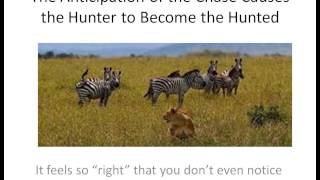
Basically what happens is your biology is just like this lion. Can you feel the excitement here? You can feel the surge. You can, you can feel the chase. They're about to get it on, man. Everybody's excited. The zebras are excited, the cats are excited. They're about ready to go, man. They're about ready to chase. They're going to get into the chase. It's kind of like my dog. I live out in a rural area outside of Charlotte, North Carolina and I have an 85 pound dog. And, and we've got deer and we have lots of deer. And you know, when my dog Buddy sees that deer, he's gone. There is no calling out his name. There's nothing that's going to stop him from chasing that deer for a while. Fortunately for Buddy, he does. He has figured out that once the deer gets in the woods, that that deer just hits in the higher gear and is gone. But the truth is, my dog is built to chase.
There are some of you as traders, built to chase. If you are built to chase, you have two options. You are going to either need to get out of trading or you're going to need to deconstruct the belief system around chasing because chasing will suck capital out of you. Over time, you may win one or two and it makes you feel really good and it pulls an addiction off and stuff like that. And you keep doing the same dang Thing over and over again and you keep telling the stories. Yeah, man, I took my account up. I took it at 50% in three months, man. It was great, man. And then you talk to them later and, well, I'm having to go back to work now and stuff like that. I've blown out another account. That what I want you to recognize. It feels so right. And that's exactly what you need to start learning how to observe that. When you feel that it's just right, most likely it's dead wrong for you. It's dangerous. The excitement's there. If you're going to learn how to disrupt this stuff, you're going to have to start becoming. You're gonna have to develop something called the observing self. You're gonna have to observe the physical body because the excitement has a pattern to it. Excitement has a whole piece to it. You can feel the tightness, you can feel it surging, you can feel it building. Instead of going with that, you need to disrupt it. You need to spot it first. In the same way that mental self, instead of just the physiological self arousing, you're going to start noticing the racing thoughts. You're going to start seeing that. Get in now. Get in now. Get in now. Get in now. That's the death. Until you recognize that your mind, until.
You have it properly trained for probability thinking rather than certainty thinking, chase thinking, it's a dangerous partner. And you have to wake up as an observing self and start recognizing, oh, my God, man, I have an untrained mind here. What in the world was I thinking? I need to reorganize the elements of this mind and create a different self that I bring to trading. How do you do that? First of all, when you do that, what you're looking for.
From these, from particularly these nine elements that I showed you, you're looking for the euphoria that jumping into stuff. Oh, won't it feel good to have all that money to fomo? Fear of missing out. Oh, my God, I can't let that trade. I can't let it. Oh, my God, it made a move. I need to get in. Or the boredom escape. Okay, those are the things you need to spot and say, oh, there's the problem right there. Boredom should be a symptom that is telling you that you have lost patience and there is something really wrong going on in your psychology. And you better correct it pretty soon because patience is the work of trading. More about that later. So how are you going to do it? Well, the first thing we have to Take the acceleration of this emotion that we've been talking about, this excitement going, oh boy, I'm going to get in that chase, I'm going to get. You need to be able to disrupt it, stop it. Because if you don't, it is going to continually hijack you. Emotional regulation skills is the fundamental level. And it starts with your breathing. It starts with the tension you keep in your body. It starts with your heart rate, your blood pressure and a lot of other things that you can spot, your excitement. What will happen when you're getting excited? You will notice that you stop breathing or you start breathing very high and very little in the top part of the chest. What you're doing is you're cutting off oxygen supply to the brain, ensuring that you cannot think. Okay. If you were doing diaphragmatic breathing, what you would be doing is you would be disrupting the ability of excitement or fear to take over the mind. The same with tension. If you start noticing your tension, it's very common when you look at traders or portfolio managers is they do not notice the tension. The first fists that start the gut, that's that rapid foot that starts shaking the pencils that start doing, they don't see the emotion beginning to accelerate until it's too late. If you can't catch the emotion in the arousal or the excitatory process, you're cooked.
You will get hijacked. That's the way it goes. So the first thing you're doing is emotional regulation. You're learning how to calm the emotion down. Because if you can't get down to the emotion, if you can't calm the emotion down, you never get to mine. Okay, then you're going to need to develop mindfulness. You're going to need to step the ability of stepping back out of yourself, out of your thoughts and recognizing that you and your thoughts, you and your beliefs are not the same. As a matter of fact, you are not having thoughts and beliefs, particularly when you've been sucked into the excitement over trading. They are having you. That's why at the end of it you're saying, what was I thinking? You weren't thinking. You were being had here. What we're doing is you begin to recognize in neurobiology, we consider the brain to be a community of rival emotional programs. They have duked it out and they have organized you into a particular self to survive in a particular environment under certain circumstances. And when you take that out, that you take yourself, the self out of that environment, you're going to recreate that Environment. That's exactly what over trading is. That's the brain having organized a community of rival programs in into a particular set of assumptions that you don't even know are there, they're having you.
The other part is when the brain becomes mine, when the mind emerges out of brain, suddenly those emotional programs are given voice in your mind as thoughts. And this is when it gets really tricky because suddenly you discover in mindfulness is that your mind actually is committee rival forces that are still duking it out. Some are highly destructive, some are highly constructive. But you've been asleep, no observer around.
And it's just willy nilly you have to wake up and decide, no, I need to reorganize this mind. If I want to be an effective trader, if I want to talk trading and if I want to talk about the fish that got away, all that kind of stuff stay with your mind. You got. But if you want to become an effective trader, you're going to go, you know something.
There'S at least one or two highly effective trader trainers in this room right now. And what I know is that both of them can tell me, Randy, I can trade them how to trade and I can trade, I can teach them how to trade, I can teach them everything I do that I make so much money on, but they still can't do it because they still get hijacked.
This is the thing that you're looking at, how do you do that? This is where the emotion has to get calmed down. You see the door of the mind, you open it and what you discover is over trading. If you're becoming the observer, over trading truly exposes the beliefs that you're bringing to the management of uncertainty and probability. And this is when you start realizing, oh my God, you know, I have just been absolutely mindless about the management of the mind that I'm bringing into a moment.
Mindless people don't make money trading, they give money to really good traders though. That's what happens. This is where you have to start observing.
All these hidden beliefs about needing to prove the self for all those people who need to make money now, needing to prove his demonstrating mattering and worth, and particularly feeling power. This is at the core of over trading. Until this is solved, you're going to continue over trading. There are no superficial fix, there is no external holy grail. There is no nlp. There is no hypnosis, there is no tapping, there is no easy way that just changes things. That a snappy finger.
Change is a process. It's not an event. You have to change a belief at the level of circuitry. Those assumptions we were talking about, about if you cannot separate your performance from your worth, then you have problems. You're not going to make it as a trader. And what we're really saying is in the same way you look at a grant glass, is it half full or is it half empty? Or if you're thinking from a probability mind, you're thinking, well, you know something, it has water in it. And the probability is it could be probability. It could be half full depending on somebody's drinking. It could be half full depending on people pouring into it. You begin to see the difference in mind.
Then with this really new tuned skill of yours that you learn and that, well, at least you learn it in my courses, okay? It's, it's, it's required. You begin to recognize that there is a internal struggle going on within you all the time, like these fencing guys. And the truth is, is this internal struggle is literally what over trading is all about. You can hear it, man. You know, the thing is. Get in, get in, get in. No, no, no, Mike. Get in, get in, get in. And then after you really blow it. You idiot. You idiot. Freaking idiot. What? What could. That's the internal struggle, friends, okay? That is the mind of ineffective trader.
And.
As you begin to develop the ability observing the forces in the mind, what you realize, is there an inner critic in the mind that is out for your destruction? And it will tempt you. That's what the over trading thing is about. It will lie to you, it will deceive you. You know, the Chinese called it the Yin Yang, the destructive and the constructive simultaneously happening. And what most people do is they turn away from the destructive parts of themselves so they don't see them, thereby giving those destructive parts of themselves enormous power to influence your performances. They have you locked on outcome goals when you really have to be in the performance goals, okay, this is where you have to find this. And it's not comfortable, you have to turn toward it. Once you get this, then what happens is you're going to have to learn how to produce what I call the internal hero within the cell. In the same way that there is critical nature living within you, judgment living within you. The critical, that critical voice, that inner critic. And there is also fear. Okay, God almighty, if I keep blowing this stuff up, what is my spouse going to think? Oh my God, I'm going to run out of capital here. What I'm going to do? That fear after all the excitement's gone.
By. The way this is an image of Rosa Parks, sweet little, sweet little lady, Montgomery, Alabama. And one day she chose to not sit in the colored section of the bus, but chose to sit in the white only section of the bus. And it created the whole huge thing that we call the civil rights movement in the United States. Rosa Parks was a sweet, kind help around the house that found an enormous internal strength living within her. It doesn't have to be like Conan the Barbarian, it doesn't have to be Jean Luc Picard. It can be something so simple as a frightened woman finding the power living within her to stand.
This is the thing is that in my work I use something called memory restricting to get at the discipline program, the ability to maintain order under pressure. Archetypally that's called ruler. I use the same technique to find the ability to protect the self, to stand, to stand tall, to basically guard the boundaries of the kingdom. That's the warrior, that's courage. And then I also very importantly use the same memory restructuring of an image to find what it's like to self soothe. Nobody has ever become a better trader by beating the self up. The ones who finally get at it realize that this is, there's a lot of suffering in this internal struggle. And what you need is, you need self soothing, you need nurture. Otherwise this fearful part of yourself that I call orphan simply digs deeper and becomes more dangerous to your long term performance health. Okay, so this henoric nature is, it's, you know, the thing, it's there, it's in the programs in the brain, it's in the voices in the mind, if you know where to look.
And this is the, the mind that is prepared to manage uncertainty, manage probability comes out of this disciplined impartiality. When the fear is calmed down.
By self compassion and the inner critic's criticism and taunting is confronted by the internal warrior. Suddenly this discipline, this ruler, this impartiality, this sage can trade in probabilities, the higher brain function and over time the amygdala, the orphan begins to actually trust higher brain function to manage long term benefit rather than orphan short term survival. That's the big deal, friends. This can be done. And what ultimately you end up in is this.
You learn the practice of patience. You discover that patience is an enormous powerful warrior skill. And what happens is that it gives a humble confidence.
And this is the new mind, this is how you develop the new mind. Suddenly what happens is you realize there's always going to be pressure. You can't ignore it. What you do is you turn toward that fear, you calm it down, and then you pull forward into working awareness, the discipline, impartiality that allows you to operate under pressure without going bonkers and without your mind being seduced by all this heavy duty money that you're about to make.
Okay? The problem is this. It's like raw talent. You've got the raw talent, you have the knowledge, but it has to be developed into a usable skill. Okay? Discipline, courage, patience and impartiality are neural programs in the brain that take on voice as thought in the mind that you can learn, you can be taught how to approach uncertainty from them, and your performances improve dramatically. And suddenly, when you actually do come to this moment where you are no longer trying to be in control of outcome, you realize that was an illusion anyway. You can't control the markets.
You know, you can't do that. They're so far beyond you that you have no control of that at all. Once you accept that, you find out something. What I can control is the mind that I'm bringing into the performance of the moment.
That's the zone. That's the flow.
No promises spoken to soon, no promise of outcome. But what happens in this flow state, you're controlling the process. And if you do that, your methodology is going to give you an edge that extracts capital out of the markets. That's the way it works. This is the missing edge. It's not out there. It's not in your methodology. It's in your methodology, your platform and your psychology acting as a unit. This is the zone. This is flow. Then I want to take this thing. You know, we all think that, you know, you've got to be doing something. Be doing something. You got to make things happen.
Most people don't really know the habits of the cougar. He's a North American apex predator and they hunt very differently. A little earlier, we showed you a picture of lions stalking zebra. Everybody's getting excited and lions get hurt a lot, okay? And you can see him really working, working, working, doing things, chasing, chasing, chasing. I like that.
The photograph of the cougar on the left, what do you think he's doing up in that tree?
He's hunting.
He knows where the white tailed deer is going to come. He knows the setup. He's waiting. He's very patiently waiting. Patience, patience, patience, patience, patience.
Yeah. And by the way, that's where he spends, well, 95% of his time, okay? Patiently waiting for the deer to show up in the trap. Remember, he's an ambush predator, okay? The Same way as you. He's, he's got a setup. He knows the habit. He has probability on his side. He's waiting for it to occur. And I have one trader who has this mantra that she, as she pets a statue of a cougar, it's patience, patience, patience as she's breathing, strike.
Okay? That's the power. So the key is, what I want you to see is patience.
Is about the work of trading. Nobody looks at a cougar, striking and thinks that he's not an apex predator. It's a big cat and it's a, it's a dangerous cat. And yet at the same time, people don't know his habits. He's not fierce. He waits. He waits. Okay, that's, that's what you need to develop into the patience of a cold blooded killer. Okay, he's just doing business, man.
What have we talked about here? What we've talked about is a process. We've seen the problem and then we've walked through a process.
Of profound change that allows you to be able to design the mind that you're bringing to the moment of performance and trading rather than using the one that you came equipped with default programming, which by this time I hope you've discovered is not working. You know your trading account is going to tell you whether or not it's working or not. And it's your decision about how much capital you're going to shell into your trading account to learn what does work in trading as a mindset to complement methodology and platform. What we've learned here is the first fundamental thing is once you got the problem and once we get these, all these assumptions that are just absolutely screwing with my mind, that that's in performance, you learn emotional regulation. You cool the emotion down. Until you do that, you never get to mine. When you do that, you develop mindfulness, stepping back out of thought and beginning to recognize, oh my God, I am not these thought, that's not me. What you realize is that the I that Descartes was wrong. He said, I think, therefore I am. He recanted that. Okay, The Buddhists have a much more interesting way of saying it. I am. Yes.
But who is this I? Okay, that's the real question. What I is showing up in the performance. It doesn't need to be the I who's thinking about making a lot of money. It needs to be the I in the performance of the moment execution. Then once you develop that awareness that mindfulness, what you want to do is you want to become aware of this Conversation that you've been avoiding. You know, instead of shocking yourself, you're turning toward that discomfort and you're discovering the inner critic and the orphan, the fear living within you. Then you're using the same mindfulness tool to find the strength that Rosa park was demonstrating when she got on that bus that day. Or you did an athletic performance, or you went through a struggle that, you know, the outcome was uncertain. You didn't know and you were scared, but you pushed through it. You ended up on the other side. I'm sure that Rosa Parks was scared that day when she got on that bus. You awaken these heroic traits, the discipline, the courage, the patience.
Impartiality, and you bring them into working awareness. You bring them into the committee of the mind. Then that's not enough, though. You become intentional. You decide, you know something, I'm just not going to go into my trading room with any old mind that just happened to wake up with. No, I'm going to intentionally build the mind the same way that a great hitter has a routine, has a process he goes through to get into the mind that hits the 100 mile an hour fastball the same way that any athlete, any performance person gets into a mine at the, at the peak performance arena. That's what you have to do. You just can't, you just can't show up there. This is how you do it, friends. And if you want to go, okay, I, I, Randy, you know something? I'm listening to you and I'm getting it. You know, I do want to truly overcome my over trading. And I realize that the truth is, is I've blown a lot of capital. I've wasted a lot of time trying to do it myself. I'm beginning to see that I need help. I'm beginning to see that left my own devices. I fall back in this trap over and over again. And I have the blown accounts to prove it. I have the losses to prove it. Well, what would it be like to develop a new way of hunting patiently? Okay, well, if you're there, we've got some options. The first is we have an individual program, we call it the Ignite the spark program, where literally you see me 10 times over a period of three, four months. And we have an entire comprehensive personalized program that we work through and I walk you through, particularly when it comes down to the micromanagement of that impulse, getting it under management. We walk through it. It's a powerful program, very powerful. We have a group program coming up in September. It teaches the same basic Skills not as elaborated as the, as the Ignite one. And it's highly, it's a highly. You know, you go over the same basic skills, it works over 10 weeks, it works from a virtual classroom. Whereas the ignite program, you get, you own the materials and you get five group sessions with me where we're going over this and we go over learning how to do emotional regulation. We train on mindfulness, we train on the internal dialogue, we train on awakening the heroic nature, we train on intentionality. And then you actually write a trading plan powerful course that is also done as a self study. Okay. So that if you don't want to. If you don't want to have other human beings or if you've got really wacky time zones and things like that.
Possible. So here's the invitation for those of you who really want to make change in your life and you recognize that you're going to have to become the change and you need some help to do it. If you're at that place, ask for a free consult saying you know something. I know that, Randy, what you're saying makes sense. I want to talk about it. Then go to our website.
Hit contact us and Dolores will set up a time that you and I can speak on Skype. And the thing is, is that I would encourage you first go to my website if you don't know me, get my free ebook. Okay. Then read the articles, see the videos. There's lots of. It's a. It's lots and lots of material. Lots of free material to explore. And then if you can have a free consult with me, read my book, it'll help you a lot. You will get. You will be more prepared for your time with me than if you just kind of show up one day and kind of want to know, want to talk trading because I'm going to want to talk. What's stopping you from being the trader you can be? So with that, I want to thank you for being here. And if you have questions, please type them in and we'll take some. We've got some comments. We'll start with those.
If they're nice.
This is from Max. I've been. As I've looked at this issue, it seems that difference between over trading and simply trading more often and it is entirely contingent upon.
Being able to simply discern each and every opportunity. I, I am grateful that this does not affect me as much.
As near as it used to. But I do have to keep tabs on it. Absolutely. No matter what you do, you will have to Keep tabs on it. Because if you don't keep tabs on it, it will come back in and the potentiality is always there. Okay, so.
It may be that I've been so good that I have answered all questions.
Another comment. Okay. Last training education I attended, students were taught to be money making machine and hence desire to make money. Now. Grew up. Good luck. I did that work. Grew up. I know a lot of people who, you know, like I said, this is really, I'll give you an example is that when you look at an Olympic athlete and you're looking at him perform, you're not looking at him wanting to win the race. What you're doing is you're seeing him performing and executing his method. At the end of it, you can go back to your outcome goals, but in the moment of performance, you're not thinking outcome at all. You're thinking performance. This is Deborah.
What if it's over? Trading based on trades that do meet my criterion. I find I start to dip too far down into cash just because the cash is there and the right setups are there. But this risking too much of the account. Well, you know, it's really interesting, you do have an interesting problem because a professional trader with an adequately funded account is going to need to take about 80% of the viable setups that come his way because they, they need to do that to produce the probabilities on their side. What I'm hearing you say for your account size that you can't, you can't do that. So what you're going to have to do is you're going to have to, you're going to have to rethink how many setups, how many trades you take in any one particular day. And you're gonna have to start from the beginning because what I'm hearing is, you know, people, people with fairly small account size have a very difficult time playing probabilities and just letting it run. They, they, they, you have to put some rules, you have to put some stuff around it. Okay, Your book is the ebook. No, there, there's, there are two different things, okay? There is a free ebook. If you go to my, if you go to the website, you'll say, get the free ebook, okay? And it is a compilation of about four years of my articles. It's 160, 70 pages long. People use it like a textbook all the time to read and stuff like that. My book is Mindful Trading, Mastering your Emotions and the Inner Game. That's not a free ebook. But what happens is Interestingly, I just had one bought by the Central bank of Malta and it's being sent to Malta. But the key is that is a book that is built around the way traders see their world. And what I do is I take traders who initially do not understand why they're bull in the china shops and blowing things up and I take them through progression of learning the skill sets that I teach toward the end where they are now in control of the mind they're bringing in to manage uncertainty. It's a powerful book. Okay.
Here'S Rick. Do you trade or have a moment to moment peak experience endeavor you speak from or is your specialty a theoretician coach? I do not trade. Okay. And the truth is is I started working with traders because they started coming to me. I was a peak performance coach in a lot of other areas and a therapist by training. And what happens is they kept coming to me and I found it very fascinating because what I had with traders was a black and white truth meter, the account that allowed us to see what assumptions and what beliefs were actually acting at the base. That's how I started. I have a fairly significant meditation practice. I have a very significant.
Mindfulness practice that I use and that I practice. The literally what I would call the archetypes that show up and speak to you right now are coming from a very specific place. It's a very intentional mind. And so from a theory standpoint, I guess I do teach theory and stuff like that. But most people who get to know me realize that I'm more about practice. I could really care less about whether or not you could do something in a yoga studio or whether or not you can do it in classroom. I am very interested is, can you perform in the environment that you're going to be operating in? If that answers your question. Good. So we have another one.
Barb, do you think overtrading psychology is better control in longer term trading over short term day trading? It can. What happens is the same kind of crap happens is that when you look at a swing trader, they're always still analyzing and analyzing and analyzing. The jumping in and out and stuff like that. They're still over trading. Okay. So the timeframe is not the big thing. If you have an impulse disorder, okay, scalping is probably the worst thing in the world you can do and day trading is a lot closer. But the major thing is over trading is it's impulse control. And what you're looking to do is and particularly in and around money because money is going to reveal your beliefs about your ability to manage uncertainty like I can't. It's unbelievable. What you're looking for, either short term or longer term. What you're looking for is can you manage or are you just simply avoiding the discomfort of the belief system lying behind the urged him to be impulsive. That's really the key. Okay, whether or not you're scalping, day trading or swing trading or active investing, here's Keith. Is it over trading when you take every signal your system is giving you depending on if the signal is hitting your plans? We have a very fine trader trainer in here today, David Dubuis, who, who would be, in terms of the signals that he would teach his students to use and stuff like that. You know, if you're getting the right signals and it's a go if it meets your criterion and if your account size, you know, your account, you know, you, you're not going to be risking, there's a small percentage of the account that you're actually risking at any time. And like the woman was talking about a little earlier, she takes these trades. But the thing is, is by the time she accumulates the number of trades within a day, she often gets past the kind of risk that's tolerable for her account size. And the same way here is that if you're taking signals and if that signal says and it meets criterion, then yeah, you know, if you're a professional trader, you're going to be taking that, but a professional trader is going to have, you know, they're going to have a sized account that's going to be able to absorb the volume of trading they're doing at the risk level they're working with. Okay.
Okay, we've got time for one, maybe two more. Yeah.
Is it over trading when you trade too many hours in one trading session? Most likely, Most likely. The, the thing is, what most traders discover is that less is more, is that, you know, ultimately when you.
The way your physiology works, when I'm working with a trader we're looking, what I'm recognizing is that their, their brain cycle, that glucose that fuels the brain when you're thinking like with the order that happens in trading is that you're draining the fuel tank and your brain of glucose very rapidly. And most people actually need to be taking 30 to 45 minutes breaks continually. They're there and they need to be taking a good sized break like at lunch so that they can recoup and they're doing something other than left brain activities. So if you're, if you're Just trading and trading and trading. Most likely you are in fact over trading most people. Like for instance, in day trading, when you start approaching more than five trades a day, that's a lot of trading. Okay. Now, scalper might be taking more than that, but when you start seeing, you have to start asking, why am I trading so much? Okay. And you start asking yourself, is it. Is that. What are you trying to accomplish? And particularly if you're losing money, why are you trading?
So my view is you. You're asking a question that I don't know you. I don't know your style of trading. I do know most of the traders I work with really end up trading a lot less, but far more effectively. And they conserve their energy and they. They don't think they have to be doing something to be doing something, which is what I hear you're doing. But I don't know. I don't know you. This is max. When it comes to the having the internal observer or developing the internal observer per se, Would you suggest.
Would you suggest that incorporating aspect of Zen meditation practices to help create the internal observer? Specifically, do you suppose that just because one develops the internal observer that they may be positioned more favorably to be a consistently winning trader? Yeah, I do. Is my internal observer is modeled after Zen notion of mindfulness. I take it one step further though, is that in Zen, what you're doing is you're becoming witness to the rising of thought out of nothing, having a life, and then going back to nothing. I'm interested in. I know that thought has an emotional charge because I know it comes from an emotional program. So I'm interested in the emotional program that it's coming from. Okay. And I'm actively teaching a person to manage the emotional programs that are producing the thinking in the brain. So I start with a mindfulness meditation, very strong in my teachings. Okay. But what happens is I take it and turn it on its head. But as you start producing the amount of calmness and you're no longer fusing to thought, which is what Zen meditation teach you, is that you literally are teaching yourself to step back out of thought. And then when you start seeing yourself that you have fused into thought, you're stepping back out of thought. And all of a sudden what you'll find is that you're able to emotionally regulate your in calmer states. What I find in trading is that the mindfulness meditations are very useful, but at the same time, what you have to get at are the beliefs and assumptions that are driving the performance. Okay. And that's something that I have not found Zen meditation to be very useful for. Okay. And I am a practicer of Zen meditation, so it's not like I'm not trying to poo poo it, but at the same time, I'm at a moment where I realize you've got to get down at the core, core of the neurology of the belief. Okay? You can watch all the thought and then all that you want, and then it can be hijacked. But if you understand where it's coming from and you understand the structure of the belief, then you've got real power to change. Two more questions, folks. How your student traders have performed after taking a course. I get a lot of compliments.
I can give you a list of people. There are. There are various students right now, former students.
In this webinar.
You go to my website, there will be lots of stuff. And if you want references, I'll be happy to give you them. They're fine. What I've discovered in my own stuff is that, particularly with my individual clients is that I have a rate of about 60% of having powerful change in performance.
And I would like to think it would be higher, but I basically discovered is that I know that people. There were people who have paid me $3,500 and never showed up for the first class, and they will not return emails, so I can't even return the money. I have people who just kind of blow off the course. I have people who start the course and life gets in the way. And I have. I have some people that would have obsessive compulsive tendencies. I would have people who are bipolar, who have. Who have no business trading. But I. And I'm. The 60% is. I've come to recognize that.
That'S a good benchmark. And. Last question. I'm comfortable with it. Last question. Okay, Randy, from Jim. It's from Jim. What's the key technique you use to change an unconscious belief? How does that process impact convincing the amygdala to trust the neocortex? That's a good question, and it's a loaded question. Is that when I hear your question, I get that you want some technique, some magic wand like NLP or hocus pocus that changes a core belief. I just simply haven't found. I am a product of the human potential movement, and I have done a lot of stuff like that. And what I've basically discovered is that.
The technique I teach is you turn toward the discomfort and you begin to honor the struggle that that orphan nature of yours went through to create the response self that is there. And it is through compassion and through discipline that you rementor that part of yourself. A lot of people would call that arrested adolescence. And what you're doing is you're learning how to deconstruct that and to reconstruct it into higher functioning. And I haven't really found technique.
I haven't found any magic wand that works. I have, I used to do cathartic work where people would have these powerful experiences and they would cathartic and they would say, ran, I am changed, I am wondering. Everything's fine. And two weeks later they were in the same ditch. They were in the same pattern again. It's the catharsis doesn't work long term. It feels good.
I hold that there is mindfulness, there is the ability of pulling forward these emotional programs and beginning to operate out of higher brain function. And you practice that, you maintain a practice of that. That's what I do. I maintain a practice of what mind I am going to bring into a particular moment. And I, I. And what I hate it is when I fall out of that and I, I show up in a mind that has no business being there. But so there's no special technique there. There is getting to know.
Getting to know the self on a much more profound level and truly rementoring the emotional brain.
The recording will be on YouTube tomorrow, probably afternoon. Yeah, yeah. Over trading and Randy Howe will do it and, and it will be out there tomorrow afternoon because it has to render tonight and then I have to, I have to get it uploaded and blah blah, blah, blah blah blah. Okay, but it'll be out there and with 50 other videos by me. But anyway, I want to thank each and every one of you for coming. I really liked your questions. I like most of your questions. I also like the ones that I like, the ones particularly about technique because as many techniques as I do at the same time, what I recognize this is not a technique driven thing. You're not going to change the mind based on technique. And I'll give you one last story is I work with a very good trader at times who is a feast and famine trader. And we've done it, we did a lot of work together. He really stabilized himself. And you know what happens? He got into tapping and said tapping is, you know. And ultimately I look at tapping and going. What it's good for is disrupting a pattern. Okay in the moment. But the problem is it doesn't change the pattern.
No amount of affirmations. No amount of visualizations is going to change a pattern rooted in belief.
The body's more clever than that. It's more resistant to change than that, and it takes more effort than that. At least that's what I found in my time. And I've worked with anywhere from violent prisoners doing anger management to 10 years with Atwith youth and traders, you know, And I've discovered that change is not fast. Permanent, lasting change is not fast. You know what happens. It's a process. And you finally get to the moment where you learn how to drive a different car. Okay, so, friends, I thank you for your time, and I wish you well. Great prosperity. If I can help you, it would be great. Okay, but get the free book, whatever you do, and take a look at the stuff. Got it. Thank you. Thank you very much.









