Breaking Through the Invisible Barriers to Your Trading Success
Webinar transcript of Randy Howell (Traders State of Mind) explaining psychological barriers that undermine trading performance. Howell describes how instinctual limbic responses (fear, FOMO, greed, boredom/alpha-driven overtrading) create habitual, automatic reactions at entry, order-fill, and when trades go against the trader, and outlines an emotional-intelligence training approach (emotional regulation, diaphragmatic breathing, mindfulness, internal-dialogue mastery) as remediation.
Chapters
The broadcast is now starting. All attendees are in listen only mode.
Welcome everyone. My name is Randy Howell with Traders State of Mind and I am delighted to have you here. And we're going to be looking today at what those invisible barriers are that you just keep tripping over. It's like almost stepping into a trap. But before we do that, let's just find out if you guys can hear me. If some kind souls would please just type in a Y into the question box, it would allow Dolores and I to know that. Yep. Okay, we're good. We're good. Well, the only other real rule here is, and I hold questions toward the end on my, these webinars. That doesn't mean that you can't write a question into the question box because I would really love to have them instead of having all that awkward stuff I need to write a question in. So as we come along and as you start hearing this and you have questions spring forward into your mind, write them down. It'll allow us to get started quickly on the, on the Q and A. So how about it? Anyway, let's get started, folks. Let's get started. This is, I love this concept. I love the way that this, this is like something that a trader, until they really begin to get, get just how psychological the trading mind really is, is that they don't recognize. You have to really learn how to spot these invisible barriers that are deterring your trading success. And they will do it. It's like you just step into the same thing over and over and over again and you just, you don't even know it. You go, well, what just happened? Have you ever had that happen? It's kind of like this is that.
Most of us have seen some Charlie Browns. And I'm going to show you something. This is one of the most famous of all the scenes is that Charlie Brown constantly is doing this thing where Lucy brings him in to where he's going to kick the ball and do the extra point. And yet again, I mean, at least for like 50, 60, 70 years, she would always pull the ball right to the last and he would, he would tumble, but he kept doing it.
So when we're looking at these invisible barriers, we're really saying the way you would actually know they're there is because you still keep doing the same thing over and over again, trying harder, trying harder, doing this, doing that, getting new teachers, getting new, getting all new stuff. And yet the pattern remains. The pattern remains because ultimately that's what we're talking about. When you see something Going over and over and over again, happening over and over again. It is an habituation, it is a pattern. It's an emotionally based pattern that's firing right underneath your nose, but you don't have the eyes to see.
You know better. And you intellectually, you say, I know I'm not supposed to do that, but why do I keep doing it? I have plenty of, plenty of knowledge. I have plenty of knowledge about trading. The problem is, is when I'm in, when I'm really under the gun and there's real money there, I have a very difficult time maintaining order. The mind that engages, I can no longer follow my rules. I don't know what happens. But when the smoke clears, it's not a very pretty sight. What I want to do is I want to go through these and I want to start reframing some of these very common traits of bad trading so that we got to get a more of an idea. It's not really your fault, but what happens, you don't understand your biology. You don't have a grasp of the emotional intelligence that a really good traders can have to have. So let's take a look at this. So what we're looking at is there is a powerful moment.
Where.
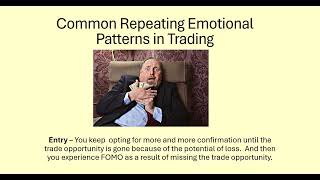
You know, have you ever did an entry? A lot of people have entry problems, and it occurs at various places. Some people are absolutely right and ready to go up into the moment where the trade starts really warming up. It's just not, ah, there, okay, I'm looking at it. But no, when it really starts hitting, it starts hitting your conditions and you're going, you know, some wait, this is getting to be a real viable option. And at the same time, what happens is that.
When you go to the point where you realize, I'm about to risk capital.
Your limbic system, your caveman brain, doesn't see that risking as capital as a good thing. It's looking at that as like, you could lose. And you know, and suddenly that limbic system, that caveman brain of yours is going, how do I protect this money? And if it can stop you from getting into the trade.
That'S a victory. Short term success, survival. You lived, and you bypass the problem. Now you look at that and go, why is this? Why is it so hard for me to risk capital when I know that's what I'm supposed to do? Your emotional brain, that mammalian brain you have, that caveman brain you have, does not understand money.
What caveman understands or cave woman understands is life and death. And when you are risking capital, it doesn't see it as money. I mean, if you gave a boatload of money to a caveman, he wouldn't know what to do with it. But.
If you put a significant threat in front of him, suddenly what you discover is he has a sense of powerlessness, of helplessness. And it just so happens that capital is safety, capital is power.
It is making things happen your way, all that stuff. And all of a sudden you start realizing is that caveman sees money very differently than you. And ultimately, what you're doing is you are actually. You are actually trading your beliefs about your ability to manage yourself and maintain sobriety, emotional sobriety, when risking capital to the caveman, risking life. So, entry. And by the way, it's not just when the trade warms up. I know people who. They get up out of bed already in dread. By the time they get to the trading room, they're just. They're elevated. And they have a hard time even turning their machines on, much less populating their charts, okay? So you're looking at it going, where does that happen? And I want you to notice this is a repeating pattern. It is a repeating pattern, okay? And that's the key. If it's a repeating pattern, what you're looking at is emotions have organized a habitual response to what it sees as either an opportunity over trading or as something dangerous, having your money taken from you, like a loss. So the first place is at entry. Do you have a problem pulling the trigger? Okay, that's. And what is the pattern that just keeps happening over and over again? That's the very first thing that I want you to really begin to see is, okay, we've been talking about fear of pulling the trigger, but at the same time, what is actually that? What does that mean? Let's look at it a little bit deeper and go, okay, what happens is that is when I am beginning to experience the potential loss, but not of money to the caveman, but of my life. Okay? Of my life. So there's entry, but let's go there and go fomo. Well, let's just say that you're in the same position where you didn't get into the trade a couple of them because you wanted more confirmation. More confirmation. And the trade got away from you. And those. Those trades just took off and they just did magnificent things. And all of a sudden you go, oh, what have I lost? What about, oh, why didn't I get in? Oh, you fucking. The fear of missing out. At the same time, what happens is now we have something of where you've had that situation of going, okay, I don't want, I don't want to lose. I don't want to lose. Oh, it got away from me. Oh, it got away from. Now you're going, oh, my God, I got it. I got to get that money. I got to make it happen. And all of a sudden, another emotion. Is that lust or greed? I like lust as a better way of looking at it. You've got to get in. You've got to get in, you've got to get in, you've got to make that money. And all of a sudden what you see is that the emotions of the brain have been polluted by the lust and you no longer are capable of really trading with the mind. And again, what I want you to see is the connection between the pattern of missing entry points and then the pattern that's connected to it of fomo. And it's still about fear. Sometimes it's about fear of missing out. But what happens is that you can also just have that fear sitting there and you're realizing, you know something. If it's not fear of missing out, I could have, you know, if I were there, I would have fear of, oh, my God, what happens if the saber tooth tiger grabs me? Look at the pattern. Is this something that habitually happens with you? Because ultimately, if it is, it's something that the limbic brain has organized in looking for a solution, okay? And it finds a solution, it works, then it locks in. When it locks in, you no longer building a pattern, the patterns creating your circumstances. So now we're going, okay, I'm hoping that you're getting, is that you can put a label like this on it. But the thing is, is then chasing trades from boredom, okay? Or aggression. Practically every alpha I know who has been really successful, successful in other businesses and other ventures, comes into trading and thinks quite understandably, that I'm just going to apply the success skills that I developed to produce wealth in the other world. And I'm just going to apply that to trading. I'm going to, I'm going to win. I'm going to be a winner. You know, I hate losing. That's why I win. And the alpha, when you really get to it, the alpha is really what happens is he has to win to keep feeling like he matters. So now you're looking at it going, okay, a good alpha will sit there, he'll sit down and he'll be watching things. He brings the screens up, his mind might be right, and there's nothing going on. Which is a big thing. Big thing that happens in trading is it's just sitting there, honey. His own business. He starts doing some email, he starts doing some other stuff, makes some calls. And then, you know, what happens is, you know, I just think, I'll go check. I'm gonna go check another market just to. Just out of my curiosity, then he gets there, and before you know it, he sees something. And his need to jump into trade, his need to make something happen, so valuable in entrepreneurship and leadership in other areas, comes to haunt him. He wants to make something happen. He's bored. He sees an opportunity. It's not in his trading plan, but he jumps in it anyway. He wants to make the money. He wants to have action. He likes that thrill of the chase. Okay, and all of a sudden.
What do you think happens? That when you start chasing that and over trading, you start losing, which sets you up for a desire to guess what make up for prior losses. So.
But first, this is actually at order fill. I consider to be the most.
Worst of everything of how traders build their minds. This is the worst managed moment. Up into the moment of order fill, you've really been an offensive coordinator in American football. You're looking to exploit opportunity. But at the moment when you place that order and the distance between placing that order and order fill, there is a moment. It may be a nanosecond, but there's a moment of. Of where you are no longer an offensive coordinator in football. Exploiting, looking for opportunity to exploit. You are a defensive coordinator, and you don't mind taking small losses, okay? But you don't want to give up the big one. And so the psychology suddenly shifts, and yet very few people take that moment, reorganize the mind, getting it ready to manage trade, okay? And then when they get in and that trade goes against them, they're unprepared for it, and they are blown away. And if they, you know, that trade comes in and it starts, you know, it starts really wicking on them, and at the same time, you're going, okay, but where. Where did this happen? The pattern is that the mine wasn't ready at order fill. Okay, so now we're going, oh, I'm beginning. I'm hoping you're beginning to see that these are habitual patterns that are rooted in our emotional nature, our emotions. From my standpoint, emotions are a biological action potential. It's about action. It's not about thought. That is all about coordinating activity between the markets, the jungle, and the trader, the organism. And when you see. When you start going out there and then that trade goes against you.
Right then to the caveman brain that is the saber tooth tiger beginning to stalk you. Okay. And what happens is the trades going against you. And all of a sudden you're swinging. Oh my God. Oh my God, I'm losing. A lose, I'm out. I'm losing, I'm losing. And the thing is, is that when you decide that I'm losing, the, the brain, the limbic system is thinking about a biological threat to your existence. It's not thinking about the paper stuff coming out or what's coming out of the bank. That's not it at all. And this is the part, unfortunately, the thinking brain can't see, doesn't see what's right in front of his face. But this is the trade going against you. Oh my God. Well, what do you think it's going to do? It's going to. If it stays within the range, you should be, you should be happy. It starts approaching that stop. Oh boy, everything starts going down. But I want you to see the pattern you have when the trade starts going against you. That's when you either start really getting, having fear. Oh my God. How do I start? I'm going to. I'm going to, you know something, I need to, I need to use my stop. You know, I need to, I need to. You're no longer in your trading plan. You're actually at this particular time in fear. And it's teaching you. I can't let it go. I can't let. Basically, to the caveman brain, a saber toothed tiger is rapidly approaching you at that moment and you look like a tasty dinner. Okay. A loss is devastating. Then what if you take the loss? Okay, you've taken the loss. Oh, the shame of it all. Oh my God, I blew it again. I took a loss, I took a. I've got to get that money back. Oh my God, I'm scared to get in the trade. I want you to see how the pattern evolves. And all of a sudden that you start taking that loss and you take that loss as personal, you know, you take that as who you are about your competency, about your mattering, about your worth, about your belonging, about your sense of being lovable. Yeah. All of a sudden you're not the person you need to be. And oh my God, people are going to find out. So what you're doing is. Here you go, you're going, you know, and what's so weird is it really excellent traders have to become expert losers.
To Hate losing. You're in the wrong game if you're going to be a successful trader. So we've taken this thing up and then let's take the opposite angle for a moment. Let's just say you've gotten some wins under your belt, okay? And all of a sudden what happens is, whoa, what could be wrong with winning? It's one of the most dangerous things in the world that can happen in trading, particularly early on, because when you win you get a, you get a rush of dopamine, reward chemical. And all of a sudden what happens is that reward chemical is what forces the habit to really get glued.
And all of a sudden you have a neural pathway set up and now it's myelinating, it's in insulating so it, it's really hot, it's really fast, okay. And can take over mine. So I actually was in China one time teaching and I was in an auditorium with about 200 people and this is at a giant fund, okay. And I had made the statement that you're not allowed to feel good while you trade, while you risk capital. And a guy looked at me, spoke very good English and he says, but I like feeling good. And I said, you, you can feel good, just not when you trade. You know, after you win, go take a break, you know, always celebrate. But when you come back, you're back into disciplined impartiality. He said, but I like it. And it's, it's done me well, of course, understand at this time China had been on a bull run for about 50 years and you know, just throwing darts was going to produce winners. So here he was two days later, I'm still there. What happens is There is a 2% correction in the Shanghai. And all of a sudden he blew it up. And he actually had the humility to come to me and said, Mr. Howell, I now see what you mean. I look at that and I realized that all the signs were there, that I should have gotten liquid. And.
I ended up doing some really stupid things because I felt good and it felt good doing that. I thought I was going to win. So now you're beginning to see these patterns that just keep, they're just, they're always there and they're so human novice. They're not you, they're human novice. These are, these are traits that were very useful in our younger days when there were really lions, tigers and bears that thought we were pretty interesting critters to consume. And you know, out of that we built short term strategies for living. And it just so Happens that we don't live in that jungle anymore, we live in a different kind of environment. That those particular traits that now have wired into literally transmittable patterns across time, they grab you. It's called evolutionary psychology at that particular time. It's not just what you learn in your family and your culture, it's what you brought forward from ancient times. So now you've taken a look at these and what we want to do is say what's really behind the emotional pattern. And Horace.
We lost the slide.
There it is. Thank you so much. If you want to know what your emotional brain feels like when taking a loss or risking capital, here it is. Now you think about it. Here's this guy and here's this, here's this saber tooth that's, oh, I don't know, about 1400 pounds. And you know, in truth, he would have had a spear, he wouldn't have had a knife because we hadn't hit the, we hadn't hit the iron age yet. We hadn't really, we didn't really have the kind of cool things. But what happens is he's, he's on high alert, friends. The chance of him making it out of this particular situation is pretty daunting. So what I want you to start noticing is fear based patterns. They are lightning fast. Once the habit has been embedded into neural circuitry, it is going to fire at the moment of threat and it is going to be in your bloodstream in nanoseconds. Now.
In a real life situation, what happens is that the information coming in from your senses is already reacting to the emotional pattern and firing and you're in la la land. But if that information does go to your thinking brain, which is what you want, it's going to take a quarter of a second. Do you see the difference here? It's that on one end, the instinctual stuff that happens without you knowing it is in the bloodstream in nanoseconds. And by the way, when you feel an emotion, it's in the bloodstream and that's the subjective experience of the emotion. If you've ever had a pit in your stomach or if you've ever felt like on fire, you know the feeling. So then the brain has to be able to figure out, well, now I have to think about it. Well, if you did that, you'd be dead. This is why instincts are so powerful and this is why you're looking at a scene from our ancient primordial history. And it's playing out in trading time. That's why the thinking Brain does not see this. It is so automatic, it is so familiar, it is so instinctual that unless you trained yourself to see it, you wouldn't see it when you had a chance to do something about it. So now.
What'S behind it? We begin to see this is all about threat or opportunity. Okay, Right now you're looking at a threat, and in a few minutes we're going to be looking at opportunity and the way that it can kind of blow out a perfectly good trading mind too. And again, what I want you to get is that these things are on automatic. It doesn't even pass by the thinking brain. It happens. It happens. It basically what happens, the sensorial information comes in and it stops at a place in the thalamus. And the thalamus is kind of like a traffic cop at a busy intersection moving traffic through. And when an emergency vehicle comes through, what he'll do is he'll stop all the other traffic. He'll stop thinking and allow the emergency to come through. That. That's what happens. That's why you don't grasp it. And without training, you're just not going to keep doing the same thing over and over again and work through it. You're going to traumatize yourself. Re traumatize yourself. Re traumatize yourself so that you have a reactive pattern that takes you out. That's what happens when you have lost a lot of money. That's what happens is all of a sudden reactive pattern, something like PTSD type stuff happens. And you know, suddenly you feel powerless. And you know, you can either take it as fear and crumbling down, or it can be. Or it can be rage, where you're attacking the perceived threat. But we're here, okay? Your emotional brain experiences fear as a clear and present danger to your life. Okay? It bypasses. And the thalamus, that traffic cop, it bypasses thinking. Thinking is shut off. And that's why you ultimately end up doing the same thing over and over again. Even though you know better cognitively, you have to. You have to get at this from an emotional standpoint in the emotional mind, not from thinking. So now we've gotten this thing and going. Well, to kind of give you an idea. This is the dilemma, friends. What I want you to notice is the geek guy driving the brain doesn't even know that he has a pasture in back. He doesn't have the senses.
He has very little emotional literacy is what it amounts to. And yet at the same time, there the caveman is in the back seat. He's all Your instinctual reactions to fear and opportunity. And all of a sudden, though, is that when you get in the heat of the moment.
Suddenly the driver, the thinking brain, is blown out of the water. And what happens is you work from the instinctual.
Survival instincts that drove our success in the first place. The problem is those survival instincts don't work in trading. That's the whole key. You're going to have to find a new set of rules. That including that includes really getting to know your emotions, not shutting them off, pretending they're not there. The only time emotional nature is not there is when you're dead. And that's not what we're after. But we are looking to say, okay, What I know is that regardless of what I would like or not, caveman is my trading partner. I need to get to know caveman. I need to develop the emotional intelligence to be able to work with that aspect of myself. Because caveman does not think, okay? He reacts by pattern that has been established for short term survival. And when you start getting in these losses and you hate losing, you have that belief of hating to lose and stuff like that. Yeah, you're sitting duck for reacting to patterns, the pattern taking over, leaving you in the dust, and you wake up and go, what happened? That was not in my plan. Well, the thing is, you didn't plan to include your caveman nature. Unless you do, you're missing a whole chunk. Okay? So now we're looking at this and going, okay, this is what it's like, friends. That is a depiction of a clear and present danger. And it's something that happened 12,000 years ago. 12,000 years ago, cats this big were around, and it so happens they like to live in caves. And they found that humans like to live in caves. And that humans were pretty easy. They were a lot easier to take care of than, say, woolly mammoth. So you're looking at it.
You have to begin to define success in terms of the emotional brain. Just not all that money that you're supposed to be making do. Your thinking brain, you have missed opportunity knocking. The emotional brain has locked into avoidance of risk as a survival strategy that has been turned into a habitual pattern. Okay, this right here, if you've ever taken a loss and it's. You've avoided it, you keep going down, going down. I'm double down. I'm a double down. I'm going to. I'm going to. This thing's going to come back. You're fighting for your life. Just like this dude right here is his job Is at this particular time is he can go to avoidance, he can submit and just allow himself to be eaten alive, or he can fight back. This, it's all instinct. At this time. There is no thinking and it happened in an instant. So here we are. The thing is you are locked into patterns because that's what your brain does. It creates emotional based patterns that make it automatic. The way you engage the world, a lot of people call that personality. And the real deal is that if you're going to have success as a trader, you're going to have to start redefining winning and losing and you're going to have to redefine basically what exactly is your job as a trader. And that makes it pretty interesting. And on the other side of this thing is when opportunity knocks is that to pull down a woolly mammoth fed a small group of cave people for a week, a month, okay? But the problem is if you notice that, that, that, that woolly mammoth is what, 30 times the size of each individual men, to attack that, they had to get really cranked up. They had to, they had to get really on a lot of, a lot of speed, adrenaline, a lot of just going, you know something, this is dopamine, man, I'm, I can do this, I can do this. I mean this drug induced thing where if I attack that thing and we win, I get rewarded heavily, I get status, I become a leader, I also get, I get first dibs. And being able to push my genes into the future, that's a big, big motivator. So what happens, alphas, what they're doing is they're attacking it and stuff like that. They, they just think, I have a famous blue raincoat, nothing's going to happen to me. And at the same time, there's a lot of people going to die taking an animal like this down. And yet the rewards, you know, you get all cranked up, you get all wonderful. You're seizing opportunity and this is where it comes from. This is the evolution of that. But now what I want to do, I want to show you what this looks like in real life today. Take a look at this. When you take a look at this image, that guy is that that tiger is pouncing. I want you to feel that that is taking a loss, okay? That is taking a loss. That is what taking a loss meant to the caveman. Now it just so happens that that human being right there is actually the trainer of that lion. And that lion and he are actually playing. But when you look at it, boy, you begin to Say, oh, my God. Yeah. I find myself in a fight for my life. That's revenge trading. I find myself getting all cranked up and just really doing over trading. That's that caveman's getting ready to attack a woolly mammoth. And there's a lot of rewards that blind you to the potential of getting really, really hurt. This is happening every day. This is the subcontext. I don't call this the subconscious or the unconscious. I call this the limbic learning. And of course, it's not available to your thinking brain. It's not been repressed. It is sitting there on familiar pattern, and you no longer have to think through it. It automatically reacts, and you wouldn't even know it happened. Okay, so that's what's behind all this stuff.
And here we go. What I want you to notice is that that modern Homo sapiens right there.
Basically from that really ancient creature that was using a smart, smart, smart great ape. It was using tools and stuff like that, but it really. It was not built for the modern world. It was built for another time. But the thinking brain, that thing that elevates us so far beyond everything else, grew out of the mammalian brain, out of the emotional brain, out of the caveman brain. It didn't happen overnight. Took about 125 million years. But you're beginning to see it's working through, working through, and that modern Homo sapiens is carrying the emotional brain, the mammalian brain of a distant ancestor. Okay, do you see the quandary? This is what you bring to trading. And you, unless you won the genetics lottery, you're not prepared for it. And to be honest with you, I am just enormously blown away by how poorly trained traders are to be able to manage psychology, but not even that. It's amazing to me how many traders refuse to look at their psychology is something that has to be developed. You take a look at Michael Jordan's. You take a look at the guys who are at the top people. They all had coaches, psychology coaches, to be able to help them chisel that mind, to become that super performer. But what we got here. Yep. What we got right here is you're carrying a brain that's built for one thing, survival in the moment to Homo sapiens still working there. And you're taking it to trading, where if you're thinking survival in the moment rather than probability, you're not going to work. It's going. You're going to get into things and your sense of loss is going to be about, yeah, sabertooth tigers eating me Alive. So this is what we've got, friends. And you're going to have to figure out.
A way of mitigating all this. And the very first thing where we need to really start is we need to start taking a look at our beliefs about winning and losing. Okay? They are not going to build success in trading. You know what happens? The victors, the conquest, the loser. Oh, the shame of all the losing. What happens is that in trading.
How competitive you are doesn't work for your favor at all. You know, most of a lot of our people come out of competitive families and cultures, particularly the United States. And winning defines who we are as a human being. Yeah. If you win, you're a winner. At the same time, what happens is that in trading, no matter how hard you work, how much effort you put in, you don't control the outcome. You see the problem this is the thing is that if you don't control outcome and you define yourself by winning and not losing, you have a very serious problem on your hand. You have a brain that was built, okay, enough part of whatever he was doing before trading, but it's a liability for you now in trading, you're going to have to take the pliability of the brain, revolve it so it's ready to take on the incredible power of what it's like to find a success in trading. And here it is. Okay, what we really want to do is start here. There is so much. The other day I'm going, I'm writing and I'm going to get some groceries and stuff like that. And I'm behind a guy and his tag says got to be number one. Now he actually went through the expense of paying for that vanity plates to be able to tell everybody that he was a winner. And what has to be relearned in trading. By the way, this guy would make a terrible trader. Okay? He wants to win, he wants to control outcome and he can't do it in trading. And here it is. Winning in trading only means that you landed on the right side of probability relative to you. There's no reason to get excited. It's dangerous to get excited. That's going to pollute the mind that you need to be able to trade well. Okay. It's the same thing that happened to the Chinese trader. He felt good. Oh, look at me. And that is not the kind of mindset that was able to make probability based decisions. It was the kind of mind that those guys were attacking the woolly mammoth with when a couple of them were going to Die that day. But at the same time, the reward was, man, look at the status. Look at my leadership. Look at my genes going into the future. Yeah. So the first thing is. Oh, this. This isn't about winning, Randy. What are you talking about? I want to win. I mean, I have a. I have a goal set for how much money I'm gonna make a day. Well, I would advise this very strong thing is that I'm not. I don't care about whether or not you win or lose financially. I'm interested if you performed well. Did you execute? Did you execute your plan? Does that, does that plan have an edge in it? If you execute the plan and it has an edge in it, what you're going to do is you're going to extract capital out of the markets more than you put capital back in. But understand, you are putting capital back in and you are extracting capital. And if you have a winning top of mind, you are forcing yourself to do something that cannot. You cannot control. So there we go. Wow. You know, it's kind of like, whoa. And then losing. Losing is only landing on the wrong side of probability relative to you. I have a basic formula for people to use when they're trading. If they take a loss, what they ask is, is this a psychology mistake? Did, did, did all that stuff, did my beliefs show up and they weren't there? Well, that can be repaired. Is this a method mistake? I didn't follow my rules, or was this just landing on the wrong side of probability? And the last question is, would I take this trade again if you would take that trade again? It's not a mistake. It's just simply working with probability. And you did your job. You performed the way you're supposed to. It's not your value. It's not a statement about your value as a human being. And also the deal is this.
As much as you don't like to admit it, is that we only learn when we fail. The brain doesn't learn from success. That hardens a pattern. What you do is that when you fail at something, what you're doing is you're saying, oh, I need. What happened here? How do I fix this so that it doesn't happen again? That is like Ray Kroc, the inventor of McDonald's made the statement, I failed my way to success. Now, he had a very different attitude about winning and losing. Do you see that? And so now we're going, oh, I'm beginning to see winning and losing are going to have to change. Okay. And yet, at the Same time.
The big deal. If you are going to be a successful trader, you're going to have to become an expert loser. You're going to have to be able to keep the losses small because you're going to be losing a lot, a lot of times, but not necessarily big chunks of capital. But the thing is, if you keep your rules, this is how much I can lose. I'm stopping it here. I'm not letting it go. I'm not getting sucked into that trade. So now what we want to do, we want to start saying, oh, the rules of success for trading are very different than the ordinary life. And trading forces you into being to transform the beliefs that you bring to trading and project upon the markets. Because that's exactly what's happening. You're finding out.
You'Re finding out how effective your beliefs are in the management of uncertainty. And what most people discover is that we've been living in delusional state thinking we're in control. And when you get to trading and discover that cover is blown.
What you're in control of.
Is your performance. Now you think about a basketball player, you think about sitting at the foul line, games on the line, okay. It's so easy for a conversation to erupt. Oh my God, what if you missed at the same time, another potential can be there where you're looking at it and going, you know something, whether or not I win or lose, I'm okay. There's a potential for both. What I can do is I can do everything in my power to produce my mind so that I perform really well in this moment. And then the odds then are in my favor. Your job is to perform. You should be rewarding yourself for performing. Well, if you say, yeah, I'd take that trade again after a loss, what you're doing is maybe take a break, congratulate yourself, self, soothe yourself because you did really well. And that caveman brain of yours needs to be soothed. So he doesn't think that the loss of capital is in fact a loss of life. This is what, this is how you begin to train. You begin to train. So what we're looking at.
Your job, should you want to become a successful trader, is to build a probability baseline for long term success, not short term success. That's the deal. And the question is that you know a lot of people, oh, I've got affirmations, boy, I've do some visualization, I've got that, I've got things, I have blah, blah, blah, blah, I've got all sorts of stuff. And what I want to do is start saying, you know, does it work? What's the health of your trading account? That's how we're going to look. And what happens is that this is where we teach a process, okay? And it's a way of imagining yourself going up steps. You accomplish one thing, you go to the next, you go to the next, and before you know it, what you've done is you've really had enormous impact on the shaping of the way you react to uncertainty, to the way you react to the certainty, the uncertainty of winning or losing. And what happens is you realize, okay, this isn't about winning and losing. This is about performing. How do I train the brain, okay, to be able to produce the probability based mind that I call traitor state of mind. Well, well, I'm glad that was asked because here's the deal. What I want to do, I'm going to show you what we teach.
And the very first thing, both in our group course and in our individual work, the very first thing.
You start with recognition of the need for more emotional intelligence. Really getting to know emotions a lot better than you've ever had so that you find out what makes you tick. And by doing that, you can begin to say, okay, this is beginning to make sense. You know what's interesting is I have been working in the field of emotional intelligence for between 25 and 30 years.
This work that I'm presenting right here to the neuroscientists is about 25, 30 years old. It's not new news. At the same time, when I talk with people and I start talking about this, I think this is revelatory and it's because you really haven't truly began to say, how do I learn about what makes me tick? Well, that's the emotional intelligence. The new perspective where you discover is that, friends, you don't have emotions, they have you, you don't have beliefs, they have you. And then within this process and beginning to recognize there's going to be some work here about retraining an old mule to be able to play a new game. And what you. The very first thing we teach is emotional regulation. How do you calm emotions down? And it is deeply linked to the tension in your body and the way you breathe. The very first thing you do in my work is you learn how to diaphragmatically breathe in the presence of fear. Fear cannot maintain itself. Anger cannot maintain itself. Lust cannot maintain itself. Greed can't maintain itself. If you're breathing diaphragmatically, it starts calming Down. And all of a sudden what you realize is emotional regulation is not going to solve the problem of your beliefs. But emotional regulation gets you to the door of the mind because up until then you're going to be taken out and never know what happened to you, what happened. You haven't learned to regulate. Of course you're being hijacked. The third thing that we teach is mindfulness. What really makes you tick and you begin to recognize is that your brain is actually a community of rival emotional programs that are duking it out to take your potential and organize it into a particular self that you call you. And then what you realize is the mind is a space where those emotional programs are given voice in this governing committee of the mind. And what you discover is that there are some, there's very. It's an undisciplined mind right now, undisciplined ruling Jhnta. And you're going to have to come in as the CEO, the chairman of the board, and start rearranging everything so that the bad guys, the ones that want to take the company of you down pretty much a dead end, don't have all the power in critical moments. What you want is, want to train elements of yourself to be able to pull forward. That in mindfulness, you open the door of the mind and you start understanding the forces that are play at play in the mind. Then we have mindfulness. This is when it gets interesting because then I'm going to have you looking for the historical internal dialogue and that where you meet the inner critic. The inner critic is that part of you that takes a whip out and ties you to the whipping post and just gets at you. It's the one that criticizes you. It's the one that judges you. It's the one that tempts you to jump out of your rules. That one. And also you meet the adaptive self that is the brain organizing your potential into a self that can survive short term. It becomes locked in. By the time you're three years old, 75% of your personality is already locked in. By the end of childhood, it's mortified. 75%. You have some flexibility in there. And your job is to say, oh, the internal dialogue, the inner critic and the adaptive voice are the parts that locked in. And they became so familiar, I didn't even see them operating. And those are not your thoughts, that's the inner critic's thoughts. And you realize, wow, then again, using that mindfulness, then what you're doing is you're looking for.
The discipline of a ruler, the courage of a warrior, the self soothing of a caregiver, the critical thinking of a sage. They're there. They're part of your human endurance. You're part of the human condition. The thing is, those are not necessarily the ones that were brought forward and have taken over the ruling committee of the mind. Your job is to start waking them up, start nurturing them so that they are what is active at the moment of challenge. You're no longer depending on a childlike orphan and someone who wants you destroyed, doing your trading. What you have is you have a powerful new way of performing exceptionally well. There you go. And the last thing we teach is mastering of that internal dialogue. You're no longer just letting it sit there and you're no longer denying that it's here. You're no longer avoiding it like crazy. You're realizing, no, that's the ticket. That is what has to be mastered. That is that nature. There is the whole thing of self mastery. And as you gain the self mastery, that's when you wake up and you realize that I'm a competent trader. I can handle the fears. I know how to soothe that adaptive voice. I know how to protect the boundaries of my kingdom. I don't let the inner critic in. And I act from these much more empowered parts of my personality that I truly didn't really know how to pull forward. Friends, that's what we do. And when you do this, what happens is that you start sabotaging your potential. You start becoming open to it. You start becoming curious. And you're no longer worried if I win or lose, it's going to make me something different. No. What happens from my viewpoint, you are children of creation. Okay? You have been given this vast opportunity out of this gigantic big big boom moment where everything coalesced and then some supernova blew up and turned all this helium and hydrogen into elements and some that coalesced with a hot iron center into a planet that protected us from all the cosmic radiation that would burn us to Krispy Kreme. And somehow.
We ended up developing consciousness. We ended up recognizing that we are part of all this much greater picture. This is, friends, when you start really realizing, wow, as I develop myself, my heroic nature, I do, in fact, I find the gift that's been living within me. And I have the ability of pulling them apart. And believe me, the brain was just doing its job okay in the first place. You honor it. It's just that human beings have to wake up to start claiming the power that's Right in front of their eyes. And psychology makes it impossible not to if you're going to be successful. And, friends.
The problem's not out there in another system, another this and some more acquisition of knowledge. The power is inside your head. It's taking your brain, beginning to develop it with the tools that we teach here, and developing that mind so that it has a completely different nature. What engages the challenges of living. You're comfortable with uncertainty. Losses no longer mean that you're dead. They no longer mean you're a loser. Wins don't mean that you're a big dude. It just means that you landed on the right side of probability. And as you look at money, you're going to have to start really going. You know, money has been about power for me, about safety for me, but money can be so much more, okay? It can be what makes things happen. Money can become a very different conversation. And, friends, this is kind of the nature. This is the nature. And what I want to know is this, is that first, do you recognize that you're going to have to become the change? You're not going to find the change out there, and you don't have to change at all. No, you're going to have to change the way you engage uncertainty. Okay? And what I encourage you to do is look at the group course.
It teaches all the basic skills. And what we have is five group sessions with me, okay? It's a webinar format where these are taught. What most people do is they register quite early. I mean, we already have people registered for the summer course. What they're doing is they're getting a head start. And they realize the first thing about emotional regulation. It's going to take about a month or two to train realistically. It's not going to happen because you listen to a stupid guided meditation. It's going to be because you take the guided meditation, you internalize it, and you start using it as you trade under combat conditions. And what we do is we give. We give a free gift, an emotional regulation workshop that you can pay 200 $199 for it. You can get it free by being smart, getting the course now, and being really ready when you show up in the summer. The other one is that we have an individual course, and that is highly comprehensive. It really gets down into what makes you tick. And it comes with 10 sessions. With me, it's comprehensive. It's more involved than the group course. And it's for people who are so serious about changing themselves to be able to Become successful traders and human beings. Because what you can discover about this work is that it initially didn't. It wasn't really for traders. It was for empowerment. And it just so happens I ran into a trader, hedge fund manager that saw the value of this and before I knew it, I was in hog heaven. I was working with the brain on uncertainty and I haven't looked back. Okay, but if you're not ready for that, at least get my free book. Better than that though, is get my book to be able to start saying, yeah, mindful trading. I need to start learning that. And you're going to see the process that we use and the videos. My goodness, I have well over 200 videos. I have articles. I have. Take it and start learning about this stuff, friends. And then come to the moment of going, how do I prove to myself whether or not I'm going to be able to do this all by myself or whether or not I actually, I need some help. If you find help would be a more efficient way of becoming that trader. You could be. We'd like to help. And I want to thank you. It's been a lot of fun. I, I just love talking about this work and the impact it can have on your life. I thank you for coming here and if you have, if you have any questions, we, we. We have a few minutes and.
I'll be happy to answer them.
Okay, let's see here.
Okay, we're. I see the. Hi, Randy. Hi, Randy. When bidding at auctions, I get the same sort of emotions that I get when doing trading during trading. I bet you do in day trading. Like trading, auctions have very limited window of time to make decisions. And once you place your bid on the lot, there's no turning back. Yeah, it's very much like it. Unless.
Unless you get outbid. I accept that I will not attempt to win every lot that bid on as funding to every. As funding is limited. But the feeling of loss can still be there. Feelings of remorse when winning can also be there. Yes. Do you see a viable analogy and the potential for improvement in performance between auction bidding and day trading? Yes, I do. I've never. To be honest with you, I've never. I've never heard of auctions. I never thought about that. But yeah, the, the analogies. The thing is, is auction is just like life. We. We pretend we live in the illusion that we have control when in fact we don't have control. I mean, look at me. I went to China and making a ton of money giving speeches and stuff like that and I thought, man, I am so in charge. Yay. And what happens, I ended up getting heart disease over there from horrible pollution. And within two years I had a pacemaker with another two years I was in heart failure. And then I had a, then I had a heart transplant. So who's in control here? And ultimately the heart transplant has just opened up enormous possibility for me. So yeah, it's very similar. Maybe I'll retool this course for people who go to auctions. That's pretty interesting. Thank you. That's very interesting. Barbara Best webinar. Or maybe I'm just ready to hear it now. The link for the free. Okay. Oh, that's Barbara. Okay, well, thank you. The thing is, is that there's a common saying in the east is when the student is ready, the teacher appears. And I have found that to be very powerful. And my promise to you is that you're going to have to master the biology of emotion if you're going to become a successful trader. So thank you.
Okay. The link doesn't work for the free ebook. We're going to look into that. Ken and I don't, I'm not sure what the deal is, but we will, we will get that. Okay.
Well I, I, well then you're gambling. You know, I have, I know very few people who consistently win, win at something as, as far ranging as the crap table. My dad was a poker player and he was not a man to get into a poker game with. He had a photographic memory and he could count cards and, but he was not gambling. The people who were playing him were gambling, but he was not gambling. So, and I've worked with a couple guys who are poker players and they, it's, it's very similar, it's very similar to trading. There's a, you have a lot more control in gambling and poker playing than you do in the being able to do trading because trading just has infinite possibility in it. That's it. Okay, well, right on time. You guys are great. I appreciate it. Friends, no matter what happens, my hope is that you have a glorious life. My hope is that you find the empowerment living within you and can develop a mind that can engage these challenges of living and realize the challenges are not bad. They're how we grow and recognize that we're all morphing, we're all evolving and trading forces it. I never would have thought something like trading would be one of the most powerful self development avenues there is. But trading is. And tomorrow when you buckle up, ready to go. I want you to look at your body. I want you to look at your body and see the emotions already there. And the way you breathe and the way you owe attention. Listen to the chatter in the mind and recognize. Is this a disciplined mind? And the key is. Would you like to bring a disciplined mind? I can teach you how to do that. So, friends, I wish you well and.
Ah. Yeah. Dolores says the recording will be on the website tomorrow. Probably not. Not at noon, but it'll get there tomorrow. Okay. Yeah. Main page, scroll down. Got it. Thank you, folks. Have a great life. Bye. Bye.









