Breaking Through the Invisible Wall that Keeps You from Achieving Your Potential
Randy Howell explains why traders fail: your brain reads market uncertainty as a threat and triggers fight-or-flight responses that sabotage decisions. He outlines a process using emotional regulation and mindfulness to replace panic with discipline and patience.
Questions this video answers
Starts in September (speaker referenced an early-enrollment deadline of Sept 8 or Sept 9).
$1,195 (speaker said it can be paid in installments; mentioned 5 payments of about $239).
$3,500 (or three payments of $1,200 over 90 days).
Chapters
Welcome, everyone. My name is Randy Howell, and I am delighted that you're here today. And this is Trader State of mind, better known on the Internet as my trader's state of mind. And what we want to do is we want to look at how do we get past those invisible walls that, you know, have you ever experienced one of those that, you know, the thing is, you keep doing the same thing over and over again. You have a methodology that works in, you know, and it should be able to drive profits, it should be able to pull and extract capital out of the markets. But somehow as you're building that, building up, building up, building up, then you go smack and you do the same thing over again. You blow up and you give back your money and you're starting over again. Okay, that's what we're going to be looking at today. First off, though, is I want to make sure that I'm just not talking to thin air. So if you would. Would somebody in the audience just simply say, yes, that you can hear me, or no, if you can't? Ha, ha ha. That's. That's my funny joke. Okay? So, yes. Thank you. Thank you. Okay. And the last bit of kind of like house cleaning is this, is that I save questions toward the end, okay? And this is a new presentation here, and I was noticing I had a little more. A few more slides than I normally do. So we're gonna, we're gonna look at that. But that's the thing about it. I've always found that.
When I get questions during the piece, a lot of those questions would have been answered anyway through the course of the presentation. So we're doing that. But what we're doing here, friends, is we are merging emotional intelligence and mindfulness and applying it to the uncertainties of trading. That's what we're doing. Okay? The hardest part in the evolution of a trader is recognizing that you're the problem and that you're the one stopping yourself from achieving your potential. Okay? Only you don't see the problem. You don't see that invisible wall. The problem is just invisible. And you keep running into it again and again and again. But what if you created the invisible wall in the first place? Wouldn't you want to know something about it and how you would go about dismantling it and getting to higher function? I hope you do, because that's what this is about today. First thing, what actually stops traders from developing their potential in trading? Okay? You go in, you learn. You know, I've. I've never seen a Group of people that are more hard working, study harder than traders, and yet invariably the vast majority get stuck, okay, and kind of in that limbo world or they blow up accounts or they just stay stagnant with minimal, with minimal profitability. So they have no idea.
What they're getting into. When they first start trading, they think it's like a business and they're gonna have to learn how to do the, you know, the rules of that business or it's another new skill to learn. They don't realize that they're going to have to change the very way that they engage uncertainty. The very way that your emotions and you have evolved over time to deal with the uncertainty and risk of life, their mindset, your mindset has to evolve, not just skills. And this is where traders get in trouble all the time. They just want to be able to say, you know, I can make it, I can just. All I have to do is learn these skills, learn, you know, learn these things. Just tell me that, tell me the secret code and I've got it, I've got it. I know there's a code out there. Well, the truth is, you're the code.
The way the brain responds to uncertainty and it's important, is important to get pushed into the background. Happens all the time. You know, you don't, you know, when was the last time when you really in training and stuff like that, they may give you lip service about trading. Psychology. Yeah, it's very important, keep your emotions under control. But then what they do is they keep talking to you about all these really cool things. And I get the emails too. I see the ads all the time, the come ons all the time, oh, this new thing's gonna do all this, all that stuff and you read it and get all revved up. You drink the Kool Aid, friends, and you come to believe that knowledge will set you free.
That psychology stuff, that's just not that important to you, man. You've got psychology. You can do it. This is the first invisible wall.
And it's really about not understanding what you're asking the brain to do. You know, in fact, you're asking it to do something that it can't do.
And here we go. You know, the thing is, traders acknowledge they need to be emotionally disciplined and patient, okay? But then they keep pushing, pushing, pushing up against a primitive emotion, a way to control it. And they discover again and again that it's a futile effort, but they keep doing it. And by not understanding emotions and mastering them, you become the emotional victim. This is the second invisible wall. And it's just like this very wise man, this very rich man says, you know something, what you have to do is you have to get emotional discipline there first. And you have to get your facts there, okay? Sound judgment. But what you have to have is you have to have them together. Otherwise you're like this poor guy in the bottom there where everything's just spilling out. That's the way traitors work. So.
Your ignorance of the emotions, of emotion, your emotional nature and how to effectively work with them to create a trading mine is the wall that the trader does not want to see. That's why it's invisible. You don't know to look there and you don't want to see it. Therefore, they keep being blindsided by something that they don't want to see. It's kind of like a denial thing. You know, it's there because you keep doing things over and over again even though you know better. And by the way, isn't that the rule for insanity? You keep doing the same thing over and over again and you expect different results. Well, there you go. That's trading. And what I want to do is, I want to point this out. I'm going to read this to you. This is actually an email I got the other day from a trader, okay. And he had just usually the usual courses. People see my work on YouTube, they go to the website, they start reading articles and I start going, oh my God, I had no idea. And here he goes. This is in his. And he paraphrased this. It's coming to your senses. I've been hitting invisible walls in my trading through self sabotage my entire career. In the beginning, I wasn't aware that it was my psychology that was holding me back. Okay, boy, I want to tell you something. He wrote that for practically every trader ever worked with with. Now more recently in the past year or so, I'm aware of it. And it is a painful experience knowing that the problem, what the problem is and not knowing how to fix it. I hope that your work will help me succeed in this harsh environment of trading. Wow. And that's that definition of craziness. You know, you wake up, you keep doing the same thing over again. You recognize it's not working, but you keep doing it over and over again. And what we can know is that the brain that you're bringing, the brain and the mind that you're bringing to trading is not fit for trading. It's not going to bring you success in trading no matter how hard you Try. And I, I get it hard. I work with traders all the time and they are generally, they're pretty smart, but darn, they're hard working. It's just that they don't understand how the mind is created out of emotional programs. And they keep think they can just push the emotion around and then when it pushes back, it blows them off the wall. So now you see the thing and the real key is it's when you stop running.
Okay, from what you may discover, and that's one of the big things, is that it's very common for traders to say, oh my God, oh my God. I don't know the reason I've been really avoided working with you. God, what am I going to discover about myself? What you can discover about yourself is that you're a typical human being. That's all you know, coming out the normal rate away and just coming there and recognizing you've got two things against you. You've got your biology that's evolved over a bunch of time that literally is not designed to work in probabilities at all. And you've got a psychology that's developed that has a fear of losing, sometimes a fear of winning, a fear of chaos. And so we're stuck here and we get two stories. And the first story, you know, I worked with a guy the other day and he was actually thinking about taking my course and he chose not to. And he'd been trading for 10 years. He's blown out numerous accounts, spent hundreds of thousands of dollars, okay? And he says, I know the problem is me. I know it's the distance between my two ears, I know it's that problem. But the truth is, Randy, I just, I'm just scared to see what the problem is. What if there's something really wrong with me? I want to be right. And he chooses to go on with this. And you know, I can't talk him out of it. He's sitting there and he's been determined to make his way work. Even though he has 10 years of experience saying that his way doesn't work and that he has to alter the mind that he's bringing to the management of trading. But somehow he won't do it. The other is a woman, this is a woman coming into our group course who says, you know something, I was really scared about taking this course. I didn't know what I was discovering. I'm really scared, but I'm going to do it. And she pushes through that fear of breaking open her comfort zone and she says, if I'M going to be a successful trader. I'm going to have to break through my comfort zone. It's comfortable in here, but it's not making me any money. And ultimately you're going to have to decide what do you want? Do you want to stay comfortable with your little sense of self or do you want to break open the comfort zone.
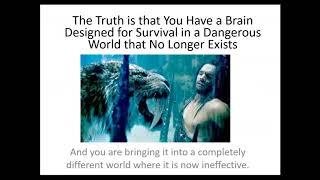
And reorganize it into a higher functioning mind that's no longer a victim of survival instincts and it's developed into a probability based mind. Because what I can promise you is this here's the truth. You have a brain designed for survival in a very dangerous world that no longer exists. You know that that saber tooth tiger, you're looking there, there, no doubt for the movie here, there's no doubt that that's a bigger head. And a saber tooth Tiger only had 6 inch incisor teeth rather than foot long, okay? But they were about a thousand twelve hundred pounds. And they clearly show that they. They ate human beings and that there's no doubt that a caveman should indeed have a deep fear about his existence with those around. And they were around 10 to 12,000 years ago, just a blink in evolutionary time. So our entire brains designed to be able to produce a. A sense of controlling the outcome, survival of being right and predicting what's going to happen, okay, no matter what, it will lie to itself to feel the confidence of I'm in control. And yet that worked so well then. But then you pull it into trading and it's a different environment, you know, and all of a sudden you discover the brain that's adapted so effectively for us to survive and dominate in this world simply not a factor. And being successful in trading, as a matter of fact, it's producing extinction. And that's what happens, Ben. I'll tell you. Trading can produces enormous extinction of the people who come in to learn how to trade. And then they discover, oh my God, my brain won't work. Yeah, you're right, it won't. It has to readapt and you can be the designer of that. So.
You experience what our caveman friend here is experiencing every time you engage in uncertainty. With money on the line, your emotional brain is adapted to react to imminent danger. And it does in fact, see the potential loss of money as not just an existential threat, but as a biological threat to life. Okay? You'll find it in pulling the trigger. Better not to pull the trigger than to take the loss, man. That's a. That's a good survival. Oh, we've been Straight. Well, I'm gonna get him back. I'm gonna get that tiger back. I'm gonna take my spear and I'm gonna go after him. Yes, sir. Or fomo. Fear of missing out. You know, the thing is, oh, my God, I finally got into profit. You know, I better take the profit right now, or it could be taken away from me or worse. When you see a move get past you and you go, oh, my God, then you have a fear of missing out on missing the next move. You end up jumping into trades. That's all caveman brain. That's all. That's a brain that's just built.
Not for trading. And you insist on bringing it to trading, and you insist on trying to force it to trade without altering it. So there you go. And what we go is that, you know, you may sit in a fancy chair now in front of screens, but your emotional brain sees the potentiality of dangerous world all the time. Who do you think wins? The primitive brain does. The emotional brain does. Why is that? Well, if you take a look at it, this is pretty much the way it works, friends, is that.
You are not a rational being that has emotions, okay? You are an emotional being who rationalizes whatever the emotional brain has decided. And besides that, not only do you not have emotions, they have you, okay? And ultimately, when you trigger an emotional. When you trigger the emotional brain emotions, this is pretty much what it's like. That's that rational self right there. And there is this big honking monster, the Hulk, just sitting there and can absolutely blow apart the irrational mind. That's what you're working with, friends, and no wonder you're having problems. You know, the thing is, is that unless you decide to change, it's going to stay that way. You're wired to instinctively react to the environment, then make up alibis to support to make it sound rational. Okay? Your thinking brain is the last one to know. And take a look at this thing. What you do is use that conscious stuff that's all up there, most of the stuff. When it says unconscious mind programming, what you're looking at is limbic system. The emotional brain, what it's wanted to do is it's going to wire limbic beliefs into you, okay? About your ability to manage uncertainty, you're seeing the effectiveness of those beliefs every time you produce performance and trading. And then take a look at your trading account, that's what you're seeing. And what you'll notice is that based on how few people make money in trading, what you recognize very clearly is the limbic memories, the limbic beliefs, the emotional beliefs aren't working friends. And a thinking mind can't get to those beliefs. That's the deal. So here you go, you know, you got this stuff going and all of a sudden, have you ever experienced this? You ultimately, to the old survival brain, risking capital is the same as biological threat. And it just so happens that in this particular scene, you know these idiots in this car.
They see a bull elephant musking, which is, which means they're just absolutely out of their minds. And what they decide to do is they honk at it and they want it to get off the road so they can go past. They probably have an important date that they have to get to and this elephant in the middle of the road stopping them. And this is what happens. This is in the same thing, that elephant. You have one of those running around in your head. If you've ever experienced impulse, if you ever experience revenge trading, you know it well, okay, so it's there. And the truth is all you're doing, that brain is only doing its job as it understands it. The deal is to change the job description and to retrain it. Every time your brain perceives uncertainty, it triggers to vulnerability. You're that, oh, I don't want to feel vulnerability. That vulnerability by evolution is hardwired to the fight flight response, okay? Think about how many times you feel vulnerable when you trade. Well, most time you know, you're in uncertainty and you don't really know what's going to happen. You'd like to, you'd like to know what's going to happen, but the truth is you don't. And so you're constantly in vulnerability and you already have a hardwired default program leading to fight flight. Do you see the problem here, friends? I hope so. And here's your good Buddy, here's your 800 pound gorilla that fight flight response triggers, okay, in response to conquest and threat. And this is the invisible wall and most people ignore and they actually try to push around this 800 pound gorilla as if it's not there.
So the left brain does not see the primitive limbic system's concerns. This friends, is the invisible wall in some shape, form or the other. You might frame it another way, but this is what it is. And what I'm going to do, I'm actually going to show you this slide twice because it's probably one of the most important slides. If you're a serious, if you're serious about evolving yourself as a trader, this is what happens. Is this is what you've got to master. On the left side of that, what you look at is you look at external input coming in through your sensorial system. It's coming to what we call the sensory thalamus region. Okay. And that's in the limbic system. And there you could look at the thalamus. It's like a traffic cop. It's making a decision about basically which way the traffic's going to go and that information coming in. And it will make a decision based on limbic beliefs.
About your capacity to manage uncertainty. That's the deal. It will make a deal. It will make a decision. And the first one usually is the low road. It's quick and dirty. The impulse is sent straight to the amygdala and to the fight flight response. That low road takes nanoseconds to activate. The emotion's already there.
That's how information never gets to your thinking brain. It takes half a second later and the emotions already broiled up and it absolutely become that wild elephant or that gorilla and taking over things. That's. It never reaches, it never reaches the long road, the high road. It's in fight flight response. It. Okay, this happens to you all the time. And until you can change, literally, if you look at that thalamus area and the information, if you cannot change that right there, you're never going to make it as a successful trader, okay? You're going to be hijacked by emotions. And it's not like you're going to whoosh yourself. You're not going to use magical thinking. There's not going to be some sort of special knowledge. No, you have to actually go into the emotional brain, the limbic system, and you have to transform the beliefs that it learned about your ability to manage uncertainty. That's what has to happen, Kerr. And it's not like you're just going to magically wish that.
So what we get here is this, is that that instinctive emotional brain wants to control and it's going to stay away from the risk or attack the risk. That need to control, that need to be right, that need to predict outcome, blind you to other options. And those other options are big time friends. Because ultimately you're trying to control something that cannot be controlled. And you're being given evidence all the time in trading or in active investing that you can't control outcome. No, you can't. And yet you keep trying, keep trying, keep trying, keep trying. If you were to accept, oh, that's the wiring of the brain that gives Rise to the mind. But what happened if you change that wiring so that you started saying, well, what is it I can control?
That's when it starts getting interesting. This is the default programming you're bringing to the management uncertainty and it is not going to work for probability management. That's the piece. Okay. Your emotional system just simply is not going to warm up to that idea. It's going to stay reactive. You need to show up.
As an invisible wall. It's been there all along. For all that can see, you simply have not acknowledged it. Acknowledging it has enormous power.
Because ultimately, unless that's reprogrammed, the emotional brain simply is going to overwhelm the thinking brain under stress. That's that gorilla, that's that elephant. Okay? This is where traders stay stuck and they burn out of capital and time. No matter how hard you work or no matter how certain you feel. And just to let you know is one of the problems with feeling certain feeling competence is that it is a feeling, it's actually chemistry. And that chemistry is altering the way you perceive. Suddenly you know and like certainty, you feel certain about something and yet what happens, there's no evidence to support it, but you feel that because of the chemistry is there. Once that chemistry dies back down, you go back into self doubt. The same thing with like overconfidence, you get euphoric. You say, I can do this, I can handle this, I'm a winner. And you, what happens is that you feel that you crank yourself up, but the evidence time and time again points to something different.
You know, a confident trader is not a euphoric trader. A confident trader is humble. They know that they can't control outcome. They control something far more important though.
Before we get that, we need to look at this is the colliding worlds that we have to really look at here. Because ultimately the question is, when have you had enough? Okay.
The key is to bring a patient, disciplined and impartial mind to trading. To do that, you're going to have to master the monkey mind or it's going to keep banging that symbol and it's going to blow you out of the ability to read that newspaper with a logical mind. It's not going to happen by itself. It's not going to happen with a little bit of information. No. You're going to actually have to do kind of like brain surgery. You're going to have to force the limbic system to change the pathways that are really our beliefs. The good news is this, you can reprogram your brain's Response to uncertainty. You have to be willing to break out of your comfort zone, though. You have to be willing to see what you don't want to see. And you have to be willing to reforge the trading mind. And, friends, that can be done. It truly can. And again, I want to show you again, okay, this is where it's at. What I want you to look at is that place where it says external input, and there is a line that go and says sensory thalamus, friends, that is where the limbic beliefs that you hold about your ability to manage uncertainty, that's where they're embedded.
That's where the decision is made to take the low road over to fight flight and do all that crazy stuff that you're here looking for a solution to, or taking the high road to your thinking brain, where thinking brain and the emotional brain are in partnership. That's what I want you to look at. Okay? So.
You don't change that. I come out of and, you know, out of public mental health. And we. We worked with addictions. And the very first thing had to do, you had to dry out the attic. Okay. And then what you had to do is then you. You knew that it was going to take about three months for the brain to reorganize itself. That's what we knew going in. It wasn't going to happen overnight. We had plenty of people who do pink sky. And they would say, oh, I got it. I never want to drink again. I never want to drink again. And those are the guys who would go out and fall on their face and they'd relapse. But the thing is, what we're looking for is going, okay, it takes that long. You have to get your stuff dry first. Then you have emotionally sober, okay. And then you have to get in the moment saying, I need to change the way my emotions work and trigger and produce a mind. Yeah, now you're talking. So we're talking about reprogramming the reactive instinctual mind to become a trading mind, to be able to reprogram it so that it's based on probability rather than survival. And by the way, what we're about to show you is exactly what we teach in the. In the group course that's coming up in September and also in the individual course. So if you're interested in how do you actually go about doing this? How do you actually change those limbic beliefs that are disturbing the way you would like to trade? How do you. This is how. The very first thing.
Is that you have to recognize that you are blindly operating from emotional programs. And the question is, have you had enough of this? Are you ready and willing to wake up and recognize that all that's really been happening, this thing you call a rational mind is a rationalizing mind that is making alibis up for what. For what the emotional brain's already decided. Okay? That's the very first thing. Second thing is that you're gonna have to cool the reactivity of the emotional brain. Survival instinct. We call this emotional regulation. And what we teach, the first part of the teaching, is that we are actually teaching you how to regulate that emotion. And what I want to do.
Go to the next slide, Dolores. What I want to do is what I want you to remember.
I want you to remember this slide. Because here's this really rational, modern fella. And you know what? He's driving along as if he's in control. And what's behind him is your emotional brain. Okay? This is the one that has to be cooled down. This is the one that's reactive. I want to read you something. This is from a woman who has enrolled early into our trading into our group course. Okay. Hi, Randy. Just wanted to tell you I did some Bellows breathing today. What a difference. And what she's really saying in my lingo is she's practicing emotional regulations first time. So I knew I was going to look at charts and felt the normal tightening in the chest. So I started the breathing and got myself calmed down before I opened my platform. What an idea. That's my comment then. It was such a calm process. Every time I felt my breathing change, I tried to bring it back to Bellows again. The only time it feels calm is on Sundays when I look at charts. When the market is closed and there's no risk coming up. I don't trade all day. So don't spend the day in front of charts. I tend to focus on day bars rather than untraday. Wow. That's all I can tell you. Thank you. This has made all the difference in the world to me. What you're listening to is a person who is beginning to grasp what an emotion is. She's beginning to grasp that, oh, biology, emotion, brain, mind are all linked together. And what she's discovering is that volitionally she can change the way the emotion present in the body is being managed. It's not allowed to crank up to anxiety. She's calming it down before then. And she finds she has a calm mind there and it's making a difference in her performance. This can happen to you too. This is the very first skill we teach. Second thing, well, third thing here is that you have to redesign you to think from probability rather than certainty and control. The more you push against your brain in an attempt to train it and to control your emotions to your liking, the more it will push back. You don't push, you approach. And what you're doing in this illustration, what we're doing is we're saying, you know something, we're not going to force, we're not going to force an old brain to adapt to a new environment. We're going to take the old brain. What we're going to do is we're going to, we're going by exercises, by skill development. We're going to teach you how to change some of the most basic beliefs that the limbic system, your emotional brain has about managing uncertainty. If you trade not to lose, you have a belief, I promise you, about fear of not being able to manage it. If you have a need to win, you say, I'm going to win, I'm going to win. I want to control that outcome. The truth is, is alphas don't do well in trading. They blow up. It's not about winning, it's not about losing, it's about performing. And by the way, if you're going to be a great trader, you're going to have to become a substantially good loser.
Okay? You're going to have to be a really, you're going to have to cut your losses early, just as a matter of course. So we're getting there and going, wow, okay, we can reinvent this thing. And the truth is, in sports, this is really evident. If you've ever, when you see these high stakes money games in golf and everybody there is in the top 50 of the top golfers in the world, they can all drive the snot out of a ball, they can all putt. But when money shows up there and there is only probability what's going on between the 36 inches between you holding that club and the mine.
That's the difference between a champion who recognizes that they cannot control outcome. They can't control the weather, they can't control whether another guy's having a great game or not. They can't control the stupid fans, they can't control if it's going to rain. What they can control is the mind they bring to that moment of performance. That friend. That friend is the probability based mind that gives you substantial edge. Fourth, mindfulness.
Friends, this is the tool that changes everything. As you develop mindfulness what you discover first is that you and your thoughts aren't the same. These aren't my thoughts. No, they're not. You know, you got born into a soup of distinctions. You got born into a family history of language. And what happens is all that stuff gets embedded in. You learn long before you can think or even have an opinion about it. You're already wired. And what we're doing is in mindfulness. You step back out of that, you start realizing, oh, this is just simply one potential organization of itself. And it's the one that happened historically based on the family I was born into, the culture I was in and circumstances, and it organized me into a responder to uncertainty that has a very specific way it goes about doing that. Okay. And what you realize is, oh, that's not me. That's just one potential organization of itself. And you go, wow. And you step back out and you go, oh, okay, I'm not. My beliefs and I'm not. And I'm not. And I'm not. My thoughts, my God, I can reorganize this kind of. Yeah, you are but one organization of potential self friends. You can reorganize your emotional nature to respond to uncertainty.
Very differently. And that's what the group course, that's what the individual course is all about, you know, and it's something that you're going to have to do. And a lot of people say, well, you know, it's something, you know, you stay in suffering for a long time. All you're trying to do is you might have to take four or five years where you're just kind of learning and you just churn, churn, churn through it. And then what happens? You finally learn how to trade. And. And that's a really dangerous. That's a dangerous bias, friends. Four or five years. The average length of stay of a trader in trading is three years. They burn out their capital. There has to be an easier way of being able to cut through the learning curve and get to the point where you have the mind that can engage this thing, engage this environment. So radically different than what the brain was designed for. So we got it. We know that we can do it. And what we're looking to do. By the way, this is a photograph I took when in Hawaii where there was a gigantic earthquake in Alaska and the waves were gigantic coming in and all the locals were coming out to watch the waves because they were really interesting. And this photograph is a local looking at waves. And by the way, it's his sons are in that water Surfing and it's just, that's really working with uncertainty and risk and being calm about it. The key is this, is that the emotions needed to create the probability based mind that you need if you're going to plan to be successful are discipline, courage, self compassion and impartiality. Okay. The key is, is you have to learn to train yourself to pull those emotions forward when you experience uncertainty and the consequential vulnerability, otherwise it's going to trigger to fight flight. And of course what we do is we have a very highly specialized program that allows you to go and work from memory to be able to pull forward emotional programs so that you feel the emotional program because it's in that feeling. When you feel an emotion, you're feeling the chemistry of that emotion in your body and your brain and it is altering the way you think. What we want to do is not think from fear, not think from anger. We want to think from disciplined impartiality. That's what you end up training yourself to do. And it just so happens we teach you how to do that. You know.
Particularly with the alpha stuff and the perfectionism, they think, okay, if I do everything right, then I'm not going to be wrong. Well, you know, in trading you find out you do everything right and you still be wrong. Perfectionism being right doesn't work. Alpha wanting to win, being number one, not losing, doesn't work either. Okay? You can't control outcome that way. You never could control outcome. Controlling outcome is an illusion, friends. In trading, what you can control is the mind that you bring. And none of this is, I mean, Plato, for God's sake. This is not, this is not neuroscience news that was discovered in the last little while. All learning has an emotional base. What we're saying is that you have to be able to manage the emotional base that you're learning from to create the perceptual map that you're going to use. And we teach that the challenges of uncertainty will always be there. But the difference is you can program the emotional brain to produce a mind that engages probability from strength.
Rather than weakness. Okay? That's, that's the key. And if you're, if your trading account is stagnant or blows up or shrinking, you're trading from weakness. If it's growing, you're trading from strength. It's the psychology, friends. Once you have knowledge of trading, you have to learn how to use it in the environment of chaos, of uncertainty, of randomness. And the brain that you brought to trading is not going to do that. So what you're doing is say in applied mindfulness, what I can do.
Is I can actually train the brain to be able to pull discipline, courage, patience and impartiality. And this is the traitor state of mind. It is the one that is really built and designed to manage probability. And often a lot of people in my work will notice that I use a lot of archetypal stuff. And fundamentally what you discover is discipline. The ability to maintain order under pressure is what we call ruler. You got to have a strong ruler, you got to maintain order under pressure because you got it. You have to have courage, the courage of a warrior. You have to be able to turn toward your fear and master it. You have to have patience, you have to have self soothing from self compassion. We call that caregiver. And what most men traders is they lack it. They don't know how to self soothe themselves and they get all cranked up out of that. When you have those three emotional programs working, getting at impartiality, clear thinking, we call that sage, suddenly everything starts being clear and you see how things work. So we, and we teach a process of that. And this is what I want you to understand right here. Your brain is really a community of rival emotional programs that has duked it out and the winners have built what you call self. Say, oh, this is me. No, it's the winning, it's the winners. If you take a look at the movie Inside out by Pixar Disney, you will see a wonderful depiction of how emotional programs create the mind of the little girl. Okay? And you see the battle going on between the emotional programs, that's exactly what happens. Then in the miracle from brain to mind, those programs are given voice in your mind. If you've ever experienced rage or anger and you're, I'm going to get you, you know that. You know that voice. If you've ever experienced self doubt, you've experienced what I call the inner critic, criticism and judgment about you as a human being and what I would call your orphan nature, your fear. Okay, you begin to say, wow, how do I go organizing this? What you're looking for is you're looking for that ruler, you're looking for that warrior, you're looking for that caregiver, you're looking for that sage to show up at the committee meeting and start contributing instead of having a power struggle where the bad guys are winning. Okay, is you want the good guys to win. It's not like the old's bad. And I give the example of this is that you know if you take a look at apex predators, take a look at the African lion, apex predator, man. What they do is they live in packs and they chase, hunt, and.
That'S what they do. They also get gored. They get kicked. They do a lot of things, and they're. But they're very successful, and they have a breeding program so that they can replace, increase the pack and go on. Okay. Very successful predator. If you took that same African lion and put him into the American forest of North America, it starved. Wrong environment. Yet if you take the American cougar, that cougar does not stalk. It does not chase. A cougar hunts by climbing a tree, getting on a limb, and waiting for dinner to come to him. He's an ambush predator. He knows the deer's habits. He knows the setup. He waits. And what he does is when he drops down on the deer, he breaks its neck. He doesn't fight it. They don't get injured. If they don't kill it on impact, the deer gets up and runs away. And the cougar does not chase it. It minimizes its loss.
Okay? It climbs back up the tree, waits for the next setup, just like a trader needs to be. What I want you to recognize is neither are bad, but it's. It's the.
It's the competence in the environment that you're operating in. And it just so happens that trading is a lot like the way the American cougar hunts.
So you're gonna have to. I actually have traders who have images of American cougars, and they really have gotten in. They've used a lot of my. A lot of my memory enrichment work, and they pull forward all those emotional programs that have become associated with that, and they trade from that. That's the way they do it. This is the mind that can be reorganized, friends. All you have to do is decide to do it.
So ultimately, we teach a process.
That leads to shaping a mind built for probability management by design. Not hope, not magical thinking by design. And that process, pretty simple. You really start developing your emotional intelligence. You really begin to understand what makes the human being and you tick rather than not whatever you've learned. The second thing is you learn emotional regulation, just like the woman I was telling you about. It's like a revelation. My God, I had no idea that I could manage the insensitive emotion. Yeah. So it doesn't take over. Then you develop this observer, this mindfulness, so that you begin to separate your identity from all the thoughts and beliefs running around the head. And then you go into Applied mindfulness, where you begin to learn how to find these emotional programs, the ones that we've talked about, discipline, courage, patience and impartiality, pull them forward and create a mind from that emotional base that's the one built for probability. And you reprogram your responses to uncertainty from survival instinct, that's what you're doing right now, to probability management, friends. That's how it's a process.
And it's learnable. And it's really about you deciding whether or not you really want to evolve into a trader or whether or not you want to be right. And the damn markets are just gonna have to conform to the way you trade. Okay, good luck with that concept. So we look at this thing going, you know, my question to you.
If you grasp that, you're going to have to reprogram your instinctive brain and mind for probability management. If you grasp that, and that's the invisible wall that has to happen. My question to you is this, how long have you been at it in trading? Have you traded long enough to know what's required? People listen to me and they, and particularly if they've been trading four plus years, they know, they know I'm telling, I'm shooting very straight with them. They know that, yeah, you can, you can blow out many years, 10, 20 years easy, and start with a major fortune and go down to a small fortune and have nothing to say for it. And you realize, oh my God, I wish I had just gone back and train the mind. And the real question, are you willing to engage your comfort zone, get a little uncomfortable so that you can change and develop a mind for trading? If you are, you know, if you've come to the moment where, how do I become the change?
And.
Taking this step, the courage to take the step of saying, you know something, I know it's a risk, but I take, that's what I do for a living. I take risks. And I know that the answer is uncertain, but you're going, I know that if I keep doing what I'm doing right now, same stuff is going to keep happening without changing the way the brain and the mind engage uncertainty. It's the same old same old. You keep hitting the invisible wall again and again and again.
What I'm asking you to is make a difference this time and doing that depending on where you are in your evolution of the trader. You know, ultimately, if you don't have my free book, get my free book. Start there. If you haven't gone to my website, if you haven't gone to my YouTube channel. Dive in there. You know, there's hours and hours of articles and hours of video and webinars that really give you a deep understanding of the theory behind this thing. Okay? And my book, Mindful Trading for Goodness, that's, that's also important. But ultimately it really comes down once you get past being timid, buying a little guided meditation, buying this reading, going, who is this Randy Howell guy? What does he know? Blah, blah, blah, blah, blah, all that stuff. And you go, you know something? I get it. This is the guy talking about emotional intelligence. This is the guy that has taken neuroscience, glued it to self development, okay? And you're going, okay, I want to look at it. My invitation to you is come to our group course that starts in September, okay? It's a. The group courses, it's. It's what we call the value package. You know, it, it's. I wouldn't call it cheap or inexpensive, but it's, it's less expensive than the individual course. And what happens is we meet five times over a period of 10 weeks as a group, and then what happens is that you, you've got access to a virtual classroom where there are all these tools that you learn, there's all these guided meditations, there's all this stuff that you're learning how to build the mind for trading. Okay? And recognizing, oh, there's going to be an internal struggle, but you're going to. That internal struggle never changes. The difference is the mind that you bring to the internal struggle, the vulnerability. That's what matters. And the real key is if you join by Saturday, the 9th of September 8th. Excuse me. We're going to give you a free emotional regulation workshop and you can buy it for $199 or I give it to you free. And the reason I want you to do this is not necessarily just to get you to sign up for the course and for me to make money, but that's always nice. No, the woman that I read from about the breathing has signed up for that course already. She wanted a head start. She wanted to get with the program because she realized that, you know, her concept of what the world mind and brain is, is going to go through major surgery. And she wanted to get a head start, and she's already reaping the benefits from that. That's what I invite you to do. Okay? And ultimately it's 1195 and it's get broken down into payments of 5. I think it's 239 a piece or something like that.
That's a powerful way if you're, you know, if you're not so sure you want to check out things. That's a fairly inexpensive way of testing me out and finding out if I know what I'm doing. Also for folks who just aren't, you know, don't have the net worth, it's an affordable way of developing powerful new skills for your trading. Okay, the next one though is the individual course. The individual course, the big thing about it is it comes with 10 consults with me over three to four months, which it's also far more comprehensive. And by the way, they're all on Skype. I mean we're looking at each other, we're talking with one another and it's very powerful. It's like being in the same room. And what you discover is it is far more comprehensive and very personal. It comes equipped with this enormous large amount of PDF, text, videos, MP3s, all sorts of stuff. And when you first get to start downloading stuff, you go, oh my God, what have I got myself into? It produces a curriculum that you and I are going to follow from emotional regulation to mindfulness, to applied mindfulness, to really getting in and understanding your fear and the beliefs behind that fear and transforming them. But you have somebody to walk with you and to talk with you and to mentor you rather than in the group course. Big deal. So friends, I invite you to become the change. I invite you to get out of your comfort zone and say it's time. It's time. Okay. And where we are at right now, if you have any questions, I'll be very happy to answer them. We have, we've got about five minutes, so if you have questions, I'll be happy to answer them. Okay? And it's just a matter.
Of. Oh, and right now Dolores is pasting the link for the group course. If you're interested in it. It's a very powerful thing and you know it's true. You can get a $199 program for free for signing up early. But the thing is is what you're fundamentally doing is you're getting a program that can be life altering. Okay, okay, let's see.
I am lucky having find you'd method in my first year at trading.
Ah, well, you know, I tell you something, you are what, what it really boils down to. I'm amazed that occasionally most people I work with are in their 40s, 50s, 60s and now 70s. And recently a couple guys have shown up in their early 20s. And I asked him what's this all about and what they said is to all three of these guys said, you know something, I got it, I have the knowledge. But I see very clearly that if I don't get my head on right that this is not going to make it and I don't feel like wasting time. Okay, that's powerful. Hi Randy. How much is the total cost per year coaching?
That's the individual. That's $3,500 or three payments of $1,200 over 90 days. Okay. And understand, it's just not me talking and us discussing. You're taking a graduate level course at a major university or this thing you're getting, you know, you end up with a syllabus, you end up with a curriculum. And this, this whole program is designed to take you through something. Believe me, it's just not talking with me there, is there, there, it's, it's graduate level.
Okay. How many people have taken the group course, have succeeded and start being profitable? You know, I can't answer that. I know that we've had hundreds and hundreds and hundreds of people go through that, but I do not, we do not maintain.
They just kind of go off on their own. They have access to the virtual classrooms for virtually forever. They can take another, they can audit another course, but we actually don't. And we get a lot of accolades. We get a lot of people finishing the course saying that this is just mind altering. It's just amazing thing.
But it's very rare when we get feedback about how that's happened. And I have tried to do something about that, but I don't get a whole bunch of feedback.
I don't get enough response to produce a statistical, valid response. In the individual course. I know that 60% of the people end up in a completely different place. And I know that 30% of the people end up consistently profitable after that. You might say, well, those are pretty low. Not really. If you take a look at the people showing up in a trade room, 95% of them are not going to be successful. Okay. They're going to go from trade room to trade room and.
What happens is nothing really changes. The real key is that you walk away from my courses equipped with skills that teach you how to work and manage emotions and to create a mind. Okay? And basically what we say is do the homework and you will see the change happen. What we've seen repeatedly, whether or not it's a group course or the individual course, if you just doing the friggin homework to get off, we have me off your back. And you show up so that you've done it and say, oh, yeah, I've done it. Then, you know, you're not. You're not going to take this work and you're not going to. You're not going to incorporate it. You're not going to change a darn thing. However, if you're motivated and recognize that you have an enormous opportunity sitting in front of you, if you work your butt off. And a lot of the people I work with will say that, Randy, I work at this about two to three hours a day. You know, that's sometimes reading. They're using audio books and they're doing stuff like that, but they're committing a couple hours a day to their education. Now, these guys are motivated. These are the guys saying. These are the guys writing back saying, I have been consistently profitable for three years now. And I just want to thank you very much. I don't use the same methodology I used to. That just simply didn't work, even though I paid $50,000 for it. But your work does work. But the thing is, is that you work the program and it works. That's just simply what I've noticed. Okay, so that's the best answer I can give you.
Yes, true. I have a problem with my head. And listening to you is like reading my mind. I get that a lot. What you really discover is that.
This is just brain.
Experiencing uncertainty. And we all come.
From a group of people on the African savannas. We all have that emotional brain. We're all going to have a very common experience about the way we experience uncertainty. That I can use examples. And people say, God, how did you read my mind? Because that's the brain on uncertainty and risk. And the truth is, all it's saying is that it's time for you to learn how to manage the stress of uncertainty very differently than the way you learned the first time. And you learn by default, man, you got born into a family, you got born in circumstance, you got born into a culture, and you know, all of a sudden you got downloaded with that, and you bring that to trading and you discover, duh, it doesn't work. Then you go, well, how do I go about changing it? And one last thing is that if you are interested, if you're looking at this going, you know something? This is really serious stuff. And I'm really considering his individual course. Ask for a free consult. Okay. All you do is you go to a website, hit Contact Us, and Delores will find time that you and I will talk on Skype. You know, so we'll be looking at each other and it's just like being in the same room. And we'll take a hard look at whether or not my program matches up with your needs. You know, basically what I've discovered is that if you're bipolar or if you have obsessive compulsive disorder, no, this is not a good course for you at all. But if you have a typical architecture, typical mind, this is a very powerful course about regulating emotion, about going in and finding the beliefs that you're projecting onto the marketplace that are going to have to get altered if you're going to become successful. Okay. Because basically you're trading your beliefs. You're projecting your beliefs about your ability to manage uncertainty onto the markets. And your scoreboard is your trading account. If your trading account doesn't add up to the talk, you talk, it's saying that you're not being honest about the beliefs that are driving your performance. That's the big deal, is that you're a human being. Of course, when you get exposed to uncertainty, particularly with money and that money conversation running around your head, you're going to trigger to vulnerability. And vulnerability is hardwired to the fight flight response. So that has to get rewired. It's not going to happen overnight. It's not going to happen magically. It's not going to happen because you go to a webinar one day. That's why I've got these things designed. My group course is two months long. My individual course is three to four months long. It takes that long to start implementing the way you change an organic substrate like your brain. That's what's required. So, friends, I have. We're at the witching hour. We're at 5:30. I want to thank you for being here. I really love this stuff. And it's just something where I get a big kick out of people's eyes opening up and going, oh my God. There is a way. There is a way that if I work I can develop these skills and I can have a very different life. Yeah. And what most people notice is this. This just isn't about trading. You know what, what the power of trading is that you have that trading account. That's a truth meter that tells the truth about whether or not you're lying or not. Okay. But it applies to the rest of your life. You're going to end up with being highly more effective in other areas your life that are important to you. Okay?
Yeah. And what will happen if you're here, you will be getting a notice that the recording that we're doing right now will be on my website tomorrow morning. It will be the second video. And that that's at the my trader state of mind. And it will be the second video. And you just have to scroll down a little bit and you can just study it to heart content. That's what we basically discover is that people, when they start listening this, they realize that, oh, my God, this is like 150 miles an hour going past me. I need to slow this thing down. I need to. I need to be able to listen to this repeatedly, because you know what he's saying, I've never heard before. So check it out, okay? And I really, really care. Okay? And I thank you all. Have a good evening.









