Building a Probability Based Mind
Randy Howell explains how fear-based instincts sabotage trading decisions and teaches a method to build a probability-based mind instead. He maps common failures like revenge trading and FOMO to evolutionary wiring, then walks through emotional regulation, mindfulness, and memory work to rewire your responses under pressure.
Questions this video answers
Randy Howell (Traders State of Mind).
YouTube webinar titled 'Building a Probability Based Mind', February 11, 2019.
A one-time payment of $3,500, or three payments of $1,200 over 90 days.
Begins in March (year implied by webinar context).
Chapters
Welcome everyone. My name is Randy Howell with Traders State of Mind, and I welcome you to this webinar. This is gonna be an interesting one. I think what I've really done is I finally came down and finally understood exactly what the problem is and whether to language it. And so I'm interested. The key though is that what I want you to think about is the potential that you approach trading with. And when I ask you what happened to that potential, when you get into the up and down, into the risk and uncertainty of trading, what happens to that potential that you see so clearly? You're going to understand what's happening at the end of this webinar, okay? And. But what I'd like to say is that I hold questions to the end of the thing, okay? And basically that's because I answer a lot of questions. And we have a big. I'm ambitious tonight. Okay. So other than that, you can write questions in and Dolores will handle some of them. And if need be, what happens is that they can be held and I'll answer them at the end. Fair enough. Okay, well, let's get started.
Tell me something. Have you ever had something that looked like a great idea at the time, but it didn't work out? Take a look at this bamboo. You know, I have no doubt that every bamboo would like to. I mean, every.
Bamboo that's not a baboon wants to do what he's about to do, but no baboon in his right mind would ever do it. I don't know what happened after here, but in many ways what happens in trading is that we walk in with an idea that we can be in control of something, when in fact what we discover is we're not in control at all. And the key is we can't control the outcome. But what is it we can control? Friends, this is the difference between a probability mind.
A fear based mind. Fear based brain, okay, is the fear based brain wants control. The probability mind is looking for an edge and can actually maintain it.
Then what looks so promising? I have no doubt that baboon just thought that was gonna be really rosy. Getting back at the old Mr. Lion now becomes a place you're stuck in. We get stuck in places in our trading. I can't tell you how many times whether or not it's having entry problems, whether or not it's taking losses, revenge, trading, getting out early, all those things. What we realize is that we're triggering something.
That keeps us from being able to achieve our potential. So there's just something missing. In the way that we understand the brain trading. Okay, so here we go.
And this is what makes it so difficult. It's a repeating pattern. You're on your game and then emotions show up to break up the party. You know, you've earned it, you know how to do this and you just can. All you're gonna do is execute. You know how to do this. And then emotions show up and change everything. This is why it makes so difficult. It's like a switch goes off. Literally, literally one minute can be, you can be logical, rational, and then you're swept away into emotional storms. And friends.
It'S not until.
It'S not until you find the missing puzzles that this problem will become a non. Starter. The problem's not going to go away because of wishing. It's not going to go away because of you Work harder, you've got a winning attitude. It has nothing to do with that. It's actually understanding how the brain works. And the key is these figures. You know, you read these figures and you know, golly, where do they get them from? But ultimately what they say is that 95% of traders are not profitable. Okay? And what they don't say is that 98% are the only ones that 98%, the only 2% that are actually profitable to the point of being able to sustain themselves. Okay? So when you see the 95% that also includes, includes the marginal traders, the ones that are at break even a little less, little more. Okay, but we were looking at it and going, what does this have to do with my brain? Well, it so happens it has to do with a lot with them. Fundamentally what you're trying to do is you're trying to ram.
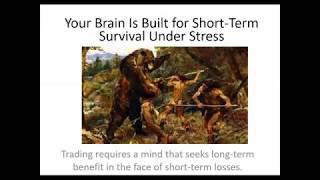
A fear based brain, a square one at that, into a round hole of probability. And this is simply the way your brain evolved. And it's not your fault. This is just the way the human brain evolved. Including yours, including mine. And if you're going to learn to trade successfully, this is going to have to shift. You're going to have to take that fear based brain and you're going to have to learn what it takes to soothe the fear behind all those problems and be able to work in probability. There's really no way out. This is what your brains built to do. This is the survival brain. And what you're doing is, you're seeing, we'll return to this in a while. But this is what you call revenge trading. This is, you know, these guys are fighting for their lives and their clan's life and it's a big bear and they're risking their lives to save themselves and to save the clan. This is what your brain is built for in terms of short term survival under stress. Wow. It literally scans the environment looking for risk. You'd think that would be a good thing, right? But it can't tell the difference between biological threat and psychological discomfort. To the, to the, to the trader. To the trader's brain. If you've ever experienced revenge trading, you've experienced literally the difference between short term survival versus long term thriving. You've experienced what these guys are dealing with here now.
Next slide, please.
And it also, this is. Your brain wants to control outcome. It wants to be right.
Certainly not to lose. And it appears you can in fact control outcome until risk creates stress. Then all bets are loss. They're just completely off. And that's what happens with traders when they're not trading. They can see clearly from a rational mind.
And the problem is the rational mind has no business trying to deal with uncertainty, particularly under stress. So an effective trading mind.
Has to let go of the illusion of control to get comfortable with not knowing and calmly accept losses and wins. I want you to compare the two. One wants one thing, the other wants the other. Well, let's go in further.
Your primal emotional brain sits in the background, scanning for threats to survival. Okay, that's that little caveman guy sitting in the back. And here's this really modern age modern guy and his little driving. He thinks he's driving the brain. And when you experience uncertainty, suddenly there's a threat to survival. And control of the mind is shifted from the thinking brain to the caveman brain. This is where it gets interesting. Now here's the sequence. When you experience uncertainty, okay? It triggers vulnerability. Vulnerability to Mr. Caveman here was dangerous. I mean, think about the bear. It was dangerous. And it would immediately fire to fight flight. Okay? And here you go.
Is that. Here you are, modern man that you are. You're looking back at your ancestral history and saying, stop following me. Well, you may wish that, but it's not going to happen. You carry that brain as your emotional brain, your limbic system with you into the modern times of trading. But that limbic brain is not trained. Your emotional brain is not trained for those rigors. Wow. That's why your thinking brain is swept away so easily by the hidden power of the emotional, by the survival instincts of your emotional brain. And it's like nobody wants to recognize it and do anything about it. And in trading, you're going to be forced to or you're not going to be in trading. Well, you're not going to be a successful trader and work up, work up the ladder. So.
Excuse me.
Missed the slide. This is primal fear. Okay? This is primal fear. This is what your brain experiences when it engages risk of your capital. This is at the bottom when you, when you have found yourself at a place where you can't get in. It's scared of the shark. You find a place where something happened, the trade goes against you and you start fighting back. You're being attacked. You know, this is the key of the way it works now.
The emotion actually is simply coordinating action between the organism, that's you, the trader, my friend and the environment, the markets and all. Thinking is emotional state dependent. What do you think happens if you trigger to primal fear? That's that risk. Then it can't tell between biological threat and psychological discomfort and you're not prepared for it. Well, that's what we were here to discuss, isn't it?
But let's take it from the theoretical, the neurobiological aspect of understanding this. Let's taking it, let's take it to your world. How do you experience this brain mind gap in your trading? What I want to do is take a look at this.
Is that the major piece is that the brain you arrived with is not going to be the brain that brings success in trading again. It's not your fault. I mean if you want to blame somebody, blame evolution. Okay. The key though is that what are you going to do about it? Given this is, given it, it's a given.
Let's take a look at entry problems from the short term survival instincts that you carry with you. Keeping you out of risk when long term gain is probable. More confirmation, more confirmation, more confirmation. And then the trade gets away from you because you were looking for too much confirmation to the emotional brain that success, friends, it kept you out of having to deal with the shark or the bear. That's short term success.
So.
Over trading, wow. You know that over trading. I'm gonna do it. I'm gonna do it. I've got it, I've got it. I'm, I'm on this. I'm. We can see it. This is really the short term alpha motivation to win and make things happen. Now over the long term approach that allows the market to reveal what it's willing to give you. The thing is, is that in over trading the euphoria kicks in and you just get overconfident and over excited and you end up trading. You're Chasing the bear away. Now.
Then, let's go back to our friend that we were working with the bear. Here's this thing. Revenge trading is really nothing more. The short term need to save yourself from more hurt while the long term need to learn to take losses is overwritten. Okay, that's. Remember that caveman dealing with those that, that bear. Well, here it is. That ancestral brain and mind is still in you. It's not going to go away because you've got a 21st century brain. That's just the way it is. Fear of missing out.
Think about it this way. Short term need to conserve gains before they can be taken away. While long term benefit of probability hitting targets is minimized. You can see the short term, I can see the short term benefit here. Yeah, you want to conserve the gains. You don't want them taken away from you before you enjoy them. And yet at the same time you get out, you have a skinny little profit and then what happens is that it goes to target and there you go. You begin to see the difference between what the survival brain, what's on its agenda and what the thinking brain is on its agenda. And you discover that the survival brain is far stronger than the thinking brain.
Overconfidence. This is a short term euphoria of winning leading to questionable decisions. While long term view of winning and losing as probabilities pushed away. You become overconfident. You believe that you're the man part of woman and suddenly you start making really.
Rash decisions that you look back and later and you realize, boy, I tell you, I just got really suckered into that. I don't know what happened to me. And at the same time here it is, overconfidence has grabbed and it's coded in to the way you respond to uncertainty and to the vulnerability. That's the key. You see this uncertainty, the vulnerability and you as an alpha wants to take advantage of that. It wants to push, it wants to win, it wants to control outcome. When a much better approach of seeing what the the market will really give you would have worked better in your thinking brain. That's not the way it works.
Self sabotage, my favorite. A lot of people say this, giving your gains back, but I like self sabotage. I think it's a much better way because what happens in self sabotage is that you start having good days, good weeks, and all of a sudden then you give it all back. And usually you start feeling good, okay? And when you do that, you start ignoring probability.
So here's that booger man, that emotional brain now it's feeling good because it's been victorious about being able to supply food for the village. And it thinks, oh, it's going to go on forever. I'm the man, the woman. All of a sudden you discover no, that's not the way probability works. You could easily lose the next five trades. Okay, so there we go. Now fear of losing. This is the primal assessment of threat to survival. That's that shark, that big 50 foot.
White shark that that person was swimming with. That's what that is. And yet it overwhelms the long term understanding, applying to an edge to probability. So the thing is your edge to probability.
Loses it its ability to be present for you if you don't know how to manage the emotions of survival instinct. And that's just kind of the way it is. And out of these things, you know, all of these examples are about of lack of emotional intelligence. Friend. The very first thing that we teach, what we're teaching right here is about emotional intelligence. More than 90% of the decisions you make are made by the emotional brain without your conscious consent. Think about the guy who over trades and he says I don't know why I did it, I don't know why I did it. Think about the guy who can't get in the trade because he's scared. I don't know why it was really there. It's all happening beneath the radar. Friend. The thinking brain only creates an alibi that rationalizes what the emotional brain has already decided. And here's the way it really looks. And I want you to, if you have not ever seen this, I want you to really take a look at it because it's important.
What I want you to notice. First off it says sensory cortex, that's your thinking brain. I want you to notice how far away it is from the action. That's the first thing I want you to notice. I want you to also look at that thalamus. That's where information coming from, the sensoral modalities are coming in. And the thalamus can be thought of as a traffic cop on a big huge busy street and he's directing traffic based on conditions that traffic cop will make a decision. It has to be an instant decision about what he needs to do. Do I need to take care of this in a quick and dirty way, the low road, Send that information over the amygdala and go fight flight or is this more okay and I can send it up to the brain, the thinking brain and get a slow but accurate reading of the situation. It's called the high road. The truth is that you're built under stress to take the quick and dirty low road.
That's the biology of it. Yeah, and you rationalize and stuff like that and you say it was emotions, but the truth is.
Is that it's the way the brain operates, it's the way your survival instincts operate. And by the way, I have a some sort of bug right now and be glad we're not face to face. Okay. And occasionally I will cough and I do apologize in advance but we will work through this. Okay, so now what we're looking at and when you try to say okay, I can control this, I can use thinking, I can use affirmations, I can use visualization, I can use nlp, I can use tapping, I can use positive thinking. The problem is those do not get at the root of the problem. The root of the problem is really about the way the limbic brain, the emotional brain has learned to deal with uncertainty and delta limbic learning, that's the big deal that you're dealing with until you learn how to go in and change that. What later becomes a belief. To the, to the emotional brain it's not even a belief, it's a knowing, it's a, it's a learning it doesn't know it has emotions. It's only when you get the cerebral cortex that you start going oh, I'm having emotions, I'm having thoughts. But this is the big key. So this is what we want to work with.
And.
So the bottom line, I think one of the hardest things for people to grasp particularly got people coming into trading who think they're going to get rich rich quick is recognizing that the trading mind requires self mastery. It really requires the ability.
Of taking a thinking brain and an emotional brain and wielding them together and getting the best of both worlds. Or as Lao Tse said, mastering others strength, mastering yourself is true power. It could not be said more, more powerfully than in trading than any other, any other endeavor you can find trading's hard cause in most other endeavors. You really don't have to change the perception of your brain in trading. You have to change the perception of your brain. No matter how good it's been in the past, it's just not the brain that's gonna work in trading. And how do you do that? Okay, well it starts with recognizing. We need to build probability mind from a fear based brain. It requires very different understanding of the relationship between brain emotion and thinking. Let's take a look at in the way we Teach it. This is the way. This is the way we teach it. First of all, that emotional intelligence stuff, skill one. But then what we do is we start working with emotional regulation. We know that emotions are biological in origin. They're actually biological action potentials that coordinate action between the environment and you.
And you're gonna have to learn how to cool them down. The first part of our trainings is always focused on this. And people are just downright amazed at how much tension, how little breathing they're doing, and how they're letting their bodies go out of control until they recognize that that body, that tension, that breath is all part of an emotion and that you're not managing it, it's just running wild. By the time you notice it, man, it's already, it's already, it's already slam dunked you. So the very first thing is you learn emotional regulation. Pretty simple concept. Been around for about 4,000 years.
Herbert Benson took that from Hindu yogas and said, how, how they're claiming they can do things that western science says we, you can't do that. He brought him into the studio. Well.
Brought him to the laboratory, not the studio. And what he discovered is that yes, they could. Yes, they could.
And he just, when he won, he stripped the culture out of it, stripped the, the religion out of it. What he discovered, it was the way you breathed and it was the tension in your body. He created something called the relaxation response. This is the very first thing that you need to learn how to do is you need to be able to train yourself to calm the emotional intensity down so that it doesn't take over thinking mind. That's the very first thing that has to happen.
If you don't do that, everything else is rock and roll. You, you never get to the door of the mine. You just. None of that. So first thing, learn how to manage motions. Second thing, our skill three, mindfulness, is.
You know, it's, it's interesting. You are both a participant in your trading and you're also an observer of your trading. And unfortunately.
Nobody has helped you to develop the observer so that you can watch your trading from an observation standpoint rather than just a participant standpoint. And what you discover when you do that is that you and your thoughts are not the same. Learning to separate yourself from thoughts and beliefs is the key to mindfulness. And it's also the key when you realize that, golly, the world opens up because you realize that mindfulness becomes the tool that you reconstruct the potential of the self with. What does that Mean, here's the deal. You, this thing called I, okay, are really from a neurological standpoint, are only one potential organization of a self that could be. So that's the one that could be.
It's become you. What you recognize the brain as a community of rival emotional programs that are duking it out from control of the mind. That's what you got.
You take that observing self to discern the mind.
And the way we teach the minds, conceived as a board of directors, that's having a power struggle and needs to be reshaped by the awaking observing self. What you discover is that there are destructive and constructive pieces going on in the mind and you're going to have to learn how to discern them and change them. And the next skill is you have to find the self limiting.
Beliefs of historical dialogue. You discover an inner critic and adapted voice that are really truly potential aspects of you. But they're not you. They've just had control of the mind, the committee of that mind.
And you would know the inner critic by the judgment, by the criticism, by the temptation that you hear in your mind. You would know, you would know the adapted voice when you fall into self doubt.
Like right here.
If you've experienced either of these, the self doubt or the overconfidence, you've experienced the dance between the inner critic and the adapted voice. And friends, this is not something in the fifth. What you're learning to do is you're calling your empowered nature into awareness. In the same way that you've got some junk floating around there in the mind, you've also got incredibly powerful aspects of the self that need to be called up. Okay? These are the emotional programs that can create the mind that engages the moment. What we do is we teach you how to pull the emotional programs of discipline, courage, self soothing and impartial into your performance mind. They can be called up under stress. That's the big deal. Okay?
So the key is you do not change the challenges of uncertainty. Uncertainty is just part of living. But what you do change, you ultimately change the emotions that give rise to the mind, that engages uncertainty. This is the patient disciplined mind needed for probability management. And you learn, and literally you learn to say, you know something? I no longer fear my fear. I realize that fear only has the power that I give it. And what you also discover is, is that it's time for you to start getting serious and start rearranging the mind. And particularly what I would call your orphan nature, so that it knows that it's supported, it knows that it's cared for, it knows that it's going to be protected because usually behind the fear of losing is there, there's a good reason, there's reasons that you have a fear of losing. It's often, I'll never measure up if I don't. In my family, winning was everything we had to be perfect. Well, that doesn't work in trading.
So when you do that, what you discover is this. This is a shift from a fear based brain to a probability based mind. You take a look at this thing right here, okay? Now I look at that and if I were on that boat right now, that would be a scene of absolute chaos. Just me probably going nuts. Okay? That's just the survival brain in me. With no additional training and yet you look at this, these guys are, these guys are having a day of it. They're in rough waters, they all know what to do. The skippers in charge, they have the right, they have the right attitude to be able to deal with the water they're dealing with. And they have the faith that allows them to move on. Despite that, they're looking all around them and they realize something very powerful. You do not control the outcome, you control the mind that you bring into the moment. This is the big deal, friends. You do not control outcome. You control the mind that you bring into the moment of time.
When that happens, you master your fears from the inside out. Think about this, think about this wave, disguise surfing right now, okay? Clearly he has no power over that wave. Clearly he's acknowledged that wave is much bigger than him. But yet at the same time he's, he's attuned to that wave. He's learned to ride that wave and this is what you have to learn to do. Also, if he messes up, and sometimes that happens.
He can be in big trouble. You know, surfers have some problems when they're dealing with waves like that. At the same time they have the skill sets that allow them to be able to manage the mind they bring into that moment.
We want to manage the mind that you bring into the moment of trading. Not, not really, you know, the surfing mind. But we want, no, we want a trading mind. That's what we're looking for. So.
Here'S the whole lesson here, is that you control the mind that you bring into the moment of performance. If you choose to do it, if you choose to say, you know something, I get it, Randy.
I get it that I have been allowing my survival emotional brain to basically run the show. I've been trying to overpower I've been trying to be perfect. I've been trying to do all these things. But what I recognize is that the only thing I really control is the mind that I bring into the moment. Yeah, the one that engages the uncertainty. And the Romans had a good saying for this is the future favors the brave. And that applies here is you're looking at a group of sprinters. All these guys are world class.
And you know, if you have a great day, but someone has a greater day, they win. You can't control what other people are doing. You can control only what you're doing. You can only control the mind that you bring in that moment. This is what this stuff is all about, friends. That's what it's all about. Then you discover that your new skills are useful well beyond the trading room. Most people describe, well, my athletic performances, my relationship, they've all really proved improved because I now, I now am no longer just reacting to things around me. I am actually saying, you know, I can control the mind, not the uncertainty. And this is the big deal. You end up being at more at peace with yourself. And you're also able to work from a humble confidence in your capacity to perform. And that's the big thing that always happens. It's all about humble confidence. Can you execute the moment of stress? It's not about having a winning attitude. It's about can you execute in the moment of stress. That's what we're looking for. So what have we done here today besides you listening to a little bit of my coughing? And I do apologize for that. So what we're saying is that what we teach is pretty simple. The very first thing is a very different understanding of the way brain, mind and emotion work. To give thinking is emotional intelligence. The second thing is emotional regulation.
All that breathing stuff. And you would have to learn to regulate your breathing as you trade. Not after you've done something stupid, but as you trade.
Then what people grasp is that, oh, an emotional regulation does not solve the problem. No, it does not. It will get you the door of the mind which you haven't been able yet to. But you have to go into the mind. We have to develop another tool, mindfulness. And in there you start really developing, oh my God, I'm not. My thoughts and my beliefs, they're just simply one organization of my potential that can be deconstructed and reconstructed to higher functioning. Yeah. And then as you develop this observing self, you're taught how to start looking for the aspects of your mind, those self limiting beliefs that keep cropping up at the wrong times. And you learn to. You don't bash them. What you do is you master them. And you recognize that the inner critic, that part of you that is highly judgmental, critical or tempting is going to be always be there. There's no reason for you to go, I've beat the enemy. No, you haven't. He's just waiting for a more opportune time. I promise you, is that part of the self is going to be around. And it's like a backseat driver. It just never goes away. But more important is you start developing the empowered aspects of the self. You start developing and recognize that you can actually call forward emotional states on cue. And we have a very specialized process. We use it. We call it memory enrichment, where we take the memories of emotional moments out of experience, not out of wishful thinking like visualizations or affirmations. And we teach you how to recall the memory differently than the way it was first encoded by the brain so that you actually have access.
To the actual emotion that you need to build the mind that can engage uncertainty. And we do that with discipline as ruler. We do that as courage as warrior. We do that as self soothing, as caregiver, impartiality as sage. Those are four emotional programs. And as you learn how to use them, you learn how to manage the mind that engages uncertainty. And I might add, there is actually a sixth skill here, and it's called. It's called vigilance. Is that the moment that you start thinking that you have it, you just lost. This is really about humble confidence and knowing that you can manage the mind that you bring to the moment, but you do not control the outcome. That's up and beyond. So there you go. And where do you go from here? I mean, if this has just been a very useful webinar, I'm happy for you. And at the same time, I'm actually addressing the folks who are realizing that, you know, this psychology piece, this. I'm beginning to see that it's the biggest piece of the puzzle. There's plenty of people that have great knowledge. There's plenty of people have great knowledge, but they can't trade well. And the difference is that they don't know how to manage the mine that trades. So if you're just beginning, you've never heard of me, I invite you to go to our website and get our free ebook. Okay. Is just download it and.
Really start getting to know my work. Watch all the free videos and all the articles. And if you're really Pretty curious. Get mindful trading my actual book. Okay. But if you've been trading two to five years enough to know that you know something, if I followed my plan, I should be having more experience and I should be having more success than this. I'm not. And if you're serious though, ask for a free consult. You just go to the website there and any contact us and Dolores will find a way just to get us together and talk about what, what it's going to take to get your mind from coming out of a fear based brain and coming and so that. And you developing the capacity to take that brain and retool it with your mind. Really cool stuff. To produce a mind that engages uncertainty very differently. And if you're just kicking tires, you know, read the book. Okay. And the group course is something that a lot of people end up taking because it's, it consolidates a lot of this training really quick. And our next class begins in March, so it's not, not far away. And that's a course that is a virtual classroom. We meet every two weeks for an hour or so as a group and we go over each core piece of what you need to know, how to change the brain.
What you discover is that it's interlinking, is that there is a, there is a organization to what we teach in the process. We take it. You go from one step to the next step to the next step. And that's the way it works. It's very powerful, cost effective course. Our individual course is literally built for people who have decided they've had enough and they know that they're their own worst enemy and that they need to do something about it. And they want, and they want, they want mentorship with me. Okay. That's the. And you get. Ends up having 10 consults with me over Skype over three or four months process. And it's a much more. The individual course is a much more comprehensive, much more personal. We really get into your orphan nature and all that stuff that's been really creating havoc in your trading life and other parts of your life too. But I, I want to thank you for being here and if you have questions, please type them in. I still have some points. I have made a recovery and I'll be happy to take your questions.
How do you charge for the. It's done by some sort of credit card, PayPal.
Oh, how do you charge for the individual course?
And I'll say what we have.
We have a payment of $3,500 that pays for the whole course. Or $1,200 over nine weeks. No, nine.
Days. There you go. And so there's three payments of 1200 over 90 days. And that's the option a lot of people take, spreads out their payments.
And it works.
Okay, Will emotional regulation and mindfulness help if I do not. If I am not following my trading plan at the time of a trade, despite the good intentions to do so?
You're asking a fairly complicated question, but what you're basically saying, I think, is that you already find yourself in the middle of a hijacking. And then you're saying, can all this stuff help you in the midst of hijacking? And the answer is no. What happens is you learn how to control the mind that you bring into the moment. It teaches you also how to regain control. One of the things that I encourage when people are going berserk is that it's time to take the loss. It's time to get out and recover. And so the major thing is that as long as you have the mentality of a band aid, everything you look at will be a scratch that you need to band aid for. We're talking about a much bigger operation here. We're talking about changing the brain that actually engages the uncertainty.
We would be expecting you over time to be in management of that mind that as you engage.
What's the one trait that traders you've worked with have in common?
The biggest one, the one that proves that they want to work and they've learned how to turn their work ethic, that never say die thing, but what they've done is they've recognized that what they're doing is not working. And what they are is voracious students of this work. I have a guy right now that I'm working with, and he's out of the UK and.
He'S just eating this stuff up. And he, he's already, he's already showing the emotional regulation and mindful skills in his trading. He's able to slow down thoughts as he's trading. And the, the major reason is he's highly motivated and he. He realizes that he has one heck of a chance. He's finally found somebody who knows what he's doing and can teach how to change the brain. And that's the main thing, is that they work hard and then what they do is they practice it. They practice it.
How do you find out what you. What are the impediments that make up an individual's barrier to winning and trading? Well, fortunately, that's not even rocket science. What you'll discover is that when your brain is born into circumstance called your family, culture, circumstances, and all like that, by age 3, most of the brains already grown out. And there will be certain Olympic learnings that have already occurred and the ones that, as children grow up in their homes.
There'S a sense of the adequacy, there's a sense of mattering, there's a sense of worthiness and a sense of powerlessness. And if you grow up in a home where you had to do really well to matter.
You could never prove yourself enough, or you lived in a chaotic home where you felt powerless, or if you lived in a home where you had to make straight A's all the time, and you come in with a 95, and your father asked you, where's that other five points to make a hundred? What you're doing, you're seeing how the limbic brain has produced emotional learnings, and you're seeing them all grown up, trading. That's what you're doing. How does meditation convince the brain? Meditation doesn't convince mindfulness. Did you see mindfulness meditation? Meditation doesn't convince the brain of anything. Meditation is a good way learning to slow thought down and to be able to get out of what Easterners know is monkey mind.
I don't per se teach meditation. I teach mindfulness meditation. In that what you're doing is you're observing the thoughts they come up with. But what I'm also doing is much different than Zen, where you're just not observing them having a life and then finally going back to the nothingness that came. What I know is those emotions are coming out of emotion. Those thoughts are coming out of emotional programs in the brain. And I want to know in the thinking, I want to know what emotional programs are coming from. And usually they're coming out of like an inner critic and they're coming out of an orphan nature. And then what you're going is that we need to reorganize the way we respond to these things. And that's where it gets really interesting. But the. The actual. The actual meditation, I teach mindfulness on that. You know.
Do you get into the conscious versus the unconscious mind? Well, I probably have a very different orientation, is that I come from a science background. And what you will see me do is, is I will. I recognize that.
I'm going to explain this the way I. That most of the decisions that you make are subcortical. Your thinking brain has nothing to do with them.
Now, in neurobiology, that would be called Implicit learning.
In, in Jungian psychology and Freudian analysis, those would be called the unconscious mind.
I never separate the brain, your body from emotion and mind. I recognize that this is really all about what the limbic system learned early.
Before you had a mind to discern it. And it's just operating there. And is that unconscious? Yeah, you can make a case for that. Sure. I don't have a problem with that at all. But I would have. I would rather say it's implicit that keeps me.
And you're talking to. I'm a certified therapist in North Carolina and.
I've always found that it's easier to go in and learn about how the limbic system adapted you than to try to dig up the unconscious. Because when you find out the way the limbic system adapted you, you learn what the subconscious is all about. But let me, let me explain something to you. Is that in modern advertising and marketing, if you want to read a overwhelming book, it's by Dan Hill, it's called Emotionomics and it's a textbook. I wouldn't necessarily go out and buy this book. I mean it's a college level textbook. Okay. But what he talks about is that his company, literally what they do is they do the. They do the videotaping of the eyes and the mouth and they literally go into advertising campaigns and stuff like that and they're not interested in what the person says they purchase for. They're interested in what when they're being videotaped. Watching cues in the body that tell you the limbic system has made a decision that now the rational mind is making an alibi for an excuse for an explanation for. So that that notion is. It's like I said, I call it implicit learning. You can call it unconscious. It's just that I.
That's not the way that I like to operate. Okay. Okay, friends, that has been fun. I thoroughly enjoyed. I thoroughly enjoyed myself and I, I want to thank you for putting up with my voice here, there for a while. I wasn't. That was kind of testy. That was one of those things where. Well, okay, here we are. Here we are. And we'll see where this goes. Fortunately, it wasn't too bad. And no matter what I wish. Is my book on Amazon? No, it's. It's on my website. Is. There it is down at the bottom. Www.mytraderstateofmind.com Amazon.
Just takes way too much of the, of the money and we, we probably sell less books but make a whole bunch more money because we do it ourselves. So it would be at my website. Okay, thank you. And get well. Thank you very much, Walter. I really mean that.
I only have two sessions tomorrow and I am going to do rest. So thank you. And no matter what, the best to you and my hope is that you find what you need. And I hope that you can bring success as a probability into your space. Take care my friends. Good night.









