Building a Rock Solid Psychology for Facing the Challenges of Trading
Randy Kardec Trader explains why trading psychology matters more than your system: 95% of decisions come from your emotional brain, not logic. He teaches breathing, muscle relaxation, and mindfulness to rewire survival responses under stress, plus how to spot the inner critic that ties your self-worth to wins and losses.
Questions this video answers
About 95%.
About 2% of traders.
January 19.
Limited to 30 seats; nine seats left.
Chapters
The broadcast is now starting. All attendees are in listen only mode.
Happy holidays everybody. I hope you are welcome. I hope you are beginning to look at the holidays and beginning to grow and prosper with them. Meanwhile, back here we're ready to do and good evening from England. Absolutely. And while we're here, a couple notes is that I hold my questions to the end. It certainly doesn't mean that you can't ask before then. Just have it there so that we got them loaded. And also before we get too far, let's make sure that everybody can hear me. If some people just type into the chat box a why I would really appreciate it so that we know that we're actually being there and stuff like that, that would go all clear. Okay, cool. Now with that, let's jump into this thing. You know something.
What does it really take to develop a trading mind?
You know, you want to build a rock solid psychology because you're going to have to face challenges that present themselves and those challenges are unique. They're in uncertainty. Not something that you can define as I can work on this, I can work harder and harder and harder. It comes down to how do you go about what's so different about trading and the necessity for a trader. Psychology there and psychology that wins in other areas. What's the difference? Well, that is exactly what we're going to be pursuing today. So let's go and whoops, we're having some issues here. There we go. You know something? One of my favorite people is Albert Einstein and just about everybody knows this quote where he said insanity is doing the same thing over and over again and expecting different results. What I tell you is that that's not my definition of insanity. That's my definition of, of being normal. It's normal to keep becoming emotionally hijacked as you trade.
Because your brain and its need to survive locks in on particular perceptions and different action routes, locks them in, puts them into circuitry and boom, you're there. It doesn't matter about working harder. This is working differently.
What's required for success in trading is up and beyond, very different than practically any other thing that you've ever worked with. It doesn't matter about hard work. It really matters about basically being able to manage emotions and use emotions to your benefit rather than to your detriment. And that's what we're really looking at to do is how do we do that? First, what I want you to see is this is what is often called the three legged platform of trading. The very first thing up at the top, you really truly have to have a trading system that works. You know that it has to be able. You just can't blow trades because you fat fingered it. You can't blow trades because the system didn't want to work. That system has to be able to work with you. Essential. And then you have to be able to develop a methodology, a system of risk management. Often that's their rules. That's how we manage the risk and give ourselves an edge.
And putting capital at risk so that we're extracting more capital out of the markets than we're putting back in.
There are zillions of places to learn about the trading system and the methodology. They're all the place, you know, when I talk with groups of people, I'm the loan trading psychologist. Usually everybody's got, everybody's teaching risk management the rules basically that the thing that can work, my rules really make it win. But very few people really talk about another element that is incredibly necessary. Trading psychology. If you would imagine that trading psychology is like a Formula One car. When you take a look at a Formula One car, you know this car can go 250 miles an hour and it's a, it's a, it's a beautiful thing to watch when a driver is in one. However, the skill set that I have.
Would not know what to do in a car like that. I would be dangerous. So even though that car may have an edge in being able to race, being able to take corners and stuff like that over the competition, what happens is the driver.
Has to bring an edge so that he can exploit the edge that the machine gives. It's the same thing here is that when you finally have a trading system that really works, you have a methodology that really has an edge. What you've done is you've seen. The only thing that's standing in my way between being able to be a consistently profitable trader is the psychology that I bring into the moment. Yeah, that's where it's at. And at this particular moment in time you find out really quickly that you are going to have to build a trading psychology. Because the truth is the psychology that you brought with you, okay, that one got poured into you from your family of origin by your parents, the one that you received from evolutionary science psychology, that is not going to work. That is, there's nothing wrong necessarily with that psychology, but it's not built for trading.
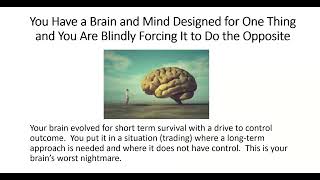
Your brain adapted for short term survival and it adapted to control outcome, actually control environment. You know, when we take that brain to trading it wants to control outcome, winning and losing. And it's built to do that. It is absolutely dedicated. It is on a survival instinct level that it's doing that. And that, my friends, is what you bring to training. And ultimately what you do is you give, you force a brain designed for one thing, built for one thing, and you force it to try to behave differently without any, any, any training. Okay, he's just going to make it, he's going to learn how to do it. I can think through this. This is not about thinking, friends. This is not about thinking at all. This is about managing emotions and managing the deep beliefs.
That you have about engaging uncertainty and the challenges of living. And this is where it gets really interesting because ultimately we are not taking into account the survival instinct program in the emotional brain. You know, when you see a shark, you know, and you just hear that and you see like.
When you see that big huge mouth open, there is just an instinctual fear. They're primitive primordial animals and ultimately the more knowledge you have can lead to more fear. This is the whole thing.
We have a thinking brain that if we could manage the emotions of the time, that thinking would allow us to become probability based mind and be able to work with the uncertainty in a calm way. But the thing is, is that your thinking brain is just simply not in control. Thinking by itself is an afterthought. It actually creates an alibi, it creates reasons, it creates a fiction that supports whatever the emotional brain has already decided. And ultimately what you're doing is saying, well, how would I possibly go about learning to be able to be calm.
Right in the face of uncertainty when I know that my caveman brain views taking a loss.
As becoming somebody else's launch, being killed.
That's what's happening on the primitive instinctual level. When you see taking losses, finally it gets to you and you just don't want to die. And you react and you, you fire off and you fight to the finish. And unfortunately it's not, it's not to the advantage. And here, here we, what I really want to do.
Is really the power of two minds, two brains. That tip of the iceberg is your thinking brain. That's the one that you think you identify with, that's the one that can read, that's the one that can do all this cool stuff. It's the one that can put a spreadsheet on and see how great trading can be for you. And the difference though.
That thinking is emotional state dependent. And when we start talking about the subconscious mind I actually prefer calling it the emotional brain, the mammalian brain, because at that level, what that brain is trying to do is trying to find out whether or not you can handle challenges to. From coming from the environment means risk with the, with the trading mind, with the trading markets. And all of a sudden you're looking at it and going, it's already built. It's built processes that react automatically without thinking before you would ever even think about thinking about it. It's already, it's chemistry of emotion already in the bloodstream long before you're looking at it and decide to think about it. That's the problem is that you get yourself stressed and in that stress fearful. And all of a sudden you're already primed to jump to fight flight. And what we're saying is that's what the brain is supposed to do. But if you want to be a trader, you're going to have to rewire it. You're going to have to build a workaround so the brain doesn't do what it's supposed to do. It's going to fight, it's going to flee.
Fight flight in the presence of uncertainty that it doesn't think that it can handle and it has a lot more say. So about 95% of your decisions are made by that subconscious of the emotional link, the brain below threshold of consciousness. Thinking brain doesn't even know about it. Your emotional brain doesn't think in language, your thinking brain does.
Your emotional brain doesn't think. It reacts and builds systems that are automatic. When a danger shows up that it's automatically there. Time is sweet. It has to be done really, really rapidly. And to look at this differently, here's the problem is that in this illustration you see the geeky modern man driving the brain thinking he's in control. And that's exactly what you're thinking when. Oh yeah, I have a methodology that works. I have a system that works. I'm really good for it. All I have to do is follow my plan. Well, the problem is following your plan depends on getting the buy in from the guy in the backseat, the caveman. He doesn't have a thinking brain. What he has is he has an emotional brain engaging in the world. And to him the emotion. Emotions are not psychological. Emotions are biological action potentials waiting to happen when there is a change in status in the environment. When you've been looking at your charts, have you ever noticed their changes and status changes in the direction of markets and things like that? All the time, yeah. So what you're doing is you're trying to pretend the caveman or woman is not there and it's just getting cranked up. Meanwhile, you think you're controlled, everything's fine until you reach that stage where, oh my God, you know something?
I feel like I'm going after prey. I feel like I'm about to lose. I'm doing all that, all that stuff triggers the big deal. And this is what we need to develop. We need to be able to develop.
That. You know, you find out that believing that thinking will work, you just keep banging your head against the wall before you finally decide, you know, there's something wrong with this thinking thing. I'm not going to out think this. No, you're not. You're going to have to actually get to the beliefs that you have about your ability to manage uncertainty that are deep, deep sense all the way deep down in that emotional brain of yours. That's how it's going to work. Because here's the truth. When you take a look at this illustration, what you're looking at is that one is that you do not.
You do not see and then believe the truth. What you do is you believe in the truth, then find it, then see it. You see that you're not a rational being, no matter how much in control that thinking brain of yours thinks it is. The moment you add stress to the kettle, something happens. You get to the moment of where you realize that you're actually an emotional being that uses reason to rationalize what the emotional brain's already decided. And it has decided based on beliefs.
That it has like created about your ability to manage the challenges, the uncertainties of life, of the markets. And so you get an assessment that becomes a belief and it takes on the feeling of certainty, of truth.
It's all chemistry. But once you start believing something, that becomes the narrowing of vision that doesn't allow you to see other things around. If you believe that you know how to really, if you beat yourself up and condemn yourself and all that stuff and give yourself a really hard time after a trade tell, you're worthless. You shame yourself, do all that. You're demonstrating your beliefs right there about your value as a human being and you're tying it to, you're tying it to winning or losing. And you have given the markets way too much control. So get this. As you do not see and then believe. You believe, then you see. And what your trading account is doing, it's revealing. It is really, it is revealing the beliefs that you really have about your ability to manage the Uncertainty and the risks of trading, that's what it's doing. Now. Most likely, you don't want to see those beliefs. You would like to put distance between you and them, but the truth is that's not going to do any good. It may work in other areas, but the time compression of day trading, you're going to have to master those beliefs or you're going to be in really big trouble. And a lot of people get in really big trouble. So there you go. So these beliefs we're talking about are not thinking beliefs. They're not the ones that you talk about, you know, and that I can control this. I can do that. I believe this. I believe in apple pie. It's not that.
Those limbic beliefs are actually called limbic learning. And when the emotional brain's engaging the environment, it's learning how to operate for survival, instinct for surviving the next moment. Then it locks it in into circuitry. The circuitry gets myelinated, insulated, and it becomes a hot circuit so that every time that you see a stress, that circuit fires and you don't even have to think that's what's happening. Then into the brain goes all this sensory modality from your eyes, from hearing, from smell, from taste, from touch and bodily feeling, Kinesthetic stuff that's input coming into a brain who has never, ever experienced the light of day. It's down there in the dark, perpetual darkness down there. And what it's doing, it's building a symbolic representation of what the world probably is like out there.
And in fact, there's no world out there. What there is, is there's a world that the brain is creating, and you're looking, and it's done through beliefs. And that's what you're seeing in the health of your trading account. And out of those beliefs, okay, and biases and assumptions becomes your decisions, and out of those decisions becomes your behaviors that you do all that crazy stuff that you're trying to pat down and trying to stay calm, cool, and collected while you trade. But this is. This is the way it works. And what we're looking at right here, this is all neurobiology. Okay? In neurobiology, what would we. What we would say is that you have a brain that starts firing so much. It's a big, huge.
1960S muscle car, and it fires so much that it produces states of constant consciousness. But understand this. The brain, the mind, is really more of a space.
Where all these forces, these emotional forces are at play with one another. They're very competitive with one another, and they're trying to take control of the way that you're organized as a self. And if you happen to have scarcity thinking, what happens is you start looking for more and more confirmation about something. If you're looking to hit a home run, what happens? You jump into trades that you don't even fit your rules. So you're looking at this and going, wow, this is what's happening. This is what's underneath the hood, friends. And you're going to have to learn to deal with it, because what happens is this what you're seeing. 95% of the decisions that the human being makes are not being made by thinking. You're not even aware that decisions are being made. The limbic system, the emotional brain, is making those decisions. And I'll tell you what, this is the way it works. I have. We have a hardware store here called Lowe's. It's a big, huge super box. And what happens is a lot of guys show up there and they get in these really big, huge, monster pickup trucks. And they cost a lot of money, too. You can put 50 to $100,000 in one of these trucks easily. And then what happens is, you look at these guys and they look like me. You know, they're middle age beyond, and they have that little pouch that guys get, and they. They don't look like they've done very much hard labor recently. And they're in a truck that is built for work. It's manly, it's masculine. And what you notice, that truck doesn't have a scratch on it. That guy is not driving that truck because he needs a truck. He's driving that truck because he wants to boost his testosterone. So. And his masculinity and feeling good again because he doesn't produce any testosterone anymore. Advertisers know that, and that's why they have those big, huge things. Meanwhile, so he's feeling really confident about his ability. This is that engine purr in that massive truck. I can. I can conquer anything. And then what happens? He gets on snow, he gets on black ice and takes a turn. And all of a sudden, he starts skidding. Suddenly, that thinking brain that was so in control, it's no longer there. It's been disabled. All that circuitry, insulated circuitry, pops up. And before you knew it, he starts making foolish decisions, just like you do in your trading. A lot of people, particularly alphas, get bored. They want to make things happen. So they start looking at other places, check their mail stuff. Oh, I'll just check this, they'll see a trade, they'll jump into it. That wasn't even in their agenda, okay? It's that kind of stuff. They got hijacked, they got disabled because they had that. They had that urgency to act, to prove themselves, to make things happen. At the same time, you can also get disabled when that trade turns against you and it's heading toward that stop and you want to move that stop and all that because you don't want to lose, because if you lose, you're somebody else's meal. So you're going to fight to the death. That's a disabled thinking brain, and that's what we have to overcome. And what does this actually look like? I like to use this graph because it's really. It points it out. You have all this sensorial information coming down on the bottom left. It goes into the thalamus. The thalamus is, if you can take a look at it, like an area where a traffic controller is managing a lot of aircraft. They're all flying around the sky. And, you know, if there's an emergency that happened, all that aircraft controller has to start rearranging things. And if it's an emergency, man, that goes. They just stop everything and go into that. And all of a sudden the emergency takes over. When that happens, and it happens a lot in trading, what happens is that the, the route, the long route to the thinking brain is cut off. The short route, nanoseconds. Nanoseconds is directly to fight flight, the amygdala. And suddenly it cooks up with a dangerous memory in the hippocampus, and it's. And all of a sudden, the emotional response to behavior and actions already out there. Meanwhile, the information.
Never got to the thinking brain.
That air traffic controller has that much power. Okay, that's the low road. And if you've ever been hijacked, if you've ever beaten yourself up, if you've ever been hard on yourself, if you've ever just started strutting around thinking you were, I'm a winner, I'm a winner, I'm a winner. I just won a lot of money. Money. You have been hijacked and you have disabled your brain. So now we kind of understand that problem and what you need.
I love this. I'm going to read this one straight. You're looking at believe with a lie in it. You believe facts according to your emotional beliefs about your capacity to manage uncertainty.
You know, your brain creates story. It's a great storyteller. It produces a narrative of fiction and it starts trying to fit all the things that will take all sorts of very comfortable, reassuring lies and it will just build them into that belief. So you have a belief really not that isn't really performance built. It is like making you feel good and powerful. And then what happens is you test it. The problem is, is your brain cannot tell the difference between psychological discomfort, okay, if the trade's going against me, I might lose capital and a threat to life. That's a saber toothed tiger bearing down on me. Can't tell the difference. But at that time.
So that brain is looking at a saber tooth tiger bearing down on you rather than just getting close to your stop. This is the survival instinct that has to be rewritten. So.
A little bit more about evolution, okay.
From your evolutionary psychology, you're going to come preloaded with some really distorted stuff. Okay, that one, if you, if you became a trader and you had looked at the numbers and realized that only about 2% of traders ever make it to consistent profitability, if you get to that and go, well, I'm going to beat all odds, you are looking at a bias right there.
You are looking at the winning bias that you're going to. You're going to, you're going to be Rocky Balboa and you're going to win against all odds. Lots of movies are built on that premise and they do bangers. Well, that's exactly what Caveman had to do. It had to believe that it was going to win against all odds, even though the odds were against him. And we come out of that. But the thing is, when applied to trading, it gets really dangerous. The next one that you believe that you can make up for prior losses, it's kind of like crazy. No one trait is connected to another. But we believe that if we get into a hole, we're going to get it back and we're going to force it. We're going to force it, which only causes the hole to get deeper and deeper and deeper. Yet that belief, and we had to do that at one time. We had to believe that we could, we could get out of this jam. We had to believe that here in trading.
The best loser actually is the winner. The whole one of the big arts in trading is to say, you know, I know that I have a bias against losing, but the truth is I need to be able to say, you know something, I need to be able to take small losses rather than have them magnify so that when good, good wins show up, I really maximize that. So you're looking at that and go, huh? Okay. Making up for prior losses. But gee, Randy, it seems like I do. Yeah, it does seem like you do. But if you look at it long range, you're not doing it. Now we also have. I love that the brain is also built in the certainty of short term survival. It's built that way. I'm sorry, wrong slide. You're built to win. You believe that winning is going to make you the person you need to be. I got it. And the problem though, is that you can't predict what's going to happen. You know, it's something that happened in our caveman days and it. It stuck around and we still will predict things even without evidence to support it. You just feel something like that. And I work with traders with intuition also. And the one thing that the trader has to do, the trader has to be able to distinguish between.
A voice telling you to do something and a free gift.
That you can take or not take. Very few people can use intuition and win consistently long term. I know some, it's possible. But the thing is that bias really gets you into trouble. Now then, what's the last thing you believe? That winning is going to prove your value as a human being. You believe that you know something, if I win, if I make money, I mean, how many of you have started the day saying, let's make some money today I'm gonna win. The key, though, is you have just given the trading gods an enormous amount of power. You have no control over whether or not you win or lose. You're prepared to lose and keep the small, small losses if it happens to go your way with your edge. So you're going to maximize that thing. Your beliefs about winning and losing are going to have to really come under examination because ultimately the one thing that you can control is the mind you bring to the moment of performance.
If you can do that, and if you have an edge in your methodology, then you extract more capital out of the markets than you put back in the thing, though. If you think you're going to win and then start losing, what do you think is going to happen? Do you believe that little caveman brain sitting inside you is going to believe that thinking brain anymore? No. It'll take control.
Now. So.
You have a brain that's built for the certainty of short term thinking. And you never know when the black swan is going to show up, or in this case, the shark. Okay. We have a brain built around fear. It's the mother of all emotions because it worked. And by working, it allowed Us to survive and to create the species that we are. The thing, though, is that brain simply is not built.
For the management of uncertainty, for the management of probability.
It's built to win or not lose, depending on how you want to say it.
Here. You know, we're showing what a lot, a lot of people would love to think about the brain. It's a bunch of wiring and a good electrician ought to be able to go in, do some snapping here and there and organize it again and it'll be better. Or another way of saying that is they come to me and say, tell me what the secret is. Tell me what it is. What do I need to do? Oh, you mean you want me to do these? You want me to learn? You want me, you want me to take this assignment where I do breathing exercises for three weeks before you ever meet? Yeah. Well, they do them for a couple days and they don't realize. They think that, oh, I can just do it a few times and that habit will become circuitry and circuitry will become, will get insulated and it'll be there by the time I meet Randy. Well, no, it won't. You'll be particularly with breathing as a way to control emotions. You're going to be practicing that for the rest of your life as a trader. So you're looking at it and going, oh my gosh.
This is really more about reprogramming an organic substrate.
And having to watch it grow in a petri dish rather than just changing out some wire. That's what we're thinking about. Okay, and so the real question.
Your brain adapted to survive in, you know, in moments of great challenge, in moments of great safety. It was up and down, up and down, up and down.
Just like, guess who the markets.
That brain of yours.
When it's engaged in confusion. Hold on a second, I have to do a little cough here. So I'm going to turn you off while I do a cough.
Sorry about that. So.
We need to reprogram a brain.
To move from fight flight to discipline. Partiality.
That's the job. Hold on, hold on. One more. Mine.
Okay, so the very first thing, you got to get rid of abundant thinking. I'm thinking abundantly and it's just going to come to me. You need to cultivate probability based thinking. You need to recognize that there's always challenges out there. There's always different decisions that are made that you have incomplete information about. And if it's wrong, what happens is you cut it off. It's kind of scientific method. You Cut it off and you use the other direction. And it's really more about maintaining order of the mind. Yeah, you want to win, but how do you do it? You maintain order of the mind. You're not thinking, I'm just going to believe, I'm going to believe and good things are going to show up. No, what you're going to do is you're going to develop a probability based mind and when the probabilities don't work out, you cut it off short and you move on.
That's how you do it now.
So from there.
From there.
We want to rebuild a fear based brain into a probability based mind.
And the very place it has to start.
Is with you deciding that it's time to say uncle and say what I've been doing hasn't worked. It's kind of like that. When you look at the recovery movement in aa, the very thing that you have to do, the very first thing that you have to do is you have to come to the moment that you by yourself are not going to conquer this problem. And in this particular case, what you're doing, you're saying, you know, I've tried hard, doesn't mean that I'm a loser. It just simply means I need to find a teacher. I need to find a way of understanding this thing that would open a door possibly for me.
And so out of this, the very first thing is that accepting that what you're doing now is not working, it's really hard to do that. Everybody takes so much pride and all this that the other. But ultimately this is what's going to have to be done in order to be able to say, well okay, I am now ready to learn. I'm ready to learn and figure out how I can move through this. Rebuild circuitry of a brain, build new beliefs that gives rise, that gives rise to a very new brain. Okay, that's what we really need to do.
And what I want to show you here.
Is.
This is a called the yourkeys graph on stress. It's been around since about 1895 and it's highly accurate. There are two forms of stress distress which is the what you don't want to have. That's when you're losing your stuff are eustress. That's when you're positive, everything you're engaging you enjoy this challenge. It's a great thing. What you'll notice way over here is that when nothing's happening, there's a lot of boredom, there's a lot of depression, there's all that stuff. But when the stress starts going up, there is a optimum level of increased attention and interest.
It's at an equilibrium. There is some stuff there, but the thing is, it's at an optimum level. But moment you start sliding past that optimum level where your brain's really working, really producing a very good mind, it starts growing into anxiety, it starts going into basically shutdown. How does this look like in trading? In trading, you do not need to be having your heart rate in rest digest the lowest possible thing. You actually need to show that it's got some arousal in it so that cognitively you're ready, you're focused, you can really act. But the stress, the concern has not gotten so high that it's triggering fight flight yet. You don't want the stress to trigger the body. You want it to stay minimal. That's something that I train in my course. And the truth is, how do you start really actually doing it though? It starts with emotional regulation. Motion regulation, as I teach it, is really using breath and muscle tension that are part of an emotion and part of an emotional hijacking and altering it before it gets there. If you're, if you're angry, if you're sad, if you're scared, you will have a particular breathing signature stopped or holding your breath or high, high, high level stuff, you will have tension in your body. That's the emotion that's already triggered and is revving up power. That's stress. By breathing and breathing alone, you can interrupt that process because if you're breathing diaphragmatically, you cannot be scared.
You can be concerned, but it will not fly. Jump over and fight flight simply because fear requires holding breath, it requires panting, it requires tension. And if you take those away to relaxation, you will actually have a relaxation response rather than the stress response.
The problem is that emotional regulation by itself is not enough. We have to find a way.
To open the door of the mind.
And to be able to look in and decide what's there. But the deal is this is that.
When you have the ability of calming the mind down, it allows you to get to the mind and begin to say, well, how do I start looking into the mind? No back, I'm still on the brain.
There you go. This is where we're at. We're saying, how do we develop the ability to observe what's in that mind? This is when mindfulness becomes a very, very important tool.
The major thing is really here.
The truth is this is that you and your thoughts, you and your beliefs are not the same. You do not have thoughts and beliefs. They're creating your experience. So you begin to see this guy on the left. What he's done is he has merged. His observer has fused to all the thinking and beliefs about it and he has become that it's controlling his destiny. On the right, you see this guy stepping back out of them and recognizing that these aren't me. These are thoughts running through mine. Do I want to identify with them? Do I want to fuse to them? This is where you have choice. Okay. All you are is one potential organization of a self. That's all you are. It's. You are not you. As a final sense, you are an organization that was successful at one time or it wouldn't have become a self. And you've brought it to trading. And it's not. And it's not working, working well at all anymore. That's what the problem is.
So now you get it, is that you can become the designer of the self that trades. And what you're really looking at is. You're looking at. You have a number of forces working in the brain as emotional programs and being given for a voice.
In the mind. Understand this. The mind emerges from brain because of the transactional speed that it has. And suddenly it's there. And that mind.
Becomes literally a committee of the mind.
So now we've got it. Oh my gosh. The brain's a community of rival emotional programs that is duked it out to organize itself. Yes. In the mind is that space.
Where those emotional programs now having voice, begin to start organizing. And they become the governing committee of you, the self. And what most people discover is that they've lost control of that. But, and I'm observing, learning how to observe. This is what you really discover.
The very first thing you want to do is to find the historical internal dialogue. And that has been pestering you for a long time. You will know that by if you're hard on yourself, if you beat yourself up, if you get yourself all pumped up, that is the historical internal dialogue. And it's led by.
Something I would call the internal inner critic and also what I would call the adapted self. And you're looking at this thing going, wait, nobody likes to deal with that inner critic. And so they try to ignore that part of themselves. And by doing that, it gives that inner critic enormous power over. Over basically what in the world you can do with yourself. But this is the one thing that has to get mastered. Because that little angel looking critter, is that what I would call the adapted self. And that's where you carry the self lending beliefs that you have brought to trading. And you will have brought self learning beliefs based on your trading count to trading. And what you really want to do is find out what the inner critic is saying to you about who you are as a human being, about your mattering, about your worth, about your adequacy, about your lovableness. And then you really begin to say, well, what did I swallow and what do I, what do I, what have I merged with? About, you know, an Alpha saying, you know something, I want to make money because then I'll matter. I want power because then I'll matter.
The perfectionist says, you know, if I do everything right, I won't be wrong. You're beginning to see how these old historical dialogues really, truly limit the ability for you to perform well. Then.
It just so happens that this is the organization itself that will sabotage you.
It was at one time an invention of the brain to create a cell that worked.
That worked. You know, ultimately everybody in a family system has learned a role that helps support the instinctual short term survival of that family system. No matter how sick. You know, I grew up in an alcoholic family system where, you know, my job was to be surrogate parent and my job was to take care of my mother and to calm her down. My brothers was to become a scapegoat. He created so many problems that my mom and dad never had a chance to look at themselves. My sister didn't fit in to a lot of this. And what happened is that she ended up being what we call a wallflower. She just went to her room and kind of disappeared. She couldn't participate. She just stayed out of the way. This is happening all the time. It really depends on is your observer locked into that. And that's certainly going to be showing you in your trading. So self mastery is inevitable in this game. And then the fourth skill that I teach is actually to find the hidden strengths, the empowerment that lives within you as potential and how to access it and how to develop it, how to summon it up to the point where what you're doing is you're summoning up an emotional cocktail that gives rise to a mind that can deal with uncertainty quite well. Thank you. Rather than the old mind that had a really hard time with uncertainty and risk of capital. And what we're looking to do here, we're looking to develop the discipline of a ruler, the courage of a warrior, the self soothing of a caregiver, and the impartiality the clear thinking of a sage. And probably one of the best movies of all time for looking at these archetypal strengths within humans is you take a look at it. You look at Eragon, there. He's ruler, he's the discipline. He's maintained order. He ran this thing. Yeah. In the Lord of the Rings, you're looking at the elf that he fell in love with and that was the caregiver, that was the one that was willing to give up her elfhood to be with him. Then you're looking at Gandorf.
He's the sage. He's the one that has the wisdom. You're also looking at Frodo, who found the warrior within the discipline within to be able to give up, which no human could do. Throw the ring back into the molten thing. You find warriors. You find warriors there protecting you. Find friends. You find dreadfulness. And you also find over on the very top right, you find a woman that wanted to be a warrior, was never allowed to, but found herself on a battlefield anyway. And she kills something that cannot be killed by man. And as she kills it, she's saying, I am no man. I am a woman. So you begin to see that these are traits dwelling within us. But they have been pushed away by development, by what was important. And what we're really doing is saying we're going to develop those parts of the self within us to be able to create a very different mind that engages uncertainty as you think it. This was uncertain times. This team of people had to work in coordination against great odds. So.
What'S all this far. The truth is in self mastery and particularly in trading is you're going to have to turn toward your demons, turn toward the darkness living within you, the fears within you. And you're going to have to master them. They're not going to go away. There's no tricks. What there is, is the courage of a warrior. There's the discipline of a ruler. There is the self soothing, the self compassion of a caregiver. And there's the clear thinking of a sage. With that, what happens is you recreate the self. And you do not slay the dragon like kill. You master the dragon and it becomes part of you. A very powerful part of you. But you need to know it well.
And honestly. That's what we do in our business. Okay. What would it look like in a real test? I want you to take a look at this photograph. This is no place on Earth I would ever be. You're looking at a very well trained crew working under the Direction of a captain. Everybody knows their roles and they're performing them in really rough seas.
Everybody has confidence in the captain, the ruler, everybody knows their job, everybody has their courage, they're calming themselves down and they're depending on the clear thinking that's within that group. This is where, this is what you want to pull together in your mind as a trader. You can use the old way, you can pull that together. It's, it's instinctual, it's easy to pull up fight, flight's easy. But.
Under stress, discipline, courage, self soothing and impartiality can be difficult. But if you, if you're able to manage yourself, you can pull up the sage that you want trading. So you look at this and go, wow, this is kind of what it's like. Yeah. And what you want to learn how to do is do it so well, so proficiently that it becomes instinctive itself. You know, it's the.
What you do is you, the whole conversation that you have about winning and losing.
Stops being a way of I need to win to prove myself, I hate losing. No, you have to become a really good loser. And this is really your winning is really about your performing. Can you perform at a high level in the moment? That is the trick, friends. That's the trick you move from. I'm going to make some money to prove myself, to show that I'm deserving, blah blah blah, to I'm going to perform well. Because what I realize, I don't control outcome, but what I do control is that I bring the mind that I bring into the moment of performance that you can control, friends. And it really is a decision about whether or not you want to control or not. And if you're interested, if you're listening to this going, you know something Randy, you're making a lot of sense. And that's almost one of the first things that every everybody says when they first meet me. Randy, I'm talking to you because I've listened to a lot of this stuff and this is really begins to make sense. Well, I invite you, first of all, if you've hardly ever met me, haven't, if you haven't gone to my YouTube channel and gone through all that, if you haven't read all the articles, if you haven't got the free book, if you haven't done all that kick those tires, really get an idea of what I'm talking about and what I'm teaching, then depending on where you are, get my book, get my workbook. But at some moment it really comes down to two. Two opportunities. The group course, which is happening in January and we have now nine seats left. We limit it to 30 because that, that, that's a workable crowd. When it gets more than that, it just gets, it's a, it's a bad experience for us. It's not as good. Good as you guys deserve. The thing is.
You'Re going to learn the basic skills that you need to be able to master the mind that engages uncertainty. You're going to be able to calm things down. You're going to produce the mindfulness. You're going to discover your inner dialogue that's historical and limits you. You're going to discover the power that lives in you, that you have to shape into being. And you're going to learn how to pull it forward. You, you don't ever change the challenges of trading. That's just uncertainty. But you're going to change the mind that engages those challenges. And it meets five times over a period of 10 weeks. And I teach that class. And it, it's, that's the thing is, is that it's. You don't get to see, you don't get to talk to me all the time. But we have those sessions and you get the stuff that you can. You get what you need. Also, if you sign up early, we like people early. Not because we want you to sign, we want you prepared. This course flies at you when you hit the road. You're running, and a lot of people get in right at the last moment. And what they discover is that they're already far behind. Because I'm expecting you to have worked with the emotional regulation section two or three weeks at least before we get to the. Get to the first meeting on January 19. It's the first meeting. And it's January 19. It's the first meeting. Now here's the deal.
We also give an early gift. It's emotional Regulation workshop. You can go to my website and pay $199 for it, or you can get it by saying, I was going to join anyway, Randy. I'm just going to join early so I can get started. And we were trying to reward you for that really good behavior, that way of thinking. Okay. We also have the individual course. The best way to describe the individual course, it's highly comprehensive, it's highly personal. And people who take it are looking and they want a mentor. They want a live mentor they talk to. And the main thing it has, is it has 10 sessions with me over a period of three to four months. And it, it Also has. It has some deep materials in.
Goes into heart rate monitors and stuff like that. So what I want to do is I want to thank you for being here. And if. If you have questions, we have five minutes. I would be happy to answer a few if they're on here. Let's see. Here's from Alan. When trying to make up for previous losses, which is a fallacy, by the way, could an obsessive compulsive behavior be the root of forcing trades based on previous losses? Sure. But the thing is, I wouldn't. First of all, obsessive compulsive is a very distinct understanding to me. My training is that of a therapist, and I tend to think that way.
Obsessive compulsive is something where the very first thing, if you're obsessive compulsive, the very first thing is that understand your fear based. And the obsessive compulsive is trying to control things. Okay. So that you don't have to feel your fear. The very first thing is you have to become an expert breather. Okay. But. Yeah. Can it do that? Yeah. But the thing is, believe me, not wanting to take a loss is that. That's just evolutionary psychology also.
Okay, here's from Bill. If you could have trained a caveman to have a probability mindset, you can't. Would it. Would it. Would it have made better to make a more efficient hunter than if he hunted on the basis of certainty in capturing food? Wouldn't some of the cavemen have used at least some level of probability thinking in preparing for a hunt? And wouldn't there be more successful over though than the caveman that hunted only by the basis of certainty and successful hunt? Well, you're making some assumptions, is that it wasn't until about 75 to 50,000 years ago that thinking as we understand it came online. So when you're right there, you're already going, is that. That sage like quality is not there. What you're looking at is there are plenty of very good hunters, I think of the North American cougar that are using an emotional brain, the cave brain, and they're doing a highly proficient way of doing it. They're not thinking. But the thing is, yeah, if caveman, at some moment, caveman was a very smart animal. Okay. And at some moment, it crossed the line into becoming something really, really different. But there's a lot of supposition here that is. It really doesn't matter. It's a mixed point. The thing is, you have an instinctive brain that Is set when it triggers to a threat, it's going to trigger to fight flight. That is what has to be mediated. Okay. This is not. This is not thinking and thinking in circles. This is literally going. I have to mediate that power that the emotional brain has to hijack thinking.
As a trader, you don't really have a choice. Are you going to get washed out really? Well, you can hang around for a long time in regular life. Okay, this is Jordan. Thank you, Randy. I enjoy webinars every month from the UK. Yay UK.
And one of my 2023 goals is to join your individual course. Well, congratulations. So I will be seeing you next year. Congratulations. Thank you very much. And thank you. And this is from Joyful. That's a what? A what? A joyful name.
Training the mind to be immune, not immune to losses, and just focus on applying the rules. Is this the edge for growth mentality?
First of all, understand you're not going to be immune to losses. What you're doing is you are taking.
You are changing at a foundational level the beliefs you have about your ability to manage uncertainty. That's what we're saying here. We're not. If people could apply the rules, there'd be a lot of rich people. Okay. But that's not what's happening. And so.
This is Captain Kurt. I love that. One of my favorite characters of all time, starting in January. Oh. Oh, you're Captain Kurt. I guess I'll be seeing your name more often. Cool. Hi. Working on the January class materials. Thanks. Looking forward to it. Have filled out journals. Not much, but some good. It's a thing of like, what's more important than anything else? The journals? You know, what you're doing is you're getting what your thoughts are, you're getting what your emotions are. In particularly, you're digging a little deep and you're finding the beliefs. But more than anything, when you practice emotional regulation, don't do it on the cd on the guided meditations. Do it while you're trading. Okay. Had to generate safe place. Hard to generate safe places. Easy to remember bad things. You know something? When I was working with violent prisoners, often it would take them six weeks or so to actually find a safe place concept. And more than often, it was more like a concrete bunker with a bunch of rifles in it. Okay. And at first I thought, how can that possibly be? And realizing that the families they grew up in, the neighborhoods they grew up in, just the adaptation the brain was doing to a very violent area, is that safe place truly for them became a bunker. I would ask, I would encourage you.
To start saying, well, where do I feel calmest? I mean, I've had a guy find his safe place in a 1965 GTO going 150 miles an hour down the road.
That was where, where he was calm. Would it have produced calmness? To me, no, but that's how, I mean, he practiced that. He, he refurbished GTOs for a living and he loved GTOs and he, he drove them like that. And for him, 150 miles an hour. That, that just was calm, man. So keep looking and just look again. It's not so much safe as it is calm. You're looking for calm mind. Merry Christmas, Randy and Doris, and a happy New Year. Well, thank you, Bill. Thank you, thank you, thank you. Well, folks, we have finished this year's series of webinars. I wish you great, great holiday. I wish you a great new year. And my hope for you is that you truly find a way to generate the dreams you have about your trading and that you begin to really true, truly find a masterful life and enjoy this great gift called life. It's something that I truly am very grateful to be alive. Okay, So I wish you a great holiday. Good night.
Thank you for getting that water.









