Claiming the Power Within You to Master the Mind that Trades
Randy Howell explains how traders' brains treat market uncertainty as a threat, triggering fight-or-flight responses that sabotage decisions. He teaches emotional regulation, mindfulness, and deliberately building new mental programs like discipline and courage to create a probability-based trading mind instead of a fear-driven one.
Questions this video answers
December 14, 2017
14 microseconds (decision cited in talk)
10-week program with five group sessions; payment plan offered (advertised price 'right under $1,200' or $239 every two weeks for 10 weeks)
Individual mentorship with 10 Skype consults; deeper, personalized program (more expensive than group course)
Program designed for four months; he advises 6 months to a year of diligent practice for substantive change
Chapters
Welcome everyone. My name is Randy Howell with my Traders State of mind and I am delighted that you're here and I am just looking forward to having our time together. And right up front, I wish everyone a merry Christmas and happy holidays. I hope everything is just opening up for you and you're having a beautiful time. Anyway, what we're here to do is to discuss something that, you know, you go, you know, we've all had those moments where it all came together and you were in the zone and you traded from an empowered mind and at the same time you go, wow, that was really cool. If I could only do that. How do I get back in that zone? How do I make it? Rather than some of the accidental talent that showed up, how do I make it a skill that I can kind of begin to trade from on a consistent basis? That's what we're going to be looking at today. And for those of you who are not used to the way I run a program here is that I hold questions toward the end. Please write your questions in, okay, as we go along and I will get to them if we haven't already covered it by the end. Okay. And at the end we'll have a question and answer section and we'll move from there. But first let's take a look at this. I get in the zone, I know I have this power, I've seen it, I have mastery for moments, but I can't make it a skill. How do I go about doing this? Okay, let's take a look at this thing. And first you go, well, you know, knowledge and luck are never enough.
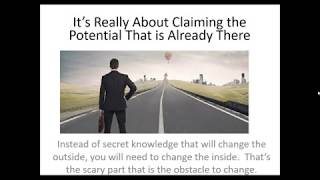
What happens to the trading mind that steers it off course. And you know, the thing is, what you're looking for is that how do you go about mastering this mine? You know that you, you see the potential, okay, you see the potential and at the same time, you can't make that potential into a mind that constantly gets consistent profitability. And what you really true is what you really find that people are experimenting, experimenting and finding and trying to find the right tool often out there that would open up, would open up success for them in trading. But the truth is, is that we, we really need to look in a different place. We need to be looking in a different place, friends, okay? We need to be going, you see again, you see the potential, but if you only knew how to tap it, it's really an inside job, okay? That's the whole point. It's really about changing the potential that's already there. If you were to Understand the brain say the way the a neuroscientist does, they would say, you know something? Really what your brain is is this adaptive organism that has organized the potential that lives within you into a set something called self that allows you to survive in the environment that you're thrust into. Born into. What we're doing was going well, we're very thankful that brain organized the potential of us to be able to survive our environment. But how about this new environment that we live in, this trading environment? How do we go about going back and asking the brain, saying, brain, I really appreciate the job that you used that you did at one time, but the truth is it's no longer working in this trading environment. Can we work together and produce a completely different mindset that allows us to produce trading results more in our favor? Okay. What you're going to notice is that instead of secret knowledge coming from the outside, what you're going to need to do is to change from the inside. That's the scary part, because human beings are notoriously scared, changing their self concept. And to become a successful trader, you're gonna need to do that. So ultimately, let's take a look at where we come from. Let's.
Why do we get stuck in certain patterns? Well, the reason we get suck in survival patterns is because the truth is, our ancestors from caveman even earlier were being subjected to a lot of scary stuff where literally uncertainty meant danger. It meant a biological threat that could come at any time. It just so happens that as we evolved into that guy at the computer, we still brought that old caveman brain with us. Okay, so really the problem is what happens to the brain under the stress of challenges. The old brain, that emotional brain, sees this as a danger to self. The brain activates its survival instincts at the very time you need to have your wits about you. That's the problem, friends. Okay? And we go, well, you know, geez, what does that really look like? And in this slide, what I want you to really see is what you need to do is that. Here's the thing, take a look at this graphic. Uncertainty triggers a sense of threat in the brain and the body. Now, have you ever recognized, no matter how much you have your environment under control.
The rest of your life, have you noticed that in trading you are constantly dealing with uncertainty? And here we are, we are now going, oh, my goodness gracious. Our brain has been designed to trigger from a threat perspective when it experiences uncertainty. And what happens there, okay, Suddenly you go from uncertainty to vulnerability. Oh, my gosh. The brain doesn't like that. To confusion. Oh my God, I'm totally what's going on. That is directly wired.
Into fight flight. That's what's happening to you when you get confirmations, but still can't pull the trigger because you've got risk there, you've got uncertainty there and you could lose your capital to your emotional brain. You could lose your life. So it sees it as successful to be able to stop you from entering the trade in the first place. It congratulates itself and meanwhile you and the rational brain says, you know, if I can't even get into the trade, how am I going to make a career out of this? Or if you've ever revenge traded, you know, what happens is suddenly something has taken something from you, valuable, you better fight to get it back. And that's dangerous because trading is so much more bigger and overwhelming. Or if you've ever experienced fear of missing out when you finally reached a profit and, and it might be taken away from you, you can feel that fear gripping you, that uncertainty that you might not be able to hold on to what you've got. And suddenly your brain just absolutely freezes on you, your thinking brain. And suddenly those emotional instincts, the survival instincts kick in and you get in with a modest profit, you get out with a modest profit, and then you see that baby just go on to targets. Everybody's been there. And this, friends, is the problem. The very highly successful brain that you brought to trading has served you well, but it becomes your biggest liability to success in trading. Now the question is, are you willing to buy into that and recognize, oh, I'm gonna have to wait, I'm gonna actually have to change the way my brain.
Engages.
Uncertainty and how it responds to uncertainty. Because ultimately what you're getting is this. If you take a look at this fella facing this bear, you know, this is what you experience every time you risk capital in a moment of uncertainty. Okay? And then you look over there on the other side, this other graph, you see that that's usually in high emotional stages. And what happens is that suddenly my higher cortex, meaning your thinking brain, is absolutely disabled. It's just like the cables cut and suddenly there's no signal going up there and everything is being done by the amygdala. That's that source of emotion, that source of fear. And wham, there you are. Your trading mind is hijacked at the very time you need to be thinking long term and probability based. But unfortunately you haven't learned how to sit there and calm that instinct. Down before it fires up, raise havoc in your brain and has you as a, as a bucking horse in a burning barn. This is what happens. The uncertainty triggers the vulnerability to threat and that activates your survival instincts for short term survival preservation. Bam. Your, your, your ability to think clearly is completely compromised and you have no business even trading. Then what do you think happens?
Well, to the brain.
It considers this to be a successful solution. It saved your life in the short term from its perspective, from that big bad bear it. And so what it's going to do is set up a pattern of expectation.
So all of a sudden you're sitting there and you find yourself in the mind in the future and you have these expectations about what, what it's going to be like to make that trade, to get her, enter that trade, to get the confirmations, to manage that trade, to be able to hit your targets. And all of a sudden, all of a sudden the training from the experience that led to a pattern from experiencing the uncertainty and the fear. It was so successful that it goes in and starts cranking on you even before the event happens. Now that's when you have dread. That's when you have self doubt or in other cases when you have grandiosity and you think that great times are going to roll on forever. That's what happens. And once habituated, it triggers automatically as you engage uncertainty and risk. That's the caveman survival brain trading with you. Okay? And the thing is, is it was really great for survival back then, but it's not good for thriving in a world of probability. You know, it wanted something completely different. It wanted certainty of survival. And what it has to learn to tolerate is probability.
That's something that it was not built to do. So ultimately what we've got here, taking a look at this guy, this is what happens to very smart people who have a lot of trading knowledge, but not the emotional intelligence to use that knowledge under pressure. Okay? People continually experience the emotional hijacking where they lose the rational control of the mind at the wrong time. And the problem is you don't see it coming. It just seems to come out of left field and all of a sudden, boom. And all of a sudden you've done something really silly and you're on the other side of the trade and you're going, what just happened? I have no idea what happened. The emotional hijacking is what just happened. Friends, okay? And it's not going to go away until you learn how to deal with it and can deconstruct the way it's currently programmed, okay? So ultimately.
There'S the potential locked up by the survival instincts, just like this acorn has the potential to become a mighty oak tree. Okay? The thing is, is that as long as the potential is being locked up by the survival instincts of the emotional brain, what happens? You've got a problem. What makes it even worse, and I see this all the time, is the trader's refusal to change. He doesn't want to change. He's scared of the change. I can't tell you how many traders I meet after they have actually blown up.
100,000, 500,000, a million, more than a million dollars. And they've blown up their capital to trade with. And now they go, randy, I really wish I'd listened to you. I now really began to see that it wasn't really about how smart I was. It wasn't really about how much knowledge I had. It was really about how emotionally intelligent I am, about being able to use emotions effectively during periods of stress. Yeah, It's a lesson learned too late by most traders, and they. They blow up in three years. That's. Yet there's that potential, okay? So what we have is we have potential to reorganize the brain, the mind, the self, into a mind that can trade in probabilities, or that it's pitted against the instinctual forces that are enormously powerful. They're going to keep that capacity to change, to evolve, to adapt, locked up. And my question is, what do you want? Because ultimately, this. This diagram right here.
I encourage you. If you haven't. If you're. If you're making copies, this is what you want to make a copy of right here. Because this is what's happening to you. Fundamentally, this is what's happening as information comes in, okay? And it's coming in through the spinal cord, going to the brain, and that's sensorial information. Its first stop is at the hypothalamus. Okay? And when it does that, what happens? A quick snapshot is made about, is this a threat that I need to act immediately on? Like that bear chasing that guy? Okay. Or.
Is this something that is not. Is not threatening, that I can send to the thinking brain and we can deliberate about it. This decision is made in 14 microseconds. If it decides that it's threatening, what it does is it disables the communication going toward the thinking brain and enables what is known as the low road. And suddenly the impulse goes straight to the amygdala. And. And you act from instinct. You act from Survival instinct through the fight flight, that happens all the time. So what we want to do is we want to have an intervention. We want to train something so that the brain goes to the high road where the thalamus sends information to the thinking brain and the thinking brain and the emotional brain work together to produce a disciplined, impartial mind. Rather than a fear based mind or an anger based mind or a greed based mind. That's what we're looking to do, friends. This is exactly where it happens. And this is the exact G spot that you're going to have to learn how to work with and to move into your favor rather than survival's favor. So we've got that. Ultimately, at an instinctual level, this is what's happening. When you trade all the time. Your trading account is going to tell you what you're really believing in. The moment of performance, okay? This is what your emotional brain will tell you about uncertainty, risk and capital. It doesn't matter what you say you believe. It matters what your emotional brain believes and dictates. Your rational brain just makes up an alibi, friends. After it's all over with, you make up this alibi. And it sounds good, but the truth is, is that the rational brain simply.
Is the cart behind the horse, the driver of the emotional brain. So this is what we've got, okay? And this is what we have to learn how to do. We have to be able to cool that down. So ultimately you have to regulate emotion before it hijacks mind. You have to be able to keep the emotion at a particular level. You can't make emotions go away, they're part of you. The only time you don't have emotions is when you're dead. And we don't want that. We just want the emotions under management.
Ultimately, you have to get past the survival instincts of the emotional brain. And until you can emotionally regulate the fight, flight process or response to uncertainty and risk, there's not a way to develop your potential as a consistently profitable trader. You can take a year to fact. You know, I had a guy today said, you know, Randy, I've only been trading a year, but I've discovered that this is really all about what kind of mind I'm bringing into my trading. And I know that if I don't get that right, I'm never getting anything right. I'm going, my gosh, he's only been trading a year and figured this out. And he has the humbleness to be able to say, I need help, I need to, I need to fix this. Problem. Not like some magical knowledge. But I need to retrain the way my brain responds to uncertainty. The first step is emotional regulation. Because ultimately what you discover in emotional regulation is that.
Well, what you do is you calm it down. And this is it. If you take a look at this graph, understand that emotions are biological. First they take over mind. But they're not psychological. They start. They are biological. They are biological action potentials that coordinate the action.
The involvement between the organism, the trader and the environment, the markets. What you want to be able to do is to keep the emotional aspect lower, okay, at low emotions, so that the emotional brain is not hijacking the higher cortex. At high emotions, what happens is that that higher cortex is cut out and you don't. And you're just, you've gone kind of nuts and you, after it's over with, you get your mind back and you know what just happened? You got hijacked. That's what happens. Ultimately in emotional regulation, what you're doing is you're controlling the intensity, the intensity of the emotion, the way we teach it in our courses. As you use your breathing, we teach a process of, where we teach you to use bellows breathing, diaphragmatic breathing. As you're encountering the uncertainty of training, learning to breathe in a yoga studio is worthless. You're learning how to breathe and calm yourself down in a safe place. What we want is for you to be able to calm your body down, thereby calming your mind down.
An uncertain place. So you're learning how to control the emotion through breath because breath is an element of an emotion. You know, if you think about anger, you're holding your breath. Either you're panning. And the same thing with fear. It's that shallow breathing or you're holding your breath that's adding gasoline to a smoking fire. Also, the tension you hold in your body is part of the emotional arousal of that motion. You can volitionally train yourself to relax your muscles by doing that. What you do is you calm the emotional down from high emotion to low emotion. Just watch yourself. Trade. If you're trading still in these holidays and notice how much tension you carry in your body and how little breathing you're doing. You're setting yourself up for failure, for the lack of performance. So when you get that done, we generally take about three weeks to train that. So you're going, okay, what happens if I, if I learn how to regulate the emotion, is that going to make everything better? No, what it's going to do is it's going to Help you regulate the emotion so that you don't get hijacked. And by doing that, what you do is you get to the door of the mind. And ultimately what happens is you come to the mind where all this potential has been hidden. And I want you to listen this Krishnamurti quote. The highest form of human intelligence is to observe yourself without judgment. How many of you do that? Ultimately, we teach mindfulness at this particular time where we are asking you to go. What I want you to do is to recognize that you and your thoughts are not the same, that there is an awareness outside of your thoughts, and that you can become an observer of the thoughts that emerge in mind. But you don't have to fuse to them. And particularly you don't have to get into the self judgments, because ultimately what you discover.
Is that you will be listening to thoughts that you didn't even know were there that are very destructive in their nature.
And you didn't even know you were doing it. And you've been listening to them. And even though there's little evidence to support them because you've kind of blanked them out and you haven't been seeing them, they've had great power. What we're saying is, as you learn to step back and again, this is what we teach. We teach it in a couple very powerful ways, is you learn to step back out of thought and you begin to see I'm not my thoughts. As a matter of fact, what I can see is that my brain has simply organized me into a particular self that's an expression of my potential. What we want to do through mindfulness is begin to become conscious designer of the self that engages uncertainty rather than it having happened to you before you can even think. So this is the tool that we want to be able to use. And when we have the mindfulness as a tool, what we discover is, oh, my goodness, wow.
You begin to view the mind very differently. In fact, the brain you begin to understand as.
Basically a collection of emotional programs that are in an incredible competition, cooperation with one another. If you've ever seen the Pixar Disney movie Inside out, they have a great depiction about the way emotions create mind. And it has enormous impacts about the way the little girl thinks and perceives. But ultimately, what you discover in the same way that.
Emotional programs duke it out to produce the winner itself. Okay. When that emotional self becomes. When that emotional brain begins to create mind, you discover that those thoughts are given voice in your mind. This is where it's interesting, because you start noticing the Mind has a lot of different forces in it. When you're having. When you're in self doubt, notice that there's at least two conversations going on. You're debating. There is a part saying, no, no, no. There's a part saying, no, you're worthless, you'll never make it, blah, blah, blah. You start going, oh, There is an internal struggle going on within me amongst my parts. The biggest fault that most people have in trading is they don't want to say, hey, Maya, I'm not crazy. I haven't got a bunch of. I don't have all these voices in my head. Yes, you do. And until you recognize that by not recognizing them and learning how to organize them, the destructiveness stays there. What we're saying is your mind literally becomes like a trading committee, a committee of the mind, like a board meeting. And what you do is you wake up in mindfulness and recognize, oh, my gosh, this thing's in disarray, it's disorganized. I have a power struggle going on within the committee, and I need to. I need to solve that. So they're all pulling in one direction. Okay? That's. That's what we're doing. And we're recognizing there is no one final self. The self is just one organization of your potential. And what we're saying is, oh, through observation and applied observation, you can begin to reorganize it into higher functioning. This is when it gets really powerful. Okay? And ultimately then.
What you discover is that there's nothing wrong with the historical organization that you brought to trading. Unfortunately, it's built around instinctual survival reactivity. And it's not functional. It's not functional for the trading world. And it's kind of like this quote from Ernest Higginaway. There's nothing noble in being superior to your fellow man. True nobility being superior to your former self. I want you to hear what Hemingway is saying here. He's saying that you can evolve the self so that it becomes more functional in a particular environment. That's what we're looking for here. Except we're saying we're going to be taking the mind and recognizing that it just hasn't been gardened well, it hasn't been nurtured. Well, you know, the thing is, if you have a garden growing up in all weeds and stuff, stuff like that, there's lots of competition, but you're not getting very much production out of the garden. If you weed and if you fertilize, if you take care of that garden, suddenly the Parts of the garden start working together and they produce a bountiful harvest. That's what we're looking for here. So ultimately, this is why it's inadequate for the challenges of managing uncertainty and risk. No matter how you want to improve it, you have to recognize that brain of yours, no matter how good it's been, is not going to work in trading. Where you have uncertainty, that has to be dealt with. You don't want the survival instincts of fight flight guiding your uncertainty decisions. We need something else. And fortunately it can be designed.
But what I would say to you is this. It's really a training process rather than an event. There's no magic knowledge, secret knowledge that once you know it, everything changes.
What there is is changing the way your emotional brain perceives uncertainty and how it responds to uncertainty. What we want to do is we will want to be able to take uncertainty and say, I know that it's going to trigger emotions. I don't have freedom from that. But what I do have freedom of is to choose the emotions that I use to respond to uncertainty, okay? Because ultimately the old mind is built around fear, aggression and impulse as a response to uncertainty and risk. Probability demands a completely different mind, okay? And this is where, this is where you need to begin to recognize that not only is there fear as a program in your brain, not only is there jealousy, not only is there a sense of revenge and anger and a sense of like greed, what there also is is discipline, courage, self soothing and impartiality. These are already existing as emotional programs in the brain. They just simply have not been trained to be pulled forward into working awareness when dealing with uncertainty and risk.
And they need to be if you're going to become a successful trader. So this is when we go, hmm, you have to become a designer. The particular emotions that gives rise to mind that engages uncertainty, okay? This is the big deal. The potentiality already exists within you. Your job is to learn how to awaken them and to nurture them, just like that garden example into the mind.
That directs the way you actually process the uncertainty.
So from there in our training, what we teach is there is no such thing as freedom from emotion. What there is is freedom of emotion.
Okay? And ultimately what we're looking at and going, okay.
What we know is that we can actually redesign this thing. We can redesign the brain and the mind that engages uncertainty. It's going to take some work. It takes heavy emotional lifting. You know, the brain doesn't really want to change. It's found success. It's going to be resistant. It has self preservation in mind. And what you're asking it to do is step out of the comfort zone into the magical zone. And until that magical zone becomes the new norm, your brain's going to resist as it will. This is what the training is for and this is the way it works. Ultimately, the very first thing you have to do is you have to be able to disrupt the old survival circuits to free yourself from the old patterns of dealing with uncertainty. And take a look at what Bruce Lee says. If there's anybody who really learned how to face and become something more. To understand your fear is the beginning of really seeing. This is what we're really saying here is that fear becomes your teacher. Okay? To be engaged rather than avoided. The truth is, is that you may say, I don't want to hear that. I don't want to know about that, about myself. Well, your trading account is telling you all about it anyway. Nobody's fooling the trading account. And so what we're doing is we're saying no. We actually want to be able to come toward the fear. We want it to teach us. We want to master that fear.
So ultimately, the first step is you have to train yourself to soothe your fear. Okay, that's that self soothing, that's that self compassion. And most traders spend most of their time beating themselves up as a way of trying to make themselves a better trader. It doesn't work. It digs the fear deeper and makes it harder to access and to heal. So what we want to do is say, okay, the first thing we've got to disrupt those old patterns, we've got to go in, we have to face them. We have to face the fear and the underlying belief behind it. And those beliefs are pretty simple. They don't. People like to acknowledge them. It's a sense of inadequacy, a sense of not mattering, having to win to prove the self, a sense of worth. I don't really deserve easy money. I have to work hard or powerlessness, it just blows up on me. The truth is these are all parts where you are learning going, okay, the truth is if I reorganize.
The deep material within me, what I can do is I can build a mind that is no longer shackled by those beliefs that I bring to the management of uncertainty. This is the beginning of really seeing. So.
Ultimately it's like this. In the Avatar.
It was very difficult to tame the dragon, to choose the dragon, because the dragon was trying to kill you at the same time. It was something where you had to master your fear to be able to ride the dragon. Suddenly, the dragon was no longer fearful. The dragon, once mastered, became an incredibly great servant. Okay, that's the deal here. You have to master the dragon that holds you back and you no longer engage uncertainty from a position of fear, but from probability. This is very powerful and it can be done. It's just not in the movies. I see people doing it all the time. So ultimately it's just like in surfing, you know, you think about it, the brain so much wants to control outcome or it wants to predict outcome, okay? But ultimately in surfing, what you get very clearly when you take a look at that little puny little guy in there against that big, huge wave, you get it that there's no way that he can control the wave.
What he can control is the mind that engages that wave. That's where success is measured. Even if you have the right mind, doesn't mean that you're not going to take the wave's not going to get you. But the probability with you have the right mind focused on process that you're going to get a heck of a ride out of this thing. So understand that the surfer nor the trader does not control outcome. What they control is the mind they bring into the moment of performance, the moment of now. Winning and losing takes care of themselves. The really, truly great traders don't really think of winning or losing. They, they don't see winning is just simply landing on the wrong side of probability. Losing is simply landing on the. Well, I'm sorry, winning is just simply landing on the right side of probability. Losing simply landing on the wrong side of probability. You control neither in trading, what you control is the mind you bring to the process. Okay? That's what you control and, and that's what gives you the edge.
Just amazing. Think about this is you can actually train the mind to do this. And with this new mindset.
It starts taking root again. The focus gets away from winning or losing. As a matter of fact, in trading, what you do is you become an enormously good loser. An enormously good loser, okay? And if you don't like losing, don't trade. That's a really good thing because you're going to lose a lot. But I want you to look on this, in this graphic, in this image. Listen to these words. Focus on the execution process of the second serve and not on the outcome you want to achieve. Meaning forcing a short ball, for example, or not this missing what you're doing is the moment that you are in expectation out There of something that you really can't control. You've set yourself up for losing. However, if you focus yourself on what you can control, the process, the mind you bring into the moment of action, this is where it's at, okay? You have a new mindset that's focused on the moment and that's what you can't control, friends. And ultimately what you discover in probability management.
Is by controlling.
The mental process, by controlling the mind you bring, what you're doing is you're realizing.
Control of outcome has always been an illusion. Prediction of outcome has always been an illusion. It's really about. You have a hypothesis that has good probability of happening, but the truth is you don't know. When you get in, it can easily go against you. And you need to be. Once it hits a particular area, you know that you need to be out of it and you need to minimize the loss when it happens to go your way. What you want to do is you want to have the mind allowing it to run and to be able to hit targets. That's the probability management. There's no reason to get excited. It's no big deal. You know, ultimately you realize that winning is really more about the mindset that you bring that gives you an edge that allows the methodology edge that you have to manifest. That's the big deal, friends.
So.
This is one of the biggest things and the hardest things that traders have to learn. We have this whole idea about winning that we've got to be a winner, we've got to make things happen. And we even have a Vince Lombardi archetype coach saying, show me a good loser and I'll show you a loser. And at the same time, what happens is that in trading what we acknowledge is that we're not in control of either winning or losing. It's a probability. And it becomes enormously important to become a good loser, to cut your losses small, okay? Because there's going to be plenty of them. I know professional traders who only win 30% of their trades. So they're losing.65% of their trades are losers. But they manage the losses so well, they minimize the loss. And when they get, when they get the winners, they manage them so well that they do quite well. It's not about the win percent. It's really about being able to manage your losses. You have to become that great loser if you want to become a winner. In trading, the whole notion and thinking of being a winner really has to be re examined because you're managing risk, you're not prevailing Your will against another football player. So what we're really saying, then.
It'S a whole new ballgame, friends. Okay, the mind that you brought to trading is not going to be the mind that's going to produce success in trading. It needs to adapt. It needs to evolve to a new standard, to a new way of perceiving uncertainty and a new way of perceiving winning and losing. Not winning an outcome, winning in performance. You can't control what the gods of trading are up to. But during this time, what you discover.
Is that you begin to transform your thinking. You move from that caterpillar to the butterfly. You don't necessarily see it, but step by step, training by training.
You really have to make one decision. Do you really want to be right or do you want to become effective? That's really it. If your trading account is going to tell you, okay, it's going to tell you.
If you're being effective or not. You can want to be right. You can just say, it should be this way, it should be this way. But the truth is, this is a probability game and you have to give up being right to be effective. That's the big deal. And if you're passionate about trading, it's something that you're willing to do. If you're passionate about your little ego, it's probably not something you're willing to do. You'll find excuses and alibis that keep you in the game and keep you at minimal losses are just kind of hanging there. Or you blow up. You finally have Peter weigh all your time and all your capital and you leave trading. At the end of the game, though, the reason is because you weren't willing to change. You weren't willing not to be right. You weren't willing to become a really good loser in order to win. It's a new ball game, friends got new sets of rules. And ultimately the way we teach, okay.
Because ultimately, this is a process that you go through that equips you to be able to change the way, the way the brain creates mind and what mind's looking for. The first thing is emotional intelligence. You begin to understand that this is really about learning to use emotions smartly. It's not like you can't use them. You are an emotional being that has an aspect of being reasonable. You are not a rational being that has a little bit of emotion. And you're going, okay, I need to learn a lot more about that right brain, about that emotional brain, so that I can build a partnership between my emotional brain and my thinking Brain, now you're cooking. The second thing that you need to do that we teach is emotional regulation. You have to be able to start controlling the intensity of that emotion when they trigger or you'll never get to being able to build a mind. The third thing is mindfulness. We teach where you need to learn to start stepping back out of thought and recognizing you and your thoughts are not the same. You learn I and again, we have really cool ways of teaching this and a lot of it's driven by a number of the guided meditations that we use. But that mindfulness is a tool, it's not an end within itself. We call it applied mindfulness. The fourth thing is we, once you learn the mindfulness, we say, okay, now what we're going to do, we're going to spot inside the mind the historical organization itself that's stopping you from being able to achieve your potential.
That's what we're going to do. And you'll discover that there's an inner critic living within you that is very critical, very judgmental, and will tempt you and seduce you into the stupidest things you've heard the inner critic. When you have been beating yourself up, when you've had self doubt, you've heard the self, you've heard the inner critic. When you have talked yourself into jumping in trades that you know that's not in your rules. The thing is, is can you distinguish it and confront it and stop it from taking over mind? You're going to have to do that. You're going to have to say, oh, that historical organization mind. Yeah, and that fear is what we call orphan is always trying to prove itself. Or it already believes that it's a victim and blows itself up. This has to be changed. The fifth thing that we teach is how to begin to awaken the empowered self within you. How do you awaken the discipline of a ruler? How do you awaken the courage of a warrior? How do you awaken the self, soothing the self compassion of a caregiver? And how do you awaken the impartiality, the clear thinking of a sage? They're all part of your genome. They're emotional programs that come with your humanness. It's just that they have not been trained and pulled into working awareness under stress. We're teaching you how to do that as you learn to calm the fear down. First you have to calm fear down, then you have to observe it. Then you have to be able to reteach the fear it teaches you. Then it's not over there. You have to begin to realize that the internal struggle goes on forever. You will always have. As long as there's ambiguity, there will always be struggle. And what you learn to do, though, is this, is that you equip yourself to go into the struggle with the right mind rather than the old mind that led to fight flight. We're going to teach you how to produce a mind rooted in discipline, impartiality. That's the mind that works in dealing with probability. So ultimately, even when you learn that, then you start realizing that you have to produce intentionality. You have to intentionally put yourself in the zone to trade. You learn a process to do that. And you recognize that if I cannot produce that intentional mind, I'm not going to trade. Not trading sometimes is the best trading you've ever had. There's sometimes when your mind's just not right. You've had an argument with your spouse, your kids are going berserk. You've got things going on that are just. You cannot make. You can't get your head together. There's no reason for you to trade because trading requires man. It requires a mind. That's right. So you get the intentionality going, and you come to the moment where you would never trade if you could not produce the trader state of mind, the intentionality. The eighth thing is vigilance. Often what happens when people kind of get this, they start becoming successful and they go, I got it. I know. I figured this out. I have. I have the power. No, you don't. What you have is you learn a process that allows you to produce a mind that can engage uncertainty really well. But it's the process that gets you into the mindset. If you don't practice vigilance, the old default programming will come back. It's that strong. So what you're doing is you're realizing this is a process that's a lifelong, lifelong learning experience. And ultimately you can do it, though. So my question is this.
Are you ready to claim the potential living within you? You know, the surfer does not control the wave. He controls the mind. He brings to the performance. Most squander their capital and time before they realize that there's an opportunity here. This is the need right here that if you want to achieve the dreams that you have, you're going to have to let go of control over outcome and prediction of outcome. And you're going to have to trust your methodology. And what you're going to have to do is you're going to have to change the one thing you can change. The mind that you bring to the performance, you can't control outcome. You control the mind that you bring to the process. Okay, that's it, friends. It can be taught. It's there. And the only question is, do you want to claim it? Have you come to the moment in your trading career where you realize that I need to work on my head? You know, it's the, it's the piece that always messes me up and I need to correct it if I want to achieve my bigger aims or do you want to be right?
So how do you become this change? Well.
As you might imagine, we have some thoughts along those lines. The first thing, if you have never, if this is the first time that you've shown up and listened to me, what I really ask you to do is go to the website and get the free ebook. Okay? That's the very first thing. Just get the first ebook. Kind of go through it. It's a collection of articles that really drills down into this material and it kind of gives you a real look. Then explore the website. But ultimately and you'll discover there's my book Mindful Trading that really opens this stuff up. There's also lots of stuff that's available. There's more videos, there's more articles. It's a content rich site. But ultimately when it comes down to do I want to become the change? There are two powerful ways. The group course, the individual course. The group course starts in January. It's a powerful thing. It's the economy model. What it does is it teaches the process and it teaches you how to build the mind that you need to engage uncertainty. And it's taught over a 10 week period with five sessions, group sessions, where we go over this stuff and you go to a virtual classroom and get all the materials, class and work on them from there. The good news is it's inexpensive. Well.
It'S cost effective. It's right under $1,200 or.
$239 every two weeks for the 10 weeks. So we have a payment plan involved in that stuff and it makes it really affordable. If you sign up real soon, by Friday 1 12. Friday 1 12? Yeah. Friday 112 you get a free emotional regulation workshop that we sell at $199 for free. So we, what we discover is people need to get into this course earlier because when you show up the first day, it will be assumed that you have been practicing the emotional regulation work. So what we're asking is that you act on it.
The second piece.
Is the individual course. Ultimately it Is highly comprehensive and very personal. It comes with 10 consults with me on Skype and it digs really deep into your head. And it's a mentorship where I'm the one teaching you the skills. And there's a lot more to it than in the group course, but it's also more expensive.
You can go to the website and check it out. There's a payment plan for it also. And ultimately, if you're really looking at it and you're really serious, what I encourage you to do is to get a free consult with me. Just go to the website, that's it right there below you, and hit contact us and ask for the free consultation. Doris, Dolores will find a time for you and I to meet in whatever time zone you're in and whatever time zone I'm in for us to really look deeply at this and see if this has worked for you. So if what I would like to do. We have questions. Good. And here's the first question. Randy, Would you say that we subconsciously ruin our trading performance by thinking beyond what is happening in the now moment? What I'll say is. This is. You will find that I am not a big fan of the language of subconscious and unconscious. What I will say is that.
We learn, we download programming from past generations and.
We learn self limiting beliefs long before that we can think about them and they become so familiar that we push them out of mind. And that's what a lot of people call unconscious. Okay. And my job is to say what I want to do and those things will be patterns. Like for instance, I grew up in a very chaotic family where no matter what you did, things were going to blow up. And ultimately, if you saw me as an adult, I'd adapted to it so well that if things were going well, I would screw things up to have to have chaos because I was so used to working in chaos. Okay. So I wouldn't say. I would say that we. These. The unconscious is something that you need to reveal yourself and it's stuff that you've pushed outside of awareness. To me, subconscious is a lot of the brains processes that never show up in mind because they're, you know, they're out there working on your heart. They're, you know, they're taking all these shortcuts that allow the processing of the brain and mind to be focused on other things. Okay. But. Okay, another question, Randy. What activities can we do that stimulate the mind to think in probabilities? The very first thing is mindfulness. You know, ultimately, if you're to produce relaxation by breathing, by breath control and relax yourself. And then you start observing the thoughts that run in mind. What you discover is there's lots of crazy thoughts running through mind. Quit ignoring them. What you do is you begin to slow them down with breath and to start looking at them and start questioning them. And then particularly when fearful stuff comes, okay, that which would lead toward fight flight, you begin to say what is this fear?
What is the fear about? You begin to actually turn toward the fear. You calm it down. What that does is it allows you to calm the fear down. That opens you up to being able to manage probability a lot better. You have a much calmer mind. That's not triggering to fight flight. In fact, what you do is you start triggering instead of to fight flight to something called the emotional motivation of approach. And that's literally the approach motivation is what you want to be able to engage the uncertainty with. Good question though. How long would you say that it takes to make the transformation? Well, I can tell you this, is that my individual course is designed to last four months. Okay. And the reason that I have centered on that is because, you know, and back in my therapy past, I also worked with, with drug addiction and stuff like that. And what we realized is that it took three months to get the brain clean.
And it was at three months that we could start working with the, the mind for the, for what the drugs were covering up. And what I've done is I've designed my program for four months because it gives me. I'm not assuming that you guys have addiction problem, but what I am doing is it takes that long to take emotionally wired in patterns and to bring them forward, to be able to observe them, to be able to deconstruct them and to be able to reconstruct a better emotional response to uncertainty. So I found four months. However, what I have found over time as you really implement this stuff, I find that it takes really about six months of diligent work to be able to use the materials to start really, really building that probability based mind. And I got a. Interestingly is I got a. An email today from a guy who was in my course about a year ago and he said, randy just wanted to write you and let you know that I've had my first profitable year. And it's interesting is that I don't use a lot of the methodology that I learned where I was at, but I'm using your stuff all the time. And it's the piece that created the corner that allowed me to Open the door into consistent profitability. So it took him about a year. And that's, you know, if you think about the years and the effort that traders put into stuff.
Six months to a year is a reasonable amount of time to be able to change the brain and the mind that you've got born with.
It's a challenge. How do we break old thinking patterns? Well, I can tell you how I teach them.
And this is also in my past. I've done a lot of treatment of post traumatic stress disorder, which are patterns on steroids that really throw amok a way a person can relate to typical stressful situations. The way you ultimately do it is you prepare for it. And it's much the same way in this course, what you discover is the very first thing you begin to understand how the brain encodes memory. Okay? And you begin to go, oh my God, it's just not happening. There is no real memory in there. There is an observer that is encoding an experience into memory. And what we're doing is we're realizing that in the encodement, a lot of stuff was missed. Okay? What we're doing is through emotional regulation.
We'Re slowing the fight. Flight response to threat. That's the first thing that we're doing, okay? And understand in trading.
The moment that you're risking capital with an uncertain future, you're certainly triggering the emotional brain to a presentation of threat. So you're calming it down with emotional regulation. But then what you're doing is saying, what organization of the mind is greeting this particular situation? And what you discover is that it's an untrained mind. It's a mind that's not built to be able to deal with stuff like that. And ultimately, and again, I'm just telling you what the course I teach because ultimately then what you're doing is you're saying, how do I build a very different perceptual map that can engage that old pattern? And what you do is you start turning toward that pattern. You start turning toward that pattern.
And you start calming it down. You start calming it down. And in the courses that I teach, we actually, we will actually, in the, in the individual course, we will actually have a heart monitor on you and we will actually find exactly what the pattern triggers. And we will back up from that pattern and we will train the mind before it gets to that tendency area to be prepared for the triggering of a reactive pattern. And you go into it non blindly, mindfully, and you go in and you reconstruct that pattern.
That's actually Pretty sophisticated work that I'm talking about, but that's how we do it. Okay, well, friends, it is 5:30 and I have appreciated your time. I appreciate your questions. I love those questions. And the truth is, my hope for you is no matter what, I hope you have a merry Christmas and happy holiday depending on what tradition you come from. What I also hope is that you find the courage to really embrace who you can be. And in that, what I really hope is that you go, you know something, I realize the potential is there.
I have to find the courage to be able to say I am going to shape that potential. And if I can help you do that, I would love to have that opportunity. Okay. So what I would actually say is I hope you give yourself a great Christmas present and start looking at the group course in particular. Or if you're really sitting there and you're really serious, look at the individual course and say, you know something, I need to give myself this gift. It's just like I was talking to a guy earlier today and when he says, you know something Randy, I haven't been trading that long, but I've discovered that unless I do something about, with my, with my head, I'm not going to get anywhere doing this stuff. I already have good knowledge. But you know something, I get it that I need to train my emotional response to uncertainty. Now he's, he's getting this at a year. Most traders have to spend about five years of getting their head knocked in to discover that, you know something. I need to get my head together to be able to use this really cool information and knowledge that I have and actually extract capital out of the markets rather than looking good and thinking, I'm a trader, I'm a trader. So my hope is this is, I hope yourself, I hope that you give yourself a great gift this Christmas season. I hope you get the gift yourself. Take a look at our, take a look at our offerings. Take a look at that group course. Take a look at the individual course and really think about it. Okay. And say, do I really want to become the potential I know is there? Am I willing to pay the price to do it? That's what it comes down to. Am I got the courage to face that I need to change. So friends, I wish you a great, great tidings. I, I hope that your new year is wonderful and whatever I can do to help you, that's what I would like to be able to do. Thank you. Peace be with you.









