Controlling Your Emotions Under Pressure
Randy Howell explains how fear and uncertainty trigger your amygdala and hijack rational thinking, why paper trading feels nothing like risking real money, and how to rewire your brain through emotional regulation, mindfulness, and building what he calls a committee of the mind: discipline, courage, self-compassion, and impartiality.
Chapters
The broadcast is now starting. All attendees are in listen only mode.
Welcome, friends. My name is Randy Howell and I'm with Traders State of Mind. The first thing I want to know is, can people hear me say if someone would kindly just place a yes in there and stuff like that under the question box. Yes. Thank you. Thank you, thank you. Okay, so we know we've got that. That's good. And just to let you know, we're having some significant thunderstorms happening around us, and if power were to go out, we have a generator that would immediately come on. So if we get knocked out, just come right back in. Okay, so what I want to do today is talk about what in the world goes on with you when there's pressure. And in trading, we're specifically saying there's an uncertain outcome and there's money at risk. What actually goes on that takes and pushes you over the edge and causes us not to be able to be able to do the work that we're supposed to be doing. And we seem to be having something funky going on.
Dolores will be fixing this. There we go. We're back. There you go. So the deal is, is we're saying we really want to look at trading more holistically and say what is it really is necessary. And where I want to start. Oh, one last thing is on questions, for those of you who haven't come to my presentations, is I hold questions toward the end and I generally have enough time so people can ask whatever questions they need to and stuff like that. But to be honest with you, it just kind of jars me and gets me off my track. So it's just found out to be the best, the best solution. So here we go. Now, you know, intellectually, when you start looking at trading, you go, wow, you know something? This. This looks easy. I can do this all day. Now, what you might notice is these are actually collegiate swimmers who've been in a pool and swimming for most of their lives and can stay underwater and do all this stuff. But when you look at it and go, yeah, this is kind of like when I look at trading that I know nothing about and I don't really understand what's required. This whole thing of, like, uncertainty and probability and all this stuff, and then they're teaching me these systems that allow me to manage risk, it just looks so easy. All you have to do is to plan your trade and then trade your plan. Everything is going to be okay. You're going to have the edge, and by doing that, you're not going to Be taken away, moving into other areas that you don't belong in. And it just looks easy.
Then boom. Then real risk shows up. And, you know, it could be a shark, but at the same time, you and I, as Homo sapiens, are wired with a brain that looks at uncertainty as dangerous.
We look at uncertainty in the same way that we would look at staring down a saber tooth tiger or a shark. So you're going, okay, yeah. You know, when you have the cage there over here on the left, what you're looking at is paper trading. Okay. It's not really risk. You can hit the reset button and everything's fine. And so really when it's, it's easy to say, yeah, that's a very dangerous shark there and it's really close. But I have all this cool stuff that's protecting me, so I'm not really at risk.
On the other side, quite different. You're out in the ocean without any protection and the risk is real suddenly, and it's a big shark, so you're looking at it and going, wow. My brain is seeing the engagement of actually placing a position.
That'S actually a maneuver into uncertainty. And the brain views uncertainty as potential threat, as potential death. So we're looking at it and recognizing, okay, it looked easy and now I understand why that when I was doing paper trading, then I could mint money, it was doing great. And then even adding a small amount of risk when you're only say, risking with like a micro 20 to $50, suddenly it's real. And the whole game saying, it's a little shark, but it's a dangerous shark. And we're beginning to say, why is that? You know, survival instincts kick in.
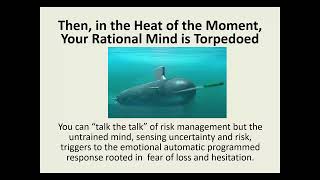
And when they kick in, that great, wonderful new brain of yours just absolutely gets blown out of the water. And the key is, why is this what is going on? Because in the heat of the moment when the risk is there, and particularly when it appears like when that trade goes against you, you've got that thing, you're in the trade and all of a sudden it starts going against you, that's when your mind, your rational mind gets torpedoed. So what is very common here, what I hear about all the time, is a lot of traders talk, the talk of trading. It's kind of like when you get around a bunch of fishermen, they start talking about all the fish that got away, this and that, the other. But the key though.
The key though.
Is you've planned that trade and then you're ready and things don't go that way. Suddenly the brain's need to be in control of outcome is blown out. And suddenly you're no longer looking at numbers on a chart.
You're looking at the saber toothed tiger staring you in the face from six inches. So we've gotten that and all of a sudden, before you know it, people who have problems with getting an entry, they have a fear of loss and they keep looking for, they kept, they keep looking for more confirmation, more and more confirmation, and sudden it gets away and then they get frustrated because now they've missed out. They have fear of missing out. And before you know it, they get themselves into a position of where they're doing really dumb, stupid things. Friends, that's your caveman brain. Until you learn how to work with that caveman brain, the limbic system. All this glorious thinking that you have and you can do if you weren't dealing with uncertainty is offline. And how do you go about getting it online? So.
You'Re in this thing of it's automatic. That's the whole point. You have an automatic biological response to uncertainty.
And that happens. You keep thinking it's going to be different next time, it's going to be different next time, it's going to be different next time. No, what you're really saying is your understanding of emotion.
And psychology.
That understanding.
Does not produce competence as a trader. It may produce competence as an engineer, as a salesman.
All sorts of different things, an accountant, who, whatever. But those are all things where you're looking to control outcome. And sometimes by sheer force, you can make things happen. With trading, even if everything lines up, you don't know what's going to happen. That is the provocation. Because uncertainty plus risk to the brain equals imminent biological threat.
If you've ever just lost your stuff and just gone crazy, this is exactly what's happened.
Where you can't take that. So let's start in the beginning. Let's start saying what, what actually produces successful trading.
You've got to start with a trading system, a platform that allows you to be able to do this stuff.
And a lot of people have breakdowns with their systems and stuff like that. And you have to get that platform working in order that you can actually act. I mean, if you have a platform that's just not filling orders and stuff like that, you're, you're missing the timing, you're missing everything. But at the same time, the second leg of that pla. Of that trading chair is your methodology. That's how you manage risk. That's literally where you're planning the trade and trading your plan, you know what you're supposed to be doing. If it goes against you at a particular area, if you're guessing it right, you know what you're supposed to do. All that stuff, everything's copacetic. That's like that first slide I showed you where, oh, I can do this all day.
Until.
You'Re trading psychology and your evolutionary psychology kicks in gear and suddenly what you discover is you're trading psychology. Really your beliefs in action.
These three parts create a steady platform for trading. This is what, this is what successful trading is composed of. What most people do is they say, well, I can do this, I can do this, I don't need help. And they get the platform, they go all around finding platforms and they find the methodology. They go find different teachers and stuff like that, and they think that should solve the problem. They never look at the trading psychology and it's the kids of death. It's kind of like this. If you take a look at a Formula One car, okay, there's no way that I'm going to get in a car like that and attempt to drive it. I know that I'm an okay enough driver in the cars, you know, passenger cars and stuff like that. But you have to have a good bit of training and a good bit of risk tolerance to be able to get in that machine and, and to be able to do what that machine can do. That's the psychology. You know, what I'm built for is not for that Formula One car. And ultimately what your brain is built for is not for trading. Trading literally is your brain's worst nightmare. It doesn't have control outcome.
Winning's not assured. You are going to lose. And your predictions may or may not be right a good bit of the time. So everything that the brain's built for for the last six and a half million years, it's just blown apart. And yet you're saying, well, I don't really have to train myself in psychology. I'm good, I'm good the way I am. When you take a look at your trading account, what you're really looking at, the health of it is totally about the performance beliefs that you have about your ability to manage uncertainty. That's what's being revealed in the health of your trading account. And if you'll notice that only about 2% of traders are actually consistently profitable, you discover not many people have got their psychology together, but those are the three elements. Why?
Why does this happen? It's because the truth is your Thinking brain would like to believe that the emotional brain, emotions don't really exist. You can become rational and devoid. That's our friend Rene Descartes trying to separate mind from brain. And before you know it though, what you discover is the emotional brain, the limbic system was there millions upon millions upon millions of years. It's also called the mammalian brain. To give you an idea.
Before the neocortex, that higher cortex, that thinking brain of yours that you want in action in trading became a tumor that grew from the emotional brain. And what happens? That emotional brain has extensive communication networks of nerves moving into the high brain, but that higher cortex only has a couple of 19th century telegraph lines going back in to the emotional brain. Okay. And that amygdala viewer is super sensitive. So this is what's happening. You get in and you're thinking, oh, I've got it together, I can think through this. I don't really have to have emotions. Yeah, you do. The only time you don't have emotions is when you're dead. And what we're doing is saying, hmm, trading really is about designing the emotions that show up to create a mind that engages uncertainty. That takes a lot of work. Otherwise what happens is that.
When a tilt happens.
Your thinking brain is just disabled and suddenly you're a bucking horse in a burning barn. No thought going on there.
So, and this is what I want to do.
This is a diagram that I've developed about what is it really, what's really going on. Okay. When, when you're trading.
And something shows up and the one that has been showing up a lot lately is the basically refusing, refusing to lose. And you just, you think it's going to turn around, you think it's going to turn around and you start throwing more money, good money, at bad money and it goes on and on and on and you blow up your account. I've seen that a good bit in the last several weeks. So let's take this from the top. Okay. There is sensorial information coming in. That stuff that you see, that stuff that you feel, that stuff you're reading with your eyes, smell, all the sensorial modalities coming in. And at the point, at some point they are all converted to electrical energy. You know, that's what happened, that's what's happening in the eye. At the end of the eye where the optic nerve comes, all the information is being converted to electricity and taken to the brain. What you hear sound waves hit your ears and hits those really fine follicle ears and then that's turned into electrical energy that goes to the brain. The touch is the same way. So this information is coming in not to the thinking brain, but to the limbic system and in particular to the thalamus. That's your gut level analysis. And when it comes in, if you can imagine, in the thalamus, it's kind of like a traffic cop. He's at a really big city intersection and he's, you know, he's directing traffic moving this way and that way and all that kind of stuff. And then all of a sudden, an emergency vehicle enters the scene. Sirens are blasting and stuff like that. Suddenly what he does is he stops all the traffic for the fire truck or the ambulance or the cop to get through.
He essentially has hijacked the regular communication, the coordination of action of the traffic, because an emergency showed up. And this is what happens in your thalamus. It's sitting there, information comes in, and it might be that. It could be that you have a hard time getting into trades. You have that paralysis by analysis. You look for more confirmation because you're scared of the potential loss. And all of a sudden that influences in the thalamus. The cop looks at that and says, oh, fear, fear, fear. Fear of loss, fear of life. And this is when it gets happened. That cop stops the drag traffic. It's no longer going to the high road to the neocortex, which, by the way, it actually takes 0.25 seconds for the information to get there before it can reason logic through things. No, what the traffic cop does is it sends it down the low road. Yeah. Which takes three nanoseconds to get to the amygdala, blowing it up and charting the whole fight flight process, just like that. And besides that, the amygdala has an enormously strong link over the neocortex. It can hijack, it can blow it up. Now, the thing about the neocortex is you need that to produce the probability mind. Okay. However, under stress, under pressure might take a loss. What happens is that it goes through the amygdala, out from the thalamus, and it goes to the reactive survival mind. And all of a sudden you're in fight flight.
And the memories are stored in the hippocampus that has these really extraordinary things. Oh, I remember. That's immediate. Like when you smell something, it's on a very primitive level. When you're seeing a trade go against you, your thalamus, your traffic cop sees that as a biological threat. All things are gone. This is what's happening to you, friends, if you really want to see graphically what's going on inside your brain, that continually blows you up when you're trying to maintain order under pressure, this is what's happening. And that thalamus is talking about very primitive beliefs called limbic learnings. Okay? Implicit memory, where it's underneath conscious awareness and it directs basically what the new brain does. It starts making up alibis, making up fictions that supports whatever that limbic system has already decided. That's what's happening in your trading. And you're going to have to fix that problem. It's not going to go away by the cell. It's this vulnerability. It's this vulnerability. I think, yep, you're right. It's this vulnerability that really triggers this whole thing. The brain, when exposed to uncertainty, experiences vulnerability. And after that, it goes bonkers. So when you're trading, guess what? You're exposed to vulnerability. You're exposed to uncertainty. That begets that. It forgets the vulnerability, and that's where it hurts. And all of a sudden, you're looking down at a bunch of crocodiles as you're walking very tenderly across that cesspool there. So this is what's happening. It's so easy. The moment that you're no longer in control, it triggers the emotional pain to fight flight. And all of a sudden, all that intricate communication going into the thinking brain hijacks the thinking brain, which you desperately need to work in probability. The emotional brain is only. It only cares about survival in the moment. That's why you get hijacked. So.
Here'S the deal. This is what you really have to look at. Here is what we're looking at. You have an activating event, okay, that, and that would be the trade goes against you. It hits your loss limit. You move it. The trade sitting there, it's hitting all your. All the conditions that you need. And then you want more. You want more and more and more. What happens is that it's that activating event that automatically triggers the vulnerability. That's what happens with uncertainty. You are vulnerable. You don't know. You're not in control. You don't know what's going to happen. And for our ancient ancestors, that was dangerous. But what you do have, depending on your training, and this is the training on the right side of this. What you're looking at, what you want coming out of there, is disciplined curiosity. That's called approach motivation from the emotional side. And then what happens is it goes into approach motivator. You go in you're able to establish an emotional cocktail that gives rise to a mind that can deal with uncertainty quite well. It's been able to calm caveman brain and your fear down so that you can actually think and actually execute your trading plan. But at the moment of vulnerability, if you haven't learned how to do this, it's a threat to survival. The moment that happens.
It'S fight flight and you're all gone. So you're looking at it. Fear and uncertainty are linked and it so easily, it is so hot wired to fight flight that it takes an enormous amount of work to be able to say, well, you know, I can fix this problem, I can fix this problem. And the key is.
Until you solve this problem, your trading is not going to happen. This is, this is an enormously famous.
Tennis player and listen to his quote under pressure. I see things very clear.
Now that didn't happen overnight. I have no doubt that Roger was trained really well and stuff like that. I also know that he would have gone through and worked with sports psychologists and stuff like that to be able to train the way that he approaches uncertainty. He's not looking to win or lose, he's looking to perform. When you take a look at a Tom Brady, he's in a situation where he's yeah, the overall goal is to win the game. How do you do that? To perform each moment. To perform each moment. This is where you find out very quickly that method and platform are driven by the performance of your psychology under pressure. Knowledge that you've been hiding behind is never enough. I can't tell you how many bright, bright, bright people have attempted to trade and they can't do it because they have plenty of knowledge and plenty of hardware. But the thing is they don't have what it really takes. So what we need to do, if you're going to be a successful trader, you're going to need to learn how to use the emotional programs that have been with you for as human, as human beings for 6.5 million years, but have existed in our animal part of ourselves for around 600 million. So you're looking at it and going, I have to take these emotional programs and adapt them to something that they were not intended to be. So we have to use emotions to create the mind that is built, required for probability management. Now how do you go about doing that?
Truth is, there's actually one extra step here. In the process that I teach, there is a process and it starts with understanding emotion very differently than you understand it. Now they're not feelings. There's something more grand. The truth is, is you are the embodiment of emotion. We'll get to that. Then once you grasp it and you really begin to go, the very first thing you have to learn how to do, and first thing we teach is you're going to have to learn how to regulate the emotion so that it does not build up, build up, hit a turning point and then flood the body with hormones and take you out. That's actually how the hijacking actually happens. It happens in chemistry, biochemistry, it happens in physics. Now when you build that, you finally say, okay, what emotional regulation does, is keeps you from getting hijacked all the time. It doesn't solve the problem, but it's an essential piece because with emotional regulation, you can actually get to the mind. And with a tool called mindfulness, you begin to really, truly have a new understanding of the mind. And with that new understanding.
You can become designer of the mind that engages uncertainty and risk. But to do that, once you get mindfulness, you get to the door of the mind, you open the door and you start looking in. And what you discover is what I call the historical internal dialogue. And there you will find some very nasty critters and you'll discover that you, you're going to have to learn to break the patterns of how you engage with uncertainty and they're going to be resisting you. But the thing is, you find out what composes this particular submerged internal dialogue. And we'll be talking about that in a few minutes. Then the fourth step then becomes being able to free your heroic nature from exile. You know, we, we, we, we put it out, we never developed it for whatever reason. Sometimes it's just simply because we never learned how to deal with stress. Sometimes it's a family of origin issue, just all sorts of circumstances. You could have been overwhelmed by something and the, the mind just learned how to do something else. But you find your heroic nature, which we're going to be talking about, and as you develop that area, that, that part of yourself, you start embracing the internal struggle very differently from a heroic standpoint. There will always be struggle. There will always be the challenges of living.
There is no easy street. However.
What you can do is you can't necessarily force winning, but you can do something. You can control the performance that you have in the face of uncertainty. Yeah. So the last thing though is that what you'll discover, what I'm laying out here is not easy. If you're looking for a magic fix, just get off the sub. There's no reason for you to be here. What this is, is you're actually having to come to rewire the self, which is not easy. And what you learn to do is you produce intentionality of the mind that you're going to bring to the management of uncertainty as a practice. And as you do this, if any of these parts about producing the intentionality of that trader's mind, if it falls apart, you don't trade.
Trading is hard enough. Okay? It's one of the most difficult things you could ask your brain to possibly do. And there's no reason to do it when it's not stacked in your favor. So.
Emotions are at the root of cognition and color what you see, what you do, and how you engage. We like to think that that little tip of the iceberg up there, the rationality is, oh, that's reality. No, it's not. What's beneath.
That emotional brain is what has to be managed. That that is what creates the mind. And you're going to have to learn that or you're going to continually tilt. It just works that way. Or that tilting may not take the point of where you just absolutely lose your stuff and, you know, you start doing really dumb, stupid things. It could just simply take it where, you know, I just. I can't even get in my trading room. You know, I start having dread before when I'm walking down the hall to my office. Yeah, that's the kind of stuff we're talking about. And.
So what we really want to do is this. That first step is emotional regulation. But what I want to do is I want to talk about what emotions are. Emotions, from a neural, biological standpoint are biological action potentials that coordinate activity between the organism that would be the trader and the environment that would be the markets. Anytime that there is a change in status in the markets and you're sitting and looking at your charts and there's a change in status on your charts, by definition, an emotion is going to trigger and emerge. And what's interesting is after that change in status, when the emotion actually triggers, the first thing that it's doing is arousing. It's revving up, getting the body ready for action. Remember, it's a biological action potential. It's not a feeling. And so it's getting ready and it's arousing. Then at some moment, it hits a particular trip switch and it's revving up. The chemistry of that emotion starts flooding into your body and your brain. That, my friends, is what a feeling is. When you feel the emotion, you're already toast. It's already flooding in your body, altering the way you see things. Then as it's altering, that emotion is going to have a motivation. It's either going to attack, avoid, or approach. Those are the three big things you have to train your brain and your mind to approach motivation. If you're going to manage probability. It's easy to go fight flight. I mean we've been doing that since we, since the get go. It's easy, it's hardwired. So then you go, oh, the emotion can be taken in different directions. Yeah, that's where that emotion is taking you. The other element, that of the emotion, is temperament. Some of us are just more risk tolerant. Some of us are less, we're more anxious. That's the temperament that we have to find workarounds for if we're going to trade. And the last thing about an emotion is the emotional or limbic belief. And that's the one you see in your trading account. That belief, that emotional belief, it's not cognition. It's about recognizing your competence in being able to deal with the uncertainty. Can I deal with this and come out okay, or am I scared of the uncertainty? Yeah. So that's where we are now.
Now let's talk about rebuilding the mind that trades the very first place to be able to take the intensity of that motion, that arousing. Because remember, you don't want that arousal to get feeling. You're cooked at that state. That's the first thing. So how do we do that?
Well, we use emotional regulation. We don't want to get cooked like that guy. Okay. And it just so happens.
That emotions are biological. They're embodied. And what you're looking at, because they are biological.
Because they are biological, they also, they also have a signature. Part of that signature is the way you breathe, the way you hold muscle tension. And you can alter by diaphragmatic or bellows breathing, you can alter the ability, the emotion to continue revving up. It's called relaxation response. And it was by.
Howard Benson. Howard Benson. And that was in the 1980s. The thing is, you can actually disrupt the emotion from growing. You have to learn to do it. Because when watch yourself trading tomorrow, you're gonna notice it. It's not a pretty sight. You can get a camera, you can get a mirror and watch yourself trade. And you'll look how much you look like this guy in this photograph. You'll see the tenseness, you'll see all that stuff because you're, you're not knowing how to manage your engagement uncertainty at all. You're just an animal. You're just a primate, a smart primate. But you're not using the faculties of your humanness to be able to go beyond.
So the first thing, you control that intensity rather than being swept away. Now.
Just by using the body, you can actually lower, you can just, you can keep it calm, you can keep it up. By doing that, what you're doing by, by using your breath and relaxation, muscle relaxation, you disrupt that emotion to being able to hijack the mind. What a gift. And it's something that's been been taught for breathing has been taught by, since the Hindus 4000 years ago. Mindfulness has been used since the time of Buddha 2,500 years ago. So these are not new practices. But at the same time, is that I don't, I don't know very many traders when, when I first start working with them that are able to train them, that have trained themselves to stay calm by breath and by muscle tension as they engage the uncertainty of the markets. Watch yourself tomorrow, it's there. You've got to train yourself into a very different way of being in the world.
Now this, now what happens is this. You come to a moment where once you have that biological system, calm the mind can be approached in using mindfulness. What you're doing is you're recognizing something very powerful. You can step back out of thought, you can step back out of the beliefs that are driving your experience. And you recognize a really big deal. You recognize that you and your thoughts are not the same, you and your beliefs are not the same. That's just rival emotional programs being competitive with one another and organizing a self from your potential to stay alive for that moment. Very interesting. I was working with a guy today, a new client. This is a place where he's at and he says, randy, it's just stunning is what I've realized is I've been mindless for the last 10 years. I've just been trying to ignore all this stuff. And because I was ignoring my beliefs, ignoring the emotions, they were also consuming me. Well, that's how powerful this is, friends. And then again, in mindfulness, what you're doing is you're saying it truly allows you.
To be able to see where you're stuck without judgment or blame. That's the big deal. This isn't a flaw in you. This is a flaw in the human race. And it probably got exacerbated in your family of origin. But the thing is, is you're going to have to overcome this. You're born into a history. You inherit those beliefs and those thoughts, and then they start creating you. And in mindfulness, you are the awareness that watches you. No longer just a mindless participant, There's a part that the faculty of observation watches. And this is where you start discovering. It's very powerful because this is what happens in mindfulness. You can say it's mindful or mindful, mindful or mindful. You're looking at two stick figures. On the left is a human being with this high octane brain and all she is is worried, worried, worried, worried, worried, worried, worried about this and that and the other. The mind's going this and that and the other. Meanwhile, the dog being mindful is fully present in the moment.
The human is someplace else. We would say that the human is mindless and we would say that the dog here is mindful.
We want to be able to use that mindfulness, that ability to say, you know something?
I can be more than just witness to the emotions, to the thoughts, to the beliefs that create me and drive my interactions with uncertainty. Through mindfulness, I can become the designer of that mind. Okay, and this is where it gets fun. This is based on the work of David Eagleman. What I'm about to say. The brain from a neurobiological perspective is a committee of rival emotional programs that duke it out to build the self. When somehow in the miracle of mind emerging from brain, they emerge as thoughts in your mind.
And it becomes like a governing committee. Okay? And what you do is when you start waking up, you realize that you as CEO or chairman of the board have been asleep at the wheel and you have some very bad dudes in your, in your governing board. You have highly destructive elements of the self and you have very constructive, but there has not been leadership. And what you're being called to here is to reorganize the committee of the mind and to produce the kind of leadership and the kind of team. Because otherwise what you're going to find is this. I call it inner critic. It's called various things, critical voice, parental critical, parent voice, a lot of different things in psychology. But the truth is, is you have to use that mindfulness to observer, to open and look into the mind and recognize that you know something, there's some there. I need to look in there and I need to find the submerged stuff. I'm looking for the inner critic and the adapted voice.
And here's the inner critic. Have you ever self doubt? Have you ever had that, oh, I should do this or have you ever done something where I really want to get in this trade? Urgency, urgency. Urgent. Get in, get in, get in, get in. That's what I call the inner critic.
And what you'll discover, it's critical, it's judgmental, it's deceiving and it's also where it wants to.
It really wants to trigger the fear based part of you or the aggression base. So what you're looking at is going, that's just simply a part of your mind. It's not going to go away. There are some religions that take that inner critic and put him outside of the cell that's really.
That cripples your ability to use that religion. No, this part, this destructive part of the self that's within the self. And.
You also have this adapted voice. And with that whisperings of self doubt and all that kind of the urgency from that inner critic, what you're discovering is that there is what is known. The brain is organizing. And suddenly you start discovering it can organize you in different positions from that of a victim, that of a worrier, that of that of a perfectionist, that of a saboteur, that of an orphan, that of a fraud, lie to you, so that of that of a rebel. Where I'm going to show you that's called revenge trading and Alpha. I got to win, I got, I'm going to, I'm going to, I'm going to show that I'm the big deal. Yeah, those are all adaptations. And that's when you start seeing that the inner critic aspect of your being and the adapted voice part of your being, that's when you begin to see them and go, oh, this is where the real battle's at. Yes, that is where the real battle's at. What we want to do is we want to be able to produce your ability to be able to find your heroic nature that's been in exile. We want to be able to show you that you can in fact access emotional programs that have your long term best interest mind. And in the same way that judgment and fear live within you as potential.
So does discipline, so does courage, so does self soothing, so does impartiality. These are the parts of the self that you have to develop in order to be able to work in probability where you're not in control.
What you've finally figure out is what you really truly do. Control.
Is your performance. The mind you bring to the moment of performance. That's what you do. And if you want to get further on this, if you were to put Them is.
What you have to develop is the courage of a warrior. You really truly have to be able to stare your demons down, your dragons down. And you have to recognize that the dragon's there for you to master.
You can get away with a lot of really stupid self talk and all that kind of good stuff and masculinity stuff and bs. But in trading.
Your trading account is a truth meter. It tells you and you have to develop the courage to face your darkest secret or they're going to consume you. You also need the discipline of a ruler and I define rules. Discipline of ruler is that part of you that maintains order under pressure. It's there, but the thing is that you really have to develop. You have to take it out of where it's been pushed out and you have to pull it forward and recognize this is if you want discipline, partiality as the elements of the trading mind, you have to develop it. I mean you think about George Washington, the basically the father of the United States. You know something, he took a huge risk. He was one of the richest people. He married one of the richest, I think the richest woman in the new world. And then he put it all on the line.
For the creation of the United States. And yet no wonder people followed him. But he had that way of people willing to be with him, willing to fight for him. He maintained order under really dreadful situations. Also what you're looking to do is to have the self compassion of a caregiver, Mother Teresa, something like that, a grandparent. If you it is the antidote to fear. It's not courage, bravado, no compassion directed towards self is the antidote to your fear. Then if you're able to do all that, what you're able to do is actually bring the rational mind up, the logical mind. And you can trade from logic as you're engaging uncertainty, it's no longer vulnerable. You have an heroic way of organizing the potential of your mind so that it's well suited to work in probability. That's where the impartiality of a sage comes in. These are the elements, friends. And when it really comes down to it is this. If you take a look at this boat.
Now, this is a team of people that are in serious traffic and it's from real competition. Every person in this boat knows their job from the warriors, the courage from the people who know what they're doing and give advice from the captain who is maintaining water. All of them at the same time, they're trying to stay calm. That's serious water, right There and you're looking at it. Instead of choking in the clutch, this new committee of the mind pulls together. And that pulling together is disciplined, it's courageous, it's self soothing, it's impartial. This.
Leads you to be able to face uncertainty from a disciplined, impartial mind. This is the deal. And when you can do that, what you've got.
Is you have the ability of mastering the dragon, mastering your dark side that you're not showing anybody, maybe even yourself. The key is you become in charge of that internal dialogue. The self doubt's not there anymore. You soothe it, you find the leadership and.
You'Re no longer overwhelmed by your fears. What happens is fear becomes your teacher. When you make a mistake, it's not about you and your inadequacy, no, it's about your competency. Because what you will also learn is what I call inherent worth. Inherent worth is that part of you that has value just because it has value.
It's biologically wired into this and you have to learn how to view it. Is that no matter how much you lose, you're still okay. You're making money doesn't have anything to do with your inherent worth. But if money becomes tied to your sense of worth, you've got trouble in trading. So this is the elements that we put together into a program.
And what you have to do is what I've just talked about.
Has to become intentional. I mean, you take a look at this guy right here, I would never be caught dead on that. But he does not control the wave.
He controls the mind. He's bringing to the performance and interacting with that trade.
He can't be scared.
He has to be humble. So this is the whole point. You become focused on performance rather than on winning and losing. Winning really all it really means is you landed on the right side of probability. Losing means that you only really landed on the wrong side of probability relative to you. But at the very core that inherent worth is there.
And by developing that team.
You deliver your system's edge. Because now you have a psychological edge. You have a brain that has been adapted for the management of uncertainty rather than the one you brought that just simply has a really hard time. I mean, that's the worst nightmare thing. So this is where you're going, friends. And the truth is, is that you're going to face self mastery as a trader and many of you just simply aren't going to make it. Because you're really looking for the answer out there by magic by some. I had a guy the Other day, who wanted to basically just have three sessions with me that would solve the problem. I said, no, it won't. I teach process because I know that there's not magic here. There's nothing that I can impart magically to you that's going to make you a better trader. You have to build it from the biology out. So what I'm asking you is tell me something. For lasting change to occur, you're going to have to build a committee of the mind, and it's not going to be the one that you brought to trading. It's going to have to be developed. And the real question is, do you have. Do you have in you.
The understanding that it's probably not going to happen by itself? I know a lot of people that do trainer, trainer, trader, trainer, jumps. They go from one guru to the next to the other, and, you know, 10, 15 years later, they're still in the same place. You know, there's plenty of good traders, but there are very few, very people who are outside of trading coming in who really understand the task that sits in front of them and what they have to do. So my question is, who's going to populate your trading committee?
We personally would love for you to take a look at our programs. If you have. If this is. If you've just gotten to know me and go, whoa, where is this guy coming from? I encourage you to go to my website, get the free book, you know, start just kicking tires, go to YouTube. I've got well over 200 videos there that'll give you a really good understanding of this. But if you're gone, there you go. Okay, I'm still kicking tires. But.
Then you go to the book, my book, Mindful Trading, and it has a workbook that goes along with it. It has all sorts of stuff that goes along with it where you can really still stay cognitive and. And not put yourself at risk.
Read up. Excuse me.
There's a lot of free content on the website. Do the reading, watching the videos.
You know, really get into the book, start looking at that and going, oh, I think I see what Randy's talking about now. And we have two primary vehicles that we use for retraining the mind. And first is a group course that's got five sessions with me, group sessions with me. And what you do is you. You are taught the skill sets we have. We have, I believe, right at 15 people signed up for the September 8th start, and we only have 30 slots, so close to 20 now. Oh, I'm sorry. Dolores said we're up to 20 now. Close to 20. We had two signings just before we came on. Because what I want you to do, if you're going to come take the group course, you need to at least have done for two to four weeks the first chapter, the first unit on emotional regulation, or you will be lost when you get there. Because I'm assuming that you've already done it. And there's a. It's a very powerful, packed course and I haven't got a whole bunch of time to waste on people who think there's magic, so. And for till it starts the eighth. But the truth is, is that we really want you to get in early and start with the work. So what we want to do is if you sign up for it, you get a free gift at an emotional regulation workshop, which is exactly what I want to train you on. And you get access to the first class. It's powerful, friends. And you're prepared when you get there because it starts at. It starts. It starts at a. It starts at it. You hit the road running, you're going to smoke some tires when it hits. The second way is with our individual course, which is an incredibly highly comprehensive and very personal course. We really get deep down to your psychology. We really have a. You. You have.
It comes with 10 sessions with me on an individual basis. It gets to the meat of what's holding you back and we dig into it. That's a big do thing and it's a very large multimedia. It's got text and it's got videos, MP3s. And did I mention those concepts with me over a period of three to four months? I want it to be four months because I get more time with you. A lot of people like to do it less because they're in a hurry. They want to get their career cranked up. But those are the ways of working with us. And my hope for you is this is I really do wish for your success and I truly hope that you're the human being that recognizes that you're going to have to do some extraordinary development of your mind. Not because there's anything wrong with you. Okay. But because trading demands a very different mind than you brought to trading, evidenced by your stuff. Okay? So what I'm saying is if I can help you, I'd like to. However, right now I want to say thank you for being here. And if you got a. We've got about five minutes, so if there's some questions. Alan, you're a very smart guy. What beliefs are the cause of why one would like to trade bigger size and take higher risks. I've got to prove myself to be a man. I feel. I feel powerful, man. I got this money. It's the same thing when you walk into a freaking casino and you get some guy who feels large and in charge and he's. He's pushing around some big money.
It could be just absolutely blowing. I actually worked with a guy one time where he went to Las Vegas on a business trip and lost his house. He was large and in charge. But that would be one start. I don't know you, but that's a very typical thing. Large and in charge. Okay, Allen, again, if one has a belief that money comes easy and goes easy, how would that reflect in trading?
Okay. Reflect in trading in a negative way. How would it go. Go about changing it if that does not serve positive positively in trading? First of all, easy come, easy go. I don't know about you. I don't know of any trader who's not concerned about their performances and about whether or not they're making money. And the moment is easy. Kind of there is a need to be able to let go and move forward. But the deal is, it's really about what mind are you bringing into that moment. And the mind that you're bringing in the moment that's going to produce consistent profitability. It's not easy come, easy go. You know what? I would look at it. Easy come, easy go is a very frustrated kid who grows up in a family where he's never allowed to grow and be what he could be. And he's kind of just said, oh, easy come, easy go. I'll never get it anyway. Just might as well let it go or I don't deserve it. If I start making money, I don't deserve that money and I'm going to lose it. There's multiple beliefs that just get wired into us. This is from Bill, is the feeling of resignation when in a trade, a good mindset to have no in that either I win or lose the trade, it's no big deal. That's impartiality. It's big. Different reason. Resigning yourself to fate is victimhood. Okay. Or should the feeling of resignation be something which needs to be removed? It needs to be mastered. You're not going to surgically remove it, but what you're going to do is that resignation is. I had that when I. I grew up in a very profound, profoundly alcoholic home where I just didn't think anything was ever going to work. I was resigned to this insanity. And what happened is that had to be mastered, okay, that had to be mastered to become the human being I am now. This is Pavel. Hi. What beliefs are making me moving my target for a trade further away? I would have nice open profit and I would love my target. I would move my target further so that I can make more money. Greed is that what you're doing is you're saying okay you know something, I can do this but I want more, more, more, more. What you're really talking about is the urgency and it really more of probably about mattering if I make money, if I make big money then that'll be a big deal. Every Alpha I know understand Alpha needs to stay out of trading. Alpha can make tons of money in business and corporate life when it comes to trading all that I've got to win, I, I'm going to win big. I'm going to show everybody what a big dude I am. That's going to get you an enormous amount of trouble in trading. The trading gods just don't care. Okay.
Do you know about the vitamins for the brain? I do not enter that area. That's an area where I am. My big thing is the neurobiology of psychology. So I don't know about vitamins for the brain.
Moses. What? Oh that's a great name. That is, gotta be a great name. Feels like I am in your program to train myself to transform into a sniper. Even if I like scalp, right? Pretty much, yeah. I would say this, a sniper can be a scalper but the thing is is that a gunslinger, he can't be. I mean I have seen high level scalpers and literally just watching them trade, it's like bam, bam, bam, bam, bam, bam, bam, bam, bam, bam, bam, bam, bam. And he was successful at it. The thing is, is that you're trying to convert the gunslinger who eventually is going to get hit into a sniper where you know, the sniper.
The victim may be, the target, may be two miles away. But yeah, you're training yourself to be a sniper rather than a gunslinger. That's what you're doing.
Here's John. So we don't change our inherent fears during trading, but we recognize that they come out, but we learn to react different. No, you change, you master the fear. You master the fear.
When you have a fear of loss. Like I'll give you a really good example. I work with a guy, I mean.
I work with a guy who grew up in a trailer where money was always tight. Bill payer, bill collectors were there, they were Always being threatened with not being able to even have a roof of their house. He grows up and he just wants safety, okay? I just need safety. And what happened is he built a big company and was very, very wealthy and doesn't need to work, doesn't do anything. But what happens though, he still gets in the point where he is scared of losing. In his mind, his fear of losing is being left homeless on the side of the road at his trailer park that he grew up in.
That fear has to be mastered now. He's doing a good job of that. But the thing is, no, you master the fear. You're not going to use magic. You know, you're going to master it and you're going to take what I call your orphan nature and you're going to mentor him very differently so that he knows he's not alone.
And that he will have mentors around him teaching him how to deal with the challenges of living.
Renee, hello there. Once you are registered, are you allowed to take group course more than once? Yes, you are. As a matter of fact. That's a good question, Renee, is that I know that a lot of the stuff this happens, it's going 150 miles an hour for a lot of these people. So they can audit a second class for free. But better than that is that you pretty much have a near lifetime access to the, to the course. We know that it's going to take time. Okay, is that. We don't. Sooner or later it's going to end, but we don't have any plans for it at all. We want you to go through it. We want you to come back.
We want you to come back right after you finish do the course again. See how things organized. So you see. Oh my God.
Yeah, you have one audit, but I'm talking about access to the, to the actual whole program. You have access to that 247 for an indefinite future. We want you. We want you to succeed. Okay. We've never denied access to any former students. Yeah, I mean, it's just we want them. We, you know, they're there because they need to learn. So there you go. Anyway, that's it. My friends, I want to thank you for being here and sharing your time with me. I just appreciate the whole things. And if I can help you, I'd like to be able to do that. I know that my work is a lot weirder. It takes a very different way than most people's work is. But I learned when I was working with PTSD long ago as a therapist that most of what you're taught to change doesn't work. And what happens is you have to do. You have to really develop a whole intentionality of becoming designer of the self. And that's what we're teaching here. So if I can help you. Please, if nothing else, get the free book, start kicking tires, and start really finding out if you can do it on your own or if you need a little help. Meanwhile.
I wish everybody well. May their trading dreams come true. Or may you find a much deeper happiness and mastery through trading than you ever dreamed possible. Thank you very much.









