Controlling Your Emotions When the Money Is Real
Rande Howell presents a psychology-focused lecture for traders about how emotions—rooted in evolutionary survival circuitry—dominate decision-making when real money is at risk. He argues traders cannot eliminate emotions but can change the mind that engages markets ("freedom of emotion"). Key ideas: the caveman brain triggers fast, low-road emotional hijackings (amygdala ~0.003s) that can disable the thinking cortex (high-road ~0.25s); trading success requires integrating platform, risk management, and psychology; trainable skills include emotional regulation (breathing, heart-rate control), mindfulness to observe inner dialogue, reorganizing emotional programs (archetypes like ruler/warrior/caregiver/sage), and using compassion and intuition judiciously. He also discusses practical measures (use heart-rate monitoring during training) and offers courses/resources.
Chapters
The broadcast is now starting. All attendees are in listen only mode.
Oh, okay. We're starting over. Friends, I thought. Welcome, welcome each and every one of you. I welcome you because what we're going to be doing is we're going to be looking at the way the interplay between cognition and also emotion and what actually is going on when the money goes live. Okay? But first, before we do that, let's take a look and say, can you hear me? In the question box is a couple of you would just simply please type in a Y for yes or no. Yes. Good. Well, what we know then is that we're good to go. We are here to look at how do you actually control emotions? And what I want to do is, I want to be really specific with you, is that you do not have emotions, okay? Instead, what happens is emotions have you. Every thought you have, everything you do is rooted in emotion. And so that's the point. The very nature of you thinking that you're in control or can control emotions is really the biggest, one of the biggest obstacles you can imagine. Because ultimately, emotional nature, you would be dead without it. Anytime there is a change in the status out there in your world that you there is an emotion that automatically picks up. However, here's the deal is, though you cannot control emotions, you can control the mind that engages situations. So you can find out that you know something. What I can do is I can have not freedom from emotions, but you can have freedom of emotion. You can actually change the way the mind engages reality. That's what we're looking at. And let's see, we just had someone come in, and I'm going to see if I can just move this thing forward myself.
So let's see here. I can't move the slide, please.
Okay, so now we're at this place where we're going to. Let's start. Let's start with the dream. The dream that traders fall into. You know, you think about it, you start studying and you start going, wow, you know, you can make a lot of money doing this. All I have to do is learn how to trade and then I can become, you know, I can really mint money. I can. I can come to the moment where I have personal freedom. I'll be able to have the kind of.
Just the freedom that allows me to be who I am and stuff like that. And we go, you know something, that's just the way it is. We want that, we want it so bad. And then we go, you know, I want it. Why can't I have it why I fall into this dream? Why can't I fall? And why can't I just do what I want to do and do this? Okay, that's the deal. So we're there and we go, what do you mean I'm falling into a dream? Yeah. You know, you think about it, money and trading are so intertwined, it's that you really begin to say, you know something, what, what happens is that if I make money, I have power. And all I could do is I can have. With money, I can have power. The truth is that's an external. You're going to have to find locus of control. You're going to have to find locus of control inside the self, not outside of the self. And this is where we actually find this enchantment that we fall into. We find that what happens is that we really, truly believe that, okay, it's like Ted Turner, really real rich guy, is money is the way we keep score, okay? Money is. It's about winning, it's about making money, it's about having power, right? To do all this. And yet at the same time, what you discover is, that's not. Is what's going to happen. That's not the way it works at all. Now this is the place where people fall all the time. They think, you know, what happens if I can just do this and I can find that formula and I cannot make this money and all of a sudden there's going to be a pot of gold at the end of the rainbow and all that happens. And you think it's going to happen. Hold on one moment.
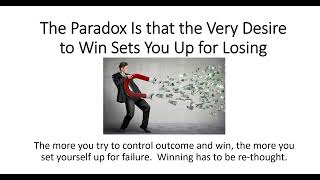
The paradox in this particular kind of concept is this, is that the very strong desire that you have to set to win, in fact sets you up for losing. Why? Because ultimately what you're looking at in trading is you do not control the outcome. We like to live in the illusion that we can control outcome. And then we get to trading. We find out that that illusion may be well founded in other areas and other times, but it is not. It does not work in trading. So we find ourselves, what is wrong with me? What is. And the truth is, there's nothing wrong with you. What happens is that you're going to have to understand that you are a social mammalian. You are a great ape. You are a homo sapiens and you carry 98% of the genetic material that are next to kin. The bonobos and the chimpanzees have. We are wired much the same way for things that happen to us. And it just so happens is that we Desperately, our caveman brain desperately wants to control outcome and at the same time it can't. So we get into this situation. What is the actual problem that keeps wrecking your trading potential? And you know, you should be winning. You know how to trade. But something happens the moment the money's real, the moment that you're sitting there going, well, what's going on here? Why can't I trade? What I see? Why, why am I having this problems where I'm getting blown out emotionally when I know how to trade? What we're looking at is your beliefs. We're looking at. If you take a look at your trading account, your trading account absolutely shows you exactly the effectiveness of the beliefs that you hold about your ability to be able to deal with uncertainty, about how effective they are from extracting capital out of the markets versus letting money go back into the markets. Okay? And here is where it's at. We often don't even know the beliefs that drive our emotions. And that is the piece that we really need to start looking at. And that's the problem. And the deal, the deal is this.
The more you try not to lose, the more that you're going to lose. You know, the thing is, is okay, what I'm, I'm just not going to get in trades. I'm going to be really safe. And what happens is I start closing down and getting smaller. And what you're doing is you're avoiding action. And so now you're going, whoa. So it comes down to, we have been able to live lives without ever having to say, you know something. I don't need to really take a look at what I really believe, not what I say I believe, but I need to look at, I need to look at my nature, about how I go about making decisions. That is what really defines the belief. You may not even know the belief. Every, practically every person I work with in trading has a scarcity belief that, that what I have can be taken from me. If you happen to be born and grew up in a house, grew up in a neighborhood and stuff like that, you're going to have that, oh, well, you know something, it's so much easier to stay in this little world than to go out and explore because I could lose. That is the peace that you've got. And we're going to have to take a look and say, how do we do that? Because fundamentally, you have a brain and a psychology that emerges out of that brain that is built for short term survival. Remember, 72 tigers were still around stalking us and eating us 12,000 years ago, that's the blink of an eye. We had to have a short term survival focus and we had to win in the moment. So from way back then to where we had hominoid ancestors, to the guy working on the computer, working on, you know, just trading and working in probabilities, that guy sitting down at that computer brings that brain from way, way back then. And I don't mean just when we emerged as homo sapiens coming out of the trees in Africa. I mean, even further back. We're social mammalians. We've got about 120 million worth of years worth of programming that are reactive in nature. And then what you're doing is you're slamming right in. When you take that same brain into trading, you're slamming it right into the midst of this evolutionary psychology. And you don't know it, but you better learn about it. Okay, so let's put it this way. Right here, you're looking at one of the things that our caveman ancestors did. Do you think this is a wise idea? Would you go and do this? These guys are taking some wood and some arrows, some arrowheads, stuff like that. And they are taking and attacking something 10 times their size. The chance of them getting hurt is high. Yet the thing is, they're all excited. These are men. These are the guys who, if I attack this, I'm going to get the thrill of victory. I'm going to win. And out of that, I get tremendous status from my community.
I get to be part of the ruling piece. They have respect. And I also have first dibs on the babes for projecting my genes into the future. This is the way it works. The men were willing to actually go in and produce a famous blue raincoat that did not have them falling victim to being hit by one of these guys. If they won, it was great. They got everything. But the problem is the chance of them winning repeatedly was slim. It got in their way. But this is the thing, is they were so wanting to kill that animal to be able to feed their village for a month, that they were willing, they were bred from an evolutionary psychology standpoint, not to see the danger right in front of them. Have you ever over traded? It's the same mechanism right there. So you can begin to see our emotions are all over the place and they are just absolutely taking us down. If we're not able to say, you know something, we need to look at this differently. And the truth is, risk and reward was not presented in a random world back then. I mean, There was danger everywhere. There was far more danger, and we had to be prepared for that danger, either by aggression or by avoidance. So when we met something, a stranger, we automatically would have thought we would have triggered to either, I better get aggressive. You know, I might need to avoid, because I don't know what the result's going to be. That is the very brain and mind that you're bringing into the world of trading, okay? Then you've got this brain, and you bring it and you bring it into this completely new paradigm that that brain is never. It's never known anything about it. You just had these dreams of making a lot of money and living a great life, and all of a sudden you're going, you know something? There's a caveman brain sitting in the back that has a completely different agenda. And when the money gets real, when the money is being really risk, that brain doesn't tell. It can't tell the difference between money, which the caveman doesn't know what is, and power to live. Can't tell the difference. And suddenly it's in that place of going, wow, you know, I can get into these traits and suddenly things go crazy, and I go crazy, I go, tilt. No, what you're doing is you're reacting from instinctual things that used to serve you well, but no longer serve you from that time, way back then, where our ancestors really needed that survival stuff, and the survival stuff is showing up and it's killing you. So now what I want to do is take a look at this.
I want you to start thinking about the system, the organic system that the trader really is, is the trader does not exist outside of the trading system, the platform, nor the methodology, the way he manages risk.
All that comes together to provide the trading account help. You have to have the platform, you have to have the risk management, and you have to have the psychology that drives that in a powerful way. These are the three places what. What is taught in most places is the platform. You know, if you just follow these rules, it sounds very simple. You just follow these rules and you'll make money. And we have these really good risk management tools and all like that. And again, all you have to do is follow the rules. The problem is your psychology is somewhere between the ancient caveman days and the modern days, and it's not prepared for the task that you're asking it to. And it's understandable, okay? It's just that's the way it's always been. So ultimately, what you get into is this.
Believing that you are separate, okay, from your platform. And your methodology actually keeps you from developing the you that actually can trade the system. You know, the thing is, is that.
To you, the trader that save the tooth tiger is really real. And at the same time the trading gods, you can fall right into the mouth to the mouth of the beast and not even know it. So body, brain, emotion and mind are inseparable. Okay? They are inseparable. And besides that, an emotion is not what you think it is. An emotion from a neurobiological standpoint is called a biological action potential that coordinates action between the environment that would be the markets and the organism that would be the trader. And anytime there is a change in status, when the trade starts going in different ways and stuff like that, there's automatically going to be an emotional response response. And all thinking is emotional state dependent. So what happens is that if that happens to.
Trigger to an angry response, aggression or an avoidance fear response, the whole thinking begins that and suddenly what you see out there is danger. Or if you're thinking that you're going to kill the woolly mammoth and have a great life and the everything's going to be great, you're going to have this euphoria and this excitement about attacking something that may very well kill you. Do you see all this stuff happening in your trading all the time and yet you didn't know what was going on. This is what's going on below the surface. And here's, this is when you really look at it over here on the left with the blue higher neocortex. What you're looking at is you're going, okay, the low emotion and that there's no danger, there's no opportunity. You're just sitting there. And it just so happens at that particular moment, it takes about a quarter of a second or more for all that information to get to the higher cortex to be able to think things through. And then it just triggers and there you are trading and you're in the zone. Yet.
It just so happens if there's high emotion, if there is danger spotted or extreme opportunity, there is, you're going to. What's going to happen is that suddenly your thinking brain is hijacked, it's cut off, it's disabled. It's no longer part of the decision making loop. When you've ever made the statement, Randy, I was just doing fine. Everything was going great and then the smoke cleared and I just lost a ton of money. I don't even know what happened. This is, this is exactly what happened. Your thinking Brain that you need for trading got disabled.
And you went on instinct, survival instinct. You acted from fear or you acted from revenge, you acted from anger, okay? And everything blew up. This is what is going to continually happen until you retrain your brain to be able to respond differently to uncertainty and the risk of loss of capital, the loss of life. Caveman. This is just a natural thing that it was very useful. It allowed us to be very successful as animals, growing and becoming something very different than any other animal that's ever done. But the thing is, we very rapidly can be turned back into a scared animal very quickly unless you go and start recognizing what emotions are and how you go about dealing with uncertainty. And the deal is this, all behavior and thinking are emotional state dependent. Like I said, you do not have emotions, they have you. This.
Understanding can change the way you trade. If you go, oh, wait a minute, wait a minute, I don't have emotions. They're having me. They're creating my experience. The question really then becomes, well, how do I learn to manage these things? How do I learn to control them? How do I learn, even better, how to use them to create the mind that I need? Well, that's what we're going to look at. First stop though. This is important.
This is a little biology and a little chemistry and a little brain science. Okay? This is what an emotional hijacking looks like. Okay, first of all, you have all this sensorial information coming in. That's the nerves bringing in information to the brain, all that kind of stuff. The very first thing that happens is that information comes to this place that I call the traffic cop. And he's sitting there and he's just directing traffic, he's moving traffic this way. But if an emergency situation happened, like a police car or a fire engine comes along blaring their sirens and stuff like that, suddenly what the traffic cops is to do, he's going to stop, he's going to stop traffic. That's the hijacking based on very tight circumstance. And at that particular time that's happening in the sensorial thalamus, all that emotional information is coming in and suddenly it's going, oh my God, this is dangerous. And ultimately it will take what is known as the low route, the low road. And it literally takes 0.003 seconds for the information to get to the amygdala and then to have an emotional hijacking on you where you're going to be in fight flight. That's what it does. What normally what you want to happen is for that information to get to the thalamus and it says, okay, we've got this, everything's fine. And we're going to shoot it along to the thinking brain where a good decision is going to be made. That's the high road. The problem with that, it takes 0.25 seconds for the information to get from the traffic cop up to the high route into the thinking brain. And then the brain has to kind of crunch it and stuff like that. Meanwhile, if the other part has triggered that low road, you've already been hijacked, okay? And you would not know it, it would happen so rapidly and you would have been into action that is instinctual for survival, not for thriving in trading. Remember, your brain is built for survival in the short term. The brain that you need in trading is about thriving in the long term with probability, where you have an edge. Your caveman ancestor didn't have the time to think about whether or not he had an edge against the saber toothed tiger. He had to trigger really quickly. So this is what's happening inside your brain all the time. Every time you go, randy, I have no idea what happened. I just, I don't get it. I don't know why it happened. Well, here it is. This is exactly what happened. So. And then another really crazy thing is that most traders try to conquer their performance problems by defining the problem is out there. I just need another system, I just need another coach. I just need another tool. When in fact they not seeing that you are always finding out the effectiveness of your beliefs that you're projecting onto, onto the markets and you're winning losses, that's what you're looking at. And most of us, we're blinders, where we cannot see that. It's a large number of people. It's really common for me to have someone who wakes up and says, oh my God, Randy, this is amazing. I've become a much better trader. And they start being really happy and telling people about it and then saying, why don't you go see Randy? And they say, no, I'm not going to let anybody in my head. I'm not going to let people find out if something's really weird in there. And the truth is now you're just a normal human being and your brain was not built for trading and you're going to have to rebuild it or you're going to stay stuck in these survival patterns. Okay, so we've gotten that and then we go, you know something? At some moment, the aspiring trader, not yet a professional, has to Realize that he is, you can call it limbically, are unconsciously writing the performance script. This is an Escher, where you're writing one, is writing the other into it. And what you're getting is that performance script is what's limiting you. We humans create narrative, we create stories about why. It doesn't need to make sense, it just needs to answer the question why. And here is, what happens is you start, you start saying, well, you know, I sabotage myself, you know, I just go on and I start getting pretty good. And then I have some, I have some really great days, weeks, maybe even a month or two, and then I blow everything up. And then you create a story about there. And the truth is, is you're constantly rewriting your script. Except most people get stuck and they don't know how to help the brain rewrite the script. That's what we're going to be looking at today. So the deal is this, is that we like to ignore that emotions are part of life, but the truth is that emotion is the 800 pound gorilla that you ignore at your own peril. And the reason that there are less than 95% of less than 5% of traders that make money, about 2 1/2% actually make the, you know, have the life. Okay, when you say only 5% make money, that doesn't mean that they're making lots of money. Okay, this is the, this is the thing, this is the beast you have to tame within here. It can be tamed, but you have to recognize is that you have an enormous thinking brain that is very vulnerable to the emotional impulses of the mammalian brain. And you're going to have to do this. And the deal is there is no freedom from emotion. There is freedom of emotion. And the question is, how do you go about working with that? And, and let's remember this, all thinking, all perception is emotional state dependent. Emotion drives thinking. If you took a look at, if you saw a locomotive and it had a caboose, what you would discover is the locomotive itself is emotion.
The person driving the train, the engineer are the beliefs you have and thinking.
Is the caboose. It's just following along for the game. It's making alibis up and that we already as human beings have a negative bias. You take a look at the news, when's the last time you saw good news on the news? It's not going to happen. They're looking for things that incite you to say, I need to be careful. I need to be able to look out and find the danger. Out there so I can react to it before it gets to the me. That's what that's all about. We have that. We're bringing that same instinctual brain into trading. This is require training. It's just, that's all it is. And the very first place you start in this whole thing is you start with emotional regulation. You're going to have to learn to keep the revving of an emotion way lower than the way it works right now. If you put a heart rate monitor on yourself right now, you started trading and you would see that you, you crack 95 beats per minute a lot. In my training, you know, what I'm doing is I'm teaching you to be able to keep it within a very tight area because that is called. That's emotional arousal. And it is. And one of the indicators of it is heart rate. And the deal is your heart rate is going to have to be within a certain level for you to be able to maintain emotional sobriety and run a thinking brain. So emotional regulation, that's the breathing, the way you breathe, the way you hold it, tension your heart rate. By changing the way you breathe, which is the first part of my course, you alter the ability of the emotion to grab you and take you away and hijack you. By being able to notice that you have tension in your body, you're saying, oh, that's emotional arousal. I need to relax the tension. I need to go back to the bellows breathing and calm myself down. That's the first thing that you have to do. Then the deal is what you're looking for. You're actually looking for the volitional management of an emotion. Like right here, you see this big cat sitting up on a limb, hanging out, sleeping, just doing like that. No, he's not. He's actually hunting. This particular cat hunts by not stalking, not by chasing, but by ambushing. Sooner or later, prey is going to walk underneath him and he's going to drop the 15, 20ft. Right now, he's in watchful wakefulness, much like the view of this guy looking at the stillness of his mind. He's in watchful wakefulness, waiting for the forest to give him something. Okay? That's the type of thing is you have to develop the patience to be able to recognize this isn't about you going out and making things happen. This is about you taking advantage of what it's given to you. So the thing is, breathing and relaxation produces calm mind. And without that, you're not going to go anywhere. Now, the second part of this thing is, this is that as you develop the mental side, you discover something powerful. You discover that you and your thoughts are not the same. In fact, you're not having thoughts, they're having you. And what you're going to also discover in neurobiology, what we would say is the brain is actually a community of rival emotional programs that are duking it out to take control of the emotional programs that actually run the mind and run you and the conditions of uncertainty. And what you're going to have to do in mindfulness, you're going to have to develop mindfulness to be able to start really recognizing that this hijacking has been going on because you have not been alert. And you have to start developing that and that you're going to have to change the organization of the self rather than the one you came stock with. You're going to have to reorganize the emotional programs that run the mind so that they give you freedom of emotion. And that's where it just starts getting good. Because this is the deal, once you do that, mindfulness is a transformational deal, is that in mindfulness you can actually step back, no longer feel, I don't want to see anything that I don't want to see. And you recognize that, oh my God, if I do not start spotting the beliefs that are driving my performances, they're going to kill me.
Many traders never wake up, they never do that. They want to keep false beliefs. And what they discover, those false beliefs lead them down to defeat. And what you're doing is you recognize you do not control outcome. You control the emotions that give rise to the mind, that engages uncertainty. That's the psychological edge that you're going to have to develop. And absolutely essential is the mindfulness so that you can actually spot those particular emotions before they just take you out. The deal though is that.
Your beliefs about your capacity to manage uncertainty is powerfully reflected in your trading account. It's the truth meter. It's the only thing you will lie to yourself. Okay, everybody has a good liar sitting inside their head. But the, the, the truth meter, your trading account is going to tell you the truth. And what it's going to do is it's going to show you the wall of self leaning beliefs. And that's the very wall that you need to start being able to say, oh, this is what's been standing in my way. The beliefs I have about my ability to be able to manage uncertainty. You're going to find out that your beliefs about mattering, I will matter A lot. If I make a lot of money. Your worthiness, I'm not worthy of making easy money. Your competence, oh, I'm just not good enough. I'll never make it. Your sense of being loved, you know, if I make a lot of money, I'll be loved. And your sense of powerlessness, okay, Those are the five beliefs that are going to drive all your problems. There's no rocket science. And if you're a human being, you've got every one of them. You're going to have in some portion in one of those. And if you're an alpha, it's going to be about mattering money and power. You want to win to prove that you matter. You know, if you have worthiness issues, I don't really deserve easy money or, you know, I can't get past this amount of money because, you know, basically what I learned in my family of origin was that nobody was worth over this amount of money. And that becomes a self limiting belief that holds you back and ties you down. So now we're going, okay, we have a way of spotting it. We've calmed the emotion down, we've got mindfulness where we can start looking and we can actually start spotting the beliefs without getting all bent out of shape about, oh my God, what if people find out that I'm not the cool guy that everybody thinks I should be? And you know, ultimately what you're doing in mindfulness is you're finally producing an observer that can observe the aspects of the self. These special interest groups that are running around your brain that are called emotional programs. And in human beings, those emotional programs are given voice because we humans started developing language. So suddenly thought was not just an electrical behavior running through the neurons of your brain. Thought took on voice. And you hear that every time you beat yourself up, you've done it. When you're your own worst enemy, the same as you talk yourself into stupid trades, it's the same thing. And what happens is that you are looking in this image. You are looking at a mind, one, you know, one cellular mind, but all sorts of different aspects, okay? And those different aspects of itself, archetypes or emotional programs, they're the ones that are coming together, creating the mind, they that engages the uncertainty. And the mind is where these programs are given voice. And this becomes the committee, the governing committee of the self that you bring to trading. This is where things have to change and they can train. Now the deal is this. Have you ever experienced when you've become your own worst enemy and you have this Voice running in the head. And it's just, you know, it's telling you you're not going to make it. And it's easy to go, oh, my God, that's my thoughts. No, it's not. That's not your thoughts. That is an aspect of your being that is called the inner critic by me. It's the part that judges, it's the part that criticizes, tempts you to jump into things you shouldn't be. It's all that, and it's always there. It's a part of your human nature. I would actually say that one thing that George Lucas got right about Star wars, that there is a dark side and an empowered side to the Force, and there is darkness within all of us. And it will destroy you in trading if you don't acknowledge that it's there and if you don't learn to master it. And here you're looking at going, this guy is learning about the internal dialogue and learning that there are mentors inside you and detractors living within, within you. And you're going to have to decide which ones of those you're going to feed and to develop into the mind that engages the uncertainty. Because if you do not believe that you.
Are worthy, just as you are, that if you win and you demonstrate by winning that you're going to be worthy, the inner critic is going to eat you alive. And out of that.
What you begin to do is you begin to really, truly learn to observe that internal dialogue, particularly as you trade. And what you're going to discover is that that inner critic is. Look at him. He's just wrapped up on that guy's ear, just whispering little things all the time. Yeah, that's it. And then you're going to have, from the inner child movement, what Carl Jung would call orphan. You're going to have this orphan nature that. That's the part that adapts you to survive, basically based on fear. Okay. And you find yourself in self doubt. It's, it's. Everybody else can have that, but it's not going to happen for me, okay? I'm not going to make it. I just had a trader tell me that two days ago. Okay, so we've gotten that. We're going, boy, this is a lot more complicated than I thought it was. Yes, it is. It is a lot more complicated than I thought it was. So now we're going, okay.
And we realize, go back one.
Suddenly it doesn't go back. There we go. You got it. So what happens if you sit an unobserved internal struggle. My promise to you is this life is struggle. You're going to be challenged. Whether or not it's in trading, whether or not it's the rest of your life. It really depends on what comes to that challenge, what comes to that trouble to deal with it. Most traders are totally unprepared to be able to deal the uncertainties and they crash and burn. What we're really saying is that you can develop, you can develop yourself so that the mind you bring is highly specialized. And here I teach. There are these archetypes, these emotional programs, this internalized circuitry, these inner resources. Within each of us there is a ruler, there is the discipline to maintain order under pressure. And right here it's symbolized by Abraham Lincoln, who kept the United States together during a civil war. It's interesting as I was working in China several years ago and I actually had Mao Zedong and I was told to take that off because most people, they had lost about 100 million people in the re education effort. And he was not considered to be the leader that I thought the propaganda had told me he was. At the same time, there is also a warrior. The ability to protect, the ability to have the courage to turn toward your fear, to master it. That's there. It's in your genome. Okay. Also, what happens is that there is something in you of nurturing. There's a caregiver within you that you have to develop, particularly if you happen to be a man, because you don't want to. You know, you've kind of pushed away all that you don't want to. Oh, that's touchy feeling. The deal is, is that compassion is the antidote to fear. Without compassion for self, you're not going to take all those neural pathways that have solidified into automatic responses to ins certainty. Compassion will take that, tease it apart, and then you can actually reorganize it into higher functioning responses to the environment. Powerful, powerful, powerful. I know that when I was, I went through heart failure and had a heart transplant. And the deal is, one of the main things that I learned really quickly is I needed to have a lot of compassion for myself because, you know, they had cut my chest open, they had taken somebody's heart, slammed it in me. And it was rough. Let me tell you, it was very rough. At the same time, what happened is I knew that compassion was the ticket out. It was the ticket to get the body to work together. So I started having compassion for myself. The discomfort that I was experiencing, the inconvenience and I also had compassion for the guy who gave up his life, not necessarily for me, but I was using his heart. And out of that, a completely different world appeared. And if you do develop those three.
Different programs, emotional programs, what happens is you end up having access to clear thinking, critical thinking, and that's the sage. And this is the part that you want making trading decisions. But you have to do the other work. You have to have the courage to feel, face your own fears, not project them onto other people. You have to have the leadership to maintain order under pressure, because there's going to be pressure. And you're going to have to have the ability, the powerful ability of having compassion and nurture for yourself so that you're developing the mind that can engage the uncertainties. And to be honest with you, that's actually done even in football. So you're getting this. You're going, wow, there's a lot more to this than I thought. Yeah. The deal is what I want you to recognize, and I'm using here, the Lord of the Rings, as a way of.
That, was a master of being able to take archetypal language, put it into a movie that we can all see. What you're looking at is that there's Eragon, who basically was disgraced from and by his family because they didn't hold up their honor. And he's coming in to reclaim that and to bring forth the new world into being. Ganondorf is a magician who has a vision. He also is a sage that has wisdom. And at the same time, you're looking at, like, Frodo and Sam, the internal war is theirs. I mean, they have to hold that. And at the same time, there has to be compassion. There has to be compassion to be able to work through this and to believe that there's going to be another day. And if you take a look at Gollum, you know, at first he was an okay little critter. It's just that he got corrupted by evil, okay? And before you knew it, he. He was pretty much soulless. All these potentialities are living within you. The deal is, is that in my work, what I'm doing is I'm teaching you how to pull these potentialities into the mind that engages the challenges of living. Not just trading friends, we just simply. I found that trading, it becomes absolutely imperative that you develop a mind that allows you to engage uncertainty successfully. But what I've. Most people discovered that we're really talking about the rest of their lives. Initially, my work was not built around traders. I ran into some hedge funds, hedge fund managers, and they opened my eyes about what the potential there. And I found that in trading, what happens is it's about the brain on uncertainty and I was home free. So the deal is this, you have this ability to organize this and then you have the ability in this work that I do is you bring that mind together and you teach yourself to become. Having an intentional mind, not just any old mind will do. You look at this guy in the batter's box, what he's doing is he's pacing the pitcher, he's getting in the groove so that he can face 100 mile an hour fastball and win. Now the thing is, as you prepare for the moment so that you're ready when it arrives, you maintain that you don't wait till it's there or knocking you against the wall. But this is the peak performance mind and everybody has opportunity to do it. Okay? They can. Most people, they're not. This is not taught. You have to learn this. You have to find specialized teachers who's going to be able to impart this. So you get it is, you know, ultimately.
Oops, hold on a second. There you go. Ultimately, this, it's here. You do not control outcome.
The surfer.
Is surfing a wave and his job is to be an expert at being able to be in control of himself. Otherwise he gets swallowed by the wave. He does not control that wave. He controls the mind that he brings to the engagement. If he does very well, he gets the ride of a lifetime. Okay, the same here is that you have never been in control of outcome. And trading, no matter what you believe, no matter what you want, control is an illusion. What you're doing is you're recognizing. I get it, Randy. I get it. Is I fooled myself into believing that by some magic by getting the right teachers, the right this, the right that, that I could just not have to look at myself in the mirror and saying the problem and the solution is right here. Trading is forcing me to make a decision about whether or not I'm going to develop the mind powerfully, intentionally.
Or whether or not I'm going to keep projecting all my troubles onto other people and other situations and stuff like that. No, what happens is you have to take responsibility for the mind that you bring to trading. The one you brought from caveman days up until now is not going to do the job. You might hear about guys making a lot of money without doing anything and stuff like that, without all this training. They're few and far between and usually they're high Functioning autistic. Okay, so you've gotten this thing and ultimately it comes down to it, you're going to have to master the internal struggle. You know, whether or not it's in trading, whether or not it's other parts of your life, you're going to have to quit lying to yourself and you're going to have to say, you know something, I'm worth it. I am worth reaching down and finding what I'm made of. And what I'm made of is power. I have the ability of finding this place where I can be part of the world and I can face my demons, I can face my dragons and I have the confidence that I can face them and find the victory of a deeper, more meaningful life. That is the difference maker, friends. That's how you do it. And the difference really, when it comes down to it.
You'Ve got a brain that is in transition from survival brain to probability mindset. You have to develop the emotional intelligence to go along with all that other great intelligence. That emotional intelligence is what helps tame that caveman brain and takes the animal that you are and has it where it's no longer working on instinct, when it's flabbergasted by the uncertainty and the risk involved. That that is the master of the self that trades. Friends, you can do this. It's just part, it's just simply part of the way you have to do it. But the thing is, you have to change. The programs that I work with, whether or not it's the group, whether or not it's the individual, whether or not it's just the books and things like that, it's all about self mastery. Is that in trading.
You'Re not going to go around the problem. What you discover the problem is not the problem. The problem is the mind that you bring to the problem. That is what has to be changed. And you can master the self that trades. And by doing that, you have the psychological edge that drives the performance edge that you have. You become a complete whole trader. And friends.
That is how you do it. And what I encourage you to do is that, you know, if you're, if you're new to me and you just heard this and go, whoa, where is this guy coming from? Go to the website, read all this free stuff, get the free book, go to my, go to my YouTube channel, watch the 240 plus videos that are up there and start really recognizing, oh my God, I'm beginning to finally see why I haven't been able to adapt to trading. And out of that we have a group course which is coming up pretty soon, and it only has. I know that it has less than 10 spots left because we break it at 30, and I know that we have well over 20 right now. So if you want to be part of that, you better act okay. And other people are looking at it and going, you know something? I really want to work with this guy. That's the individual course. It's highly comprehensive, very personal. It really gets into the meat. And you end up with 10 sessions with me through Zoom, and you get this multimedia course that goes along with it. It is very powerful. People who are very serious about taking it to the next level. Otherwise you might say, well, you need something. I just think I'm going to get his free book. You know, I just want to start and just kicked my tires a little bit. And a lot of people will watch these. They'll watch my programs for years and years and years. Some decide, well, I'm going to go, I'm going to start working with him. Others say, you know, I'm just staying at this distance. The deal, though, is this. Use this work in any way you can to build the mind that you bring to trading. I want to thank you for being here. And we have a few minutes. If you have some. If you have some questions, I'll be happy to answer them as best I can. But right now all I see is. Thank you. So let's see. Does anybody have any questions? Yeah. What heart rate? It's a really good question. What heart rate is optimal? The truth is, there is no universal perfect. It really depends on what your heart rate at rest is. For instance, before my. Before my heart failure, my heart rate at rest was 58 beats per minute. After the surgery and after they cut the vagus nerve, my heart rate is 110 beats per minute. The thing is, is that if you took a look at, say, my heart rate at rest was around 60. What you would say is you have a sliver of about 65 to 75 beats per minute that allow you to be in the zone. Other people, I mean, I've worked with people, their heart rate's 50. I've worked with people that their heart rate is 80. And that doesn't. That's doesn't really much margin for error. But what you're looking for is at rest.
The mind's just not active enough, focused and ready enough to be able to take advantage of the information coming its way. So, you know, getting deeply relaxed is not a good idea for trading. But you're finding this happy blend. And again, if you, again, if you take your heart rate at rest, bump it up about five beats. You're looking at the beginning and it's a short little area I want to tell you. And you're going to find if you really watch yourself, you're going to see it bouncing. Your heart rate bouncing all over the place. You're being hijacked all the time. You just didn't know it.
Hi, Randy, this is from Jan, or Jan, depending on. Yeah, hi, Randy. I hope you are doing well. Thank you, I am. I just got back from Pakistan and we're getting over. Not Pakistan, Portugal. And we're, we're kind of getting back the time zone thing. You two are awesome. Your work. Oh, I'm sorry. Hope you are doing well. So do you recommend.
To measure heart rate during training? Absolutely, I do. Interesting idea. Understand your heart rate is a function of emotional arousal. It's allowing you to see. Now, mine's more sophisticated because I'm going to have. I want the heart rate on digest, not on my wrist. And I also want an app that allows you to maintain a certain range of that rather than just looking at. Oh, I'm oi. No, you're going to want to maintain a particular range. There's a couple apps that can allow you to do that. Yeah, it's a, it's a. What is the cost? How do you get the group course? Okay.
Yeah, Go to Trader State of Mind, look up the group course and it'll tell you all about it. And it's 11.95 and it can be broken down into five payments. Okay. So that's how that works. I've tried to keep these things. I've actually tried to keep them affordable. Okay. Okay, John. Portugal sounds great. It was, it was really great. I don't want to drive there in Lisbon or in other places that they. Those guys have skinny little city streets and you go down, you can go down a Hill at 45 degree angle. It's pretty interesting somewhere else. You mentioned that there are three different types of people.
Audio, visual and kinesthetic. Yes.
In case I am a kinesthetic, is there a certain way to activate the committee of that? Yes. I'll give you an example. The way a guy did it that I worked with a number of years ago. He was a professional scuba diver and his job was to go into large lakes in Colorado in the United States and go down about 70ft and find a pillbox made of concrete and go in and find valves that they Shifted to water because they're banking water for the summer and using it for agricultural and for municipal purposes. And he would go down and he would do this. And this is. You can't see anything at that depth. And it's not like being in the Bahamas where the water's clean, it's all silty. You're doing everything by touch kinesthetic. And what happened is he went down there this time and he got his tether that was tethered to a boat, got hooked and he was being constricted. And if he didn't pretty quickly find something to get out of here, he was going to die. And he cut himself out with his scuba knife and stuff like that.
And ultimately what he did is he trained himself because in using that knife he found the discipline, he found the courage, he found it self soothing and he found the clear clarity of thinking that allowed him to get out of her big fix. And then he, in the exercises he took that knife, he embedded these particular four feelings, okay. Of the discipline, of the courage, of the self soothing and the clarity. He embedded that and could hold his knife and grip it and he could produce that combined feeling state that create, created the mind that allowed him to trade in the zone. It's a very interesting guy. Okay.
Hi, Randy, thanks very much for your great wisdom and super knowledge. What's your perspective about intuition in trading? The really great traders use intuition and they use it rightly. I'll answer it this way. Several years ago I was working with a trader who traded with an eight figure account. He was a big boy and he was not working with me because.
Because he needed a trader psychologist. He was trading with me because he said, you know something, I have hedge funds paying me big bucks, big fees to talk to me every morning before the open. And you know, they're, they wouldn't continue paying me if it weren't working out. But the thing is, I don't take my own advice, I don't take my own intuition. And so ultimately what we did is we started developing his intuition, our knowledge of his intuition. And the way I define intuition is knowing something without knowing how you know it. And you know, ultimately you have to be able to test that intuition and be able to discern it. Between that and what I would call the seduction of the inner critic. The intuition's, it's a gift freely given. Whereas if it's that inner critic, the thing is you need to take this, you need to take this, you need to be able to discern that. I don't teach it in my primary courses simply because there's not the level of discernment yet that allows you to be able to take intuition and as an archetype, it's called creator, and be able to use it wisely. It takes some effort.
And the intuition has to be accurate for about 60% of the time to be able to be worth it. And you do not act on intuition alone. You act in concert with your sage faculty. Okay. They become partners. And so you keep the intuition there as part of the decision, but you don't leave your trading plan and go do crazy stuff. It's a very powerful thing.
Hey, Randy, I would like. Oh, oh.
This is different. Hey, Randy, I would like to know if I can just relax.
Just relax. Not trading, just chilling is the kind of thinking that I engage into that state of mind, also emotional state, depending. Yes. There is never a moment that the mind that you bring into being, when you're chilled out, you're calm. That is an emotional program. And it's also not a good emotional program to trade from. Remember, you have to be focused. You have to be ready. Okay. And you have to be.
It's present. And that requires a little bit beyond total relaxation. Is there has to be a certain level of alertness that has you ready to act. Okay. It's a fine balance. But.
The only time you don't have emotions that are guiding cognition is when you're dead. So I'm hoping that you do that. Most of us, really, again, people do not have a clue about what emotions really are. Emotions are not feelings. Emotions are biological action potentials. They happen before thought. They slam thought to the ground, and they push thought into arenas. And thought ends up making up alibis to support what the emotional brain's already done. We have it so wrong. Rene Descartes did not do us any favors. There was a great movement in separating mind from heart. But the truth is, what we're finding is you cannot do that. Not really, but that's it. Well, cool. Well, friends, I want you to have a great life. I encourage you to look at this material. And if you're. If you're in a place where you're going, you know something? I really get it. I'm gonna really have to train myself. I would be honored to talk with you and see what you could do and how that can work. The deal is tomorrow, what I ask you to do is get something like a video, Get a mirror and look at yourself. Trade. And notice how much tension, how much you're holding your breath just right there and say, you know something? This is, I'm just looking, learning to observe and I'm recognizing that I have been putting myself behind the eight ball without even recognizing it. You need to be able to learn the skills that give you not just emotional regulation, that's not going to give you victory, but if you can't emotionally regulate yourself, you're never going to get to the mind, you'll be jumped. You're going to need to develop the mindfulness to be able to say, you know something, who is this talking in my head? And you're going to come, you're going to find out that there's a multitude of inner resources going on in your head and some of them are not good people. And you're going to find there are some really great mentors and you're going to have to develop that. It is a journey into self mastery and watch that and just notice it. And meanwhile, no matter what, if you just go and kick around a little bit, if you go to my YouTube channel, all I can tell you is my hope is that you do well and that you find, you find the kind of peace that you're seeking. And trading can be a lot of fun. And if you're really passionate about it, and not just the money, but you're passionate about trading itself, you're, you're on the right path. So I thank you. It has been a lot of fun for me and I will see you next time. Take care. Bye. Bye.









