Dealing With Your Trading Demons
Randy Howell explores the inner critic that sabotages disciplined trading by tying performance to self-worth. He uses cultural metaphors from movies to neuroscience to show how destruction and construction coexist in the mind, then offers practical fixes: breathing techniques, mindfulness, and separating your trades from your value as a person.
Questions this video answers
March 8, 2024.
March 28 (year implied 2024).
Five group sessions (webinar format); meetings are recorded.
Total $1,195 (presented as $239 five times).
Individual course: 10 sessions; price approximately $4,000 (can be split into three payments; speaker quoted $3,939–$3,995 in places).
Chapters
The broadcast is now starting. All attendees are in listen only mode. Hello there, my name is Randy Howell with Trader State of Mind, and I am delighted to have your company. But let's check out. The main thing is, can we hear each other? If some consoles would just simply put a check or a Y in the question box, it would allow us to look and say, okay, they can hear me. Yep. Thank you, thank you, thank you. Okay, so if you can't hear me, then the problem is with you. Okay. Okay. Now it's really interesting. I have avoided using the word demon in my work for about 15 years, but yet a couple weeks ago, I'm talking to a trader who is really making progress in my system and stuff like that. And I asked him, well, how he was doing, and he says, I'm dealing with my demons. And I looked at him and says, well, it's got alliteration to it. But more than that, though, that's the way this guy perceived the kind of problems he was having with what was going on in his head. So today, what we're going to do is kind of take the gloves off and we're going to say, you know something?
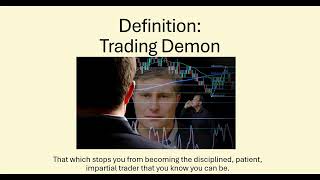
What if there are demons in your head that really crash trading? And right there, what I want to do is define what I mean by demon, okay, is have you ever been sitting there trading and you had a plan? You know what you're supposed to do, you had rules, and then all of a sudden, before you knew it, the smoke clears and you go, what just happened? Why on earth did I do that? And then you might be angry like this guy, or you might be, you know, you might be scared of just, just all sorts of stuff. The thing, though, has that ever happened to you? And if you're a trader, the answer is the high probability of yes, it has happened to you. And what we want to do is we want to say, hmm, well, what is a trading demon? The way I define it, it's that which stops you from becoming the disciplined, patient, impartial trader that you know you can be. So we're sitting at a place and we're going, okay.
We see that demon, and we're not naming it like something awful. What we're doing is that which stops you from becoming the disciplined higher self that you know you can be. But something happens along the ways that stops you from that. And so that might be it. Okay, so we've gotten this thing where we've, we've really said, okay, what we're doing. We've defined the trading Demon. And what we want to do is say, hmm, well, and by the way, if you're taking a look at this image, what's really interesting about that is the demon who is talking into the trader's ear is actually me, okay? And the image that you're looking at is actually of my son. And the person who actually did the art direction on this is my daughter. So it's kind of a family affair. But the major thing is, if you start taking a look at it, that which stops you from becoming the disciplined, patient, impartial traitor that you know you can be. And then what happens is you start recognizing that that demon is a voice in your head here, symbolically represented by me holding and whispering into the traitor's ear. So we've gotten there, and the deal is, this is. It's the voice in your head that criticizes that, judges that, tempts you and seduces you into taking action that is not consistent with your rules. Okay? That's what it is. Now, it's easy to go over there and do the horns and things like that, but you discover that a lot of people chase money. They really. They really don't know what trading is all about. They're chasing money. They're going to be making money. That's the whole point. And the deal is, as my promise to you, one of the great truths is you do not control whether or not you win or lose. You control.
The mind you bring into that moment. That's the big, huge key, and that's the psychological edge needed to drive a method. Edge. Too much, though, is we tend to have an association between money and power and safety. And we begin to think that, you know, if we just had money, it would solve all our problems. The problem is the way we think about money is what causes us problems. Money becomes a symbol of your power. It becomes a symbol of your ability to make things happen, your status and all of that. But if you talk to a guy like Richard Branson, Sir Richard Branson, he defines money as, oh, that's what makes things happen. He's looking at it. How do I put deals together? How do I get them financed? To be able to, in his words, is, I want to have a thriving place for people to work. So his notion of money is nothing to chase. It's a lubricant that allows him to create more job creation. Do you see the difference? And ultimately, that's one of the big things that's going to happen. Now, what I want to recognize is that if we move that demon Into a way of saying it is that it's the destructive side of the mind. And what you're going to discover is that we have both destruction and construction Happening simultaneously in our brains and hence in our minds. And. And what we really want to take a look at, though, Is recognizing that this destruction construction model has been going on forever. You know, if you go to Hawaii, you realize that the big island is still an active volcano, and it's creating land mass and it's destroying a lot of stuff. Houses disappear and the lava flows and all this kind of stuff. Yet you give it thousands and maybe millions of years as it drifts along, and all of a sudden you discover is that those are fertile lands. They just do all sorts of stuff. And you're seeing that, okay, destruction happened, but also construction, creation happened also, and they both are working together simultaneously. Now, what we want to do is we want to take a look at that principle that you see quite easily in nature. Because in the same way that a lot of foresters will do prescribed burns, very destructive, it kills a lot of stuff. But at the same time, over time, it's very healthy for the trees and the community of trees in the forest. So we're getting this thing is that winning and losing Are just simply two sides of the same coin. And, you know, ultimately, it's really about winning. As you go through my system, what you learn is only landing on the right side of probability. It is no reason at all to get excited. It's just a transaction that fell on your side. Now you had an edge. But the thing is, to start nailing your sense of worth as a human being with whether or not you win or lose in trading is dangerous. And it's what holds everybody back. So now what we know is this demon is represented in the physical world that we have is. But it's the destructive side of life. On the other side of that is the constructive side of stuff. But let's take it and start really exploring how different people, different cultures have examined this destruction construction model that seems to exist. Let's start with movies. There's our good friend. There's our good friend, the evil number one himself. Okay? And ultimately, this is the one that seduces Darth Vader. This is old thing. What happens is that this is just simply an aspect of the mind that is called. That I call the inner critic. And it is that part that criticizes it, judges, attempts. It sets you up for failure. It gets you when you take a few wins, it makes you, oh, I got it. I Got it. I know how to do this. And what you do is you start feeling good. Feeling good in neurobiology is called euphoria. You fit the dopamine reward system, and it's making you. It's taking you out of the mind that can allow you to trade effectively. On the same hand is if you take a loss, and particularly a couple of them like that, what happens is suddenly you start looking at that loss going, oh, my God, I got to get that money back. Or, oh, my God.
I don't know if I should even trade. And you see that yin yang go. But this is what it would look like in the media. You would see this in the Gladiator, the Emperor was the evil guy, and Maximus was the good guy. He was the constructive part of the self. So you're looking at it and you're going, okay, I have a resident emotional program in my brain that is destructive. Yes. That in Star wars, they would call that the Dark side of the Force. And it's highly seductive. And they demonstrated that by what not just happened to Darth Vader, but Anakin and all that stuff that goes into that. And you're saying, oh, okay, they're more than just talking about a movie here. They're talking about life. Yeah. The life you were ignoring until you got into trading. And all of a sudden, this destructive part of. Part of it is you don't have control of it. You don't have the illusion of control of it, and it really starts taking on a totally different light. So then let's take it a step further. Now. Let's go to science.
Stanley Milgram was a social scientist at Harvard at the end of World War II. And what happened is he was very interested in the Nuremberg Trials where they were trying all these Nazis for basically.
Industrial genocide. Okay. And he was kindly. He was just interested because he has always. He had always thought that there was some level.
To humanity that you could not go below. And what happened is these guys had produced atrocities that were. I mean, you'd have to go to Genghis Khan to find somebody who had done stuff like this. Okay? And what happened is, what really blew him away was that when prosecutors would ask these German officers why they did it, I mean, you're talking about people killing tens of millions of people. And they all. To a man said, because I was told to.
And that really puzzled Milgram. And he ended up setting some experiments. And one, the famous one is the Stanford Experiment they made a movie out of. Basically, it's where you're Putting different groups of people in different power zones when one has power over the other. Okay. They were just looking to see what happened. And this particular experiment was done in ucla and what they did is they recruited college students at UCLA in the early 60s to become guards. And they were told that they were going to use Pavlokian conditioning to be able to condition these prisoners to be able to.
Do as they were told. Okay. And what they said is we're going to use obnoxious stimuli, an electrical shock that if they don't do what they're told, then you're going to shock them and they're going to learn, they're going to learn that that's a negative reaction and they're going to learn how to comply with requests. That was the thing, Pavlokian, all the way down to the core. Okay. Then they also recruited graduate students to become the prisoners. And this is what they told the prisoners, the graduate students. He says these guards think that they're going to be shocking you, but the truth is they're not. They don't have any electricity, but you're going to be able to see them. Even though we've told the prisoners that nobody, I mean the guards, that nobody can see them. And that's a one way mirror looking out where you know you're going to be kind of in this electric chair type thing stapled into this electric chair type of thing. And they're going to do the shocking, but you're going to see them turn up the voltage and do all that. And what we're asking you to, is to pretend, act that you're being shocked and you're going to resist to the very end.
Being compliant with their request. Okay, the setup, and they're in this, I understand the guards are in these rooms where nobody can see them. That's part of the deal. And that they can see what's going out there, but they believe that nobody can see them. And there is a proctor in the room with them. And all that proctor says if the person doesn't comply with request is up the voltage. That's all that's being said. Okay, well, this experiment was set up to last for two weeks. It was over the Christmas holidays when nobody was going to be there. And they were able to take the psychology department, UCLA and turn it into a prison type situation. Well, that two weeks got collapsed down to three days. Why? Because the guards, now remember, these guards are upper middle class white kids in college in the early 60s. In three days they had turned into volitional killers. 66%.
Of the guards knowingly, willingly gave electrical shocks that were lethal. And they would watch these guards, I mean, these prisoners convulse and stuff like that and die and get taken out on gurneys. Now, the prisoners were not being hurt. They were pretend acting. But the thing is that the guards didn't know that. Yeah, they did not know that. They thought they were administering this. And ultimately, at the end of three days, they quit. They had to shut it down because they were getting people who were traumatized. The guards, after they had done this stuff, they oh, my God, what have I done?
Sounds like the demon attacking you, doesn't it? Oh, what did I do? I was supposed to be following my rules, and all of a sudden, what have I done? What made me do that? Well, here it is right here. And ultimately what they discovered is there is a switch.
That, particularly with misinformation that gets up to a point where that switch suddenly moves from the mores and kind of thinking that keeps people from killing each other. It flows back over and suddenly they become monsters. This is happening today in our political systems, not just in the United States, but all over. You're seeing that misinformation now is we don't even try to hide it. So now we're looking at it and going, oh, my God, they found the switch. And ultimately it's also what the Japanese used to be able to turn the switch and have their soldiers become brutal guys that invaded Shanghai. So now we've gotten this thing and we're going, okay.
They were able to switch destruction and construction, okay, and it was a lot easier than they thought. So now we're looking at it from the scientific. But now let's go back to ancient China at that time. Now this is a secular society. So what they're doing is they're saying, you know, what life is is the inner tangling of destruction and construction. They work together much like the volcano that I showed you. They just happen together. You know, you destruction happens, and out of that destruction comes new life. At the same time, they had it so that at yin yang, destruction and construction coexisting with one another. And probably one of the favorite stories about this is about the farmer who has a child. It's a boy. So that's a good thing in Chinese culture at that time. And the villagers come out and say, oh, you lucky man. You are so lucky to have a son. And you've got the whole thing set up your. You're so. It's. You're good to go. And the farmer goes, maybe, maybe not. Number of years later, the boy has an accident, breaks his leg and he's got a permanent limp, so he's not really good for heavy lifting and stuff like that. The villagers come out and say, oh, this is a horrible thing. You know, what happens is your son, the person, your heir is no longer the person who can do that. Oh, what are you going to do? Whoa, whoa, whoa. And he says, maybe, maybe not. A couple years after that, the emperor comes by conscripting soldiers for a war. His son can't be conscripted because he's got a bad limp. He's unfit for combat, and so he's not conscripted. The villagers come out and say, oh, you very lucky person. You have avoided sending your son off to war. And he goes, maybe, maybe not. What I want you to see is the yin and yang of this and how they work in and around one another. Now, this is also understand we were talking about the way different cultures, different groups, different people have conceptualized how this phenomenon of destruction and construction coexisting simultaneously together. And believe me, it works in trading too. So now let's take it one step further. Let's go to the three headed God of the Hindus. You know, in their conceptions, they were going, how do, how do we do this? And ultimately they put together.
The creative part of constructing the world, sustaining the world and destroying the world all in one godhead. And you ask a Hindu about how do you go about working with that? And what they will tell you is, oh, you focus on the good sides of God. So you still, even in their way of trying to go non dual about it, they're saying there's still good and bad. So now we're working through this and we're going, okay, well, I'm beginning to see that everybody, since time began has been trying to figure out this relationship between construction and destruction. Okay, so now let's go to the Cherokee Indians of the southeastern United States. They were a highly.
Advanced civilization. And when Europeans first started coming, they realized that their day was over and that they needed to adapt to this new world coming their way. They created a language, written language. They moved away from their traditional ancestral ways of farming and hunting, and they moved into becoming goldsmiths. They became all sorts of silversmith, and they even became plantation owners. And they literally out whited the white people. Then gold was found on Cherokee lands, and before you know it, they rounded up and most of them are taken to Oklahoma. Okay, but in their spiritual philosophy, they held that man's mind was composed of two wolves. There was a dark, destructive wolf. There was a white, constructive wolf. And they were at odds with one another, and they were highly competitive, trying to win the war of the man's destiny.
The way the Cherokee understood this, and this is where I really think they demonstrated just how brilliant people they were, is they held that the wolf that the man fed is the wolf that won the man's destiny. Man became responsible for creating his own destiny out of the way they viewed things. So now we're going through this thing, we're saying, okay, this is getting more evolved. And I want to also work with one that is more unusual, okay? And it's going to take us into another step into this thing. I want to talk about the Aramaic notion of Satan or Sadat or Santana, okay? What I want to do is say, okay, again, it's the one that accuses you, it's the one that criticizes you, all that stuff. Now, if you and I were to get in a time machine and we were able to go back to Aramaic times, that would be two to four, 5,000 years ago, okay? The culture, the language of the Middle east was Aramaic. And what happened is we heard these people talking about this Satan Santana, and we said, can you translate.
That word? With.
Translated into modern English so that we can understand it. Okay? They would translate that word Satan into prosecuting attorney in today's world. Yeah, prosecuting attorney. And I would.
Let me ask you something for those, particularly in America. We see this stuff all the time. But my understanding in Mexico, it's even worse than here, is that.
What does a prosecuting attorney want? Does he want justice or conviction?
If you said justice, you're naive. There are so many cases that are overturned because they wanted the conviction, and they would do all sorts of things. And the next question would be, would they lie to get the conviction?
Yeah. Yeah. Particularly if you've been in the judicial system. You know.
Will they criticize? Will they set you up? Will they make you look like a fool? Yeah, they will. Will they deceive you? Yeah, they will. And all of a sudden you're realizing, oh, my God, you have one running around your head. And most likely you've done what other people have done with this destructive element of the self. What you've done is you've tried to ignore it, you've tried to push it away. You've done everything you can, and God forbid that you might have a silent moment so that it can start talking and stuff like that. And I'm going, where is this voice? I don't want to hear voices. The thing is, I don't want anybody to think I'm crazy. And my view is that you're crazy if you don't become an observer and can spot the inner critic as a voice living within the mind, okay? And you see it all the time. Now. Let me ask you a few questions.
The main thing is this is the inner critic is going to associate your trading performances with your worth as a human being. Who in here has beat themselves up after a silly mistake, okay? If you're being honest with you, most of you. And let me ask you something, has that ever helped? No. All it does is it digs the grave deeper. And you're going, okay. Have you ever gotten to a moment of where you were scared to get in because there was a voice in your head that says, but what if you lose? What if you're wrong? Okay? That's not your voices. That's not your. That's not you. That is the inner critic as part of what I call the governing committee of the mind, taking over the committee and producing the voice that comes out of your head, okay? That's the behavioral output. So all of a sudden, you realize, oh, my God, he's associating my performances. And golly. Who in here? What. Who in here is okay with losing?
Well, what happens. It's really. It's ironic that in trading, what you're doing is, you know, you're going to be taking a substantial amount of losses. A substantial amount. I have friends who are profitable that only win 35% of the time. I have people who are profitable 80% of the time that lose money, okay? So you're looking at it and you're going.
It's always about that trading performance, you know? And all of a sudden, can you. Can you pull apart your value as a human being, that which I call inherent worth? Okay? From your performances? And this is the deal. If you can do this.
You actually come to a moment of winning, and losing become the measure of the value of your life. This is the deception. Because ultimately, winning and losing, from my perspective, as I teach it, is either just simply landing on the right side of probability relative to you. It's absolutely no reason to get excited. Or losing landing on the wrong side of probability relative to you. The deal is your human brain, your mammalian brain, your social brain, your. Your emotional brain does not want to take a loss because to it, that loss is not about money. It's about your power to survive. Your caveman Brain simply doesn't understand money at all, okay? If you put a boatload of money in front of it, it would have no idea what to do. However, money has become symbolically related.
To our power to survive, to our ability to master, to conquer, to be able to have status. And being a winner means you matter, okay? And you don't want to lose. Because if you take a loss to your caveman brain, that's the saber tooth tiger stalking you down and planting its teeth into your most delicious body to it. So you begin to see as it gets pretty warped. And you're seeing how easy it is for this element that I call the inner critic to have you believing that you must win and that you don't lose. And at the same time what happens is that clearly success in trading is about being able to extract more capital out of the markets than you're giving back in. So it's really more about performance. It's really more about becoming competent in your performances. And by doing that, what you're doing is you have a mindset that allows you to trade your plan and you don't fall through it. If you're falling through it, you're listening to the inner critic, okay? Now so we've come there and the deal is this, this thing about failure, understand this, is that performances reveal competencies which can always be improved. Probably one of the most famous quotes about this is from Ray Kroc, the founder of McDonald's.
Where he said, I failed my way to success.
The interesting thing about this is that the brain does not learn from success. When the brain produces more success, it locks in habit into neural pathway and then it starts myelinating, insulating it so that it's really rapid. And so it becomes an automatic response to whatever condition triggered it in the environment. That's just simply emotions, okay? However, if you fail, if you lose.
What happens is the brain's forced to go what's going on? And at that particular moment you have an opportunity to learn new ways of understanding this stuff. If, if you're open to failure as a pathway of growing, okay, that's the deal. Is that your story about failure loss has a lot to say about whether or not you're going to become a successful trader or not. If you hate to lose.
You really ought to examine that. Because if you hate to lose and you're not going to do anything about it, what you're doing is you're saying, I'm setting myself up for consistent non profit, that's what I'm doing. How Do I learn from losing? And even when you learn from losing, part one of the big lessons is that in probability, of course you're going to lose. And there's only really three big questions that are really asked. Say when you take a loss or a win, but loss is the one that really sticks in your mind is one. Is that. Is this a psychological problem? It may be. You followed your rule, everything was fine. No, it's not psychological. Is it a method problem? And as you really start digging down. It's very common for me to work with a person. And about two thirds of the way through the course, what they realize is that as their mindset improves and they can really. And they know how to psychologically build a mind that engages uncertainty, what they realize is their methodology, their rules have big holes in it, and they have to go patch those things up. Okay, so again, what you're doing is you're learning from failure. At the same time is you have to build a mind that is comfortable with losses, with failures. And going back to this analogy, though, but what say if the methodology was okay, the psychology was okay, then you ask the question, or is this just probability? Okay? And a lot of the times the trade checks out. It just didn't land right for you, Just probability. Then you look at that trade, and you look at it and say, if I saw this setup again, would I take it? Would I play it the way I played it? And if you said yes to that.
That'S as much of success as that you can control. That's a really good trade. You did your job. Okay, so now we're going. Okay, I'm kind of beginning to get this. I'm beginning to see that the inner critic wants to associate failure with. With an inherent disability living within me that I can't do anything. Yeah. All that shame stuff and that guilt stuff, and I don't. All that stuff. Yeah. And if I make a lot of money, I'll matter. People have respect for me. I might even be likable if I make a lot of money. And there are other people who sit there and say, you know something? I really don't deserve to make easy money. I have to work that puritan work ethic. I have to work for my money. And in trading, you know, what happens is as much work, physical work, you're doing is you're using your little index finger to go in and out of trades. So what you're doing is you hold the concept of worth. And I've actually worked with people who grew up in Families in this one particular one where the father was a laborer and he just would pound his fist on the dinner table and say, nobody's worth a million dollars. Talking about his boss's boss's boss, okay? And what happened is this guy integrates, that grows up darned if he doesn't become a trader. And he's trading with a very high six figure account. He's been doing that for 10 years. And every time he goes over to seven figures, a million dollars, he loses back down. And ultimately what had to get done is that he had accepted he had just sucked in that belief about worth. And he needed to deconstruct that belief and come to a greatly different idea of what success is and what money is. And it became okay to have in seven figures. So now we've gone through this stuff and we looked around and we want to look at the beliefs.
We want to look at the beliefs that you bring to trading. And the deal is this. A lot of this is one of the biggest ones, literally is I'm not good enough. You know, I get in, you know, it's, you know, or if I mean, oh my God, I finally got into profitability. I better take it before it's taken from me. Scarcity thinking. Then other times what happened is.
People have taken really gigantic kits and they've really got what I would call subclinical levels of post traumatic stress disorder. And what happens is now they're scared to get in because they've lost 100, 200, $300,000 and they have. It's like, oh, my God. And they get close to the concept of losing and they go nuts. All these things are sitting there and you're going, wow, you mean these are the beliefs that I have, I'm holding about winning and losing? You need to examine them. The good news is.
There'S really only several we can look at. But what I'm asking you to do again is who is this that's saying I'm not good enough? Who is this saying, I'm not safe in this, not win or lose. This is the inner critic. And what it's doing is it's talking directly to what I call the adapted voice. That would be that childlike, fearful or aggressive part of yourself that wants to prove himself or not lose because, oh my God, the shame it would bring. That is orphan or the adapted voice. And there's a dance going on between those two. And the deal for you is to say, you know something.
There'S good news and bad news about Trading. And the deal is that you can't hide from your beliefs.
You can do that. You can deny your beliefs when you're in the regular world. You can just pretend none of that's happening. Blah, blah, blah, blah. We have a set of friends who the guy retired, okay? And what happened is that he started watching TV and eating and he's ballooned up to an ungodly amount of weight. And yet he says, I've worked my life and now I'm in retirement. I am retired. This is what you do when you're retiring. Now anybody can look at that and say, boy, this is getting to be a dangerous situation. Okay? But the thing is he can deny it.
All the way to when he gets real problems start occurring in trading. You can't that trading. God. You project your beliefs out onto the markets and what happens is that you're going to find out if they're effective for.
Extracting more capital out of the markets than you put back in success. And what you'll find is the vast majority of traders can make money on paper, but what happens is when they go live and it's real risk out there and their beliefs are really being exposed, they can no longer trade effectively. And why.
Here'S the deal.
These are the self limiting beliefs that I work with in my business, working with traders. A sense of powerlessness. Have you ever been in a situation where it's just going crazy and you just lose? You're like a bucking horse in a burning barn. You're just powerless. I'm powerless to do anything about this. I give up. I'm swept away. Yeah. The second belief is mattering. I have to make money to matter. If I'm not making money, I don't matter. And practically every alpha that I've ever worked with coming in from business or corporate has made a lot of money. They have a success formula for the outside world. But they come into trading and discover that the success formula they've used to amass all this capital doesn't work in trading. They have no control over outcome. They can't make things happen. They need to learn to let things happen and follow what markets are going to give. And they sit there and they. Whether or not they hate losing and want to win doesn't matter. They don't control that. And what that does, they tend to not just take losses, but they blow up accounts, okay? They just don't want to believe that, that their power can't sustain. And then the one I've already talked about is worth you Know, tying your worth to your performances in trading, that happens all the time. A lot of people say, I just don't believe that I'm worth that much money. Or they will make money up to a particular level. When they cross that level, all of a sudden it falls apart. They actually have like the guy that I was talking about working at seven figures. There was a ceiling that he had to finally see. He couldn't see it. Inadequacy. I'm not good enough, I'll never make it. Everybody else is so much better than me. And even lovableness. A lot of people believe that if I make money, people, people will love me. Okay?
I don't think so.
Elton John found out that that's not true. He had lots of people that wanted to do drugs with him. But when he went clean, he discovered they all fell away. That he really wasn't all that. He found love. He found a new way of being in the world, but he had to find it by himself in a very, very different way. So now.
The real key is if you're still with me and you're going, you know something, I get it. Randy's talking about the inner critic, that which is going to stop me from becoming the traitor that I could be. Okay. And this is also really about what can I really control.
And what we discover is that the mind you inherited from your caveman ancestors and the mind that got shaped in your family of origin, your neighborhood, your culture and circumstances is not going to be the mind that brings success in trading. This is the very first thing, is that in order to be able to find the self willing belief that you hold, you're going to have to be able to acknowledge it exists. Interesting. A friend of mine, very successful trader trainer and he's got a guy that he really wants to see me. And what happens is he keeps saying, now Fred, why don't you see Randy, just talk to him and because you know what happened, your psychology is really in the way of your learning my program. He says, oh, I can't do that. I just, I'm not going to do that. Okay, now we don't know why he's not going to do that. Whether or not it's here, I'm going to find something about him. I'm going to find out he's human, okay? And at the same time though, is that though other people can see right through you, you can't see the void, right? Staring you in the face is you have to understand beliefs are just simply assessments that got made and they start taking on the power of truth. And we, the observer that we are, just become sucked into them. What we have to do is we have to construct beliefs that allow us to interact with uncertainty.
By approaching it with curiosity and concern, not with fear, not with anger. That's what we have to do, is we have to be able to do that. Now.
That's the first thing. Big thing. Second thing, you are going to have to develop emotional regulation. Most people.
By the way, emotional regulation as diaphragmatic breathing, bellows breathing has been around for 4,500 years. I'm not preaching something that is just outlandishly new and all that stuff. No, the Hindus started this stuff many, many thousands of years ago. And they learned that what they could do is by calming the way they breathe, by breathing into the belly first and expanding the chest, holding, releasing slowly, they disrupt emotions like fear and anger, which require you to hold breath or pant very quickly and only use the top third of the lungs. And then what they discovered is that they also learned to release tension. When you feel tension in your body, you're actually experiencing emotional arousal. The motion's already triggered, it's gaining a head of steam. And. And after it reaches a particular point, it flips the switch. And that emotion is chemistry in your body altering the way you perceive reality. And I want to tell you something. You want to be the one who creates the emotional mindset that creates the thinking that engages the uncertainty of trading. That's how you're going to extract more capital out of the markets than you give back. So that very first thing, that very first thing is that you are going to have to come to the moment of where if tomorrow when you're trading, just take a video camera, take your phone, take over, take anything and record yourself as you trade. Even a mirror will work. And start noticing how much tension is in your eyes, in your jaw, in your neck, in your body.
You are compromised psychologically. If that's happening, that stress, that's either anxiety or distress, or it is, it's fear or the anger. So the thing is, you can manage that from the get go. And that's the first thing in my group course, first thing that I teach people even before they show up for the first day is they will have had two or three weeks of learning how to breathe. So that it interrupts this tendency to get swept away by emotions. And it also gets you to the point where you're not so easily seduced by this inner critic guy. So.
So we've gone there and Then, but that's not enough. Basically, what emotional regulation is going to do is it's going to allow you to not get swept away and allows you to get through the door of the mind. But you have to have another tool, mindfulness, that allows you to be able to open the door of the mind and look in and start making sense out of these questions. You ask them the very first slide, what was I thinking? Why did I do that?
That's where the money's at in there. And ultimately, what you discover in mindfulness is where it has a big huge break, that you and your thoughts are not the same. You and your beliefs are not the same. Matter of fact, you don't have beliefs and thoughts. They're creating your experience. You're just. You're just Elmer Fudd walking down, trying to find Bugs Bunny and getting swept away. But in mindfulness, you begin to realize that your brain is a community of rival emotional programs that are duking it out to control the construction of the self. That part of you that you think is you that goes out and trades. And when the miracle of mind shows up.
What happens there? This community of rival emotional programs are given voice. And suddenly you start realizing there's a lot of conflicting voices running around in my head and I might end up in self doubt, I may end up in lust and jumping into trades. You got all that stuff. So in mindfulness, you begin to step back and realize that you are just a construction of potential.
And what you realize is that the you that is trading can be deconstructed and formed into higher functioning. That's the miracle of mindfulness, friends. Then when you start getting that tool, you also recognize something. You recognize monkey mind. And all of a sudden you hear all this coffee of voices in your head, want to go, do this, do this. And you realize there's a mutiny going on in your head. And if you haven't trade some more and start noticing all that stuff and it's there. And the question is, until you learn at first, is that there are some highly destructive parts of the self there that.
They would love to see you fail, destruct, and you learn this healthier ways of dealing with that inner critic. Because ultimately what you discover, it only has the power that you've given it. And by ignoring it, you give it enormous power. By running from it, you give it enormous power. By running into it headlong thinking you're going to beat it to death, you give it enormous power. No, you master the lessons, friends. You master the lessons. And out of that the very fifth thing that is really, really important is that you have the very first skill that you have to be able to do is to separate your performances.
From your being. Your performance is winning and losing from your inherent worth as a human being. And here there's a photograph of someone, that child is learning inherent worth by the closeness with mom. You're beginning to see that. And she ends up walking away and learning a lot about herself. The reason I know this is pretty true. That's my daughter and that's my granddaughter. And I'm going to tell you, my daughter is an amazing. She can produce stuff she believes she can. So you're looking at it and going, I have to claim my inherent worth. Otherwise the inner critic is going to always pry that thing open, sabotage me, and I'm going to start comparing myself to others, comparing myself to winning and losing, when in fact I'm good. Either way, I'm good. If I win, I'm good. If I lose, my inherent worth is still intact. However, do I need to learn competencies in being able to maintain order of the mind? Yes, you do. So what happens there.
Is that you discover that within all this stuff, when you find out that, oh, there's an orphan, like an adaptive diet, part of myself running around in my head, there's an inner critic running around in my head. What you discover also is a movie like the Lord of the Rings, basically, is really an exploration of your inner space, is that all these characters are representational of different archetypes.
From ruler, the ability to maintain order under pressure, to.
The warrior.
Think of Eragon's best friends. They're warriors, they're protecting rulers back. And then the compassion.
That allows you to lay your life down, you're going, you know something?
We have to have mercy for ourselves. And also you finally, if you do that, you begin to develop the wisdom of a sage. That's Ganondorf. But what I want you to notice left the own devices. You got Gollum over there, who started out as a pretty interesting little creature, but what happened is he got seduced by the dark side of the force by listening to the inner critic. And that it's a beautiful movie to see that these elements are all there. And the difference is this, friends, is that you actually can choose. And it so happens that in my group course and my individual courses, I'm teaching you to actually find these inner strengths, these inner resources, and to bring them into working awareness so that you're actually thinking and acting from them, rather than that historical internal dialogue between the orphan nature and the inner critic nature. It's a completely different mind. You realize that this is the best guess based at this particular time. It's a good guess. It's got an edge to it. And I would do it again. That's the power. So these skills are taught and it's quite transformational. It's something that is a lot more than just something that is about your trading. This is really about preparing yourself for the living of life, for mastering yourself. So the deal though, it doesn't stop with you finally being able to develop these particular states of mind. What really matters is that they are there in the action. There will always be challenges. You know, when you think about it, a baseball hitter is a beautiful thing. There is a pitcher, there is a catcher, there is the hitter. And what happens is that he doesn't always get the base hit. He doesn't win all the time. As a matter of fact, he's going to lose 70% of the time if he bats 303 base hits every 10 times. He's in the hall of Fame. What happens is he has come to understand those numbers and he plays by performance, he performs, hit the ball and all the training and stuff like that kicks in and he continues having a teacher to teach him and stuff like that. But this is the heroic journey right here. You have to learn to be that batter in that box, having no idea that's 100 mile an hour fastball. And that pitcher may throw one at me too. He may brush me, he just may decide to hit me. But what happens is I have to have the courage, I have to have the discipline, I have to have the self soothing and I have to have the clear thinking that allows me to stay present when that ball's coming at me. Batter up now. Out of this, friends.
You know, ultimately there's nothing wrong with the brain, the mind that you brought to trading, but it was built for something very different. Okay, when you come to trading, even if you are incredibly well adjusted, have been enormously successful and all that stuff, when you come to trading, it's a different set of success rules. And you're going to have to learn to redevelop the potential that you are as a human being into the potential, the self that can trade in probability rather than the certainty of short term survival. How do you do that? If you've come to the moment of going, you know something, Randy, this is really interesting stuff. And I've probably seen a lot of people have seen a lot of these things and they go you know something? I need to. I need to decide that I'm going to do this thing. The group course is what I'm encouraging you on, includes five group sessions with me. It's a webinar format. Okay. Meetings are recorded because we work in a time area. Okay. And the deal is you go through and learn these skill sets that I've talked about. And the class starts, begins this month. So if you're interested in improving the mindset, the psychology that you bring to trading, register now. If you do, you get a free gift worth $199 if you go to our website. That's how much you can pay for it. I'm going to give it to you because I want you to sign up early enough so that you are already practicing and habituating the breathing skills, the relaxation skills, so that you'll be ready for the first thing. It's a powerful thing now. And for those people who are also look at it and go, you know, golly, Randy, I would really like to work with you. That's the individual course, and it's highly individual. It is really personal and it really goes deep.
It has 10 sessions with me. That's why people will choose it. They want to work directly with me. The key, though, is I want you to train your mind to be able to engage uncertainty and improve your chances of victory. Okay? The brain you brought is not going to do the job. However, you can learn to be able to build that mind by acting now. And I want to thank you for being with me this evening. And if there are any questions, type them in in the question box. And.
What I'll do is I'm. There may be no questions. So what I'm going to do is I'm just going to say I really appreciate your being here. And I really. My own hope is that tomorrow you have listened to what I've said and see it in action as you trade. Yeah. And the recording I will have up in the afternoon tomorrow, and it will be on my website and it will@www.traderstateofmind.com and it will also be on my YouTube channel. It'll be on the homepage of my website and my YouTube channel. You can. From the. From the video there, it could take you to YouTube and there, I believe, last count, I have about 240 videos up there. Pretty extensive. So the deal is this. Hold on. Very good. No, no, no. Okay. The deal is this, is that.
The individual course is basically $4,000. It's 393,995 and can be broken down into three payments. Okay. That's how a lot of people do it. I just want to make it in. The group course is $239 five times. When you break it down to where we're helping you finance it, which is 1195. And what I've done is I have done my best to make my courses reasonable and approachable. Very aware that the individual course in particular, it's too cheap. But when do the classes start?
First meeting is March 28th. But, yeah, March 28th is the first meeting. But what I'm telling you is this, is that to take that course, you're not doing yourself a service if you don't start early because you have to do the rote training of breathing, of the relaxation exercises, so that when you show up, you're actually demonstrating the skill as you trade. And it takes usually, I mean, two, three weeks is minimum.
A lot of people take this course two or three months in advance and have the breathing down so that it's habituated and, you know, it produces monster results in that you realize, oh, my God, I've just been a hairpin waiting for an accident to happen all this time, and all of a sudden I can control that. It's powerful.
Yeah. And at night, you can start anytime you want to.
Yeah. The individual. The individual course. Okay.
After March, when will there be a next class?
Probably June. Okay. And.
This is from Bob. Hello, Randy. How long does it take to become an observer? I have been practicing in preparation for your upcoming group course for about two weeks now, and I am eager to become an observer. Well, that would mean that you have moved beyond just the breathing and have moved into observation. Is that the major thing.
If you're listening to the lectures?
What most people acknowledge, for instance, when they're watching the clouds go by, is that they can watch those thought clouds go by for a moment and suddenly they've been taken away. The deal is, is that awakening, the observer is recognizing that the observer has fused to the thought cloud, has taken you away. You pull it back and. And what happens is you recognize you're not going to be a Zen Buddhist Monk who has 10 years experience who just can do that all day long.
Yeah, exactly. What happens is when that happens and it's going to happen, you pull back to observation again, the clouds reappear. Then a few seconds, few minutes later, what happens? The clouds disappear and you're off and running again. You catch yourself, you pull back, and what you do is you observe what happens when you when you have done that. Because the thing is this is an untrained observer. You have to wake it up. You have to practice it like a muscle.
Yeah. If you have further questions, email Dolores. Okay, let's see.
I just got here and missed most of the webinar. Can you please send a link? Yes, it will be on our website tomorrow afternoon. Okay.
Let'S see. Can any link be sent to my email address to register?
Just go tell them. Just go to Trader State of Mind.
Yeah. All you have to do, go to www.trader state of mind clip on group course. It'll take you there. And I mean that's the link. That's. That's our website. Let's see.
Okay. Dear randy.
I can't read. I can't see that. Okay. Dear Randy, thank you so much for making the effort to speak to us today. I'm pretty new to trading six months that is youngster. And I've taken excellent lessons and made foundations based on some of your great YouTube content. I started off well, always bearing in mind your teachings about beliefs and your inner thief. Oh, I like that. I like that word, inner thief. Is there any advice you can give to so early on to help me ingrain some of these fantastic teachings?
Constantly observing but without realizing the gorilla has beaten his chest. Basically.
Observing as much as I consciously can. Consciously. Is there anything else you could tell me.
If you are?
There is one mindfulness retail guided meditation on my website. Okay, that and it is actually it's the one. It's so good actually. I incorporated into my group and my individual about thoughts running between two doors. And it's an incredibly good guided meditation to teach you mindfulness and to be able to use it, I would recommend that because otherwise.
I teach mindfulness very differently than it's traditionally taught. Like Eastern mindfulness is. I'm actually. Instead of just having an observer that watches thoughts come out of nothing, have a life and they go back down to nothing. I'm asking you to slow them down, to actually identify the thought and to start really examining that out thought and questioning that thought and recognizing there's enormous amount of misinformation going around in your head. Global assessments. Okay, friends, I'm gonna. We're gonna have to shut up. Shut up the.
Close it down. That's what I meant to say. Sorry about that. That might have been a Freudian slip. I don't know. But anyway, no matter what, I really ask that you recognize that there are three.
Three legs to the stool of trading platform. You've got to have a really good platform that doesn't freak out on you when you, when you start doing things. You have to have a methodology of risk management and that's where all the training's at. The deal is, is when you do that, suddenly what you discover is that trading psychology is front and center. It's the last thing that traders are going to look at and most have already burned through their capital influence. They do it. And what I'm, what I'm encouraging you to do is recognize you're not going to become the trader that you can become unless you really dev into trader psychology and develop the self specifically for the uncertainties and risks of trading. It's, it's people don't get it. The mind you brought is not going to work. You need to, you need to retrain it. So that's it. Friends, I want to thank you very, very much and I encourage you to sign up for the group course. It's something where.
Interesting is that once you take the group course you can actually take it again for free. And a lot of people do that. So you learn the basic skills that allows you to truly begin to shape the mind that you bring to trading. And friends, my hope for you is that you have a glorious life that you, you work, you produce a life that you're satisfied with. I thank you and I will see, I'll see you next time. Take care. Bye bye.










