Developing a Patient Trading Mind
Randy Howell explains why the aggressive mindset that works in business fails in trading. You need patience instead, built through emotional regulation and mindfulness. He breaks down the evolutionary drives that push you to act too fast, then offers techniques to build a patient trading mind.
Chapters
The broadcast is now starting. All attendees are in listen only mode.
Good evening, how are you doing? My, I am delighted for you to be here. And before we get very much further, let's just find out if you can hear me. If some kind people would just simply type into their, their question box just a couple yes or why's, I would greatly appreciate it. Yes, thank you. There we go. Now the amazing thing is I started looking at my, my webinars for the last 15 years and I noticed that I did not have something dealing with patience. And I thought, how in the world could I have missed that? Because it's one of the biggest things in trading. So the main thing is that we want to take a look at the background to what produces a patient mind, look at it and go, well, how would we go about building one? Okay. Rather than say the one that keeps flubbing up, keeps suddenly getting out of patience and all of a sudden wants to have an urgency, wants to get in, just gets bored, all that stuff. Now one last thing is that I hold my questions. I answer my questions at the end of the program. So if you have a question as we go along, please go ahead and write it, write it in. But the thing is, is what.
I'll, I'll, I'll get to them at the end, okay? So please do that. Now let's get started. You know something? Many people, many people come to trading.
No, it's the first one. You just missed it right here. Many people come to trading and they are experienced, they have experienced success with before they got into trading. It's kind of like they understood what it's like to win. They understood what it was like to make things happen. Like, you can see this guy, he's in all in the celebration, the euphoria of winning. And ultimately they have learned that aggression making things happen, pushing and seizing control over outcome really pays off with great success. Okay. And they often make a lot of money in it. Often they come into the moment of where you know something, I am tired of this rat race. I would like to do something simple. I would like to have more time for my family. I would like to have more time for myself. And they start, they look at trading and oh yeah, this is going to really work. And they think.
They think that that success model that they've used was so successful that it was wired into as normal. And quite logically, this success model was brought into trading. And of course you would think that the same thing happened. I actually had a client one time who was a very Successful serial entrepreneur. And he and his partners had just sold a distribution center for cash. And he was talking to his brother, he found out that.
Trading was a capital intensive business. And so my client thought, oh, wow, this is great. I know how to figure out businesses, that's no problem. And I also have a lot of cash. I've got the whole thing. This is great. So he got into, he got into trading and he found out the way he was wired just simply wasn't going to work work. He was wired for success as an entrepreneur, but he was not wired for success as a trader. And really the question really becomes, well, why not? Well, the truth is, making things happen now is not part of the success model of trading. Think about that. In trading, it's all different. What you do is instead of acting on the world and making things happen and winning and that stuff, what you do is you learn how to like.
You don't have control over outcome. That's the problem in trading. And all of a sudden you get now using, okay, now what happened to these guys who learned from this old success model that things don't work that way now? Well, the truth is.
In trading, you've all heard of the tortoise and the hare. And what you discovered is that in trading, slow is fast, okay? Slow is fast. And a lot of people have that problem of saying, you know something, this is going to slow. I'm getting bored. I need to look someplace else. And they search. I need to be, I need to be accomplishing my goal. And all of a sudden, before you know it.
They'Re stopped looking for what the market is going to give them and they are looking for what they can take and they start looking for it and they wouldn't even have known about it. So we've got this thing going and then you go, ooh. And it's also, by the way, it is so hard to stay patient when you're thinking about those goals. You're thinking about that money, you're thinking about, oh man, you know, when I make this money and all this kind of stuff and you know, I just, you know, I have it down, I have it down, I've got it. Unfortunately, all you have to do, follow your rules, you bring an edge to your performance and that gets hijacked. The human brain wants novelty and excitement. It does not want patience. Okay, you see the problem we've got here and somehow that's going to have to get trained out of you because you know, ultimately what you've really got is there are several Pathways to having this problem of patience. And the deal is this.
During our other areas, other times before we were Homo sapiens, when we were Homo erectus hominoids, and all the way back, what happens is that the need to act at particular moments in time, particularly in moments of danger or opportunity, you had to, you just couldn't sit there. You, you're taking too long. You had to do it now for survival's sake. Either the prey was going to get away if you were acting in urgency, or if you didn't, if you didn't, if you just stood there, you could get gobbled up. So what we began to see is that, wow, some of the things that we brought through our evolutionary psychology into the trading mind that we bring into trading just don't work. Wanting, wanting success. Now that's not gonna work. Just sitting there is so boring. So yesterday that you begin to go, wow, what is the problem here? And out of this, here's the deal. This is the formula that so many traders have used. Coming from being an alpha, having done really well and really pushing to win and hating losing, what happens is they learn hard work in, success out. That's the whole thing. We don't even, we don't even question it. What we know is we just work real hard that it's going to produce success. And yet we don't really take a look at it says, does that work in trading? Yeah. But the truth is, is that in many endeavors in life, that hard work does lead to success. And it becomes a core belief, though, that's driven your life. And when you bring it to trading, you discover something very different. You discover that the formula is so accepted that it is rarely questioned. And you don't realize that in trading, it's not a straight line in trading.
It's just you're not in control of where that trade's gonna go. You know, the thing is, you get in, it starts going between, it starts bouncing around, it goes over here, goes over, much like the guy drew the pencil things here, and you're trying to adjust, and all of a sudden you go, whoa, whoa, whoa. Hard work and a focus on winning, making money, results in failure over and over again. But you don't stop employing this thing because you're not a quitter. You know, and you know, you, this has been successful. I know the success formula. It works. And you keep doing it. You keep doing it, you keep doing it. And finally you come to a moment of it just doesn't work, and you don't know why or Even if you do know why you don't know how to stop it. You don't know how to stop that movement. Particularly with a lot of folks that lose patience. They lose patience while they're waiting for setups. They get bored. And as they're sitting there bored, they start looking elsewhere. And suddenly that mind is so primed to make a jump that the trader would never know it. So.
I don't think that's the one I'm supposed to be at. Let me go one. Go one. Before. Before.
Huh. We appear to be missing a.
Hold on a second.
Well.
Hold on a minute.
We're having an issue here. 1, 2, 3, 4.
Well, I'll tell you what. We're just going to move the slide forward.
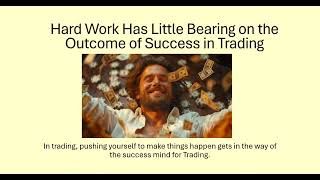
So then we go. You know something? What we discover is hard work has very little to do with outcome of success in trading. We learned that in trading, if you push yourself to make things happen, what happens is that is not the way it works. You get in trouble, then what you're doing in trading is you're saying, you know something, What I need to do in trading is I need to wait to see what the market is telling me, and I will move from there. But the truth is you're so programmed, so programmed to say, you know something, you know something.
I'm just going to keep on buying into that old belief that hard work is equal, delivers success, because that's the way it's always been.
Oh, I have it out of order. And what I can tell you is that I often am in out of order. So there you go. So we've gotten that. We're going, oh, my God, Randy, are you telling me that hard work, the stuff that has brought me success, that brought stuff that I have learned my entire life.
It'S not working in trading? Yes, that's exactly what I'm telling you. And out of that, what you really discover is this. The success mind is better understood as waiting for opportunity. You think, look at this fisherman. He's casting, and then when he makes the cast, what does he do? He's waiting. He's waiting, and he's waiting for opportunity to arrive. Okay? Now, this whole idea of working hard is going to lead to success is a. Is a way of understanding work. Work is hard work. What I'm asking is that work constitutes effective action in a trader, and it's maintaining a disciplined, patient and partial mind. It is not focused on doing. There's not that much doing that goes on with this, but yet there it is. So now we're beginning to see some real differences in the mind that you basically to grow up in a modern culture, you're going to be competitive, you're going to want to win, you're not going to want to lose, you're going to make things happen. All that stuff, all that stuff you're taught that it brings success. All of a sudden you discover is that that's no longer effective and it really comes down to, well, what do I do? What's going on? And then you discover that one of the big things is boredom, particularly if you're alpha. If you're used to having been making things happen, what happens is you're going to be sitting there and you're just waiting, there's no setup inside and you go, well, maybe I'll look at my phone, let's see what's there. Yeah, yeah, I've done all that. And maybe I can do some emails and you know, maybe I just look at someplace else, another market just while I'm sitting here doing nothing. And before you know it, you've jumped.
The problem is that we don't see the patient mind crumbling. In the midst of all this action around you, something else takes over and it's so familiar, you don't notice. Feels good to be in action. You know, if I'm doing something, I'm doing something. Okay, you don't see that as a danger, but it is. The one thing that you don't want to do is you do not want to feel good. When you trade, feeling good produces euphoria, euphoria produces overconfidence where you think the good things gonna roll on. And I can just, I can see this opportunity, I'm gonna jump on it. That is really flawed thinking. You're not thinking from discipline, you're not thinking from patience, you're not thinking clearly, you're thinking from euphoria. Okay, so then that's when you discover that.
The trader's mind has become a gambler's mind. You're not, you're getting very false beliefs that say you can make things happen. I make things happen. Maybe in the other world that's a real true belief, but in the world of trading, it doesn't work. It becomes a gambler's mind where you lose your psychological edge to be able to drive your method edge and extract more capital out of the markets than you give back. But this is the kind of the dilemma that traders end up in all the time. And then you look behind that boredom that in that boredom is this is the urgency to expedite your goal for success. I cannot tell you how many traders I've said, you know something, I know what my goals are. I know how I can do this. I know that if I follow my rules, then I will get there. But it's going to be in the trader's time. I want to get it now. And you know, out of this, what I'll say is this, is that when you start thinking about getting it now, you're beginning to look at the diminishment of the ability to have patience, the short attention spans that we have learned in the modern era, where, you know, you've got all this social media where it's real fast, you have all this advertising that's also real fast. And you're constantly switching between things to be entertained so that you're not bored. God almighty. That you would experience boredom and have an interpretation that boredom's bad. Boredom is just patience. It's a, it's a positive spin on boredom that allows you to say, I'm waiting to see what the markets will give me. So we've gotten this thing, you want it now. It's a problem with goal oriented people in trading is that you're not in control. You know, you can't make goals and then go out and accomplish them. You have to do something else. And yet what happens is that instead of this lying, stalking, what happens is this is that you discover when you're not achieving your goals, you get bored and then you want to take action. And what you discover that there is a caveman brain sitting in the backseat of your brain. And caveman doesn't understand patience. He does not understand probability. He understands the taking of action. At this moment, when he sees opportunity, he wants to seize it. That opportunity to him though, would be like a woolly mammoth and eight men attack it. And they've got this whole thing, they've become so jacked up that they don't really see what a dangerous situation they're putting themselves in. Somebody's going to get hurt, not just the mammoth. And yet that's the way that primitive, instinctual part of our brain works. Meanwhile, that instinctual part of the brain can absolutely flip the thinking brain. That's a little nerdy looking guy here. And before you know it, you're no longer trading from thinking, you're trading from primitive survival instincts. And the thing is, that is flawed logic. So then, by the way, this is an osprey. It's one of the most powerful hawks, particularly in the swimming regions, the coastal regions, of the world in trading, just like this osprey, what happens is that you wait for the opportunity to come. You. This is where the skill of patience really becomes one of the core beliefs of the way that you operate in trading. And what happens is that most likely because of your upbringing, because of the social media, because of advertising, most likely your attention span can't handle too much doing nothing. And at the same time is you can learn to sit patiently in watchful wakefulness like the sauce spray. Okay? This is the formula for success in trading. And you have to do, you have to decide whether or not you want to be a successful trader or not. Is.
A lot of very successful entrepreneurs find out that the mind they have to go to trading is not going to produce success. And they get smart and say, I'm just going to go find something else to do with my mind because it's got a talent. But the talent doesn't match up well with trading. And I don't want to learn those new skills. So the thing, think about it. We're looking at this going, okay, the patient mine is actually essential.
Essential to success in trading. And yet we don't see it as essential. And that is a tragic flaw. And what I want to do, this is an image from what is known as the, as the marshmallow experiment. And it was, it was asking kids, young kids, if they could, could maintain discipline and not eat the marshmallow while the researcher went out of the room. And if he did that, he would get double or triple or quadruple the amount of marshmallows when the researcher came back. And you're looking at the struggle right now. You know, if you think about it, if you're looking at a pot of gold right now going, you know, all I need to do is get in. All I need to do, I can make money, I can make money. I can make money. And yet you don't see that you're developing the urban urgency to act. Okay, you're doing that. And the one thing that you do not want to do in trading is work to do from that urgency to act. And by the way, most kids fail this test and they could never, they could never wait two minutes, okay, to be able to be able to get the reward of more marshmallows. Very few, it's amazing. It happens in trading. Again, this is where you need to train your brain to produce patience so that you can say, okay, one of the skill sets that I have to have is trading. I have to develop the patience so that I'M there in watchful wakefulness, waiting for the market to show me what it's willing to give me. And this is where emotional intelligence becomes so important. And so you get into that watchful wakefulness. You begin to see that it is the attitude behind patience. You're watchful, you're in wakefulness, and you're waiting for that opportunity to come towards you. Now, let me tell you a story. What I want to do is I want to tell you a story of the American cougar. The North American cougar, to be exact. The North American cougar is an apex predator. He is top. He's top. Okay. Yes, please. I'm sorry. And he is top drawer. Okay. But the thing is, you look at him, he can be a 225, 250 pound cat and, you know, formidable, okay? And yet at the same time, when he hunts, what he does, he climbs up a tree, goes out on a limb and he sits there in watchful wakefulness until the deer shows up and is set up just like this cat's doing. He's sitting up in a tree where the deer can't seem and the deer's neck can't clean up. Okay? And he's very. If you looked at him, you might think, well, maybe he's asleep. He's not working. Yes, he is. He is being watchful wakefulness, waiting for the forest to show him what dinner is. That's what's happening. He's very much. It's not about doing okay. It's about, it's about the preparedness to act when the moment is there. And what happens is when you see the breakdown of patience and you're moving into, into movement, what you're looking down is the breakdown of the, of the effective action of trading. You're not being shown what to do. You're going, I'm going to make it happen. And yet here's this cougar just sitting there waiting for a whitetail deer to set up in the trap. He knows the patterns, he's done his homework, he's done his charting and he's waiting. And when he comes down, he comes down 15, 20ft and in hopes he's going to snap the deer's neck and it's going to drop dead on the ground if he doesn't do that. And the deer gets up and runs away. The deer, the cougar, does not chase. He takes that as a small loss. He's not all been out of shape, but he missed the kill, climbs back up the tree sets up again and waits for the forest to produce another deer. Watchful wakefulness. And it is the quintessential skill that you're going to have to develop for trading. Because ultimately what this is, you're going to have to produce this sense of centeredness, this sense of watchful wakefulness in the midst of all these voices running around in your head wanting you to act, saying that you know, you're just sitting or wasting your time. You need to be doing something, be doing something.
Hard work does not produce success. Effective action produces success. And patience is part of that effective action. You're looking to see what it says is available. And this is where the biggest thing and it's, you know, they have almost everything done, but the hard, the hard work leading to success. Belief is still there. And you're going to have to learn to look at it and dig it out and pull it out and challenge it so that you can change it to the coordination of effective action, which is centered in patience. And if the results from your training.
Do not show effectiveness, then you have a self limiting belief that is driving all this. And the question really becomes this, how do you go about changing that? And the first thing is you recognize that in the course that we teaches in our, both in our group course and our individual courses, what you discover is the very first step is emotional regulation of both physical fear and impulse. And the impulse is what leads to really getting into trades too early. Then you have to develop mindfulness as a tool. You have to finally learn how you can step back out.
Of the conversations running in the head and you can say, I'm not any of that. My thoughts and I, my emotions and I, my beliefs and I are not the same. I'm beyond my thoughts, I'm beyond my beliefs, I'm beyond all that. The third thing is you're going to have to start waking up to the internal dialogue that's already going on in your head. When you make the statement, you know something, I am my own worst enemy. What happens is you have confused.
Your observer has fused to this elements of what I would call the inner critic. And it's saying that you know something, you're never, you're too late, you're too late, you're going to have to do something. You have to do something. And all of a sudden you haven't ever seen that. You've been saying, oh, that's, that's beating you up and you're harsh as christening. No, that's what I call the inner critic. And it's beating up on the adapted voice. And that's what most people call me. And what happens is when you're sitting in patience, all these things bubble up into the mind and no wonder you want to get out of it. It's uncomfortable because you don't know how to deal with it. But yet in trading you are going to have to turn toward your discomfort, you're going to have to turn toward your fears and you're going to have to master them. You're not going to obliterate them off the face of the earth that you can master them. The fourth thing is you're going to have to start learning how to bring empowered elements of your personality into awareness. And you'll find the ones that we're interested in teaching is the discipline of a ruler, the courage of a warrior, the self soothing of a caregiver, and the impartiality of a sage. These are what combines into the mind that can deal with probabilities and uncertainty. It's possible those emotional programs are part of your human condition. The fifth, you start intentionally developing an internal dialogue for peak performance trading. It's not the one that says, oh, maybe this, maybe that, oh my God, what happens if I lose? No, it's what happens is that, okay, I've got probability on my side, I've got good stops, I can take small losses, that small loss will stop bigger losses. So I need to become a really good loser. And also, if I am fortunate enough to land on the right side of probability, I'm not looking at that as something of mine. You know, I just landed on the right side of probability and I'm thankful for that. And that's called a winning trade. But the truth is, is that I didn't make that happen. What happens is I let it happen. So this is the process that we use in our group course, okay? And it's also what I teach in my individual course. And ultimately to get into this, what you really discover in this first essential skill is emotional state management. You have to start recognizing your iq.
That's all that knowledge you have. But unless you have a development of your EQ emotional intelligence, you can't use that iq, that knowledge under tight circumstances. So what you're doing is you're saying, you know something, I need to start looking at this link between my biology, my emotions, my mind and what is actually going on here. The emotional intelligence is what allows you to recognize what makes you tick. And that is enormously important. Most people don't know it, they don't Even recognize that they're being sabotaged until it's way over. And they see the withdrawal from their account and they go, what just happened? And it's that mindlessness that has to stop. And you have to start going, you know something, I need to find out what makes me tick and I need to be able to start altering it. This is part of. And you discover I need to develop the patience. I need to develop patience. That's what I need to do. So you're sitting there and ultimately it's this lack of management of both fear and aggression. Aggression. Aggression is what makes you jump into trades and you think you're, you know, you, I'm tired of, I'm bored, I'm jumping into this, right? That's aggression. Fear is when you are, you know, you don't get into trades or what happens is you fear loss. And you start saying, I'm in a fight to the finish. And truly to your caveman brain, you are, you know, you are tangling with a saber tooth tiger and you're going to fight to the finish. And what happens is that to do that you're going to have to gamble. And you see what happens. Because ultimately fear and aggression hijacks objective thinking. And all of a sudden, guess what it creates? The fear based herd or hunter mentality, you know, just running all together of the hunter, where you're getting into aggression, okay? Then the trading mind becomes seized by ancient impulses of action right this moment, action. And you're no longer in that patient, disciplined, impartial mind needed for trading. Then you start making trading decisions outside of your trading plan. Oh boy. And you start transferring your capital to the 5% of traders who are disciplined, who are patient and who are impartial. And they've trained that, they've trained themselves. They just didn't show up and say, wow, here I am, I've got it.
So we've gotten this thing, let's say, how do we do this? And I want one more thing. When you say, what is an emotion? Okay. To me, an emotion is a biological action potential that coordinates activity between the organism that would be the trader and the environment that would be the markets. And what it really boils down to, anytime that there is a change position in the markets, there is a corresponding triggering of emotion in you. And the first thing that happens to that is you get arousal. You'd see the body cranking up, you start getting flush, you know, you're, I'm ready, okay? And you hold your breath and all that stuff. Then Motivation kicks in. The motivation is what the emotion is telling you to do. Attack, avoid or approach. And unfortunately what happens with traders, it goes to fight, flight, attack or avoid. And the thinking mind, the ability to approach is gone. The next thing that is in an emotion is meaning or belief. And ultimately you see yourself in beliefs all the time when you look at your trading account because ultimately you trade your beliefs. The, the beliefs that you have about your ability to manage uncertainty and challenging moments are constantly being projected on the screen. And what you're seeing in the result of your trading account is the effectiveness of those beliefs. Now the next element is the feeling. You would know feeling as the chemistry. That's the chemistry of the emotion in the body altering the way you perceive. This is why it's so important to have a disciplined, patient and impartial mind that creates the mind that.
Engages the uncertainty of life markets. So now we've gotten there and the last thing is temperament. That's not something that we, I spend a lot of time with. It's, it's the genetic predisposition that you have. There are some people who are just born nervous, anxious. There are some people that are real hot headed and they just come by it from, they come out that way. So that's an emotion. And the question really becomes what skills do you need to develop to master your emotions to arrive at a patient mind? One that can wait for the market to show you what it's willing to give you, fortunately for all of us is emotional intelligence, unlike IQ can be developed. We're kind of stuck with our iq, okay. But emotional intelligence is something that you can grow and you can become wiser about what makes you tick and how to use emotions to create a mind for a particular situation. And that is very powerful. Now that first skill.
Is emotional regulation. You are going to interrupt the arousal of an emotion. Remember that arousal is what kicks it up. And what you would notice an emotion that's beginning to grow. You would notice that you're holding your breath. Just watch yourself. Put a mirror up. Put something that allows you to see your face while you try tomorrow. It's not pretty. You'll see all that holding the breath. You'll see the rapid breathing. You're getting tense muscles in your neck, jaw, shoulders and you become fixated.
That's the death of patients right there. Then your pulse starts pounding, you're getting really cranked up, you're increasing energy and suddenly the thinking mind has been blown out and what you have is reactive thinking. And by the way, you would Be too if you were facing the saber toothed tiger. Okay, the thing though.
Is that for the caveman, that tiger is real and it is not a existential threat. It is a biological threat to its existence. The deal is those tigers died out 10,000 years ago. There hasn't been. We don't have lions, tigers and bears around our trading environment. So what you're looking at is you're looking at old instinctual adaptations that are still showing up because your brain doesn't know what money is. It sees it as the power to survive and it sees that it's being threatened. Or you have an opportunity to really live large and in charge. So now we've gotten that. That's the first skill. The second skill is mindfulness. You know, fundamentally in mindfulness, what you're doing is you're stepping back, you're detaching from thought.
You are no longer identifying with the thoughts as who you are. You start using a language, says, I was scared, I was this, I was that. And what you're realizing is now what happened is that your observer fused to fear, your observer fused to aggression, and there went the trading mind. And so you're having to learn to step back, to look out there and start identifying a lot of stuff going on in the mind. And what you're going to discover is this, is that.
If you think there is misinformation in American politics, you ought to look inside your own head. There is tremendous misinformation that you need to develop the observer for and to be able to say, you know something, I need to discern this because I'm believing a bunch of lies and it's altering my trading. I need to decide what evidence is there for this assessment about me and what is really true. That's a big deal.
Now.
Then you're going to have to develop the observing self. The observing self is this sense of like where you can watch yourself. And there is. It watches. It doesn't assess, it watches. It becomes an observer to the self. It's a faculty that is in all of us. And ultimately it's really recognizing that you and your thoughts are not the same and that you're creating. The world doesn't exist out there, my friends. The world exists by all these sensorial inputs coming into the brain. And the brain based on its biases, assumptions and beliefs, creating a story about what's out there. And for instance, there is a line in trading that says scared money. What you're looking at there is a brain that has taken sensorial inputs and has created a view of the world where it's scared of losing money.
It's not like the money is going to be lost. But if you stay in the scared money mindset, the likelihood is, yes, you are going to lose money because you've set it up now. The second thing is you got to. Once you have this observer, you have to really look and you have to be able to say, you know something. What's going on inside this mind? You know, ultimately there's just a lot of chatter going on, but what you're going to notice is there's some conversations of substance in there. You'll notice judgments, you'll notice criticism, you'll notice that you're being tempted a good bit. All that stuff going on, you know, get in this trade, get in this trade, get this profit right now. Jump in this thing now or oh my God, take your money now before it takes taken away from you. And you're going, whoa, man, there's a lot of stuff going on in there. And it's certainly not disciplined. So learning to be able to observe that internal dialogue is truly half the battle, maybe more. And what you're going to discover in there is that your own internal conflicts are going to show up in there. And here this is. You're looking at managing this internal dialogue is your job. And if you don't think there's an internal dialogue, a multi log going on inside your head, then you've fallen for the easiest, cheapest trick the Jedi have. And that's to believe that there is no. There is no. You don't have multiple personalities inside the self. That's crazy thinking. My telling. What I tell you is this. If you do not recognize that you have very powerful, special.
Special interests.
That are duking it out for control of the way you act in the world, then you are blind. Okay? It's the management, this. Of this internal dialogue that has to be managed to be able to trade well. And what I'm gonna do is kind of show this and this is. Just think about it in your mind. What you're looking at here is the inner critic on one side. That's the left side. It's the criticism. It's the never measuring up. It's not good enough. It's the one that tempts, it predicts doom. And it's in a intimate dance with what I would call the adapted voice. And you might know that adapted voice is the doubter. I can't ever win Chicken Little. Oh, negative. You know, the sky is falling. This guy the gambler leaves. I gotta. I'm gonna take this. I'm gonna seize this opportunity. The perfectionist.
If I. If I do everything right, I won't be wrong. And of course, you get into trading and find out that doesn't work. The entitled one, I deserve. I've paid so much money to learn what I know. I deserve to be winning. Now, the con, when you lie to yourself, the fraud, when you lie to others, you're interested in looking good. The orphan, your reaction to the uncertainty of placing action that could lose capital or gain capital, the saboteur, that's when you find yourself blowing stuff up. You know, you've done well for a day or two, a week, a month, and suddenly you have a bad day and you blow it all up and then some. And then the alpha. The alpha is that part of you that has that success formula that we were talking about. Hard work is equal to success. And what they want to do is they want to win. They want to make things happen now. They want to achieve their goals now. And if you bring that mindset, no matter how successful it was, in other areas, into trading, you're going to blow yourself up. The last one I'll talk about is Rebel. Rebel. Is that part of you that hates losing. That's the one that will not take a loss. It will fight to the death. And what happens is it blows itself up doing that. The truth is, is that is simply a manifestation of the orphan nature, the adapted nature within you. And it's being the inner critic has this intimate relationship. And you have been stuck in this conversation for most of your life. Everybody has. It's not like there are any people who just don't get to have this wonderful internal dialogue going on in there. Okay? Now, there's also the fourth skill for this really lasting change. It's using mindfulness to develop indwelling resources of your potential. You have enormous inner resources that are just simply born into you because of the genetic history of small groups of humans learning how to survive together. There had to be leadership. There had to be people who could think clearly. There had to be caregivers. There had to be warriors that would defend the pact. There had to be visionaries, sorcerers who could see into the future and envision new things. These are parts, these are inner resources that probably weren't developed in you the way they could or should have been developed for you to become a successful trader. They're there, though. And ultimately, what we're looking at is this.
The inner game. It's always Always, always about recognizing that your mind is actually a governing committee of the mind that has various forces that have voice now and they have different directions they want to take the organization of the self. And unfortunately, the leader of this thing, the CEO, the chairman of the board, has been asleep at the will. And as it wakes up, it realizes that there's a mutiny going on inside the mind that he needs to get in order and he needs to be able to find the right partners to build this mind, to be able to produce the kind of mind that can trade in probabilities. These are developing the inner resources. Now. What do they look like? What do they look like? I use a Jungian way of getting at emotional programs. The very first thing is that what is required to produce a successful trading mind is you have to have the courage, turning toward your fears to master them of a warrior. You have to have the discipline of a ruler that maintains order under pressure, that becomes, that's where your patience comes from. You have to have the self soothing of a caregiver to calm your fears down. And then if you do those three parts, and these are all emotional programs that you can access and develop, what you get is, you get the space where the impartiality, impartiality, impartiality of a sage arises. And that's who you want making trading decisions. So you begin to see that, okay, I can do this. And it requires a patient mind. But developing these things produces a patient, patient mind also. And the real question, what I'm going to do is I'm going to kind of leave you with this, is that over on the left is probably where you're at right now. This is the mind you bring to trading. It's impulsive, fear based. You know it under really challenging moments, it, it falls into fight, flight. And you trade often mindlessly. You're blind to the internal dialogue, to what can be done there. And you're unaware of other potentials. The inner critic and the adapted voice take over the conversations of the mind. And you have scared money, you have impulsive money.
Or you can learn to be able to develop an emotionally regulated, calm, focused mindset. We would call this mindful trading, where you have control not of the outcome, but control over the internal dialogue. And what you would discover to have control, what it would look like as a diagram up top would be ruler. That's the discipline you need, the leadership you need to be able to maintain order. What you would also discover is the sage, the impartiality, the warrior, the courage. And you'd find that you have to have passion for trading to do all this stuff. You know, I would never do that. It's just, you know, I don't have passion for trading. And out of that you have the patience of a caregiver. This, friends, is the mind that you need to develop to produce the consistent profitability that opens your dreams up so that they can become real. Okay, now what I want to do is say, how do you, how do you go about doing this depending on where you are? Like some guy, he just said found out two days ago who Randy Howell was. I get a lot of that. I do, I do. And there are people like that that probably need to kick some tires. They need to look around. My invitation for there is to get our free book. Okay? It goes through some stuff and it's easy. You just go to the website and have free book. Then maybe you want the, the book about mindful trading. That's, that's more. But then you're still kicking stuff. But then there's also tremendous amount of videos on YouTube and you'll find some on the website too. And that'll take you the whole night yards. And you can spend weekends listening and seeing me talk to you. I hope. I just, I have people do that all the time. It just kind of amazes me. Okay, now.
Ultimately though, it comes to a moment of when you're saying, you know, I really want to figure out how to do this rather than hearing all this great knowledge, but how do I internalize that knowledge and make it real to me? Well, we have two ways of doing that. One is a group course that basically you have five group meetings with me and it's in a webinar format and meetings are recorded. You receive copies of all the recordings and you go through the five essential skill sets that you need to be able to produce a trading mind. You come away and you also, you have access to this stuff virtually forever. Okay? And our next one begins in September and I encourage you to register now because if you register now and we want you to be prepared and it, you should be, you should be getting three weeks to four weeks head start. Okay? And if you do that, we'll give you a $200 thing that we sell on our website and we'll give it to you for free. And that's just not really. Not to get you to make a decision. It's to say, if you're going to do this, we want you in there early and learning the emotional regulation skills. My individual course is highly comprehensive and very personal. It gets to the meat of what's holding you back from your potential. And it comes with a multimedia learning system. And it comes with 10 sessions with me over a period of time, three to four months. It is. It's very powerful. And it, like I said, it gets at the stuff. And you have me basically as your mentor going through this program. Okay. So I want to tell you, I thank you so much for being here. And if you have questions and hopefully some smart person wrote a question in so that I have something to work with. Mdr. What I'll say about MDR is that it is a highly effective tool to use with trauma. I don't necessarily use it. There are. There are different traumas that are used in trauma stuff. I personally spent a lot of time with post traumatic stress disorder when I was a therapist, and I never really used EMDR because I never thought I needed it. But EMDR is a good way of being able disrupt traumatic pattern. Okay, let's see here. No problem, Mohammed.
I feel like.
Oh, hi, Randy. I am someone who cannot afford your course. Okay. I would like to know if it is possible to go through all your free material and be able to effectively apply it to my trading. Well, I'll tell you this.
My first impulse would be to tell you no. But what I would also say is this. I have people all the time write us and tell us that they're doing the same thing. You're contemplating duding, and they have become consistently profitable. So the answer is, yeah, you can. And what I would encourage you to do is to get the workbook, to get the book, to get several of the guided meditations. And a lot of people call that the poor man's course. Okay. And what they do is they train. They train. They train now. But I appreciate that. And what happens is that some of the problems is that I live in the United States, and a lot of people who really watch me a lot live in India. And, you know, my personal course is the price of a small house over there. I understand the problem, but the thing is that the minute that I would try to do the administration and all that stuff just doesn't make it possible. I wish you well, Muhammad. What is objective thinking? Well, what I would. I don't really even talk about objective thinking. I talk about clear thinking. What happens is that you are looking at the last emotional program that emerged that made us so uniquely different than other great apes was impartiality. Impartiality may look like no emotion, but it is an emotion. It's a fragile emotion that if you have everything else done, the impartiality shows up and it is able to deliver what most people would call objective thinking. My view is there's no such thing as objective thinking because you don't know what emotions are producing the thinking. And all thinking is emotional state dependent. So again, what you're looking to do is to produce, produce an emotional cocktail. In this case, rooted impartiality. But you're going to need the discipline, you're going to need the courage, you're going to need self soothing to be able to produce a mind that clearly thinks as it's under pressure. That's the best thing I can do for you.
Will the recording of the call be shared? Yeah. We will have this on our website sometime tomorrow. It probably won't be tomorrow morning, but it will be sometime tomorrow. It'll be there and it'll be on our website at the same time. Okay. Melvin.
Read the book Mindful Trading. I have become a successful trader because of it in part. Yeah. Thank you, Melvin. That's really what, that's what people need to hear is that a lot of people, they're different people that I have people who are watching and listening to me as they trade and apparently I ask people why they do that and they just say, Randy, your voice is so calming that when I'm listening to you, I'm a much better trader. And the real key is however you do it, if you find a way of producing consistent profitability, do it. Like I said, I see people, I hear people, people are writing me saying that it's been this work that they've really delved into and no, they can't afford my trading my courses, but they can do it. Muhammad, recently my belief been telling me no, this won't work. That's the inner critic. That's not, that's not your belief, that's the inner critic in you taking command of your trading committee because of this and that. Do you have some tips to counter this? First of all, recognize it is not your belief that is the inner critic. And what you're doing is you're saying what makes that true. And there, there is no truth. You know, what there is, is even if there's evidence that you fail before, that doesn't mean that, that you are a loser. It just simply means that you haven't learned the skill sets in your deal. And building a mind, you have to building, building a mind for success in trading and anything else. Failure is your route to success. When you Fail. The brain wakes up and is ready to learn. We have to be willing to learn what it wants to teach. And most of it you become recognizing is that you don't control outcome. You control the mind you bring into the moment. Okay. That's the difference. And at the same time is that the inner critic lies and it's trying to convince you and it's doing its best. And what I'm saying is fight back. Find the warrior in you, however that may be done. Find the warrior in you. Find self soothing, the calming. Or find inherent worth.
Okay. This is from Nate. Hey, Randy. I basically have everything down except for impulsiveness. Well, that's a big if. Getting sucked into charts and over trading. But the thing.
That there are times I do everything right that you mentioned, I am inconsistent. I have taken accounts to 100 to 13% in hours. That's the problem. And have ultra focus mode. I am thinking about taking your course. How long does it take for your students to really stop the impulsivity and waiting? A few months. A few months? Yeah, if you're taking the. If you're taking the individual course. And it really just also depends on.
How you apply yourself. Right now I can go into my office and I can pull my working file. And some of those people, I've never seen other people you see, they stopped at three or four, you know, three or four sessions. They get to the heavy emotional lifting and say, oh, I can't. I'm not doing this. This is a course for a person who really is willing to say, you know something. I want to know how to construct a self that can work with uncertainty. Yeah. For personal growth. Okay? And that is the big deal. Okay. And this is Jan. How can I get back to patience once I lost it? I'm going to answer that right now. Is that what you do is when you've lost it by impulse and have done some really stupid things. Things. The chemistry of that impulse is in your body. Okay. And you need to burn it out. The most effective way of burning out that chemistry in the body is by. By exercising, taking a walk, running, doing something that burns that chemistry out. Only then do you go back and start to try to reassert the state of mind that you need. How do I get back to patients once I lose it? And an impulse. And did an impulse trade. Of course you did. You've got all that dopamine running in your system and you didn't burn it out. Is it again the breathing, et cetera, or maybe some other things to do that's the. In a case like that, what you're doing is you've got to burn the chemistry out of the body. And that's done by exercise. Because I see my anger and impatience, but I can't just get out of it. Thanks. In regards from Germany, John, what I'll say is this, is that I don't say you can or you can't, but I believe that if you believe that you can or if you can't, you're right, is that this is a place where we are. We're actually in a place where you're going, okay, can I take control over this mind and can I build it? And what you're seeing is that you have. You're seeing an opportunity to say, this is where I need to focus. I need to look at what's behind the impulse. Not just the impulse. That's a behavior, that's an afterthought. You're looking at the belief. And often it's about trying to make money fast. It's going, you know something, I'm. I'm here and what happens, I have these goals of making this money. I'm not getting there. I need to do something now. And what you see is if you lost. You've lost the trading mind and you've fallen into listening to the inner critic, and there you go. Nate.
Is there. Is any of this able to be done in person or is it all online? Zoom. It's on Zoom. It has been.
More than a decade and it's not going to happen. Okay. No. Is that we. That's just. We have had some very bad experiences. Okay. Yeah. With people visiting us, and we finally came to a position where we. We just can't do that anymore, you know, and it happened. Okay. Is this. Nicholas, how important is a well defined strategy edge for consistent property? It's indispensable. The problem is you have to have a. You have to. Have to have a psychological edge that drives that edge for you to be able to extract more capital out of the markets than you put back in. Okay.
Second, what elements of a strategy are most important when developing your own? Now, I don't. I'm not a strategy guy. I am a psychological guy. But I'll tell you this, is that what you need to do is you need to be able to say, you know, at any point in a trading system, with any point that you're actually engaging uncertainty, you need to have taken your mind and built it into the trading state of mind so that your methodology is being run by the trading empowered trading mind. Okay. And you know, that's what I teach at the same time, is that there are plenty of fairly inexpensive guided meditations and the workbook and the book that if you're, if you're a clever fellow, you can start putting that together and you can see how to do that again. We call that the poor man's course. Actually, I didn't do that. I started hearing that that was what was being called on the Internet. Christopher, in the UK. I'm in the UK. What time are the 10x Zoom personal sessions? UK time? It's 10:30 right now. What happens is that generally we work in Europe in the early afternoon. It's usually evening your time, but not late. Okay. Is that it would not be unusual for me to have a session in the UK or Germany or Italy at one or two o' clock in the afternoon.
Or 10:30 in the morning, depending on. Yeah. Eastern. It's all based on eastern New York time. Okay, let's see. Whoa. Cardique. Okay, Dave. I like Dave. A lot easier for me, I believe to do such a course you will need to do a lot of self work. Of course you will. About your beliefs. Of course you do. Generally, if one is impulsive, impatient, then one will not have the patience to do this kind of deep work.
Kind of, sort of. I've seen people, I've seen people motivated enough that have developed patience from their incorrigibility. How will your program assist the individual in such scenarios? You're building. You're building emotional programs that allow you to have a completely different management structure of the emotions that arise, that produce a mind. That's Fernand. Okay. I have created my own statistical edge which works great. Over 800 trades sampled. But I don't trust it because I love it because I don't trust myself. What can I do to overcome this problem?
There's no easy answer to that. What happens is you have to actually go to the untrusting part of the self. In Jungian psychology that's called the innocent. And you have to understand how trust got brutalized. And what happens is ultimately.
Yeah, that's a one on one. Yeah, that's the individual court. Yeah, that would not enough time for that. But what happens, what you're doing is you're saying there is a developmental arrest that occurred that I don't trust. Okay. And that is actually an attachment wound. And that attachment wound has to be healed. Now I personally come from an incredibly chaotic and not well, alcoholic, chaotic and mentally ill family that it took Me a long time to learn to trust others, trust myself. And I'm not saying that I'm perfect, picture perfect now, but I have it under management, so it takes a while. Muhammad, being manipulated by the market is part of the game or could you avoid it? Well, understand you're being manipulated by the markets is probably due, in fact, that you do not have a solid state of mind that you're engaging the market markets with. Is I, I tell a story of a trader that I worked with, a big time trader, and he, he, he, his account was huge. It was more than, it was more than 10 figures. And one day he's looking at me and we're talking and he, and he shows me this chart and he says, randy, you tell me what I see here. And I'm looking at him going, what is it I have, Can I possibly tell Christopher? I said, christopher, you tell me what you see. And he said, blood. You see all these retail traders right here, I'm about to shake them, give them a scare, and they're going to get so scared that they're going to jump out of that trade and I'm going to suck their blood. Now.
There'S no doubt that Christopher was in his time, a market maker. There is no doubt that what he ran into was scared money. Okay. And just so happens if that you're still vulnerable to scared money, then yes, a guy like Christopher can take your lunch. Okay. At the same time, if you're solid and have a solid strategy, is that taking a small loss is just part of the game.
Oh, this is a long time ago. Back in, I worked with two hedge fund traders and they sat side by side. They used the same methodology. They used everything, they were best friends, the whole nine yards. And they talked while they traded. One was the, was the home run hitter for the, for the company. The other was hung on because he was, okay, profitable. The difference was the mindset that one of the traders brought to the game. The difference was also on the other side, the mindset that the trader brought to the game. One produced a little self doubt. The other was willing to take a loss and he was going to manage that loss. And he didn't have fear of losing, he had fear of, he had a concern of, you know, getting an extraordinary loss. Okay. But the thing is you can do that. So how do you avoid it? You develop the mind so that it's not, it's, you're not showing up with scared money. Okay. This is gonna be the last one. Okay. Hi, Randy. Hi. It's Jake. Hope you are well. I am. As a matter of fact. This is more so for other people that are on the fence on your course. They should take your course. Preferably the individual course if they can afford it. It might be more time or less time for the session to click for someone, but it will be worth it for years down the road. I know this.
I know that it was for my committee. And Jake is a former client. Okay? So the thing is, what you're looking at.
Is that you can build this mine like Jake is talking. And it's not like he's finished. But what happened is he began to recognize and buy into that. The mind's a committee. And you're going to have to decide which part of that committee you're going to feed. Are you going to feed the destructive elements of the cell? Are you going to feed the constructive elements of the self? That is what creates your destiny. Friends, I want to thank you for being here. I have thoroughly enjoyed myself. And no matter what happens, to be honest with you, I wish you only the best. If I can help you, let's talk. If otherwise, happy trails to you. Until we meet again. Take care, my friends.









