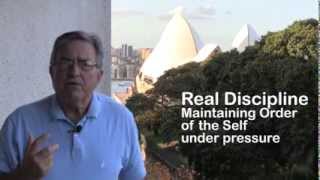
Rande Howell separates surface discipline, which collapses under pressure, from real discipline: the trained ability to manage reactive emotions during uncertainty. He traces reactivity to formative beliefs and fear of loss, then prescribes practices like anticipating discomfort, breathing, and mindfulness to shift belief structures and control your mind instead of outcomes.
Chapters
Welcome to Sydney, Australia. What we want to discuss here today is, is the difference between surface discipline and real discipline.
Surface discipline is that discipline that you have when you make mistakes and you say, you know something, you know, what I can do is I can just make another rule. And once I get my rules set, then obviously I'm going to have it down. And every time I set those rules, I'm going to make myself a better and better trader. But what happens is that you set that and all of a sudden in the heat of the pressure, boom, there you are. You know what to do, but you're not doing it. And that's the whole point about surface discipline, is that it's good on the surface, but it's not good under pressure. Let's talk about real discipline. Let's talk about the real discipline that allows you to maintain order of the self while under pressure. The key is this.
You will always want to regress to old reactive patterns that allowed you to produce success earlier. That's during your formative period. That's when all these reactive formations were going on. And ultimately that's what happens in trading is you're exposed to uncertainty. You don't really know another mind to bring into that moment. So what you do is you're sitting there and you're trying to use these rules, these left brain rules, and you discover that under pressure they fall apart.
The thing is, you have to go beyond the surface of pretending. You have to get to real in real discipline. What you're doing is you're able to learn how to manage this reactive patterns of when you're getting into uncertainty, when you're really feeling the ambiguity, when you're really feeling the confusion, being able to manage that. So out of that confusion, fear or grandiosities as it show up, that's the real trick. How do you do that? First of all, you recognize that surface is not going to work. Real requires training. You have to understand that these are emotions in play and that you're not going to control emotions. You can either learn to work with them or resist them. But ultimately, when you learn to work with them, the key is you go, well, I know that what I have to do is I have to retrain myself, I have to be able to see, I have to be able to turn toward my discomfort. That's what the big things are. You know, here in Australia, I've been both at some very big banks and at the Australian Technical Analyst Association National Conference. And that's the big takeaway. What they discovered is that you know, the big deal is being able to turn toward the discomfort and the vulnerability of that discomfort and doing something there. That's real discipline. Until you have real discipline, the surface stuff is just a bunch of rules that get blown out of the water. How do you do that? Okay, the very first thing is, in any emotional intelligence approach, the very first thing is you have to understand that what's underlying this is the beliefs that you bring into the management of uncertainty. That's what's being revealed on the surface. Oh, I'm going to control this thing simply by some new rules? No, the right brain really doesn't care about that. Okay. It's going to blow right past that. What you're doing is you're turning toward the triggering of your beliefs about managing the unknown and the vulnerability that it creates because you've got risk you could lose. And to the emotional brain, that loss means loss of life.
However, in trading, it means psychological discomfort. You've got to make that distinction. And in doing that, what these guys were doing at this conference is they were learning, how do I go?
How do I manage this discomfort? The very first thing is you have to anticipate there is going to be discomfort. You're not going to pretend that you're going to have a couple of stupid rules that allow you to get beyond the need to control the mind that you're bringing into the unknown.
That's the ticket. That's done by emotional regulation where you are both breathing and reducing the attention of the emotion that's triggering. And after you do that, you're producing mindfulness that allows you to step back out of thought and to recognize that you and your thoughts, you and your beliefs are not the same. You have awareness outside of thought and belief. As a matter of fact, not only do you not have thoughts and beliefs, they have you. They have you friends. Your job is, is to observe the thought and belief that's getting in the way, turn toward that discomfort, regulate it, and then to really look at it and say, how do I change belief structure? You do that by first shifting from your performance being a reflection of your being, your character.
Net worth is not equal to self. You find this place where you know you have worth beyond your performance. When you do that.
Something magical happens at that particular moment in time. Performance is just performance. It's not a reflection of your character. And in your performance, what you learn is this, is that the one thing I can control in trading is not the outcome. What I can control in trading is the mind that I'm Bringing into the performance.
Of the trade the mind that I'm bringing to the performance of the unknown, of uncertainty, into ambiguity, into the confusion of not knowing. That's what you're doing. Because ultimately if left to your own devices, confusion is going to generate fear. Yet to the trained mind, to the emotional, intelligent mind, what you're going to do is it's going to automatically generate a sense of approach, a sense of curiosity, a sense of focus, a sense of resolve where you have this sense of calm authority about the management of uncertainty rather than a fear of what's going to happen. So instead of going, oh my God, what's going to happen, fearing the future, fearing what happened in the past, you're literally in the moment. That's what you can control.
The mind that you're bringing into the moment, that's everything in trading. That's where the performance mind ends. That's where trader's state of mind is. And as you do that, you realize that you have the skills within you to be able to build the mind for discipline, for courage, for self soothing impartiality. When you do that, the mind that you bring into the moment of performance.
Has the edge.
That's the trick, friends. That's the mind that has the edge. Not the mind you brought to trading, but this new mind that you have developed not by tricks, not by little surface patterns, but in the depth of your core of your being. What you're doing is you're managing literally what mind you're bringing into the moment of performance. You are controlling performance, not outcome.