Developing Real Emotional Discipline for the Challenges of Trading
Randy Howell argues that trading success hinges on emotional discipline, not strategy or intelligence. He identifies four self-limiting beliefs that sabotage traders and teaches breath work, mindfulness, and physical exercise to rewire your nervous system so you can think clearly under pressure.
Chapters
Welcome. Welcome, everyone. Friends and neighbors from around the world first, my name is Randy Howell. I'm with creator State of Mind. And we're looking at emotional discipline today. And I want to take a stereotype to begin with. Okay, here's the deal. Before we do anything, though, let's find out if people are actually hearing me talk. If you can hear me talk, just type in that, that Y into the box and let me know. I just want to make sure that everything's copacetic. Yep. Okay. Thank you. Thank you, Rick. Oh, yeah. Lots and lots of people. Okay, well, then that's not the problem. Good. Let's define this thing, you know, particularly as men. And there may be a few women in this group, but the truth is, well, more than 95% of the people that trade, or at least that I see, are men. You know, we grow up being men and we begin to think, what is it like to be a disciplined man? Well, you know, you got to be tough, man. You can't show your emotions. You've got to win. You got to shake fear and discipline off, like that's nothing. And you don't talk to anyone, particularly to another guy, about your fears. Okay. You know, and you won't even talk about fear to yourself. This would be emotional discipline.
Ladies and gentlemen, we're going to open up something very different. We're going to not look at the crazy stuff that's happened in the mind and particularly in our cultural mind that talks about discipline. We're going to actually talk about discipline from a very different perspective. We're going to be talking about it really, about how does your brain, how does your body and how does the mind that comes out of this brain deal with discipline? How does it deal with emotions and what really is discipline? So on this journey, by the way, one last thing is I hold my questions till the last. If you have a question as we go along, go ahead and type it in. I appreciate that. I will get to that question. It will be the first thing that I do when I see it. Otherwise, we'll wait toward the end and we'll wait for some questions. But when you hear something and you have a question, go ahead and write it in. I'm just gonna. I'm just gonna save it till the last 10 minutes or so. Okay? You got it. Well, what I wanna do is I wanna start with basically one of the best traders that's been around forever. Most people know who Trader Vic is. He has a very long history. You can. You can read about him in Wikipedia. And the whole nine yards. And listen to what he says, okay? The key to trading success is emotional discipline. He goes on to say, if intelligence were the key, mean, like all these smart guys sitting around there, there would be a lot more people making money. If the strategy, if the method were the key, the same thing you would be getting people making a lot of money. But that's not the difference. Okay, so here's one of the most successful traders ever, leveling the playing field for you and for me. And the truth is it's not knowledge, it's not about smarts, it's about emotional discipline. That's what makes the difference. How many have a successful strategy that if they could only use it with the right mindset, would extract capital from the markets. And, and I'd appreciate it. Just a handful of you guys just simply write in yes or no. Do I have a successful strategy that's proven that can make money if only I could use the strategy with emotional discipline? That's the big question. And I know people who are, yes, if only. There you go. I love that. Yes. Oh, that was from Wendy. I love that. The honest female. I love that. Thank you, Wendy. The key is, understand this.
If you know this, this is the key. What's actually stopping you from developing the missing link in your trading? Okay. It's not like it's going to go away. It's not like unless if you had won the genetics lottery and came equipped with the high tolerance for risk that some people have naturally and just simply don't mind it, or if you were high functioning autistic like Asperger's, you know, those are highly qualified and rarefied individuals that really don't come very often. The rest of us have typical emotional architecture that we're going to have to retrain. It's pretty simple on that.
Hold on, what?
Yeah, there again, there are some people that just have this. We have an acquaintance, Jan Arps, who literally grew up with a father and they were using.
Old Wall Street Journal stuff where they were watching stuff and they just went and just developed this stuff and you know, they were using rulers and stuff like that. And before they got to it, you know, when they finally got to trading, it was easy, but they were developed in a family system that really encouraged risk, calculated risk. And that when the risk didn't turn out, it was really more about managing the loss. It wasn't about, oh my God, look at you, look at you, slimy, stupid idiot. No, it was like, wow, okay, what did we learn from that? And wow, you did everything right. Well, that's just the way, that's the brakes, that's the way it goes. So we get this, we know that it's necessary.
And then, you know, everybody.
Looks in all the wrong places and do they have to get real or get out of trading or continue to stay in pregatory? And there are. Everybody has common fixes. And I want to go through the number of them about emotional discipline. Which ones of these have you tried?
Willpower. Whoops, we missed that slide.
Willpower. Have you ever just been tried to be stronger than the emotion? Okay. And conquering it just by your strength of character? You know, very interesting is I. A friend of mine was in the Vietnam war and he said, you know, we, you know, we were scared going into basic training and we met these guys in this case from New Jersey who had a loud mouth and they were just really bravado and they were just machismo. And we were talking about how tough they were and stuff like that. And boy, they looked like they were tough. They went through basic training and all that stuff. Then they got in, then they were on patrol in Vietnam where everything broke down. And what happens is that my friend was well trained, he was scared, but, but he had learned how to master that fear. As he's walking through the jungle waiting for the bullet. The guys from New Jersey just absolutely fell apart. They had a good show. Willpower. But what happens is when it came down to actually facing the dragon, facing the emotion, no, they couldn't do it. Or how about the emotional tough guy?
Everybody knows that. Tough guy. I mean, I can take it, I can take it. I can take it. I, I can deal it out. I can deal it out. This is my favorite and you know, I love it because I live near a Lowe's hardware store. This is in the United States and you know, it's where everybody goes to get their supplies through their home projects. And I come there and I look in the parking lot. There are all these 50, 60, 70, $80,000 pickups and they're giant pickup trucks. And I look at them and boy, they look cool and they don't have a dent on them. Then I start watching and who gets in these trucks? And what you discover is that middle aged guys who, you know, they're not doing serious work on a construction site, they don't need that kind of truck. But what happens is it makes them look emotionally tough, man. It makes them feel that adrenaline revving that, revving that car up and feeling like the master of the universe. Emotional tough guy. How many emotional tough guy survivors do you know in trading? That's the deal. It doesn't work because your interior strength has to be stronger than the primitive emotional responses to uncertainty. That's the trick. You're not going to overpower them. And also a big one from psychology in particular is compartmentalization.
We're just not going to see those emotions. We're going to put them up on the shelf and we're not going to pretend that we're going to see them. Nope, we're not going to do it. We're not going to do it. And by not seeing them and not acknowledging them, we're not going to have to deal with them. And there's this hole, and out of this hole, this blast of emotion comes just at all the wrong times. Have you ever felt that way? Have you ever done that? Does any, any of this connect with you? And the easiest one is denial. It's very typical. When I'm working with a client, they'll say, you know, Randy, I'm talking to several of my friends about what great work this is and how I'm improving and stuff like that. And they're saying, man, I'll tell you, I'm not going to do that. I don't want to find out what's in there. I'm just going. I'm going to deny my emotions and I'm going to push them away and I'm going to get over it one day. Emotion. What emotion? Real men don't have emotions. This is how traders get run over and then we move to the others. Is that all positive thinking? No negative thoughts allowed? And the truth is, is that.
The markets really don't care. Okay. And what matters is whether or not you can manage probability. And probability is not all about positive. The truth is, is that most traders, good ones.
Lose between 40 and 60 percent of the time, and they win somewhere between 40 and 60% of the time. What they're doing is they realize is that, you know, if their hypothesis, no matter how much they want to believe it, is wrong, they promptly admit it. They don't make up a story about how it's positive and they get out of the trade. And if they're fortunate enough to land on the probability of winning, they allow that thing to go to target or beyond. But the thing is. Yeah, but can you out positive the markets? No, absolutely not. They just don't care. Also, one of my other ones is to resist the motion. I feel it, I feel it, I feel it. But I'm going to resist it. I'm going to push back against the emotion. I'm not going to let the impulse to jump in that trade.
I'm not going to succumb to fear. I'm not. I'm not. I'm not. And Carl Jung, one of my favorite psychologists, psychiatrists, actually said, what you resist, persists. If you resist the emotion, the emotion persists and it gets stronger. Everybody will have seen that in their trading. I'm going to resist it. I'm going to resist it. And then they get ran over by it. Okay, let's go on other ways for doing this emotional, Emotional discipline stuff. And I'm showing you these, not because these are all wrong, but I'm saying they're inadequate. They're inadequate to be able to build real emotional discipline from the inside out. This is like taking stuff, visualization. You know, you go, you know, I'm going to visualize success, I'm going to visualize winning. I'm going to visualize this. And what happens is visualization. Again, you have to get used to that in trading. There may be a positive outcome, there may not be a positive outcome. There may be a loss. The thing is, you can visualize all you want, but the visualization, when you're visualizing about something you would like to have happen.
Under the stress of trading, under the challenges of trading, under the challenges of uncertainty, the visualization breaks down. I actually saw this a couple years ago when I was watching some racers with slalom where they were. They were very trained. They were actually sprinters that had matured out of sprinting because that really takes young legs. But they had powerful acceleration that could put them into the sled and they could ride that thing fast and they'd have that extra head start that's so valuable in sled riding like that. They would. The problem was they kept hitting corners and stuff like that, and they would end up losing hundreds of a second. And before, before you know it, the Americans were out of, out of contention of medals and stuff like that. They visualized success. And then one of the women said, I'm just going to go back and visualize this. I'm going to overcome it. And dang it, she didn't come back and do the same dang thing. The stress was there, and it overcame her ability to visualize success if she didn't have the skill sets to deal with the stress. That's the thing that we want to take a look at. Also affirmations. Oh, my gosh, I am a Disciplined trader. I am a disciplined trader. I am a disciplined trader. What happens with affirmations? And understand, I actually use visualization and affirmations in my work, but I don't believe that I can retrain the subconscious mind from a position of B.S. okay. And with affirmations, you are basically, you're faking it till you make it. You're going to believe something, I'm going to hold it be true. I'm going to make it. I'm going to make a wish. I'm going to make a wish. I'm going to make a wish. And what you discover is affirmations have to be backed up not by wishful thinking, but they have to be backed up by actual experience where you feel the actual. When you feel the emotions that you need to be present, present, not just wishing, they'll show up. So what we've done, we have a problem here. And this is something.
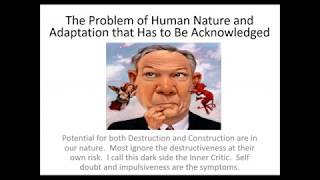
This is actually the very first time that I've ever talked about this in one of the webinars like this. And it's something where, you know, I wanted to be more positive and stuff like that. But the truth is, part of the problem of being human is is there is both a very destructive and a very constructive part of us. People have noted this through all sorts of time. The ancient Chinese called it the yin yang. There was construction and destruction going on. I personally, I like the way the Cherokee Indians of North America explained it is that they said that there were two wolves that lived within man. One very bad, one very destructive, and one very constructive. And what they held, the one that won, the one that actually guided the way your life was going to be built in the Cherokee spiritual philosophy, was that the one that won, the wolf that won the destructive or the constructive wolf, was the wolf that you fed. Now we're getting closer to the truth. Okay? That internal conversation that's happening.
On an unconscious level needs to be made explicit, needs to be made conscious so that you're beginning to see it and you can do something about it. That's the wolf that you're feeding. Then what you notice is in Hinduism, they have, in their concept, they have this creating God, they have a sustaining God, and they have a destructing God. So you begin to see, wow, a lot of people have talked about this quality within us for a long time and it gets wired in. And the Abrahamic religions, and that would include Islam, Judaism and Christianity, there is this concept of satt, or what we would translate into English as Satan if yet if we were to Go back into Aramaic times. And we were to ask a group of Aramaic speaking people, we've heard you talk about the Satan stuff, could you explain that into English that we can understand? And they said, oh yeah, that's a prosecuting attorney that lives in your head. Okay? So what we grasp is that this prosecuting attorney is not external to us, it's internal to us. In the same way that the yin yang is internal to us. In the same way that the good wolf and the bad wolf are eternal to us. In the same way the.
Constructive God and the destructive God are living within us. Okay? That's the concept. I want you to see that these are fractals of this and we turn it on. There was a beautiful experiment there. Everybody knows about the Sanford experiment where they turn perfectly intelligent college kids into sadomaschesis in less than five days. But there's another one that's done at UCLA where they recruited UCLA college kids, upper middle class college kids that tested out to be normal or healthy in their psychology. And they said, okay, what we're going to do is we're going to train. You're going to be guards and you're going to train prisoners to do as you request. And if they don't do it, we're going to classically train them by shocking them, giving them an electrical shock until they finally comply with rest. Yeah. Okay. Okay. This is classical conditioning. Pavlok did that with his dogs. Okay. They also had the prisoners who are actually graduate students.
And the graduate students were in on this game they were going to be playing because the graduate students were never going to receive an electrical shock. They were going to pretend they were getting a shock, but there were the prisoners. So when the guards showed up, they had these rooms and they had this one way mirror and they were looking at the prisoner and, and he, the graduate student, and he was kind of locked down in something what we call an electric chair. And that this whole game of that, making requests. And then what would happen is that the prisoner would deny the request and they would give him an electrical shock. At first that worked and then they started being, they started being oppositional again to it. And they were said, well, just turn up the shock, turn up the electricity. And within three days, friends.
These kids that were normal psychological kids from UCLA willingly knew that they were administering lethal shocks to the prisoners and killing them right in front of their eyes. Now again, the prisoners were graduate students and they were not being shocked. They were pretending they were and literally would go into the death throes of being shocked and die. It created a lot of problems. But there is a switch that can turn destructive on you, okay? And it's something we see in trading all the time. It's the same thing that the Japanese did before they invaded China and Shanghai where they just massacred a bunch of people. They had, they had created them to demonize them. And they, this is. They turned on that destructive switch. What I want you to hear is this. This is part of your human nature and it's going to be exposed in trading. There's really no way around it, but there is a way through it. That's the big deal. So let's get down to this. Every time you engage in uncertainty with skin in the game, you trigger the uncertainty monster, okay?
Left to your own default programming, you're gonna be in trouble. You're going to default to the kind of destructiveness that happens when you revenge trade. When you over trade, you've hit the destructive button, okay? And all of a sudden you're no longer in control of yourself. But something else is, kind of like your evil twin is. And what you're doing is you're reacting to uncertainty. And you're reacting to uncertainty in such a way that there's a trip switch that can become very destructive. Okay? This is what you're doing is the emotional brain adapted you to survive in the formative environment that you were wired in. And usually that doesn't pretend well to uncertainty. We don't. Our brain is designed to control outcome. It abhors randomness, uncertainty. And it has to be rebuilt after millions of years, it has to be rebuilt to engage uncertainty. And look what you do. You're actually working with trading, which is an exercise in uncertainty and probability management. Wild, isn't it? Yet what happens is we insist on using.
Square wheels to be able to push this through with it. Because we're not born with these genetic disposition to do this again. Unless you won the genetics lottery, and there's not many people that do that. They have to rebuild the emotional circuitry of meaning and belief about engaging uncertainty. So what we're doing is we're truly trying to pound a square peg into a round hole. You have to develop the brain and the mind for managing uncertainty. Because my promise to you is that the old brain, the emotional brain, is not going to do it for you. As a matter of fact, in this illustration, it says, stop following me. What happens is modern man is looking back at his more primitive ancestors and saying, you know something? I don't want that emotional brain that just absolutely hijacks me from coming and, you know, it's trying to control outcome and is resisting uncertainty. You know, I want the truth is your brain evolved for short term survival over long term benefit. If there is perceived danger, thinking is bypassed by your survival instincts from all these ancestors. You're looking, you're dealing with this every day. And the question is, if you don't get it, wake up because you're missing something.
This is where most traders refuse to recognize. You know, we are flesh. Our genetics here. We have, we have. Before we were homo sapiens, we were hominoids, but we, we were animals. And we still are animals. And that part of us, we need to learn how to deal with a lot better because emotion, that flesh part of us and that cognition part that makes us so different than anything else. They are deeply, intimately related. Okay, As a matter of fact, you carry your caveman with you. No matter how thoroughly, thoroughly modern you feel, driving your fancy cars and all that kind of stuff and having all that modern equipment in front of you and having, oh, man, all that, you know, all that platform, all that stuff, all that jardin that you talk about in the back seat, friends, is a caveman and he's worrying the heck about whether or not he's going to survive the next moment. He does not like uncertainty. He wants control. He wants to be right. He wants his predictions to be right. He wants to believe that even if they're wrong. Well, this is what you're carrying with you. Caveman lives. And trading is a very different world than the world that he's prepared to live in. And if you don't believe me, look at your trading account and say, how much money am I making or not? How much money am I leaving on the, on the table and how much time have I squandered this caveman? What we want to do is we want to look at the circuit this. Friends, you are looking at the problem that you have. Okay.
In here, this is the glitch between our ancestors and who we are today. Trying to play a probability game. When our ancestors are playing a certainty game about survival. There's this sensorial information coming in that's on the bottom left hand corner where it says external input. That's from. That's information from your eyes, your ears and all that stuff. It's coming into something called the sensory thalamus. And it's this kind of like traffic cop, okay, where it decides, you know, which way signals are going to go. You know, are you going to go this way, you're going to go that way. Are you going to stop what you're going to do? And it makes a very quick and dirty decision about whether or not information coming in is a threat or whether or not it's something to be pursued. Understand, if there is uncertainty involved, your default programming, your survival instincts are going to see that as a threat, a threat to biological survival. Pow. Automatically, the thalamus routes that the low road right over to the amygdala, okay? And suddenly the amygdala fires up the fight flight response. And all of a sudden, all these emotional responses are coming out. And you over trade, you under trade, okay? And you. You end up being so fearful, you can't get in trades. You see the fight flight response there. And here's the deal, friends, it happens in nanoseconds.
Nanoseconds faster than you can blink an eye is how fast the old sensory thalamus has already made a decision, routed information down the quick and dirty low road to the amygdala in fight flight, with all the problems you're experiencing in trading, or if it's not seen as threatening, that information is sent up to the cortex, the neocortex, the sensory cortex. And this is the slow but accurate way. And that's who you want working. That's the high road. The problem is, that takes half a second.
Half a second, friends, compare a nanosecond to half a second, that's universes in terms of emotions that are firing like this. And so what you're looking at is going, okay, I have to reprogram the way my primitive emotional brain processes sensorial information, whether or not it's fight flight, or whether or not my neocortex, my thinking brain can work with this, whether or not caveman or modern man gets to deal with this. And, friends, you might say, oh, this is crazy. I'm nothing like my ancestors. Blah, blah, blah, blah. Yes, you are. You know, if you're having problems pulling the trigger, if you're having problems with. With over trading, if you're following having impulsive trading, revenge trading, yes, you are. This is the circuit that's being tripped. And the truth is most people stay on the low road, and they never learn how to stop that because they're trying to use emotional discipline techniques, the ones we went over before, to solve a problem that could care less whether or not you have techniques or not, okay? So we want emotional discipline focused at the low road, focused at the sensory thalamus to calm it down.
And that's what in my work, what you'll discover is I call that orphan. Okay? It's very interesting. And as a matter of fact, I use the term amygdala, the kind of seed as an emotional center. That's actually what I call orphan. Okay, so we get that, we go, wow. And friends, this is literally, if you're going to produce success as a trader, this right here, this circuitry you're looking at right here is what you're going to have to transform. You're going to have to unlock it.
You're going to have to give the limbic system, the emotional brain a better reason than I told you so, okay? The limbic system is going to make a decision based on its best survival, whether or not it trusts higher thinking or whether or not continue the trust in the low road. This is what you have to solve, friends. And I can tell you right now, very, very few of you are going to do it with trader trainers do it all the time and they can teach you. Blue in the face. One of the better trader trainers around today, David Debase and in the audience, and he's a friend of mine and you know, it's, he's, gosh, he's proven his worth over many, many years and he has a great trade room. But at the same time what he realizes is that unless you can get your head together, unless you can manage this circuit right here and get to the emotional beliefs beyond it, nothing that he teaches is going to make any difference because you have to have the emotional discipline to be able to use the method. Once you get the method, whoa. Then all of a sudden Trader VIX online, it's, it's going. So we now we see what the problem is, we understand what discipline has to be actually focused at.
So now the real question is how do you go about retraining your brain? Okay, you can be as strong willed as you want, it's okay. The markets really just simply don't care, okay? They, the markets will keep gladly taking your money and squandering your time. It comes down to making a decision that your brand of emotional control does not work based on your performances, based on the results in your trading account, not based on what you think, not based on what you feel, not based on what you would like to believe, but based on what your trading account is telling you. That's the big deal, friends. That's the big deal.
It takes an enormous amount of courage, particularly for a man who's focused on that external courage business to look inside and say, oh my God, I have a problem in me. Me is the problem. And I have to work me into a different organization of the self. And by the way, women, because they don't have so much dang testosterone running around in their systems, actually can make much better traders because they're not so tempted by the risk of testosterone. So where this gets is we have to conceptually understand the brain and the mind very differently than we currently do. In my coursework, I teach, and this is from. This is neurobiology I teach. The brain is actually a community of rival emotional programs that have duked it out for control of who runs your mind. If you've ever seen the movie Inside out by Pixar Disney, you will actually see how they have taken these emotional programs and given them a life inside the mind of this young girl. And you'll see how they're duking it out, how they're highly competitive with one another, they're changing alliances all the time. And until finally they finally figure out that sadness has a place at the table and joy needs to kind of like stand down and just recognize there's a lot more to managing emotions than being joyful all the time. And here what we're doing is we're saying what we are looking to do is to take the default programming of who won the battles, what mind you bring in. And again, this is by the results in your trading account, not by what you feel, not by what you think. Because I can tell you right now, don't trust what you feel, don't trust what you think. Look at your trading account and become a detective and say, what's behind what's behind these losses? What is the belief system that's triggering these performances in the clutch? So we get it. The brain's a community of competitive programs, okay? And ultimately what you're looking at, this is pretty much what.
When you have an undisciplined mind, this is pretty much what's going on inside your mind when you're trying to trade.
And you get it in the disciplined mind. You know what forces need to be in play to produce peak performance.
In the undisciplined mind, which is basically practically everybody in trading, you don't know how to coordinate the forces, you don't know how to bring them into working mind, and you don't know how to use emotions.
To build the emotional cocktail that creates the mind that you bring into the moment of performance and trade. That's a big mouthful, but I want you to hear it is the disciplined trader understands that there's all sorts of internal struggle going on. And what he realizes is that he has to calm the fear down, not suppress it. He calms it down. Okay? Compassion is the antidote to fear. Not strong will. Eventually the emotion will grow an ellipse. Strong will just give it enough time, trade long enough and it will happen. And then the disciplined mind recognizes that there will always be a part of destructiveness that you need to confront a little bit more about that later. You have to have the courage to face your dragons. You also have to be able to maintain order under pressure. And this is where the emotional discipline comes from. But it comes from inside the self, from experience, rather than wishful thinking. But this is the mind that most people bring to trading. This is the mind that just gets more reinforced. Because what happens, you take this amygdala and it's looking, see, can I trust the thinking brain? It goes, no, he's doing the same stupid things over and over again. I'm going to have to hijack the mind even sooner. So you start getting hyper vigilance built in, almost PTSD type stuff. When you've made a bunch of losses and you look back and go, what was I thinking? Well, you're telling the amygdala that it cannot trust higher order thinking. You're not teaching how to bring that emotional discipline into play and to work with emotions rather than to push them away. First, let's take a look at this. What is emotional discipline? Well, you might want to write down what your definition is and you can see mine. Okay. What I want you to recognize from my perspective is emotional discipline is the capacity to maintain emotional and mental order when facing challenges where the outcome is certain, uncertain, and the risks are tangible. That means you don't know if you're going to win or lose. You'd like to win, but the truth is, is that you have a probability. But it's just a probability and you've got skin in the game. If it's a loss, money's going to go, okay? And you realize I have to maintain the order of the mind during that sequence. That's emotional discipline, friends. Okay? It's not the lack of emotions, it's the management of emotions. Okay? Where do you start with emotional discipline? Well, I can tell you where I start, folks. Okay?
It starts with emotional regulation. Once you really recognize that emotions are biological, they are not psychological, they overwhelm psychology and thinking. You go, oh, they're biological. And besides that, you discover they have a signature. They have elements, breathing and tension, heart rate and A number of other phenomenons are part of that emotion.
Tomorrow, if you trade, what I want you to do is notice how you breathe. Notice the tension in your body. You're going to see it rampant. What you're doing is you are experiencing the emotional arousal, the emotions triggering friends. It's there, it's just building up ahead of steam. And if you don't stop it, if you don't know how to regulate it, it's going to stop building a head of steam and it's going to start flooding through the body as chemistry. Then you hit that feeling state and it's all over your. The brain's cooked. So the first place you start with emotional regulation, you start going, you know, breathing. You're telling me to breathe in. And tension reduction. Absolutely. This diagram, been using it for 25 years. And the truth is, is if you, if you start working bellows, breathing and muscle relaxation in the environment while you trade, what you'll discover is that you start calming down the emotion, emotional reactions that your sensory thalamus is kicking over the low road over to the amygdala, calming it down. And you're getting a little bit more access to the neocortex, the thinking brain. And you're doing that literally volitionally, by the way you breathe diaphragmatically and the way you're letting the tension go instead of letting it rev up, rev up, rev up. Friends, I have. Whether or not you take my group course or my individual course, literally, this is where you start. You spend at least two weeks training yourself on doing this in the midst of training, not in the yoga studio where everything's easy. No, that's useless. If you don't learn the skill in the environment that you're going to be using it in, it's not a skill. So we've gotten this thing, okay, we've gotten some emotional regulation stuff, okay, we've calmed it down. But there's another piece you're going to have to learn to step back out. Using mindfulness to generate an observer of the self. I actually had a guy that I work with in South America, says Randy, the very first time today, I realized that I actually produced. I calmed myself down. I was sitting there and I stepped back out. I started observing, being mindful, and I started recognizing for the first time in my life how bad the inner critic, all that negative talk inside my head beats up the orphan, beats up that fearful part of myself. And he said, you know, I was actually shocked. I had no idea. And of course, what we went on to talk about was some of the skills that we teach in here about how to bring the discipline, how to bring the courage, how to bring the self soothing into the picture of this mix in this moment to calm everything down so you can get back the impartial discipline mind that you need to trade. But the truth is, is that have you ever experienced this observing phenomenon? I can promise you you have. I'm going to give you a couple examples. The first one is who in here has ever experienced a moment when they wish that they only knew back then what they know now?
Everybody has. What you're doing is you're producing first order observation. The problem is you're way too late. You're observing a past event and saying how it could have been different. But the truth is, is that you need it in real time. And if you've ever read or listened to George Soros very much, what you discover is he has a very active observer where he recognizes and when he talks, he says, I have an observer and I have a participant in the markets. I'm not a pure observer because I also have to participate in the market. But what happens is that my observer starts looking for bubbles in the markets and I observe the bubbles and I start doing my investing and my trading and my positions there. He said, in, in cases I get to the moment where I, I can no longer tell how long the bubble will last. And I know that that's my time to pull out of the trade, pull out of the position.
He's observing in real time and being able to call forward the emotions necessary to make good trading position or investing, active investing decisions. I'm not saying that you can become a George Soros in your ability to observe and participate simultaneously. But this is the goal that you need to be able to set for yourself. And yes, we teach it. And it starts with mindfulness about being able to step back, observe thought. It's not as who you are, okay? You and your thoughts are not the same. You and your beliefs are not the same. It's just one potential organization of a self that happened that you have not woken up from and started observing, saying, oh, I can change the organization of this self so that it performs better with probability. Absolutely. And the big trick more than anything else is actually beginning to.
Recognize how little.
That'S conscious about your decision making. That's where you have choices and stuff like that. Most of the stuff is happening on the limbic area, often what we call the unconscious mind, where the programming of all that information coming the Sensorial thalamus and making a decision based on whether or not it's good or bad and sending it the high road or the low road that's happening outside of consciousness. Friends. It's called in psychology we call that implicit key limbic thinking, emotional learning. And you have to go in and reprogram that emotional learning about what it learned about uncertainty. Until you do that, all this unconscious programming is going to fire anyway. You have to make that implicit, that unconscious mind explicit. You have to get to go, oh my God, I really have to look at this and I have to learn how to bring those unconscious beliefs that are polluting my performances into working awareness because that's where I can do something about them. And the truth is this is the huge breakdown in discipline. We just simply do not want to face our dragons. And you know it's really interesting is it's pretty easy. What you discover is this is that there are four major self limiting beliefs about that are manifested in all walks of life. But in trading they can't be avoided. Not well at least not profitably if you're going to be profitable. The first is a sense of incompetence. I'm not good enough. The second is I really don't matter. And you see people, I have to prove myself. I have to prove by making a lot of money and doing all this stuff and I make a lot of money. I'll show people that I matter. Other people have problems with their worthiness. Do I actually, am I worthy to make money with little work and a lot of people? No, not actually. And they have to find that. And also when you sabotage yourself, you'll find that's how it happens is it's your unworthiness kicking in. I don't really deserve this kind of money. I have to blow it up. Or you get so euphoric that you start making stupid decisions. Either way, the euphoria is a dragon. The fear is a dragon. And you're going to have to face those four self limiting beliefs if you're going to develop the kind of discipline that you're looking for. Okay, so what you're looking for is that emotional learning behind the fear. That's what has to be mastered. Friends. And these are beliefs about your capacity to manage uncertainty revealed in performance in your trading account. Notice my definition is very, very specific. It's not what you think, it's not what you believe. It's what's being revealed in your trading account and your performances. That is how you become a detective to find those One of the four. It's literally about adequacy, mattering worth or powerlessness. That's the big forefronts. And ultimately though, understand this is that discipline, like other emotions, can be activated, okay? Discipline exists as an emotional program within you. What I teach is how to get at that emotional programming, okay? And to be able to pull forward the emotional program of discipline. It's not like you're trying to make it happen externally by being tough. It's something that you're actually going into memory and pulling it up. It's method, act, okay? But ultimately you find it and you learn. Like Eragon here is that you can sit with the ghost army and what you do is you fear not the ghost and death, but what you fear and you recognize is that it's claiming your destiny and creating a new destiny for yourself. This is the power. And so I, you know, actually when it comes down to it, I'm showing kind of electrical drawings, but it's neurocircuitry, which are electrical circuits. You actually, you're not going to fake the emotional brain. You know, you can talk the talk all you want, but the truth is the emotional brain is looking at your performance. It has to learn to trust you, okay? You have to learn how to rebuild that brain and mind that first learn how to deal with uncertainty, then train it into a more effective way.
And again, that's what my work is about, is training you in that effective way. And when it comes down to it, the discipline comes from the inside out. It does not come from the outside in looking for fixes outside of yourself and all those toys you got and all those teachers you've had, ultimately that's not going to be the, that's not going to be what makes the change. The change happens between your ears and your brain and your mind with your emotions and the beliefs that you really truly hold about your ability to manage uncertainty. The challenges of life that come your way, that's the difference. You have to rewire the original default fault programming friends. That's the, that's the trick. And the truth is, is that.
The same emotional programs that you brought to the game are not going to work in trading. You're going to have to change them from a survival based programming, particularly scarcity thinking, okay? Where you're scared that you might loosen a fomo, fear of missing out of profits, okay? And you're going to have to transform them. And when it really comes down to it, what you do is I want you to take a look at this. Is this is competitive sailing. And I want you to take a look at that. This, these guys are in rough sea. And what I want you to see is that's a mind. Those, those people on that boat are acting in one mind. And out of that, what you're seeing is, yeah, man, things are challenged. These guys are challenged. It's pretty uncertain waves like that. And they're in a tough position. They are all doing their jobs, though. They're focused on their job. They're not focused on outcome, they're focused on their performance. They've reorganized the mine, okay? So that becomes an effective tool to take the instrument of that boat, the instrument of your platform, the instrument of your methodology, and to extract the edge performance. That's. This is, this is what's so workable, friends.
So here it is. We know that we know or I don't know, you may not know. I'm very clear that you're going to have to retrain your brain and your mind to be able to trade successfully. Okay. And there's the, the.
You know, trading is littered with the corpses of people who said, I can do this, I can do this. And they blow out their capital in three to five years. And, you know, what happens is they, they finally wake up and go, you know, yeah, if I'd only had emotional control. Yeah, what a, what a concept. And my view here, and my question is that the problem is not going to go away and do you have a better solution to give to the emotional brain? It's going to be trained. And the real key is what choice are you making.
Now? If you're looking at it and you've been getting the game for three, two, three years and you're looking at your trading account and it's not getting better and you already know how to trade. You know that it's the performance mind that's the problem.
And for as long as you want, do it as long as you want. But ultimately it comes down to most people keep trying to do the same things over and over again, thinking that they're going to have a different outcome and they don't. What I'm asking you is.
What if you made a choice that.
I'm going to choose to really rework the way the emotional brain and the thinking brain cooperate together.
Wow. Well, if you wanted to do that, I have good news for you. Okay. We have.
And depending on where you are in your journey into trading, my encouragement is first get free gift. Just go to my website, it's right down there. And get the free. It's an, It's a free ebook. Get it? It really started you on the journey. It'll kind of give you more about kind of like this unusual way I talk about the trading mind. The second thing is, my goodness, when you go to the. There are tons of articles that I've written that are on there. There are tons of videos that are accessible from the website on my YouTube channel. There's, gosh, I don't know, I think There are about 200 videos on there now. And people spend lots and lots of time. It's a content rich. And then when you come to that, get the book, Mindful Trading Book. It's, it's powerful. You know, it tells you exactly how this process that I teach works. It shows you how normal you are and how every trader is going through this same crucible. And how do you, how do you, how do you work the program? But at some moment it comes down to, well, I want to go in training. You know what? I recognize I can read to my heart's content, but the truth is I actually need to train with a mentor who knows how to do this. A mentor that knows how to train for the mental and the emotional side, not the trading side, the actual trading information side or trading knowledge side. And it comes in the individual course and the group course. And the way it works is go and read. Basically, the group course is financially an effective way to learn the basic skills. And it's a wonderful course. We get lots of reviews. The individual course is you have me as a personal mentor working through and it's literally you get 10 consults with me and it's enormously more. Yeah, it's all on Skype where, I mean, we're looking at each other. You know, we look at each other and we see what people are dressed at. It's like being in an office together. And it's highly comprehensive and it's highly personal. But the thing is you have choices, friends, and it's a matter of moving them. And we do have a group course that starts in September. And I would encourage you, most people, good, smart people will start that course at least a month early and they will do the emotional regulation work before the course starts. Because when the course starts, you're going to be hit the ground running. If you haven't done the emotional regulation work, you're already going to be behind. It's that simple. This is very serious work. I'm not looking for people who are looking for magic bullets. I'm looking for people who recognize that they're going to have to get in and get dirty in their brain and their emotions and rewire them to be able to work probability rather than survival. I want to thank you guys for coming and if you have questions or if there are any questions here, there is a question right here.
Well, this is a question period. Do you recommend or not a treadmill at the trade station? Absolutely I do. Also, would you promote a 30 minute exercise routine prior to trading? You know, I have found that there's so many different ways and I'm going to go back to the. I promote, yes, I promote an exercise routine, but I also promote the exercise routine basically twice a day. One to make sure that you burn whatever chemistry, emotional chemistry before you get into the game, but not so much that you're tired and actually have a recovery period. Then somewhere along the day, usually at lunch there's a. More of an exercise routine where you're burning out the chemistry, usually cortisol anxiety from there. So it's. Yeah, it's essential. Basically, if you understand the way an emotion works is once it triggers, it begins to build. It hasn't necessarily taken shape yet, but it's beginning to build. And that's called emotional arousal. And that's, that's the, when you hold your breath, that's the muscles getting tense, that's the jaw clutching, that's the fixation on the screen. All that stuff, what you're experiencing is an emotion building the chemistry up, getting ready to flood into the body, into the brain. And when you start seeing that, when you, when you recognize that you cannot manage that by breath, you can't manage by the committee of the mind work that I do, what happens is the very best thing is to get on. I, you know, I know people that use exercise trampolines, I know people who have treadmills, I know people who go for runs, I know people who do some yoga. I'd rather active stuff that would burn stuff out. But once that, once that emotion has triggered and it's building and it's past your ability to pacify it and manage it. The way you manage it is you exercise because that burns the emotional chemistry out and it resets about your ability to pull the emotional programs up and produce that chemistry. Because ultimately this is a game of chemistry. You're producing a particular emotional chemistry that governs the way you think and perceive. So yeah, I promote that.
Okay, well we're not showing, we only have, we only have three more minutes. So if you have anything, if you have any questions, this would be the time to put them in, and Dolores is putting in. You know, you should be able to see our website.
And the major thing while we're waiting here and seeing if anybody's going to have another question is this, is that it's no fault of your own, okay? This isn't about something wrong with your womanliness or your manliness. This is about having a brain that was designed for one thing.
Then applying it to something else and recognizing.
That that brain is not going to produce success in trading, okay? It's just not. It's not up to the task. The good news for us is that the human brain is an enormously adaptive organ and that it can adapt.
The very beliefs, the very programs that run it. You can reprogram yourself.
And, you know, when it really comes down to it, elite athletes have sports psychologists. You know, the top golfers actually have their psychologists at the games with them so that, you know, between at night and stuff like that, they're. They're going through this and making sure that they're staying in a focused mind space. They're in that mind. They're in that zone. And ultimately what trading is, is there is a zone. And I call it.
Disciplined impartiality. That has to be manufactured. I mean, literally, that's what you learn how to do in my courses. You manufacture that mind and then you maintain that mine through your performance, through the performances. That's how it's done. And professional athletes have a lot of money and they can afford this. But the truth is you can afford to do this. Randy, I have a problem of getting out of a trade. Fear of loss. Is there anything I can do for this? Thanks, Kevin. Kevin, that's a lot more complex question. I don't know very much about you, but what I'm hearing is you have a problem of getting out of the trade, even if it goes against you. I'm going to take it from this position where it's. Where it hasn't necessarily gotten profitable, where you have a problem, fear of missing out on profits and you get out, but you're in the trade, it starts going against you. Then you say, well, I'm just going to give it some more. I think it's going to turn around. I think it's going to turn around. Well, you've already been hijacked. If this is the case, and I don't. I don't know. Again, Kevin, I don't know your history, but I know that most people have problems getting out of trade. The problem is they end the trade it's going against their hypothesis and it's going past their parameters. And what they do is they change their parameters on the go and they become gamblers. Okay? And at that particular time, what you're doing is that the emotional hijacking did not happen then, okay?
You just. The trap shut when you couldn't get out of the trade. You end up taking a much larger loss. Okay? Because you didn't want to, you know, you didn't want to let. You didn't want to be a loser. You know, I had to be a winner, and I'm gonna make this thing win. And the truth is, is that's a whole mindset, that's a whole set of beliefs that has to change. That whole notion of winning has to be thrown out the window in trading is that you don't have any control at all. Okay?
Do for this thing. Fear or fear of loss? Well, the thing is the fear of loss, you're still getting in this thing where you're saying trading is really about becoming a master, a master loser. Okay? And what I would encourage you to do is take a really close look at the group course and the individual course, read the book. But the major thing is, what I want you to understand is the fear of loss is this is what has to be. You have to. You're going to look, you're going to be losing a lot of the times. And really great traders, what they're doing is they have no problem at all getting out of a trade that's losing because they realize that my hypothesis is wrong, it didn't work out, and I need to get out of this trade. It's no big deal. The mind of performance is what mattered, not the outcome. You want the outcome. You don't want to lose. I don't want to lose. I don't want to lose. When in fact the focus really needs to be on how am I performing. And if you focus on performance, then you're going to find that losing is just simply part of the game. But in your particular case, my promise to you is that when that trade's gone against you and you are losing and you have a fear of losing, is that the emotions already? That's the trap that collapsed on you. The most likely where you need to be focused on is when you actually.
When.
The brokers got your money, when you're committed to the trade. Most people do not prepare their mind for managing the trade. Okay, Is that you become a defensive coordinator rather than an offensive coordinator. In American football, the offensive coordinator.
Before the money's been put there about the risk is placed is that you're looking for opportunity to exploit the defensive coordinator. When you're managing trade, what you're doing is you're trying not to give up ground. You don't mind giving up a play or two, but what you're trying to do is you want to bend but not break. What you're doing is breaking. Literally. It is like at order fill, you need to be looking at what's going on with you. At order fill, my bet, you'll notice you're holding your breath. My bet is that you'll be tense and as it moves in there and that thing starts going, you know, whacking around within its range is you're. You're losing it there. At the same time, emotional regulation is going to go so far, it's going to calm the emotion down so that you can think more clearly. But the deal is, is the problem is in the mind. You have to get to the door of the mind. You have to look in. That's the mindfulness. And you have to understand the structure of the mind. That's what I teach, and that's where you find out how to solve that problem. But you can start by just noticing it and noticing that you've been hijacked a long time before. Before you start either revenge trading or you just simply keep throwing good money after bad. Okay, I want to thank all of you guys. And thank you, Kevin, for your question. That was actually a very good question. I want to thank you guys for coming. I am delighted. I really love to talk about the mind on uncertainty. It is just. It's just. It's just like. It's just like a pick and slot for me. And if I can help you.
Move, move. If you're really looking to build the mine that can produce the kind of success, the kind of potential that exists in trading, you're going to have to invest. Okay. Whether or not it takes you, you realize going, yeah, he's right. Or whether it takes you five years and $500,000 or more to learn that lesson. The markets don't care. And it really does depends on you. What do you want here? Do you want to become the trader that you could be or do you want to continue along the same lines? You're working. If I can help you, really.
Would like to help you. Take care, my friends. It's been a lot of fun. Take care.









