Developing the Mindset of a Highly Effective Trader
Randy Howell explains why traders fail: your brain craves certainty but markets live in uncertainty. He maps the neurobiology behind panic trades and walks through six steps to rewire yourself, from emotional regulation to building what he calls a "probability mind."
Questions this video answers
December 6, 2018.
97%.
.003 seconds (to the amygdala) vs ~.5 seconds for high road thinking.
Begins January 17; built for 10 weeks and meets five times (group-format).
Ten consults with Randy Howell on Skype.
Chapters
Season's greetings, my friends. My name is Randy Howell with my Trader State of mind, and I welcome you to this webinar here. And it's the December one, the Christmas one. But before we get started, I just want to make sure of a couple things. One is, can you hear me? If someone, if some good people would simply type in why and let me know that you can hear me and everything's copacetic, will get started. Okay. And I would really appreciate that. Just all I need is a few. Okay, thank you, thank you, thank you. Okay, so we're there. The other thing, the other bit of housekeeping that's usually important is that I keep questions till the end. Please ask them. Just type in your question, Dolores. We'll keep that there. But I found that by keeping myself focused on the message that I'm delivering, I, I answer a lot of questions along the way. And it'll also give you better prepared questions when we get to the end. Okay, that's pretty much it. Meanwhile, let's get this truck moving. Okay? And where we start is this.
You may have noticed that producing success and trading is different than you thought it was going to be like. Yeah, let's take a look and find out what the world is going on. And it was started out just, hey, just bring that proven success strategy to the world. You're gonna, you're gonna be okay. And you know something? Once you see this thing, once you figure out how to trade, you're gonna be able to, man, you can just size this thing up and, man, you can see the financial success. You can see the personal freedom. Practically everybody that has come into trading has fallen or taken that bait. Okay? You think you know how to be successful in trading. You really do. And once you learn how to trade, that's gonna be it. You're gonna start seeing that upside potential and dreams are gonna come true. And, man, you're ready to rock and roll. Do you remember those days? I'm sure you do. They were heady days. And what was that? You know, you have to. All you have to do is learn this business of trading and success will follow. And you know what those rules are. It's about making things happen. It's about being perfect, about being, doing everything right so that you're not wrong. It's about having a goal and really sticking to it. It's about being disciplined. It's about working hard with urgency. It's about never giving up. It's about that enthusiasm. It's about positive thinking. It's building A plan and sticking to it. Don't you wish you could do that? And it's the achievement. You're going to do it. You're going to make it happen. I cannot tell you how many people come into this with a personal development mindset about winning and not losing. And they get here and guess what, the money just flies away. But no matter how close you are to turning the corner, it's still just around the corner.
Trainers, have you noted, just seem to make it, they seem to make it easier that you're going to be able to trust that edge in probability.
Yet no matter how close you get to the turning the corner, your trading, the money keeps going the wrong way. So guess what, success wise, you try harder. But what is really going wrong with your trading? If you're like the vast majority of traders, 97%, 97% are not making consistent profitability and they keep going. You know, I'm just, I'm so close. There's just this one little thing missing. There's this one little thing missing. If I only understood what it was then, you know, maybe it's a, maybe it's the new indicator, maybe it's a new teacher, maybe it's a new strategy. You go through those for years, then you finally come to a moment where what is going on? And all of a sudden you discover something. Or maybe this is the first time.
Is that successful trading really a three legged stool? You know about two of them, you've heard some lip service about the third part of that leg. Everybody knows you need a good trading system, a platform that allows you to move in and out and it doesn't jog gump on you, doesn't, doesn't freeze up on you. It really is useful. And you also know that you have to have a set of rules, methodology that allow you to manage risk and to have probability in your favor. And with that probability in your favor, you're sure everything is gonna be fine. And then, oh yeah, oh yeah, you better take a look at your trading psychology or at least leave your emotions at the door. Don't trade with emotions. That's really good psychological advice, let me tell you. And all of a sudden you realize that the third leg trading psychology is the kiss of death to almost everybody's work.
An armchair theory, I will answer that. Usually I hold it. An armchair theory is, we call them, we call them particularly, we call them armchair quarterbacks. On Monday morning after an NFL Sunday, you hear a lot of people pontificating about what should have happened and they talk as if they have. They know what is. But they never been in the game. They've never been under the pressure in the moment of feeling the pressure of being in the game and acting on a logical, impartial way. The armchair quarterback, the armchair observer thinks they can do that, but they can't play the game. That's what it's about. So what we're looking at here, we're looking at, oh, my gosh, you know something? We're one of the. We're missing one of the big things. We got three legs necessary, but most people only have two legs working. They usually have a pretty good system. And usually. And they have a methodology. They got trading rules. The problem is they can't follow their rules. They know how to plan the trade, but then they can't trade the plan. Somehow it just flies in the face. And they never seem to look at their trading psychology. What's going on with that trading psychology? Because it is the trading psychology that is typically ignored at the trader's peril. But he still does not act, okay? He still does not act on it. He sees something going wrong, but he keeps thinking that he can solve this problem. And it's not a problem with his head, okay? Little does he know the tip of the iceberg is psychology. The meat of the iceberg that keeps you from being able to trade effectively is biological in nature, and you don't even see it. And it's sitting there right in front of your face. And here's where it starts. You never see the cause of the problems because ultimately your brain is designed.
Designed.
To love certainty and to loathe uncertainty. And can you imagine that you who are trading.
Are working with the management of risk, the management of uncertainty, and yet you have a brain designed that loves certainty, wants to be right.
Okay? And it wants to make things happen, and it wants to control outcome, and yet you're asking it to do something that is downright impossible. Okay?
Traders don't see that the very mindset that we're both biology and psychology they bring to trading conspires against them.
This is very interesting. So what would it look like? Their own brain and psychology are blocking them from seeing the problem. You see that filter things. Glasses. You have information coming in. You have a filter that biases everything. Then you have a brain that has a perception that says, well, you know, success is right around the corner. You know, I've got this thing, trader psychology. It's fine until you've burned a hole in your capital.
All trading information is filtered Through a brain that seeks control over outcome and will deny culpability for performance problems that have to change to achieve success. Okay? On an unconscious, emotional brain level, you do not see the fix that you've put yourself in. You keep looking for a perception problem.
When in fact it's a limbic problem. And your thinking brain doesn't even know, doesn't even notice the limbic system operating and making all your decisions outside of conscious awareness. Ooh, this is where it gets interesting, doesn't it? So you're projecting your beliefs, my friends, upon the markets and you're finding out whether or not your beliefs hold water or not. And here's the key, friends, and you do not want to see that you are the problem. You want to believe that the answer is waiting to be found out there. So what you're really seeing is this. You do not see and then believe. What you're doing is you're believing and then seeing. You keep seeing results based on your belief systems. And you don't want to see that you're the problem. And it's okay with me, it's okay with me. It's just you have to decide whether or not it's okay with you and your trading account because understand the deal is stacked against you. Very few people are going to survive their venture into trading. And most of it is because they refuse to see the problem and then they refuse to do anything about it. This is the big deal. There's a glitch in the way that your brain creates mine for success in trading, I might add. You don't see it because it is short term based and most of your life is more long term based. You filter it out. You take a look at this guy with the dominoes, you know what is happening? Cause and effect.
Are happening at the speed of instant karma. You know, you do something and you don't want to really believe it, you don't want to, you want to deny it. But there it is in your trading account instead of in real life. You can make a decision. You can lie to yourself, you can deceive yourself, and you can just pretend that never happened for almost forever. Like for instance, my dad, God rest his soul, he smoked Camel unfiltered cigarettes for 52 years. And after World War II and the 50s and the 60s, he's still puffing away. And people are beginning to recognize that, yeah, this is really dangerous. You need to really stop that. It's going to kill you. My dad would look at it, says, well, I'm not dead. And he did not see the slow march of death coming on. Till one day a doctor looks at him and says, howard, you're basically a dead man walking.
Your lungs are charred, just chunked up, and you need to get your things in order. The dominoes finally caught up with him, but it was so long term that his limbic system, his emotional brain, could pretend not to see it. The problem in trading and in active investing is that the cause and effect are so close to one another, you're gonna have to do something about it. Okay, so.
This is what.
You are essentially doing right here.
You've got these bachadone that have a very tight little thing and you've got tunnel vision. You have a brain built for certainty and an environment for probability. Your need for control and to be right is so strong that you can't see the grave that you keep digging. And as long as you don't fix this mismatch, you're asking the brain to do something that it cannot do. Yet looking through that tunnel vision box there, you don't see the problem. You keep thinking the problem is elsewhere.
Yet I want you to read that 95% of what you do.
Is an unconscious pattern. It now translate that 90% of the behaviors that I do when I'm trading actually are happening in an implicit memory circuits in the limbic system. Okay? That means you don't have conscious awareness of them. They're happening just absolutely underneath thinking and they're making your decisions. Like for instance, who in here has the experience of looking for more confirmation about getting in trade? You want more. You want more because you want to be sure. You want to be sure. And then you, you keep asking for more confirmation. Finally the trade gets away from you and then go, oh my God. That's an unconscious set of decisions. It all made sense logically. But then you're looking going, well, you know, I was actually. My limbic system was actually keeping me out of the trade. Okay? It was keeping me out of the trade because if I'd gotten in the trade, I could have lost. So from a short term survival perspective, it was really accurate. Or go to the next one. The other one that's really popular is you're in the black. You finally got in the black. It's been gone against you. It's it that. And all of a sudden it's in the black. And there it is, fear of missing out. And all of a sudden you find yourself jumping out of the trade, taking that skinny profit where your, where your broker wins. And then you See that thing hit your targets and you go, why am I out of this trade? You're looking at unconscious emotional pattern triggering and FOMO is taking you out of the trade. It didn't occur to your thinking brain, but yet this is what's going on. So if you don't retrain the brain and mind to anticipate and to see the blind spots, you're going to stay stuck in the self learning patterns that it supports.
Take a look at this. Really dramatic, really dramatic. This is the way your brain interprets uncertainty. The limbic system is far faster nanoseconds than the thinking brain. Microseconds. You're already emotionally triggered before you think to think. Look at this picture. You have a hunter and all of a sudden you have a grizzly bear. He's already turning and the alarm systems are already on.
Thinking occurs literally half a second later. Let's hope this guy knows how to use that gun. Let's hope he's trained because fight flight is triggering and now's a good time to be able to be trained rather than try to run from a bear that is faster than you. From ancient times, you are primed for the fight flight response to uncertainty. Okay? It perceives it as danger or opportunity as in greed. It is still happening. As you trade and you gauge uncertainty.
Expect.
Accept, you don't know about it. It's happening subcortically and as long as it's doing that, you've got a problem. But let's take a look at literally what's happening to you. Here it is. You're looking. I want you to look over at the bottom left corner where it says external input. What that means is your brain is getting input from your senses, your eyes and all that stuff. And it's coming to this area in the limbic system called the sensory thalamus. It's kind of a traffic cop. It makes a decision, a really quick and dirty decision of whether or not that information represents something dangerous or something worth looking into. Thinking wise. Now, if it's uncertain and risk is involved, it's already preloaded to believe that it's a dangerous thing. And what it's going to do is that traffic cop is going to decide, no, that information is not even to go to the thinking brain. That's called a high road. That takes half a second. It's slow but accurate. Know what I'm going to do? The thalamus says I'm going to take it down the low road. That takes.003 seconds to the amygdala and trigger and trigger the fight flight response. Whether or not that is.
Staying out of a trade, whether or not that's revenge trading, whether or not that's over trading, impulse trading, whatever, it's taken the low road and you never knew anything about it. Do you see the problem here? Do you see that the brain that you brought to trading is simply not equipped for the challenges you find in trading. And I, I'll be the first one to admit that no one tells you about this. I've had a lot of people who will say, Randy, why didn't somebody tell me about this? Why should they? Okay, if people knew that it's going to take a total reorganization of the brain they brought to trading in order to be successful in trading, they'd be a lot less traders.
And then let's talk about simulation, okay? Versus live trading.
Over here on the left, you find these guys in a video box. They're under there and there's a pretty big mean looking shark. People are safe, they're close to that shark. They photographed that shark. But ultimately that shark cannot get at them. It's simulation, it's not real life. Every time you trade in simulation, that's what's happening. You can reload. The bad guys are not going to get you. But take a look over on the right.
There's no protection. It's raw. You've got skin in the game. And if you don't watch out, bad things can happen. This is live trading.
This is where people have the biggest problem.
When you move from simulation, you're saying, oh, I got the theory down. I know how to take pictures of shark and the water.
But I don't know how to take pictures of sharks without a cage protecting me from him. And he's hungry. Okay, this is the dilemma that you're going to have to figure out how to solve. And what I want to do is I want to show you.
It's the link between uncertainty, vulnerability and emotional response that has to change. Take a look at, take a look at this graph I've got here. This is where your trading psychology.
Just absolutely fails you. And this is what has to change. You have an activating, you have an event that activates uncertainty. You're about to get into a trade. The trade goes against you. The trade.
Gets into the black. You win a trade, you lose a trade. Any of those events that's going to trigger a sense of vulnerability. That's what happens with uncertainty. When you face uncertainty. It's here. If you leave it to the brain that evolution designed and gave you.
That vulnerability automatically triggers a threat to survival in the fight fight response. However, with a trained brain, a trained mind, one that where you recognize you don't have freedom from emotions, but you do have freedom of emotions. You can be the designer of the emotional response you have to uncertainty and then to vulnerability. And then suddenly a disciplined curiosity occurs. And you have in neurobiology would say approach motivation is activated. You have a, you, you're, you're approaching the trade rather than trying to avoid or attack the threat within the trade.
This is what has to change, friends. This over on the left is what people do with an untrained mind. Over on the right is what they do as they train their mind for it. And what we want to do is, hey, what if there was a school where you could learn to work with the brain's resistance to uncertainty? Well, here we are, we're going to invite you to our uncertainty school. And this assumes that the mind really has to be built. It's not the one that you came stock with. The illusion of control is costing you in trading. And the real key is if you realize you don't have control over outcome, the question become, well, what do you have control over? And the answer to that is the mind you bring to trading. And here's what I want to demonstrate here is that I want to talk to you about.
This is images of the American cougar. It's an apex predator in the North America, in North America. And it is a bona fide lion. It's about £250, 225 to 250. And it has a very unique way of hunting that's very different than its African cousin. The African cousin with that big huge mane and that handsome, majestic look, gets all the alpha points. Yet when you look at them, when you look at them, they stalk prey, then they chase prey and, and they take heavy casualties. They have to have very large prides to be able to sustain the injuries. Yet if you take a look at the American cougar, still an apex predator, but he's not a stalker.
Instead.
He waits with deep patience because he's an ambush predator. He waits in a tree just like this cat. And what you'll see is if you were to look at one of these cats hunting, you would actually say, well, he's probably asleep. He's not really hunting, he's not doing anything. Yeah, he is. His strategy is simple. He sits up in the tree, waits for the forest to give him to. He waits for the setup, when the setup comes, that's a red tail, that's a white tailed deer. When they launch at the deer, it literally uses its arm to snap the deer's neck. And the deer just simply falls on the ground dead. There's no fight yet. If it misses it, the deer gets up and runs. And the cougar does not chase. It minimizes the loss.
And afterwards what it does is it gets back up, it starts the game over again. What I want you to see is this is an apex predator, this is an alpha, but it's, it's adapted to a particular environment that is very akin to trading. The African lion is adapted to a chase strategy and would starve in the American forest. And it's a dangerous way of understanding how to trade. It's going to chase.
So what we're doing is we're saying, okay, now I get it. What happens is it's not that I have to give up my masculinity or my testosterone. What I have to do is I have to rearrange the energy. What it goes about, how it goes about working. I need to hunt from patience.
And discipline rather than chasing down things and getting hurt. So.
Let'S take a look at this how Trading success is all about emotional self mastery in response to uncertainty. And here's the way I teach it. It's actually like a six step process. And the very first thing is you learn emotional regulation, learning how to regulate the emotion so that it doesn't just absolutely wipe you out. You learn mindfulness, a new way of understanding the mind. Then you use mindfulness to really start getting at the internal dialogue that's going on inside your head about your capacity to manage uncertainty. You find those beliefs and then what you do is you start finding that there are very powerful emotional programs, powerful forces living within the brain and the mind that you can pull forward. That creates the mind that engages.
Uncertainty. Okay, it's different. Remember the old way of doing things? The mind's going to get excited and it's going to either go fight flight this new way. What we're saying is you can also learn emotional responses that allow you to be patient, allow you to be disciplined, allow you to soothe yourself, and you make the kill. Because you're taking what the markets will give you. You're not trying to take anything. You also come to, you also come to embrace the struggle, embrace the uncertainty. You realize that you will never have control over outcome, but what you do is you have control over the mind. You bring into that moment and friends that's the holy grail. That's the psychological holy grail.
That drives platform, drives methodology and is able to extract.
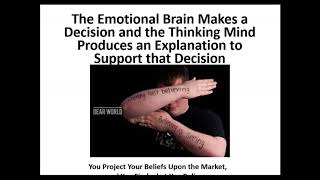
The edge that you have in your methodology. The last thing is you realize that you're going to have to become intentional. Not just any old mind is going to be there. You're going to have to learn to pull a mind together that actually can do this. You build the probability mind, you practice it, you become intentional about it. And if you can't produce that mind, you don't trade. So here we're looking at a graphic where you know, when it really comes down to it, you discover something. All thinking is emotional state dependent rationality. And thinking is just highly overrated. Just look how, look at it. Such a small part of that iceberg that rationality is, and what looms underneath is emotion. You're not a rational being, you're actually an emotional being rationalizing what the emotional brain has already decided. And by maintaining the emotions that create the mind, you learn to control the mind that engages uncertainty. This is the big, this is the big trick, friends. But it does take work. It takes effort and takes time. Rather than believing you can control the outcome of uncertainty.
The first step though, wow, we have to work with that anger and work with that fear. So we have to learn emotional regulation until you calm the intensity of an emotion. The untrained trader at the mercy of the fight. Like fight, flight, response hijackings, it just happens that way. Just look at your trading, look at other people's tradings and you realize you know something, if you don't have emotional discipline, you're not going to be a successful trader. And what you're looking at, right, there are two people who don't have the emotional discipline. And yet emotional discipline is built. So emotional regulation.
Is the very first skill. And it is rooted in the understanding that an emotion is actually biological. It's not psychological, it takes over psychology, but actually an emotion. An emotion is actually a biological action potential that coordinates action between the environment, trading, the markets and you, the organism. Okay? The trader. What you discover is that an emotion has a breathing style and attention style that are part of that emotion. As you start recognizing and tomorrow, just do this tomorrow, just watch yourself. Notice the tenseness in your body. Notice the shortness of breath. What you're experiencing is emotional arousal. And if you don't interrupt it, it's going to hijack you. Yet it can be shifted literally by the way you breathe and the way you hold tension. And the first two to three weeks, depending on Whether that's a group course, individual course, you're learning to rewire the way your body emotionally, physically, biologically responds to stress. You're learning the emotion, the, basically the relaxation experience. So you, you're actually managing the intensity of the emotion so that it doesn't take over mind. When you learn how to do that, you'd think, oh, wow, that doesn't. I've got it. No, no, no, no. That's just the start. Because you're using the body to manage the bio. You're using the body to manage the biology of the emotion. Okay? It's called the relaxation response. The good news is that it can be taught.
This does not change the beliefs that drive emotions, but it gets you to the door of the mind. That's the big deal, friends. That's where you go. And that look, by the way, that little, that little almond shaped thing in that guy's brain is the amygdala. And that is the thing where once it heats up, you're cooked. And until you learn to calm it down, you're not going to produce the potential in trading that.
All that work you've done, demonstrate you have. But let's say once you do that, once the biological system is calm.
The mind can be approached. Mindfulness is that human faculty for being able to step back out of thought and to recognize that you and your thoughts, and I might add, you and your beliefs are not the same. You're not having thoughts, you're not having beliefs, they're having you. And then noticing what you notice rather than just being carried away by it, that's the big deal. You start going, wow, I start noticing there's a lot of tension in my body. Hmm. I start noticing that's emotional arousal. I start noticing that I can interrupt that as I become aware of it. Mindfulness, friends.
And that mindfulness allows you to see where you are stuck without judgment or blame. You know, the deal is a lot of people don't. I don't want to see it. I don't want to. You know, I, you know, I have such a fragile ego that I don't, I really don't want to see what my faults are. My promise to you is you're human and you're simply organized in such a way that's not going to make it in trading without an overhaul of the way your brain responds to uncertainty. That's the, that's the truth of this matter. It's not you, it's the whole human race. I mean, if you had picked, if you had picked something that was the total opposite of what your brain was designed to do, it'd be trading. So you have this, and all of a sudden you realize, well, you know something, I'm born into a history and my thoughts and my beliefs are creating me. But the truth is though, the you is the awareness that watches. And this is where.
This is where it gets interesting. Because you take a look at this, you have a dog and a human walking and taking a walk. And all sudden you see that the human very preoccupied. Their thoughts are way out there in the future or way in the past, not a good place. It's not there in the moment. The dog is sitting there in the moment. What we want to do. If you have knowledge of trading and cannot apply it effectively in the heat of trading, you are stuck in a perceptual map without knowing it. Nothing changes until this changes. And usually it's the trading account that keeps telling you that. So now we have this tool of mindfulness. How else are we going to use it? Well, this is one of the big pieces right here. This is the concept of the brain as a committee of rival programs that gives rise to thoughts in the mind. Whoa.
The relationship between brain and mind. This is a big deal. There's a lot, there's a lot of characters running around in your head that you don't know about. What you hear is when you experience self doubt, when you experience that urgency to say, I'm going to be in charge, I'm going to make this happen. You're actually listening to a conversation going on inside the mind. Because ultimately the brain is a community of rival programs that have duked it out to create a self a you. Okay. The mind is where those emotional programs are given voice.
As thoughts in your mind. And in mind, you begin to conceptualize as a, as a committee, as a boardroom where there are rival factions trying to take control of the company. And you wake up as an observer and realize that you have not, you have not disciplined your mind, that you need to make sure that you have the right people and the right skills doing their jobs, rather than the way it's currently organized. This is where, yeah, the relationship between brain and mind is pretty complicated. And here it is, it can be dealt with. So you work with these ideas and then you go, whoa. Then we go, let's take a look inside the mind. Have you ever experienced self doubt or an urgency to jump into a trade? This is the internal dialogue. What you want to do is learn to observe it going, you know, something I realize that there is a cacophony of different conversations going on inside my head. Again, if you've experienced self doubt, if you just had this urgency to act and are trying to resist it, you know that emotional regulation and mindfulness allow you to see the submerged beliefs you've been avoiding. And that's power, friends. And the ones you're really looking for are the inner critic and the adapted voice.
The voice thoughts of your historical adaptation. Let's take a look at that. Have you ever had this experience? Have you ever just really heard a critic or a judge inside your head? I have one today that says, you know, you're stupid, you're never going to be make it. What in the heck ever made you believe you could trade? This was literally a conversation going on inside his mind, unfiltered. Yet you know, you're looking at this guy and he's going, whoa, whoa, wow. I have a critic sitting on my shoulder and it's telling me this. Well, there's always an inner critic living within you. And the truth is pretending he's not there is dangerous. What you need to do is you need to be learning to confront that part of yourself and to recognize he speaks with global assessments that has little evidence. And you need to start really, really working with that. This is one of the big main things is you start recognizing I am not. Those criticisms, there may be some justification or there may not, but it's just an assessment. What I need to do is I need to find a deeper way to, because I know that I need to confront that part of myself and it's not helping me become a better trader. You inherited these self limiting beliefs that you hear through the inner critic from your history, from your families, from your culture, all that stuff, but they are not you. They are only the default programming that whispers or shouts in your mind's ear.
But it is the mind that you bring to trading and it has to have some work done. Fair enough. Let's take a look at that.
So fortunately there's some really good news, friends, is that you also have what I would call heroic nature. You actually have emotional programs in the brain that are built to be able to manage probability rather than certainty. And in the same way that judgment and fear live within you, they do. They're not going to go away. So do courage, so do discipline, so do self compassion, impartiality. These are the qualities you can develop in your working awareness. And it changes the internal dialogue, it changes the mind that you bring to the engagement of uncertainty. This is where it gets interesting.
Let's even take it a step further. Let's move.
From the conception of the brain as emotional programs and let's go to where we've become mind, where you recognize that these emotional programs have been given voice. Discipline becomes the ruler. Discipline, the ability to maintain order under pressure becomes ruler. Courage, the ability to turn toward your fear and act in its presence, becomes warrior self, compassion or self soothing. The ability of calming down your fear becomes caregiver. When those three different elements of self that Carl Jung would call archetypes are present and have calmed down the fear, you're able to find the impartiality that's that clear thinking so coveted in trading of a sage. These are programs, friends.
These are programs that can be activated with training.
The key, though, you realize that they're there and you realize that you can in fact regulate the emotion, develop the observer, and recognize there's a lot more going on than the inner critic and the adapted voice living within you. There's also this courage of a warrior, the discipline of a ruler, impartiality of a sage, and the self compassion of a caregiver. And it so happens those four qualities, those four emotional programs or archetypes are the exact emotional cocktail needed to create the mind for probability.
Wow. Okay, now we've got something.
Uh oh. It's showing here that audio has been compromised.
Are you able to hear me? If you will just type in.
They're saying lost sound. Oh.
Well, Dolores, what do you want to do?
Okay, how about now?
Do you hear me now?
Yes, yes. I have no idea. It just glitched out for a minute. I think it's probably gotowebinar.
Okay.
Okay, let's try one more time. Can you hear me now?
Going once. Yes, yes. Thank you, thank you. I'm not sure how much we lost.
But what I can tell you is this, is that the mind can be built. Okay, I think we're. Okay. The key here is we're looking at being able to develop these emotional programs into working awareness. And we develop these as. And they're really the archetypes. I like that. The visual component of the emotional program. And you learn what we teach is through memory enrichment. We teach you how to access these profound feelings of courage, of impartiality, of self, compassion and discipline and pull them up to create the emotional cocktail that you bring the mind from. It's that mind rooted in those emotions that can work probability. That's the key, friends. This can be taught.
So.
The challenges of engaging uncertainty and Risk can be ever present. You've got money on the line, it could be a loss. And there's always.
That limbic system, that emotional brain that's going to see loss of capital as a threat. You're always on that edge and you have to be able to develop the mind intentionally. It's the mind that engages the uncertainty that is the game changer. Friends, everybody. Every decent trader has a game, has a platform. It's very few people who make money though, those are the ones who have been able to build a mind that engages uncertainty properly. And now we're saying, okay, we can in fact build a calm, disciplined, curious mind for probability based management. Yeah, you can. And you know, the truth is, is that this new committee is still challenged. I mean, look at these guys. This is a committee running a sailboat. And my guess is they may be having just a thrilling moment, but I can also tell you they're really challenged. And at the same time they have a ruler that's managing and maintaining. They have warrior. Every one of them are warriors. They're looking in and turning toward and they realize, yeah, I'm in serious water. But they're maintaining emotional sobriety. They're calming themselves down as they work the program and they're thinking clearly. That's the piece. They're under pressure now. They're not falling apart. They have built the mind out of the emotional substance to be able to deal with the challenges. That, friend is exactly what you must be able to do. Also.
Ultimately, you end up mastering your dragons. You engage the internal struggles from a position of interior strength. You recognize that the truth is, is that.
You can. Based on the emotional program, based on that belief, you're creating the reality that you're working with. Fears reveal.
What and where you need to learn they're not about who you are. And you come to a moment of, you realize, I can manage this. I can be able, I can do this. I do have to let go of who I used to think I was. But the truth is, is that fear is a door that you learn to have faith in walking through. And when you walk through it, you're going to find the resources you need to manage.
So.
It comes down to intentionality. You become like the surfer here. Do you think that surfer controls the wave? No. Do you think the wave even knows he's there? No. Same way with the markets. Yet what I want you to look at is the skill sets that this trader has. He has learned to engage that wave.
He's not trying to control it. That's crazy. He's not trying to make him right. What he's doing is saying, if I dance with this wave, if I bring the skills of discipline, of courage, of self soothing in clear thinking.
I had the probability of a heck of a ride. I could still tank. But the probability is now on my side. I accept that I and the wave are one. I'm working with the wave. This is what happens with trading. And this is the mind that really has to be developed. You're dancing with it. You're not controlling it. You never had control. The control was an illusion.
So the kind of last skill.
It'S actually intentionally building, the committee of the mine is you're going to have a committee of the mine engaging uncertainty in trading. It's going to happen. The only question is which one? The trading committee of the mind is a fact. If you ignore it, what are you really doing? You don't master it. If you master the mind that engages the uncertainty, what happens is you then have the mind that you need to be able to produce the success you're looking for. So what's the next steps? First of all, are you really serious about trading or is it just something where you know something, you're just going to get lucky and you're just going to, you know, you're gonna find the right magic and you're going to just do it. Or if, but if you're serious, usually this means two to five years. I encourage you to first, first of all, get, go explore the website, get the free book, look at all the free videos and articles. I've got hundreds of them. And then if you want to go further, get my book, Mindful Trading. It explores the process. I use the whole nine yards. But after a while, you know, after you get past some of the.
Other things we offer, it comes down in training to the group course or the individual course. And this is when you're serious. This is when you're saying you know something. I need to develop skills for building the mind for probability. That that's what I really know. That's the missing piece. And guess what? That's the missing piece of practically everything in trading.
If you take a look at that group course, what you discover is that it's built, and it starts in January, it's built for 10 weeks where we meet five times. And it actually goes over the very skills that you need. And it not just goes over, but it teaches you the very skills you need to build a mind for probability management. Okay, the same mind, that's what we're really going to do. And so you're looking at it. You go, wow, well, that's, that's that one. And a lot of people take it because it's.
Cash wise. It's, it's what a lot of people can afford, and it teaches the essential skills. Other people say, you know, something I like, I want to work individually with Randy because what I know, it's the coaching, the mentorship that I actually like the most. And one of the biggest things you find in the individual course is it comes 10 consults with me on Skype, okay. And it's just highly comprehensive and it's highly personal, which is better. It really, to be honest with you, it really depends on what you can afford. The thing is, a lot of people look at it and go, well, you know something, $3,500 is nothing. I can lose that a day. And that kind of person, you know, goes and says, you know, that individual course is great. Other people say, oh, my goodness gracious, you know, twelve hundred dollars is so much money. Well, we do break it up into payments. So what I want you to do is I want you to explore that group course. And if you go ahead and register, you're going to get a free $199 gift of an emotional regulation workshop that really teaches you and deepens the skills that you're going to be using. The key is, is it begins January 17th, and if you start now, you'll actually be prepared for it because it starts at a run. Okay. If you. The free gift is up to 1:11. And I encourage it. And a lot of people will take, basically it's called pay as you go. Where I'll say, I'll take the first. I'll take the first class. And when I get past that, I'll get it in the second class. And people will do that. And they finally go, I'm ready now. I am prepared. I'm prepared now.
Yeah. And it's. You're taking all of them. But the thing is, is you're prepared because most people are unprepared in the beginning for the first course because it starts fast. If you're sitting there and going, you know something, I really want to work with Randy. I want to talk to him, see if this is, if this is something that I want to do and if this is the right fit, go and ask for a free consult. And out of that you just, you contact us. Dolores finds a place that we can both work together and talk, and it's on Skype. And you get to, you get to ask, you get to have an hour with me. Okay, so are there any questions?
Okay, the first one.
Can you please tell me the difference between emotional regulation and emotional control? I read an article that in trading we should try not to control our emotions, but confront them. Is that correct? Geez, good luck with that line of reasoning. We're not trying to control an emotion as if we could just wrap rope around it and tie it down. We're learning how to manage it. Because an emotion again is a biological action potential. And the more you resist that emotion, the more it's going to persist. What you're learning how to do is the first thing is you learn how to manage the intensity. That's the breathing, that's the tension reduction. And finally you come down to what is the belief behind that emotion that's triggering the response to uncertainty. That's what has to be changed. But no, I personally. What was that in Tools? Does your book include info and tools to make the mental changes? Yes, it does.
What it does is it describes the process. Is it complete like the group course or the individual? No. Lot of people though. I've that report back to me and says, randy, I read your book and it changed my life. You showed me how, what I need to do. You showed me the steps from emotional regulation through the development of the mind that I need to be able to go through. And you see me step by step about through that process. Now I can tell you this, is that I hope you're not a pipe dreamer because I don't find very many people who can read something and get it on a neurological level. Okay. Most people have to literally go into their limbic system and change very core beliefs about their ability to manage uncertainty. And that takes work. Okay. And yet at the same time, I see it all the time. Okay. I don't see anything else. And we're, we've got a few, we've got a few minutes. And I want to thank you for your time. You have shared with me and if I can help you.
Ah, Trudy is actually a person who just finished the course and she's saying it's brilliant. Thank you, Trudy. Thank you very, very much. And the truth is that course teaches you the fundamental skills that you need to redevelop your mind for trading. That's what it does. And it is a, it's a powerful course. It's been going on for about seven years now and.
It'S best deal for the money there is. So I want to wish you guys happy holidays. I want to wish you guys, you folks to wake up and to recognize that I can, in fact, develop my potential to become a successful trader. It's going to take some work, and I have to quit standing in my way. I need to start recognizing I can become designer of the emotional programs that respond to stress. I can become designer of the mind that I bring into the moment of performance. Friends, that's. That's really possible. It really is. With that, I wish you a tremendous holiday season. And if I can help you, please let me know. Take care.
It.









