Developing Your Capacity to Actually Follow Your Rules Using Mindfulness to Build
Randy Kardec Trader explains why traders abandon their rules: an evolutionarily wired brain that craves certainty hijacks your reasoning when money is on the line. He teaches emotional regulation, mindfulness, and belief reconstruction to rewire your mind for probability-based trading instead of fear-driven decisions.
Questions this video answers
September 6, 2018.
September 13 (year not re-stated; implied same scheduling cycle).
$239 every two weeks; meetings every two weeks, five sessions total.
Between three or four months (weekly or biweekly Skype sessions).
More than 200 videos on YouTube.
Chapters
Thank you for being here. I am delighted to see, see, to hear, to imagine the presence of each and every one of you. And what I want to do is.
People who follow me discover quickly that what I talk about and the way that I understand what happens to the brain on uncertainty is, opens up in a huge door for people to better understand their performances in trading. Okay. And here intellectually, you know, it's really easy. Oh, oh, oh, yeah. I should ask if you can hear me. Just simply put a yes in a yellow so that I know that I'm just not talking out into the ethers and stuff like that. If some people will do that, I would greatly appreciate it. Yep, thank you. Thank you very, very much. I hate that, you know, you start talking and suddenly you find out nobody can hear you. Good. You know, intellectually we really all understand.
That we're working with markets as an exercise and working with randomness, okay? And it's essential to follow your rules if you're going to create an edge that renders you and gives you the ability to extract capital out of those markets in that uncertainty and with that randomness implied. And so everybody knows this. Everybody walks in saying, okay, I need to develop a set of rules that allows me to add structure to the randomness that has an edge in it and, and that allows me to extract capital over time. Everybody knows that.
Here's the deal, though.
Hardly anyone can follow the rules. It takes quite a bit. And yet the major definition that will guide you into success is emotional discipline. And yet we find ourselves constantly moving out of our rules. And ah, let's give it a little bit. What we want to do is understand why, what happens. Okay. And how we can better deal with this. This is really interesting because what we're talking about is ultimately what we're being asked to do if you're going to find success in trading, is that you're going to have to rebuild. You're going to have to rebuild the very brain and the mind that you brought to trading. Okay? And some people go, whoa, no, that's what you're going to have to do. Your brain is built for one thing and the markets require a very different set of circumstances and you're going to have to learn how to do that. So we're about to get started, but I want to do one thing is that feel free to write in your comments and particularly your questions as we go along, but I'm going to hold questions toward the end. I have found that if I follow with a presentation many of the Questions that people ask are answered, and after that, they have better questions. So we're about to get started. We're ready to go. And what we're gonna do is we're gonna hold those questions. So here's the deal. Have you ever felt like this, you know? Have you ever felt like a cat watching an aquarium full of fish? They're just so close, you just can almost touch them, you know? And you know, your system, the way you trade, you're so close to getting there, but there's this gap, okay? And what you're doing is you're going, if only. And what you discover is that if is a very big, huge contraction, and that the if is something that we can't do. If only I could follow my rules, then I would be very successful. Boy, I could almost mint money. I can't tell me how many times I've heard that.
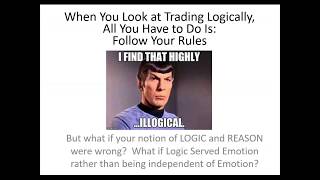
Yet. What I want you to see is that your thinking brain, this thing that you think is you, is doing all this thinking and making an assumption that you're rational, okay? And you should be able to follow your rules. Yet when you get into the play of the markets, with the uncertainty, with the risk, somehow that emotional brain of yours just short circuits all that thinking capacity, and before you know it, you're not following your rules. You have triggered to fight flight, and you have either aggression or fear leading the charge of you moving and working with the markets. So you go, whoa. And at the same time, you know, you go back and forth, back and forth, back and forth. But I know it's. You know, when I look at trading logically, I really do know it's just following the rules. But my question is this with my friend Spock here, but what if your notion of reason and logic were wrong? What if logic served emotion rather than being independent of emotion? Spock would say, I find that highly illogical. At the same time, you know, in a character, Spock, he was always torn between emotion and reason, and often he would fall into emotion, and it would be a big struggle for him because he so desperately wanted to deny emotion. That's a lot like us. That's a lot like people in trading, where they want to deny the emotion and say, well, you know, if I can just push the emotion away, then I can trade and follow my rules. The answer is no, you can't do that. As a human being, you're not a rational being that has some emotions. As a human being, you're an emotional being that rationalizes what the emotions tell us. That's the big deal that you have to really understand. And once you understand that, it makes it a lot easier because then all of a sudden you go, well, I want to know about this invisible barrier that's keeping me from the promised land. Okay, what is that barrier? Why can't your rules of success, no matter how successful you've been in other endeavors, it's very typical for me to work with a guy who's been incredibly successful in business. He's an alpha and then he gets into trading and all those rules of success, of winning, of making things happen, of being right, of being number one, absolutely blowing him up in trading. And he has to re examine what actually success is. Okay, what you're going to discover is that emotions are far stronger than reason, even if you believe otherwise. You know, it's just like this guy right here. You can pound your head up against a wall for as long as you want, but ultimately what you're doing is you're not working in a system where you control outcome. Your brain wants to do that, and most likely the mind that's been created out of that brain and the experience wants to do that. And your theory and what you've learned in trading want to do that. But when it ultimately comes down to it, what you're, what you're really doing is you're working with randomness and you're having to adapt your mind to work with it. A randomness rather than the certainty of controlling outcome. Okay, that's the problem with human beings. That's going to have to happen whether or not you like it or not. To do that, it really comes down to emotional intelligence.
And the depravity that most traders, that not just most, except for a very, very rare few, the ignorance of emotions that are brought to trading.
Excuse me. And not learning about emotions.
Keeps you stuck. But when you start working with emotions, what you discover is that human beings have a system where they have an emotional brain, they have a thinking brain. We define that is our limbic system and our neocortex, or where our logic is. When they work together.
What'S developed is a wise mind. What we want to do.
Is we want to train ourselves so that it's not just logic we're bringing to the game, that we're also bringing the skills and tools of our emotional brain to the game. And we're creating a new mind that can manage the uncertainty of trading rather than continue to do what evolution has given us about the need to control, the need to be right, the need to be able to predict, okay, the need not to lose. Because all those things are illusions once you get to trading and your trading account is going to tell you really seriously about this. So we have to learn how to use emotion. So being smart emotionally is, you know, basically you can't use your knowledge unless you develop emotional competency. And it's just like Daniel Goldman would say, this is a quote from him. In a very real sense we have two minds. One that thinks, that's the one that you think you are and that's the one that you want doing all your trading. And one that feels that's the one that you want to turn off and have it not show up for the trading game. Well, that's impossible. You're actually asking the brain to do something that is completely impossible. The emotional brain is going to be there whether or not you feel the emotions, acknowledge the emotions or not, the emotions are going to be there because ultimately you are an emotional creature. And until you learn to be able to use them together, you cannot develop the brain or the mind that can deal with probability. Friends, this is what's missing. And you know, the rest of this workshop is going to show you. Well, this is more about it and this is what you can do about it. But the very first thing that you have to recognize is there is something wrong. There is something really wrong. And what's wrong is that you brought a brain and a mind that are incapable of success in trading to the game. And that you need to be able to rewire that brain to go from the certainty based model of survival, really logic to a probability based model of thriving. That's the big deal.
And my promise to you is it's just not you. It's very common for me to talk with traders that think that, well, there's really something wrong with me. And nobody else has this problem. No, everybody has this problem. And if you get around, if you get around traders, what you discover? Very few successful traders. I've seen people show up at trader expos and say, I'm going to find some successful traders. And you know, there's thousands of people there and they go around asking all these traders, are you successful? The answer is no, I'm losing money. I'm losing money. And yet everybody's there pretending as if some stupid system that somebody's selling them is going to be the specialized knowledge that gets you into nirvana. It's not. The key is, is that system is necessary, but somebody has to drive that system. And until you learn how to drive that system with emotional Discipline, it's pretty useless.
It will, you know, it'll give you some success. Then you fall back into. Then you fall back into not understanding your emotions and having them blow you up. So we're looking at that and going, oh, wow. So the key thing that you need to really understand is this, is that decisions are really made long before the thinking brain really becomes engaged. I mean, we're talking about the difference between nanoseconds.003 seconds for an emotion to trigger versus microseconds, a half a second for the thinking brain to be engaged. There is a whirl that happens between that nanosecond and that microsecond. That is where you know, you may think from a conscious standpoint. I've got this under control. I'm logical. But what happens is the feed to your thinking brain is being cut off by literally information coming into the brain at a very primitive level. And it's deciding that it's scared, that it's a threat to its existence. And every time that you engage in certainty, you trigger vulnerability. Every time you trigger vulnerability, you automatically hit the hardwire impulse to fight flight. You're doing that all the time, okay? And the more you do it, the more you traumatize yourself. And all of a sudden it becomes automatic response and you can't pull a trigger. Or you keep jumping into trades, you over trade, you blow up your accounts, or you die the death of a thousand tiny cuts. Okay, so we're looking at this and going, wow, what are we going to do? Fundamentally, what you have to grasp is that all thinking is emotional state dependent. There is no thinking outside of an emotion. Even what you call logical thinking is a sense of impartiality, which is an emotional state that allows you to think what you would call rationally or logically. We're going, whoa, so you're saying that I just. The normal state when I look at things, my logical thinking, really.
That'S emotional driven? Yes, it is. The moment you add stress, the moment you add risk, the minute you add uncertainty, that logic is blown out of the water. Okay, so, wow, what do you do?
My promise to you is this, as your thinking brain produce an explanation of what the emotional brain's already decided. It's kind of like this. I love this, I love this quote. Before the truth can set you free, you need to recognize which false belief is holding you hostage. And I want to talk about this false belief business, because a lot of people that have come through this and they've done a lot of self development Work. They really have, you know, they've got these mantras that's got these things where they have these visualization exercises and they are training their unconscious mind to think expansively and probability based and all that kind of stuff. At least that's theory. What happens is you can do that, but underneath all that stuff are still limbic beliefs that show up in your performances as you're engaging uncertainty. And friends, those are the ones that are important. Those are the ones impacting your trading account. Not the high and mighty things that you have posted on your mirror, but the limbic beliefs, the limbic learnings, the emotional learning that sits below conscious threshold or what we would call implicit knowledge. Okay, out of conscious threshold are what some people would call the unconscious. But the thing is, what you're saying is that's why you keep doing all the stupid things over and over again. And you know, if you knew what was going on, you wouldn't do it, you would stop it. But the thing is that the belief is unconscious.
It's not available to your awareness. And what happens is it's driving your performances. So what we're going is, oh my God. Thinking is being sabotaged by primitive emotional beliefs. Yes.
And that's what has to stop. Okay? That's what you have to become a lot more aware. You have to start really thinking about it. And ultimately. And the one thing about trading versus a lot of endeavors in life.
Trading is like instant karma. The results just show up almost immediately and they, you just cannot sugarcoat them. They're there. Whereas a lot of times in other areas of your life, you can make up all sorts of yarn, you can develop all sorts of.
Alibis to support your way, your cause. Like, my dad smoked Camel unfiltered cigarettes for 52 years. People were constantly telling him, howard, you're going to kill yourself. You keep doing that, you're frying yourself. And my dad, and he was an engineer and he very logically looked at it and says, well, I'm not dying. I don't see that mine dying. So therefore that's illogical. That's that Spock thing. And by the time the doctor said, well, Howard, you need to start getting your affairs in order.
Your lungs are toast.
You can't breathe. My dad was all trying to make up for it, but it was too late. He did not see, he did not see the behavior driven by an internal belief that was causing him to be in destructive behaviors. And every, practically everybody I know in trading has pretty destructive behaviors. Whether it's not getting into trades or whether or not it's blowing up trades, getting in our revenge, trading. You see this destructiveness in there and you go, wow. And that that's happening because I have an unconscious belief that I'm too chicken, I'm too scared, I'm too uncomfortable to stare down and to master. Yes.
Yes, that's, that's the deal. And that's the deal breaker in trading. You can get away with it and a lot of other endeavors. And if you're not willing to do some deep work on yourself, I encourage you to get out of trading and do something that you can do other things with. Because you got to make this unconscious part. You got to get a lot of that conscious. And what I want to do is I want to show you why you have problems in trading. This diagram. I mean, it doesn't show the brain, doesn't show the molecules.
But literally this is why you have problems in trading. What you're going to notice is that you have sensory information coming in, okay, over there on the left bottom. And it's hitting what is known as the sensory thalamus region. It's part of your limbic system and it acts kind of like a traffic cop, okay? It decides right then and there which messages are going to go to the fight flight response or which messages which information is going to go to the thinking brain. And based on experience of interacting with its environment, it has a set of emotional learnings, emotional beliefs that decide on the spot in a very primitive way, way past conscious thinking of whether or not the information represents a threat to a biological existence or whether or not it's a good sign and, or a neutral sign needs to be sent if it's a threat, understand? And the limbic system cannot tell the difference between a biological threat to existence and psychological discomfort of engaging uncertainty. Can't tell the difference. It's all one and the same. If that cop decides that, oh, that's the bad guy, it will trigger and send the information down what is known as the low road. It's a quick and dirty. It's nanoseconds. It hits the amygdala, the amygdala fires the fight flight zone. And suddenly you're panicking, you're jumping out, you're freezing, you're over trading, you're just absolutely losing. When the trade goes against you, you're just losing your composure. All that, okay? And yet you thought you were being logical. And what it really comes down to is that when that information hit that salary thalamus, you did not know how to.
Sensory thalamus. You did not know how to regulate it. You didn't know what beliefs it had already established that guided the way your thinking brain thought and understand. What I'm showing you is that the emotion has already kicked in and you're already in behaviors before the signal even gets to the thinking brain. It's been hijacked. Okay? That's what you're doing every day. And every time you revenge trade. Every time you over trade, every time that you we have a trade go against you and go into powerless. Every time you freeze, every time you don't take a trade, this is what's happening, okay? So.
And particularly when you put money on the line, you got skin in the game, you take this thing and incite it to another level, literally. My programs that I teach work right here. What you want to do is you want to calm this thing down, produce a sense so that it's no longer activating the amygdala in the fight flight, and it allows higher brain function to start making decisions. But to do that, you have to be able to manage the emotions and you also have to be able to get at the beliefs that are driving performance. Okay? You have to get at them. You're just not going to steamroll them friends. You're not going to positive think them out of existence. You're going to have to turn to them and you're going to have to master them. So.
Now that you understand this now, okay, and I hope you, you know, I know people who have that, have this, that particular slide posted in their trading rooms. And look at it so it gives them a graphic representation of what they're really up against. Okay? So what we're doing is this is, no matter how hard you try, the beliefs of your survival instincts, that's that limbic system unavoidable and must be mastered. And what you see in this graphic is that. Oh, well, 95. What you don't know, okay, that you believe it's sitting over there and you're not knowing, maybe say, well, I'm Jew. I'm really sorry, Randy. I didn't know. Well, the trading gods don't care. Your trading account doesn't care. You're not knowing is not an excuse. It's going to work in trading. You're gonna have to drill down and find those beliefs. And I'm gonna make it easy for you. Just a moment. Okay, so.
What you're doing is you're getting to see the consequence of your beliefs by checking out the health of Your trading account, literally, you know, you're looking at it and you're saying, you know, I want to believe that I'm a really stand up person, you know, I've really got the police, I'm a winner, I'm not a loser, man. I can really do this and I can do, do that. I've got the beliefs, that's what you're saying. But the thing is, is what the, what the trading account is revealing and its health or its non health is the real beliefs that are below conscious threshold. Kind of like with this magician thing, the real belief that's driving. We want to see the hidden impact of beliefs, okay? And that's where we need to be looking. And I promise you, if you're a human being, somewhere between the biology of evolution and your development of psychology, you're going to have some beliefs that.
Do not work well when engaging uncertainty. And in doing that inherent, you know, you're looking at a graphic where you're looking at this modern man and you're looking in the backseat and seeing this caveman or the primitive brain. What you're doing is his primitive beliefs are in his brain. They're in the emotional brain, they're not in the thinking brain. You're not even aware that you have these things, okay? They become embedded in the way you respond to uncertainty. It's just not trading. It's the rest of your life too. So in your performance, you're seeing what you actually believe. And I want you to hear this about your capacity to engage uncertainty or better or for worse, that's what you're doing. And you can either say, okay, you know, I have a lot to learn about my psychology, about my emotions and basically what evolution gave me if I'm going to become a successful trader. If you're thinking like that, you're in the right classroom. If you're thinking, well, this is all very interesting. And the thing is, is, you know, I'm just going to keep with my mantras, I'm going to keep with my visualizations, I'm going to keep with my affirmat, going to keep with my cognitive restructures, and I'm going to outthink this problem. Then you're going to be toast, okay? And don't believe me. Believe your trading account. And what are these, what are these core beliefs that seem to just run amok in the performance of trading? Well, here they are.
It's your sense of adequacy. You know, am I good enough, am I smart enough to trade you Know, do I know how to do this or do I always just lose adequacy? Mattering? You know, do you. Do you see money as a way. If I have money, then I matter. Or is your mattering independent of your performances? Big deal. I actually, you know, my business, I work with a lot of men, probably 95% of men, and they're all 40s, 50s, 60s and 70s, almost everyone. I wouldn't have a business if it weren't for a bunch of guys still trying to demonstrate that they matter to another human being. Usually their dads, sometimes moms, and that person's already dead, but they're trying to prove to themselves, I certainly did that. I certainly did that growing up your worth. You know, I know people who really, you know, particularly with scarcity, thinking where, you know, they don't really believe they're worth this much, they should have to work hard for their money rather than a couple hours a day generating income, going out and playing and having fun. And literally what you will see is that I know guys who have hit a particular area and when they hit that particular financial area, they lose back down. And ultimately it's a family rule, a family belief that has become embedded in the way they see reality that stops them from growing. And it was be a money conversation that stops them right there. I'm not worth a million dollars, you know, I'm not worth making $500,000 a year. I'm not worth making $20,000 a year. Whatever. Whatever the line is. And the fourth one is powerlessness. Have you ever felt powerlessness? If you've ever had a trade turn on you, okay, and you just, whoa. And just felt your armpits just. And you felt, oh, my God, oh, my God, oh, my God, what's happening? It's. It's turned against me. It's turned against me. You have experienced powerlessness. And the real key is all the trades doing is. It's doing what the trading doing. It's the interpretation you're bringing to it. That's the problem is that what you see, if you're not in control, then you're in powerlessness. And you really want that control. And that's what a lot of alphas do. They want to be in control because they are fearful of their powerlessness. It's a big deal. So these are the ones. These are always reflected in your trading accounts. They're not going to go away, okay? They're going to be there and no amount of wishing and hoping is going to make them go away. But Turning toward them, learning how to work with those very core beliefs, those limbic learnings. You begin to redevelop the brain. You begin to redevelop the mind that you bring into the moment of performance. This is real critical, friends. This. This is inescapable, even though people continue to try to escape it all the time.
Now, we want to do.
What's your job? And by the way, starting right here, we're gonna actually start talking about what I teach. Okay? Your first, your real job is to manage your emotional nature that's being triggered by uncertainty. And then you're going to need to reconstruct the beliefs that drive performance. You know, in this illustration, what you're seeing is the emotional brain just beating the slop out of the thinking brain. Well, friends, that's happening all the time. You know, trades going against you, not getting into trades, just having all sorts of things, wanting to be right, not not allowing yourself to be wrong. Basically, what you're having is you're. You're having your emotional brain beat up your thinking brain, okay? And until you master your emotions in trading, you really don't have a chance at getting at the hidden performance beliefs. So we've got it. We've got to learn how to do that. And, you know, what I want you to understand is that the brain is really built and it will lie to you. And in this particular illustration, what you're seeing is.
You experience this horrible thing. The dowel just drops like crazy, and everybody gasps. And then what happens is that a few days later, a few months later, someone says, I knew it all the time. Oh, so did I. So do I. And all of a sudden, you start seeing how the brain lies to you. The brain creates an alibi, says, well, well, you know, then, now I have this explanation. But in the moment, you didn't have an intellectual explanation. You had an emotional response to uncertainty and to surprise. That's what you did. And if. If you recognize that the brain and mind that you brought to trading is built on the illusion of control over outcome, you will never find success in trading. You'll find explanations like you find in this illustration, but you won't find success. You've never controlled outcome. But the good news, friends, the very good news is you do control the mind you bring to performance if you're willing to take off your blinders and if you're willing to do some emotional lifting, okay, and change some core beliefs that you have about yourself. And let's start with what's an emotion? What I'm showing you.
Is two neurons. And ultimately what happens is an emotion is really a learned behavior and a biological action potential, okay, that these neurons have figured out somehow, which is just absolute way past my pay grade. And what you're looking at, it went in between the synapses and the dendrites and stuff like that. What you're looking at is this thing called action potential between the two neurons. When something in the environment changes, by definition, an emotion.
Triggers. I want you to hear that because ultimately, emotions are all about.
They manage or coordinate the action between environment and the organism, between the trader and the markets. And you're looking at it. And what I want you to do is look at an emotion on the level of a neuron, not on the level of your feelings. Feelings, friends, are part of an emotion? Yes. They're the chemistry of the emotion pulsing through your veins, your arteries, and your brain. When you feel the emotion, your brain, your mind is already cooked, okay? That's the key. What we want to do is we want to learn how to manage the emotion so that by the time it becomes chemistry in the body, that you have the right chemistry to produce the right mind to perform well, it all starts recognizing. Emotions are not feelings. They're not touchy feely. No. They're neurons that have wired together and fire together, and they produce an emotional response that includes arousal. It includes motivational fight, flight, or approach. It includes feeling states. It includes temperament, genetic predisposition. But do not mistake it for just a feeling, okay? And by the way, just to let you know is you don't have emotions. They have you. Okay? You're an emotional being. You're not a rational being.
So.
This emotion fires. There's a stimulus that goes on that might be a trade going against you. That might be you seeing a setup happen, okay? That's a stimulus. And automatically an emotion triggers. That emotion necessarily hasn't taken shape yet, but that impulse goes down. And here we are back at the sensorial thalamus. It filters through, that makes a decision about if it's dangerous or whether or not it's benign or whether or not it's approachable. That's when thinking happens, interpretation happens there, then comes behavior. But understand this is that an emotion can fire and absolutely not go through the filter, not go through the interpretation, and go directly to the behavior. That's what fight flight's all about. That's what that traffic cop is all about. Your brain. And you're dealing with this all the time because you're engaging uncertainty, which is going to trigger emotions, it's going to trigger uncertainty and it's going to trigger vulnerability. The question is, once it hits vulnerability is what shape does that emotion take? This is the big deal, friends. This is big deal. What we want to do first, we want to regulate the emotion. That's the first thing that we teach in our courses. It's the first thing you really get is that we want to be able to manage the emotion so that we calm it down. We want to calm it down so that as it's starting to arouse, start building up. When you start feeling that muscle tension, when you start holding your breath, we want to be able to say, oh my God, I can stop it right now before it hits a trip switch and the chemistry of the emotion floods in the body and I'm cooked. So what you're doing in the emotional regulation as we teach it, you're going to be using your breathing, you're going to be using the tension in your body as signals that an emotion is present.
Rather than finding out after the fact, oh my God, what just happened here? No, you're going to start really observing your body, observing how you breathe, and you're going to start altering the way you breathe because if you breathe diaphragmatically, you can stop fear and anger from escalating and keep it within a manageable area. Okay, Big deal. Very big deal. You can also, by learning how to relax big muscle groups. What you can also do is there, you can, you can arrest the arousal impulse of the emotion before it gets to a feeling state. Okay? That's the big deal. And really when it comes down to it, you have to do this. And my promise to you is that it's not going to solve your problems.
Emotional regulation. Now, I have actually had people, once they got emotional regulation down, they were such, they had, they had their heads together, they were ready to trade all. They just simply didn't know how to regulate the emotion to get it in the right intensity area to work with it. Most people, what they discover is that they have to regulate the emotion. Because.
Without regulating the emotion, you never get to the door of the mind. And what we want to do is in here, you start going, we need to be able to. And by the way, this is the second thing we teach in our courses. We want you to come to the moment of right stiver being just absolutely believing that you are your thoughts and you're getting covered up by thoughts. Like over in the left eye side of this thing, you get caught up in your thoughts. What we want to do is we wanted to create some distance between you and your thoughts so that you're in observer mode and you're watching thoughts and recognizing that you and your thoughts, you and your feelings, you and your beliefs are not the same. Okay? Is there is awareness outside of those thoughts, this becomes where it's powerful. And you discover that not only are you not your thoughts, but what you really are is a particular organization of a potential self. And you've been calling it the historical self. But the thing is.
If you don't do this, if you don't learn to step back out of those thoughts and be able to take steps, stop, take perspective. You stay stuck doing the same stupid things over and over again, over and over again that traders do. This is why it's so important you develop the ability to observe. Because in the ability to observe, what you do is you begin to look inside the mind and what you discover first. This is really important, friends. You discover that your brain is really a community of rival programs that are vying for control of the self. Unfortunately, without mindfulness, you've been asleep at the wheel and there's just been a mutiny going on within your mind, within your brain that you haven't been privy to. Because if you're a guy, oh my God, I don't feel, I don't feel emotions. I'm, you know, I'm logical. No, you're not. Okay? These emotions are in the background. What you call logic and reason is rationalization. You rationalize what the emotional brain has decided. So here we are. What we know is that the brain is a community of rival programs that has produced a particular organization that produces what you call yourself. Okay? And here's where it gets interesting. That brain, those emotional programs that produce behavioral thoughts in the mind, those thoughts are given voice in the mind. I meant in the brain. They're given voice in the mind. This is where it becomes very interesting. And this is also where you discover there's a historical internal dialogue going on within you. If you've ever fallen into self doubt, if you have ever fallen, fallen into over trading, if you have ever fallen into revenge trading, okay? You know, this internal dialogue, you realize that there is an inner critic living within you that really is highly destructive. Okay? It represents that destructive part of our human potential. And it's not going to go away. And you will be able to witness it, observe it, because it is judgmental, it is critical, or it's highly tempting for those who jump into trades, chase trades and stuff like that, or revenge Trade.
The thing, though, is you start listening to it, and you go, wow, I had no idea that was even in there. Of course, what you've done is you've pushed it away, and your need to be positive thinking, and you do not see the darkness that lives within you, manifest and can take over the mind very easy and blow you up. You need to master that part of yourself. You also have very powerful, empowered parts of the self that you haven't learned how to develop. And so what you do, though, is you discover that there is an adapted voice living within you that has adapted to these, basically the character assassinations or the needs of the inner critic. This is what you hear as you trade. And if you don't start keeping a thought log as you trade and start noticing when the thoughts arise, start starting noticing what is the emotion that that thought's coming from. That's the big news. That's where the mindfulness really starts paying off. And.
What you discover in this work.
Is that there is no such thing as freedom from emotions. Remember, you don't have emotions. They have you. However, as you develop your emotional intelligence, as you develop literally, what's the potential living within you? You discover you have freedom of emotion. What does that mean? That means that you can't change the uncertainty. You can't change the danger around you. What you can change is the emotions that you call forward into being that create the mind in that moment. And I'd like to give you an example of this on a personal scale, is that my wife and I went to our daughter's wedding, and we were really, really high. And it's just so high and like, 12,400ft.
Yeah, not high, like. Like drugs high. Like, altitude. And it just so happens that I carry a. I have a pacemaker and had. I have. You know, I've got some issues with my heart. Within two days, I was having enormously difficult time breathing to the point where I was. It was really hard. Really hard. And I would be lying in bed, and what I knew is this is. I could not allow myself to become scared. And yet, at the same time, you know, I was breathing really hard. And it's just like, am I gonna be able to get my breath? And what I realized is that fear was not a workable emotion in this moment. What I did is I stayed highly disciplined, highly impartial as I used my breathing and got my tent and got their attention and relaxed my body so that it could breathe properly. And my heart basically limped along. Okay, what I want you to see is the uncertainty. I couldn't change that. I couldn't change that. I showed up high altitude. My heart's having a problem. What I could change is not the. I could not change that. I could change literally what emotions are going to show up in that performance. And by the way, now I'm fine. You know, it's the moment that we got out of that really high altitude stuff and got back to Denver, which is only a mile high, I started becoming fine. And when we got back to Charlotte, where we're 600ft above sea level here, I'm fine. But, you know, what we know is that Randy's not going to go high altitude anymore. But I'm saying this. I want you to see that this was a very stressful situation. It would have been easy to have been scared to act from fear. What happens, though, is I didn't have freedom from emotion. It's not like I could make concern or fear go away. But what happens in this, in this moment, I could bring the emotions I needed to create the mind that could manage that situation. Okay? That's what I'm talking about. That's the stuff that you have to do in trading. And when you do that.
Just like I was talking about, the feeling of vulnerability and being challenged is not going to change. But in this, when you're looking at competitive sailing, what you're looking at is a team of people cooperating together in the same way that your mind has to cooperate. Your mind. I would want you to look at your mind literally as a committee, as a governing board of a company. And what you have is you have a power struggle going on on that board. And you, as the chairman of the board, have just woken up and realize you have a mutiny on your hands. And you need to start learning to take control. You need to develop some parts of the mind and you need to start going, I need to pull back on these areas of the mind till you can do what this boat's doing. It's being severely challenged. Things are uncertain, okay? There is risk. At the same time, everybody on that boat's trained and there is a captain, there's a ruler on that boat who is barking out orders, keeping the team together and focused on performance. And out of that, they have the best possibility of success. They're not thinking about winning the race. They're thinking about maintaining order. That's what they're thinking about, okay? That instead of having fear and aggression of the fight, flight, response, directing the mind during uncertainty, what you're looking for is discipline, impartiality. That's what forms the mind you're looking for. And it just so happens that it can be taught, okay? It can be taught.
So what we're doing it doing here is saying, hmm, the mind that you brought to trading is not going to work for success in trading, okay? If you haven't figured that out, go trade some more. Keep, keep, keep a good relationship with your trading account until you finally see the evidence is so overwhelming that the mind, the brain that you brought to trading, it's not going to work for success in trading. You're going to need to retweak it. You're going to need to rebuild it. So the good news is this is you don't have to sit there and just get battered. What you can do is you can say, I can rebuild this mind for the environment of trading, okay? This is the difference between blindly trying to win. I'm a winner, I'm on alpha.
And mastering the mind that can trade. Okay? And this is the mistake people make. And what I've discovered over time is this. See this guy with his little tunnel vision and just, you know, you look at him and go, God, what a goofus. What I want, I want to, I want to say this to you and I want, I want to say this as compassionately as I can to you as a trader, as a person trying to learn to trade. Trading is littered with the mass extinction. People blindly seeking the secret knowledge of trading.
Talk to, talk to trading trainers. You know, what happens is they come in and I was talking to a guy last night, he said, yeah, the best one that I've had is some guy comes in, says, you know, I've got, I've got summer break. And what I want to do is learn to trade so that I don't have to get a job and I can earn money this summer. And, you know, this guy has been trading for 35, 40 years. He learned from his father. He's, he's a, you know, he's a really great trader. And the guy was shocked thinking he actually thinks that he can blindly and arrogantly walk into trading and just kind of poof, make all these disclaimer messages disappear and haul in the gold. No, it's not going to happen that way. The whole key, though, is by building emotional wisdom and discipline. That's the secret hidden in plain sight. Okay? And the real question for you is this. Are you willing to develop yourself for the challenges of trading? It doesn't have to be, you know.
You can have all Sorts of stories you want about self development, but understand is that the brain you brought to trading is not going to work. For success in trading, you're going to have to redevelopment. Can it be redeveloped? Yes. And the real question is, do you have the humility? Do you have the drive that really wants that? You have the desire so that you were able to rebuild the mine for the probability needed in trading rather than certainty of survival? Because friends, that's the trick. The traffic cop at the sensorial thalamus will stay that way until you learn how to regulate, to observe and to develop other aspects of your being, of your brain. It's going to be that way. So what if you did? What if you are at a place where you say, you know something, Randy? I know I need to trade. I know I need to change, I need to learn, I need to. I need to do this. First of all, if you've shown up here the first time and you're just listening this first time, go to my website. That's my website down there. And hopefully Dolores will put that in the chat box and go there and just get my free book. It's a free ebook. It's got a number of articles that I've written. Read it and just start getting an idea of what I'm talking about here. Go to my website, watch the videos. I've got more than 200 videos on YouTube. Read the articles. There's tons and tons of them. Really start looking and then get my book, okay. And really start recognizing. Oh my God. I really am going to have to redevelop my, my brain and my mind. But if you get past all that kicking the tire type stuff and you say, you know what I really need, I actually need to learn how to do this. And I'm going to start investing in the development of my potential rather than all this stuff I've got that I'm still, I'm still stranded in my trading because I.
We have a group course starting real soon, a week from today. Okay. And it's a powerful, powerful thing. And it's. That's the one where you have virtual classroom. You have unlimited access 24 7. And the first, the first session starts September 13th. Okay. And I would advise you to register now. Okay. And that's the link right there, right below it in yellow. Okay. Oh, in the blue. I'm sorry. But the key is, is that if you register now, we're going to give you a free piece that normally costs a couple hundred bucks. Emotional regulation. It's a workshop. I Did a while back. The reason and part of it is, yeah, we want to give you something free for you to sign up. But the truth is, what we want to do is we really want to train you so, you know what in the world's going on in your body and your brain and your mind when you trade. And it's a great program, and it also gets you in so that you start practicing with this stuff. People will sign up at last moment, and they show up and they realize, I've already expected you to be in training for a week or two before the first meeting. And people go, oh, my God, he's teaching me the emotional regulation, but he's also doing the mindfulness, too. Yes, I am. This is serious stuff. I only want serious people who are really recognized. Man, I got to do something about my psychology that I'm bringing to the moment of performance, So I encourage you to do that. The other thing you can do is that we also. You can use a payment system where it's 239 every two weeks. We meet every two weeks five times. Okay. And what we teach, it's a curriculum where we teach, literally, emotional regulation, mindfulness, applied mindfulness, where you get a hold of the internal dialogue. We teach how to build the empowered emotional programs and totally build a new mind. And then we teach you to take that into the trading powerful stuff, and you end up producing your own psychological plan. It's a powerful, powerful course, and I personally highly recommend it. And if you're one of those guys who's saying, you know something, I really would like to have the mentorship that comes along with Randy. I've heard enough about him that I really want to work personally with him. The individual course is highly comprehensive, and it's very personal. It lasts between. Excuse me.
Between three or four months. And it also follows a curriculum that is much more in depth and comprehensive. Okay. And it's the one that people really just go, wow. And what you also discover, it's very personal in that you and I are meeting on Skype usually once a week to. Once every two weeks for three or four months. And it's just like being. It's like being in the same room. We're looking at each other. We're talking with one another. It's very powerful. And if you want a free consult to really look at that just on our website, just hit contact us, ask for a free consult, and Dolores will start organizing that time so that we'll find a time that you and I can meet together. But the Thing is, this really is about. Do you want to take the tunnel vision goggles off and do you want to really see what it's going to take to rebuild the mine? Okay. So from there, I want to thank you. And.
We have a question. Okay, here's a question. Can I do the group course and individual course at the same time or is it redundant? What I would say is this, is that it's very common if you do the group core. If you do the individual course, you don't need to be doing the group course. The individual course is far more. It is really much more in depth and it is much more personal and there is a lot of redundancy in it. But the major thing is that when you take the individual course, I will often.
Your. If you take the individual course, you can take the.
After you finish my program, you can take the group courses, basically review. Okay. And by the way, on the group course, people, is that you can also take it and then you can also audit it for free at a future date. What we've realized is that this stuff's pretty radical stuff when you get around it. And a lot of people, the first time they get a hold of this material and do the work, it's like going 150 miles an hour. The second time they take it, it slows down a lot. So the answer is the free gift link. Dolores said we. Yeah, just go to the website and.
Yeah, and just click on the free book. Yeah, it's a free ebook. It's easy. Okay, let's see. Are there any other questions here?
Here's one right here. What stops motivated traders from evolving into consistently profitable traders? Well, it's actually pretty easy. Remember me talking about the traffic cop and the sensory thalamus? It's right there. Basically, our limbic system, our emotional brain, our mammalian brain, will lock in particular way learnings about how to engage uncertainty. And they are pretty much immune from, you know, you out thinking them and they keep you locked in. And until you go in and unlock that emotional pattern and reorganize it into higher functioning, you're pretty much stuck. Okay. No matter how much you do. That's. That's kind of the way that works. Okay, Is.
That'S it? Okay, There is.
Here's one question. Here's one last. It's actually a good parting way of saying this is what habit. Can you recommend that I start tomorrow? That will help me with my emotional state while trading. Well. Well, I'll tell you what I would encourage you to do. Okay? And this is a great thing and really show it is. I want you to. Tomorrow morning, what I want you to do is start observing your body. Observing your body as you trade. And one of the best things you can do is get a mirror. You know, just a mirror that sits there that literally you can look and you can see your face in so that you can. Instead of just going, well, I think I know when you look at the face, you'll see all this I expression. You know, 96 of the muscles of your eye are not controllable by conscious contact. So what you're doing is you're saying, I want to observe for tension in my body and recognizing that the tension in the body is actually emotional arousal. So I want you to start noticing really quickly that, wow, I'm already triggering to emotion and I don't even feel the emotions. That's correct. Then what I want you to do is start observing your breath. Because what happens is that people will.
They will hold their breath, they will start breathing high, very high in the lung. And ultimately that is like adding gasoline to a fire, to an emotional fire is that you're fanning the ambers and you're creating it. All of a sudden you're saying, okay, I can start observing myself. I can start observing the motions and then keep a journal and start noticing, okay, I see the emotion and if I can name it, okay, that's fear. Okay, that's anxiety. Okay, that's anger. I feel angry, I feel pissed off. I, you know, there's any type of emotion that's there. And then start noticing what the thought is. You start linking the emotion and thought together. You start realizing what. Wow. Yeah, thoughts are, are rooted in the ground of emotion. Absolutely. But the thing is, and people are, they're blown away because what they do is they start discovering in the mirror that they're fixated. You know, they're stiff, they're, their jaws are clenched. They have all this stuff going on and they've been going, well, well, yeah, well, I'm a little stiff. No, what happens is that you are, you are trying to trigger the fight flight response. And what I want you to do is learn to pull it back. Use diaphragmatic breathing to pull it back. Use tension reduction to reduce the tension in the big muscles. And I want you to start noticing the intensity of motion going down. Literally. In my group course, that's the first two weeks of training. In my individual course, that's the first three weeks. And I'm saying, no, this is. Now it's got A lot more instructions to it. But the thing is, is that what I'm saying is you can do this tomorrow. You can start seeing the impact of emotions on cognition and your ability to perform right then and there. Okay, friends, I want to thank you for sharing this time together. I've enjoyed myself enormously. And what I get is that this is a great group of people who are really trying to learn how to build the brain, build the mind that can engage uncertainty and become a winning trader.
Yeah. And what we're going to be doing is that we will be sending you a link so that if you want to review this thing, that you'll be able to do it. Okay. And I encourage it. I've noticed that a lot of people on our websites, they spend a lot of time.
Actually clients, current clients, spend a lot of time watching these webinars because they want to stay in tune, and it helps them to go, oh, my God, yeah, yeah, yeah, I remember this. Yeah, yeah, yeah. It keeps them focused on what's really necessary. So I thank you for your time, and if I can help you, and I know I can, unless. Unless you have a severe mental problem can help you. Okay. And what I ask you is to take off the blinders and to start really saying, what is it I'm really going to need to do with my brain and my mind in order to be able to produce being a consistently profitable trader and become a person who consistently performs.
And focus on that rather than winning. If I can help you do that, I am blessed. So take care. I've enjoyed myself, and we'll see you next time.









