Developing Your Hidden Strengths that Transform Your Trading
Rande Howell explains how fear responses hijack your trading decisions and describes the neurobiological pathways involved. He argues you can retrain emotional programs like discipline and courage through emotional regulation and mindfulness, and outlines his coaching and course options.
Chapters
Foreign.
Welcome everyone. My name is Randy Howell, trader set of mine. And I am just happy to see you here. And this is really exciting. I usually what I realized when I was doing this presentation is I often focus on the negative part of trading, the trading mind. But this time I said, you know, let's look at the hidden strengths. And I have a question for you. Have you ever noticed perhaps that all the skill sets that you had in a previous life, doing something else in business and corporate and stuff like that, you actually saw these particular strengths. You saw leadership, you saw courage, you saw the ability to work through things, stuff like that, and you go, wow, yeah, that's pretty good. It's really neat. Then you got into trading and out of that something weird happened. All of a sudden, those talents, those gifts just disappeared on you at the wrong time. Well, that's what we're going to be looking at tonight. What happened to those gifts? And how do you. Where do they go into hiding? And how do you bring them forward so that you can use them to produce the trading mine that extracts more capital out of the markets than it gives back? But first, before we get started, please let me know if you can hear me. A few of you folks just type in a Y in it if you can hear me, so that I know that I'm just not speaking to. Yeah, there you go. Thank you, Steve. So we're here and we have a question.
What actually stops you from getting into and staying in the zone, that place where you really have a sense of being at one with the market, where it's easy for you to use the market information that's coming into you to make good decisions. What actually stops you from doing that? Well, friends, I'll tell you. It really starts with the brain. And the brain that you need in trading needs to be disciplined. It needs to be impartial in the face of uncertainty. The problem.
Is that the brain you have is organized around fear from the get go. At least for the last 6.5 million years as humans and humanoids and for 600 million years as life evolved, it was all organized around fear, avoidance, choosing to run and hide and freeze rather than to confront uncertainty. So there you go, we have it.
And what you don't know about your brain and its response to uncertainty, I mean, program deeply. You know, your, your genetic predisposition will in fact stop you from assessing these needed strengths because the more stress you're under and you're risking capital, okay, that's going to produce stress because it just so happens that the brain perceives capital really as the strength of your life. Power, safety. And all of a sudden, it's in flux. It's in flux. So, and also the other thing I've just got told is that I hold my questions toward the end. That's when I answer them. If you have a question as I go along, write it into the chat box and I'll get to it, I promise you. Okay? So there you go now. So we're sitting here.
Just simply through evolution. You bring a brain built for survival in the short term, and you are asking, demanding that it.
Work in probability for the long term.
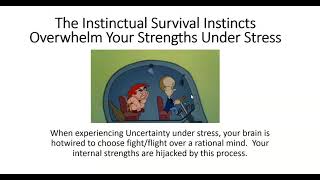
Now, what do you think is going to happen there, friends? What do you think possibly is going to happen? Well, for the most office, it's not pretty because here's the picture. This graphic really describes exactly what's going on with a person who doesn't comprehend the mind. For trading is. You really think I'm really smart. I've got this knowledge and I'm driving this cart. Look at me do this. All I have to do is be reasonable, and I should be okay. I just need. I just need to plan my trade and Trent and plan my trade and trade my plan. That's all I need to do. It's so easy. What we're not looking at in our thinking brain, we're not looking at the back seat where the emotional brain is, or what I affectionately call the caveman brain.
It doesn't have a thinking cortex.
It relates emotionally to the environment, and it.
By large is organized around uncertainty to produce vulnerability, vulnerability to produce confusion, and confusion to drill toward fight flight. And if it just so happens that if the rational mind gets in the way of fight flight, it's toast. At this moment, your internal strengths are hijacked in this process, okay? Particularly in the compressed time zones that are found in trading. That's the big ticket here, is that when you start compressing the difference, the distance between cause and effect, it's the difference between instant karma and long term, lifetime karma, where things catch up with you. You can ignore. You can ignore things when you have a long time span, when you have a short time span, you can't ignore. You can't create fictions, you can't lie to yourself. And it just so happens, under stress, the guy in the backseat, the caveman, is who takes over mental functioning, takes over performance. It's not like you should be able to do this. It would be incredible for a person just to simply walk into trading and say, you know something? I'm just going to take this mind and I'm going to use it. I'm going to be rational. And I am in fact that. Because ultimately you're an emotional being.
Who rationalizes. Okay? And what we're doing is we're saying we need to be able to calm that Capan brain down, that emotional brain down, so that it doesn't hijack thinking. And that's what happens. Anytime that you've actually looked for too much confirmation, it got away from you. If you've ever taken your profits too early, if you've never refused to take a loss, I'm like, I can't take that loss. You have felt caveman brain taking over rational thought, okay? Happens all the time. Nobody notices this part of the self, but it's there, it's powerful, and it's absolutely eating your lunch. So.
The internal resources are there until this very moment. And it's kind of like in this graphic. What you're looking at is the heart. The emotional brain is going. It's just, it's instinctive. It reacts based on patterns that have already been established. When it encounters uncertainty in the environment, the brain, that thinking brain, and what happens is, can say, oh, now yo, last time you got hurt, don't do that. But tell the emotional brain that has established a successful short term pattern before and it keeps replicating, keep replicating, keep replicating, because that's all it knows, okay? This is the power of the emotional brain over your thinking brain. It happens that fast. And what I would like to do is for you to understand that uncertainty is a threat that demands action. Now for the emotional brain. So you may. And if you've ever noticed the difference when paper trading and when you're actually risking capital.
When you put that capital in there, you're putting real guts into it. Because suddenly what happens is that it's no longer. You can't reboot that program. The money can be either lost or it can be grown. But the thing is that the emotional relationship that you have with uncertainty shows up. That's what's happening, friends. And what I want to do is show you exactly what happens.
This is, this is a graphic where we're taking emotional stimuli. You could call that data, data coming into the thalamus. And at this particular moment, if you were to see in that thalamus, kind of like a busy, huge city intersection where there's a traffic cop, that traffic cop is directing traffic when he's, he's moving people and different things and an emergency vehicle comes, what he does is he Stops all traffic and lets that emergency vehicle through. So it's the shortest route to the emergency. That's exactly what happens in the brain also, because ultimately the. The information comes in. What you see, what you feel, what you touch. All that stuff ought you hear, all that stuff comes in. And what it's doing then is based on. Based on that traffic cop's assessment, is this an emergency? Like, it's going against me, okay? It. It can easily, if it's hits the right criterion, it automatically sends a signal straight to the amygdala fight flight, okay? That takes nanoseconds,003 seconds for that information to activate the amygdala and start the fight flight process. And then you'll notice that that little line has up to the hippocampus. The hippocampus is where memory is stored. And you might have a memory, say the memory, you know, like when a child hits a hot plate, hot stovetop, There's a memory there embedded. It's an emotional memory. It's not necessarily visual, but under those circumstances, I get near the stove, I get burned. Is there. That's what really trips the amygdala up to fight flight. Now, let's just say. Let's just say that it wasn't necessarily that big of an emergency at that moment. That information, the thalamus would then send that information to your thinking brain. The problem with that, it takes microseconds to get there. 0.25 seconds versus directly to the amygdala in 0.00 seconds. That means the information.
Three seconds. So what you're looking at, this is called the shout short route, the low road. And literally it's already activated the amygdala, okay? That's the emotional center and particularly toward fight flight. And it's already revving up, getting ready to spill the chemistry of fight flight into the bloodstream, into the brain. Meanwhile, the big train that's going 0.25 seconds per year finally gets information to the thinking brain to make a logical decision. Well, the emotion is already in the bloodstream, is already taking off and has left the locomotive, has left the depot by the time the thinking brain even gets the information to start sorting out.
This is why you say, I don't know why. I don't know why I didn't do it. Right? I just, you know, I know what to do, but I just can't seem to do it under the pressure. This is exactly what's happening, okay? And what I want you to realize is that my work is associated with interrupting that emotional stimuli coming into the thalamus and disrupting the traffic cop. So there's some precious time. And to be able to take emotional, other emotional programs other than fight flight, aggression, fear, to be able to engage uncertainty with, okay, that's the big, big, big deal.
So.
To get to your internal strength under pressure and that pressure in trading, not only is it compressed time, but there's also a money value to that. You're risking capital, you're risking your life to the emotional brain. That's what's seen. So ultimately we have to break through the brick wall of that old pattern. And what you've noticed is you keep doing the same stupid thing over and over again. What you're recognizing is just how thick that wall of that pattern is. It has been well established. It's probably had, God knows, decades and decades of, of basically route, just root recurring, adding, adding, adding insulation to the circuit. So it's really hot and fires really rapidly. So what we know.
That when that brain encounters uncertainty, it is going to experience vulnerability. And boy, you know how people don't like vulnerability. You know, you talk to a man about vulnerability and you discover, oh my gosh, oh my God, anything but vulnerability. I can't allow myself to be vulnerability. Well, if you're going to be a traitor, you're going to have to, you're going to have to learn to deal with your vulnerability very differently. That leads to survival instincts, okay? And that's your fear and aggression taking over the rational thought. That's like in that, in that car of a brain, that dweeby looking neural.
Brain is sitting there thinking he's in control. And meanwhile caveman brain sitting back there waiting to be triggered. And once the trigger happens, thinking brain's wiped out. This is where we started, okay?
And right here, my promise to you is training the subconscious, okay? Is, or the emotional brain, I would actually call the subconscious the emotional brain. It's not like it's subconscious beneath thinking. It is simply a different part of the brain that takes information very differently. And it does not think, okay? It emotes, it does not think.
Ultimately, if you're going to change the emotional brain or those processes that are instinctive, you're going to have to retrain all this stuff.
Because once it's disrupted, okay, you can go and train your brain to respond differently to uncertainty than the way evolution and natural selection organized you through experience.
Actually understand this. When you're born.
Your brain is born nine months premature compared to other higher apes. And it takes nine months for it to catch up, say with the chimpanzees. However, the moment that brain starts engaging the environment, I mean right from, right from literally the delivery table, does that brain get put on his mama's belly and make eye contact with mama or does that brain get whisked away and cleaned off and stuff like that? It's all that thing, the brain right there and is already organizing how it's going to respond to the environment. And it's learning about its worth, it's learning about its mattering, it's learning about its competence and whether or not it can risk. It's learning all that stuff. And it becomes organized. And what you do not want is the way that nature organized you to respond to uncertainty. If you're going to be a traitor, okay? And this is really about the adaptation and the generation of the self is what really happens is that the brain is organizing. If in.
In physics.
Reality is not seen as objects out there. Reality is understood to be potential, okay? And it's the observer of that potential that gives form. It creates the self that you call me.
So it's just one. What you're looking at yourself as is one particular organization of itself that generally happened before you knew what was going on. And it just organized you. And oh, by 5 years old, 75% of your personality, the way you respond to uncertainty is already locked in. And very few people, as they grow, ever question the way that organization happened. They just say, oh, that's just me. No, it's not. It's just simply one organization of a self that your observer more about that a little later has fused to and it becomes basically your prison. And in trading, what you discover is that that prison really becomes obvious. Really becomes obvious. And this is, I want you to look at this and this is really important. This is the kind of stuff that you, in the 25 to 30 years that serious neuroscience has really been around, what we have discovered is that we do not perceive a truth or reality out there based on our beliefs, the assumptions and the biases. We're born into.
Reality. The truth is created in your brain. And what you're actually doing when you trade your trading account is actually telling you how effective or ineffective your beliefs are about your ability to manage uncertainty. That's what the account is showing you. You are projecting your beliefs onto the markets. You're creating a market. And I'll give you an example. I used to work with a guy who traded with a eight figure account. He was a, he was a big boy and he was not using me, my services to help improve his trading. He was actually using me to help improve his intuition. Okay? Now, one day, he and I are talking on Skype and he says, randy, what do you think I see here? And he pulled up a chart.
And I said, christopher, who am I to tell you what you see in that chart? What do you see in that chart? What he said was blood.
I'm going to get a bunch of these retailers up in this region right here, and I'm going to shake them a little bit and I'm going to suck their blood because they're going to be so scared.
He sees a very different truth. He sees a very different market than the ones that most traders see. That's because of his belief that had been built over 40, 45 years worth of trading. He knows how to do things. But what I want you to see is that when you're trading, you're projecting your beliefs onto the markets. And what you're getting confirmation on is how effective they are. Are not effective. They are with extracting capital out of the markets. Okay? And when you get around really good traders, what you'll discover is their beliefs open up to the truth of the markets very differently than the way a lot of other people do. So now we've gotten to belief and truth, and it seems like a weird world out there, doesn't it? And as you develop this capacity, what you discover is that winning and losing simply become. What side of probability do you land on? You're no longer trying to win to make money.
Instead, what you're doing is you're trying to maintain order of the mind. You're no longer worried about winning or losing because you're looking at that as just simply saying I. Those are just simply parts of probability that I landed on. And if, you know, if I lost, I need to be asking the question, was this a method mistake which you know can be improved, or is it a psychological mistake where I need to be able to look at what in the world's going on here about my relationship with uncertainty and to start working those beliefs so that my dealing with uncertainty does not trigger fight, flight, but triggers discipline, impartiality. So you see these obstacles, okay? So more than that, though, your beliefs about your worth, your sense of mattering, your inherent worth, are constantly being projected onto those markets. And what you'll discover in my work is I actually place a great deal of emphasis on something that I call inherent worth.
And out of this, an inherent worth, you're actually going in and discovering an Element, a part of your being that simply has worth beyond performances. Who in here has taken a loss and heard a voice in their head say, oh, you're a loser, you'll never make it? Well, almost everybody has. Nobody wants to take a loss. Why? Because to the caveman brain, taking a loss is being somebody else's meal. Okay? And nobody wants to be somebody's meal. So you can see how that primitive brain shows up. It doesn't want to take the loss. If I take the loss, it's like, oh my God, it's. I'm being consumed. Yeah, I'm gonna have to fight back. Yeah. That's all primitive stuff. That is non thinking. You can call it subconscious. No, that's the emotional brain. That's the survival instincts of the emotional brain. And as you gain control and you realize that I don't have control over the outcome, what I have is I have control over my performances. And in particular, one thing it's greatly emphasized in my work is you have to get to a moment of where you can discern the inherent worth that lives in you as a human being.
It doesn't have to be done from a spiritual context. It can be done from literally a biological context. But the thing is, is you're having to get and realize that, yes, I have worthiness beyond my performances and that my performances are never an indicator of my worth as a human being. That has to be, that has to be overcome and built with. Because until you see you have that worth and you're no longer comparing yourself, that's when you can become a really great trader. And when fear is actually taken offline, you can actually start.
Developing those inherent strengths, strengths that fear has been blocking you from. But the question really is, how do you take fear offline? How do you do that and discover these internal strengths? How do you do that? Well, I'm glad you asked that, because that's exactly what I train people to do. Let's put it this way. In the very same way that you have experienced greed, you will have experienced lust. I want it. I want it. I want it. You have experienced fear, anxiety. You experience this whole thing, disappointment, sadness, this range of emotions because they're part of the human experience, or we would actually say the genome. But within you is the discipline of ruler. That's the capacity of maintaining order under pressure. It exists, it just hasn't been developed with such short time frames like in day trading. You also have to develop, you also have already on board the courage of a warrior. What that really means is you have the capacity instead of turning away and ignoring and denying your fears or projecting them onto other people, including the markets, you turn toward yourself and realize that fear is always there to be mastered, not necessarily avoided. Now, if it's saber tooth tiger coming at you, you better think about avoidance. But for anything else, saber toothed tigers died out 12,000 years ago. They're not here yet. At the same time, we need the courage because we still we fear fear. And it is that, it's that relationship to fear that we have to be able to have the courage to turn to. And when we turn to it, we need the self soothing, the self compassion of a caregiver. In trading, my friends, you are going to be losing a lot of. And in fact, instead of hating losing, you get comfortable with losing because it's part of the game. And your job as a competent trader is to make sure your losses stay small so you maintain a ratio of 2 to 1 of winners to losers. That's the ticket. But you also need the self soothing so that you know, it's really interesting is compassion is the only emotion that has been proven that it will go into a belief circuitry as a neural circuit and can tease it apart, the circuit that holds your belief. Okay, now get that and then rewire it back together into higher functioning. That, my friends, is a really, really powerful emotion that is very much underutilized in trading. Most people I know, when a mistake is made, they beat themselves up. What I'm saying is the exact opposite. What happens is you need to have compassion for yourself, not pity, compassion to be able to recognize that and to soothe that. Because once you soothe it, you can put the self into a position of learning and that's what you want. So it's that curiosity that goes along with self compassion when you do these three things. Developing the discipline of ruler, the courage of a warrior, the self soothing of a caregiver. And remember, these are emotional programs that are inherent in your brain. They can be activated and most likely at one time or another, you actually live from them. What we want to do is when you put those all together and they're functioning as an intentional mind rather than the mind that you brought to trading. You get to experience the impartiality, the clear thinking of a sage. And that's the mind that you want when trading. You want clear thinking, impartiality, you know, it's just a trade, it's just a performance. It's not your life, it's not a reflection of you, it's just math. Okay. And you act, you actually act from your strengths rather than your weaknesses.
And then, you know, we've, it's amazing is in my work I go through a lot of, I gotta go to a lot of depth of helping to people understand what an emotion is and the way it locks you into a particular perceptual map or tunnel vision in this particular case. Why is it so important? Why is emotion so important? Well, I'll tell you why. Because all thinking is emotional state dependent. There is an interplay between belief and emotion that you're going to have to learn to work with. Because at the core of an emotion is the belief or what would in neurobiology would be called a limbic learning about your capacity.
To engage successfully the uncertainty and challenges of living. That's the creatures that we were built to be. What you're going to have to do is you're going to have to separate literally your.
Evolutionary psychology.
And say that's my genetic predisposition. I'm going to have to learn how to work with it. But I'm going to have to build another kind of response to the challenges that I'm presented in, not just in trading, but in life. What most people discover is that when they take my work, they discover that it has. Yeah, it can be applied to trading, but it's better applied to life. The way you engage life and it's, you discover and learn a lot about yourself and it leads to self mastery. And here is the, here is the natural response. Okay, if you go back TO graphic Again, 12,000 years ago, these big cats were still around and they liked us, they like to eat us. And you're actually looking and you can see why humans would have developed a natural emotional response to uncertainty as fear. Even if fear, understand fear is the, is when you experience threat, threat of losing. Okay, when you experience threat.
That threat evolves and can go through avoidance. That would be the fear based emotions or through aggression. That would be your anger based emotions. You have experienced as over trading. You would have experienced it as revenge trading. You would have experienced as scarcity. Thinking and getting, taking your money before you allow it to go to target. You would have experienced not getting into trades. You experience all that and what I want you to notice at the very tail end comes thinking. You say, well, why did I do that? You didn't notice that you disappeared. Your thinking brain, when you're under stress outside of the yoga studio, in the real combat zone of uncertainty with trading is that thinking brain just gets disappears if it's not well trained, okay? That's the deal.
So courage is needed, okay? So that you might face your fears and master them. You don't conquer them and throw them to waste. You master them. There will always be uncertainties. There will always be all that stuff. And you're wired to trigger, to feel. But the thing is, is you can rewire yourself, okay? You can rewire yourself so that when you face the uncertainties of trading, the challenges of trading. Oh, my God, do I stay in? Do it out. It's getting really close to my stop. But, you know, maybe if I just give it a little more room. Listen to all that rationalization going on, okay? It is here. Trading.
Is really forces this whole issue of facing your fears. If you're going to learn, master the mind that trades, you cannot use disinformation to fool the trading account, okay? It may work in a lot of other areas. It's just because you're proudly saying, yeah, yeah, I've got, I'm training my subconscious. I'm, I'm big, I'm, I'm bad, I'm. All this stuff. Do you think the trading gods care? No. What happens is, again, it goes back to what beliefs are you projecting onto the markets about your ability to manage uncertainty? That's the deal, friends. That is the deal.
Now, self compassion. I know every guy in here is looking at that, going, oh, that's so, that's so. We'll see all that. No, this is really. This is really true. It's very interesting is.
16 months ago, I had a heart transplant. And a couple times during that course, I came very, very close to not making it okay. Not before the surgery. And I mean before the surgery, not. Not after the transplant. And I went to Duke, and it's interesting is they gave me a pillow, looks like this, but it says Duke Heart center and all that kind of stuff on it. And I thought it was the dorkiest thing I'd ever seen in my life. And. But I kept trying to throw it away, but I kept retrieving it, and now it's in my office sitting, and it's sitting in a corner, and I look at it, and when I look at it, I recognize the gift of new life. So now what happens is that the kind of medical compassion that I was shown and the expertise also has given me new life. And that's the development of gratitude, that's the development of a particular mind that you are then living and engaging with. So the whole point is when you're actually soothing, you're also getting at the inherent worth of yourself. And you're calming the emotional brain down. And that the fear response which I call orphan no longer is triggering. So. So all these things are important. The discipline of a ruler, the courage of a warrior and the self compassion of a caregiver are necessary to get at a high. To be able to use that brain of yours to produce reason rather than rationalization. Big deal there.
Now what does it look like? What I want to.
To me, I think one of the greatest archetypal movies ever produced was the Lord of the Rings. And in it what you got to see was pure archetypal personifications. Now what I mean by archetypes are emotional programs that are instinctive in the human psyche. And you would find for instance, Aragon back there. You know, the thing is he's the ruler. He has to reclaim the throne that was lost in disgrace by his family. Gandalf there. You know, the thing is he's the sage. He's the one helping and steering them through. And I could never pronounce those elves names. But the compassion, the love that allows. Yeah, that and also Sam, if you think about Sam in this thing is his compassion for Frodo is what helped Frodo actually through go through the deepest struggle that any of them could have and understand. A lot of these big dudes that had all this other stuff Frodo had the internal warrior, the discipline, the compassion and the clear thinking to be able to take something that would have absolutely corrupted anybody else. And what you discover is that, yeah, suddenly what you see is a symbolic representation of Eragon as the ruler representing discipline. Frodo's. All of them, Gandorf, all of them are sitting there and almost these are parts of the self. I personally actually my favorite is Winston Churchill. Because what I recognize, if it weren't for Winston Churchill, I would probably be speaking German today. He put the free world on his back against the greatest army that had ever been built. He saved London. He took two absolute enemies, Stalin and Roosevelt, and had a working partnership with them. You begin see the enormous emotional programs that were activated to produce.
A winning effort against incredible odds. This is what's living within you. And what we're doing is you realize that you know something. This is the mind that I need to build. I need to be able to separate. When I. When I lose a trade, I realize that's a performance that I need to evaluate. But it has nothing to do with my being as a human being.
The perfectionist. The guy who wants to win a lot. Money becomes Representational to their worth. That is what cannot happen in trading, otherwise the trading gods rule you. So it's this whole thing. And what really revolves around and what's really not shown is that.
At the very inherent part of this, what you discover is there is an inherent worth. They're actually tuning into and saying, you know, something.
I am worth. I am worth beyond something I am worth simply because I have worth. You know, whether or not you see it from a biological perspective or where if you ever watch wildebeest running from an attack by lions, what you will notice is the children and the moms will go to the center of the pack, and the males and the infirm will go to the corners or the sides, basically putting themselves in harm's way.
The children, the little. The little deers in there have. The little wildebeest have that much worth that their society would put them first. Now, from an evolutionary standpoint, it's all about the gene pool. But that's caught in biology. That's called altruism. We generally, in human terms, call that compassion. But you discover is that we have to tune into this worth not talking ourselves into it by affirmations and visualizations. But no, you actually need to tune in at the level of visceral gut, that part of you that has inherent worth. That's what you're beginning to develop. So we're here and we go, wow.
We began to see the mind as a governing committee in much the same way that the brain is conceived. And David Eagleman is where a lot of this theory comes from. So if you want to check him out.
He'S the one who began to say that the brain really was a community of rival emotional programs that duked it out to create the self from the potential that was there. And that's what you call me. What we're saying is that when that same brain produces mind, that community becomes a governing committee. And on that committee are both parts of the self that are very destructive and parts of the self that are very constructive. And the deal is, is that trading is going to force you into reorganizing that committee to work with probability, where you're not in control of outcome. You're not in control of being right or wrong. You're not in control of your predictions being right. What you are in control of is the mind that you bring into the moment of performance.
Okay? And you learn to master those parts of the self that are destructive in nature and feed the parts of the self that are constructive in nature. So out of this.
How does this really look like? If you ever had self doubt or sense of urgency to get into a trade, you're looking at the committee of the mind at work. You know when you're looking at that going, self doubt, you're hearing this going, oh my God, am I going to lose, am I going to lose it? All this money's going away. What made me think I could ever trade urgency? Get in right now, get in right now. There's money to be made, Money may be made. This, this is the committee of the mind at work, but not a good organization of it. It is a committee of the mind that needs to be retooled. Instead, what you're listening to is the influence of what I call the inner critic. That which wants that stops you from being your best. And what it's doing is it's trying to keep you small. That's what it does. It's very destructive. And the adapted voice is that part of the self right there that has his shoulders shrunk over. And you're beginning to see that, oh, maybe I can't do it. And the key is that with this Newfoundland capacity, you're organizing it so that inner critic is stopped from getting its little claws onto that part of the self called the adapted self or the orphan. That frees up the ability for you to be able to truly begin to build a powerful thing. And who in here has ever not had self doubt? You're looking at self doubt right now and you're listening to an ear, listening to this, but doesn't know how to discern the difference because it's just stuff going through the mind. And this is why it's so important for me to build an observer of the mind so that you're no longer identifying with these destructive voices. It's not like they're not there, they're not going to go away. But you sure don't like, you don't have to be steamrolled by them. You can develop eternal vigilance because that ultimately it's the price of your freedom.
So your job is to reorganize the committee of the mind around your strengths in the context of trading, not the context of your corporate life or your business life or wherever you came from.
And you're beginning to change. You're accepting that you no longer control outcome. And the alpha has the biggest problem because he, he's there to win, he's there to make things happen. He gets into trading, blows up accounts simply because he's still wanting, he's still Using a mind from another time and another place to try to work in trading. It doesn't work in trading if you're not willing to give up control, go back to the old world. Because the world of trading requires a disciplined, impartial mind to be able to manage probability. And really doesn't mind losing. I mean, prefer not to. But, you know, the thing is, is that losses are just simply part of the game. So we're looking at this and we're realizing that reconstructing the mind can be done. It takes work, and it can be done. It really depends on whether or not you have the motivation and the desire to really decide that. I finally have come to the realization that. That the weakest link in my trading system is me. And I care enough about producing competency in trading that I'm willing to reorganize the me that got organized a long time ago without me knowing about it into a different organization of itself that engages the uncertainties and challenges of trading from a stable mind.
That can be done. And it's so cool. And these skills can be taught. The very first part of my work is emotional regulation. And in emotional regulation, what you're really doing is you're learning how to calm down emotions, once they've triggered before they reach a threshold where they become chemistry and flood through the body and into the brain and just wipe away the thinking brain. That's done through breathing, that's done through muscle relaxation, and I add other things in that. But then also you have to develop mindfulness. You have to come to the moment where you recognize that you and your thinking, you and your thoughts are separate from one another. And that actually this you, that you call yourself is just one potential organization of a self. And that you can in fact reorganize that potential into higher functioning. That can be done. And so this is when the mindfulness is what allows you to discern the committee of the mind. And.
It also is where within that committee, as at the very core of it, there needs to be an acknowledgement and the living of the inherent worth you have as a human being. Because ultimately, as long as you're identifying your performance with your being, you know, if I make money, I matter, you know, and you know, if I lose, I'm a loser. As long as that's going on, then you have tunnel vision and you are not separating performance from your being. Performance is about competence. It can be taught. Your being is something, is something beyond all that. It's something that I would say is very much entranced in love. So if you were to think of a surfer, what does this really look like?
If you were to think of a surfer and you take a look at that wave that surfer's on, do you think he controls that wave? Nah. If you've ever been in a big wave and lost a board, you realize that you're really dust in the wind. Yet at the same time, though, he does not control that wave. What he's learned how to do, he's learned to be the discipline to manage himself so that he doesn't freak out. He's learned to have the courage of facing the uncertainty of whether or not the wave gets me or I get to ride the wave. He has compassion for himself, calming himself down. And what happens is he becomes at one with that wave. He comes to the moment of where he is mastering himself, he's not mastering the wave. That's what allows him to have that beautiful ride. That's, that's right. That's there for all of us. Okay. And the question really is, is how do you do it? And a lot of people say, well, if you've just met me and just go, wow, this guy's really, boy, what in the world, man? This guy's saying some pretty interesting stuff. Before you get anywhere, go to my website, start reading the articles. There's a lot of free content, it's known as a content rich site. And really start educating yourself about this understanding of the emotional intelligence of the trading mind, of how neurobiology really is much more powerful than your deception of a thinking mind. And then go to YouTube. I have over 200 videos on YouTube and people do weekend marathons on them. Go there and really start learning about what in the world's actually going on in your trading and start really beginning to see that it's workable. And then you get my book. There's lots of things along the way, but when you come to the moment going, you know something I get it is I need to learn how to do this. We have two basic routes for that. One's the group course and it has five meetings, okay. Over a 10 week period. And the skills of emotional regulation, mindfulness. Using mindfulness to start discerning the voices on the stage of the self, that committee, and learning how to start finding the strengths within you, start building them up and you never change that. It's challenging, but what happens is you start learning to have an intentional mind that greets the uncertainties of life rather than the mind you came with.
So we're getting there and we Go. Okay, that. And it meets. You have virtual. We have a virtual classroom that you have access to 24,7. And we're basically. It's right now, it's. We have. It's January, our next class. And people are already signing up for it because they discovered that it's a powerful course and you need to be really prepared for it. And it also, it comes where you can pay one to five payments as you go along. Okay. It's pretty. It's the entryway. The actual cost of the course is 1195 and be broken down into payments of 239, I think over every two weeks. The individual course. Oh, and if you sign up by not 9 10, but that was January, it'd be somewhat early January. You would. You would be giving. Given a free gift of a. Of a. An emotional regulation workshop. And I'm not trying to get you to sign up for the workshop here. I'm trying to get you to recognize the need to, to sign up early and start working, to start getting. Retraining the brain and the body to respond differently to uncertainty. Okay. The individual course is for people who want to work personally with me. It's highly comprehensive, very personal, and it gets to the meat of what literally, literally gets on it. The major root is that it's got 10 personal consults with me and right now I'm using Skype over a three to four month period. Very powerful course. And if you're interested, keenly interested, let's talk. And you just hit contact us and ask for a free consult. But be interested because Flores will be having you. That's the individual course. She will be having you. Do some reading before you meet me. I'm not interested in meeting a person who's kicking some tires and hasn't done any of the work. Just wants to know if he can pick my brain. Not interested. Okay. Anyway, this whole thing. Hold on. Dolores is raising her hand. Oh, we've got some questions. Great.
This is Farzana. My rational mind. Where does it start? The blue box. Fear. Don't have enough money and yet need to make money to get really frazzled and upset and frustrated. Yeah. Well, what I would say is you are a perfect candidate to begin to learn how to regulate the frazzleness. Because understand.
You are projecting beliefs onto the markets and your body is accelerating. All that frazzledness is the physicality of an emotion. Emotions are biological. They take over psychology. So your first step is emotional regulation, which is what we teach in our course. Here's William. Should a Trader consider their intellectual abilities as part of their trading plans. Not really. Just as most students won't be scholars, most traders.
I won't be spectacular. Traders won't be spectacular. You're right.
I'm having this. That was it. What I'll say is the most important part of successful trading is emotional management rather than knowledge. I If you've ever been around really good traders what you really notice is they can manage their selves emotionally and yeah hopefully they are. They have a really great handle on the system. They have but ultimately you don't. This isn't about being smart. This is about being emotionally intelligent. Okay. This is Christine. Christine. I had a trading coach tell me that if you know what you are doing.
That is the psychology. It's only if you don't know what you are doing that you would be fearful, et cetera. What do you think of that way of looking? I would say that that would. That's not a piece of advice I would give anybody. I'm going to leave it with that.
Andrew. Where do I start? The blue. The blue. Your book, workbook and guided meditations are life changing. Well, thank you. Oh thank you. Thank you. I am addicted to practicing the reinvented me during trading. Not a single losing day in more than two weeks. Well, good for you will double the daily target reached. Wow. From your experience, how long would these new programs in the book and meditations take to truly sink in and become second nature? Three to four months? No, a lifetime. It's just the same way is that you see a concert pianist work a long time to become the expert that he or she is and what they do. Yet at the same time if that concert pianist doesn't play for two weeks it takes him six weeks to get his edge back. It's the same thing in trading psychology.
Thomas Jefferson made the statement that eternal vigilance is the price of freedom. I buy into that completely. Is that the people I work with, I'm encouraging them to practice, practice, practice and what happens is of course they will make a mistake. They will fall off the wagon. We don't see that as a shameful event. We see that as a moment of learning. And over time in my own with personal stuff I see people a chunk of people get into consistent profitability while I'm seeing them and I see them sink because they quit. They quit with their rigor and then they get back to their rigor and they discover it takes between six months and a year is to make this more instinctive. Okay. That's the that's the big thing though. Okay well I want to tell you something. I have had a great unless there is another question I am.
The recording is going to be out there tomorrow and right now we can gosh we amazing me is I'm finishing five minutes early. This is great. What I want to do is I want to thank you.
For coming and also personally my hope is that you have a great life. My hope is that you find how to organize your mind to pursue trading and recognize the gift that it can be for you not just financially but in a self development standpoint. It's going to produce a need for self mastery. And my hope is you find that My hope is you do begin to really truly recognize is that your brain and your mind are very malleable and that you take responsibility for the mind that shows up in any challenging event. And with that that's my blessing to you. Okay so with that I'm going to sign off and wish you all a great life. Goodbye.










