Discovering Your Historical Narrative that Sabotages Your Trading Mind
Randy Kardec argues traders fail because of inherited emotional programming that treats money risk like survival threat, not because they lack good indicators. He outlines a five-step process to identify and rewire these historical narratives, starting with emotional regulation and ending with intentional practice to build a probability-based trading mind.
Chapters
Welcome, everyone. I am delighted that you have chosen to spend some time here and learn about this historical narrative that just, you know, most people don't even see it, they don't know it, and they start discovering, what is this that blocks me from my potential in trading? Okay, that's what we're going to be doing here today. But first let's find out. Just, just on safety sake, just make sure that you can hear me. Okay? If you'll just simply type in saying, yep, I can hear you. Everything sounds good, yes or no. And of course, if you, if you write no, I know you're lying. So there you go. Thank you very, very much. Okay, we're ready to go. So for people who know the way I run approach this program and for those who don't is I go through the presentation and toward the end of the program take questions. I don't take questions during the presentation because a lot of the questions are answered during the process. And to be honest with you, I often lose my train of thought when I'm. When I have questions and I have a goal that I'm working to do. So let's start there. Let's now take a look and start really looking at this historical narrative that holds back the potential that you have in trading. Okay? And it starts right here, is, you know something, you start looking at trading and you start looking at it going, you know something, you look at this stuff and all I have to do is, all I have to do is follow my plan. All I just have to do is keep doing the right thing over and over again. And I can size this thing up. And you know, I can, man, I can, I can see the potential here. And you know, hey, I get it. I'm going to dream it, I'm going to plan it, I'm going to work it, I'm going to make it happen. What could be easier to do than trading? You know, and you go, you know, there's lots of people who've gone before, but you know something? I just think, I think I, I think I'm special. I think I can handle it. And ultimately you go in, you spend a lot of time, a lot of money learning systems, and yet that system down and you almost know it in your sleep. And you sit there and you go, well, it's just fine and dandy when it's in simulation. But the moment that I go into real life trading, where I have money at risk, suddenly there's a bunch of crocodiles in that river. I thought it was going to Be an easy crossing. And suddenly, suddenly I just can't seem to get pats. And it seems like I'm stuck in a loop. When we want to take a look at what that loop looks like, how it happens, and we want to say, how do you get beyond that loop? How do you get beyond those alligators? Okay, but even before then, what do you do? You try harder, you get more force, you have more force at will. And you push and you push and you push and you all stay stuck in the self limiting performance patterns. And you know, traders search for solutions as roadblocks. Success leaving no unstone unturned, except for the one they can't see. And that's the one we're going to be talking about today. Okay, and you begin to go, well, I work hard and yet why do I stay stuck? What is actually going on here? Truth is.
Why.
The brain has created a narrative, a story about you and success that puts you in kind of a tunnel vision. And you see that you don't see anything beyond the tunnel. And like what this is saying right here, you know, the woman is saying, you know something, your perceptual map, you can read that as your narrative may say that you're on the right road, but this map says that you're wrong and you're lost. And what happens in trading is this, is that the only map worth listening to is your trading account, the one that that trading account applies because ultimately what you're doing, you are actually projecting your beliefs about your ability to manage uncertainty or your capacity to manage uncertainty on, onto the markets. And you're getting feedback, real time feedback in your trading account. That trading account doesn't really care what you think about success, how many mantras you've got down, what affirmations you have, what kind of visualizations you have. It only cares about are you projecting in your narrative onto the markets an effective set of beliefs for managing uncertainty? Not okay. And if, if the truth be known, 95 plus percent of traders lose money. No matter what kind of talk they have about success and winning, they're losing money, everybody's losing money. And you're going, well, Alpa, except for those few guys who are not okay. And it just so happens one of those traders in this room tonight, and I promise you, he thinks differently than the vast majority of you. And so we're sitting here going, we need to examine this perceptual map if I want to become successful. And what I want to show you is this guy who hasn't done this, who hasn't been a male and done this. Basically your brain deceives you. It deceives you into believing that you're right, even though it's very glaring. If you were to look with real eyes that something's wrong. This is this, this photograph of, you know, basically appearance dysphoria is a big thing. I know I have this problem myself. I look in a mirror and I look at myself, well, I'm not that overweight. I get on the scale and it tells me a different picture of that. It's busting my story that I want to see the way I'm deceiving myself. You as a trader are doing that every day. You're caught in this narrative that's basically deceiving you into saying, this is what you need to see, this is what's right. But it's not adding up in the trading account. And what I'm asking of you, if you want to be successful, if you want to go to the next level in your trading, is quite stop believing the lies. It's kind of like Groucho Marx said, who are you gonna believe? The lies running around in your head are me. Okay, this is what we're saying here is the truth meter is the trading account. If you really want to become a successful trader, you have to start asking, well, okay, I get it that Randy's saying I'm projecting my beliefs about the ability, my ability to manage uncertainty onto the markets and I'm getting honesty and out of the trading account. It does not jive well with my self image about the way I want to be a winner.
It may be that you need to be able to take a look and say, well, what's going on with this winning stuff? Because ultimately the narrative you have about winning is causing you to lose. It feels good. You know, all those endorphins running in there, you get some dopamine going in there and it just feels so good. And ultimately that feeling good, that dopamine rush, that you want to be right, you want to be right, you want to be right, starts forcing you to see only one small element and you're not seeing the bigger possibility around you. Okay? Because ultimately in trading, you're not going to be able to control outcome. You're going to be able to manage only the mind that you bring to manage uncertainty. Most people who have gotten into trading have come in and they have convinced themselves that they can control outcome. What every alpha who has said, I've got to win and because you know something that's winning really works. I am a, you know, I make myself by willpower, by seduction, by this, by that I can win. I have a direct influence on the outcome of events. And then they get into trading and they start putting that into practice and it does not work. As a matter of fact, it gets them into overtrading, gets them into revenge trading and then they get scared because they've been traumatized. That's the normal route. So now we're talking about, wow. This narrative I have about winning, no matter how good it's been in the past or how good it's been in other areas, is not working in trading. True.
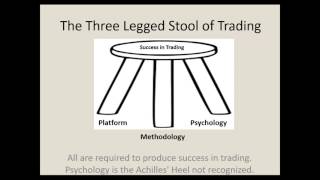
True. Okay. I've actually had a very successful trader look at me and I was talking to him about a entrepreneur who had been in a number of different businesses and done very well, not just in one, but he had proven his mettle a number of times. And he's. This guy's wanting to become a trader and he says, you know, that's just a waste of a perfectly good entrepreneur to try to force his mind into becoming a good trader. That just, there's just something not right about that. And at first I didn't necessarily understanding but I've come to see the wisdom is that trading requires a very different mind than success in most other endeavors. Okay. Because you're not going to be able to control outcome no matter how hard you work, no matter what you do. And this is a. Now let's start seeing where this flaw, this flaw that you're bringing into trading. Let's see where it fits. Let's take a look at trading as a three legged stool.
And if everything goes right, you produce success in trading. The first thing is you got to have a good methodology. You really do. You have to have a way of managing risk that allows you to lose and keep those losses small so that when you do hit winners that you really can drive them and they really can produce the income and you can extract the capital. You need that, okay? And there are very good methodologies, there are very good teachers out there that can teach you how to do that. David Debay is in this class today. He's a very good teacher. He knows how to do this and he's been producing success for, God, 25 years. Okay. Yet at the same time, that's not enough. The next thing comes platform. You have to have a platform that runs right. You have to be able to have that thing so that you, you know, you're getting your orders filled, you're getting in and out of trades and Stuff like that, just working like magic. You have to be able to have that or you're not going to be able to keep up the markets. No doubt about it. That's the trading system. Okay. There's this other part, though. There's this other part that's talked about.
But very few people do anything about it. It's the psychology that you bring to trading. Yeah, that soft stuff, that social science stuff that, you know, push that away. That's. Hey, man, I'm. I've got it. I. I can do this. I can make things happen. No, you can't. And ultimately, at some moment, you discover is that platform, methodology, and psychology work as a unit. You, the trader, are part of the trading system. You're not a part. You're not separate from it. You're literally an integral part of the trading system that you work in. I've worked with traders who had the same methodology, the same platform. The difference was the psychology they brought to it. And they were staggeringly different outcomes for each. Okay. The difference was in synchology. One, one of the traders was trading not to lose. Okay. And the other was literally trading to perform. He wasn't trading to win.
So success in trading is not the opposite of trading not to lose. Success in trading is about performing well. Okay? He's thinking about performing, performing, performing. He trusts his. His methodology. He trusts his platform. Ultimately, what happens is that's bared out. He sees it in his trading account. So what we're doing is we're saying, oh, okay, I can have the platform, I can. Methodology. That's where the vast majority of traders stay. And they don't look at the psychology. As a matter of fact, they're scared of it. They don't want somebody inside their head. And I can promise you, I don't want to be in your head either. What happens is we still have to be able to redesign the brain and the mind to move from what it used to be designed for to what it needs to be designed for to be effective in trading. Okay? That's what we want to do. So what we've got, trading is definitely presented as something that even trade caveman can do with a little training. Because all you have to do is follow these numbers, do this, that, and the other. But the truth is, is that the very brain that our ancestors gave us is the exact antithesis of what's needed to trade. That guy in that picture, though, he's looking at a computer screen. He is wired for survival in the moment. He is wired for being able to Control the outcome of an event of the environment so that he can survive, he can breed into the species, he can project his genes into the future and have a successful species. Short term, short term benefit, short term survival traits, okay? Yet those very traits that were so good for us for most of our evolution turn against us in trading because we can't go to survival in the moment anymore. We have to transcend that to probability in the long term. That's a complete, that is just like a gigantic paradigm shift that your brain is not going to do because you think it's a good idea. You have to train it, okay? Because ultimately you have something that's very alien and you're going to have to learn how to do it. Okay? So let me ask you something. What if this problem is the markets aren't against you?
It's not a new indicator that you need. It's not a new teacher you need. Let's say you've done all the, you've done all the trolling, you've done all the shopping, you've sat in all the trading rooms, you've read all the books. You're just so full of data and stuff that you don't know what to do with it. But what if that were not the problem?
What if the problem was you and your brain? Okay? All traders ultimately are forced into looking at this moment all the time. What happens is most traders simply refuse to look at the moment and see it. They decide to deny it, they decide to talk about trading rather than say, you know something, I've got a problem with my bottom line and I need to get to the bottom of it. And ultimately what I'm getting is that I have to change the belief structure and I have to start really looking at, well, what is it I really believe about success? What do I really believe about winning and trading? And truth is, you're going to discover is most likely you're telling yourself a bunch of lies and the only thing that you can trust is what your trading account is revealing to you. That's the big deal. So we've gotten there. It's costly and I want to do this for.
And this is the big deal. I want you to listen to what Bill Gates said here. Success is a lousy teacher. It seduces smart people into thinking they can't lose. That's what happens. You think you're smart. Think of all the engineers, the IT people, the accountants in trading. And they're smart, boy, they're left brain smart. And they look at it and go, I I just need to learn how to like, work these numbers. I've got the head for it. Ultimately, that very success in the past becomes the obstacle to your success now. You keep relying on skills that brought you success in the past, but the thing is, they're not working. And you don't have the wisdom, you don't have the mindfulness.
To look at that, to question it. What we want to do is we want to question it. Because this basically.
If you want to know as a trader, psychologist, when I look out and look at a bunch of traders and they're asking these questions to me, this is what I see right here, is I'm looking at these guys with these big, huge, these big, huge blinders on that they've got these unconscious biases that lock you into a tunnel vision. And literally they cannot see what's right around them. What happens is they cannot see that they can't see. They have become so adapted to seeing through that they think they're seeing the way they should be seeing. They're missing the whole other picture. It may be comfortable, it may be a comforting lie, okay? But they're refusing to see the inconvenient truth around them and adapt to it. Remember, we're the only animals that can adapt by design. Most other animals adapt by serious pain or extinction, okay? And we have this incredible gift. And my question is, when are you going to wake up and use it in trading? What are you going to use and go, okay, I'm getting it. What Randy is saying is that the mind that I have brought to trading not going to be the mind that is going to produce success in trading. If you've gotten that much this far. Good. The next question, the next thing is you go, okay, I know that working harder is not going to work. I know that getting more knowledge is not going to work. I know that analyzing more is not going to work. I know that all these dang indicators that I have that just supposed to give me more and more assurance about outcome. I discovered that, you know, there's so many of them that I, you know, I.
I get all left thumbed in them. And ultimately it comes down to the old ways don't work. You have to look for a new door. And that's pretty scary stuff for a trader. You really want to believe that the truth is out there. No, it's not. It's inside you. And you're never going to be able to master the markets until you master yourself. That's the piece that people are going to have to learn. So what we're doing here, we're saying, okay.
I need to change. Yep. What a simple concept, you know, maybe a couple pills, you know, wake up the morning, it'll all be stuff or. Randy, what's the tip? What's the tip? What's that special knowledge, that secret that if you tell me that I will be able to unlock the secrets of successful trading and everything will be good? Well, I'll tell you what it is. It's very simple. You have a certainty based mind that has to be converted to a probability based mind. And unfortunately that certainty based mind is circuitry, organic circuitry. There's not a switch in there that turns on and off. And you have to change the way you think, you have to change the way you engage uncertainty than the way that nature designs you. Okay? That's the whole thing. Otherwise you stay stuck. And it's not, you know, it's not bad. It's just that it doesn't produce success in trading. You have to make a decision in. The decision is very simple. Am I willing to change the way I think, the way I perceive with some heavy emotional lifting to be able to be a successful trader or do I have to force my way of thinking to be right in trading?
Okay, I can promise you the latter. Are the ones who blow through their capital in about three years and get outside of trading and they think, golly, man, I'll tell you that, boy, there's something wrong with trading. No, the truth is it's a probability based skill set endeavor and you refuse to move beyond the certainty based mine into the probability base mind. And it's required and it's, and again, it's okay, I, I'm talking with a trader right now and she's in the process of deciding whether or not she wants to stay in trading. She, she's an immigrant and she, she had to overcome impossible odds to become the successful IT executive that she is today. Okay, it's just, it's amazing, the work, the struggle that she went through and what she learned very clearly from where she was at is that she experienced enormous powerlessness both as a woman and also as a, as a, as a kid where she grew up, there was lots of stuff and she learned that she had to control.
She had to be in control of her own destiny. And she grows up and she, you know, she immigrates to the United States, she gets an education, she ends up in it and has done really well. And then she also made a decision. I am tired of working with all these People I want, I want financial freedom, I want personal freedom and got into trading. And all of a sudden she discovers that she's a control freak, okay, she wants to control outcome. She's an alpha.
She is an alpha, true alpha and she wants to win. And ultimately what she's looking at right now is Randy, I don't know, I don't know if I'm willing to give up my focus on winning and develop a focus on performing. I want to control outcome, I had to as a kid. And she's at this fork in the roads about deciding. Is she willing to change the mind the way she perceives the perceptual map, the narrative that she has about winning and it's an honest struggle and we don't know what she's going to decide yet. And I would ask the same question to you is that are you willing to come? Are you willing to recognize you're at that fork in the road anyway and are you willing to recognize is that if you do want to become a successful trader that you're going to have to rebuild the brain the way it, what happens when it's exposed to uncertainty and you're going to have to redesign the mind about what conversations, what parts of the mind come together to engage uncertainty. That's going to have to happen or you're going to bleed by a thousand small cuts or you're going to gash yourself really good. The truth is, is that the market, the trading account is telling you to look. To look. So ultimately what we have right here.
We have a brain that's very much designed where we're hunter gatherers and what happens is we see an object out there in the field that is uncontrollable by us. And what happens is that some suddenly in our brain is 60, 65% is around vision. So through your vision, these, this data comes in your brain, cranks it that brain and your emotional brain, that's what the heart is there concoct a story about, okay, get ready for action. Or is this a threat? Is this not okay if it's uncertainty? And understand this could also to this little six figure man, this could be a meal. But the thing is he would need an entire community of hunters for that to become a meal. One man is not going to deal with a 12 foot high. 12 foot high. Well, 12 at the, yeah, woolly mammoth. So what you're doing is it's wired to trigger like that, just like lightning. And ultimately here's, here's the ticket friends. Your brain, your precious Brain sees capital risk as a threat to life or as an opportunity to seize immediately. Both work for survival, but dangerous for probability. Okay, so there we are. And ultimately the way this thing works out is that there are people who just absolutely thrive on the stress, okay? And some people are born with a brain that just simply has very high risk tolerance and if they lose, it doesn't bother them, okay? And they go on. I was actually reading about one of these guys in the Wall Street Journal and he's, you know, he's a billionaire and he, he has yachts with bikini clad girls and a lot of people talk about that, but he wages really huge risks and it just doesn't bother him at all. You think, well, I want to be like that. And the question is, are you sure?
Many of the very successful traders that you meet have very atypical emotional architecture compared to the vast majority of human beings, okay? They're outliers. And what we're doing is I'm asking you to say, well, okay, you didn't win the genetics lottery, okay, so you're not naturally that way. But can I build a mind? Can I rebuild the emotions? Can I train the emotions so that I can deal with uncertainty and threat to capital differently than I do now? The answer is yes. But what happens is that you go on this roller coaster where some people like to thrill more, more and more, and others go, oh, no, no, no. And the deal is, is most people are going to be on the other side. And you find a lot of people, particularly the guys who get overconfident and end up over trading, if they get sucked into the adrenaline, they get sucked into the dopamine and before it's all over with and smoke clears, their banking accounts cleared out. So we know that. And so ultimately what we need to do is understand this. Emotions are not what you think they are. Emotions, first of all, are going to react to conditions before thinking ever occurs. And emotions are not feelings. They're not touchy feely friends. If you want to define emotion from a neurobiological standpoint, we would say that an emotion is a biological action potential that coordinates action between the organism that would be you, the traitor, and the environment that would be the markets. That's what an emotion does. It's based on action and ultimately it causes you to quickly move and start thinking in particular ways. So understand this. As emotions are biological, they take over psychology. And as long as you're trying to push them away, then you've got a problem because, hey, they can't Be pushed away. The only time you don't have an emotion is when you're dead. The key is, can you learn to be an intelligent user of emotion to create the mind that can engage uncertainty and risk capital? That's really the question. Okay, and you need to answer that because if you're not willing to do the work, to do it. It's just a long slow drive down or off the cliff, one of the two. So what have you tried to, you know, most people have done some serious work. They've spent a lot of money, they've tried magic, you know, that positive mental attitude. They've tried the visualization, the affirmations, the nlp, the tapping, hypnosis, mind ever master prosperity thinking. They've done all these things, they've done hypnosis, they've all that. And yet at the same time, what they discover is that that's all surface stuff. What you do is you have to get down to the core beliefs that are driving the emotional reactions with the environment, with, with trading. That's what has to happen. Okay, Most people aren't willing to do it. So most people lose and the question becomes where you are and the folk in the fork in the road. Do you choose to change at the level of belief? Okay, and not the ones you think you have, the ones that are being revealed by your trading account, those or are you trying to make the world change to suit you? That's what evolution has done. Okay, so ultimately what we want to do is say, well, how do you go about transforming this mind that I've got, that's survival instinct, oriented for short term survival. Okay, how do I retrain that into a patient, disciplined mind that manages probability and keeps the fight flight response at bay and allows you to maintain rational thinking in the midst of capital risk? How do you do that? The first thing, friends, believe it or not, is deciding that you're going to actually do that, that you've had enough is enough, that you realize that you've been playing a game with yourself, that you go, you know something, I'm lying to myself. It's very apparent. My trading accounts downright telling me if you don't believe me, look at your trading account, look at it over the last several years and saying, well, this isn't, this isn't, you know, I'm becoming a better trader from a knowledge standpoint. And boy, if I can talk trading up a storm, I can carry on conversations about trading. I've got great systems, but when I look at my bottom line, what it's telling me is that the psychology I'm bringing to the game is not winning this battle. It's not winning the performance thing. How do you do that? Let's take a look at that. We've had enough. We've had enough of the bad news. Let's take a look at the good news now. Okay.
I use a five step process that I have found to be very, very successful in being able to shift the way a person thinks into a new way of thinking. The very first thing that happens is that you have to learn to regulate emotion. Okay. It's just if you're going to transform yourself, you are going to have to first stop the bleeding. You're going to have to stop the emotional hijackings that occur. You're going to have to be able to calm them down. But that's not by itself. Emotional regulation is not going to change the problem. You still have to get at beliefs, my friends, to do that. The second thing that I teach is mindfulness or what I would call awakening the observer. And mindfulness might be best defined in a very simple way. Noticing that you notice. You know, most people end up just absolutely mindless about what's going on. Like tomorrow, if you want to see a lack of, if you want to look at mindlessness, tomorrow morning when you start trading, what I want you to do is suddenly stop and say what's happening in my body? And start noticing there's tenseness in your body, start noticing that you hold your breath, start noticing that you breathe very high in the top 30 of your lung and start noticing, oh my God, I'm observing my body. And if I accept Randy's idea that emotions are biological, I'm actually watching when you're looking at tense muscles, you're actually looking at emotional arousal. It's arousing. Getting read to kick in. Fight flight. When you look at your breath and it's stopping, it's doing the same thing or high level. It's stopping, it's stopping the oxygenation process of the full set of lungs. What it's doing is only using the top so it can. It's getting ready to fight or flee. Then you start listening to your heart rate and it's going to be telling you if it starts speeding up, you're going, oh my God, it's accelerating. It's getting ready for. It's ready. I'm getting ready for an emotional hijacking. Yeah. We aren't even talking about the mind, we're talking about the body. And I started asking you to Recognize the body and the mind are intricately connected and you're an idiot to try to separate them because it's going to, it's going to, it's going to. The mind comes forward out of the brain, the body. So you start this mindfulness and you discover that.
With mindfulness I can step back out of my thinking and I can begin to see that I'm not really thinking. My thinking is having me, I'm not having thinking. But as you develop the mindfulness, the observer, what you discover is, okay, I can step back on this conversation and then I can find this historical internal dialogue, this historical narrative, okay, about my performance in Risk. And in there you discover a whole bunch of stuff. I'm going to tell you more about that, but that's the part that you've been ignoring, you've been pushing aside because it's uncomfortable, it doesn't fit your self image as being a winner, but it's there and it's causing you to choke. Okay? The fourth one is the self development of your empowered nature. And you know something? We have enormous emotional programs living within us that we can learn to call forward into working awareness and create incredible mind for managing performance. Okay? And the fifth thing is you just flat have to start becoming intentional about the mind that you bring to trading. You're just not waking up, getting ready for trading, going in there and turning on the machines and just. No, it doesn't work that way at all. The same way it doesn't work for a top echelon.
Athlete or performer. You know, they are going to work their mind up for performance as well as make sure that their fingers are ready, their body's ready, it's all there. Okay? So.
We see the process, we see the five. Let's break it down in step one, emotional regulation. Basically we have to manage the emotional storms before they take over mind. Okay? From here you start learning a lot about the brain. And that's a lot of what I've been talking about is the way the brain works versus the way you would like the brain to work, okay? As if the brain and the mind were dislocated from one another. You began to understand this survival instinct is really the first draw of the way the brain's going to work first. And you're going to have to learn how to deal with it and change it. So there is some intellectual stuff that has to happen.
But ultimately it comes down the power of emotion over rational thought. This diagram, my friends, shows you exactly what your problem is. Okay? For all of you who have ever experienced emotional hijackings where you have that I am a disciplined trader. I'm a disciplined trader. I'm a disciplined trader. I am going to follow my rules, I'm going to plan my trade and trade my plan, and then end up doing something completely different. This diagram is going to show you what the problem is, okay? What happens is that you have sensory information coming in to the brain stem into the thalamus, okay? That thalamus is making a decision right then and there based on history. And it's deciding whether or not is there danger there or can I route this stuff the long lazy way up to the neocortex and have them have everything reasoned out for response that comes back to me, which by the way, takes anywhere between half a second and a minute and a half, okay? And if there happened to be a grizzly bear bearing down on you, this is not a good plan. However, if the thalamus looks at it and says, oh, this is an emergency, I need to take the low road, Suddenly what happens is the shortcuts taken, emotional hijacking happens and suddenly everything is shifted. Nothing starts going to the thinking brain, everything's going over the amygdala and all of a sudden you go into fight flight response and bam, you have a fear or anger response to threat. Boom. Just like that. That, my friends, is what's happening in your trading day in and day out. And until you learn how to manage this diagram so that that shortcut is not taken, you take the long way, okay? To where the emotional brain and the thinking brain are working together as a unit to produce the mind that trades. Otherwise, your friendly amygdala, or what I call in my practice, the orphan, takes over because it no longer trusts higher brain function to do its job. Well, the truth is, is that the self deceptive human being is not looking at it and going, I need to change. I need to work on myself. I need to develop the brain and the mind that can allow me to trade this higher, higher levels of functioning. So it's up to you. So it's so easy, okay? And yet there's your problem, friends, right there. That's the problem that with all the magic solutions you've tried, this is why it doesn't work. You have to learn how to cool down the limbic system, the emotional brain, so that it doesn't trigger rapid fire hijack wise to the amygdala and fear response and it takes the route up there. That's the whole point, friends. You do that by Breathing, you do that by tension reduction. You calm down. Okay? Obviously there's a lot more to it than that, but in this presentation that's enough. Because ultimately what we have here.
You have diametrically opposed needs. Your brain is designed for short term survival when stressed. But trading requires a mind built for probability management over long term. It's two rams butting heads, okay? And what happens is while the two rams are butting head, the smart one is out finding the female. The key is this testosterone driven basis of trying to prove the self by performance has to stop. And you have to become a patient trader. But you have to be able to manage that emotional mind a lot better than you have. Because ultimately the key is, is that emotions are not the enemy, okay? They're not the enemy. That you're not going to push them aside, you're not going to pretend they're not there, you're not going to deny them. Ultimately, once you recognize that emotions simply are part of the brain, they're inescapable and that you better learn how to deal with them no matter how emotionally illiterate you are right now. To become a successful trader, you're going to have to become emotionally literate and you're going to have to say, oh, okay, I've been thinking emotions, you know, leave them at the door, they're the enemy. I don't want them there. Yeah, you do. Yeah, you do. But you want to be the designer of the emotional response to uncertainty. And that's what my training is all about. Okay? This is how you're gonna have to learn to regulate it instead of triggering to fight flight. It's not gonna happen just because you will it. A very famous trader psychologist, what he wants you to do is to take 30 trades, bam, bam, bam, bam, bam, bam. And accept that you may lose and all that kind of stuff. And after that you're going to buy exposure therapy, learn how to deal with uncertainty. And basically the people that I get that have gone through this process, tried this stuff, they become, they come out traumatized. You know, you have to learn how the brain works.
You just can't throw a lot of stuff at it.
Because ultimately what you're discovering is this. This, my friends, is what your brain thinks.
Its perceptual map, the narrative thinks. When you're exposed to the uncertainty and the potential of loss, okay, of capital, it truly believes it's as a caveman and before you were designed to live in a very dangerous world where just a little thing in a bush could mean, could mean Death. Okay? And that what happens is that you are hypersensitive to trigger to the fight flight response, okay? And ultimately, every time you see capital risk, every time you see uncertainty, uncertainty triggers a sense of confusion in the brain that just absolutely whacks out the brain. The confusion opens up vulnerability. You're no longer controlling outcome. Friends. Vulnerability as a direct feed into the amygdala, into the fight flight response. That's the piece that has to get done. And this is what your brain's gonna see if you can't manage it. Okay? And the other thing I want to do get really clear on you with, is that this is not about conquering. This is about mastery.
You know, we like to think that we can really man up or woman up upon things and be tough and be strong. And, you know, it feels good to be tough and strong, okay? And we liked our heroes being able to do this. But the truth is, is that that could get you in a lot of trouble. Mastery. Mastery is a completely different thing. It allows you to remain calm and not do stupid things. It allows you to sit and see what's being brought toward you. It allows you to see beyond the tunnel vision that your brain has created for you. It gets you so that you are becoming really. You are beginning to explore more of your human potential to adapt as a designer of the mind that engages uncertainty than anything any animal that's ever lived before. God. What a gift. And the key is, are you going to accept that invitation and become designer of the mind? Okay. Because ultimately it starts. Then again, I'm going to become designer of the mind. The very first thing I need to do is need to produce mindfulness. I need to be able to set back out of thought. I need to develop this observer the self. And yes, of course, we teach this. This is one of the two essential skills that you have to have before you get into the higher level stuff, the more interesting stuff. The truth is, is that what we know for a fact, if you're a human being, if you're a traitor, you have been hiding from your projected beliefs because you don't want to accept them. You don't want to deal with them. You'd much rather. You'd much rather lie to yourself about what you really are like. And what you're doing is you're saying, I need to step back and be able to observe that and not have my masculinity or my sense of self image attacked. This is not about you. This is about a particular organization of the self that has occurred before you even knew it was being organized. And recognizing that that organization needs to be tweaked is that a new organization of itself needs to be developed to be able to produce the success you want. Trading, that's, that's what mindfulness gives you. As you develop mindfulness, what happens is that you begin to go, okay, now I need to locate the historical narrative, okay? And the historical narrative, particularly about taking losses and stuff like that. What I want you to gravitate on is what is the conversation you have in your head when you beat yourself up, when you would you.
When you take a loss, when you do something stupid again and again and again when you over trade all that stuff, I want you to hear yourself beat yourself up and step back out of it. Not say, oh, that's me. No, that is two particular parts of the self inside my head that have been given voice and have been taken over the mind. And what happens? They've tied me to a whipping post. You don't deserve it. But the thing is you have to learn how to get off that whipping post. So that first thing you learn how to do that and you've heard this, what happens is that you finally discover and I just had a trader do this. He said, randy, I am so thankful to be working with you because what happened is I never knew this stuff was going on inside my head. But now that I'm trading, now that I know what I'm looking for is I'm seeing this inner critic living within me. This inner, just this critic, this judgment going on all the time and just absolutely whacking me. And all of a sudden I started realizing, oh my God, there is a scared, there's somebody scared in there and it's reacting and there's nobody helping. That scared part of me out. And what I realized is I don't have the skills or the tools to help me. And so ultimately this is the first thing you realize. You go, oh my God. There is an inner critic and an adapted voice I call the orphan living inside my head. And what happens is it's just absolutely has carte blank control because I have been asleep and in mindfulness I'm beginning to recognize I need to wake up and I need to stake responsibility.
For the mind that I'm bringing into the moment of performance.
And quit making excuses.
So ultimately what happens is this. You inherited self hunting beliefs from your history. They got downloaded from you and your family, from the family before that, from the family before that, from the family. For that there's nobody at fault.
Whether or not it's just simply scarcity, thinking of where, oh my God, my profits could be taken away from me or I'm going to fail. No matter what it's going to. I'm going to blow up or I have to prove myself, I'm going to win. All that stuff, you inherited that. And this is default programming. And ultimately you're going to have to decide is what programming.
Do you want in your head to deal with uncertainty? Okay. And ultimately, what you got to look at go, am I happy with the way it's currently doing? Probably not. You wouldn't be in this, you wouldn't be here today if you were happy with that. So let's look at the fourth skill. This is the good news, friends. This is when you start going, wow. In the same way that there's fear, there's greed, there's. And there's criticism and judgment within me, we also have empowering emotional programs that can be woken up and suddenly those can be the ones that are managing the voices in the mind that trade. Isn't that the coolest thing in the world? Ultimately, if you begin to look at your brain as a committee of rival programs, emotional programs, and begin to look at the mind that comes out of that brain as a committee of the mind, you begin to realize, oh, there are numbers of different forces of points of view running around in my brain, in my mind, that I have been asleep at the wheel. But now with this observer waking up, I can begin to say, I can distinguish these things, I can learn to pull them up. Best of all, you learn how to begin to reorganize them. And ultimately what you discover in this work is this.
These are all resonant programs. What ultimately amounts to is that within each of us is the emotional program code discipline of a ruler. And I would define that as the ability to maintain order under pressure. George Washington is a beautiful example of that. You know how he pulled that off, I have no idea. He ended up with a ragtag group of people with some help from the French, fighting the world's best army with Hussian troops, too. How he did that is remarkable. He led a country through that. You also have the courage of a warrior. You do have it in you. The capacity to turn toward your fears and to push through them to confront the dragons, the demons. Okay, you do. You don't have to be scared of them because you have to act in the presence of fear. You also have the self compassion, the self soothing that gives rise to patience of a caregiver. Living within you instead of beating yourself up.
You need to learn to self soothe. When you have these big huge hits, that's what happens. You know, beating yourself up has never made a better trader. It just simply digs the problem deeper. When you are able to do those three particular programs or those archetypes, what happens is that clear thinking, rational thinking.
Is there. The short circuit to the amygdala has been calmed down. The long ride over to the rational mind brain has been there. And the impartiality of a sage shows up. And that's who's doing your training. Between the ruler, the discipline and the sage becomes a patient, disciplined, impartial mind. Friends, that can be developed. But just doing it a few times.
And forgetting about it is not the way you do it. You have to be the change. You have to have intention. The truth is you can no longer show up at your trading desk with the same old mind. You have to go, you know something? I'm an elite. If I want to be an elite trader, I have to start doing the things that elite traders really do. They prepare their mind for performance, not for outcome for performance. Okay? And this is what you begin to see as you develop the intention. What you do is you develop the capacity of turning toward your dragons. Mastering them, mastering your fear, mastering the sabotage, mastering the impulse. Okay, you're no longer beating yourself up over mistakes. What happens? It's only pointing out where you need development. And what you realize is, oh my God.
I exist as potentiality.
The circumstances I was born into created a particular potential organization of a self that is known as the historical narrative. What am I going to do with the future narrative? What am I going to do with the future self I need to be to trade? You're that designer. You don't have to stay stuck in the old ways unless it's just something that you refuse to get out of. And I would advise you to get out of trading if that's what you're going to do.
Lasting change. Basically, you have to intentionally bill the committee of the mine. You know, the thing is, is that the committee of the mine is in fact going to be populated. No doubt about it. Happens all the time. You know, if you sit there and try to be silent, you hear all the yammering going on in your mind. That's the trading committee. Or you could say, you know something.
I want to choose the emotional programs that give rise to mine rather than the ones that I got through history.
Now there's a student trading there. Okay, you build that mind okay. And the real question is this, is that are you going to evolve by design or by pain?
Now question is, how do you become the change? How do you really do this? You know, I had a physicist I work with said, you know, Randy, when I was reading your book, I saw your theory and I was, I was just absolutely blown away by it and I became a student of yours. But in working with you, I now see that theory in practice and wow, this is amazing. It's just not talk. It's just not things that sound cool. It's actually practices that I establish as new habits, new ways of seeing the world that allowed me to trade at a fireplace. Well, here's the deal. The first thing I would really like you to do, if you don't know much about me and you're going, who is this guy? I want you to get my free ebook. Just go to the website, get the free gift. It's a series of articles that I've written that will kind of really reveal to you a lot more information about this. And it's a good first step to check out going, wow, what's this guy have to say? That's what I would do. If you're new here, okay, if you've been around, you're kicking, kicking tires. I encourage you to look at the stuff from the guided meditations that we have for sale. My book, okay, that's a very good place because it really explains the theory. Much greater detail. But ultimately it comes down to. And by the way, there are tons of free videos, tons of free articles that when you get my website, I have a. I have well over a hundred videos up on my YouTube channel. So there's that. That whole website's a gateway to learning an enormous new frontier about yourself as a trader. But ultimately it comes down to it. If you're in a place where you're going, you know something I really need to take. I need to take responsibility for my development as a student of trading. I need to. I need to. I need to. I've got this platform stuff. I've got this. I've got this risk management stuff, methodology stuff down. I need, I need to develop my psychology. How do I do that? We have two major ways of doing that. One is the group course. It's a.
More. It's. It's an economical way of getting this training. And it's one's coming up in September, September 14, as a matter of fact. It's a great thing. And you get free gifts. If you sign up early, you get you Get a whole workshop from me about emotional regulation. You get a head start. And a lot of people start early on this, okay. Because this course moves and it moves fast. And most people that register at the very end already start late because I will expect you before the start of the first session to have already started the emotional regulation work that's so vital to this powerful course. It's a good course and it's a relatively inexpensive course. The second one is my individual course.
Fundamentally what makes it different is first it comes with 10 consults with me Skype. And it has a very comprehensive and very personalized text. That's. That has the text workbook. It has the MP3s, it has videos. It is a very comprehensive thing. It's. It's staggering how large it is. But the major piece is that it comes with. It comes with a mentoring relationship with me.
And if you're really looking at this going, you know something, I'm really serious about this. I don't know what's best for me. What I encourage you to do is go to the website and just simply hit free consult and contact us. And that takes you and Dolores finds a time that we can find together and we can talk about your trading, talking about the psychology you're bringing and basically whether or not we're a good fit or not. Okay. So. But whatever you do, get the free gift. Okay? That, that's, that's a good start. It's a good way to start. So friends, if you have questions, type them in. Okay.
And I will answer. You know, sometimes I get questions out of the gazoo. People are turned on and they really want to know more. And other times I bet, I guess I did such a great presentation that were. There were no questions. So if you have questions, type them in or I and I will begin signing off because we'll see if. We'll see if there's any questions. We don't see any. We don't see any right now. What I. What I want to thank you for coming here and sharing this time with me. I know that this is a difficult endeavor to make money in. It seems on the outside that it's easy, but when you get in you discover that it is mind bogglingly hard. And it's something where anybody. Here's a question. What is the cost of the group course? It's. It's $1200, $11.95 and it can be broken down into five payments. So it makes it. And those are due every, every two weeks just before the next session. So it makes it really affordable. It's a good question, actually. You know, I like a person who wants to know how much things cost.
Or rather our emotional state. What is this? I'm not sure what this question is. I'm. I'm reading. The question is, or rather our emotional states. And I need a little William. I need a little context that. Oh, it's not William. Anyway.
Good afternoon, Randy.
That's a. Thanks. Okay, let's see. That's it. Okay, friends, I've really enjoyed myself. And we're out in an hour. Look at that. I'm doing pretty good today. Whatever happens, friends, I really wish you the best. I hope your journey into trading, I hope you find a way to make it happen for you. And I hope whether or not it's learning by osmosis or whether or not you're looking for teachers, that you find what you need in this trading. Okay. It's hard. And if I can help you, I would love to have the opportunity. So have a great one and trade. Well.
Thank you.









