Do You Want to be Right, or be Effective Moving From Self Sabotage to Humble Conf
Randy Howell argues traders fail because of emotion-driven instincts, not lack of skill. When markets trigger uncertainty, your brain hijacks rational thought with fight-or-flight responses. He teaches a five-step rewiring process: breathing, emotional regulation, mindfulness, memory work, and intentional practice to trade on probability instead of survival instinct.
Questions this video answers
January 18 (year implied by webinar date context).
Sign up before the 14th to receive a free emotional regulation workshop.
Up-front payment: $11.95 (full access). Alternatively: five payments of $239 each.
Yes — the session is recorded and will be rendered and emailed/posted on the website after the webinar.
Chapters
Welcome, everyone. My name is Randy Howell with my Traders State of Mind, and I welcome you to the New Year and to this webinar. Okay, first things first, though. Let's find out if anybody can hear me. If you can hear me, just simply type in yes or W, and of course W. Why no, just the Y. The Y will do. Okay. Not the W. And if you can, of course, type in ha ha, ha ha. Anyway, thank you very much. Okay, so we can. I can be heard. I have a question. You know, it's interesting to me that humans evolved with the need to be right, okay? So it's not just you who wants to be right, to be in control, okay? They also evolved the need to be in control, to control outcome and to predict outcome, okay? Not just control, but protect. You see that, and you see this in your trading, and it seems to have worked. We're a very dominant species, okay? At least it seemed to work until we got to trading. Then suddenly the world.
Threw the trader a curveball that they were totally unprepared for. Suddenly.
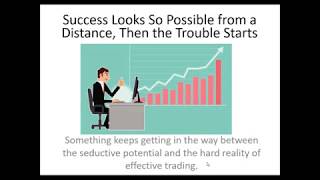
No matter how much you tried to be in control, no matter how much you tried to be right, what happened is that you couldn't be. You weren't in control of whether or not you were in control or not. The truth is, we started having to start learning how to live with uncertainty very differently than the way we had developed. And this is a big issue in trading, is that ultimately you have to let go of the need to control in order to be able to find the effectiveness that allows you to trade. And yet it's so hard to do. And, you know, it starts really easy. It starts in the beginning where success really looks possible from a distance. And what I want you to think is, think about the way trading education was presented to you. Intellectually, it looks so plausible, even the probability of uncertainty looks reasonable enough. Then the hard reality of managing uncertainty kicks in, and suddenly all that knowledge, all that stuff doesn't seem to matter anymore. You have a plan. You know that if you follow that plan, then you're going to be okay. But the problem is you have the plan. You plan the trade, but you can't trade the plan. What in the world's going on here? It's kind of like what we discover very quickly. Well, actually, two to three years into trading, you know, the time it takes to develop the knowledge, to be able to develop the capacity to trade, what you discover is all the knowledge in the world. All the King's men can't seem to solve the riddle of Trading.
They'Re used to using reason to look for something that is not based on reason.
Traders become confounded, but a confounding variable keeps blowing up. The rational mind that they keep trying to bring to trading, you think about it, you look at this graph of this compounding variable and all of a sudden exposure to the environment and the outcome changes and you start going, what's the problem? What's the problem? The truth is, is the mind that you brought and your ability to manage emotions that you brought to trading, no matter how successful it's been in another time, in another place in your life, is not going to be the mind that brings success in trading. There's a variable there that we're really missing. And yet despite persistent feedback that points to mindset problems, okay, all that knowledge and all that technical training that you go through as a trader, they keep doing the same self defeating things over and over again. That's what our buddy Einstein called insanity. Doing the same thing over and over again expecting different results.
And they're doing this, friends, despite your best efforts. Traders look everywhere.
Except one place, except at their mindset. And this is where it gets really interesting because ultimately it's just like Calvin here, you know, why do traders ignore mindset issues when they're so obvious? And there's Calvin saying it's not denial. I just have a very selective, I'm very selective about the, about the reality. I accept. The truth is that the human brain and mind does not want to admit it's wrong.
Notice that your human being and your brain doesn't like to admit it's wrong, even though it's being shown that it is. This trait is called self preservation and it's instinctual. It's not sitting there being rational, friends, this is instinctual stuff going on that you have no idea how to correct, okay? This need to preserve self image as a winner produces a consistent loser in trading. And yet at the same time you go, why? Why? Because I'll tell you what, under stress, the whole world changes. Survival instincts overwhelm the mind and your brain confuses emotional discomfort with biological threat. You know, that trading brain just absolutely has that problem. You know, it wants to see a bear behind every piece of uncertainty. And what happens is, unfortunately for the emotional brain is that when you're trading you are managing uncertainty. And so you, you get this thing where.
Your brain is ready to trigger the fight flight response, okay? And you're sitting there going, well like in this illustration, you're looking at a hungry bear and it's going well. Thank you for contacting the fight or flight response. All of our advisors are busy at the moment, which is saying, man, I'll tell you something, I've actually blown out my ability to think rationally in this moment because I'm confusing psychological discomfort, which is going to happen in trading with biological threat, which is not going to happen. But the emotional brain thinks so.
So does this seem theoretical to you?
Well, let's take it out of theory and put it right smack dab in your trading tomorrow. Have you experienced this, what this guy's going to on the left photograph. Have you ever revenge trading? Have you ever got angry when the market didn't do what you thought it should do? Or have you ever just felt completely overwhelmed when that, when things didn't go your way? You know, if you have entry problems, if you revenge trade, if you lose it during trade management, you just wiped out, just absolutely coming unglued or chase trades or over trade, you've experienced this phenomenon of the fight flight response, either chasing trades aggression or fleeing the danger in a trade, the danger of uncertainty and freezing and fighting and fleeing. Okay, so now you go, well, but, but, but I am logical. I'm a logical being, right? No, traders talk the talk.
You know, but the thing is, but they don't necessarily, they don't really walk the walk. They simply are looking and going, you know, I want to project a sense of looking good rather than learning to be good. Because ultimately what you need to really truly understand here is that you are not logical. You may have taught yourself to believe that, but the truth is we are emotional beings who rationalize, okay? And we can have access to reason, not just rationalization if we learn how to calm down the fight response to uncertainty. And that's the big trick, that people are not being taught trading. So ultimately.
What we talk about here is this. You have no friend in trading except for your trading account. And you may not like that friend, but what happens is your trading account is going to tell you the truth whether or not you want to hear the truth or not. Okay? This is a big deal because when you're looking at it and you're talking about what a great trader you are and how you can predict these things and man, I'm gonna say it's so accurate. If I could only do it when I'm live trading. The key is, is if you cannot do it when you're live and grow your trading account, you have not developed the skills of trading. You may have knowledge of trading, you may have, you may have the training, technical training of trading, but you can't trade. It's this mind that engages all this knowledge, engages all this technology that has to be ready to engage the uncertainty and work in that ambiguity. That's what your trading accounts telling you friends, don't believe yourself. Okay? It's kind of like Groucho Marx. Who are you going to believe? You or your lying eyes? Me or your lying eyes here. What I'm asking you to do is to believe your trading account. It's the truth o meter and it's going to show you whether or not the beliefs that you are using to manage uncertainty are there and can actually manage uncertainty, or whether or not they're there to avoid the danger. It sees an uncertainty.
So we know that the trading account is going to tell you how effective your mindset is for extracting capital from markets. And so, so it's through the truth of the trading account that a trader learns to develop the mind for trading. And what most traders discover, and usually it takes, it's painfully two to five years, what they learn is that the way they have been approaching the markets, the way they're, the mindset they've been bringing to trading just simply isn't working. That's what it's telling you friends, because ultimately that trading account is teaching you, showing you how effective your core beliefs are for managing uncertainty with capital at risk. That's what it's teaching you. And what most people do is they start a game of really pretending. I cannot tell you how many people to me talk to me and says, yeah, you know something, I have all these friends on social media who, man, they just talk and they talk about how great they are. They're doing all these predictions and men, I follow them because, man, now I tell you, they got really good informations but ultimately what you discover is like anything else. 95% of traders are unsuccessful, probably more than that. And what happens? So what you're looking at with all these posting, you're seeing that other people looking good. The truth is, is they're not performing. What they do is they're pretending. They want to have their trappings successful, but they're not willing to do the real work of redesigning their minds for the challenges of trading. They're scared of what they may find. They're embarrassed to think, oh my God, I'm not this man. I'm not this testosterone, this alpha that I'm claiming to be. And what you do is you like this guy in this illustration, you're CEO of a box with a little teddy bear at the bottom. So my question is this.
If you take a look at this illustration, you know, sure, I'm glad that it's not out of end of the boat. What happens is that most traders would really rather believe a reassuring lie than fix the perceptual flaw that's biological in nature and become psychological. That's the problem. This is what's so hard to own. Yet it's the pathway for developing a very different sort of mind for effective trading. Because ultimately you really, truly have to. And it's no fault of your own. It's not a. It's not a slam against you, no matter how successful you've been in other endeavors in your life. The truth is, most minds have been developed for control of outcome. It comes natural. It's been wired in for untold millions of years. And yet we come to trading and discover that given the time frames of trading, given just the absolute necessity of recognizing that the trading accounts telling me whether my belief system is effective or not. What we discovered, the mind has to be rebuilt for trading.
And ultimately what we also recognize is this.
This is what must be changed. It's in your DNA. Okay. This perceptual blindness is not psychological. It is biological. It takes an internal courage that is rare to admit that what you were doing simply does not work and that you need to change the way that you are wired for uncertainty. That's a huge task if you think about it. You know, nature or God has given you a design for living and all of a sudden you're realizing, well, it's really, maybe really good for caveman times, but it's not so necessarily good in my personal life. But boy, I'm telling you in trading, boy, I'm going to tell you something, this is causing me lots of problems. Randy, are you telling me that this is really more of a biological problem? Yeah. But that you have to use your psychology to change the biology? Yeah, that's what I'm telling you. Friends, we have the genetic predisposition that is going to just absolutely cause our trading to not be successful. It's going to want to be right. It's going to want to be in control of outcome. That comes from our caveman ancestors and they needed those traits to survive. But they were not traitors. You are. A different mind is needed. A probability based mind where a lot of being wrong is just part of the game. So.
We got it. It's not your fault.
However, what I want you to get is it's your responsibility. It's your responsibility to evolve that mind from the short term gain of your survival instincts to the probability mindset needed for effective trading. And friends, it really becomes a choice to stay stuck when you see the feedback from your trading account or to look at that as going, hmm, this is telling me there's something not working right with my mindset. And what Randy's telling me, it's not my fault. It's not like as a human being, it's not my fault, not as my name, my fault. No, it's the whole human race. It's the way we're wired. That's why so few people are successful in trading. It's asking for a completely different perceptual map. The way that you engage uncertainty, your brain is not built for it, but you're going to have to learn it. You're going to have to adapt the brain and the mind for this new world called trading. You're gonna have to take the blinders off, okay?
Yet what you discover very quickly is that pride and fear of embarrassment cause you to choose being right over being effective. And that pride weighs you down and actually keeps you from the success that's so possible.
You know, ultimately, trading is not for everybody. If you're not willing to change, if you have to be right, then this is a terrible labor. I've worked with people where they've gone through my coursework and they finally realize, oh my gosh, I know what it takes now to become a successful trader.
This is actually a person talking to me, says Randy. I've done that. I've become consistently profitable now. And what I recognize is I don't want to give up control. And he says, the best money I've ever spent. I want to thank you. And it frees me to go back to being an entrepreneur where my control actually is a valued asset. The control over outcome in trading is an obstacle. So you get it. Are you willing to deal with your pride? And the truth is, a lot of people just simply aren't.
Now I'm going to ask you a question. So if you really wanted to change the mind that trades, how would you go about doing it? There's plenty of people that teach psychology of trading, but what you discover is none of them work from the emotional level. None of them recognize that really that all thinking is emotional state dependent and that you're an emotional being. And if you're an emotional being, you need to learn how to master the emotions that give rise to mind. That's the big deal. Your entire idea about emotions really has to change. You are not a rational being. You are an emotional being who rationalizes. And unless you can, unless you can bring forward the emotions, the emotional cocktail that gives rise to the trading mind, you're not going to be able to trade in probabilities. It's real simple and it's something you need to really start saying, am I willing to do it? Now we have developed a process that we actually teach how to go in and first of all disrupt the fight. Flight response from just absolutely overwhelming things. That's all that revenge trading. That's all that freezing on the trigger, that's all that stuff. And just absolutely falling apart in the midst of a trade. We developed a process that moves from this development of emotional intelligence to emotional regulation where you can calm the intensity emotion to mindfulness where you recognize that all these thoughts running around in my head are not me. What are they then? Hold on to that. Then you begin to acknowledge the internal dialogue. You have internal dialogue going on all the time. Last time you made a mistake and beat yourself up. That's an internal dialogue going on. Why you idiot. What would you think you were doing? You can't ever get this. Also revenge. I'm going to get that back. Oh, stay away from this. They wait. Don't do that. You hear that internal dialogue, but you do not master it. You actually are just bringing whatever internal dialogue got downloaded into you as default programming. You're taking it to run trading, guaranteed not to get there. The fifth thing is you develop an empowered mind. What we do is we teach you how to access emotional states, bring those emotional states forward and out of that the feeling states, you begin to develop the mind from those feelings. And friends, that's the way it works. All thinking is emotional state dependent. What we're doing is we're developing a mind built for probability management rather than for survival in the short term, then what you do is there will always be challenges. There will always be internal struggle. But what you learn to do is you learn to bring this new organization, this future self into the mix. And that is who you engage the struggle with. You don't do it. From the old historical organization itself, the last thing is seven. Becoming intentional. What you learn is this, is that you do not just show up at your trading station and start trading. You develop the mind that you're going to bring to manage trading. And if you can't do that, you don't trade. You realize just how powerful and how needful the mind is for trading. And you Recognize that you have just been squandering a perfectly good mind that could be developed onto trading. So you're becoming intentional. You're learning how to produce that mind in the same way that a great hitter in baseball is intentional about developing that moment, that mind in the moment of hitting, same thing that you would be doing. And where it starts is here.
Okay? It starts here. Is that you begin to recognize. And take a look at this illustration. It's pretty funny. You have the heart, the emotional brain, beating up the thinking brain and basically telling the person what to do. That's the way it works. What you discover, first thing is that all thinking is emotional state dependent and that you do not have emotions, friends, they have you. As a matter of fact, your whole idea of emotions changes. Emotions are actually biological action potentials that organize action between you, the organism and the environment, the markets. That's what it's doing. And the moment there is a perturbation, a change in the environment, it automatically triggers an emotion. You have no choice about dealing with emotions. If you deny them or if you try to ignore them or push them away, they just simply overwhelm you. That's the trick.
And what you discover very clearly is that what you call thinking simply rationalizes creates an alibi for what the emotional brain has already decided. Okay? And what you recognize also, and this is the kicker, is this is all happening at a subconscious level. What you have is you have survival instincts operating before there is cognition. It's already hijacking your ability to reason when you're under stress unless you train yourself to be very different. That's the emotional intelligence. And right here, what you are looking at in this little diagram right here.
You are looking at the puzzle that the obstacle that you're going to have to solve. If you have problems with fight flight, responses to uncertainty, if you have problems in your trading. What you're looking at in this, in this, in this illustration is you're looking at sensorial information coming in from your brain stem. That's from your eyes, from your feeling, from what you're hearing, and all that kind of stuff from your screens. What you're doing is, is it's going to the, to the sensory thalamus, okay? A decision is made at that very primitive level about whether or not this is a threat that needs to be acted with right now or whether or not it's something that can be sent up to the neocortex and thought about. Well, that sensory thalamus does not have the capacity to distinguish between psychological Discomfort, biological threat, anything. Anytime it engages uncertainty, it sees it as danger. So you already see the problem. And what it does, if it senses danger, it hijacks. It cuts off access to the neocortex, your thinking brain, all that logic, all that reason, all that discipline, and it kicks in what is known as the low road to the amygdala. And all of a sudden, man, you're in the racehorse, the adrenals are there, you've got just all sorts of stuff. You've got cortisol, you've got adrenal, and all of a sudden you are wiped out. You have just, you just experience an emotional hijacking that after it's all over with, the dust is settled, you look back and go, what in the world just happened? What was I thinking? Well, this is what you were thinking right here. And that low road is happening in nanoseconds.003 seconds.
That route, that high road up to the neurocortex, that thinking is happening in microseconds.
0.2 seconds to 0.5 seconds later. Do you see the problem? Unless you can reroute that, unless you can calm that circuit down, you can't trade. It's pretty simple. How would you like to learn how to manage that circuit? How would you like to learn going, oh, not only can I manage that circuit and not get blown away, can also learn to get the information to the neocortex, where I can plan my trade and trade my plan. Wouldn't that be the coolest thing ever? Well, you can do it. The first thing that we teach in our course.
Is through breathing and body relaxation, we slow down the emotion. Emotions are biological friends. They're not psychological. And because they're biological, they have a biological signature each emotion. And like with fear and anger, it's just around your breathing, it's around your muscle tension, it's around your heart rate. And what you're doing is you're learning how to relax those and cool them down. And ultimately what you do by cooling them down, you don't allow the emotion to bill to the point of hijacking you. You calm it down. This is something that a lot of people don't get. But the truth is what you discover is that fortunately for us, fortunately for traders, is that body and mind are deeply connected and working on the body can truly change the emotions that give rise to mind.
So basically, through breathing and muscle relaxation skill development, you learn to control the intensity emotion when you're under stress so that it does not hijack mind That's a big deal.
That's a big deal. And it can be done with training.
In breathing and relaxation and imagery to produce a sense of safety, like this guy walking on the beach at sunset. So now we've gotten that. Now we've done emotional regulation and we've calmed it down. But now what do we do with that calmness? It's not. The calmness from emotional regulation is not going to solve the problem. We need a different tool, friends. That tool is mindfulness. That's the doorway to the trading mind. And what you discover.
Is that you will notice that your awareness can watch thoughts rather than be captured by them. You discover that you and your thoughts are not the same, that there is a distance between them. And you can even learn to slow down thought. And you begin to go, where is this thought coming from? And you begin to master both the emotions, the thinking behind self limiting beliefs. This is very powerful. So what you're doing is, as you develop mindfulness, what you discover very quickly. The brain is really a community of rival programs that has duked it out and has constructed itself for survival. That's the one you bring to trading. That's the one that's all about short term survival instincts. And in trading, what happens is that, well, unfortunately what's needed for trading is a long term probability mindset. And you begin to realize, oh my gosh. So this is the way, the way the brain got organized initially. That's my default programming. And it gives rise to historical organization itself. And what I'm asking you to realize is that that is the part of you that's having problems trading. You are not the problem. What's problem is the way that the organization of the self has been organized. The you that we need is a courageous one. Because what happens is that this community of rival programs gives rise to the trading mind. And this is where it gets really, really interesting. What we have to teach and what we have to learn is, is literally how to reset the mind. Because ultimately what you discover is this.
Is that the emotional programs that win give rise to the dominant thoughts in the mind. Emotional program is a biological behavior, an electrical biological behavior. Somehow in the miracle of mind, it's given voice as a thought. And what you're beginning to do is you're beginning to realize as you wake up the observer, this mindfulness, you're realizing that you know something, I've really managed my mind very poorly and I need to take it seriously, is I can't stop the challenges of uncertainty. But I definitely can rearrange the parts of the mind, the parts of the programs, what I would call the archetypes, the sub personalities that engage that uncertainty. Friends, that's the big thing. You can reset the mind so the management of uncertainty. And it's going to be necessary because otherwise you're going to go back to that Einstein thing and keep doing stupid things over and over and over again.
So.
Once you accept that all thinking is emotional state dependent, you can see that emotion and mind have to be taught to work together.
There is no freedom from emotion, there is no mind independent from emotion. But there is freedom of emotion where you learn to engage uncertainty with a different emotional cocktail than the default programming that got laid in before you could think. So what you're doing is going, am I willing to do this or do I? Am I so scared of change that I'm going to stick to my current mind even though it's costing me time and it's costing me money, or at least costing me the profits? This is a big decision. And yet at the same time, understand this. It all goes back to a brain that was designed for short term survival and under stress goes back to survival instinct versus a mind developed through emotions that can engage stress, can engage the uncertainties of trading from a disciplined, courageous.
Soothing and patient mind that's impartial. It's your choice, friends. The mind can be developed. You have to decide.
What you discover is this.
That you cannot control outcome.
And having to be right is going to make you wrong. If you take a look at a surfer, what does that surfer really control?
Do you think he can command that wave to do what he wants it to? No, he has to control himself. He has to master the mind that he brings to that moment of that wave. That wave is powerful. It doesn't care whether or not he rides it or wipes out.
But the traitor learns to master the emotions that produce the attunement that allows him to ride that wave. In the same way that you have to learn how to ride and work with the markets, you do not control the markets. Basically you're learning how to work in attunement with them. Your mind has to attune to the markets and embrace the challenges of uncertainty. That's just kind of the way it is now, you know. And this reboot, what would it look like? I like to use the example.
Of the American cougar. You know, the cougar is an apex predator. It's a lion, big cat, and it primarily hunts the white tailed deer. And what it does is it sits up in a tree. And what you look, if you take a look at this cougar over here in this tree, you would not necessarily recognize that as a hunting cougar. There he is, got his belly flopped out, just kind of chilling out. But what happened, if you notice his glaze or her glaze gaze, is that it's attuned. It's attuned to the market of the forest. He's ready, he's focused, he's attuned.
When a setup comes, when the deer comes, suddenly, there's an alertness.
Then he waits, he waits. He waits.
To the moment. What I want you to see how much discipline is involved here, his ability to manage.
Himself during stress.
Then what I want you to notice the courage. He's ready. Then what I want you to notice, he springs. And even when he springs.
He may or may not get the deer.
They have a unique way of killing the white tailed deer. They don't. They don't chase it down, they don't rip it apart. What they do is they break its neck with the paw if it doesn't do it. The cougar does not chase the deer. But because it doesn't struggle with the deer. And if you've ever seen a deer, they can use their legs, their front legs, kind of like, kind of like daggers. They're very dangerous. They literally poke holes in cougars. If it's not done immediately, they simply let the deer get away. They minimize their losses. They don't let losses become catastrophic, say the way African lions do when they get kicked in the face or gored. If they do lose and they become really good losers, they just let it go. They realize this is probability, it's not certainty. Gets back up in the tree, starts the process over again and knows that the way he executes, he's going to get his fair share of the game. That's really what the trading mind needs to be developed into. The discipline, the courage, the patience, the impartiality of the way the American cougar hunts. He's a solitary predator. He doesn't hurt, he doesn't hunt. A team, say like the African lion, they don't assault, they don't attack, they wait in ambush. This is the mine that has to be developed. It's there and it's there for anybody to do. If you're willing to do the work.
It'S really about having the internal courage to claim your potential. And I want to tell you, I want to read this to you and I'm going to then I'm going to go back to it. If you have the power to change something that is holding you back.
And you don't.
That'S a choice, not a limitation.
Ultimately, traders choose to pretend. They choose to not want to look at the very thing that's stopping them from becoming successful in trading. They're so invested and their sense of being a winner, of being right, being in control of outcome, not being a loser, for God's sake, whatever, that they're so locked into that that they will not choose to change. What I want you to recognize, maybe from tonight forward, if you choose to stay that way, it's a choice, it's not a limitation, there's nothing wrong. You've chose to stay in an organization of the self that cannot produce success in trading. That's all. If you choose to change.
What happens is you recognize. I'm going to deconstruct the self, organize it to be more effective under the conditions of probability, acting in probability, that's also a choice. My question is, which one do you want to make? This is where traders get and stay stuck. I see it every day. They don't see that they are making the choice, but understand if it's not working, fix it rather than to deny it. That's the big deal, friends.
It'S really about you. It's really about the choices that you're willing to make, the changes you're willing to make about the way you engage uncertainty. So building the mind, the trading mind to engage uncertainty is doable, shown you our process. It's a step process. It's not a magical trick, it's not an event.
It'S process. Step by step, you learn how to do this. And so I want you to look at what you're doing, Is it working? And are willing, are you willing to change?
And I have good news if you're willing to change. Because we can help you to become that very change a little later this month, January 18th to be a fact, we're starting our group course for the winter. And ultimately what you do is you learn the very process that I teach traders to be able to transform the brain and mind from survival instincts for short term survival into probability management.
One week from today, friends, you can start changing the way you engage uncertainty. What's interesting about the program is if you sign up now, before the 14th, I'm going to give you a free emotional regulation workshop that you can go to our website and pay 200 bucks for. The reason I'm doing it is because I want you to Start early. This course is not for the squeamish. It starts expecting that you have already studied emotional regulation. And we move into mindfulness in that first session.
This is not for a person. This is not for slacker. This is for people who are motivated and ready to have the tools in their hands to make change in the way they engage. Uncertainty. What's interesting about it, it's a virtual classroom. You go to. You have unlimited access to it 24 7. And then we meet every two weeks, okay. As a group, where we go over this stuff and you ask questions and we engage and we assign the next lesson. It moves there. And any rate, the thing is, is that you're going to. The biggest thing maybe is that you can receive copies of all the recordings of our meeting because people will listen to those over and over and over again to be able to extract the information and learn. It's a powerful moment, friends. It's something where if you're really looking for the tools to produce the kind of change you're looking for and how effective you are in trading, this is it. I encourage it, okay? And if you want more information, there it is. And Loris will type in the.
Maybe, maybe not. We don't have the ability of doing that right now. We'll send it in the email. We'll give you the link to the. To the program. Okay? They're also, if this is the first time you've ever been around this thing, go to my website and get the free ebook, okay. Start learning about what in the world we're talking about. Okay. And then start noticing that there is also my book Mindful Trading. But then if you're really serious, if you're going, oh, my gosh, I get it. And if you are looking for mentorship, which is easily the best way, I ask you to really look into the individual course. It's highly comprehensive, more comprehensive than the group course, and it's very personalized. We actually meet 10 times on Skype person to person as we go through this course. It's powerful. Okay. Wow. And if you're looking, if you're going, I don't know, man, I really want to talk with you. I want to see, you know, is this real? First go to the website, really look at it, then ask for a free consult, hit contact us, and we'll arrange a time for us to talk. Okay? So what I want to do is I want to thank you for being here. I've had a great time, and I'm hoping that everybody in this room is Looking to improve, to develop the mind that they brought to trading into a different mind that can engage uncertainty differently. If you have questions, type them in. We have a few minutes left and type in your questions and we'll get to the ones that we can get into and then we will, we will see what happens. Okay.
Okay. This is a former student. It's a good point.
Say it's very true is that you need the mindful traders mind, not the mindless traders mind. Yeah. And you know a lot of when you're going through this, what you learn. That's Roger, that's Roger Powell. Thank you, Roger. The thing is it's available for everybody. It's sitting there. You can in fact develop it. All you have to do is decide that I'm going to develop my potential rather than keep waiting for reality to change for me.
One question is this. What's the cost of the group course? The group course cost, there's two ways of doing it. Up front, it is.
$11.95 and that allows you access to everything all at once. What happens is most People take it five payments of $239 for every two weeks. It makes it very affordable, it makes it very approachable and it allows them to also just check it out, you know, is this guy serious? Is this guy teaching me anything that I haven't already learned and read? The answer is yes. I promise you, we don't have people stopping payment. Okay. Okay, here's a question. Does the address.
Does this address the knowing what to do versus doing it? Yes, it does. It's exactly. What that's a good question, is that this is, this is built.
For performance. It's built to be able to be able to build the acumen within you, to be able to use the knowledge under pressure that you've learned, to use all those technical skills and the knowledge you have.
In the environment under the stress of trading. So yes, that's exactly what it does. Good question.
This is from Christopher. Hi. I have just finished reading your book and I am halfway through the workbook. Is there a difference between the workbook and the group course? Thank you. Yeah. What happens is that the book and the workbook are really more cognitive in nature. Is that they are. They're showing you. And a lot of people, that's all they want. They want, they want cognitive concepts and it asks some very powerful questions. But the group course is experiential.
The major thing is that there are tons and tons of guided meditations that you're working from where we're just not talking about how to breathe. We are actually showing you how to develop the breathing. We are not saying you need to develop mindfulness. We are actually teaching you how to produce the observer of the self that's separate from thought. We're not teaching you to say that.
There is a historical conversation in you composed of the inner critic and the orphan that you need to change. What we do is we give you the tools to expose yourself directly to it and to feel the power it's had over you and to change it. What we also do is we teach you. This is the really big part, is I use a process that I call emotional enrichment, memory enrichment, where we actually go into memory, alter the memory to get at emotional programs and learn to pull them up from experience. It's a big word. You learn to prove. You learn to be able to generate emotional states from actual experience and pull them up so that it alters the way you think. It's not like affirmations and visualizations where you're using mental process to do that and hoping that you can do it. No, you're actually going into memory and isolating experience where you darn well know that particular emotional program and you pull it up. It happened. You did act from that emotion, and you learn how to master it. Powerful stuff.
This is from Lars. Okay, can you explain why trading is like it is? I'm not sure I understand.
Oh. The truth is, is trading.
Is represents a universe that is so far bigger than so far beyond your typical small little world that you live in, like your home, your little community, you know, the sales relationship where you're trying to sell somebody, where it appears that you are a big fish in a small pond and that you can use willpower to shape possibility and to bring forward possibility into the world. You look at, you actually look like you control outcome. And if you've ever done a lot of Tony Robbins things, what you do is you learn how to conquer that fear and to have this fearless attitude. You go out the world and you conquer it because you're no longer in fear. Well, my promise to you, you take that same mind in trading, and it's going to blow you up.
The markets cannot be controlled. You cannot use silver mind control to control the markets. What you do is you develop a mind like this American cougar that is willing to take what the market gives them. And you learn to say, I have to develop the mind. Because I realize that all control is an illusion.
What I control is the mind that I bring into the moment.
Okay, to the moment of performance. That's the big deal. That's the huge deal. You let go of the illusion of control, which you find out in real life. Also.
I know plenty of people who think, well, you know, we used to call them when I was in the banking industry, the blue hairs. All these older women who had these CDs and these savings account and bankers loved it because they weren't getting any money, hardly any money, but it was so safe. Okay, it appeared safe. Yet when 2006 and 8 happened, all that safety evaporated. It was a black swan event. But what you discovered is this, is that the probability was slight, but it showed up. Ultimately.
What this trading requires, it's very different than the rest of the world in slow time, is that trading requires a probability mindset, whereas survival requires a survival mindset. And that survival mindset, you know, you, you know, if you're an alpha, it's pretty easy to control a group of people. Alphas are the worst traders in the world because they come in thinking they're going to win and they don't want lose. And they realize, I have no control over winning or losing. Geez, you have to develop a completely different mind. They're like black and white. They're different universes. Good question. This is from Christopher. And just to confirm, you say that beliefs control our emotions, which are biological, and in turn control our perceptions of the mind. Is this correct? Let's do this. Emotions. First of all, let's get back to emotions. Beliefs are an element of an emotion. This is really important, is that what beliefs represent is a virtual representation of what your mind has produced as assumption. Your brain has produced an assumption and it tells you how effective that you think you're going to be in managing the uncertainties of life. When you're looking at traders, what you discover is their beliefs is that they cannot really manage uncertainty very well. And what they discover is that's true when you get around people who have beliefs about, well, actually it's probability. No, I can't control outcome, but I can control my performance. And by controlling performance, what I control, I control the edge that my methodology and my system give me. That's the big deal. So beliefs are actually part of an emotion. They're the meaning that's built into the emotion. But the emotion is also, it's the actual triggering of response to a change in the environment. That's literally what an emotion is. And in that triggering response, even if it's challenging, you will have people that go, I can handle this, there's no reason to freak out. I can handle this. And what they do is they do not have a fear response to it. They become more focused on performing their duties. There's a saying that particularly with the New England Patriots, whether or not you like them or love them, the truth is.
Several years ago when they were playing the Atlanta Falcons, you know, they were, they were down like 28 to 3 and it just looked hopeless. But if you looked at the coaching staff, they were, they were working with their athletes, their players, and they were saying, do your job, just do your job. They were getting them about catastrophizing thought about outcome and they were keeping them focused on process.
And they won. That's the power. That's what we're teaching and that's what we're teaching in this course is how to control the mind. That engages uncertainty. There's no controlling uncertainty. Okay, there's that, that's not going to happen. However, once you see the probability. And again, if your methodology and your system allows you an edge in the market, the edge literally only there if you bring the psychological edge for performance to it also.
And a lot of business that alpha or a perfectionist can win by not being wrong or by being overpowering focused on that. And in the slowness of regular time, that works. But in the world of quantum mechanics, probability in trading, that that's meaningless. And people find that out all the time. You can do everything right, still be wrong. And the truth is, is you're going to have to learn to become a masterful loser if you're going to win at trading. This alpha stuff doesn't work, not in trading. If you have to be an alpha, find something other to do than trading. Trading requires a probability based mine if you're going to produce an effective mine for extracting capital out of the markets. So I hope I answered that. Stay focused on the process of trade. Yeah, now that's easy to say. Okay. And that's, that's easy to say. Difficult to do. Hi there, sir, Just got in. Is this recorded today to watch later? Yes, it is. We will start rendering this almost immediately and once it renders.
We'Ll be sending you an email and it will be posted. And it, the, the, the actual webinar will be posted on our website. On the homepage on our website will be the second video down. It will be there. And this is a good one. This, you guys have asked really good questions.
Yeah. And you'll get an email with a link to it. So you're good to go. And we truly encourage people. What I've discovered that people who follow me is they tend to read my book three to five times. They tend to listen to these webinars. And I mean, people who have. They've already been through my programs. They've done stuff like that. They listen to these programs just like this to keep them current, to keep their mind right. Okay. So use this thing. This is how. This is how you learn. I want to thank each and every one of you for being here tonight. I know that if you're here, there's something missing in your trading that you know deep down inside your gut, your heart of hearts, that you have the potential to achieve a lot more in your trading than you are now.
What I'm asking now is to dig down and find the courage and recognize that it's your mindset that has to change. It's not all the knowledge. It's not all the technical stuff you've learned. You need to learn how to use it. And remember that Next class starts January 18th. And if you're gonna go there, friends, start early, because I promise you that when you get there, and a lot of people sign up right toward the end is you will find yourself behind. And what I want you to do.
I'm a motivated teacher. I'm looking for students who are highly motivated to take the step that allows them to start achieving their potential. So I want to thank you, and you too, Roger. Thank you very much, brother. Any rate, I wish you well. And no matter what happens is I hope you have a great new year. I hope you find. I hope you listen to your trading account. Listen to it seriously, rather than all the lies running around in your. Your head. You can't trust that stuff inside your head. Listen to your trading account and really start going. You know something? This is all about reorganizing the emotions and the mind that engage in certainty. Yes, it is. And you can do it. Anybody can do it. Okay. Just about anybody. Okay. So I wish you well, friends, and may God bless, and we'll see you on the other side.









