Emotional Mastery of the Trading Mind: The Survival Based Biases that are Robbing Your Potential
Webinar by Rande Howell describing how traders trigger ancient limbic survival biases (locus of control, cognitive dissonance, optimism, clawback/revenge, confirmation, chase/FOMO) that hijack rational decision-making under uncertainty. He explains neurobiology (low-road amygdala fight/flight vs. high-road thinking), shows how beliefs are emotional and drive behaviour, and recommends emotional regulation, mindfulness/observer training, and memory-enrichment to reorganize the trading mind; closes with course/book offers and brief Q&A.
Chapters
Welcome, everyone. Welcome to this month's edition of our webinar. And just to let you know, we're going to be looking at hidden biases that are in the emotional brain today. And we're not going to be think. We're going to see how. How hard it is for the thinking brain. That's stuff that we want to see through, how hard it is for the thinking brain to even see it. Okay. And that's why all these hijackings occur. But first, one thing about it. Let's just go over a couple ground rules is that as we go along, I do not take questions as we go. Write your questions down, type them in, and I will be getting to them at the end of the session. Okay. It's just one of those things that allows me to get through the program and make sure that it's done right. Okay. Okay. And we'll. And afterwards speak, we'll have some time for questions and stuff like that where you can write them in and I'll actually talk about them. Okay. But let's go. Let's take a look at this thing. Okay. To begin with, you know, you go. You do the math.
Oh, yeah, yeah, yeah, yeah. One last thing is, can you hear me? If somebody will just simply type in Y. If you can, I'd appreciate that. It'll allow me to make sure that I'm just not talking into hyperspace here. Okay, yes, great. Thank you very much. Any rate, you know.
It'S one of those things where you do the numbers and you see the upside of trading, and it's big. And then you learn it, you're ready to go, and then you get into it and you realize, oh, my gosh, the money's real. And then something completely different happens. So what is it? What is it that.
In theory, trading looks so doable? You know, you see the numbers, you see that big dollar bill, and yet when you really try it, something keeps falling on the face. Well, we're going to be looking at that today. And so what is going on here? Well, let's start here. People step into a world that they simply are not prepared for. In trading, they are so used to the whole idea of winning. They're used to the idea of being right, being in control. And all of a sudden they are faced with the fact that they do not have control, that control is an illusion in trading. And you have to. You have to develop an entirely different kind of mind to be able to recognize, you know, I can no longer control the outcome. I can't make Things happen. I have to literally change my whole approach.
And we don't understand emotions and the brain and mind on uncertainty. That's the big deal. We don't understand emotions and biases that drive the capacity of thinking under pressure. And that's really the deal. And what we've done.
We have done. We are asking the brain to actually do something that it did not evolve, it was not built to do. Understand your brain is built for short term survival instincts. It wants to survive this moment. And the trading mind has to be a probability based mind that is long term and is able to get things for its long term best interests. So that's the big deal, is we don't understand the brain and mind and because we don't understand it, we try to ramrod stuff through it that it's not prepared to get ramroded. The mine that you brought to trading is not going to be the mind that will bring success in trading. We, and particularly in the Western world have separated mind from body, heart from mind in such a way that we don't realize that the heart has a heck of a lot to say about what the, the brain, the mind actually thinks. And this is one of the problems. We don't understand what's required for success in trading. And that's on an industrial industry wide thing. And it's kind of the same way with, in economics. You have classic economic theory that assumes that man is a rational creature, okay? And boy, that I don't know. And it doesn't work out that way yet in behavioral economics, what you realize is emotion, emotions are driving thinking, driving desire, driving everything. So you're beginning to see completely different things in economics. And the same thing lies here is that we just simply, we look at that, we go, well golly, it would be nice to think that I'm rational. But the truth is you're not. Not when it comes to trading. It's something completely different. And ultimately what you get is you finally come to understand that knowledge by itself does not produce success in trading. It's kind of a trick that we've done to ourselves. We want to believe that knowledge is power, but yet we keep looking at our trading account, we start going, you know something, how many courses do I have to take, how many teachers do I have to have? How many indicators do I have to have? How many different ways of managing risk, how many different kinds of platforms do I need? And ultimately it comes down to something, is here you are just like this illustration right here, this very modern man driving the brain Driving the mind and all like that. But in the backseat.
Getting bored unattended to is this caveman. Every one of us has this caveman living within us. That's called your emotional brain or your mammalian brain or your limbic system. That's what we're doing and we're realizing. What I'm asking you to consider is this, is that what we've done with this high and mighty and mighty thinking brain, we like to believe that it's in control, when in fact it's not. That Capan brain back there in the backseat, as soon as it hits something in the environment out there, it just absolutely triggers and takes over thinking brain. So this is the kind of the way we have to deal. And what I want to do is this is a way of looking at successful trading. You have to have a really good platform that responds to you and you got to have the different kinds of things that allow you to move in and out of markets and stuff like that seamlessly. That's the first leg of the trading.
The second one is methodology. How do you manage your risk? How do you, how do you manage this thing so that you have an edge.
In the world of probability that trading is.
And that friends, is where most all trading is taught. They don't leave this other leg, they leave it out. The trading psychology, what state of mind are you bringing there? And more than that even is what is the emotional cocktail that the mind arises from? Because what you're going to discover is that all thinking is emotional state dependent. There are plenty of people when you make the statement, I'm going to make some money today, you're already setting up an emotional state that's unfit for trading. Others do it the exact opposite way. They're already scared. They already have a sense of dread by the time they walk into their trading room. So you're beginning to see, oh my gosh, we're mismanaging the emotions that give rise to the mind that engages the uncertainty. Yeah. And so we're beginning to see, even if this is third each, we begin to realize we're missing a big chunk of the question. And guess what? When you're on a two legged stool and ignoring the third leg, what happens? You get tripped up, you end up taking big falls. This is the brain on uncertainty. When we do not have, we just simply don't want to acknowledge that, oh my God, it could be me. But you've looked everywhere else. You probably, if you're like most traders, you have just closet fulls of stuff that has Just kind of went back there. I actually know a guy says, I just got rid of all that junk, I just threw it in my trash can and there were three trash cans of it. And so what we're doing is saying we've ignored trader psychology and what are we going to do about that? Because ultimately.
It comes down to really beginning to recognize that the thinking brain does not stand a chance when exposed to stress, when exposed to something that doesn't feel certain about. And the key is that survival instincts then take over. And it's these survival instincts that become the biases that you don't even know you have. You know, you would like to think that you're a rational person. The truth is you're not. And every time that you risk capital, this illustration is kind of what happens is that heart, that emotional brain just beats the slop out of the thinking brain. Have you ever seen that? You go in and all of a sudden depending on if you're a fear based type of trader, you know, you can't even get in the trade or if you get into trade, you just get just absolutely driven crazy. Once you're trying to manage it, it's going up and down on you going back, it's getting close to the stop outs and all that and it finally gets into the black and you jump out of the trade with a little bit of profit.
That's the emotional brain just beating up the thinking brain and you never knew what hit it. So actually.
When you're engaging risk capital to an uncertain outcome trading by definition, you are triggering the ancient limbic survival biases that are below the threshold of your conscious awareness. That's the whole key. It's built to act lightning fast before rational thoughts can really tune in. And this I think, therefore I am from Rene Descartes. Just wrong. Okay? We wanted to believe that we're a rational being with some emotions and that the rational can transcend the emotional. The truth is we're emotional beings that rationalize. Yep. Ultimately what happens is that that rational mind of yours just keeps up making stories to support what that emotional brain has already decided.
Then we get to this. Now we're getting closer to the biases that I want to address here today. And what I want you to understand. A bias.
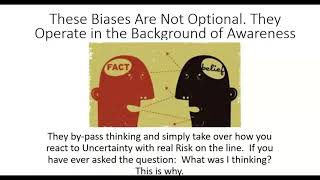
Is not optional. They operate in the background of awareness as programs that are just simply. It's been there for hundreds of thousands of years. And the key is the thinking brain never sees the biases because.
Because they're not built to even know they're there. There's not a language, it's not part of the commentary going on inside your mind. But ultimately your limbic system, through trial and error, has come to beliefs about its ability to manage uncertainty. And once that limbic belief is formed, it's implicit, it's subconscious, it's below threshold. And when you start throwing facts that counter that belief, understand, this is not a thinking belief. This is an emotional belief at a very primitive level. No matter how many facts you throw at it, it's just going to bounce right off. The belief is going to stay there. The more you try to force the belief, the more tighter, more dug in it gets. And so literally, the emotions and the biases literally bypass thinking and just simply take over the way you react to uncertainty. That's what's happening. What was I thinking? If you've ever asked this question, what was I thinking? You've experienced these biases just running underneath threshold, just taking over when things get stressful and then just blowing out the thinking brain and acting without thought.
It's already there. This is why, friends. And this next one I love, this is where it comes from.
Tell me something. Take a look at that mask. Done. Look at those little itty bitty people. Tell me something. Does it make sense to do what they're doing? They're social mammalians, these Homo sapiens that you're seeing from, oh, God, I don't know, anywhere between 15 to 100,000 years ago. They're Homo sapiens and they're learning how to hunt. But at the same time is that there are enormous biases. One, they want to get, they have to, they have to eat. Okay? And what happens is that when you're on a, when you're on a team out taking down something that's ten times, three times your size, you have to have certain biases about willingness to chase the optimism to believe that you can overcome this. A lot of these are biases that are built in. And the rewards are that you get to eat, you get really good status within your clan, and you're honored. And you also have access to the babes, okay? Because the women folk are going to be looking for someone who could provide, you know, sustainability for them. These are, these are dangerous times. And this is, this is where our mind got formed. This is, this is your evolutionary psychology that you brought from your caveman days into the computer room. When you trade, that's what you're up to and that's what you're up against. Okay? Now what are those biases? Well, let's Start with them. Let's go over the biases that really just create havoc with traders. The first one is what is known as the locus of control bias. That actually has you believing that you're in control of outcome. And if you've been like an alpha type of guy or girl, then most likely you've actually been able to control outcome. You've been able. Sheer force of will, you can control. And you want to be in control because it makes you right, it gives you power, it gives you a lot of things. And then it's all about winning and losing. I mean, two days ago, I'm behind some guy driving and he has a tag and he paid money for this, extra money for this tag, Got to be number one, got to win. And you're beginning to see, wow, he wants to be in control. And when he's a big fish in a small pond or a puddle, yes, he can. It does have the appearance of control. But in trading, you're a minnow in a vast ocean.
Your ability to control is an illusion.
Yet at the same time you want to control, you want to know what's happening, you want to predict the outcome and yet it doesn't happen. That's the control, that's the control bias. I can control outcome. I've got to be right. Okay, then this term, this fancy word term called cognitive dissonance, in the fellowship of aa, it's called the denial. And ultimately what you're doing, it's this compulsion to ignore or to dismiss evidence that conflicts with your beliefs. It just didn't happen. I didn't even see them. And yet there's all this contrary evidence. And the more you show that evidence to the person, the more he clings to the belief. And if you notice that the brain lies, understand it does, it's based, your brain is built around fear and the avoidance of fear, either by aggression or by basically fight flight. And the minute that you're shown that, oh my gosh, you know that through aggression I can win. And all of a sudden, you know, you over trade, you start trying to make up for power losses, you do that stuff. And all of a sudden this evidence is being shown that you're not in control. And yet your beliefs though are saying, yes, yes, but I need to be in control, otherwise all is lost. And that's cognitive bias. That's, that's the dissidents and there's, it's just all over the place. And as long as you're not willing to listen to evidence to contrary, you got it. This next one is one of my favorite. You know, when people first get into trading, they have this optimism bias that they're, you know, you know, against all odds. They're going to win, they're going to make. They're going to make a lot of money, and there's just all this optimism. And to be honest with you, Caveman had to have optimism. You know, it was a dangerous world, and the chance of him living were very slim. And so you had to develop this enormous optimism that you're going to conquer against all odds. But it's also kind of like this elephant flying off the trapeze, and it's going to be, you know, gathered up by. By a monkey, but it's not. It's not going to happen. You can see that. We also believe that there's a pot of gold at the end of the rainbow. That's part of that optimism bias. And yet very few traders ever get there. If people looked at it and took a realistic view, they would have to rethink because that bias to be optimistic that tomorrow is going to be a better day. I can make up for this. I can do this. I'm going to win against all odds. What it's doing is destroying your capital. That's what it's doing. It needs to be something very, very interesting. And the truth is, is.
If you are going to be successful.
And you start talking to people that say they are, what I've discovered is ask for their audited financial statements to see if they're really. What they're telling you is actually accurate or not. Very few people, if they're honest, are going to tell you that, yeah, I'm successful in trading. Truth is, about 95% of people aren't. So if you're in a room with a bunch of people, only about 5% of those traders in there are profitable. Only about 2 or 3% are consistently profitable. And yet at the same time, you get this optimism that goes into arrogance, where you start talking about, yeah, I'm a. Look at me, look at me. That's the optimism bias. And it's not like. I'm not saying you can't be positive about yourself and stuff like that, but what I am saying is that bias, ultimately, that bias is defying that you're going to have to change. And ultimately what happens is your brain is going to have to change the way it interacts with uncertainty. That's going to take a lot of. That's going to take a lot of work. If you want to be optimistic about something. That's where the bias can help you, is that I can change my vein and I'm motivated to do it. So next is what is known as callback bias. You would know it as the urgency to make up for prior losses and even revenge trading. Where the thing is, the casinos know that you can't make up for prior losses and it knows that they want to see you in revenge. And at the same time, not too much revenge, they will actually try to slow you down so that you don't just slam up and then say, I'm just had enough. No, they want to drain you over the night. And they realize they have to work with that clawback bias so that it doesn't get into revenge trading. I stay at the table, I stay there and I'm going to get it back, I'm going to get it back. But not from a revenge standpoint, from the bias standpoint that has you believing that you can make up for prior lives, ultimately losses. But the thing is, what you're really doing, the primitive survival instinct equates losing money with a threat to life. And so what you're doing is you're trying to get your life back. You're trying to fight out of a bad situation, you're fighting out of all the saber toothed tigers or another tribe coming to take over your, your fruit trees. It's that kind of thing. Then confirmation bias, it's a.
Really talked about bias, but it's also true. And this is when you really, truly new evidence shows up and you somehow build it to support your own beliefs and expectations. You just, you just see through this tiny little tube, you know, and you know, it's, you just don't want to be wrong and you want everything to confirm what you're saying and how many people can predict the market when they're analyzing and stuff like that, but when they're in the thick of it, they can't. And they, you know, people call me and ask me what the market's going to do and I tell them and it's right. The problem is I can't act on it, but I keep sticking to what I'm doing.
Confirmation bias, Ben. The really big one for particularly alpha types is chase bias. Who in here.
Hasn'T sat there with a plan, they know what the plan is and then they're patiently waiting and then what happens is that they took a loss, then they take another loss and all of a sudden they start seeing opportunity is getting away, that opportunity is getting away. I got to get It, I got to get it before it gets away from me. You can see a bunch of hunters in prehistoric times getting up on this thing. And it's. We would like to call that fear of missing out on profits, okay? And you're sitting there and go, I can't let them get away. You know, I've taken some losses there. It's all sitting there, man. Or I've missed a trade, I've missed a good setup. And all of a sudden, this urgency, this eagerness, this excitement to hunt down opportunity just takes over. And before you know it, you get past your trading plan, you're not doing what you said you were going to look for and hunt. You become a hunter of anything that moves, okay? You become a hunter of anything that moves, and before you know it, you're so far out of line that what, what edge you had is totally blown away by the chase instinct that wants to. That wants to chase, that wants to make things happen, wants to take that profit now. So putting all this together.
Over on the left side, what you're seeing is sensory modalities coming into input. And literally right at where that information starts being reviewed by the limbic system, the sensory thalamus in particular, there's a little traffic cop that's set up with perspectives, beliefs, values, memories and biases. And what happens is that traffic cop makes a decision about all that information, about whether or not it's going to be sent to the low road, up to the thinking brain, which is what a trader wants, or whether or not it's something where there's a bias there and there's a danger there, and it needs to act quick and dirty. And it goes down the low road.
Down the low road to the amygdala. And out of that comes, guess what? Fight flight, that's the way it works. There's your behavior, so you have the high road. That literally takes microseconds for the information to get to, and then the brain will debate it, or it will take nanoseconds on the low road to. To activate the amygdala in the fight flight response. Friends, this is what's happening. Notice. What I want you to notice is no thinking is happening in this graph, okay? No thinking decisions are made based on the beliefs and values and the biases and assumptions. Thinking happens later.
Much later, if at all. But the thing is, the chemistry of that emotion, of that urgency is already in the system. Hijacking, ambushing, thinking mind before thinking actually occurs. It's the difference between nanoseconds and Microseconds, that's the big deal. Meanwhile, you walk right into the ambush. And the thinking brain cannot see what it cannot see. This is a it. This flies directly in the face of Rene Descartes. I think, therefore I am thinking. Didn't have anything to do with this then. Oh my goodness. Now, once all this stuff is activated.
You are now fighting biological mandates that are going to take over your mind. That's when that herd just. You follow the herd, you jump up, you just jump into trades that you shouldn't be and the results are horrible. Or on the other hand, you don't go through the aggression of fight flight, but you go through, you go through the fear of fight flight. And what happens is you can't pull the trigger. Somewhere in there, this is all instinctual. Friends, that's what, that's what I'm asking you to really look at. And if you think that you're in control, obviously you've deluded yourself. And I don't mean that as a criticism. Prove it to yourself. Look at your P and L statement. Just look at it and see what that trading account is doing. Is it healthy? Which tells you that the beliefs you have may not be the perfect ones, but they're effective beliefs for being able to extract more capital out of the markets than you're putting back in. That's what you're, that's what the brand, that's what we're looking for.
Effective beliefs that basically the truth meter is your trading account and it's telling you the truth whether or not you liked, whether or not you want to hear it or not. So tell me something. Yeah. It seems like it's all stacked up against you. Whoa, whoa, whoa. But how do you, how do you learn to become aware and manage these biases? Okay. The truth is, is that it's done through, first through emotional regulation, then for mindfulness training, where you learn to observe what you've been not seeing. You take those tunnel vision things off and you start seeing an expanded world and you start going, wow. And then you start recognizing, you know something?
I exist as potential. This, this comes out of quantum mechanics, where in quantum mechanics what they say is that there is no such thing as mass or energy.
What we call reality is really potential. It is the observer of that potential that brings forth the form. That form takes shape and it becomes your attitude, it becomes you. But for me, that you is just one potential organization of a self. And it just so happens that it's probably not going to be good for trading that organization needs to be deconstructed and then reconstructed into a mind that can deal with probability and uncertainty, because that is exactly what your current brain is not built to do. So first thing is you start clearing the lens.
On the lens you see through and start allowing yourself to see a very different world. And then the next step is that you start regulating the biological foundations of the emotion. And here's Mr. Potato, okay? And he's lost his. He's lost everything. He's just here. Oh, my God, I'm falling apart. And the key here is an emotional regulation. You're taking breathing, muscle tension and beginning to recognize that breathing and muscle tension are in fact, part of an emotion. The emotion is biological, okay? It takes over psychology. And if it's biological, there has to be things going on that allow that emotion to arise and just to move into action. Because emotions are all about action. It's not about thinking, it's about action. It takes overthinking along the way to produce rationale. So that's the very first thing is you. You learn how to say, okay, what? I know that until I am able to calm my breathing down so that it's diaphragmatic or bellows breathing rather than no breathing or really high breathing, and I start reducing the tension in my body, I know that I'm setting myself up for emotional hijacking. I know the bias. I'm not going to be capable of observing the bias in action because I'm already emotionally compromised. That's the first step, friends. But it gets a lot better than that. So once you're able to calm your body down as a way of calming the emotion down, then you start recognizing that we have to be able to spot, we have to observe these instinctual biases, and we have to develop the observer. And, you know, it's called observing is called various things, a lot of it. The vogest one right now is mindfulness, where we start noticing what we notice, we start observing. Instead of just being swept away.
I like to be calling it the observer. I consider that there is a fact faculty in our brain, of course, that can step back out of thought and recognize that you and your thinking are not the same. It's very powerful. And once you grasp that and you start training to start being able to say, I'm going to start stepping back out of thought, and I'm going to start seeing what's there. And this is what you see.
On the left. What you're doing is you're seeing the person caught up in thought and Thinking, this is me. This is me. This is me. I am scared. I am that. No, what happened is the. The emotion fear has taken over the mind, and it's propelling the self in a particular direction of fight flight. Then on the second one, what you're seeing is the person has stepped back and beginning to observe all this crazy stuff going on inside his mind. He's beginning to see the commentary, okay? And not believing that it's a. That it's a reflection of reality and going, oh, these are my thoughts. And then you got to start going, oh, my goodness. Wait a minute, wait a minute, wait a minute.
My thoughts and I are not the same. You're right, they're not. We so identified with the thinking, with the emotions behind it that we assume that they are us. Actually, it's the observer that has fused to those thoughts, to those emotions, to those beliefs that's creating the problem. That's the guy on the left. And all of a sudden you're realizing, oh, well, not even on. Not only are my thoughts and I not the same, but more than that, I'm not having thoughts. They're having me. Yeah. So now we've got this observer stuff, and we begin to say. Now we can begin to. We can really begin to take a look and our performances evaluated by our trading account, the health of our trading account. And what you discover. Excuse me.
What you discover is this.
You lie to yourself. The beliefs that you hold about your abilities and things like that. We. We often lie. And all of a sudden you're going, wow. What I'm beginning to see here is it's hard to believe that we lie to ourselves.
To maintain ourselves. Okay, but we do. We do, but we all do. Beside that, there's this commentary, and you begin to say, I need to really examine my beliefs about who I am. And ultimately, with poor performances, what you'll discover. There's only a couple beliefs that really, there's no rocket science here. It's a sense of inadequacy. It's a sense of not really mattering unless you make money. Money becomes basically your barometer of how much you matter, and that's a dangerous thing. And then it's worth. A lot of people just really, truly don't believe they're worthy or deserving of being able to make easy money. Then there's also scarcity thinking where you believe that you know what you have is going to be taken away from you. And the last one is really powerlessness, this sense of, like, if you've ever experienced Powerlessness, I'll tell you what powerlessness is. As you've got into the trade, you're locked in, orders been filled, you're in it. And all of a sudden it's just so it's just starts going every which way on you and just absolutely beating you up, going up and down, up and down, up and down. You're thinking about moving your socks, you're not. All that stuff that's powerlessness. And what happens is out of that powerlessness start coming lies. So the observer mode, you begin to start seeing what are the beliefs, what are the self limiting beliefs that are driving me? And my promise to you is this, you're trading your beliefs.
You project them onto the markets, you find out whether or not they're effective or not by looking at your trading account.
And this is all about the beliefs. And friends, beliefs are not cognitive. Beliefs are at the emotional level. That's important to know and understand is they are not cognitive, they're not part of thinking, they are part of the emotional, of what an emotion is. That's the biggie. So we're in here and we're going to.
Like for instance, scarcity thinking. What is that a belief of? It's a belief that, you know.
It can happen for everybody else, but not for me or whatever I have is going to get taken away from me. A really good way of understanding this is I worked with a trader a couple years ago and she was a proprietary trader. She was successful, but she was not, she was not successful enough. And she was told by her firm that unless you stop leaving so much money on the table, we can't let you trade here. And she's working with me. And you know, the thing is she grew up in a really tightly knit family that lived in the Midwest on a very small farm. And what happened is she would, they never had enough money. They always thought the farm was gonna be taken away from them. You know, things just simply weren't going to work out. You can't have that dress, we have to pay the mortgage. It's all that stuff. This is the scarcity thinking. This is the whole thing about it's going to be taken away from me. That's where the belief is. And it was impacting Nancy's trading. You know, with work she was able to redesign that belief so that she was able to let more of her trades go to target than jumping out too soon. The thing is, is biology is simply not your friend here. And the brain is really good at self perception. Okay, that's the big thing that you really need to understand. So what we're looking at are these historical beliefs that drive the way you engage uncertainty. And the key to understand is that these beliefs represent only one organization of a potential self.
That self can evolve, it can become quite different than what it was at another time. And these beliefs simply are not you. It is only that the observer of the self is fused and identified with those beliefs.
There's so much more to you.
Then this organization of what I call the historical self. There is something so much more living within us is also more potential. And I'm showing you the Lord of the Rings because it was such a great movie for being able to show pure archetypes. Because in here what you're looking at, you're looking at the discipline to maintain order and to be able to set the goals and to be able to find the different talents needed to hold, to put into place so everything is actionable. You're also looking at the will, the striving that it takes to overcome great odds, to overcome great challenges. You're also looking at the wisdom and maybe a little magic, who knows of the necessity of doing that. But you're also looking at, you're also looking at that nurture, that self soothing, that innocent love that can be brought. And ultimately what you begin to see is that these aspects of the self, the discipline, the courage, the self soothing and the impartiality are just as much part of the potential of your human experience as our fear and aggression.
That's the key. The real key though is which of these emotional programs are you going to bring to summon the mind up from? Okay, because all thinking is emotional state dependent.
And you have to have the courage to look at the things that you don't want to look at. That's actually, to be honest with you, that's the biggest thing that stands in the way of traders evolving to success is they don't really have the courage to look at themselves. They would much rather find a fix outside of the self when in fact the fix has to occur the inside of the self. And it's just kind of that way. And out of this work. And we had this. I do this through memory enrichment. And ultimately though, what you do is you start recognizing this observer starts waking up and realizes that, oh my God, the mind is really like a committee. And I've been asleep at the wheel and I'm waking up to the committee of the self. And what I recognize is there's a mutiny going on. It doesn't have the leadership or the discipline needed to, to be able to pull into the team. And what you're looking at like in this photograph is there are challenges, there are struggles. But the thing is, it's like the Romans said, fortune favors the brave. The ones who are actually willing and capable of doing the work are going to reorganize them for the challenges that trading presents. You get clear evidence that the way the mind's organized now is not working for long term benefit, consistent profitability. So you're going, okay, I can reorganize the mind that trades. Yeah. And we, and in my work, I either call them emotional programs that would be that critical part of the self, the ones that want your destruction, inner critic, that fearful part of the self, that caveman part, that orphan part. But also the discipline of ruler exists within you. The courage of a warrior, the self soothing of a caregiver, and the clear thinking of a sage. This is the organization that has to start coming together to produce the mind that can engage uncertainty and not trigger survival instincts and all those biases that just absolutely flood your way. So what I want to do, going to show that this is actually a, this is actually from a piece of work I did this past week with a client of mine. Now he's personal client, so we've gotten a lot deeper. And what, what we're doing here is he has a problem of jumping into trades and then regretting. And he's really bright guy and he, but at the same time he's also been an alpha. He always had this expectation of winning. So he's doing his charting and what he does is he starts, he starts making an expectation. I'm going to make some money today. I'm going to prove that I'm number one, that I've got the stuff that's already a setup for a trap. You know, you're not listening to all the information. You have no control whatsoever of whether or not you're going to make money. Okay, what you've got, you can, you can control the performance that you bring to managing the uncertainty of trading. That's what you can. And if you have a system that indeed has an edge, that psychology also has the edge that can drive, drive your system edge. That's how it works anyway. So here he's doing his charting, he develops an expectation, I'm going to make money today. I'm going to prove, I'm going to, I'm going to show it. Then what ensues from that, from that expectation, that bias at ah, I'm Very optimistic. I'm going. I have an optimism bias here that I'm just going to go in and I'm going to. I'm going to take over. Eagerness appears. It just so happens this guy was a sprinter in high school, and he, you know, you get in those gates, you get locked in those things, you get. You get poised. You're like. You look. You're just like tinseled steel. And you're waiting for that. The signal to go. He's ready. He's poised to take off. Then the entry signal. And he uses a combination of price, action and indicators. They're in alignment with one another. The entry signals there, okay? So we're looking at it, and all of a sudden what happens is that his assumption, his hypothesis about this being a good trade is all of a sudden not being supported by the evidence coming in from the market. Now cognitive dissonance shows up, okay? But what is happening underneath that.
Is shame. This is one of the biggest things that a lot of people. And he has a belief I have to be fast and first. Not just from his track days, but also the way he grew up in his family. They totally expected him to be the fastest and the best. And all of a sudden, he was not living up to his beliefs. And he doesn't. He does not want. Okay, he does not want to have anything that takes him away from his beliefs. And yet this is the hitch. He does not understand shame. Shame is not a character flaw you're trying to hide. From an emotional intelligence perspective, shame is an emotion that's saying, hey, the way you're currently organized as a self is not working for the good of the whole. You need to reorganize yourself. And shame is disorganizing itself, which. Which creates confusion, okay? And in that confusion, the self, the historical self, is disorganized. And this is where the brain starts going bonkers. All its. All its biases are being blown up, and it's panicking. Vulnerability ensues. The opportunity is slipping away. I need to get that opportunity before it slips away.
Then this guy is gonna. He. He's gonna be. He has a tendency to act from aggression. All sudden, that chase bias automatically activates. Boom. And guess what? Sprinter bolts out, bypassing thinking, he's gonna get that thing. It wasn't in his plan, but it was getting away, and he had to get it. Then the behavior, the jumping into the trade that no longer meets entry criterion, that's how the biases work. That's how they all come together. And you Begin to see. Oh, my God. This is, this isn't your psychology, friends.
This is your biology. This is your emotional biology that has set up biases.
For millions of years ago. And that Homo erectus into Homo sapiens into modern man walks into, walks in from the African savannas into your trading room. And that part of the brain, the emotional brain is still there. It's got these biases because they needed them to survive. At the same time in the trading is you need a different set of biases. You need a patience bias, you need a discipline bias. There's lots of different things in order to be able to keep the thinking brain at the forefront rather than the emotional brain thinking it's under attack. That's the way it works, friends. And what I'll say is this. A lot of people, when they first get on this stuff, they realize, oh my God, I'm pretty unprepared. And at the same time, what we do is we train people to be able to deal with this primitive brain that you fast to do a very modern thing and how it can be trained to do it.
First of all, if this is your first brush with my work, I invite you to go to the web, my website, and get my free book, just the free gift, and start exploring that website. Take a look at all the videos I have on YouTube. There's nearly 200. So a lot of people, believe it or not, watch every last one of them. It's the craziest thing. Then start reading the articles and start getting, just getting, getting your head around this stuff. But if you're at a point where you're saying, you know something, I've been around. I've watched enough of Randy's videos. I've read his articles. Gosh, I've listened to these webinars. And yet the truth is, is that I actually need to do something about. I need to do something about my. How the way my potential has been organized. Okay. And.
This is where it works. And if you want to go a step further, get my book, Mindful Trading. It really shows you the process that I use and teach to be able to transform the mind from this, this brain that is really geared around survival instincts when under, under stress. And believe me, if you're trading, you've got challenges meeting the challenges of life, that stress. Okay. And it senses uncertainty. Yes, you're there. And at the same time, we are also in September having a work, a group workshop that will start. September when? 10. Okay. And that course teaches literally the basic skills you need to be Able to do what I've talked about here, to be able to build a mind into a probability based mind rather than that instinctual survival brain. Okay. And if you do early and then that's basically before September, because what you're going to discover is this course hits the road running and a lot of people who sign up a day or two or the day off, they discover that they should have been training their, their self in emotional regulation for two weeks to a month before they even showed up for the course. And then we're already onto mindfulness. And what I do is to kind of motivate you guys.
I give Something valued at $200, it's the emotional regulation workshop to people who sign up early. Okay. It's not available for people who sign up that day or within a week. This is something where I want you prepared. The other thing that we have, and it's, it's a, it's a 10 week course where we meet five times and it's on Gotowebinar and, and it can also be broken down into five payments. So there's a lot, there's a lot going on there. So you can either buy the whole thing, get the whole thing and you're there and you have access to all the classrooms, or you can go week by week. And a lot of people choose that. It's, it makes it really affordable. The other way of engaging this on a much more comprehensive and a much more personal way is the actual individual course. It's basically the major thing is it's, it's kind of a graduate level course and it comes with me. Whereas the group course, I, you know, I lecture, I answer questions, I go over the material, but you don't have access to me. In the individual course, we have Tim Skype meetings where literally we're just talking to each other, looking at each other, and we're going over the curriculum of the individual course. It's powerful and a lot of people just look at it and say, well, I want Randy.
I want him as my personal mentor because I want to put all the odds that I can in my favor of success in trading. We offer a free consult if you're really looking at what's best for you, which, which of these options are best. I'm really interested, but I'm not really sure what direction. Ask for the free consult and what happens is Dolores, my partner, will just simply find the time, whatever time zone you're in, whatever in the eastern time zone that I'm in and we find a time and we'll have, we'll have some time to sit there and look at your trading and to see if, first of all, if I can help you and to see if, if we're a good match. Let's take a look. And you get to figure out whether or not Randy Howell guy, who is he, you get to find out that. So bottom line is there's lots of opportunities and it's powerful. You do have to take advantage of it though. Now, I want to thank you for being here today. So if you have questions, type them in the box and we'll answer a few. We have about five minutes left, so if you have some questions, I'll be happy to answer them. I have to get my bifocals working here. Do you think.
Nootropics or microdose LSD can ever be helpful?
Well, I know people have done that. I know people who have gone to South America and have worked with what they would call shamans and they've had really powerful experiences. Personally, I'm not a big believer in.
The people who do that are in a culture and they understand.
They understand the spirituality of that and they work from there. And I don't know many people that are going to, you know, you're talking about hallucinogenic. And you know, the thing is if you're taking it with unsupervised stuff like that, it's just, it's not the same. And the other thing is that I.
I personally have found I don't like things messing with my mind. I don't like external agents having that much capacity to alter. So I'm not a big fan at all. So that would be that. I've actually never had a question like that. So if you have any other questions, let me know. We still got a few minutes. If not, what I'll do is I'll start thanking you for coming. And my hope is that you've really began to see that, you know, there is actually a, there's a mind within a mine that's going on here. And you have to develop the ability to observe that other mind, that emotional mind and what its drives are because it just, it has all this.
Your thinking brain grew up as a tumor on the emotional brain. And there is lots of, lots of communication going on from the emotional brain into the thinking brain, but from the thinking brain back into the emotional brain. It's kind of like two little old, not 20th, early 20th century telegraph lines coming back. So you have to really max out, max out.
And I just want to thank you for your free sessions. These really are helping.
Thank you. Thank you very much. Thank you. And I don't see any other questions and I really thank you for that commentation. So what we will do is we will take five minutes off and we will just have a good time this evening and I wish you well. And by the way, if you want to see these emotions in action, if you're trading tomorrow, what I want you to do is get a mirror.
Or even better than that, a video feed where you can see yourself, okay? I want you to see how much tension is in your eyes, your jaw, your neck, your chest. That's emotional arousal that you're pushing. Okay? Then what I want you to notice is how you're breathing. Notice that you're not breathing a lot of the time. You're actually stopping air oxygen from getting to your brain and you are preparing for fight flight. Okay? I just want you to look at that and say, well, and besides that there is a belief way back there that apparently I'm not aware of that's driving the way that my emotional brain and then my thinking brain engages with an uncertainty. I want you to start noticing that. Okay?
So thank you. And we will.
Oh yeah, I will be. Tomorrow I will be putting once it's rendered and stuff like that. I will be putting this on the website so you can go to www.traderstateofmind.com and it will be one of the videos displayed on the homepage. Okay. While you're there, get a get the free gift. Okay. It can only help you start really beginning to understand what in the world you got yourself into trading. Okay? So good fortune, my friends. Take care.









