Emotional Self Mastery Building the Rock Solid Trading Mind that Manages Risk
Randy Howell teaches traders how to rewire their instinctive brain to handle risk and uncertainty. He identifies three failure patterns: fight/flight reactions, needing to be right, and alpha bias. His method uses diaphragmatic breathing, mindfulness training, and deliberate practice to build emotional control.
Chapters
Welcome, everyone. My name is Randy Howell with my trader state of mind, and I am delighted that you're here today. And before we get any further, I just want to make sure that everybody can hear me. So if you can hear me, if you'll just please type in a Y so that I know that I'm. I'm not just talking out there in virtual land. Yes. Okay, good enough. No, that's very funny. I know, I know. So let's start here. Okay.
This is about emotional mastery and it's really about how do you go about building a trader psychology that allows you to work with the uncertainty that's found in trading. That's really what it amounts to. What we're going to be discovering is that the mind that you need for trading is very, very different than the mind that you need for practically anything else that you might have been doing before trading. Okay, we're going to be looking at that. We're going to say what's required. And one thing, if you're not used to being at my presentations is I hold questions toward the end. I've discovered that often I answer questions as I go through the presentation because it's a process here that I use. So hold on there. Okay, and let's get started. Okay, the first thing is, what I want you to notice is that how many people are really good at trading in simulation? Basically in theory, you can talk theory, you can just talk blue in the face and everything's fine. You can predict what the market's going to do with uncanny accuracy. But then in practice, when the money's real, very few people make money. Okay, my question is this. There's a gap between theoretically what's possible with your trading and the results that you're getting in your trading right now. It's that gap that we want to address here and we want to find out how do you bridge that gap? How do you bridge that gap? Okay, the first thing, and this is something that, this is, this is with no.
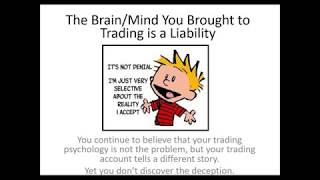
Bad feelings toward your beautiful mind and all that kind of stuff. But the truth is the brain mind that you brought to trading is a liability. Okay?
And at the same time, unless you can change that brain mind and that trading psychology.
To a very different environment with different needs, then it's going to remain a problem. And yet most people, it's really amazing is most people believe that the trading psychology is not the problem. They keep looking outside for the solution to the problem when the problem staring them in the face. It's the mind that you bring to the management of uncertainty. Okay? And yet most people never even find the deception. You keep looking outside and it's like there's all this evidence. If you were listening to your trading account, there's all this evidence. But the truth is, is that it's kind of like Calvin here. You know, it's not denial, it's just a very selective, I'm very selective about the reality that I accept. What I'm asking you to do is accept a new reality. I'm asking you to really consider that no matter how beautiful, how great that mind of yours is, how well it did in other endeavors in your life before trading, what I'm asking you to consider is that it's a liability now. And that until you accept that, there's really not very much that can be done about your performance in trading. Because ultimately what happens is emotions keep popping up. They keep contaminating the actual reason that, that you need to trade every time you get under stress. Okay? The key is this, is that when uncertainty and risk of capital become part of the equation, a performance gap becomes apparent. It's not you. It's not you. It's practically everyone who gets into trading.
They try to say, well, you know, there's a way around here. I can, you know, you know, more stuff, more stuff, more stuff. You know, I can get, I can get more and more precision, more and more precision. But ultimately what we're not looking at is building the mind to be able to deal with it. So ultimately the emotional brain and the rational brain keep fighting each other. And the truth is, is the emotional brain is going to win. The emotional brain operates in nanoseconds. The thinking brain operates in microseconds like a half a second later than the emotional brain triggers. Also, is that all thinking is emotional state dependent? When you already thinking, I'm trading not to lose, you've already produced a mind that is going to be highly ineffective in trading. So the deal is, is, you know, you go, wow.
What a what? Why do I have problems managing emotions while trading? I have them totally under control everywhere else. The truth is, it's what you're trying to do.
You're literally trying to take a square hole and you're trying to drive a round peg into it. It's that dissimilar. Your brain, the one that you came showed up trading with, is built for a very different purpose. It is built for survival in a dangerous world. Remember 10,000 years ago, there were still saber toothed tigers roaming around looking for us. Okay? 10,000 years ago, that's a blink of an eye. From an evolutionary standpoint, that brain was designed for certainty. It wanted to control outcome, it wanted to control environment. It wanted to be right. Okay? Yet the brain mind that you need for trading.
For working on probabilities has to let go of the illusion of control over outcome. It becomes a probability cloud. And you can do everything right and still be wrong.
So the whole key is what happens is, oh my God. The probability mind.
Has to get rid of the survival instincts that keep driving fear and anger and greed and lust and pull it to where it's disciplined patience. Completely different things is that you're asking. It's like asking yourself to be very calm when you see a saber toothed tiger approaching. The emotional brain can't tell the difference between the biological threat, okay, I would say the tooth tiger and the emotional discomfort of uncertainty in trading. That's what we're dealing with. And we're gonna have to figure out a way of doing it because ultimately your caveman brain is your partner in trading. Okay? Everyone tries to ignore the survival wiring, okay? Yet at the same time, it's there.
Besides that, the emotional brain has massive electrical networks moving into the thinking brain. Yet the thinking brain has two little telegraph wires going back into the emotional brain. Who do you think is going to win that game? Yet we show up every day. We have this brain that evolved over the last six and a half million years, and we expect it not to experience the caveman dwellers. Well, it is, okay?
And something did go wrong. Something went terribly wrong when you started trading. And they didn't teach you that you're going to have to change the way you think. You're going to have to change the way you perceive. It's just not all this magical of technology. It's also the technology of your brain and your mind. You're going to have to reroute it. You're going to have to take it away from the default programming that it was designed to do, and you're gonna have to reprogram it so that it interacts very differently with the probability based environment rather than a certainty based survival model. So, wow. Because basically what you're looking at right here, here's your caveman buddy. Here's, here's the part of him, and what happens is he's still operating just like he did 30, 40, 50, 60,000 years ago or more. And he's bringing the same danger signals. You know, he's realizing they're big bears, there's big cats, and they will eat you up. And the moment that you feel uncertainty, okay, triggers this whole cascade of like this guy looking at a bear.
It automatically triggers. And suddenly the emotion acting in nanoseconds takes over the mind, hijacks the mind actually just absolutely does an end run around the mind, the thinking mind. And suddenly you're acting from instinctual emotions of survival rather than the emotions of discipline and patience and impartiality that are required to trade. Well, and this is a diagram of how this works, okay? This is, this is where your brain works, friends.
This is. You can call this your brain on uncertainty, because the very first thing is that your brain is designed for certainty. It is designed to be able to assure control of outcome. It absolutely goes bonkers when it feels uncertainty. And think about what you're subjecting the brain to. Every time you look at a trade, it's all uncertain. No matter how many gizmos you have to try to make it more and more accurate. The truth is it's uncertain. And the problem with the brain is that when it experiences uncertainty, the brain goes into confusion. Confusion is a bad deal for the brain, okay? That's the shock and awe that the US military uses in its battle strategies. It produces a tremendous confusion. And people don't start doing stupid things at confusion. Vulnerability exists that you would experience that as powerlessness. If you've ever been in a trade and it's going against you and you felt that, all that stuff going on, my God, it's going against me. It's going. You are feeling the powerlessness and you are in the process of hijacking right then. And at that particular time when the brain experiences the powerlessness of vulnerability, it goes to fight flight. That would be where you can't pull the trigger. That's when you get out of trades early. That's when you revenge trade. You get angry, you're going to make it or you over trade. Okay? This is, this is hardwired, friend, okay? And this is what has to be undone. This is not going to be a little nlp. This is not going to be some magical trick. It's not going to be some, some just knocking on wood. It's not anything like that. And our tapping are the current techniques. This is a biologically wired predisposition that you're going to have to retrain. So the question is.
Until you learn to go and manage this thing differently, the default programming is going to kick in. It's going to be like the, the tortoise and the hare. You know that the hare is all about short term survival. It's very fast, it gets away very fast. But what happens is that once it gets past that, it wants to hang out and do nothing, rest, digest. Meanwhile, the turtle, completely different mindset. It's a steady process, it's slow, it's patient.
And what you do is you discover.
Okay, that wabbit has caveman brain. And you're going to have to learn, if you're going to be a successful trader, you're going to have to learn how to readapt it so that it's built for a very different world than what it was initially intended to be. Okay, and when you take a look at this, how does it show up? I want to. One of the biggest problems I see in traders, and it's kind of like this, is that people will go into trading and they. Everybody knows that it takes about three years for a trader to burn out his. All his capital, and he's gone, he's. He's done. He's gone and done. Okay? And yet there's always a new crop of traders coming up that somehow thinks that the rules don't apply to me, that I'm that one in a million, I'm that Rocky Balboa that, you know, against all odds, I'm gonna sue, I'm gonna. I'm gonna succeed. That kind of thinking gets you into tremendous trouble. And yet at the same time.
If that bias weren't there, there wouldn't be in America. Think about how many people died trying to get over to America when America was being discovered by Europe. Is that, you know, there was a frightening thing, but they all thought they were going to survive. They all fought, and eventually they did, but there was a horrible toll. So now you're beginning to see this, you're special, and you're beginning to recognize, you know, something.
Fell right for that. I somehow thought. I looked at all the carnage around me and somehow I thought it was gonna be different for me. Well, here you are somewhere between two and five years later, and you're going, well, you know.
Hmm, let's see. I haven't hit all that glory, all that glory stuff. You know, I'm sitting here in purgatory, or I've blown up some accounts and I'm going, you know something? What's going on? Am I really that special? The second one is the instinctual need to be right, okay? I want to be right. I want to be perfect. You know, I don't want to be wrong. We are invested in controlling outcome, okay? Which is impossible in trading and yet traders keep insisting on changing, on not changing, so their survival instincts take over mine, okay? And you can't trade with survival instincts and survive. Okay.
Next thing is that there's also this survival need to predict outcome. You can imagine a long time ago how important it was to be able to kind of see what you thought was going to happen in the future so that you could avoid threat. And here you are now wanting to predict the outcome and you have all this sophisticated technology to predict outcome. Yet once you're in the trade, man, you don't know it's 50, 50.
And so you can easily see how you keep wanting to predict outcome and it doesn't come true. Doesn't come true. You can begin to see how the amygdala, that part of the brain that controls fear, starts getting hyper vigilant and starts going, I don't trust the higher brain function. So ultimately what you have are hypotheses that may or may not be right. And if it's right, what happens is you follow it. If it's wrong, you get out and take a loss and minimize that loss. That's the way it works. There is no real predicting what's going to happen with uncanny accuracy. So.
Where we go from here.
Is this, is this, I love this one. This is the biggest one.
It's called alpha. You know that need to win, that one. I'm going to make, go and make things happen. A lot of people coming out of corporate, out of businesses who have experienced success based on this winning attitude, they come in and they have this thing that winners make things happen, losers let things happen. Have you ever noticed in trading friends that the strongest suit that a trader has is his patience? He has to see what the markets will give him. He has to let things happen. And what he also knows is he's going to lose a lot. Okay, he has to change his notion of what it is to be a winner. He has to recognize, no, actually if I'm going to be a great trader, I'm going to have to become a phenomenally good loser. Okay, I'm going to have to become a phenomenally good loser to the point where I'm minimizing my losses. And when the opportunity comes for me to really hit the targets and to move beyond them, I'm going to take that too. I'm going to let my winners run. So, so accustomed to creating success by pushing hard. That's what brings people into trading. I can push, I can make this thing. Yet this alpha characteristic just absolutely blows holes in people's accounts. So you have to really look at that going, wow, I have to rethink, I have to rethink even the way I think about winning. That's right.
And ultimately.
Ultimately is your survival. Emotional reactivity is going to remain a problem until.
You begin to see emotions and experience beliefs with very different eyes than you're using now. You have to understand emotions very differently. You have to, they're not touchy feely things, they are biology that take over mind. And you're beginning to go, I have to retrain my brain. I have to retrain the way I think about thinking about uncertainty. Ultimately, what happens with emotions, they control how you think.
There's a saying.
In neurobiology is that all thinking is emotional state dependent. If you begin to understand that, you begin, oh my God. So if I'm not managing the emotions.
That I'm in, in a given situation, I'm not in control of my thinking. That's correct. Okay. And I want you to listen that every time that you have self doubt, every time that you, the trade goes against you and emotions trigger. And the thing is, is that you're sitting there and you have this fight flight thing show up. Suddenly you're going, oh my God, I'm thinking from fight flight. That's not going to have a good outcome in trading, friends. So we know that. Okay. The other thing is performance beliefs are literally what you hold to be true about your capacity to face risks of uncertainty. And what happens is most people, honestly, they, you know something, they go, you know something, they talk a talk, yeah, I'm a winner. Yeah, I've got all these affirmations, I've got all this stuff that's all bs. Ultimately, the performance beliefs are being exposed by your trading account. Okay.
And fundamentally what you discover.
Is that you have never seen the markets. What you are actually seeing is a virtual representation that your brain has created by the emotion it's in. And the observer you are that you project onto the markets. The difference in trading is that the judge is not how you feel. The judge is your trading account. Okay? It's telling you whether or not the virtual representation you've created by your with your brain is actually accurate or not. And I'll give you an example. A couple years ago, I was working with two traders. They were two partners in a small hedge fund. And one of them was, he was the guy who was bringing home the bacon. He made a lot of money for investors. And the other guy, you know, he's profitable, but he wasn't that profitable. What's interesting is they were best friends. They used the same equipment, they had the same methodology, everything was the same. Okay? They even drank the same scotch. Now the difference though is this is the trader that was profitable held a completely different set of beliefs about his ability to manage uncertainty. He felt as though he felt confident that he could engage and he could stay calm and do what was necessary in his performances. The other guy had started out as a CPA and he did not like losing. He traded not to lose. And ultimately what happened is that belief system that he was projecting onto the markets, what it did is it kept him profitable, but not very much. I want you to look at the difference in the belief systems that are being projected. Neither are right or wrong, they're just belief systems. But when projected, suddenly you have a neutral, neutral assessment tool called the trading account. Judging rather than what you think is right, how you feel is right. Completely different animal. So we're looking at that. We're going, wow. And the key is you will have to get at the moment knowing how to do that. This.
And some person who apparently has read my book says, I love your quote from the athlete runner that said, I just can't. It's actually a good thing. I'd also. This is from my book and ultimately.
This a couple, you happened a couple years ago when I love track and feel, I love watching hurdles. I tried to race hurdles when I was in high school and found that that's, that's, that's just not something I'm going to do.
But these, this, all these world class sprinters were sitting there getting ready for the hurdles race and all the, you know, all the announcers are looking at the American talking about how good he was and how he was going to blow everybody away and just all this stuff that had already won the race and all this kind of stuff. And so anyway, the race began and sure enough, he did win. But it was a tight race and at the end, at the end of it and all the announcers are going, he's got gold, he's got gold. He's set a new world's record.
And ultimately at the end of this, these announcers and journalists come up to him and he's trying to get his air back.
And I'm sorry about, I have a cough that I'm trying to, I'm trying to tame, but occasionally, occasionally it just shows up. Anyway.
Anyway, these journalists are around him and they stick all these microphones in his face and they say, what was it like? What Was it like, what were you thinking when you saw that you're going to win? What did it feel like? And all of a sudden you look at this athlete, he's kind of looking at, what are you guys talking about, man? And.
I said, yeah, yeah, we want to know what you were thinking. He said, you want to know what I was thinking? Thinking when I was racing?
Yeah, what were you thinking when you knew you're going to win? I said, okay, guys, okay, I'll tell you what I was thinking. I was thinking, 1, 2, 3, 4. 1, 2, 3, 4. 1, 2, 3, 4. 1, 2, 3, 4 dot no. They said, no, no, no. What were you thinking? He said, I was thinking, one, two, three, four. One, two, three, four. 1, 2, 3, 4. It just so happens that, you know, when you do hurdles, you have to coordinate your body and your mind, and the body and the mind have to be working in synchrony with one another. The 1234. 1234 meant something to that athlete. He had been trained for God knows how many years on 1234, 1234, for his body to be going through motions that were body memory, okay? And no doubt that a sports psychologist had a hold of him and had trained him to. 1, 2, 3, 4. 1, 2, 3, four. 1, 2, 3, Four. To be in a performance mind, okay? Not in the future, not in the past, but in the here and now of the moment. 1, 2, 3, 4. Ultimately, what these journalists wanted to hear was how to feel good. The athlete simply wanted to be in the performance mind that allowed him the best probability of winning. Okay? Now, later, when he got the. When he got his award, he was jubilant and all this kind of stuff. And you hear that, you know, he and his team had truly set goals.
And about what they were going to achieve, and they had achieved those. But what happens, the major thing, he separated performance goals in the moment from objective goals about what you want to show up. That's the thing here, is that the trader's mind has to be locked into performance because that's what you can control. You can't control outcome.
So.
How do you go about changing your response to uncertainty? How do you get. How do you get the emotional brain, the heart and the thinking brain that. All that great stuff, how do you get them working in synchrony with one another where they're. They're literally working hand in hand? How do you do that? Okay, the major piece, the very first thing, the hardest thing that I think a trader has to do is they have to recognize that nothing is Going to change unless you change the mind that trades. The mind that you brought is a liability now. No matter how good it was, it's a liability now. It needs to be rebuilt, okay? And it needs to be able to interact with uncertainty very differently than what evolution has given us. That's the truth. The good news is that you can become designer of that mind. That's the cool stuff. Ultimately, what you have to do is you have to learn how to harness emotions. First. You got to regulate it. But I want you to look at this image. What you're seeing is an event happens, a stimulus happens. Immediately, an emotion shows up. Thought did not show up first. The emotion showed up. Okay?
Then it goes through certain filters. Like the hypothalamus is going to filter that thing to decide whether or not it's going to send it to the amygdala, fight flight, or send it to the rational brain for evaluation. Suddenly, thinking kicks in. That's the interpretation, then behavior. But what I want you to notice is how far down the line thinking is. Okay? Emotion explodes right at the event, right at the stimulus. And until you learn to say, I have to, I have to. Not only do I have to stop trying to ignore emotions, I need to learn how to work with emotions so that I have freedom. Emotion. That's what the real key is. Ultimately, all emotions have a biological signature that allows you to manage the intensity of the emotion so that it doesn't hijack the training mind. Okay? That's the really cool news. Now, how do you do that? In my course. In my coursework, what you do is you learn how to use diaphragmatic breathing and tension reduction in the environment that you're going to be using and not the yoga studio.
Oh. That's the first step. Dolores coaches me as I. As I speak. So what happens is you have to come in and you have to say, you know something? It might be really nice to have all that diaphragmatic breathing, but the truth is, I have to be able to reproduce that in the real environment of risk and uncertainty. What you will discover if you go trading tomorrow, what you will discover is that your body is tense. You will notice that you probably have halted breathing, or your breathing is very slight and you're only using the top part of the lung. And you'll also notice that you are hyperventilating, and you're noticing that you'll get fixated. You're hunching over your computer screens. That, my friends, is when you need to be moving and interrupting the emotion that's building up. You're feeling at that moment, emotional arousal.
Most people don't notice the emotion until it's already hijacked them and spit them out. Yet at the same time, if you become a really good observer of emotion as biological phenomenon, you can control the emotion so that it doesn't overwhelm mind. And we do it. And the truth is, is that there's. Until you learn to manage the emotion, there is no getting to mind. That's the first order that has to be done. The second order of things that have to be done is you have to develop mindfulness. You have to develop an observer, and you have to start seeing through a very different lens, okay? Because ultimately, what you really do is you learn how to step back out of thought and you discover something. Oh, my God, listen to this. You and your thoughts, you and your beliefs are not the same.
I want you to hear that one more time. You and your thoughts are not the same. All this stuff that runs through your mind, those aren't your thoughts. You're not having thoughts, they're having you. And until you wake up again to observing, going, oh, my God, man, where are these thoughts coming from? What's going on here? Ultimately, what you discover is that.
This miracle of a brain of yours with all these competing emotional programs, has organized you into a potential self. That's the one that you've been calling you or I. Okay. It's only one potential organization. And it just so happens that it's not going to work for trading. You have to change it. And fortunately, with observation, you can. So we go there and we begin to recognize another powerful thing. As we develop this ability to observe and be mindful, you also begin to recognize that your brain.
Is a community of rival programs that has really duked it out and organized you into a self. Okay, didn't know that. Did you and your mind.
Understand? At the level of the brain, thought is simply an electrical behavior, a bioelectrical behavior. Somehow in the miracle of mind, something phenomenal happens and that that thought is given voice.
In your mind. Okay? And this is when it gets really interesting and you begin to realize, oh, my God, all of these emotional programs have thoughts running in my head. Yes. And you have been absolutely asleep at the wheel of your observer. No. Mindfulness. And you have had a power struggle going on in your mind where you feel the internal struggle. And every one of you felt that if you've ever experienced self doubt, if you've ever beaten yourself up, you have experienced this internal struggle. Friends okay. Phenomenally. Is that the way the default programming is really good for survival in short units of time by fight flight. Okay. The one that you have to build is for probability management. Completely different set of programs. Okay. And ultimately what you discover is that.
You can't change uncertainty. It's there, but you can change the mind that engages it, that interprets it. Just like in this illustration here. You know, the thing is, it's like blind people. They're checking out, they're checking out an elephant, but only only sees one small little piece and all of a sudden you start interpreting the elephant based on your tiny little mind and they can't step back and see the bigger picture. That's what's happening with most traders. Okay. The deal is you can design the emotions that give rise to the trading mind when facing uncertainty and risk. Notice that I didn't say you can stop uncertainty, you can stop risk. No, but what happens is you have to. When you have freedom of emotion, you can design the emotions that show up to create the mind that engages the performance of uncertainty. That, my friends, is the edge. Because otherwise what happens? This is, you know, this is the month.
This is your mind right here. This is the internal struggle. This is a picture of the internal struggle going on inside your mind.
You got all these aspects of self, these emotional programs that are highly competitive with one another and some actually being cooperative and, you know, trying to win the power struggle. But the thing is, is that what you need to be doing is you need to learn how to observe these emotional programs as voices in mind and start saying, you know something, this is a free for all. It's a power struggle and I need to reorganize the way my mind works so they can be effective in managing uncertainty. Okay. That's the deal, friends. Most of us have avoided this because it's like what their voices in my head? I'm not crazy. You're crazy if you're not listening to the voice. Voices, friend, you have. Your brain is composed of all sorts of different aspects of self that are based on these emotional programs. And if you're going to learn how to trade well, you're going to learn how to reorganize them so that they're functioning at a much higher level when engaging uncertainty. So because most people don't develop this, what happens is that when they're in the midst of self doubt, when they're in the midst of beating themselves up for doing something, you know, are basically, why are you trading? What, what made you think you could trade you hear all this stuff going on. Most people don't recognize things. Oh, these are my thoughts. No, no, no, no. This is, this is. You have to develop the performance mind for the engaging of uncertainty. It does not come natural.
I want you to hear that. It does not come natural. Otherwise, a lot of people would be developing this performance mind and a lot of people would be tuning it, making a lot of money in trading. They don't. Very few do. But this is the piece they have to do. You're going to either, either going to have an undisciplined mind with default programming that's going to engage uncertainty. Are you going to train a disciplined mind to engage the uncertainty? It's really your choice. Okay, so.
You remember that thing where.
Winners always make things happen and losers wait for things to happen? Well, there's another piece. The deal is, this is the brain can be retrained, okay? And I want you to listen to this saying. All failure is a failure to adapt. All success is successful adaptation. The default setting for Fight Flight that you brought into trading is not working. It was not designed for the environment of trading where probability is everything. It was to serve to ensure survival in the short term in a dangerous world. And what you're seeing here is that when you make mistakes, when there are breakdowns in the continuity of flow, what you're doing is you're saying, okay, this is an opportunity for adaptation. It's not my tiny ego that's being hurt here. What happened is I'm seeing real information about where I need to change, where I need to adapt. You have to have the courage to change. That is the big deal. And I. And as you change, what's interesting is this.
You become comfortable with the discomfort of uncertainty. Okay, take a look at this guy in this wave. The thing is, is that I look at that and there are forces up and beyond him. Yet at the same time, what he's doing, he is in synchrony with that wave. He is controlling his performance, not the outcome. You don't know what happens in this photograph after this photograph, in the next moment, that thing could collapse on him. At this moment, you're looking at this and going, wow, I do not control outcome. I control the mind that I bring into the moment of performance. This, friends, is the psychological edge that's missing. And how does it work? What are you trying to do with this mind? Here it is. The thing is that the emotions behind probability mindset, again, they're not natural, but they can be learned. Ultimately, what you're doing.
When exposed to uncertainty.
In the coursework that I do, you learn to pull forward a state of discipline. Discipline I define by the way as the ability to maintain order under pressure. You pull forward the ability to self soothe so that you stay patient, so that your fear doesn't grow and hijack mind into fight flight. You also maintain, because you're able to maintain self soothing, keeping your fear down and you're able to keep discipline up. Your mind is actually able to stay impartial. It can think clearly. This is what's missing. This can be trained. And we have highly specialized ways of being able to go and do this. We don't use the typical stuff, affirmations and stuff like that. We actually use memory work where we go in and deconstruct memories and then reconstruct memories where you actually have access to the feeling states of these emotions. And you learn to do that. And so you're not using affirmations and visualizations where you're wishing things would be different. You're actually going in, finding and going, you know something, I have experienced this emotional state. I have experienced this mind. I've done it. It's real. And that's what makes it phenomenally different. So.
As we kind of begin to conclude here, when you work with us, what exactly? What's the process that Randy uses that is able to take you from where you are now to where you have a mind that can engage uncertainty with confidence? The first thing is we're coming from an emotional intelligence perspective. You learn a lot about neurobiology of emotions, okay? You learn emotional intelligence. You begin to recognize that emotions are.
They'Re what make you tick, and that you end up with a very different understanding of emotions and how to use them.
That's from the intellectual theory standpoint. But then the very first thing is you learn emotional regulation. You're going to learn, you're going to learn how to regulate the intensity of the emotion so that it does not hijack mind. That's the first order of business, friends.
Until you can manage that mind, manage that emotion, you're never going to get to the door of the mind. Okay? So the next thing that's taught, after you get the emotional regulation piece.
You learn mindfulness. What I do is our work teaches you to be able to step back out of mind, slow down thoughts and begin to see, wow, my thoughts and I are not the same. Excuse me, my thoughts and I are not the same.
My beliefs and I are not the same. And then you start using that newly appointed observer and you Start saying, let me examine the thoughts running through my mind. And you start finding the historical internal dialogue. You start finding what I call the inner critic, that judge that lives within you or that tempter that lives within you. And you also find the fear that lives within you that I would call orphan. And you realize that you have been missing in action. This stuff has been running right beneath the radar of your awareness. And you did not before mindfulness, you had not been able to see it. You avoided it because it was uncomfortable. Then what you learn to do with this mindfulness? You learn to develop the empowered mind. You learn how to develop the discipline.
You learn how to develop the courage, the self soothing and the impartiality. Because ultimately that historical internal dialogue, that inner critic and that orphan are not going to go away. But you see it and you go, well, I have to have something to confront that inner critic living within me. Yes. That's why you build this empowered mind around the discipline of a ruler, the courage of a warrior, the self soothing of a caregiver, and the impartiality of a sage. It's a new, a completely different mind. Then what you do is you become intentional friends. You learn to go, my God, I can't believe that I was walking and just bringing any old mind into to trade with. Now what happens is I have a process that allows me to bring this trader state of mind up. And actually that's the mind that I trade with. And if I can't get into that mindset with the process that I've learned from Randy, I don't trade. It's that simple. Is, that's how sophisticated the trading mind is? It is, it is a finely tuned piece of equipment and you have to work with it. The last thing that you learn is vigilance. This is a process, not an event. You never have it. What you have is you have a process that allows you to get into a mind that manages uncertainty well. And it has to be maintained in the same way that an athlete.
Has to keep practicing to keep his edge, a concert pianist has to practice for performance. They just don't go out there without practice and perform at the highest level. No, they practice. It's that vigilance, okay? It's a process, not an event. So this is the, this is the process that we teach, friends.
This is the process we teach. And it really comes down to if you come to the moment where you go, you know something? I kept pretending for a long time that my trading psychology was not a problem. And I'm Beginning to recognize whether or not I like it or not. The only thing that's really causing me a problem is the psychology, the mind that I'm bringing to trading. I got all this other great stuff and I have great knowledge. I just can't use it under pressure. You come to that moment, you say, you know something. How do I go about changing around here? You know, we have two. You know, we have lots of stuff on our website. By the way, there's a free gift there, a free ebook that you're welcome to go get there. Are there guided meditations, there's articles, there's videos, there's lots and lots of content rich stuff. But it all boils down really.
To two particular courses that we teach. The individual course, which is highly comprehensive and personal. Okay. It is the meat that it gets into the stuff that really is causing you a limited way of using your mind in trading. And the major thing is it comes with me. It comes with 10 consults with me over a period of three to four months. And it is very powerful because those consults with me are with Skype. So it's like we're. We're looking at each other head to head. We are, we are. Literally, we're in the same room. You know, it's. It's that personal powerful, powerful. And it's the one that, all things considered, it's the one that I wish everybody could take. Okay. It's also $3,500 or $1200.
Three payments of $1,200. The group course is. Is a highly effective course. It's an efficient course. It, instead of having all the materials, it's a virtual classroom that you go to to do the materials. And we meet five times over a period of 10 weeks. And as a group, okay, and what you're doing is we're going through the process, learning each of these elements each time, each time. And you're coming away with, okay, I started. I started learning some emotional intelligence. I got the emotional regulation stuff. I got the mindfulness stuff. I've discovered it's this, this historical internal dialogue that limits me inside me. Discovered that there are other aspects of myself that can be developed and are much better at trading and uncertainty than the one, the mind I came with. And you become intentional. Okay. It's powerful course. And it's. And our next class is in January. And a lot of people, what people do with this is they sign up now and get a big head start. Is that. That I had never thought of that. And then one day, some Guy from Romania said, you know something, I want to take this course and I don't want to wait that long. I want a head start. And so he paid for the course. And what he did is he worked through the course before the course started. So when the course started, he was in a much better position to get what he needed out of that course. Big deal. And if you're sitting there and you're going, you know something? I know.
I know that I need to develop the mind. I need to drill. I need to develop my trading psychology. It's the, it's the piece missing. And what I want you to do is really look for my website. It's content rich. Okay? I want you to really come and come to the moment where you go, I get it, I get it. I understand what this guy's saying. And what I want to do is I'm, I'm committed to developing my mind. If you've come to that moment, then hit. Get a free consult with me. You just hit contact us. And Dolores ends up scheduling. You know, I am, I'm wearing. We are used to working all over the globe in a lot of different time zones.
But that's the deal. And it's something where eventually.
Eventually you're going to be forced to look at your trading psychology.
Because basically at elite levels and whatever field you're in, it comes down to psychology. The PGA Tour, all those guys can drive the ball and putt, but there's only 10 big time winning game winners. And what happens is they know it's the mind that they bring to the moment of performance. That's the difference maker. Same thing here. You're not Rocky Balboa. You know, you're not going to be the one in a million that wins. What happens is that you can develop the though. Okay, if you have questions, please write them. Then I'll take some. And here's one right now. I can trade with mindfulness using small lot size, able to get out of losers quickly and not be affected by losing little. But when trading large size, $12 per tick, I don't want to get out. When losing and losses mount up. Do you have program for that? What happens to the individual program? What we do is we will actually tear that apart and tinker with it. Because what happens is that a lot of people can trade small lot size pretty well, but when they start trying to go up, they don't. They, they, they trip the fight flight switch again. And with the behaviors you're talking about or fight flight, you don't want to give up, you aren't and all that kind of good stuff. Ultimately what happens is that you still have to face the fear of that larger size and you still have to get past it and it can be worked with. Okay. It's very typical that I would work with a guy basically and the whole job is actually developing, basically going up in contract size and wrist size. And I have a process that we really go in and we establish it and we don't go beyond the contract size until you can establish the new zone of comfort.
And once you get there, we would add another contract or whatever and you acclimate yourself to the higher zone. It's kind of like a number of years ago.
But by the way, that would be something I would work with the individual course in that that's going to be one where much harder to get with a group course which is teaching basic skills. But the major thing is that you just keep. You recognize that you're at a particular level and the moment that you move beyond that level, things start shorting out and the fight flight kicks back in. What happens is you have to have a process of inoculating yourself in small increments that allows you to move and become comfortable at the new level. That's how I will answer that. Are there other questions.
Right now? I'm not seeing any. Okay, well, that was a good question. Okay, well, friends, I want to thank you for coming.
I love this stuff and. And for me, this is something that just.
Inspires me. I love seeing people when the light spark going off and going, oh my God. I really do have to develop the mind for trading. Yes, you do. And we have a way that can do that. Okay. So whether or not I ever hear from you again, see you again, my hope that I hope your trading is well. I hope your life goes well and be looking at that website, be looking at individual course and be looking at the group course. Okay. Anyway, thank you very much. May God bless and have a great life. Take care.









