Emotional Self Mastery of the Trading Mind Under Stress
A YouTube presentation by Rande Howell arguing that retail traders' certainty-driven, survival-oriented brains (limbic/caveman responses) undermine trading performance. Howell contrasts certainty vs probability mindsets, uses evolutionary and animal metaphors (caveman, mammoth, cougar vs lion) to show how fear and other emotions hijack decision-making, and outlines a multi-step training (starting with emotional regulation and mindfulness) to master limiting beliefs and build an empowered, probability-focused trading mind. The talk references a group course starting in June.
Chapters
The broadcast is now starting. All attendees are in listen only mode.
Welcome everyone. First order of business, let's make sure you can hear me. Okay. If some people would just type in a yes or a Y into the chat box or something, we would be good. Good. Thank you. I like that. Well, I welcome, I welcome all of you and I love this stuff. And it's, I have found the amazing thing is who would have thought that trading is a pathway to self mastery, yet that's what we're looking at today. We're looking at emotional self mastery of the trading mind under stress. Isn't that interesting? Now, by the way, I give a presentation and at the end I take questions. If you have questions as I'm going through this material, then please by all means write the questions in the question box and I'll get to them when I finish and otherwise we'll just go from there. Fair. Good for you. Okay. What it really comes down to is many, many people come to trading with a winning attitude. They've been very successful in other pursuits of their life and they think that those winning attitudes, those winning ways are going to work. They're going to work in trading. All they have to do is learn the game of trading and they're going to be fine. And they take that in and generally I see them three to four years after that where they've realized in three or four years they're not making progress. If they're profitable at all. They're marginal, they've had ups and downs. They can see where, you know, they've made money, they've lost money, they've given it back. They're in this cycle and they just don't understand why, you know, look, I, I did well, Randy. I know how to do this. And so something is a jar. Something appears to be so different about trading compared to the rest of the world, to business, to corporate, to whatever you were doing before you got into trading. And what we want to do is, we really want to take a look at that. Because the truth is, trading is very different. Your mind was never built for it. And when it comes down to it, here's what really happens is the old ways that you brought.
Are simply not going to work. Those tried and true ways, no matter how good they were, no matter how comfortable you are with them, you need to be listening to your trading account. Your trading count is really your best friend. It may not tell you the information that you want to hear, but it will tell you about your, if you're winning ways, if that is actually working in the new world of trading. And if it's not, then you're gonna have to find another way of working with the program.
So most people stay stuck right there. This is where they're smart, they're logic driven, they've got a plan, they're looking for the way that can be done. And they look at on the spreadsheet and they see the numbers and they go, wow, I can have that, I'm going to be there, I'm going to get that. Then again, three to four to five years later they find them stuck, kind of trapped. And they don't know, they just simply don't know what's going on.
They know that they've had a way of working the world that has brought good success. And they get in and something powerfully changes. And this is where it really is.
What it really boils down to.
Is that you're going to. Could you move the.
No, you didn't? Yep. Yeah, I did. Okay. Anyway, the point is this, the big huge thing is this. Your brain is built for certainty based, dealing with certainty based environment. It wants to be in control over outcome, over the environment really. It wants to do something it does not want to lose. Because if you look at it from that brain's perspective, you have a very primitive brain underneath, hiding underneath that big huge gigantic thinking mind of brain of yours. And it's very primitive. It doesn't think in language, it perceives in terms of threat something that's fearful or needs to be worked with, with aggression. Our approach.
And it's very certainty based.
It wants to win, it does not want to lose. And it just so happens we as human beings did that from six and a half million years ago till today. That simple formula of certainty based thinking, controlling outcome, not losing and making things happen works so good as a species that hey, it's easy to work this environment. We've become the dominant species on this planet. The problem is this.
The certainty based mindset that your brain is built for isn't what works in trading. Trading requires a probability based mind.
Where you realize that you're not in control of outcomes, you're not in control of winning and losing.
What you're in control of with the probability based mind is the mind you bring in to the moment of performance.
It is here in the typical thinking of trading that if you have a system that has an edge and if you bring a mind that can execute that edge, then what happens is you, you extract more capital out of the markets than you give back. That Sounds really great. The problem is you have a caveman brain that wants to win because he gets to live another day. He doesn't want to lose because losing means a threat to your very existence.
If you've ever seen that happen, when a trade starts going against you and it's heading towards your stop, you're going to lose. You're going to lose. I hate losing. I hate losing. Well, your caveman brain is talking, saying, I'm fighting for my life.
And this is where it happens, right here. This is a very primitive brain. It doesn't know about money. It doesn't know about capital. What it perceives money as.
Is control.
Power.
Safety, competence. And when you start taking a loss, it sees that being shattered.
It cannot separate.
The figures. You see the greenbacks and life and death. It's a primitive caveman brain called the emotional brain, or the limbic system. It's held together by a brain that's been around for about 40 million years. And in human. In human beings and becoming Homo sapiens, it becomes to have literally is a brain that has allowed us to survive and to prosper and to master things beyond belief. And now you're asking it to do something that honestly, it just simply can't do. It can't do. And it's a very primitive brain. And you're asking that primitive brain to do something that it was not built to do. And we'll take a silly illustration to demonstrate that. Here you're looking at this thing and you have our caveman friend sitting here, and it's going, you know, something it looks at. And I'm doing. I'm being a hunter and gatherer, and I'm hunter and gathering things. And so I stuff like that. And then something shows up, okay? And that something that shows up is first interpreted through the eyes of anxiety and fear. That's what allowed us to do it. And it's saying, do I have danger of this, or is this something that can provide a meal? So this is it. If that had been the same with the two tiger, it would have been very, very different. But the point is, when something occurs in the environment, your brain becomes a negative assessment machine because it worked. Worrying, having anxiety about the future worked, but also, I might add, is jumping and, like, understand.
Man actually hunted these creatures. That would be something like a mammoth, okay? They hunted them down and they got excited to see them over, trading the excitement of the thing. That's what's happening is that the old brain is simply misinterpreting what it's Being able to see and what it's doing, it doesn't know it's in the 21st century. It doesn't know about trading. It doesn't know about probability. It knows about survival. In the moment.
When it sees that big huge mastodon coming and he's just some, one single man trying to gather some stuff, what it triggers is fear. This is dangerous. I need to, I need to leave the area. When in trading, you have to develop a mind that can take a loss simply because it, because it's a game of probability. And your job is to keep losses small. You know, caveman doesn't want to take a loss at all because it means his life. So you see this dilemma and this is what you've brought to trading. And then you expect it just to turn on a dime.
And you're, you're basically expecting a higher primate to speak English to us. It's not going to happen. They can do sign language then. Now.
All that emotions are going to react to conditions before thinking ever occurs. It's really interesting. My kind of reading is, I'm currently reading a book where a neuroscientist is talking about working with fruit flies and mice. And they like to work with fruit flies simply because it's only a hundred neurons in their brain. And what they discover there is that emotions there are called biological action potentials. And what happens if you wave a swatter over the fruit flies? They see the shadow and react. There is no thought, there is no thinking. What happens is that somewhere in the evolution from that fruit fly to the human brain, this big, huge, gigantic brain showed up. So we have cognition that also filters through emotions.
Easily the most common one is fear. We're built around fear. It helped us survive. So that's what we're going to have.
And the moment that it happens.
The actual emotion firing has already happened. Before thinking even begins to think. That's about showing up. So unless you can change the way your primitive brain reacts to uncertainty, you're going to have a very difficult time trading because it's always going to be there. And to show you what I mean is this, Take a look at this guy. You know, just. Have you ever been around a big bear? Well, I have. And I can tell you right now that gets your attention. You are asking for a short term survival, focused brain to stay calm when losing. Because. And when losing, it looks, it thinks it's being attacked by a bear, by a saber toothed cat. And this is what happens. And understand you're not, you're Engaging uncertainty all the time when you trade. So you're, you're firing this stress reaction, firing this, this attack avoid moment all the time if you have not learned how to manage it. So the, the key is, is how do you do this? And what I want to do is I, for those of you, this is actually from.
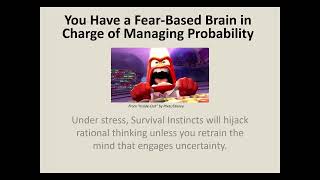
Inside out by Pixar Disney and what you're looking at is their representation of the emotional program anger and inside a little girl's mind. And as you can see that you know it's reacting to changes in the environment and it has a, it has a very localized way of expressing itself through anger and aggression at the same time. You could have had anxiety that's going to be reacting in a different way. All this is you have a fear based brain in charge of managing a probability based type of business. Okay? And my promise to you is when there's stress on the line, when you're risking capital, when you're risking life, your power.
Your safety, all that stuff, what you're doing.
Is you're triggering your survival instincts to trip and to wash out the ability to think. And all of a sudden rational thinking's gone. Rational thinking's gone. And I don't personally find a whole bunch of rational thinking going on in the world anyway. So my question is I know that everybody has tried to work this thing and I know that you're coming here tonight is just simply telling, you know what I've discovered is that they're trying, people trying to find something that actually works. But how many of you have tried positive mental attitude. I'm going to think positive and I'm going to make this thing. I'm going to use visualization what I want to become. I'm going to use affirmations. I'm going to train, train the subconscious to be, to be these profit machine that I want to be. Nlp, I'm going to do that too. And oh yeah, I might as well do some tapping and hypnosis. I can just change everything over that and then that prosperity thinking that mind ever matter. What happens here is a lot of these techniques make you feel good. And by feeling good you think oh wow, that's cool, I want more of that. That's what the brain does. But does it produce continued success over time? And most of the people I've been working with for the last 15 years is no, it doesn't, it doesn't work. It breaks down under stress. It's okay when you're talking about it, but when you're actually in the midst of it, you actually have to find something that truly works. So I'm asking you that. And if it has, great. If you're like the most of us who have gone through that and they've tried this, they've tried that and they've discovered that it sounds good when they're talking about the secret and stuff like that, but when you actually see it in operation, it falls apart. But they sell a lot of stuff. So we see that and we're reckoning saying, well, how do we go about, you know, how do we go about changing the brain to produce a different mind? That's more interesting, isn't it? The work of trading is really rooted in patient observation, not urgency. What I want you to imagine is the American cougar seen here and the African lion. You've seen those big, huge guys, they're, they're two apex predators that are built for completely different environments. The African lion, successful as he is, is a stalker, is a chaser. And they hunt down big prey and get beat up a lot. They get kicked, they get gored. So there's a high capital loss. So they have to breed a lot more capital, they have a lot more cubs and start going, stuff like that.
However, the American cougar.
Doesn'T do it that way. They do not stalk, they ambush. What the cougar is going to do, he's going to climb a tree like here, and he's going to understand the deer and the way works. He's going to know the setups, he's going to know where the paths are, he's going to locate a perch above that and he simply patiently waits. What's also interesting about cougars is that they don't chase the prey. What they do is they come down screaming at from a 20, 20 foot perch and snap the deck of the deer and it falls, boom, just like that.
If there's a mistake made and that is not what happened, the deer escapes, the cougar doesn't chase, it takes it as a small loss, climbs back up over the tree and patiently waits for the next setup of deer.
So the work in trading is much more like this American cougar than the alpha who has brought in the African lion. So the real key is that what we're looking at, we're not saying that the mine you brought is bad. What we're saying is, is does the mind that you bring to trading, does it fit the tasks that you're asking that are necessary in this game of trading? And if you're 98% of the people who are retail trading. The answer is no. And we're going to have to decide whether or not it wants to become. You want to become developing a brain and mind that can deal in probabilities and risk or whether or not you want to control, control outcome. It's kind of like, well, how, how do you go about transforming, you know, this urgency to act into patient discipline, what's process? And more about that later. But I teach a process that really start first, teaches you how to manage emotions, then observe thought and then begin to construct what kind of emotional programs and cognition come together in a moment of stress. That's, that's performance psychology. So the really the first thing that has to happen is you're going to have to decide whether or not you really enjoy trading enough to go in and change the way you think. Okay. That would be the really big deal. Because what's happened.
To your, to your.
Emotional brain, the potential of loss is like that shark.
And it's going to, it's going to crank.
You know, if you've ever revenge traded, you know what it's like to try to beat the person up. If you've ever over traded, you know what it's like to try to, you know, I'm going to make this, I'm going to make that, I'm going to, I'm going to do this, I'm going to make the money buy, I'm going to have. And also when you've taken that loss, you've seen, you've seen how that feels. You've seen, you've seen the caveman brain work. However, what you're ultimately doing is you're like this person here you are calming the physical system down. It's the personal self mastery of the mind. It's kind of like one time the Buddha was traveling with a group of people and they're going into the area of where tiger was a man eating tiger. And everybody but the Buddha decided to leave for that night and go find better places to be around. The Buddha stayed in the camp and in fact that tiger came. But the Buddha was more like this female person right here in the meditation. He experienced no fear toward the tiger. The tiger was, didn't even notice that it was there. It did not see it as prey. So we can begin to see how the smell of fear gets in the way and starts just blowing out the mind. What we want is to start saying what kind of process do you use, Randy, to transform the mind that trades? And I can tell you right now it's five step in our work. It's the first piece of my work. And all this, by the way, these five steps are included in the group course that we're starting in June. The first piece though, starts with emotional regulation. The way you breathe, the way you hold tension is accelerating fight flight, or it's calming down fight flight. The breath and the tension that you hold in your body are in fact parts of the emotion. And by doing this, what you do is you regulate the emotion so that it never just wipes out the mind. This is the first step in the metamorphosis from just simply being this person who has no idea what they're doing to amass emotional self mastery. So that first step, emotional regulation. How do you manage emotions before they take over the trading mind? This is where you really begin to recognize is that we don't understand emotions very well at all. We tend to think of them as feelings and we don't want to have them. We don't want to have bad feelings. Like, for God's sake, you know, don't give me that shame feeling is that I feel shame when I lose and I'm going, actually, you don't know how to use that emotion. You use shame to deconstruct the current organization of self that you are and to construct it into higher functioning. But it takes a lot of courage to be able to do that. So you have to be able to, to be able to hone that courage, to hone that discipline, to hone that clear thinking, to be able to build a self in the first place, that it starts with managing the emotion. Because ultimately if you cannot manage the emotion, you never get to the door of the mind. Will emotion with will emotional state, management of the regulation sort solve the problem of your trading? No, it's not. But if you cannot regulate the emotion, you never get to the door of the mind. You just simply get wiped out. And so what we're doing is we're saying, I need to develop my eq, my emotional intelligence. I figured that if you're in trading and you've plowed the kind of energy into it that I figured that most people I talk to have, you've got the knowledge, you're smart, you're all that stuff, but you can't use that smart.
Under combat conditions. And that is literally what you've got to do. And so what do you. Let's take for example, what does this really look like? What does your encounter with uncertainty, with risk and money on the line, what does it actually look like to your caveman brain. Well, here it is, folks. You ready? Boom. There you are. You are.
You'Re sitting there, and it's safest tooth tigers bearing down on you. Okay? You're just sitting there. And you might imagine that hypervigilance triggers and activates the arousal element, the emotion. You would notice that by the pulse rate increasing. You would notice that by you holding your breath or panting, okay? And you'd notice that it's moving on. And that arousal turns on the feeling component of the emotion. The feeling component. The emotion is not a psychological feeling. It is the feeling of the chemistry of the emotion entering the bloodstream and the brain, beginning to alter the way you perceive. That's what it is. It's very powerful. Because once that happens, the chemistry, the emotion floods the body and brain. And then suddenly what happens is the emotion's motivation compels you to attack, avoid, or approach, depending on the direction that the emotion is taking you. Most of you know, attack, avoid really well. Fear and anger really well. Very few of you know how to go, approach. I've got a calm, disciplined impartiality that I'm approaching the uncertainty with, allowing me to think in probabilities rather than certainties. Meanwhile, your caveman brain sitting there eyeballed, eyeball with the smell of death.
Is it there? No. What happens is it's a trade. There's probability. The caveman brain doesn't look at it that way. It sees. It sees the chance of loss as a danger and a threat to self, which produces vulnerability, which produces confusion, which triggers the fight flight pro process. So that's the very first thing that has to happen. So understand the way the emotional brain sees the trade going against you is like that caveman in front of the saber toothed cat. And by the way, this is an exaggeration. The saber toothed cats fangs were only 6 inches. These are about a foot, but still enough to go through the height of a woolly mammoth. So you're looking at this and suddenly what's happened is that motivation triggers and then the emotional belief about your capacity to manage the challenges of trading consumes your thinking.
If they're probability based, you're in good shape. If they're survival based, you've just blown another opportunity. Okay, this is what we've got. And then once that emotion takes over, particularly the belief, and these are all about beliefs about your capacity to manage literally the uncertainty that's right in front of you, your caveman brain most likely is going to have a totally different Story because the moment that it cannot control outcome, it's in mortal danger. And it's going to act from there is you have to train the brain to react very differently so that as you approach uncertainty, even a loss doesn't mean death. A loss just simply means you landed on the wrong side of probability. And also, by the way, to the trader well trained is that winning only means you landed on the right side of probability. It is absolutely no reason at all to get excited. And by the way, excitement in trading is dangerous. It leads you to euphoric thinking, and euphoric thinking leads you to making decisions that you will regret. Now let's get to the third step in this process.
Please go.
Hold on, I think I'm out of place here. Hold on, guys.
I am.
Yes. Oh, I did that. I don't know.
So the deal is we have to learn to manage the biology of the emotion. And that leads to a calmer mind under the pressure of risking capital. That's what has to happen. And again, it's literally allowing that person in this thing to decide what mind he's going to bring into the moment rather than to have the emotional brain reactively decide for him. That takes training, friends. So the second step is mindfulness.
In mindfulness, what we really discover is this is we begin to recognize that you and your thoughts are not the same. You and your beliefs are not one and the same. You and your emotions are not one and the same. A lot of us say, oh, that's just me. No, that is a particular organization of the potential that you exist as, and it has been constructed into a particular brain and mind.
What we're looking to do is begin to quit identifying with thought and belief, stepping back and to recognize one powerful thing. You have been projecting your hidden beliefs onto the markets for forever. And what we have to be able to do is we have to begin to recognize that we need to root out the beliefs that we have in our performances. Not the ones you say you have, the ones that are easy, you know, armchair, armchair, armchair quarterbacking on Monday morning. But no, the ones that are actually being revealed in your performances. That's what we want to do. And there what we want to look at in mindfulness. We want to really begin to change the conception.
Of how you see brain and mind. I offer you the concept of the brain as a committee of rival emotional programs that really just absolutely duke it out and they just, they want to win and the winner takes all and constructs itself. When that brain produces mind, a miracle happens. Those Emotional programs are given voice that you understand its thoughts in the mind. What we want to be able to do is to recognize, oh, there's like a governing committee and most likely the CEO, the chairman of the board, you have been asleep at the wheel and you begin to wake up in mindfulness and you recognize, oh my God, I've got a mutiny. I have a totally unruly group of management here that I need to get into shape. I need to start finding out who's who. Because you'll find there are some destructive elements of the self. Want to take the self one way and you'll see constructive parts that want to take it to another. And there has been no ruler there to be able to really take anchor and to really clean the house of the trading mind and to construct a mind based on, based on parts, voices that can actually trade. Well, this is where it really starts. And here. So when we get that idea that there's lots of stuff, I take you into step three, where we're looking at the historical internal dialogue and what, what you keep hearing, these thoughts you keep hearing in your head, have you ever really listened carefully to them? Well, you discover there's a lot of banal stuff going on, but there's also some pretty powerful stuff. And it's very common for traders when they start becoming honest, that they start hearing thoughts like, I'm never going to make it. What did I think? God, I'm stupid. You know, I'm, I'm a loser. I can't handle this. You start hear them battling. Of course they don't want to hear that. But give that gives that inner core critic living within you even more power. And you realize, wow, I need to really begin to understand this in this historical internal dialogue, because here's what it's like. It's like there is a judge, a criticizer, or a tempter on your shoulder talking to you. And unfortunately, you haven't produced the mindfulness to be able to decide, is this the group of people, parts of myself that I want organizing into a governing committee and making decisions? And you hear this stuff and you say, you don't know who this is. You don't know. These are just my thoughts. No, no, no.
These. You don't have thoughts. They're having you. They're making your experience. And again, that board of directors is composed of both destructive and constructive elements. Unless they're really ruled. Well.
You give an enormous amount of energy to what is known as the inner critic and to the adapted voice. The adapted voice. I often call orphan. And it's the part, it is your response to threat to changes in the environment. The inner critic is the part that judges you. It's the one that when you take a loss that you all of a sudden hear this voice inside your head that says, oh, you're a loser. That's the inner critic. It's not you, it's not the truth, but it's like misinformation. If you keep people telling people the same thing over and over again, many of them, particularly the weak minded, begin to believe it. It's your avoidance of this internal struggle that gets you into trouble. And if you're going to, if you're going to become successful in trading, this is one that you're going to have to master because it's subtle. It's very subtle. So from there.
You know, you have inherited a brain built for the short term survival. But more than that, you have also inherited self limiting beliefs. And guess where you get them from? You get them from your family of origin, you get extended family, your community, through culture, from circumstances that happen. But the thing is they're the ones that shape when you see information in a chart, it's those beliefs that are altering your perception of them. And I'll give you an example of that. This happened to me last week is I'm working with a trader and he's in some of my advanced stuff and so he's got heart rate monitor, he has an app that has, it puts, that puts the heart rate in particular parameters that relate to really good performing mind and not so performing good mind. Okay. And he said, you know Randy, it's really interesting. I was managing myself really well. I'm looking at it and I can see my heart rate within a particular range. I take a look at my chart and I read it one way and it's a good, I'm comfortable with it. Everything's going fine. And then about that time, I got a call with some bad news. Okay. And what happened is I turned around, I looked at my heart rate, it had just jumped. Which means that suddenly he's been hijacked. He said, I looked at the charts and I saw a completely different chart. I interpreted completely different. This is the power of the self limiting beliefs, living within the self. And your job is to route them out. They're not to pretend they're not there. But no, your job is to find they're there and to recognize that your destiny, your honor, your everything, your duty as a trader is to be able to master those self Limiting beliefs. And by the way, they're easy. It's not rocket science. Self limiting beliefs I work with day in and day out with traders is mattering. A lot of people, particularly alpha type people, think that they need to make money to matter. You know, if I make money, I have power, I have prestige, I have all that stuff, I have safety, I have control.
And of course the problem with making money in trading is you don't control that, you control performance and it blows up a lot of people. The second one is worth. Many people confuse their self worth with their net worth and they think if I have money I'll be worthy. Other people don't believe they're worthy of making easy money. Other people don't believe that they're worthy of making more than a certain amount of money.
This is the worthiness that becomes a self loving belief. It contains you. The next one is competence. You don't believe you're good enough, just don't believe you're good enough. No matter what I do, I just don't think I'm good enough. And you hear this inner critic saying, you know, you've taken the loss, you're a loser, blah blah blah blah, it goes on like that. The fourth one is scarcity. Some people call that fomo. I find it easier to call it scarcity because what happens is you believe that what you have will be taken from you. That's entry problems. When you oh my God, what if I lose? Or when you get into the green, then you take the skinny profit rather than letting it ride to target because you're scared that the money that you finally have made is going to be taken from you. That's the operational belief in action. The last belief that concerns traders is powerlessness. Now you would experience that like when you're in a trade, it starts going against you and it's riding and you're just really managing it and you feel overwhelmed. That and then you go bananas. That's powerlessness. And so you're recognizing, oh, these are the four age old self pleading beliefs that I'm going to have to belly up to and master. You're not going to conquer like I beat them down, you're going to master them.
How do you do that? In step four of my work I talk about awakening the empowered self. We all have undeveloped potential that is burned into our DNA most of the what happens most of the time in the families we grew up in, the circumstances we grow up in, those elements are not allowed to manifest. They're not groomed they're not nurtured into being. For instance, when I was growing up, I grew up in a retired military family where my dad was also chief aeronautical engineer on a Cargo jet called C141. It just so happens it was a kind of military rule. And as a kid, if my ruler, this disciplined part of myself who could tell right from wrong showed up, it was not a good day. You know, there was a military rule hierarchy set up in my house. And so that part of myself simply was not developed until I started discovering it missing. So what are these parts of the self that we actually need to change? Okay, this is where it gets down is what we need to do is we need to develop the courage we have inside us as potential to that of a warrior. And the major thing understand warriors, it's not as if they don't experience fear. What happens is they act in the.









