Fixing the Blind Spot that Keeps Sabotaging Your Potential
Rande Howell explains why traders fail: not bad strategy, but unconscious emotional programs that hijack decisions under risk. Your amygdala hijacks the thinking brain when fear or anger spike. He teaches breathing, mindfulness, and surfacing your inner critic to build what he calls a probability mind.
Chapters
Welcome, everyone. And before we get started, let's just make sure that we're talking to one another. I always like to find that out, if you will. If you hear me, just type in. Just type in yes or Y into that box and let me see that so that. So that I know. Yes. I love it when technology works. I do, I do. I do. Well, so let's look at it this way. How long have you been working at trading? Okay? And particularly I'm interested in people been in at it for two to five years. Initially. Trading looks so straightforward. You look at it and go, hmm, All I have to do is apply these rules consistently and the money's gonna start coming. I can do that. Yes, I can. I can do that. I work hard. I can do all that.
23 years. There you go. There you go. That's 10 years. 10 years. Yeah. Two years. Two years. That's right at the edge. That's when you're first beginning to realize that something's amiss here. So what we're doing is we're seeing this, and we're beginning to go, okay, how long have I been at this? And what is the progress been? Have I hit profitability? Okay? Have I hit consistent profitability? How many accounts have I blown up? How many deaths of a thousand tiny cuts have I bled from? Or how have I built that into.
The machine through the possibility it could be. That's the real question. Because ultimately only 2, maybe 5% ever reach consistent profitability.
95% of people have blown out their capital and are gone in three years. Think about that, friends, okay? And all that was all I have to do is follow my rules, okay? Somewhere in there, somewhere after you learn how to trade but cannot produce the consistent profitability, you start finding out that there's another side trading that no one really wants. Wants to talk about, okay? And the real truth is, you start discovering is that people have a very difficult time doing this one little simple thing, following your rules, okay? So we're looking at this and going, well, it's so simple. But what stops me to do it? What is the missing puzzle piece? You work hard. I don't think you'd be here if you didn't work hard. Are you motivated? I'd say that you're motivated. You're here. I mean, you're trying to find. You're on a quest to find knowledge. And you have a winning attitude, I hope. But even if you had a winning attitude, most likely that very winning attitude that you brought to trading from another life, actually Gets in your way of being a successful trader. More about that a little later. So what are we missing? Okay, what stops you from becoming the trader you know you can be? And the probability shows you, well, this is where we want to start. Okay. Sooner or later smart people conclude that it is them that is the problem. They've already projected the problem outside of themselves. God Almighty. How many toys have you got? How much stuff have you got? How many books, how many, how many, how many teachers, all that stuff. So you've got the platform, you've got the methodology and you have methodology that works. And then there's suddenly there's this other side to trading. It's called trading psychology. It's not important.
Until it becomes important. It's not important.
Till you discover that a lot of people estimate that once you know how to trade, trading psychology is about 80% of trading. Nobody talks about that. What I would do is I would like to say, you know, how can that be? All you have to do is trade all itself. It just, it looks so logical. It's not logical at all. Let's put it this way. If you look at trading, if you look at this three legged stool that we're looking at right now, if you look at racing, you know what happens is there's a race driver. That's the trader psychology. There's a car and a lot of stuff has been built into that car to be able to go 200 miles an hour and not kill everybody. So you see, ultimately if I were to drive that car, that quarter of a million dollar car, you know, I'm used to driving Camrys, I'm used to driving regular cars. You put me in a 650 horsepower machine that goes 250 miles an hour and I'm going to tell you something, I'm not prepared for that. My psychology.
Has not been developed to manage that platform or that methodology. And yet people walk into trading thinking that their psychology they brought from other walks of life, they're going to bring it into trading and everything's going to be copacetic. Friends, what I ask you to see is the fallacy in that. And I'm not saying before you walk in, now that you're here, now you're part of the dance, start noticing. How is my trading psychology impacting the performance of my trading? What you're going to discover, if you know how to trade, if you can become, if you can, if you can, as it said, mint money. While you're in simulation, you know, you know how to trade. The difference is you don't know how to drive the machine of trading. And guess what? Look at this. I love this. I've been looking everywhere for it, you know? But the truth is that you don't want to see yourself as the problem, okay? So you look everywhere else, it couldn't be you. I remember two guys I worked with, they were in a small hedge fund. They looked at each other, and they were taking all these tests, and they looked at each other. Trader psychology. Nah, that's not a problem. They blew out $50 million. Well, I'm sorry. $15 million in two years, okay? And it was all trader psychology. And what happened is they finally said, you know something? We need to look at this. And what we want to do is we want to start, hmm? We want to see what we've not been seeing. We want to become mindful.
Of, literally, the traitor that we are. And where is the problem at? It's your ego, friends. You know, it's not just in spirituality and all like that. Your ego really gets in your way. And that ego, that's your filter that distorts the reality, you see, it blinds you to the obvious, okay? And it's not rooted in psychology, friends. This isn't you having a psychological problem. No. This is your biology. This is your survival biology. These perceptual blind spots are created by the brain to maintain the comfort zone of the ego. They also prevent you from seeing that you're the problem. But if you don't see that you're the problem, you can't fix the problem. It's ingenious, isn't it? It's ingenious.
And yet I love this slide, okay? The moment that you start projecting responsibility for your trading outside of the self, you create the blind spot where you start doing the dominoes. It just absolutely ripples through. And you don't see it. You don't see. You know, you're going, you know something. I don't know what the problem is. I'm sitting here and I get scared before I trade. I have a hard time getting into trades or boy. And you know someone, the trade goes against me, man. I could steal it. And you never ask, well, tell me something. What's going on in the anticipation, the expectation of that moment? No one asked that. And also, it's repeating itself over and over and over again. Yet for some reason, you don't see that in the kind of therapy I practice. That's called limbic learning.
It's literally the limbic brain figuring out how to survive. Locking in a pattern. And it's not conscious.
It's happening beneath the radar of your awareness. It's there and you see it passing you and you don't see it. And most of the action that occurs in your brain, you don't see. So you're looking at it going, oh, I've got this. I'm totally unaware of the brain and the mind that I'm bringing to trading that I'm engaging in. Probably the one thing that brain is not built for. And I already know that I can't see it. That's right.
Fortunately, there is a solution to this thing, okay? But the key is this. These psychological blind spots are much like physical blind spots. Take a look at this truck. Take a look at the bicycle drivers. You know, you look at it and you go, yeah, okay, I can see that. Yeah, I can see every one of those guys are in this blind spot. My God, I would never do that with a truck. And yet over there on the right there, you have perceptual blind spots where you're bringing those to trading because ultimately, friends, what you're doing, you're projecting your beliefs, not the truth, your beliefs onto the markets. You're not projecting reality, you're not seeing reality. What you're doing is you're seeing through this tunnel vision I've developed that I can't see outside of this. I'm locked into something and I can't see the world around me. I see only this one small area. You're stuck there. And that's not going to make it in trading, okay? You have to learn to compensate for the blind spots in your mirror, okay? A trader has to learn to look for the perceptual blind spots that keep him or her from achieving his performance potential. That's the way it works. And so here we go, we're back to that. 95% of what you do is unconscious pattern. Now, in neurobiology, we don't say unconscious, okay? What we say is implicit memory. What that really means is the limbic system has created pattern that allows you to survive short term given something happening in the environment. Put it another way, here you are this trader who is going in and you took a loss. You know, you got into it and, you know, you just kind of froze up and it just went sideways on you. Then it went against you and it blew up and hit your stop and you're gone. Okay? What happens is, most likely you never had an idea of what actually was happening biologically on the level of the limbic system. You notice the fear and you have a story after the fact. But in the midst of it, you just simply get sucked down in the moment.
You can continue doing that. And that's exactly what the survival brain is going to do. That's what it's built to do, okay? The brain's blind spots are going to keep you from learning how to deal with the uncertainty and risk differently. And yet if you want to be successful in trading, you're going to have to get, you're going to have to look for the blind spots and you're going to have to know how to look for them so you can find them. This is what, and this is what the brain does. It creates patterns to respond to situations without conscious awareness. That's what's happening. And here we go. Look at this. Many traders don't see the emotional pattern that limits them until it's in your face. Like this grizzly bear on this hunter guy, you know, he's just having a great time. He's the great white hunter and he's got control because he's got that big honking gun. And all of a sudden there you have a 600 pound grizzly charging across at 25 yards. Whoa, right in your face. It's too late then. And this is what happens again and again. So what I want you to get right here is that you don't see it coming. And yet most of the traders I work with, the actual emotion that led to disruption of their performance might have happened 15, 20 minutes.
Before they noticed the emotion. They noticed the problem. 15 or 20 minutes.
My question is, can you really afford to be that ignorant of your emotional nature with money on the line? Is that the way you want to trade?
There are traders out there who really are emotionally intelligent and they will take your money. Okay? And I am going to show you exactly what the problem is, okay? And this is, you know, if you're copying things, this is the one to copy. And at least it is from my perspective. It might not be for yours. What I want to show you is this, is that it's not your psychology's fault. This is really a biological problem.
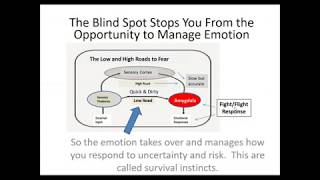
That the mind arises out of and it's already blown out of the water before it arises. Here's what happens. This is happening in the limbic system, in the emotional brain, okay? And that emotional brain was there long before your thinking brain was there. As a matter of fact, it doesn't notice really that there's a thinking brain there. And if the thinking brain gets in the way of the emotional brain, it just hijacks and pushes away. Ultimately, what happens is if you take there on the bottom left, you start seeing this external input. What that means is you get sensorial information coming in through your five senses as you're trading, okay, you know, you're watching your charts and you're seeing your entry points. You're, you're, you know, you're seeing how the trades going sideways against you or whatever. All that information is coming in, and then it's fed into what is known as the sensory thalamus. Okay, this is all part. This is a very primitive. And you might look at the sensory thalamus as a traffic cop on a really busy street. He's sitting there and he's letting traffic go one way and then the other. And if an emergency vehicle comes through, stops everything, and. And that emergency vehicle comes through, okay? It's got that kind of power. And it's based.
Its assessment, its judgment of the information coming in about how critical it is. It's based on what beliefs that you hold. And the brain has created a virtual representation that it then projects.
Onto the markets. And meanwhile, this traffic GOP deciding whether or not there's an emergency going on. And it sees this information coming in and it's thinking. It's not thinking, oh, this is going to be psychologically uncomfortable because I'm going to be under a little stress because I've got money at risk. No, it doesn't think that way at all. It thinks, is there a biological threat there that I need to avoid, or is there a prey there that I need to attack? Now, that's what it's thinking, friends. This is the emotional brain. This isn't that highfalutin thinking brain that we'd like to think is engaging the markets. And at that moment, that traffic cop is making a decision about how to route all that information. If it's not a danger, it will route it up to what we call the sensorial cortex. That's where all that thinking stuff, that's that left brain stuff, that's that neocortex, that's what you want trading. And in my coursework and in my work, I call that sage impartiality, clear thinking. Okay? However, if that traffic cop, and understand, this is the emotional brain thinking, this isn't you making assessments about whether or not something's important or not. If that traffic cop decides it's dangerous, dangerous to self, dangerous to the organism, it's going to take the low road really quick and dirty, and it's going to send that signal right over to the amygdala. And it's going to trigger to vulnerability and then fire into fight flight. And if you've ever just simply couldn't pull the trigger, if you have ever venge trade, if you want to get that money back, if you're scared out of your wits when you finally got a little profit and take it and leave chunks of money on the table, you've experienced a traffic cop. You. You've experienced the amygdala and the time between that sensorial thalamus and the amygdala firing to the fight flight response is 4Ns. Okay.
How about. Actually, that's. I usually don't take questions. That's such a good one. Same thing. What happens is, okay, this guy has asked, what about impulsiveness, jumping into a trait? It's the same. It's the same thing. Information's coming into the sensory thalamus and it's seeing opportunity. It's seeing opportunity to chase prey, to get prey, or to prove itself. And what it's doing is it's hijacking movement to the sensorial cortex that would think, well, you know, we can calm down. We know that really the patience is the name of the game rather than jumping in shortly. But usually what you discover is in impulsiveness, there is a profound need to prove the self. Okay, that becomes a liability. And in that it sees in the magic of the chart, it will make up.
Where it sees there's opportunity when there's not anything there. And it takes the load road. And that's the 4Ns point. I'm sorry, 0.4Ns to get to the sensory thalamus. It takes a lot of time. It takes a quarter of a second. It takes. It takes big chunks of time to get there. So the emotion has already been triggered. And in the bloodstream, changing and altering everything before anything happens, that's called a low road. Okay.
Oh, point. Yeah, that's 0.04 seconds. Yeah. On the low road. And that's why all of a sudden you go, you don't know when it happened. It just came out of. It came out of left field. That's why it's that fast.
Okay. It's that fast. And what happens is, until you train the brain.
You'Re stuck with that tendency. That's the evolutionary history that we bring with us, and that's the evolutionary brain that we bring to trading. And you're going to have to change the way it processes information. You're going to have to change the way it acts. And this is, and I'm telling you right now, trading is really one of the most difficult endeavors you can imagine because you have no choice about whether or not you're going to change the way the brain, and hence the mind operates under pressure with risk. But friends, this, this is, this is what's happening and this is what has to change. What has to change is when that information gets to the traffic cop, you need to have regulated the body. You need to have had a. You need, the traffic cop needs a different way of seeing that information. Not the wet, not with the brain that it acquired from history. And you need to be able to get it so that it is moving that information to the high road, to the neocortex, where you're thinking through things rather than turning to the amygdala and reacting to things. Okay? That's the key. And it's not going to happen because you say, well, this is a really cool graph. I think I'm just going to start. I can, I can get that. No, you train it in the same way that. I can't speak for other countries, but in the United States, the way our soldiers are trained, they train them under combat conditions, okay? They don't train them in the classroom. They train them in combat conditions because they know that if you train them in the classroom and stick them out in combat conditions, that classroom information and knowledge is going to fly out the window under stress. If you train them in the environment you're going to be, they're going to be acting in, then you have real knowledge, then you have real training. And this is why, no, this is not something going to read from a book and it changes you. You know, I have a good book too, by the way. Mindful training. The point is, is that you still have to go in and change the fundamental nature of the way the brain reacts to uncertainty. So we look at this, and if you want to see this in real, real action, take a look at this simulation. Trading on the left. Okay, yeah, you're up tight to a shark, but, you know, you've got that big cage and I've got my cameras and I've got all that stuff. And anyone, if he charges, you know, I'm pretty cool and all that kind of good stuff. But then the risk gets real and logic disappears. Take a look at that photograph on the right.
Now. Do you think that diver is skipping a beat in that heart? Yeah. You are seeing what happens at the level of traffic cop Right here. Okay. When, when you look at it from a logical standpoint, you say, well, this is, you know, this is really probability. And all I'm doing is I know, you know, telling myself that no one traits really important, blah, blah, blah, blah, blah, blah to that traffic cop. You've got a shark on your tail, okay? Big difference. So the real key is, hmm.
The brain sees the event of trading as a threat to life. The moment that you risk capital.
The emotional brain is going to see it as a threat to life. And the trading mind is going to be lost friends. This is how important it is. This is why you really have to train this part of your brain to respond differently to uncertainty than the brain that you brought to trading. It's nothing personal, it's just the way it is. And let's take a look at this.
What I want to do is want to break down what happens in a lightning moment. Okay. First of all, you have an event that activates uncertainty. That would be, oh my God, here's my entry point. And what happens is you hear the order fill.
Your money's at risk. You know, there's no turning back. Your money's at risk. That is an event activating uncertainty. You don't know at this particular moment in time if you're going to win or lose. What that does to the brain is it produces vulnerability. It's at this critical moment of vulnerability. This is that traffic cop stuff. At this moment of vulnerability, what mind shows up to manage the uncertainty? If you allow the old brain, the caveman brain, the mammalian brain, the emotional brain, it's going to see it as a threat to survival and it's going to trigger the fight flight response. However, if you train that brain and that mind, the vulnerability does not necessarily have to trigger to threat to fight flight. It can be taught to trigger to discipline curiosity.
Instead of fight flight motivation, it can be approach motivation. Have you ever been that thing of where that curiosity's there, you're disciplined, you recognize that everything's in the right place and you just let it flow. It's like a flow state. It's like being in the zone. Well, the deal is, is you can train your mind to be in that zone almost all the time. Because ultimately the fear and uncertainty are linked. The emotions of fight flight first have to be managed before changing the meaning of vulnerability from threat to curiosity. It can be done. Okay. It starts as evolutionary biology. That's what the problem is. It becomes psychological. Why? Because all thinking is emotional state dependent. There's never been a Time that your thinking does not come out of emotion, okay? That's the way it is in neurobiology, okay? So.
Here it comes. The brain and mind you brought to trading is not going to be the one that's going to bring success in trading. And what I want you to understand, there's nothing personal about that. You may have produced enormous amounts of success. I often work with folks who have done incredibly well in business and other pursuits of life. They come into trading and the very skills that allowed them to build that wealth turns against them in trading. It has to be retrained. So the real key is this brain has to be built, okay? From going from controlling outcome to being able to manage the experience of uncertainty in the body. Huge difference, friends. Huge difference, okay? Your brain and mind have a hatred of uncertainty and it's rooted in survival instincts, okay? And it's not going to go away.
And if you're going to be successful in trading, you're just not going to push through it. As a matter of fact, most people complicate the problem because they keep pushing harder and harder and harder and they lose more and more money and they traumatize them more to where they had been a mole of a problem, molehill of a problem, and now they've got a mountain of a problem. So what I want to do is this. I want to welcome you to join me for uncertainty school. Okay? Do you want to learn how to build the probability mind? Do you want to be able to sit there and go, well, I'm going to have to. You know, I really want all these things. You know, I really want a system. I want a system that's right all the time or most of the time. I want this, I want that. Then the truth is, is that this is uncertain. The brain mind needed for successful trading is rooted in probability. It has to be built. Unless you happen to have won the genetics lottery and you got diagnosed with Asperger's syndrome or something like that. Not necessarily good for marriage, but very good for having an architecture, emotional architecture that deals with uncertainty and money very, very well. But now what we want to do is, okay, I know that it's not going to be the one that I came stock with. And I know this illusion of control is costing me money, okay? This desire to be in control. The truth is it's going to be frustrated because you're not in control of outcome. You're in control of something else. We're going to be talking about that now.
What do you do about this? What would an Uncertainty school look like? Well, the one that we run. Okay. We've never called it uncertainty school, but I'm thinking about changing this. The trader's state of mind process is outlined right here. Okay. And these are skills of self mastery. The first thing that's going to have to learn is in emotional regulation. You're going to have to learn to regulate the intensity of the emotion. You're going to have to understand differently what an emotion is so you can work with it. They're inescapable. The second thing is mindfulness. You're gonna need to come to a different understanding of the mind too. The third is discovering what is known as the submerged internal dialogue. We'll talk about that a little bit later. That would be your self doubt and all that judgment going on inside your head. And then what happens is you begin to recognize is there is a heroic nature living within you that you can learn to free and to bring forward and build the mind from those emotional programs rather than the self limiting programs that are just so common in human endeavor. And ultimately from there you're going to embrace the internal struggle, that struggle you have against the challenges of uncertainty.
Those don't change. What changes is the mind you bring to engage that uncertainty. And the last thing is you're going to have to become intentional as a practice. You know, I have people all the time where one of the big things is, and I have a question that as you go through my coursework and the question is, is your mind, is, is my mind fit for trading right now? And you have to be able to answer that honestly. Because if you don't and then do it then, then you have the whole limbic system deciding it doesn't trust you, the amygdala doesn't trust you. And you're beginning to go, I have to become intentional about the mind I bring. If I can't get that mind there, I don't trade. Less is more. So we now see the skills that need to be built. But let's take a look at, let's start really looking into them. Emotions are going to be at the root of your cognition. They color what you see. The truth is, is you're not a rational being. That was crazy talk that some guy, Rene Descartes, had a long time ago in a place far, far away. And the truth is you're an emotional being that rationalizes. That's what your left brain is doing, is rationalizing what your emotions. The emotional brain has already decided whether it's staying out of a trade, whether it's jumping into, aggressively into a trade. Whether or not it's jumping out of a trade before it reaches its target, whatever all that thinking is supporting, whatever the emotional brain's already decided. Rationality is just really, totally, totally.
Overrated. You know, and it's kind of like in economics. For many, many years, they thought everybody, they assumed rationality. Now you look at economics and they realize that was crazy. Okay? Is that nobody's rational. So you're looking at this and you're going, okay, I need to really check out that. And then.
All this really, this emotional lability going up and down, up and down, up and down, the fear, the anger, all that. We're going to have to get that under control. How do you do that? Okay, well, it starts with emotional regulation. The interesting thing about an emotion, once you define it. Listen to this. This is the way a neuroscientist would be looking, looking at emotion. It's not a feeling. It's a biological action potential. I want you to listen. It has nothing to do with psychology. It's a biological action potential that coordinates activity between the organism that would be you, the trader, and the environment that would be the markets. When things change in the market, okay, automatically an emotion is going to arise. To be able to meet that change automatically, there is no freedom from emotion. The emotion is going to trigger. However, the emotion that arises can be worked with each emotion, particularly with your fear and your anger, the ones that you really, that just blow up people. There's going to be a pronounced breathing style, intention, muscle tension that are part of that emotion. Remember, it's biological, it's not psychological. And when you, when you disrupt the breathing style and disrupt the tension, the muscle tension, you disrupt the emotion. That's what the relaxation response of Benson was in the 80s and 90s. What he learned is that he could disrupt that. And he was looking at American yoga, I'm not American, but Hindu yoga is doing this. And he realized that, you know, angry breathing, you held your breath and you had to these big, huge things, or in fear, you stop breathing at all. That was an accelerant to cut blood supply and oxygen to the brain and to take it to the big muscles. If you altered that breathing style and did diaphragmatic breathing, the emotion of anger or fear could not be maintained. The same thing with tension in the body. As you release the tension in the body intentionally, volitionally, the emotion could not maintain itself and it would calm down the relaxation response. Okay, so we know through just that. And actually the first Three weeks of my individual course. That's what we were doing, is you are learning how to regulate and retrain the way you emotionally engage or react to uncertainty. And it's a tough thing because you discover, oh, my God, no wonder I'm all wigged out. No wonder I'm having problems. Yeah, you have a lot of retraining to do. This is. I didn't say it was going to be easy.
Then.
You have to be.
You really have to. As you use the body to manage the biology of emotion, okay. You start cooling the emotions down, okay? And this can be done. And I want you to do this. You know something? Tomorrow morning when you start trading or some of you guys who are doing the London Open or all that, just that 24 hour stuff, what I want you to do is really start monitoring how you hold tension, how you breathe, use a mirror, look at yourself, look at the tension and start going, oh, my God. This has been sitting there right in front of my face, but I've never seen it. Yeah, that's what Olympic learning does. That's what emotional learning does. You wouldn't even know it's there. It's just operating totally outside of awareness. But what you want to do is you want to learn to cool that down. You want to go below panic, you want to go below anxious. You don't want to become relaxed, though. You want a certain level of arousal that allows you to operate in the environment at a peak performance level. And that's something you can learn to do. So there's your. That's. That's how we're going to begin. Okay, that's the beginning of this. But then that's not. That's just a start. That's the easy part, friends. Then.
You start to notice what you notice. Okay. Once the biological system is calm, you can start approaching the mind. And here it is. I want you to get this. Mindfulness is the human faculty of being able to step back out of thought and recognize that you and your thoughts are not the same. They're not my thoughts. Thoughts are having you. You're not having thoughts. And the truth is, is all those thoughts are coming from different emotional programs. Some are just absolutely left to no good. Some are good. However, in mindfulness, you need to start really checking out what's the emotional charge on these thoughts? Do I need to be taking attention to them? Or what do I need to be doing? And how do I reorganize the emotional programs that give rise to thought? Friends, that's a. That might sound like A complex question, but that's the whole, that's the game, okay? So we know about mindfulness. You have to develop this. And from there you start saying, wow.
You are not at fault here, okay? A lot of people say, well, I don't want to hear about this because you know, it's some fault. You know, what if, oh my gosh, no, you're only human, okay? And the key is that's all there is here. This is human fallibility. And it's just the way the human brain's designed and it was just simply not equipped to trade. And what you're doing is saying, I'm acknowledging that I'm in a endeavor that I really need to change the way the brain operates. Yeah. And it's going to take some work and it's going to take some honesty, but I'm not judging myself. This is just humanness. Fundamentally, you're born into a history and those thoughts and beliefs are creating you. And you are the awareness that watches. Okay, I want to define that. You're not all these thoughts. You, the observer, are the awareness that watches. When you finally are able to do that, check that out. A lot of people can get a glimpse of that. That is a muscle that as you develop it can become powerful.
So what do you do from there? You take this observer and you start noticing in this illustration right here on one side, you're looking at this, the human being walking the dog. And all of a sudden they're any place but in the here and now. They're off into the future about, oh, what things could go wrong. They're back in the past, oh my God, it was so horrible, blah, blah, blah. Meanwhile, the dog is in the here and now. And friends, that's the mindfulness is that you need to be present.
With a mind that you have created to engage the markets. You don't need to be in a fear based mind that's thinking about your imminent demise or how bad your trading account is going to look. Or you don't need to be in the past thinking about the last time you really messed up or blown up stuff. You need to be here now attending to your performance. Nothing changes until this changes. Okay? So we have this. What I want to present to you is another way of understanding the brain and the mind. Okay?
In neurobiology, what we would say is that the brain really is a community of rival emotional programs.
That have duked it out and the winners have created the mind that you think is you. And there's a great movie inside out By Pixar, Disney. That really shows you these emotional programs and how they create the mind of the little girl that's having all the problems and just how the. There is a rivalry going on between all these emotions and different. Different ones take over the girl's mind at different times. And what you begin to see. Oh, my God. Yeah, this is really a committee of rival programs. And I've been asleep at the wheel. You're the guy in the center. You need to wake up. That's what observing is for. And here's the big deal.
As you start developing mindfulness, you start realizing.
These voices, these thoughts that are running through my head are actually the biological activity of the emotional programs in the brain. That's what thought is on a biological level. That's being given a voice in my mind. Those are not my thoughts. Those are emotional programs that have very different agendas, okay? Some destructive, some constructive, but they need leadership. That's where you come in mind. Okay?
The first step, once you develop mindfulness is to discover the internal dialogue. All that noise going on in j. If you've ever felt self doubt, if you've ever felt this, the overconfidence. The thing is, is what you're doing is emotional regulation and mindfulness allow you to see the submerged beliefs that you've been avoiding. And the ones that we're really interested in are the inner critic and the adapted voice. Okay? These are your historical adaptation. And they're powerful. Okay? We've got. We've got it here. Have you ever, you know, this. Take a look at the gal, the guy on the shoulder. Do you know the inner critic? Okay, that's when you find yourself in self doubt, when you swear. What kind of idiot do you think you are? Who in the world thought you that you could trade? Blah, blah, blah. Or the temptation, get in this trade, get in this trade. Make the money, you got it here. Get it, get it, get it. Yeah. Come on. I really want it. I feel it. I want to feel good. Yeah, that guy. Then you also look at the other one, the big one. That's the adapted voice, or what we call orphan in my business. And orphan sitting there going, oh, my God, I'm in the conversation of self doubt. Somebody's wagging his finger at me. There's part of me falling into fear and self doubt. You can't allow that to happen. It's not like you can block it. The thing is, is you're not using your brain to its fullest extent. You're not creating a mind that's ready to engage the probability. You're stuck in history. That stuff you grew up with, that stuff from your culture, that's stuff from circumstances in your life that locked into limbic learning. And until you change the limbic learning, you're stuck with the way it responds. You're stuck with the organization of the mind. No matter how much you try to tell your unconscious differently, that's the way it works. So you inherited this friends, okay?
It doesn't want you to change. It kind of likes you suffering. It's kind of that way. And so you inherited all these self limiting beliefs. And hey, they're pretty easy. There's no rocket science here. Every one of you are going to be having problems with a sense of adequacy. Am I good enough mattering? You know, if I make a bunch of money, people see that I really matter. I'll be the big dude. Worthiness. Do I really deserve to make easy money? Okay. Or powerlessness, you know, I just, I just fall into stuff and I just, I go crazy. I become, you know, I just panic and go crazy. Yeah, powerlessness, Those are what has to be managed. And you have to get to the belief that lies beneath the emotion. That's where that limbic system becomes so important. And you see, I'm inherited. These are not you. This is a particular organization that's stuck. And you're going to have to learn to reorganize it if you want success in trading. Okay, it's not. And again, I want to tell you it's nothing personal, okay? Fortunately, what you need is already there in your head, okay, Waiting for you to absolutely go in and to awaken it and to start using it and to build their strength up. And in the same way that judgment from that inner critic is there and fear from that orphan nature of yours is there, they live within you. So do discipline. So does courage. So does compassion. So does impartiality. These are emotional programs. These are the qualities that you're going to have to develop if you're going to build a probability based internal dialogue. This is an intentional mind. This is not the one you received from history and brought to trading. It's. And what's it really composed of? Okay, These are emotional programs that I can teach you how to access and to build into working awareness into the probability mind. The first thing is you're gonna have to have the courage of a warrior. You're gonna have to be able to turn toward your fears like this warrior turning toward the dragon. You're going to have to have the discipline of a ruler, you're gonna have to be able to maintain order under pressure. Can't cave in. You maintain order under pressure. Okay, that's ruler, that's discipline. Do you notice that there is an emotion and suddenly there's a symbol that represents that emotion? Yes, that's the relationship between brain, the emotion and mind, the symbol. Then what you notice is there's the self compassion of a caregiver. And people say self compassion, passion. I want to tell you something. You're in one of the toughest businesses that you could ever dream of. Despite what they said before, you got hooked into this thing. And you are going to, you're going to be taking a lot of losses. You have to have a sense of nurture, of self compassion, of being able to self soothe from all that losing that goes on in trading. Because you're going to ultimately have to accept losing as part of the deal and you're going to have to be taking good losses, not the ones that you go crazy on. When you get those three emotional programs or those three archetypes working together and calming down the orphan and keeping the inner critic at bay, what shows up now is the impartiality, the clear thinking of the sage. That's that neocortex. That's what was being blocked by the traffic cop way back there when I was showing you that thing about how the limbic system fires and, and takes over and fight flight. Friends, this is how you do it. And ultimately it comes down to this.
A new committee is made. The challenges of dealing with uncertainty are still there. I mean, you take a look at these guys in the sailboat, you know, they're doing this for fun. Think about they're in serious water and you're looking at that team and yeah. Do you think there's a ruler there? Do you think there's a leader? Yes. Do you think everybody's having to find their inner warrior? Absolutely. That's serious water. Do you think they're having to calm their fears down? Absolutely. Man, look at that water. And yet what you do is you're seeing clear thinking going on.
Those guys are in under a lot of stress, a lot of challenge going on, and they're clear as a bell. They're focused, they're ready. In the same way that an external team works that way, the internal team in your mind works, works that way too. That's what you have to develop. So you know it's not going to change. But the thing is, is that instead of choking in the Clutch. You act from discipline, courage, self soothing impartiality, and you face uncertainty from a patient, disciplined mind. Big difference, friends, big difference. So ultimately this is really trading in many ways is about mastering your dragons, okay? You literally, you engage your inner struggles from a position of interior strength. This is the big deal, okay? You turn toward your fears manifested in your trading and you master them. And all of a sudden what you discover is this, is that it's not really.
It'S not really the fear of loss. It's not really about your inadequacy, it's really about the mind. You bring in the moment. This is probability, friends, it's not certainty. And this is what's necessary.
So you never control the outcome anyway, but you can learn to control the mind that engages the market in much the same way that you're looking at this surfer. It's very clear that surfer does not have the wherewithal to control the power of that wave. Yet as emotionally controlled, skillful surfer, what he can do is he can ride that wave.
He becomes one with that wave, okay? Very powerful. This is what we're looking for with you, is that no, you can't control the markets. They're random and they have patterns emerging within that randomness. And sometimes the patterns emerge and work for you. Sometimes the patterns don't emerge at all. Sometimes the patterns emerge and go someplace else. Yet the mind there that's engaged with the wave, that's what you can control, friends, that's what you can learn how to control.
So in terms of lasting change.
You know you're going to have a committee of the mind. It's already there, okay? And probably because you're at this webinar, you're not satisfied with that current organization. What we're saying is, is that when do you want to change it? When do you want to start self correcting and start building the mind, okay? Because ultimately it's not whether or not you're going to have a mind that shows up or not. The question really for you is this, who is going to populate your trading committee? That's it. Okay.
Well there's a couple ways that you know, when people look at this, they go, wow, geez. I begin to see this and what I'll say is beginning traders, I'm gonna take explore the website, get all the free stuff, get my book. But more than anything else, learn how to trade, learn the mechanics of trading, for goodness sake, okay? Get all that stuff out of the way, Find something that you come to a moment of where you can actually be successful. Okay, without, without, without money on the line. So you know that you have platform, you know that you have risk management. But if you've been trading two to five years or more, like some of the people earlier today have been trading 5, 10, 20 years, if you're serious and you're going, you know something, this apparently is not going to change by my wishing and hoping. What do you do? Well, it starts with.
Read the stuff, start really checking it out. And there are two really big things, the group course or the individual course. And there's lots of free stuff, there's lots of inexpensive stuff. There's a book. But ultimately, if you want to get to the change technology, if you want to get to the moment where you can work with that traffic cop that's messing up your life by sending it down the low road to the high road, who's in that boat managing it during the storm, who's surfing? It comes down to the group course or the individual course. Okay. And it really is about, how do you, how do you choose between those? Well, what I want to do is talk about it just a bit. The group course. It's cool course. I was asked to create a group course a number of years ago by Trader Trainings because they said, you know, Randy, not everybody can afford your individual course. And we need something that we can give that it's affordable and all that kind of stuff that teaches the basic stuff. And this course does. It teaches that. All the elements that we've discussed here, it teaches them. And it comes with five group meetings over a period of two months, every two weeks. Okay. There's a virtual classroom that you're learning from 24, 7.
And when you go to the group meeting, I'm there and we're managing that stuff. And if you get in early, if you start now, you get a free gift that's worth $199. And it's really an additional emotional regulation workshop. Okay. And the truth is, is that why would people possibly want to get in early? Do we have this slide? But first, but first, the individual course. The individual course, friends, is for serious people. They're for people who, if they don't have assets behind them, they realize that this is a flaw.
In their dream of what they want and they need. What they're looking for is mentorship. They're looking for one on one coaching. And it comes in the form of 10 consults with me over a period of three to four months. And it comes with a multimedia course that will boggle the Imagination in terms of its. In terms of comprehensiveness and its deeply personal nature. And it is deeply personal. You really get. You and I really get to know your demons. And we really come to a moment of learning what it takes to master those demons. Powerful course. And if you're interested in that, by all means, ask for a free consult. Go to the website. There it is right there. Then you hit the contact us button, and Dolores will find a time for you and I to be able to meet and talk about whether or not we're in alignment, we can work together, and whether or not you're ready to take the step of saying, you know something. I know it's me. And I need to reorganize the self, the trades, friends. This can do it. And a lot of people said, why should I sign up now for the group course? Okay. You have that little. Pretty little thing where they get $199 something. I want to answer it. We have a lot of people that do this, and I'm not even the one. We're not even the ones that thought of it first. It was actually a guy from Romania said, I don't want to wait that long. And what he fundamentally. You get to receive Class 101 access now. And what people don't recognize is when you go to the group course, the first meeting there is the assumption that you have been practicing for two to four weeks on the emotional regulation piece before you hit. Before you hit the road running. I'm already into mindfulness. And a lot of people say, boy, that they. And that what happens is it takes them a while to get over that. The people who get early, what they do is they are. They have gone through that. They have worked that. And they've already seen it impact. Okay? And you get to resolve your place in the. In the class because there's limited. Oh. Oh. You get to reserve. Not resolve your spot in the class because there is limited participation. You also get to choose to sign up instead for the. At your own pace, where you get all five classes at once. And so you can. You can already be working and have gone through the class at your own pace before the group course even shows up. Then you take the group course along with everybody else. And what it's like the second time through. It's a big deal. Okay. And you're gonna receive access to Randy by. That's me from email. Okay. So it's. And also for those of you looking for expenses, it can be a 2018 expense for you rather than 2019 that's why. So let's go back. I know that I did answer this one question. We get that question a lot. And here's a question. Thank you. Oh, this is from David. And by the way, David is a professional trader and he's one of the better trader trainers I know. If you're looking for one, you really, you ought to really look at his work. David Dube, could you also classify our observable you as our inner divine self, observing your ego self? Yes, you can.
There is an element in my work and I have to be very careful with the, you know, I work all over the globe and I work with a lot of different spiritual traditions and religious paths. And where I go is this, that there comes a moment in this work where you recognize when you start observing is that there is something much greater than the self. There is something that you also begin to look at saying, why am I trading if it's money to make myself feel good? At some moment that's not going to be enough. Okay. You're going to need to find something greater to be able to get to a different place in your human development. Okay. And David is just, he's a great guy. Okay. He really is good teacher. Okay. Why do psychologists, some psychologists say we should confront our emotions and not try to control them?
And are you talking about regulating emotions? What's the difference? Well, first of all.
I think confronting emotions and trying to control them is really crazy. There. That's, that's called counteractive measures. A lot of that's with CBT and stuff like that is that emotions are much more primitive than you're thinking and if they get tired of you, they're just going to blow you out of the water. What I'm asking is you need to have the courage to turn toward the emotion, understand the emotions are going to be there whether or not you like it or not. And what happens is that emotion has a lesson for you and you're going to have to learn the lesson. You're going to have to master that emotion. You're going to have to master the, the. I'll give you a good example, people, it's very common and I'll take the easy one. Scarcity thinking. A lot of people come equipped to trading with a scarcity mentality. They are scared that things are going to be taken away from them. Okay. And it really conflicts them. It's not like you're going to turn to that emotion and I'm going to bare knuckle you and force you into submission. No what you're going to do is you're going to approach it from a state of compassion and self soothing and you're going to learn how that emotion, how the meaning, how scarcity thinking, scared that I'm not going to make it, gets present in the mind and drives the way you create your life. This is self mastery. You're not going to, I guarantee you nobody's going to bare knuckle an emotion for long. It will find another way of routing itself and it can get ugly. Okay, so I'm more there. Randy. I call this inner person the compassionate wise warrior king. It can, I would actually say there's a heck of a lot going on inside your mind. And I use a Jungian archetypal language to be able to say there are emotional programs that I and I and understand. I come out of a neurobiology kind of mindset and I understand that on a biological level, on emotional brain level, these are all emotional programs and I actually go in and use existing memory to access the emotional programs. I don't use symbolic value to do that. Okay. I'm not looking for the warrior inside at first. I'm looking for the courage and the demonstration of that courage and to bring forward that into being. However, when that biology of the brain produces mind, symbols start having an enormous amount of importance. And so what we start doing is we start building association between the symbol of a warrior to the emotional program of courage. Okay. And they live within you. I mean if you're a human being, they're there. It's just that I have found memory and the process I call is memory enrichment. I find it's a lot easier to go into memory to access the emotional program because you know, it's there, it happened and you're feeling it and you're altering the way you think rather than simply symbolic values. So okay, and again, understand there's a lot of symbolic value in my work, but it's, it's all rooted in the body. So good for you.
What does it mean by intentional? Second part, aren't all practicing, I don't understand. Aren't all practicing intentional. I see a lot of people who come, come into trading and they have a mind that they're going to maintain and do their rules and stuff like that, but it blows apart. They don't do it. What we're talking about is to bring an intentional mind that you preordain. You say this is the mind that I need to bring into trading, not the one that just blew up, we know the one that Just blew up.
First of all, I don't think it's intentional. I think it's reactive. I think it's historical. And you just, you, you brought it into the moment. What I'm saying is you build a mind based on certain emotional programs intentionally. Then you bring that mind to engage the uncertainty of trading. That's what I mean by intentionality. Okay. Okay. That's it. That's pretty good. We're only two minutes late. I want to thank you for coming. I have enjoyed myself immensely. I've enjoyed your question. Questions. And this is the deal, friends, is it's really about coming to terms and recognizing the mind that you brought is not going to bring the success that you're looking for in trading. Don't believe me? Prove it to yourself. Depending on if you've been doing 20 years and David Debay has been doing 30 plus years. Okay. He's been around a long time and he's an enormously successful trader. He just likes to keep up with this stuff. Okay.
And by the way, his, his site is Polaris Trading. And if you're looking, if you're looking for a really good teacher, you don't have to look any further. Okay. But from there, I want to thank you. If I can help you.
Hit the. Contact us, take a look at our website and start digging in and saying how do I go about building the mind? I get it is it's not going to happen by myself.
Polaris Trading.
Yeah. P O L A R I S. I guess David.
And. Or you could just type in and Dube is D U B E is that.
I'm lucky. Thank you. And just type him in, find out. He's a good guy and, you know, he and I have been friends and he's been a client of mine for, gosh, three or four years. So.
Anyway, take care, my friends and if I can help you build that mind. Let's do it.
Yes.
You'll get an email tomorrow morning that after we render this, I will put it up on my website and it will be either the first, the second video on the homepage. Okay. It's also on. It's it. And it's.
Oh, it'll be there for 30 days after that. Okay. And it'll always be on my YouTube channel. Okay. But it's easier to get people to the website than it is to get the YouTube channel. Okay. Thank you, friends. Thank you very much. I've enjoyed myself and to the future. Take care.









